

Aerostructures and Engineering Services Market Size and Forecast (2026–2034), Global and Regional Growth, Trend, Share and Industry Analysis Report Coverage; By Application, Service Type, Component, Material, Service Provider, Aircraft Type; and Geography
2026-10-08
Aerospace & Defense
Ekta Chaurasia (Team Lead)
Description
Aerostructures and Engineering
Services Market Overview
The global
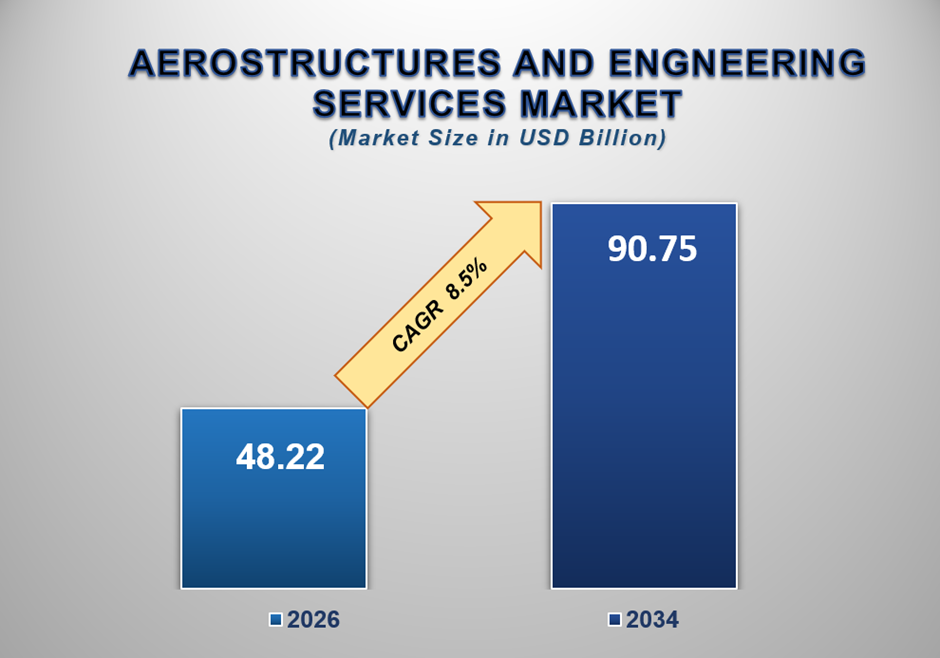
Aerostructures and Engineering Services Market is projected to reach USD
48.22 billion in 2026 and is expected to increase to USD 90.75 billion
by 2034, registering a CAGR of 8.5% during 2026–2034. The market
encompasses engineering activities and industrial services associated with the
structural elements of aircraft, including design, structural analysis,
manufacturing engineering, certification support, testing, digital engineering,
maintenance engineering and related lifecycle services.
The market is
being shaped by the expansion of commercial aircraft fleets, continued
investment in defense aviation, increasing aircraft utilization and the growing
engineering complexity of new-generation platforms. Aircraft manufacturers and
suppliers are simultaneously dealing with pressure to reduce structural weight,
improve fuel efficiency, shorten development cycles and maintain stringent
safety and certification requirements. These requirements are increasing the
importance of engineering partners that can contribute across multiple stages
of the aircraft lifecycle rather than providing only isolated design or
manufacturing support.
Aerostructures
include major load-bearing and aerodynamic structures such as fuselages, wings,
empennage assemblies, pylons, nacelles and associated structural components.
Engineering services extend beyond the physical manufacture of these parts into
stress analysis, computational modeling, materials engineering, configuration
management, manufacturing process development, testing, certification
documentation and lifecycle support. As aircraft programs become increasingly
software-enabled and digitally integrated, the boundary between conventional
structural engineering and digital engineering is also becoming less distinct.
A significant
change in the market is the growing use of composite materials and advanced
metallic alloys. Composite-intensive structures can provide weight and
corrosion advantages, but their design, manufacturing and inspection require
specialized engineering capabilities. Titanium and other advanced alloys are
similarly important for components exposed to high mechanical or thermal loads.
Engineering service providers therefore increasingly need capabilities covering
material selection, structural simulation, manufacturability, non-destructive
inspection and repair engineering.
Digital
engineering is becoming an important productivity lever. Model-based
engineering, digital twins, simulation automation, AI-assisted design and
data-driven quality systems can reduce the number of physical iterations
required during product development. Industry research in 2026 has also
highlighted the increasing application of AI throughout aerostructure design,
production, inspection and maintenance, including simulation support, automated
inspection and predictive maintenance applications.
The commercial
aviation sector remains a major source of demand because increasing passenger
traffic translates into requirements for additional aircraft, structural
components, engineering support and maintenance capacity. At the same time,
defense programs are creating demand for specialized structures for fixed-wing
aircraft, rotorcraft, unmanned systems and other platforms. The engineering
requirements for defense programs can differ substantially from those for
commercial aircraft because of mission-specific structural loads, survivability
requirements, rapid technology insertion and differing production volumes.
The aftermarket
is also becoming strategically important. As the installed fleet grows older
and aircraft utilization remains high, operators require engineering support
for structural inspections, repairs, modifications, component life management
and maintenance planning. Regional MRO capabilities can reduce turnaround time
by keeping structural repair expertise closer to operators. Safran's AMES
operation in Dubai, for example, is expanding its aerostructure repair and
overhaul capabilities in response to demand from the Middle East and Indian
Peninsula, with a new workshop planned to begin operations in 2027.
The supply chain
is simultaneously moving toward greater geographic diversification. Aircraft
manufacturers and major suppliers are increasingly working with engineering and
manufacturing partners across North America, Europe and Asia-Pacific. India, in
particular, is strengthening its position in aerospace manufacturing and
engineering through investments in aircraft components, MRO infrastructure and
high-value manufacturing. Aequs is developing a ₹1,900-crore facility in Hosur
focused on high-value aero-engine and complex landing-system components, while
its existing aerospace operations in Belagavi provide an established
manufacturing base.
The combination
of fleet expansion, aircraft replacement programs, outsourcing of engineering
activities, digital transformation, composite-material adoption and increased
MRO requirements is therefore expected to support sustained demand for
aerostructure engineering services through 2034.
Aerostructures and Engineering
Services Market Drivers and Opportunities
Increasing
Commercial Aircraft Production and Fleet Expansion
Commercial
aviation is one of the strongest demand foundations for the aerostructures and
engineering services industry. Airlines continue to require additional aircraft
as passenger traffic expands and older aircraft are progressively replaced by
newer, more fuel-efficient platforms. Each new aircraft program creates
requirements across structural design, analysis, manufacturing engineering,
tooling, certification and supplier quality.
The production
environment also creates demand for engineering support outside the aircraft
OEM itself. Tier suppliers and specialized engineering companies increasingly
participate in detailed design, manufacturing-process development,
configuration management, testing and documentation. This distributed model
enables aircraft manufacturers to access specialized capabilities while
allocating internal resources to higher-value program responsibilities.
The requirement
for production-rate increases adds another dimension. Engineering teams must
address manufacturability, repeatability, quality control and process
optimization while maintaining certification requirements. Consequently,
suppliers with expertise in both engineering and industrialization are
positioned to participate in a broader portion of the aircraft production
lifecycle.
The continued
growth of next-generation aircraft programs is also increasing demand for
lightweight structures and improved production methods. Composite materials,
advanced machining, automated assembly and additive manufacturing are being
evaluated or deployed for different structural applications. These developments
create opportunities for service providers that combine conventional aerospace
engineering knowledge with modern manufacturing technologies.
Growing
Complexity of Aircraft Structures and Material Systems
Aircraft
structures are becoming more complex as manufacturers seek lower weight,
improved aerodynamic performance, extended service life and better fuel
efficiency. The increasing use of composites and advanced alloys requires
engineering organizations to understand material behavior, joining techniques,
damage tolerance, fatigue characteristics and inspection requirements.
Composite
structures, for example, require engineering approaches that differ from
traditional metallic structures. Manufacturing variables such as fiber
orientation, resin behavior, curing conditions and bonding quality can affect
structural performance. This creates demand for engineering support extending
from design and simulation to process qualification and inspection.
Structural
analysis is also becoming increasingly computational. Finite-element analysis,
computational simulation and digital validation allow engineering teams to
evaluate multiple structural configurations before committing to physical
prototypes. This can reduce development iterations while improving the ability
to assess fatigue, loads, vibration and damage scenarios.
The complexity
of these programs favors specialized engineering providers that can work with
aircraft OEMs and Tier suppliers while maintaining aerospace quality systems
and certification discipline.
Opportunity:
AI, Digital Twins and Additive Manufacturing in Aerostructure Engineering
Digital
transformation represents an important opportunity because engineering
organizations are increasingly connecting product design, manufacturing and
lifecycle information. AI-assisted design can support optimization of
structural configurations, while digital twins can connect engineering models
with operational and maintenance information.
AI is also
moving beyond design into inspection and manufacturing quality. Computer-vision
systems can assist in identifying surface defects and dimensional deviations,
while analytics can help detect process abnormalities earlier. These
technologies do not eliminate the need for aerospace engineers; rather, they
can allow engineering teams to process larger quantities of data and
concentrate human expertise on complex decisions and certification-critical
activities.
Additive
manufacturing is another developing opportunity. In April 2026, GKN Aerospace
and the U.S. Air Force Research Laboratory launched the $8.4 million
TITAN-AM program to advance titanium laser metal deposition for large
aerostructures. The program is intended to mature additive manufacturing
technology for future aerospace structural applications.
Engineering
companies that can combine structural expertise with AI, digital twins,
additive manufacturing, automation and advanced simulation may therefore
capture a growing share of outsourced engineering and industrialization work.
Aerostructures and Engineering
Services Market Scope
|
Report
Attributes |
Description |
|
Market Size
in 2026 |
USD 48.22 Billion |
|
Market
Forecast in 2034 |
USD 90.75 Billion |
|
CAGR %
2026-2034 |
8.5% |
|
Base Year |
2025 |
|
Historic
Data |
2021-2025 |
|
Forecast
Period |
2026-2034 |
|
Report USP |
Production, Consumption,
Company Share, Company Heatmap, Company Production, Service Type, Growth
Factors and more |
|
Segments
Covered |
By Application By Component By Material |
|
Regional
Scope |
● North America |
|
Country
Scope |
U.S. |
Aerostructures and Engineering
Services Market Report Segmentation Analysis
The
Aerostructures and Engineering Services Market can be evaluated across
application, service type, component, material, service-provider model and aircraft
type. These dimensions reflect the transition from traditional structural
manufacturing toward integrated engineering, digital development and lifecycle
support.
The
Commercial Aviation Segment Is Expected to Account for the Largest Market Share
Commercial
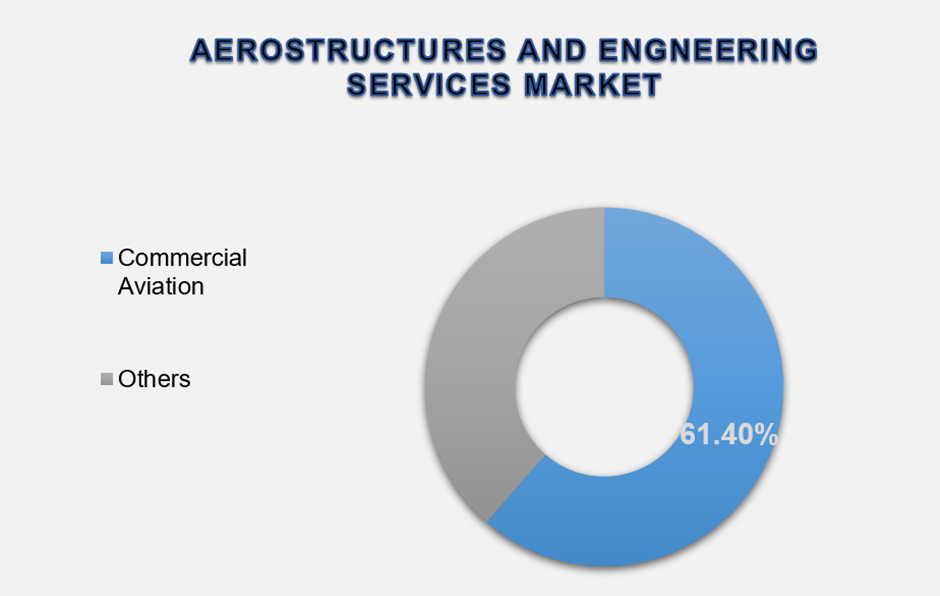
aviation represents the largest application segment in the market. A market
assessment places commercial aviation at 61.4%, with other aircraft
applications accounting for the remaining 38.6%. This reflects the scale
of the global commercial aircraft fleet and the extensive engineering
requirements generated throughout aircraft production and operation.
Commercial
aircraft programs require structural engineering from initial configuration and
detailed design through manufacturing, certification and aftermarket support.
High production volumes also create recurring demand for manufacturing
engineering, supplier support and process optimization.
At the same
time, the non-commercial portion of the market remains important. Military
aircraft, helicopters, business jets, UAVs and space vehicles often require
highly specialized structural solutions. These applications can create demand
for advanced materials, low-volume manufacturing, rapid engineering
modifications and mission-specific structural analysis.
Aerostructure
Design Services
Design services
form the foundation of the engineering lifecycle. Activities include
preliminary structural concepts, detailed component design, CAD modeling,
design optimization, configuration management and engineering change support.
The growing
integration of simulation into design workflows is allowing engineers to
evaluate structural alternatives earlier in the development cycle. Design teams
are also increasingly expected to consider manufacturability, material
availability, repairability, and lifecycle cost rather than treating structural
design as an isolated activity.
Structural
Analysis and Stress Engineering Services
Structural
analysis services cover the evaluation of loads, stresses, fatigue, damage
tolerance, vibration and structural performance. These services are
particularly important because aerospace structures must satisfy strict safety
and certification requirements.
The increasing
use of composites is creating additional analysis requirements because their
mechanical behavior can vary according to fiber direction, laminate
configuration, and manufacturing conditions. Engineering service providers with
specialized analysis capabilities can therefore support OEMs and suppliers
without requiring all specialist resources to be maintained internally.
Manufacturing
Engineering Services
Manufacturing
engineering connects product design with repeatable industrial production. The
segment includes process development, tooling support, assembly engineering,
production planning, manufacturing optimization and quality-process
improvement.
As aircraft
programs target higher production rates, manufacturing engineering becomes
increasingly important. Small inefficiencies in assembly, machining, or
composite processing can become substantial bottlenecks when multiplied across
large production volumes.
Certification
and Testing Services
Certification
and testing remain essential because aircraft structures must demonstrate
compliance with applicable airworthiness requirements. Engineering companies
support documentation, testing programs, structural validation and associated
technical evidence.
The increasing
complexity of aircraft materials and manufacturing techniques is expanding the
technical requirements for testing. This creates opportunities for specialist
organizations capable of supporting both engineering analysis and regulatory
documentation.
MRO
Engineering Services
MRO engineering
focuses on maintaining structural integrity after aircraft enter commercial or
military service. Activities can include inspection engineering, repair
development, structural modifications, life-extension programs and technical
support for operators and MRO organizations.
Regional MRO
investment is becoming increasingly important as operators seek shorter
turnaround times. Safran's AMES operation illustrates this development, with
additional workshop capacity planned in Dubai to support growing demand from
the Middle East and Indian Peninsula.
Digital
Engineering Services
Digital
engineering is becoming an increasingly integrated part of aerostructure
development. Model-based systems engineering, digital twins, cloud engineering
environments, AI-assisted design and automated data processing are helping
organizations connect engineering activities across the product lifecycle.
Cyient's 2026
positioning in digital engineering illustrates the direction of the industry:
its reported capabilities include AI-augmented R&D, model-based
engineering, digital twins and connected-product engineering, with aerospace
identified among the industries supported.
The Following
Segments Are Part of an In-Depth Analysis of the Aerostructures and Engineering
Services Market
|
Market Segments |
|
|
By Material |
●
Aluminum Alloys ●
Titanium Alloys ●
Composite Materials ●
Advanced Alloys |
|
By
Service Type |
●
Aerostructure Design Services ●
Structural Analysis and Stress Engineering Services
●
Manufacturing Engineering Services ●
Certification and Testing Services ●
MRO Engineering Services ●
Digital Engineering Services |
|
By Application |
●
Commercial Aviation ●
Military Aviation ●
Business Jets ●
Helicopters ●
Space and Launch Vehicles ●
UAVs |
|
By Service Provider |
●
OEMs ●
Tier Suppliers ●
Engineering Service Providers |
|
By
Aircraft Type |
●
Fixed-Wing Aircraft ●
Rotary-Wing Aircraft ●
UAVs |
Aerostructures and Engineering
Services Market Share Analysis By Region
North America
North America
remains a major center for aerostructure engineering because of its established
aircraft OEM ecosystem, defense-industrial base, engineering workforce, and
extensive supplier network. The United States supports demand across commercial
aviation, military aircraft, UAVs and advanced aerospace programs.
The region is
also important for advanced manufacturing research. The GKN Aerospace–U.S. Air
Force Research Laboratory TITAN-AM program demonstrates continued investment in
large-scale titanium additive manufacturing for aerospace structures.
Europe
Europe has a
deeply integrated aerospace supply chain spanning aircraft manufacturers,
engine companies, structural suppliers, engineering specialists and MRO
providers. The region's market is being influenced by aircraft production
requirements, defense modernization, sustainability objectives and the
development of advanced engineering capabilities.
A 2026 ISG
assessment reported that European aerospace and defense organizations are
increasing investment in AI and modernization while simultaneously
strengthening industrial resilience and regional capacity.
Asia-Pacific
Asia-Pacific is
expected to remain an important growth center because of expanding airline
fleets, increasing aerospace manufacturing capabilities and investments in
domestic engineering and MRO infrastructure.
India is
particularly significant. The country is building capabilities across aircraft
components, MRO and precision manufacturing, while international aerospace
companies are expanding their industrial presence. Safran's Hyderabad LEAP
engine MRO facility, for example, represents a major addition to India's
aerospace support infrastructure, with a planned capacity of 300 LEAP shop
visits annually once fully operational.
China, Japan and
South Korea also contribute to regional demand through aircraft manufacturing,
defense programs, component production and engineering capabilities.
Latin America
Latin America
presents opportunities through commercial fleet modernization, aircraft
maintenance activity and the gradual development of aerospace manufacturing
clusters. Mexico is particularly relevant because of its established aerospace
supplier base and proximity to the North American market.
Engineering
outsourcing can also provide an avenue for regional aerospace companies to
access specialized capabilities without replicating the full cost structure of
large internal engineering organizations.
Middle East
and Africa
The Middle East
is becoming increasingly important for aerospace aftermarket and engineering
activity because of its large airline fleets, expanding aviation hubs and
investment in MRO infrastructure.
Dubai-based AMES
is expanding its aerostructure repair capabilities, with a new workshop planned
for 2027 and additional capacity directed particularly toward nacelle-related
activities.
Aerostructures
and Engineering Services Market Competition Landscape Analysis
Competition is
distributed across aircraft OEMs, major aerostructure manufacturers, Tier
suppliers, aerospace engineering specialists and global engineering-service
providers. The competitive environment is increasingly based on the breadth of
engineering capabilities rather than manufacturing capacity alone.
Large aerospace
companies benefit from long-standing aircraft-program relationships,
certification experience, established production infrastructure and access to
extensive engineering data. Specialist engineering providers compete through
domain expertise, flexible delivery models, cost-efficient engineering centers
and the ability to supply particular capabilities such as structural analysis,
digital engineering or certification support.
The market is
also seeing greater convergence between aerospace engineering and digital
technology services. Companies with AI, digital-twin, model-based engineering,
cloud and data capabilities can increasingly participate in activities that
were historically performed by conventional aerospace engineering teams.
In 2026, ISG
reported that aerospace and defense enterprises were increasingly working with
midsize and specialist providers to accelerate modernization and improve
supply-chain resilience. The assessment included providers such as AXISCADES,
Cyient, eInfochips, Quest Global and Tata Technologies.
Major
Companies Operating in the Aerostructures and Engineering Services Market
●
Spirit AeroSystems
●
Triumph Group
●
GKN Aerospace
●
Safran Group
●
Airbus Atlantic
●
Leonardo S.p.A.
●
Collins Aerospace
●
Boeing Global Services
●
ST Engineering
●
Cyient
●
Tata Technologies
●
HCLTech
●
ALTEN Group
●
Capgemini Engineering
●
Mahindra Aerospace
●
Quest Global
●
L&T Technology Services
●
Tech Mahindra
●
Aequs
These companies
participate in different portions of the value chain, ranging from
aerostructure design and manufacturing to engineering outsourcing, digital
engineering, certification, MRO and lifecycle support.
Global
Aerostructures and Engineering Services Recent Developments News
GKN Aerospace
and U.S. Air Force Research Laboratory — April 2026: GKN Aerospace announced the $8.4 million TITAN-AM program,
focused on industrializing titanium additive manufacturing using Laser Metal
Deposition with Wire for large aerostructures. The initiative targets
structural applications for future defense and commercial aerospace platforms.
Safran AMES —
January 2026: Safran announced that its AMES joint
venture is expanding its Dubai aerostructure MRO capabilities in response to
increasing demand from the Middle East and Indian Peninsula. A new workshop is
planned to enter service in 2027, increasing the workshop area by 1,900 square
meters compared with the 2025 footprint.
Cyient —
2026: Cyient reported recognition across all three
quadrants of the 2026 ISG Digital Engineering Services assessment for North
America. Its stated capabilities include AI-augmented product design, digital
twins, model-based engineering and connected-product services, including
aerospace applications.
Aequs — 2026: Aequs announced plans for a new ₹1,900-crore manufacturing facility
in Hosur, Tamil Nadu, with a focus on high-value aero-engine and complex
landing-system components. The company already operates an aerospace
manufacturing ecosystem in Belagavi and has a reported $1 billion order book.
Aerospace
digital transformation — 2026: Industry research
continues to identify AI-assisted engineering, digital twins, automated
inspection and predictive analytics as emerging tools across aerostructure
development and lifecycle management. These technologies are increasingly being
integrated into engineering workflows rather than treated solely as
experimental applications.
The Global
Aerostructures and Engineering Services Market is Dominated by a Few Large
Companies, Such As
Spirit
AeroSystems, Triumph Group, GKN Aerospace, Safran Group, Airbus Atlantic,
Leonardo, Collins Aerospace, Boeing Global Services, ST Engineering, Cyient,
Tata Technologies, HCLTech, ALTEN Group, Capgemini Engineering, Mahindra
Aerospace, Quest Global, L&T Technology Services, Tech Mahindra, Aequs, and
other regional and specialized aerospace engineering providers.
The competitive landscape is expected to evolve as aerospace companies increase outsourcing, adopt digital engineering tools and diversify manufacturing and MRO footprints. Providers that combine aerospace certification knowledge with advanced simulation, AI-enabled engineering, manufacturing automation and lifecycle services are likely to encounter increasing demand from aircraft OEMs, Tier suppliers and operators.
Frequently Asked Questions
Ekta Chaurasia (Team Lead)
Ekta Chaurasia is a highly experienced Team Lead at M2Square Consultancy with over 7 years of expertise in market research, strategic consulting, competitive benchmarking, and business intelligence solutions. She specializes in ICT, semiconductors & electronics, automotive & transportation, and industrial machinery markets.
She leads end-to-end global research projects focused on market trends, industry analysis, growth forecasting, customer insights, and strategic decision-making. Known for her analytical leadership and industry expertise, Ekta helps businesses uncover growth opportunities, evaluate competitive landscapes, and stay ahead in rapidly evolving markets through accurate and insight-driven research.
1.
Global Aerostructures
and Engineering Services Market Introduction and Market Overview
1.1. Objectives of the Study
1.2. Global Aerostructures and Engineering Services Market Scope and
Market Estimation
1.2.1.
Global Aerostructures and
Engineering Services Market Size (US$ Million), Market CAGR (%), Market
Forecast (2026 - 2034)
1.2.2.
Global Aerostructures and
Engineering Services Market Revenue Share (%) and Growth Rate (Y-o-Y) Analysis
(2021 - 2034)
1.3. Market Segmentation
1.3.1.
By Application of Global
Aerostructures and Engineering Services Market
1.3.2.
By Service Type of Global
Aerostructures and Engineering Services Market
1.3.3.
By Component of Global
Aerostructures and Engineering Services Market
1.3.4.
By Material of Global
Aerostructures and Engineering Services Market
1.3.5.
By Service Provider of Global
Aerostructures and Engineering Services Market
1.3.6.
By Aircraft Type of Global
Aerostructures and Engineering Services Market
1.3.7.
Region of Global Aerostructures
and Engineering Services Market
1.4. Competition Coverage List of Market Participants
1.5. Market Definition: Aerostructures and Engineering Services Market
2.
Executive Summary
2.1. Demand Side Trends
2.2. Key Market Trends
2.3. Market Demand (US$ Million) Analysis 2021 – 2025 and Forecast, 2026
– 2034
2.4. Demand and Opportunity Assessment
2.5. Key Developments
2.6. Overview of Regulatory Landscape, Compliance Framework, and Industry
Standards
2.7. Market Entry Strategies
2.8. Market Dynamics
2.8.1.
Drivers
2.8.2.
Limitations
2.8.3.
Opportunities
2.8.4.
Impact Analysis of Drivers and
Restraints
2.9. Porter's Five Forces Analysis
2.10.
PEST Analysis
3.
Global Aerostructures
and Engineering Services Market Estimates & Historical Trend Analysis (2021
– 2025)
4.
Global Aerostructures
and Engineering Services Market Estimates & Forecast Trend Analysis, by
Application
4.1. Global Aerostructures and Engineering Services Market Revenue (US$
Million) Estimates and Forecasts, by Application, 2021 - 2034
4.1.1.
Commercial Aviation
4.1.2.
Military Aviation
4.1.3.
Business Jets
4.1.4.
Helicopters
4.1.5.
Space and Launch Vehicles
4.1.6.
UAVs
5.
Global Aerostructures
and Engineering Services Market Estimates & Forecast Trend Analysis, by
Service Type
5.1. Global Aerostructures and Engineering Services Market Revenue (US$
Million) Estimates and Forecasts, by Service Type, 2021 - 2034
5.1.1.
Aerostructure Design Services
5.1.2.
Structural Analysis and Stress
Engineering Services
5.1.3.
Manufacturing Engineering
Services
5.1.4.
Certification and Testing
Services
5.1.5.
MRO Engineering Services
5.1.6.
Digital Engineering Services
6.
Global Aerostructures
and Engineering Services Market Estimates & Forecast Trend Analysis, by
Component
6.1. Global Aerostructures and Engineering Services Market Revenue (US$
Million) Estimates and Forecasts, by Component, 2021 - 2034
7.
Global Aerostructures
and Engineering Services Market Estimates & Forecast Trend Analysis, by
Material
7.1. Global Aerostructures and Engineering Services Market Revenue (US$
Million) Estimates and Forecasts, by Material, 2021 - 2034
7.1.1.
Aluminum Alloys
7.1.2.
Titanium Alloys
7.1.3.
Composite Materials
7.1.4.
Advanced Alloys
8.
Global Aerostructures
and Engineering Services Market Estimates & Forecast Trend Analysis, by
Service Provider
8.1. Global Aerostructures and Engineering Services Market Revenue (US$
Million) Estimates and Forecasts, by Service Provider, 2021 - 2034
8.1.1.
OEMs
8.1.2.
Tier Suppliers
8.1.3.
Engineering Service Providers
9.
Global Aerostructures
and Engineering Services Market Estimates & Forecast Trend Analysis, by
Aircraft Type
9.1. Global Aerostructures and Engineering Services Market Revenue (US$
Million) Estimates and Forecasts, by Aircraft Type, 2021 - 2034
9.1.1.
Fixed-Wing Aircraft
9.1.2.
Rotary-Wing Aircraft
9.1.3.
UAVs
10. Global Aerostructures and Engineering Services Market Estimates
& Forecast Trend Analysis, by Region
10.1.
Global Aerostructures and
Engineering Services Market Revenue (US$ Million) Estimates and Forecasts, by
Region, 2021 - 2034
10.1.1.
North America
10.1.2.
Europe
10.1.3.
Asia Pacific
10.1.4.
Middle East & Africa
10.1.5.
Latin America
11. North America Aerostructures and Engineering Services Market:
Estimates & Forecast Trend Analysis
11.1.
North America Aerostructures
and Engineering Services Market Assessments & Key Findings
11.1.1.
North America Aerostructures
and Engineering Services Market Introduction
11.1.2.
North America Aerostructures
and Engineering Services Market Size Estimates and Forecast (US$ Million) (2021
- 2034)
11.1.2.1.
By Application
11.1.2.2.
By Service Type
11.1.2.3.
By Component
11.1.2.4.
By Material
11.1.2.5.
By Service Provider
11.1.2.6.
By Aircraft Type
11.1.2.7.
By Country
11.1.2.7.1.
The U.S.
11.1.2.7.2.
Canada
12. Europe Aerostructures and Engineering Services Market: Estimates
& Forecast Trend Analysis
12.1.
Europe Aerostructures and
Engineering Services Market Assessments & Key Findings
12.1.1.
Europe Aerostructures and
Engineering Services Market Introduction
12.1.2.
Europe Aerostructures and
Engineering Services Market Size Estimates and Forecast (US$ Million) (2021 -
2034)
12.1.2.1.
By Application
12.1.2.2.
By Service Type
12.1.2.3.
By Component
12.1.2.4.
By Material
12.1.2.5.
By Service Provider
12.1.2.6.
By Aircraft Type
12.1.2.7.
By Country
12.1.2.7.1.
Germany
12.1.2.7.2.
Italy
12.1.2.7.3.
The U.K.
12.1.2.7.4.
France
12.1.2.7.5.
Spain
12.1.2.7.6.
Switzerland
12.1.2.7.7.
Rest of Europe
13. Asia Pacific Aerostructures and Engineering Services Market:
Estimates & Forecast Trend Analysis
13.1.
Asia Pacific Aerostructures and
Engineering Services Market Assessments & Key Findings
13.1.1.
Asia Pacific Aerostructures and
Engineering Services Market Introduction
13.1.2.
Asia Pacific Aerostructures and
Engineering Services Market Size Estimates and Forecast (US$ Million) (2021 -
2034)
13.1.2.1.
By Application
13.1.2.2.
By Service Type
13.1.2.3.
By Component
13.1.2.4.
By Material
13.1.2.5.
By Service Provider
13.1.2.6.
By Aircraft Type
13.1.2.7.
By Country
13.1.2.7.1.
China
13.1.2.7.2.
Japan
13.1.2.7.3.
India
13.1.2.7.4.
Australia
13.1.2.7.5.
South Korea
13.1.2.7.6.
Rest of Asia Pacific
14. Middle East & Africa Aerostructures and Engineering Services
Market: Estimates & Forecast Trend Analysis
14.1.
Middle East & Africa
Aerostructures and Engineering Services Market Assessments & Key Findings
14.1.1.
Middle East & Africa
Aerostructures and Engineering Services Market Introduction
14.1.2.
Middle East & Africa
Aerostructures and Engineering Services Market Size Estimates and Forecast (US$
Million) (2021 - 2034)
14.1.2.1.
By Application
14.1.2.2.
By Service Type
14.1.2.3.
By Component
14.1.2.4.
By Material
14.1.2.5.
By Service Provider
14.1.2.6.
By Aircraft Type
14.1.2.7.
By Country
14.1.2.7.1.
UAE
14.1.2.7.2.
Saudi Arabia
14.1.2.7.3.
South Africa
14.1.2.7.4.
Rest of Middle East &
Africa
15. Latin America Aerostructures and Engineering Services Market:
Estimates & Forecast Trend Analysis
15.1.
Latin America Aerostructures
and Engineering Services Market Assessments & Key Findings
15.1.1.
Latin America Aerostructures
and Engineering Services Market Introduction
15.1.2.
Latin America Aerostructures
and Engineering Services Market Size Estimates and Forecast (US$ Million) (2021
- 2034)
15.1.2.1.
By Application
15.1.2.2.
By Service Type
15.1.2.3.
By Component
15.1.2.4.
By Material
15.1.2.5.
By Service Provider
15.1.2.6.
By Aircraft Type
15.1.2.7.
By Country
15.1.2.7.1.
Brazil
15.1.2.7.2.
Mexico
15.1.2.7.3.
Argentina
15.1.2.7.4.
Rest of Latin America
16. Competition Landscape
16.1.
Global Aerostructures and
Engineering Services Market Product Mapping
16.2.
Global Aerostructures and
Engineering Services Market Concentration Analysis, by Leading Players /
Innovators / Emerging Players / New Entrants
16.3.
Global Aerostructures and
Engineering Services Market Tier Structure Analysis
16.4.
Global Aerostructures and
Engineering Services Market Concentration & Company Market Shares (%) Analysis,
2026
17. Company Profiles
17.1.
Spirit AeroSystems
17.1.1.
Company Overview & Key
Stats
17.1.2.
Financial Performance &
KPIs
17.1.3.
Product Portfolio
17.1.4.
SWOT Analysis
17.1.5.
Business Strategy & Recent
Developments
*Similar details would be provided for all
the players mentioned below
17.2.
Triumph Group
17.3.
GKN Aerospace
17.4.
Safran Group
17.5.
Airbus Atlantic
17.6.
Leonardo S.p.A.
17.7.
Collins Aerospace
17.8.
Boeing Global Services
17.9.
ST Engineering
17.10.
Cyient
17.11.
Tata Technologies
17.12.
HCLTech
17.13.
ALTEN Group
17.14.
Capgemini Engineering
17.15.
Mahindra Aerospace
17.16.
Quest Global
17.17.
L&T Technology Services
17.18.
Tech Mahindra
17.19.
Aequs
17.20.
Others
18. Research Findings & Conclusion
19. Assumptions & Acronyms Used
20. Research Methodology
20.1.
External Databases
20.2.
Internal Proprietary Database
20.3.
Primary Research
20.4.
Secondary Research
20.5.
Assumptions
20.6.
Limitations
20.7.
Report FAQ
Our Research Methodology
"Insight without rigor is just noise."
We follow a comprehensive, multi-phase research framework designed to deliver accurate, strategic, and decision-ready intelligence. Our process integrates primary and secondary research , both quantitative and qualitative , along with dual modeling techniques ( top-down and bottom-up) and a final layer of validation through our proprietary in-house repository.
PRIMARY RESEARCH
Primary research captures real-time, firsthand insights from the market to understand behaviors, motivations, and emerging trends.
1. Quantitative Primary Research
Objective: Generate statistically significant data directly from market participants.
Approaches:- Structured surveys with customers, distributors, and field agents
- Mobile-based data collection for point-of-sale audits and usage behavior
- Phone-based interviews (CATI) for market sizing and product feedback
- Online polling around industry events and digital campaigns
- Purchase frequency by customer type
- Channel performance across geographies
- Feature demand by application or demographic
2. Qualitative Primary Research
Objective: Explore decision-making drivers, pain points, and market readiness.
Approaches:- In-depth interviews (IDIs) with executives, product managers, and key decision-makers
- Focus groups among end users and early adopters
- Site visits and observational research for consumer products
- Informal field-level discussions for regional and cultural nuances
SECONDARY RESEARCH
This phase helps establish a macro-to-micro understanding of market trends, size, regulation, and competitive dynamics, sourced from credible and public domain information.
1. Quantitative Secondary Research
Objective: Model market value and segment-level forecasts based on published data.
Sources include:- Financial reports and investor summaries
- Government trade data, customs records, and regulatory statistics
- Industry association publications and economic databases
- Channel performance and pricing data from marketplace listings
- Revenue splits, pricing trends, and CAGR estimates
- Supply-side capacity and volume tracking
- Investment analysis and funding benchmarks
2. Qualitative Secondary Research
Objective: Capture strategic direction, innovation signals, and behavioral trends.
Sources include:- Company announcements, roadmaps, and product pipelines
- Publicly available whitepapers, conference abstracts, and academic research
- Regulatory body publications and policy briefs
- Social and media sentiment scanning for early-stage shifts
- Strategic shifts in market positioning
- Unmet needs and white spaces
- Regulatory triggers and compliance impact
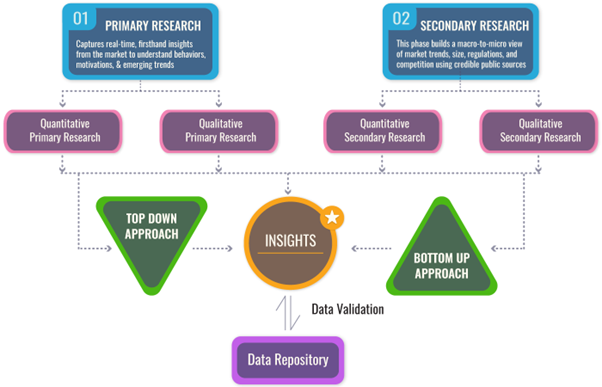
DUAL MODELING: TOP-DOWN + BOTTOM-UP
To ensure robust market estimation, we apply two complementary sizing approaches:
Top-Down Modeling:- Start with broader industry value (e.g., global or regional TAM)
- Apply filters by segment, geography, end-user, or use case
- Adjust with primary insights and validation benchmarks
- Ideal for investor-grade market scans and opportunity mapping
- Aggregate from the ground up using sales volumes, pricing, and unit economics
- Use internal modeling templates aligned with stakeholder data
- Incorporate distributor-level or region-specific inputs
- Most accurate for emerging segments and granular sub-markets
DATA VALIDATION: IN-HOUSE REPOSITORY
We close the loop with proprietary data intelligence built from ongoing projects, industry monitoring, and historical benchmarking. This repository includes:
- Multi-sector market and pricing models
- Key trendlines from past interviews and forecasts
- Benchmarked adoption rates, churn patterns, and ROI indicators
- Industry-specific deviation flags and cross-check logic
- Catches inconsistencies early
- Aligns projections across studies
- Enables consistent, high-trust deliverables