

Aerostructures Market Size and Forecast (2026–2034), Global and Regional Growth, Trend, Share and Industry Analysis Report Coverage; By Component (Fuselage, Wings, Empennage, Nacelles & Pylons, Flight Control Surfaces, Doors & Interiors, Others); By Material (Aluminum Alloys, Titanium Alloys, Composite Materials, Steel Alloys, Others); By Platform (Commercial Aircraft, Military Aircraft, Business Jets, Helicopters, Unmanned Aerial Vehicles, Urban Air Mobility Aircraft); By End User (OEMs, MRO Providers, Defense Organizations, Aircraft Leasing Companies), and Geography
2026-06-22
Aerospace & Defense
Ekta Chaurasia (Team Lead)
Description
Aerostructures Market Overview
The global Aerostructures
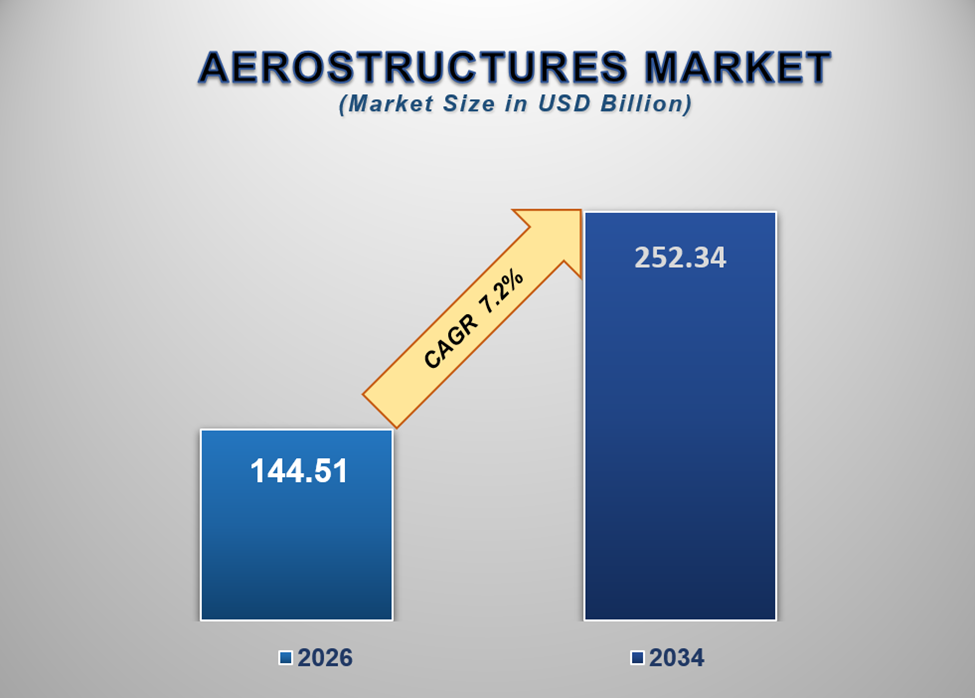
Market was valued at USD 144.51 billion in 2026 and is projected to
reach USD 252.34 billion by 2034, growing at a CAGR of 7.2% during
the forecast period. The market is witnessing robust expansion due to
increasing aircraft production, rising global passenger traffic, growing
defense modernization programs, and continuous technological advancements in
lightweight structural materials and manufacturing technologies.
Aerostructures
form the backbone of every aircraft and include critical structural components
such as fuselages, wings, empennages, nacelles, pylons, flight control
surfaces, and structural assemblies. These components are engineered to
withstand extreme operational conditions while ensuring safety, performance,
fuel efficiency, and structural integrity throughout the aircraft lifecycle.
The
aerostructures market plays a fundamental role in the global aerospace industry
because structural systems account for a significant portion of aircraft
manufacturing costs and directly influence aircraft weight, operational
efficiency, payload capacity, and maintenance requirements. As airlines seek
more fuel-efficient aircraft and governments invest in advanced military
platforms, demand for innovative aerostructure solutions continues to rise.
The increasing
recovery and expansion of commercial aviation is creating substantial demand
for new-generation narrow-body and wide-body aircraft. Growing passenger
volumes, expanding airline fleets, and rising air travel demand across emerging
economies are encouraging aircraft manufacturers to increase production rates,
thereby driving aerostructure demand globally.
Simultaneously,
military modernization initiatives are accelerating procurement of fighter
jets, transport aircraft, surveillance platforms, rotorcraft, and unmanned
aerial systems. Defense agencies are increasingly prioritizing lightweight,
durable, and technologically advanced structural components capable of
enhancing aircraft performance and mission effectiveness.
One of the most
transformative trends shaping the market is the growing adoption of composite
materials. Aerospace manufacturers are increasingly replacing traditional
metallic structures with advanced composites to reduce weight, improve
corrosion resistance, enhance fatigue performance, and increase fuel
efficiency. Modern aircraft platforms incorporate significantly higher
proportions of composite materials than previous generations, creating
substantial opportunities for aerostructure suppliers.
Additionally,
advanced manufacturing technologies such as additive manufacturing, robotic
assembly systems, digital twins, automated fiber placement, and artificial
intelligence-assisted quality inspection are transforming aerostructure
production processes. These innovations improve manufacturing precision, reduce
production costs, shorten development timelines, and enhance product
consistency.
As the aerospace sector continues prioritizing operational efficiency, sustainability, lightweight design, and advanced manufacturing capabilities, the aerostructures market is expected to maintain strong growth momentum throughout the forecast period.
Aerostructures Market Drivers and
Opportunities
Expanding
Commercial Aircraft Production Is Driving Market Growth
The rapid
expansion of global commercial aviation remains one of the most significant
drivers of the aerostructures market.
Air passenger
traffic continues to increase due to economic development, urbanization,
tourism growth, rising disposable incomes, and expanding connectivity across
both developed and emerging economies. Airlines are actively expanding and
modernizing their fleets to accommodate growing travel demand, creating
substantial opportunities for aerostructure manufacturers.
Aircraft
manufacturers are experiencing significant order backlogs as airlines place
long-term orders for fuel-efficient aircraft capable of reducing operating
costs and meeting environmental objectives. Every new aircraft produced
requires a wide range of aerostructural components, directly supporting market
growth.
The increasing
popularity of low-cost carriers is also contributing to aircraft demand. Budget
airlines are expanding operations globally, particularly in Asia-Pacific, the
Middle East, and Latin America, leading to increased procurement of narrow-body
aircraft and associated structural systems.
Furthermore,
fleet replacement programs are creating additional demand. Many airlines are
retiring older aircraft and replacing them with advanced platforms featuring
lightweight structures, improved aerodynamics, and enhanced fuel efficiency.
As commercial aviation continues its long-term growth trajectory, aerostructure manufacturers are expected to benefit from increasing production volumes and expanding global aircraft fleets.
Rising
Adoption of Composite Materials Is Transforming Aircraft Manufacturing
The growing use
of advanced composite materials is revolutionizing aerostructure design and
manufacturing.
Aircraft
manufacturers are increasingly incorporating carbon fiber-reinforced polymers,
glass fiber composites, and hybrid composite materials into structural
assemblies. These materials offer substantial advantages over conventional
metals, including reduced weight, improved corrosion resistance, enhanced
fatigue performance, and greater design flexibility.
Weight reduction
remains a critical objective within the aerospace industry because lighter
aircraft consume less fuel, generate lower emissions, and provide improved
operational efficiency. Even modest weight reductions can translate into
significant fuel savings over an aircraft's operational lifespan.
Composite
structures also enable manufacturers to create more aerodynamically optimized
designs while reducing the number of individual components required during
assembly. This contributes to improved structural efficiency and lower
maintenance requirements.
Advanced
military aircraft programs are similarly increasing reliance on composite
materials due to their strength-to-weight advantages and ability to support
stealth technologies.
As material
science continues advancing and manufacturing costs gradually decline,
composite adoption is expected to expand across commercial, military, and
emerging aviation platforms.
Urban Air
Mobility and Advanced Air Mobility Platforms Present Significant Opportunities
The emergence of
urban air mobility (UAM) and advanced air mobility (AAM) ecosystems represents
a major opportunity for the aerostructures industry.
Electric
vertical takeoff and landing (eVTOL) aircraft, air taxis, autonomous aerial
vehicles, and next-generation regional mobility platforms require innovative
structural designs optimized for lightweight performance, battery integration,
safety, and operational efficiency.
Many of these
aircraft rely heavily on advanced composite materials and novel structural
architectures that differ substantially from traditional aircraft designs.
Governments,
aviation regulators, technology firms, and aerospace manufacturers are
investing heavily in urban mobility programs aimed at transforming future
transportation systems. As these initiatives progress toward commercialization,
demand for specialized aerostructure solutions is expected to increase
significantly.
In addition, the
growth of unmanned aerial systems across commercial, military, logistics,
agricultural, and surveillance applications is creating new opportunities for
structural component manufacturers.
Manufacturers
capable of developing lightweight, durable, and highly efficient aerostructures
tailored to emerging aviation platforms are expected to benefit from
substantial long-term growth opportunities.
Aerostructures Market Scope
|
Report Attributes |
Description |
|
Market Size in 2026 |
USD
144.51 Billion |
|
Market Forecast in 2034 |
USD 252.34 Billion |
|
CAGR % 2026-2034 |
7.2% |
|
Base Year |
2025 |
|
Historic Data |
2021-2025 |
|
Forecast Period |
2026-2034 |
|
Report USP |
Production, Consumption, Company
Share, Company Heatmap, Company Production, Service Type, Growth Factors and
more |
|
Segments Covered |
∙ By Component |
|
Regional Scope |
● North
America ● Europe ● APAC ● Latin
America ● Middle
East and Africa |
|
Country Scope |
U.S. Canada U.K. Germany France Italy Spain Switzerland China India Japan South Korea Australia Mexico Brazil Argentina Saudi Arabia UAE South Africa |
Aerostructures
Market Report Segmentation Analysis
The global aerostructures market industry analysis is segmented by component, by material, by platform, by end user, and by region.
Fuselage
Segment Is Expected to Dominate the Market During the Forecast Period
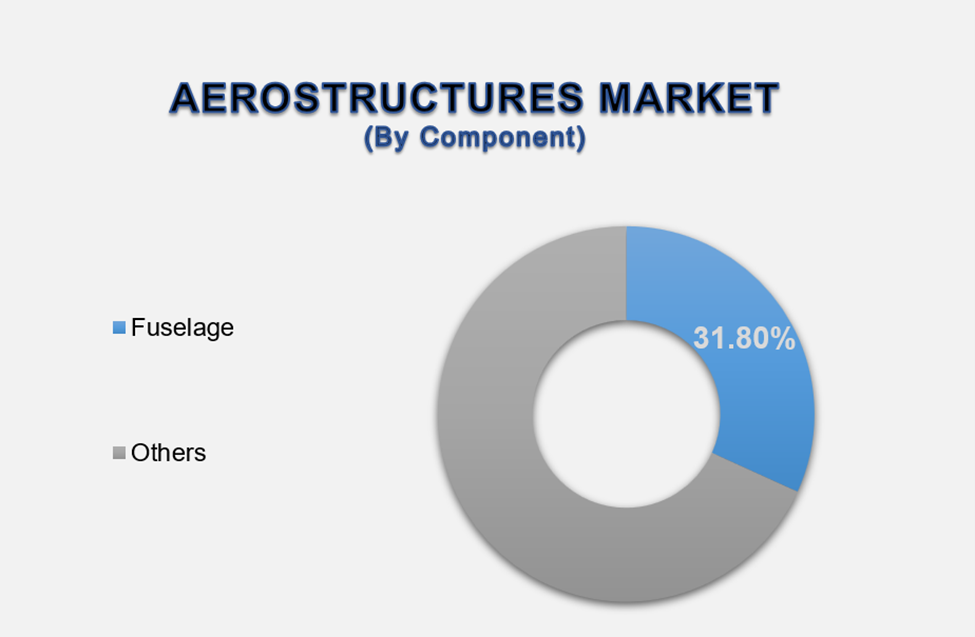
The fuselage
segment accounted for approximately 31.8% of the global market, making
it the largest component category.
The fuselage
serves as the primary structural body of an aircraft and represents one of the
most complex, material-intensive, and high-value aerostructural assemblies. It
houses passengers, cargo, avionics systems, fuel systems, cockpit modules, and
numerous operational subsystems.
The dominance of
this segment is primarily attributed to the extensive engineering,
manufacturing complexity, and material requirements associated with fuselage
production. Modern fuselage structures require advanced design approaches to
balance strength, weight, durability, safety, and aerodynamic performance.
Increasing
production rates of commercial aircraft are significantly driving demand for
fuselage structures. As airlines expand fleets and aircraft manufacturers ramp
up deliveries, fuselage suppliers continue experiencing strong order volumes.
The segment is
also benefiting from increasing use of composite materials, which help reduce
aircraft weight while improving operational performance. New-generation
aircraft incorporate larger composite fuselage sections than previous models,
creating opportunities for advanced materials manufacturers.
Furthermore,
military aviation programs continue investing in next-generation airframes
featuring enhanced survivability, mission adaptability, and lightweight
structural architectures.
Given its central role in aircraft design and its substantial contribution to overall aircraft value, the fuselage segment is expected to maintain market leadership throughout the forecast period.
The Composite
Materials Segment Is Expected to Lead the Market by Material
Composite
materials represent the fastest-growing and most influential material segment
within the aerostructures market.
The aerospace
industry's relentless pursuit of fuel efficiency has significantly accelerated
the adoption of lightweight composite structures. Carbon fiber-reinforced
composites offer exceptional strength-to-weight ratios, enabling manufacturers
to reduce aircraft weight without compromising structural integrity.
Unlike
traditional metallic materials, composites provide superior resistance to
corrosion, fatigue, and environmental degradation. This translates into lower
maintenance requirements and longer service life for aircraft operators.
Commercial
aircraft manufacturers increasingly utilize composite materials in wings,
fuselages, empennages, nacelles, and flight control surfaces. Modern aircraft
programs have demonstrated the substantial economic and operational benefits
associated with composite-intensive designs.
The military
sector is also increasing adoption due to the ability of composites to support
advanced performance requirements, including stealth capabilities and enhanced
maneuverability.
As manufacturing
technologies mature and production scalability improves, composite materials
are expected to capture an increasingly larger share of future aerostructure
production.
Commercial
Aircraft Segment Is Expected to Dominate the Market by Platform
Commercial
aircraft account for the largest share of the aerostructures market due to
their high production volumes, large structural content, and extensive global
demand.
The continued
growth of international air travel is creating strong demand for both
narrow-body and wide-body aircraft. Airlines are expanding capacity, opening
new routes, and replacing aging fleets with fuel-efficient aircraft equipped
with advanced structural technologies.
Aircraft
manufacturers maintain substantial order backlogs spanning several years,
providing long-term visibility and demand stability for aerostructure
suppliers.
Additionally,
sustainability initiatives are encouraging the adoption of lighter and more
efficient aircraft platforms, further supporting structural innovation and
market growth.
Emerging markets
across Asia-Pacific, the Middle East, and Africa are expected to contribute
significantly to future commercial aircraft demand, creating additional
opportunities for aerostructure manufacturers.
The combination of rising passenger traffic, fleet modernization initiatives, and increasing aircraft production rates ensures the continued dominance of the commercial aircraft segment.
OEM Segment
Is Expected to Lead the Market by End User
Original
Equipment Manufacturers (OEMs) represent the largest end-user segment within
the aerostructures market.
OEMs are
responsible for integrating structural assemblies into new aircraft production
programs and therefore account for the majority of aerostructure procurement
activities.
Aircraft
manufacturers increasingly collaborate with specialized aerostructure suppliers
to improve production efficiency, reduce development costs, and access advanced
manufacturing capabilities.
The growing
complexity of modern aircraft programs has encouraged greater outsourcing of
structural manufacturing activities, creating substantial opportunities for
tier-one and tier-two suppliers.
Furthermore,
rising aircraft production rates and long-term delivery backlogs continue
supporting strong demand from OEM customers globally.
As aerospace
manufacturing expands and aircraft development programs accelerate, OEM demand
for advanced aerostructures is expected to remain robust throughout the
forecast period.
The following
segments are part of an in-depth analysis of the global Aerostructures market:
|
Market Segments |
|
|
By Component |
∙ Fuselage |
|
By
Material |
∙ Aluminum Alloys |
|
By
Platform |
∙ Commercial Aircraft |
|
By End User |
∙ OEMs |
Aerostructures
Market Share Analysis By Region
North America is
projected to hold the largest share of the global aerostructures market
throughout the forecast period, accounting for approximately 39.4% of global
revenue in 2026.
The region
benefits from the presence of major aircraft manufacturers, advanced aerospace
supply chains, extensive defense spending, and strong investments in aerospace
research and development. The United States remains the dominant market due to
its leadership in commercial aviation, military aerospace programs, and
advanced manufacturing technologies.
Europe
represents the second-largest market, supported by strong aerospace
manufacturing capabilities, advanced engineering expertise, and significant
aircraft production activities. Countries such as France, Germany, the United
Kingdom, and Spain play important roles within the global aerospace ecosystem.
Asia-Pacific is
expected to register the fastest growth throughout the forecast period. Rising
passenger traffic, increasing aircraft procurement, growing domestic aerospace
industries, and expanding defense budgets are driving regional demand.
China and India
are emerging as major aerospace growth centers due to expanding aviation
infrastructure, increasing air travel demand, and government support for
indigenous aerospace manufacturing capabilities.
The Middle East
continues investing heavily in commercial aviation expansion, while Latin
America is experiencing gradual growth supported by regional fleet
modernization initiatives.
As global aviation demand continues to increase, regional investments in aerospace manufacturing and aircraft procurement are expected to drive sustained market expansion.
Aerostructures
Market Competition Landscape Analysis
The
aerostructures market is characterized by intense competition, technological
innovation, and extensive collaboration between aircraft manufacturers and
component suppliers.
Leading
companies are investing heavily in advanced composites, automated manufacturing
systems, additive manufacturing technologies, digital engineering solutions,
and sustainable production processes.
Manufacturers
are focusing on improving production efficiency, reducing structural weight,
enhancing product quality, and supporting next-generation aircraft development
programs.
Strategic
partnerships, mergers, acquisitions, and long-term supply agreements continue
shaping the competitive landscape as companies seek to strengthen technological
capabilities and global market presence.
The increasing complexity of aircraft programs and growing demand for lightweight structures are expected to further intensify competition and innovation throughout the forecast period.
Global
Aerostructures Market Recent Developments News:
∙ In April 2026,
major aerospace manufacturers expanded investments in advanced composite
aerostructure production facilities.
∙ In February
2026, aircraft suppliers introduced automated robotic assembly systems to
improve structural manufacturing efficiency.
∙ In November
2025, several commercial aircraft programs increased production targets to
address growing airline order backlogs.
∙ In August
2025, aerospace companies accelerated the development of lightweight structural
technologies for sustainable aviation applications.
∙ In June 2025, multiple defense modernization initiatives generated increased demand for advanced military aircraft structures.
The Global
Aerostructures Market is Dominated by a Few Large Companies, Such As
∙ Spirit AeroSystems Holdings, Inc.
∙ Leonardo S.p.A.
∙ Airbus Atlantic
∙ Triumph Group, Inc.
∙ GKN Aerospace
∙ Safran S.A.
∙ Collins Aerospace
∙ ST Engineering Aerospace
∙ Korean Aerospace Industries Ltd.
∙ Mitsubishi Heavy Industries, Ltd.
∙ Kawasaki Heavy Industries, Ltd.
∙ Daher Group
∙ Saab AB
∙ FACC AG
∙ Premium AEROTEC GmbH
∙ Others
Frequently Asked Questions
Ekta Chaurasia (Team Lead)
Ekta Chaurasia is a highly experienced Team Lead at M2Square Consultancy with over 7 years of expertise in market research, strategic consulting, competitive benchmarking, and business intelligence solutions. She specializes in ICT, semiconductors & electronics, automotive & transportation, and industrial machinery markets.
She leads end-to-end global research projects focused on market trends, industry analysis, growth forecasting, customer insights, and strategic decision-making. Known for her analytical leadership and industry expertise, Ekta helps businesses uncover growth opportunities, evaluate competitive landscapes, and stay ahead in rapidly evolving markets through accurate and insight-driven research.
1. Global Aerostructures Market
Introduction and Market Overview
1.1. Objectives of the Study
1.2. Global Aerostructures Market Scope
and Market Estimation
1.2.1. Global Aerostructures Overall Market
Size (US$ Million), Market CAGR (%), Market Forecast (2026 - 2034)
1.2.2. Global Aerostructures Market Revenue
Share (%) and Growth Rate (Y-o-Y) from 2021 - 2034
1.3. Market Segmentation
1.3.1. Component of Global Aerostructures
Market
1.3.2. Material of Global Aerostructures
Market
1.3.3. Platform of Global Aerostructures
Market
1.3.4. End User of Global Aerostructures
Market
1.3.5. Region of Global Aerostructures
Market
2. Executive Summary
2.1. Demand Side Trends
2.2. Key Market Trends
2.3. Market Demand (US$ Million) Analysis
2021 – 2025 and Forecast, 2026 – 2034
2.4. Demand and Opportunity Assessment
2.5. Key Developments
2.6. Overview of Tariff, Regulatory
Landscape and Standards
2.7. Market Entry Strategies
2.8. Market Dynamics
2.8.1. Drivers
2.8.2. Limitations
2.8.3. Opportunities
2.8.4. Impact Analysis of Drivers and
Restraints
2.9. Porter’s Five Forces Analysis
2.10.
PEST
Analysis
3. Global Aerostructures Market
Estimates & Historical Trend Analysis (2021 - 2025)
4. Global Aerostructures Market
Estimates & Forecast Trend Analysis, by Component
4.1. Global Aerostructures Market Revenue
(US$ Million) Estimates and Forecasts, by Component, 2021 - 2034
4.1.1. Fuselage
4.1.2. Wings
4.1.3. Empennage
4.1.4. Nacelles & Pylons
4.1.5. Flight Control Surfaces
4.1.6. Doors & Interiors
4.1.7. Others
5. Global Aerostructures Market
Estimates & Forecast Trend Analysis, by Material
5.1. Global Aerostructures Market Revenue
(US$ Million) Estimates and Forecasts, by Material, 2021 - 2034
5.1.1. Aluminum Alloys
5.1.2. Titanium Alloys
5.1.3. Composite Materials
5.1.4. Steel Alloys
5.1.5. Others
6. Global Aerostructures Market
Estimates & Forecast Trend Analysis, by Platform
6.1. Global Aerostructures Market Revenue
(US$ Million) Estimates and Forecasts, by Platform, 2021 - 2034
6.1.1. Commercial Aircraft
6.1.2. Military Aircraft
6.1.3. Business Jets
6.1.4. Helicopters
6.1.5. Unmanned Aerial Vehicles
6.1.6. Urban Air Mobility Aircraft
7. Global Aerostructures Market
Estimates & Forecast Trend Analysis, by End User
7.1. Global Aerostructures Market Revenue
(US$ Million) Estimates and Forecasts, by End User, 2021 - 2034
7.1.1. OEMs
7.1.2. MRO Providers
7.1.3. Defense Organizations
7.1.4. Aircraft Leasing Companies
8. Global Aerostructures Market
Estimates & Forecast Trend Analysis, by Region
8.1. Global Aerostructures Market Revenue
(US$ Million) Estimates and Forecasts, by Region, 2021 - 2034
8.1.1. North America
8.1.2. Europe
8.1.3. Asia Pacific
8.1.4. Middle East & Africa
8.1.5. Latin America
9. North America Aerostructures Market:
Estimates & Forecast Trend Analysis
9.1. North America Aerostructures Market
Assessments & Key Findings
9.1.1. North America Aerostructures Market
Introduction
9.1.2. North America Aerostructures Market
Size Estimates and Forecast (US$ Million) (2021 - 2034)
9.1.2.1.
By
Component
9.1.2.2.
By
Material
9.1.2.3.
By
Platform
9.1.2.4.
By
End User
9.1.2.5.
By
Country
9.1.2.5.1.
The
U.S.
9.1.2.5.2.
Canada
10. Europe Aerostructures Market:
Estimates & Forecast Trend Analysis
10.1.
Europe
Aerostructures Market Assessments & Key Findings
10.1.1. Europe Aerostructures Market
Introduction
10.1.2. Europe Aerostructures Market Size
Estimates and Forecast (US$ Million) (2021 - 2034)
10.1.2.1.
By
Component
10.1.2.2.
By
Material
10.1.2.3.
By
Platform
10.1.2.4.
By
End User
10.1.2.5.
By
Country
10.1.2.5.1.
Germany
10.1.2.5.2.
Italy
10.1.2.5.3.
U.K.
10.1.2.5.4.
France
10.1.2.5.5.
Spain
10.1.2.5.6.
Switzerland
10.1.2.5.7.
Rest
of Europe
11. Asia Pacific Aerostructures Market:
Estimates & Forecast Trend Analysis
11.1.
Asia
Pacific Market Assessments & Key Findings
11.1.1. Asia Pacific Aerostructures Market
Introduction
11.1.2. Asia Pacific Aerostructures Market
Size Estimates and Forecast (US$ Million) (2021 - 2034)
11.1.2.1.
By
Component
11.1.2.2.
By
Material
11.1.2.3.
By
Platform
11.1.2.4.
By
End User
11.1.2.5.
By
Country
11.1.2.5.1.
China
11.1.2.5.2.
Japan
11.1.2.5.3.
India
11.1.2.5.4.
Australia
11.1.2.5.5.
South
Korea
11.1.2.5.6.
Rest
of Asia Pacific
12. Middle East & Africa
Aerostructures Market: Estimates & Forecast Trend Analysis
12.1.
Middle
East & Africa Market Assessments & Key Findings
12.1.1. Middle East & Africa
Aerostructures Market Introduction
12.1.2. Middle East & Africa
Aerostructures Market Size Estimates and Forecast (US$ Million) (2021 - 2034)
12.1.2.1.
By
Component
12.1.2.2.
By
Material
12.1.2.3.
By
Platform
12.1.2.4.
By
End User
12.1.2.5.
By
Country
12.1.2.5.1.
UAE
12.1.2.5.2.
Saudi
Arabia
12.1.2.5.3.
South
Africa
12.1.2.5.4.
Rest
of MEA
13. Latin America Aerostructures Market:
Estimates & Forecast Trend Analysis
13.1.
Latin
America Market Assessments & Key Findings
13.1.1. Latin America Aerostructures Market Introduction
13.1.2. Latin America Aerostructures Market
Size Estimates and Forecast (US$ Million) (2021 - 2034)
13.1.2.1.
By
Component
13.1.2.2.
By
Material
13.1.2.3.
By
Platform
13.1.2.4.
By
End User
13.1.2.5.
By
Country
13.1.2.5.1.
Brazil
13.1.2.5.2.
Mexico
13.1.2.5.3.
Argentina
13.1.2.5.4.
Rest
of LATAM
14. Competition Landscape
14.1.
Global
Aerostructures Market Product Mapping
14.2.
Global
Aerostructures Market Concentration Analysis, by Leading Players / Innovators /
Emerging Players / New Entrants
14.3.
Global
Aerostructures Market Tier Structure Analysis
14.4.
Global
Aerostructures Market Concentration & Company Market Shares (%) Analysis,
2025
15. Company Profiles
15.1.
Spirit
AeroSystems Holdings, Inc.
15.1.1. Company Overview & Key Stats
15.1.2. Financial Performance & KPIs
15.1.3. Product Portfolio
15.1.4. SWOT Analysis
15.1.5. Business Strategy & Recent
Developments
*Similar details would be provided for all the players
mentioned below
15.2.
Leonardo
S.p.A.
15.3.
Airbus
Atlantic
15.4.
Triumph
Group, Inc.
15.5.
GKN
Aerospace
15.6.
Safran
S.A.
15.7.
Collins
Aerospace
15.8.
ST
Engineering Aerospace
15.9.
Korean
Aerospace Industries Ltd.
15.10.
Mitsubishi
Heavy Industries, Ltd.
15.11.
Kawasaki
Heavy Industries, Ltd.
15.12.
Daher
Group
15.13.
Saab
AB
15.14.
FACC
AG
15.15.
Premium
AEROTEC GmbH
15.16.
Others
16. Research Findings & Conclusion
17. Assumption & Acronyms Used
18. Research Methodology
18.1.
External
Databases
18.2.
Internal
Proprietary Database
18.3.
Primary
Research
18.4.
Secondary
Research
18.5.
Assumptions
18.6.
Limitations
18.7.
Report
FAQs
Our Research Methodology
"Insight without rigor is just noise."
We follow a comprehensive, multi-phase research framework designed to deliver accurate, strategic, and decision-ready intelligence. Our process integrates primary and secondary research , both quantitative and qualitative , along with dual modeling techniques ( top-down and bottom-up) and a final layer of validation through our proprietary in-house repository.
PRIMARY RESEARCH
Primary research captures real-time, firsthand insights from the market to understand behaviors, motivations, and emerging trends.
1. Quantitative Primary Research
Objective: Generate statistically significant data directly from market participants.
Approaches:- Structured surveys with customers, distributors, and field agents
- Mobile-based data collection for point-of-sale audits and usage behavior
- Phone-based interviews (CATI) for market sizing and product feedback
- Online polling around industry events and digital campaigns
- Purchase frequency by customer type
- Channel performance across geographies
- Feature demand by application or demographic
2. Qualitative Primary Research
Objective: Explore decision-making drivers, pain points, and market readiness.
Approaches:- In-depth interviews (IDIs) with executives, product managers, and key decision-makers
- Focus groups among end users and early adopters
- Site visits and observational research for consumer products
- Informal field-level discussions for regional and cultural nuances
SECONDARY RESEARCH
This phase helps establish a macro-to-micro understanding of market trends, size, regulation, and competitive dynamics, sourced from credible and public domain information.
1. Quantitative Secondary Research
Objective: Model market value and segment-level forecasts based on published data.
Sources include:- Financial reports and investor summaries
- Government trade data, customs records, and regulatory statistics
- Industry association publications and economic databases
- Channel performance and pricing data from marketplace listings
- Revenue splits, pricing trends, and CAGR estimates
- Supply-side capacity and volume tracking
- Investment analysis and funding benchmarks
2. Qualitative Secondary Research
Objective: Capture strategic direction, innovation signals, and behavioral trends.
Sources include:- Company announcements, roadmaps, and product pipelines
- Publicly available whitepapers, conference abstracts, and academic research
- Regulatory body publications and policy briefs
- Social and media sentiment scanning for early-stage shifts
- Strategic shifts in market positioning
- Unmet needs and white spaces
- Regulatory triggers and compliance impact
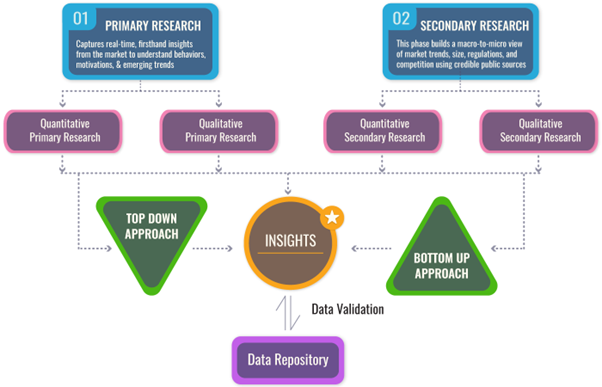
DUAL MODELING: TOP-DOWN + BOTTOM-UP
To ensure robust market estimation, we apply two complementary sizing approaches:
Top-Down Modeling:- Start with broader industry value (e.g., global or regional TAM)
- Apply filters by segment, geography, end-user, or use case
- Adjust with primary insights and validation benchmarks
- Ideal for investor-grade market scans and opportunity mapping
- Aggregate from the ground up using sales volumes, pricing, and unit economics
- Use internal modeling templates aligned with stakeholder data
- Incorporate distributor-level or region-specific inputs
- Most accurate for emerging segments and granular sub-markets
DATA VALIDATION: IN-HOUSE REPOSITORY
We close the loop with proprietary data intelligence built from ongoing projects, industry monitoring, and historical benchmarking. This repository includes:
- Multi-sector market and pricing models
- Key trendlines from past interviews and forecasts
- Benchmarked adoption rates, churn patterns, and ROI indicators
- Industry-specific deviation flags and cross-check logic
- Catches inconsistencies early
- Aligns projections across studies
- Enables consistent, high-trust deliverables