

Agricultural Adjuvants Market Size and Forecast (2025–2033), Global and Regional Growth, Trend, Share and Industry Analysis Report Coverage: By Type (Activator Adjuvants, Utility Adjuvants), By Application (Herbicides, Insecticides, Fungicides, Others), By Crop (Cereals, Oilseeds, Fruits & Vegetables, Other Crops), and Geography
2026-01-02
Agriculture Industry
Jaya Bundele (Research Analyst)
Description
Agricultural
Adjuvants Market Overview
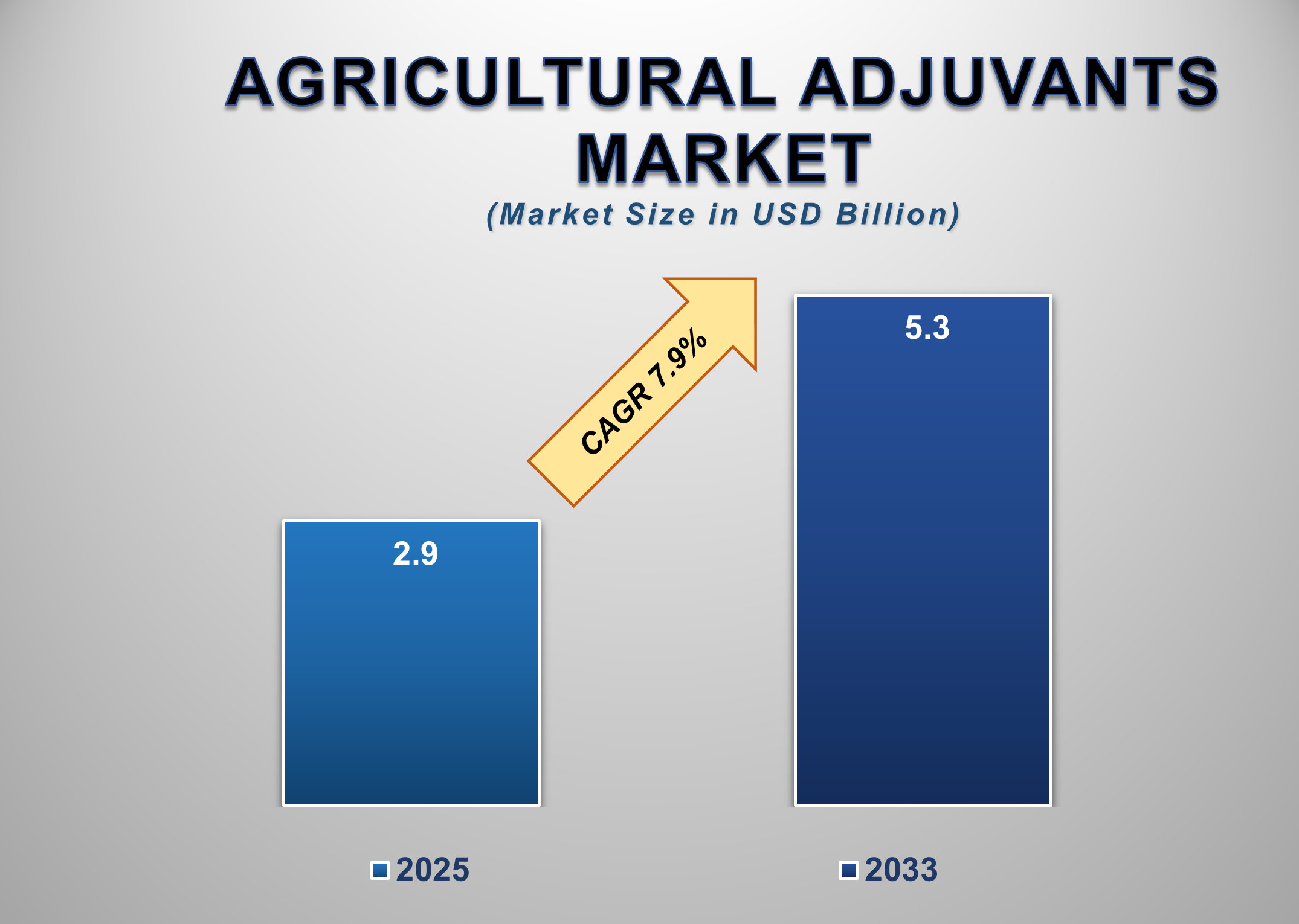
The global Agricultural Adjuvants Market is gaining significant momentum as modern farming practices place greater emphasis on crop protection efficiency, superior product performance, and precision agriculture. Estimated at USD 2.9 billion in 2025, the market is projected to reach USD 5.3 billion by 2033, expanding at a robust CAGR of 7.9%. Agricultural adjuvant substances added to pesticides, herbicides, fungicides, or other crop protection formulations play a critical role in enhancing spray effectiveness, improving chemical stability, boosting adhesion, and ensuring better penetration into plant tissues. Their rising adoption aligns with global pressure to increase crop yields while minimizing agrochemical usage and environmental impact. As farmers transition toward data-driven and sustainable farming practices, the need to optimize every spray application is fueling widespread usage of adjuvants across all major crop categories.
 Rapid industrialization of
agriculture, especially in emerging economies, is creating strong demand for
efficient agrochemical formulations capable of delivering high performance
under diverse climatic and soil conditions. Adjuvants are increasingly seen not
just as product enhancers but as essential complements to crop protection
solutions in precision farming, enabling better droplet formation, reduced
spray drift, and maximized bioavailability. Markets in Asia-Pacific, Latin
America, and North America are experiencing significant growth due to
large-scale farming operations, rising pest resistance, and expanded
application of advanced chemistries.
Rapid industrialization of
agriculture, especially in emerging economies, is creating strong demand for
efficient agrochemical formulations capable of delivering high performance
under diverse climatic and soil conditions. Adjuvants are increasingly seen not
just as product enhancers but as essential complements to crop protection
solutions in precision farming, enabling better droplet formation, reduced
spray drift, and maximized bioavailability. Markets in Asia-Pacific, Latin
America, and North America are experiencing significant growth due to
large-scale farming operations, rising pest resistance, and expanded
application of advanced chemistries.
Agricultural Adjuvants Market Drivers and
Opportunities
Rising Use of Herbicides
and Improved Formulation Efficiency Is Driving the Agricultural Adjuvants
Market Growth
The growing reliance on
herbicides across global agricultural systems is a central force driving the
Agricultural Adjuvants Market. Herbicides remain essential for weed control,
which has become increasingly challenging due to climate change, expanded cropping
intensity, and rising herbicide-resistant weed populations. As new resistant
strains continue to emerge, farmers are under pressure to maximize the
efficiency of every herbicide application. Adjuvants significantly improve
spray uniformity, leaf surface coverage, and penetration, enabling optimal
herbicide efficacy even in complex environments. Because herbicides represent
the highest share of crop protection chemicals globally, the increased need for
supporting technologies to enhance their performance directly strengthens
demand for adjuvants. At the same time, agrochemical manufacturers are
reformulating products to comply with stricter environmental and safety
regulations. Many modern chemistries require adjuvants for effective
dispersion, solubilization, and surfactant action. This has accelerated the
adoption of activator adjuvants, multifunctional surfactants, and advanced
penetration enhancers. Moreover, the rapid expansion of precision agriculture,
such as GPS-guided spraying, controlled droplet application, and variable-rate
technology, further amplifies the need for adjuvants that ensure stable spray
patterns and reliability under varying droplet sizes. Together, these factors
are reshaping crop protection strategies, making adjuvants indispensable for
achieving consistent, high-yield outcomes across large-scale cropping systems
worldwide.
Growing Adoption of
Cereals and Oilseed Farming Is Fueling Large-Scale Demand for Agricultural
Adjuvants Worldwide
The increasing global demand for
cereals such as wheat, rice, corn, and barley is creating strong momentum for
adjuvant adoption. Cereals remain the most widely cultivated crops across the
world, driven by population growth, industrial food processing needs, livestock
feed production, and rising consumption in developing regions. Large-scale
cereal farming involves extensive use of agrochemicals to mitigate pests,
diseases, and weeds that can drastically reduce yields. Adjuvants play a vital
role in ensuring that these crop protection inputs perform consistently, even
under challenging environmental conditions such as high temperatures, heavy
rainfall, or dry climates. High-volume cereal production operations, especially
in Asia-Pacific, Europe, and North America, depend heavily on effective spray
applications, making adjuvants essential for enhancing herbicide, fungicide,
and insecticide efficiency.
Additionally, the expansion of
oilseed crops such as soybean, canola, and sunflower is further boosting the
market. These crops require targeted protection against fungal pathogens and
insect infestations that can significantly affect oil extraction quality and
yields. Adjuvants ensure better droplet adhesion and cuticular penetration,
particularly important for oilseeds where waxy leaf surfaces hinder pesticide
absorption. As global food security initiatives focus on improving per-acre
productivity, and as farming in developing regions transitions to more
mechanized and chemical-intensive systems, the demand for agricultural
adjuvants continues to rise sharply. This increasing crop dependency
underscores the essential nature of adjuvants as part of modern agricultural
input portfolios.
Growing Focus on
Sustainable and Bio-Based Crop Protection Solutions Is Creating Significant
Opportunities in the Agricultural Adjuvants Market Worldwide
The global transition toward
environmentally sustainable agriculture is opening new growth avenues for the
Agricultural Adjuvants Market. Governments and regulatory bodies across regions
are implementing stricter measures to reduce pesticide residues, minimize
environmental contamination, and encourage biodegradable crop inputs. This
regulatory shift is compelling manufacturers to develop bio-based,
low-toxicity, and eco-friendly adjuvant formulations derived from natural oils,
plant extracts, and renewable surfactants. Bio-based adjuvants not only reduce
the environmental footprint but also improve compatibility with organic and
reduced-chemical farming systems segments which are expanding rapidly
worldwide. Farmers are increasingly adopting these solutions to meet
certification standards and consumer demand for cleaner, residue-free food
products. Furthermore, the rise of regenerative agriculture, sustainable
intensification, and carbon-smart farming is creating long-term structural
demand for adjuvants that enhance application precision and reduce chemical
wastage. Many farmers are turning to adjuvants that allow lower chemical
dosages without compromising efficacy, helping them comply with evolving
environmental guidelines. Technological advancements such as nano-emulsion
adjuvants, biodegradable surfactants, and multifunctional additives are giving
manufacturers new opportunities to differentiate their products. As
sustainability continues to guide global agricultural policies and consumer
preferences, bio-based and advanced adjuvants are positioned to become a major
growth engine for the market throughout the forecast period.
Agricultural Adjuvants
Market Scope
|
Report Attributes |
Description |
|
Market Size in 2025 |
USD 2.9 Billion |
|
Market Forecast in 2033 |
USD 5.3 Billion |
|
CAGR % 2025-2033 |
7.9% |
|
Base Year |
2024 |
|
Historic Data |
2020-2024 |
|
Forecast Period |
2025-2033 |
|
Report USP |
Production, Consumption, Company
Share, Company Heatmap, Company Production Capacity, Growth Factors and more |
|
Segments Covered |
●
By Type, By
Application, By Crop |
|
Regional Scope |
●
North America ●
Europe ●
APAC ●
Latin America ●
Middle East and
Africa |
|
Country Scope |
1)
U.S. 2)
Canada 3)
Germany 4)
UK 5)
France 6)
Spain 7)
Italy 8)
Switzerland 9)
China 10)
Japan 11)
India 12)
Australia 13)
South Korea 14)
Brazil 15)
Mexico 16)
Argentina 17)
South Africa 18)
Saudi Arabia 19)
UAE |
Agricultural Adjuvants
Market Report Segmentation Analysis
The global Agricultural Adjuvants
market is segmented by Type, by Application, by Crop, and by Geography.
Activator Adjuvants
Segment Accounted for the Largest Market Share in the Global Agricultural
Adjuvants Market
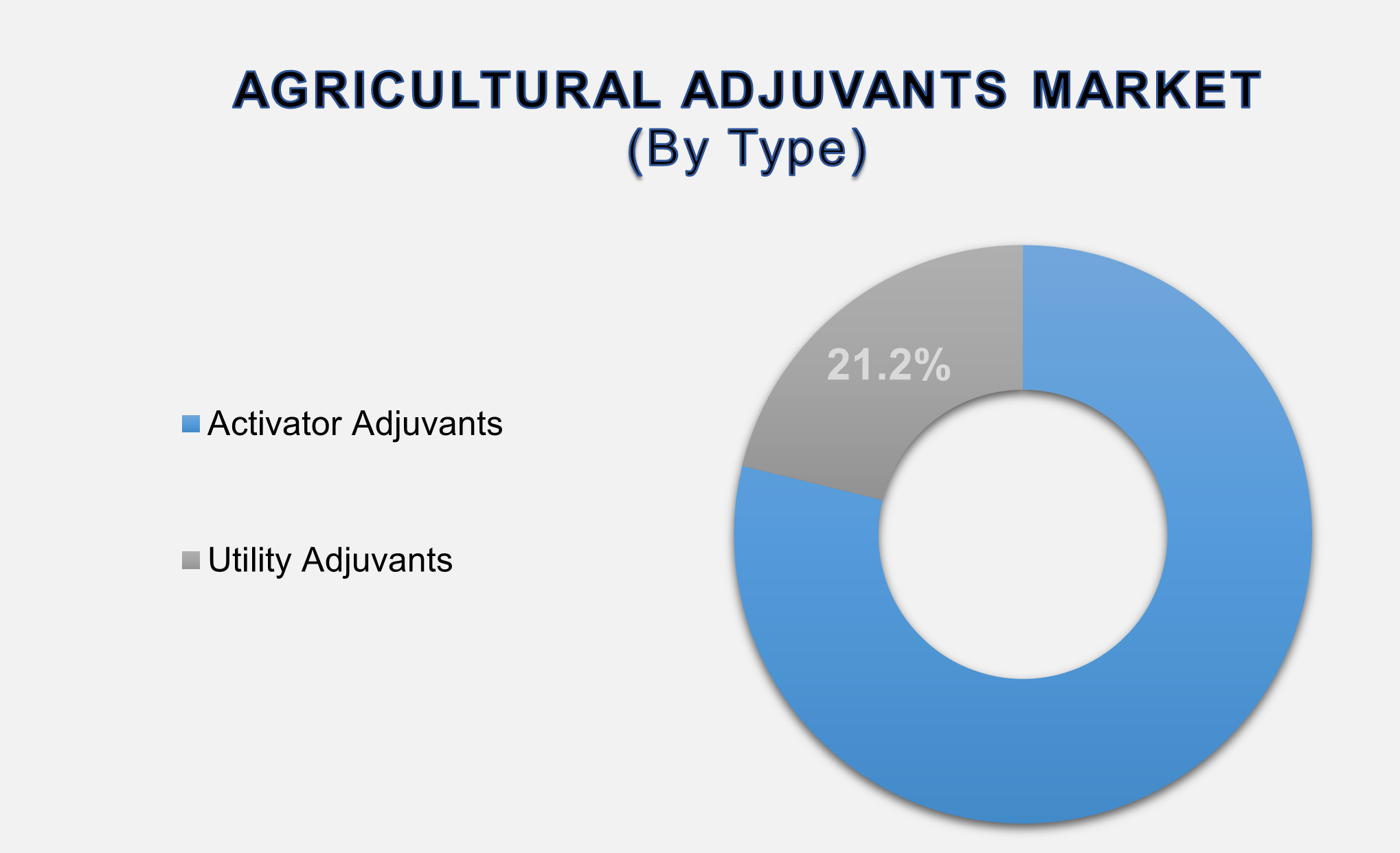
The Activator Adjuvants segment dominates the market with a 78.8% share, underscoring their essential role in improving agrochemical performance across multiple crop types. These adjuvants include surfactants, wetting agents, spreaders, and penetrants designed to enhance the absorption of herbicides, insecticides, and fungicides. Their widespread adoption is driven by the increasing use of systemic pesticides that require effective penetration into plant tissues for optimal functionality. Farmers prefer activator adjuvants because they improve droplet retention, reduce surface tension, and enhance product distribution across leaves and stems. Additionally, they allow for better performance under challenging field conditions such as high humidity, extreme temperatures, and variable spray pressures. The growing prevalence of herbicide-resistant weeds and the expansion of high-value crops globally are further boosting demand for activator adjuvants. Newer pesticide formulations are also increasingly dependent on these additives to achieve desired efficacy, making activator adjuvants indispensable for modern agriculture. Precision agriculture technologies such as automated spraying systems, controlled droplet applications, and drone-assisted spraying also rely heavily on activator adjuvants to maintain uniform spray patterns and absorption.
Herbicides Segment Accounted for the Largest Market Share in the Global Agricultural Adjuvants Market by Application
The Herbicides segment holds the
largest share in the Application category, reflecting the growing need for
effective weed control to maintain high crop productivity. Herbicides account
for the majority of all crop protection chemicals used globally, and their
performance is heavily influenced by the use of adjuvants. Agricultural
adjuvants improve herbicide uptake by enabling superior spray coverage, reducing
droplet bounce, and enhancing penetration into tough weed cuticles. These
performance improvements are particularly critical for managing resistant weed
species, which have become increasingly widespread due to excessive use of
similar modes of action over time. Farmers cultivating large-scale cereal,
oilseed, and fiber crops rely extensively on herbicides to maintain clean
fields and maximize yields. Adjuvants ensure that herbicides remain effective
even under adverse environmental conditions such as wind drift, high
temperatures, and inconsistent moisture levels.
The Cereals Segment
Accounted for the Largest Market Share in the Global Agricultural Adjuvants
Market by Crop Type
The Cereals segment, comprising
crops such as wheat, rice, maize, and barley, commands the largest share in the
Crop category. Cereals form the backbone of global food supply, animal feed
industries, and industrial applications, making efficient crop protection
essential for sustaining global food security. The high pest and disease
pressure associated with cereal farming drives strong adoption of adjuvants to
enhance pesticide performance. Adjuvants help improve spray adherence,
retention, and penetration on cereal leaves, which often have waxy surfaces
that reduce chemical absorption. As large-acreage cereal farming expands across
Asia-Pacific, North America, and Europe, the demand for adjuvants will continue
to scale proportionally. Environmental challenges such as unpredictable
rainfall patterns, soil degradation, and rising temperatures underscore the
need for reliable crop protection methods. Adjuvants support improved spray
outcomes under such conditions, ensuring reduced pesticide wastage and enhanced
effectiveness.
The following segments are
part of an in-depth analysis of the global Agricultural Adjuvants Market:
|
Market
Segments |
|
|
By Type |
●
Activator Adjuvants ●
Utility Adjuvants |
|
By Material |
●
Herbicides ●
Insecticides ●
Fungicides ●
Others |
|
By
Distribution Channel |
●
Cereals ●
Oilseeds ●
Fruits &
Vegetables ●
Other Crops |
Agricultural Adjuvants Market Share Analysis by
Region
The Asia Pacific region
is projected to hold the largest share of the global Agricultural Adjuvants
Market over the forecast period.
Asia-Pacific accounted for the
largest share of the Agricultural Adjuvants Market at 46.7%, supported by its
massive agricultural base, extensive cereal crop cultivation, and increasing
adoption of modern farming technologies. Countries such as India, China,
Indonesia, and Vietnam are experiencing rapid transitions toward mechanized and
chemical-intensive farming practices, creating strong demand for adjuvants that
enhance spray efficiency. Favorable government policies promoting improved crop
productivity and reduced chemical usage also encourage farmers to adopt
advanced adjuvant formulations. The region’s high population density and
growing food security pressures further accelerate the need for optimized crop
protection inputs.
North America is expected to
exhibit the highest CAGR during the forecast period, driven by technological
advancements, precision agriculture adoption, and strong penetration of
specialty adjuvants. The region benefits from well-established agricultural infrastructure,
advanced R&D capabilities, and widespread use of herbicides, fungicides,
and insecticides in large-scale commercial farming. Europe also represents a
significant market with strong regulatory support for sustainable agriculture,
driving demand for bio-based and environmentally friendly adjuvants. Meanwhile,
Latin America, especially Brazil and Argentina, is experiencing rising demand
for utility and activator adjuvants due to the rapid expansion of soybean,
corn, and sugarcane cultivation. Together, these regional dynamics position the
Agricultural Adjuvants Market for continued global expansion through 2033.
Agricultural Adjuvants Market Competition
Landscape Analysis
The
Agricultural Adjuvants Market is moderately consolidated, with leading players
such as BASF, Dow Chemical, Solvay, Evonik, Croda, Clariant, and Huntsman
shaping the competitive environment. These companies invest heavily in product
innovation, particularly bio-based and multifunctional adjuvant formulations
that comply with evolving environmental regulations.
Global Agricultural Adjuvants Market Recent
Developments News:
- In April 2022,
Lamberti SPA acquired Turftech International, a UK-based producer of
specialty surfactants for horticulture and turf management. The
acquisition strengthens Lamberti’s product portfolio and expands its
regional market presence in Europe.
- In June 2021,
Evonik and Tropfen commercialized BREAK-THRU MSO MAX adjuvants in
Argentina. This partnership supports the needs of South American growers
by providing advanced agricultural solutions designed to improve
application efficiency and crop performance.
The Global Agricultural Adjuvants Market is
dominated by a few large companies, such as
●
BASF
●
Dow Chemical Company
●
Evonik Industries
●
Solvay
●
Clariant
●
Croda International
●
Huntsman Corporation
●
Helena
Agri-Enterprises
●
WinField United
●
Nufarm
●
Brandt Consolidated
●
Loveland Products
●
Wilbur-Ellis
●
Precision Laboratories
●
Innvictis Crop Care
●
Kalo
●
SinoHarvest
●
Adjuvant Plus
●
Tanchem
●
GarrCo Products
● Other Prominent Players
Frequently Asked Questions
Jaya Bundele (Research Analyst)
Jaya Bundele is a skilled Research Analyst with 4+ years of experience in market intelligence, consumer insights, competitive analysis, and industry forecasting across the consumer goods, agriculture, and food & beverage sectors. She specializes in market sizing, trend analysis, growth opportunity mapping, and strategic secondary research for global and regional markets.
Her expertise lies in transforming complex industry data into actionable business strategies that help organizations identify emerging trends, understand customer behavior, and gain a competitive edge. With a strong focus on data-driven insights, business intelligence, and future market trends, Jaya delivers high-quality research solutions aligned with evolving industry demands and market dynamics.
1. Global Agricultural
Adjuvants Market Introduction and Market Overview
1.1.
Objectives
of the Study
1.2.
Global
Agricultural Adjuvants Market Scope and Market Estimation
1.2.1.Global Agricultural
Adjuvants Market Overall Market Size (US$ Bn), Market CAGR (%), Market forecast
(2025 - 2033)
1.2.2.Global Agricultural
Adjuvants Market Revenue Share (%) and Growth Rate (Y-o-Y) from 2020 - 2033
1.3.
Market
Segmentation
1.3.1.Type of Global Agricultural
Adjuvants Market
1.3.2.Application of Global Agricultural
Adjuvants Market
1.3.3.Crop of Global Agricultural
Adjuvants Market
1.3.4.Region of Global Agricultural
Adjuvants Market
2. Executive
Summary
2.1.
Demand
Side Trends
2.2.
Key
Market Trends
2.3.
Market
Demand (US$ Bn) Analysis 2020 – 2024 and Forecast, 2025 – 2033
2.4.
Demand
and Opportunity Assessment
2.5.
Demand
Supply Scenario
2.6.
Market
Dynamics
2.6.1.Drivers
2.6.2.Limitations
2.6.3.Opportunities
2.6.4.Impact Analysis of Drivers
and Restraints
2.7.
Emerging
Trends for Agricultural Adjuvants Market
2.8.
Porter’s
Five Forces Analysis
2.9.
PEST
Analysis
2.10.
Key
Regulation
3. Global
Agricultural Adjuvants Market Estimates
& Historical Trend Analysis (2020 - 2024)
4.
Global Agricultural
Adjuvants Market Estimates
& Forecast Trend Analysis, by Type
4.1.
Global
Agricultural Adjuvants Market Revenue (US$ Bn) Estimates and Forecasts, by Type,
2020 - 2033
4.1.1.Activator Adjuvants
4.1.2.Utility Adjuvants
5.
Global Agricultural
Adjuvants Market Estimates
& Forecast Trend Analysis, by Application
5.1.
Global
Agricultural Adjuvants Market Revenue (US$ Bn) Estimates and Forecasts, by Application,
2020 - 2033
5.1.1.Herbicides
5.1.2.Insecticides
5.1.3.Fungicides
5.1.4.Others
6.
Global Agricultural
Adjuvants Market Estimates
& Forecast Trend Analysis, by Crop
6.1.
Global
Agricultural Adjuvants Market Revenue (US$ Bn) Estimates and Forecasts, by Crop,
2020 - 2033
6.1.1.Cereals
6.1.2.Oilseeds
6.1.3.Fruits & Vegetables
6.1.4.Other Crops
7. Global
Agricultural Adjuvants Market Estimates
& Forecast Trend Analysis, by region
1.1.
Global
Agricultural Adjuvants Market Revenue (US$ Bn) Estimates and Forecasts, by
region, 2020 - 2033
1.1.1.North America
1.1.2.Europe
1.1.3.Asia Pacific
1.1.4.Middle East & Africa
1.1.5.Latin America
8. North America Agricultural
Adjuvants Market: Estimates &
Forecast Trend Analysis
8.1.
North
America Agricultural Adjuvants Market Assessments & Key Findings
8.1.1.North America Agricultural
Adjuvants Market Introduction
8.1.2.North America Agricultural
Adjuvants Market Size Estimates and Forecast (US$ Billion) (2020 - 2033)
8.1.2.1. By Type
8.1.2.2. By Application
8.1.2.3. By Crop
8.1.2.4.
By
Country
8.1.2.4.1.
The
U.S.
8.1.2.4.2.
Canada
9. Europe Agricultural
Adjuvants Market: Estimates &
Forecast Trend Analysis
9.1.
Europe
Agricultural Adjuvants Market Assessments & Key Findings
9.1.1.Europe Agricultural
Adjuvants Market Introduction
9.1.2.Europe Agricultural
Adjuvants Market Size Estimates and Forecast (US$ Billion) (2020 - 2033)
9.1.2.1. By Type
9.1.2.2. By Application
9.1.2.3. By Crop
9.1.2.4.
By
Country
9.1.2.4.1. Germany
9.1.2.4.2. Italy
9.1.2.4.3. U.K.
9.1.2.4.4. France
9.1.2.4.5. Spain
9.1.2.4.6. Switzerland
9.1.2.4.7.
Rest of Europe
10. Asia Pacific Agricultural
Adjuvants Market: Estimates &
Forecast Trend Analysis
10.1.
Asia
Pacific Market Assessments & Key Findings
10.1.1.
Asia
Pacific Agricultural Adjuvants Market Introduction
10.1.2.
Asia
Pacific Agricultural Adjuvants Market Size Estimates and Forecast (US$ Billion)
(2020 - 2033)
10.1.2.1. By Type
10.1.2.2. By Application
10.1.2.3. By Crop
10.1.2.4.
By
Country
10.1.2.4.1. China
10.1.2.4.2. Japan
10.1.2.4.3. India
10.1.2.4.4. Australia
10.1.2.4.5. South Korea
10.1.2.4.6.
Rest
of Asia Pacific
11. Middle East & Africa Agricultural
Adjuvants Market: Estimates &
Forecast Trend Analysis
11.1.
Middle
East & Africa Market Assessments & Key Findings
11.1.1.
Middle East & Africa Agricultural Adjuvants Market
Introduction
11.1.2.
Middle East & Africa Agricultural Adjuvants Market Size Estimates
and Forecast (US$ Billion) (2020 - 2033)
11.1.2.1. By Type
11.1.2.2. By Application
11.1.2.3. By Crop
11.1.2.4.
By
Country
11.1.2.4.1. South
Africa
11.1.2.4.2. UAE
11.1.2.4.3. Saudi
Arabia
11.1.2.4.4.
Rest of MEA
12. Latin America
Agricultural Adjuvants Market:
Estimates & Forecast Trend Analysis
12.1.
Latin
America Market Assessments & Key Findings
12.1.1.
Latin
America Agricultural Adjuvants Market Introduction
12.1.2.
Latin
America Agricultural Adjuvants Market Size Estimates and Forecast (US$ Billion)
(2020 - 2033)
12.1.2.1. By Type
12.1.2.2. By Application
12.1.2.3. By Crop
12.1.2.4.
By
Country
12.1.2.4.1. Brazil
12.1.2.4.2. Mexico
12.1.2.4.3. Argentina
12.1.2.4.4.
Rest of LATAM
13. Country Wise Market:
Introduction
14.
Competition
Landscape
14.1.
Global
Agricultural Adjuvants Market Product Mapping
14.2.
Global
Agricultural Adjuvants Market Concentration Analysis, by Leading Players /
Innovators / Emerging Players / New Entrants
14.3.
Global
Agricultural Adjuvants Market Tier Structure Analysis
14.4.
Global
Agricultural Adjuvants Market Concentration & Company Market Shares (%)
Analysis, 2023
15.
Company
Profiles
15.1. BASF
15.1.1.
Company
Overview & Key Stats
15.1.2.
Financial
Performance & KPIs
15.1.3.
Product
Portfolio
15.1.4.
SWOT
Analysis
15.1.5.
Business
Strategy & Recent Developments
* Similar details would be provided for all
the players mentioned below
15.2. Dow Chemical
Company
15.3. Evonik
Industries
15.4. Solvay
15.5. Clariant
15.6. Croda
International
15.7. Huntsman
Corporation
15.8. Helena
Agri-Enterprises
15.9. WinField
United
15.10. Nufarm
15.11. Brandt
Consolidated
15.12. Loveland
Products
15.13. Wilbur-Ellis
15.14. Precision
Laboratories
15.15. Innvictis
Crop Care
15.16. Kalo
15.17. SinoHarvest
15.18. Adjuvant Plus
15.19. Tanchem
15.20. GarrCo
Products
15.21. Other
Prominent Players
16. Research
Methodology
16.1.
External
Transportations / Databases
16.2.
Internal
Proprietary Database
16.3.
Primary
Research
16.4.
Secondary
Research
16.5.
Assumptions
16.6.
Limitations
16.7.
Report
FAQs
17. Research
Findings & Conclusion
Our Research Methodology
"Insight without rigor is just noise."
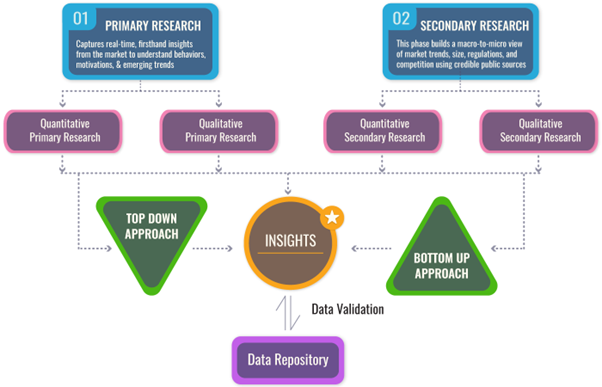
We follow a comprehensive, multi-phase research framework designed to deliver accurate, strategic, and decision-ready intelligence. Our process integrates primary and secondary research , both quantitative and qualitative , along with dual modeling techniques ( top-down and bottom-up) and a final layer of validation through our proprietary in-house repository.
PRIMARY RESEARCH
Primary research captures real-time, firsthand insights from the market to understand behaviors, motivations, and emerging trends.
1. Quantitative Primary Research
Objective: Generate statistically significant data directly from market participants.
Approaches:- Structured surveys with customers, distributors, and field agents
- Mobile-based data collection for point-of-sale audits and usage behavior
- Phone-based interviews (CATI) for market sizing and product feedback
- Online polling around industry events and digital campaigns
- Purchase frequency by customer type
- Channel performance across geographies
- Feature demand by application or demographic
2. Qualitative Primary Research
Objective: Explore decision-making drivers, pain points, and market readiness.
Approaches:- In-depth interviews (IDIs) with executives, product managers, and key decision-makers
- Focus groups among end users and early adopters
- Site visits and observational research for consumer products
- Informal field-level discussions for regional and cultural nuances
SECONDARY RESEARCH
This phase helps establish a macro-to-micro understanding of market trends, size, regulation, and competitive dynamics, sourced from credible and public domain information.
1. Quantitative Secondary Research
Objective: Model market value and segment-level forecasts based on published data.
Sources include:- Financial reports and investor summaries
- Government trade data, customs records, and regulatory statistics
- Industry association publications and economic databases
- Channel performance and pricing data from marketplace listings
- Revenue splits, pricing trends, and CAGR estimates
- Supply-side capacity and volume tracking
- Investment analysis and funding benchmarks
2. Qualitative Secondary Research
Objective: Capture strategic direction, innovation signals, and behavioral trends.
Sources include:- Company announcements, roadmaps, and product pipelines
- Publicly available whitepapers, conference abstracts, and academic research
- Regulatory body publications and policy briefs
- Social and media sentiment scanning for early-stage shifts
- Strategic shifts in market positioning
- Unmet needs and white spaces
- Regulatory triggers and compliance impact
DUAL MODELING: TOP-DOWN + BOTTOM-UP
To ensure robust market estimation, we apply two complementary sizing approaches:
Top-Down Modeling:- Start with broader industry value (e.g., global or regional TAM)
- Apply filters by segment, geography, end-user, or use case
- Adjust with primary insights and validation benchmarks
- Ideal for investor-grade market scans and opportunity mapping
- Aggregate from the ground up using sales volumes, pricing, and unit economics
- Use internal modeling templates aligned with stakeholder data
- Incorporate distributor-level or region-specific inputs
- Most accurate for emerging segments and granular sub-markets
DATA VALIDATION: IN-HOUSE REPOSITORY
We close the loop with proprietary data intelligence built from ongoing projects, industry monitoring, and historical benchmarking. This repository includes:
- Multi-sector market and pricing models
- Key trendlines from past interviews and forecasts
- Benchmarked adoption rates, churn patterns, and ROI indicators
- Industry-specific deviation flags and cross-check logic
- Catches inconsistencies early
- Aligns projections across studies
- Enables consistent, high-trust deliverables