

Agricultural Tire Market Size and Forecast (2026–2034), Global and Regional Growth, Trends, Share and Industry Analysis Report Coverage; By Tire Type, Equipment Type, Sales Channel, Application, and Geography
2026-11-03
Automotive & Transportation (Mobility)
Ekta Chaurasia (Team Lead)
Description
Agricultural Tire Market Overview
The Agricultural Tire Market supports farming operations by supplying tires designed for tractors, harvesters, sprayers, trailers, and other agricultural machinery. These tires are engineered to provide traction on soil, stability under heavy loads, and durability across demanding field conditions. Their design influences equipment productivity, fuel efficiency, soil compaction, and the ability of agricultural machinery to operate across different terrains and weather conditions.
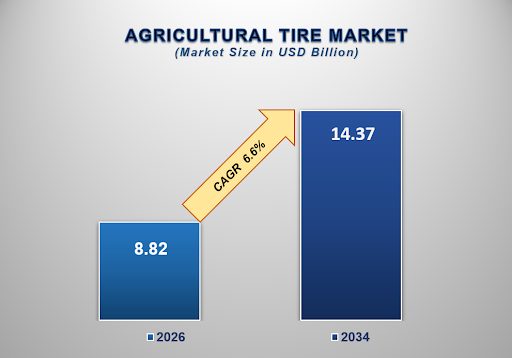
The global Agricultural Tire Market is valued at USD 8.82 billion in 2026 and is projected to reach USD 14.37 billion by 2034, registering a CAGR of 6.6% during 2026–2034. Market growth is supported by agricultural mechanization, rising demand for efficient farm equipment, the replacement of worn tires, and the increasing use of specialized machinery for planting, harvesting, spraying, and material handling.
Farmers and agricultural contractors increasingly require tires that balance traction, load-bearing capacity, durability, and soil protection. Radial tire designs, advanced rubber compounds, and specialized tread patterns are helping manufacturers address these requirements. At the same time, market development depends on farm income, equipment purchasing cycles, raw material prices, tire replacement frequency, and the affordability of advanced tire technologies.
Agricultural Tire Market Drivers and Opportunities
1. Increasing Agricultural Mechanization Is Supporting Tire Demand
The growing use of tractors, combine harvesters, planting equipment, and other mechanized agricultural machinery is supporting demand for specialized tires. Farm operators rely on machinery to complete fieldwork within increasingly narrow planting and harvesting windows. As equipment utilization increases, tires must withstand repeated loads, rough surfaces, and changing soil conditions.
Agricultural mechanization across established farming markets and developing economies is creating opportunities for both original equipment manufacturers and replacement tire suppliers. The expansion of commercial farming and agricultural contracting also increases the importance of durable tires that can support high equipment utilization while minimizing downtime.
2. Demand for Productivity and Soil Protection Is Encouraging Advanced Tire Designs
Agricultural operators increasingly seek tire technologies that improve traction, reduce slippage, and support efficient power transfer. Tire performance can affect fuel consumption, field productivity, and the time required to complete agricultural operations. Radial construction, optimized tread patterns, and appropriate tire-pressure management can help improve performance under suitable operating conditions.
Soil compaction is another important consideration because excessive pressure on agricultural land can affect soil structure and crop productivity. Manufacturers are developing tires with greater load capacity and wider footprints to help distribute weight more effectively. These requirements are encouraging interest in advanced agricultural tire designs across tractors and other heavy farm machinery.
3. Precision Agriculture and Specialized Equipment Create New Opportunities
The expansion of precision agriculture and advanced farm machinery is creating opportunities for tires designed for specific operating conditions. Modern equipment may require tires that accommodate heavier machinery, higher load ratings, variable field conditions, and improved stability. Tire manufacturers can differentiate their products through specialized tread designs, durable compounds, and compatibility with modern agricultural equipment.
Emerging opportunities also include improved tire-pressure monitoring, smart maintenance practices, retreading where suitable, and more sustainable tire materials. Manufacturers that combine performance, durability, and cost efficiency can address the needs of large farms, agricultural contractors, and smaller operators seeking reliable equipment.
Agricultural Tire Market Scope
Agricultural Tire Market Report Segmentation Analysis
The Agricultural Tire Market is segmented according to tire type, equipment type, sales channel, application, and geography. Each category reflects different requirements for traction, load capacity, durability, soil interaction, and operating efficiency. Tire construction is a key distinction because radial and bias tires differ in their structural design and performance characteristics.
Radial tires are generally selected for their flexible sidewalls, improved footprint characteristics, and potential for reduced rolling resistance under appropriate conditions. Bias tires remain relevant in applications where rugged construction, affordability, and resistance to certain types of damage are priorities. The choice depends on equipment design, field conditions, workload, operating speed, and the buyer's budget.
Radial Tire Technology Supports Demand for Advanced Agricultural Performance
Radial agricultural tires are designed to provide a broad ground-contact footprint and flexible sidewalls, which can help improve traction and reduce soil disturbance when used at appropriate pressures and loads. These characteristics are valuable for tractors and other equipment operating across large fields, particularly where efficiency and soil management are important.
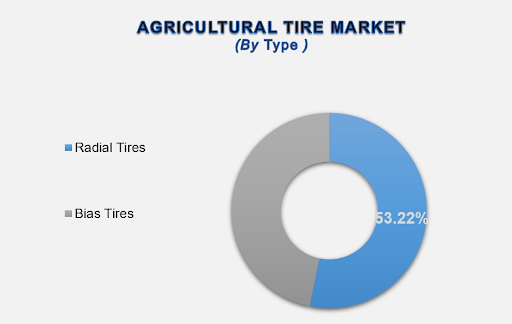
Bias tires continue to serve farms and applications that prioritize robust construction and purchase cost. Both categories remain relevant because agricultural operations vary widely by equipment size, terrain, crop type, and working conditions. A verified numerical market share for either construction type is not assigned here because a consistent segment-level dataset has not been established.
The Following Segments Are Part of an In-Depth Analysis of the Agricultural Tire Market
By Tire Type, Radial and Bias Designs Address Different Farm Requirements
- Radial Tires: Radial agricultural tires feature a construction that allows the sidewall and tread to respond differently to loads and surface conditions. They can offer traction, ride comfort, and fuel-efficiency benefits under suitable operating conditions. Their use is particularly relevant for modern tractors and high-utilization equipment.
- Bias Tires: Bias tires use overlapping cord layers arranged diagonally across the tire structure. Their construction can provide ruggedness and suitability for certain demanding applications. They remain an option for farmers who prioritize purchase cost, durability, and compatibility with existing machinery.
By Equipment Type, Tractors Represent a Core Agricultural Tire Application
- Tractors: Tractor tires are designed to deliver traction, carry equipment loads, and operate across varied soil conditions. Their performance influences power transfer, field productivity, and the ability to perform ploughing, planting, cultivation, and transport activities.
- Combine Harvesters: Harvester tires must support heavy equipment and withstand demanding field conditions during crop collection. Load capacity, flotation, stability, and resistance to damage are important design considerations.
- Sprayers: Agricultural sprayer tires support machinery that moves across fields while carrying liquid loads. Suitable tires can help maintain stability and minimize unnecessary soil disturbance during spraying operations.
- Trailers: Agricultural trailer tires are designed to carry crops, fertilizers, equipment, and other materials between fields and storage or processing locations. Load ratings and durability are important because trailer operating conditions can vary considerably.
- Irrigation Equipment: Tires used on certain irrigation systems and related equipment must accommodate movement across agricultural land and changing ground conditions. Reliability and resistance to wear are important for equipment operating over extended periods.
- Other Agricultural Machinery: This category includes tires used on specialized planting, cultivation, harvesting, and material-handling equipment. Requirements vary according to machinery configuration, load, speed, and working environment.
By Sales Channel, OEM and Aftermarket Demand Serve Different Purchasing Needs
- Original Equipment Manufacturer (OEM): OEM demand comes from agricultural machinery manufacturers that install tires on new tractors, harvesters, and other farm equipment. Purchasing decisions emphasize compatibility, performance specifications, supply reliability, and long-term supplier relationships.
- Aftermarket: The aftermarket includes replacement tires purchased by farmers, dealers, agricultural contractors, and maintenance providers. Demand is influenced by tire wear, equipment usage, seasonal workloads, farm income, and the availability of suitable replacement products.
By Application, Crop Production and Specialized Farming Influence Tire Selection
- Field Crops: Tires used for grain, oilseed, and other field-crop production must provide traction and load support across extensive cultivated areas. Equipment frequently performs repeated operations such as planting, spraying, and harvesting.
- Orchards and Vineyards: Specialized tires may be required for narrow machinery operating between crop rows. Compact dimensions, maneuverability, and compatibility with the terrain are important considerations.
- Livestock Farming: Agricultural machinery used in livestock operations may require tires suited to transporting feed, managing manure, moving materials, and operating around farm facilities.
- Forestry and Agricultural Material Handling: Certain agricultural and forestry-related operations require tires designed for rough terrain, heavier loads, and increased resistance to damage. Tire selection depends on the equipment and working environment.
- Other Agricultural Applications: This category includes specialized farm activities that do not fit within the primary application groups. Tire requirements vary according to machinery design and operating conditions.
North America, Europe, and Asia-Pacific Influence the Agricultural Tire Market
North America Benefits from Mechanized and Large-Scale Farming
North America has an established market for agricultural tires because of its use of tractors, combine harvesters, and other mechanized farm equipment. Large-scale grain and oilseed production creates demand for tires capable of handling heavy machinery and repeated field operations. The replacement market is also important because equipment utilization and seasonal workloads contribute to tire wear.
The U.S. is a major market for agricultural machinery and related components, while Canada has significant crop-production activities across extensive agricultural areas. Demand depends on farm income, equipment investment, crop conditions, tire replacement cycles, and the adoption of advanced tire technologies.
Europe Emphasizes Efficient Machinery and Specialized Farming Applications
Europe's agricultural tire demand is shaped by mechanized farming, diverse crop systems, and the need for equipment suited to different field sizes and terrains. Germany, France, Italy, and the U.K. contribute through agricultural production, machinery manufacturing, and specialized farming activities.
Demand also reflects the use of tractors and equipment for orchards, vineyards, and mixed farming. Tire efficiency, durability, soil protection, and compliance with relevant product requirements influence purchasing decisions across the region.
Asia-Pacific Offers Growth Opportunities Through Agricultural Modernization
Asia-Pacific presents opportunities through agricultural mechanization, expanding commercial farming, and investment in modern farm equipment. China and India are important agricultural markets, while Japan, South Korea, and Australia contribute through their distinct farming and machinery requirements.
The region includes both highly mechanized operations and farms transitioning from manual or less mechanized practices. This creates varied demand for premium radial tires, cost-effective bias tires, and replacement products. Market development depends on farm affordability, government-supported mechanization initiatives, machinery ownership, and distribution networks.
Latin America Supports Demand Through Commercial Crop Production
Latin America's agricultural tire market benefits from commercial crop production, including grains, oilseeds, and other agricultural commodities. Brazil and Argentina are relevant markets because of their agricultural production and use of mechanized farming equipment. Mexico also contributes through its diverse agricultural sector and machinery requirements.
Large fields and intensive equipment use can increase demand for durable tires with appropriate traction and load capacity. However, sales are influenced by commodity prices, farm profitability, import costs, currency conditions, and machinery replacement cycles.
The Middle East and Africa Present Opportunities in Agricultural Modernization
The Middle East and Africa offer varied opportunities for agricultural tire suppliers as farms invest in mechanization, irrigation, and equipment modernization. South Africa is a relevant market for commercial agriculture, while other countries may experience demand associated with agricultural development and machinery imports.
Local operating conditions, soil types, climate, purchasing power, equipment availability, and distribution infrastructure influence tire selection. Suppliers offering durable products and accessible replacement support may benefit as mechanized agricultural activity expands.
Note: Regional descriptions are qualitative. Region-specific market shares have not been assigned because a consistent, verified regional dataset is not available in this report.
Agricultural Tire Market Competition Landscape Analysis
Competition in the Agricultural Tire Market includes global tire manufacturers, specialized agricultural tire producers, and suppliers serving original equipment manufacturers and the replacement market. Companies compete through traction performance, load capacity, tire life, resistance to damage, fuel efficiency, product availability, and distribution reach.
Product development increasingly focuses on tire construction, tread design, rubber compounds, and solutions that support soil protection. Manufacturers also work with agricultural machinery companies to develop tires suited to specific equipment configurations and operating requirements. These partnerships can help ensure compatibility with modern tractors, harvesters, and other agricultural machinery.
The aftermarket remains an important competitive area because agricultural tires are exposed to demanding working conditions and require replacement over time. Dealer networks, technical guidance, availability during peak farming seasons, and support with tire selection influence purchasing decisions. Price sensitivity also remains relevant, particularly for farmers operating under fluctuating commodity prices and input costs.
Global Agricultural Tire Market Recent Developments News
Advanced Radial Tire Designs Are Supporting Agricultural Efficiency
Tire manufacturers continue to develop agricultural tire designs intended to improve traction, load handling, and performance across different field conditions. Product engineering focuses on tread geometry, casing construction, and sidewall flexibility to meet the requirements of modern agricultural machinery.
Soil Protection Is Influencing Tire Design and Operating Practices
Soil compaction remains a consideration for farmers using heavy machinery. Tire selection, load management, and appropriate inflation pressure can influence the distribution of equipment weight across the ground. Manufacturers and agricultural equipment providers continue to emphasize solutions that balance load capacity with field performance.
Digital Tire Monitoring Is Supporting Maintenance Planning
Tire-pressure monitoring and related digital technologies can help operators identify pressure deviations and maintain suitable operating conditions. Appropriate tire pressure can support traction, tire life, and operating efficiency, depending on load and field conditions.
Agricultural Mechanization Is Sustaining Replacement Tire Demand
As agricultural machinery continues to be used for planting, harvesting, spraying, and material handling, replacement tires remain essential to equipment uptime. Demand varies with machinery utilization, farm income, tire durability, and seasonal maintenance requirements.
These points describe broad industry technology and operating trends rather than verified announcements tied to specific dates or company launches.
The Global Agricultural Tire Market Includes Several Established Tire Manufacturers
The competitive ecosystem includes companies with agricultural tire portfolios, off-highway tire expertise, and distribution networks serving farm equipment manufacturers and end users. Key participants include:
Michelin
Bridgestone Corporation
Continental AG
Trelleborg AB
Titan International, Inc.
The Goodyear Tire & Rubber Company
Yokohama Rubber Company
BKT (Balkrishna Industries Limited)
CEAT Limited
Mitas Tires
Alliance Tire Group
Nokian Tyres
Pirelli
Sumitomo Rubber Industries
Maxam Tire
Frequently Asked Questions
Ekta Chaurasia (Team Lead)
Ekta Chaurasia is a highly experienced Team Lead at M2Square Consultancy with over 7 years of expertise in market research, strategic consulting, competitive benchmarking, and business intelligence solutions. She specializes in ICT, semiconductors & electronics, automotive & transportation, and industrial machinery markets.
She leads end-to-end global research projects focused on market trends, industry analysis, growth forecasting, customer insights, and strategic decision-making. Known for her analytical leadership and industry expertise, Ekta helps businesses uncover growth opportunities, evaluate competitive landscapes, and stay ahead in rapidly evolving markets through accurate and insight-driven research.
Global Agricultural Tire Market Introduction and Market Overview
Objectives of the Study
Global Agricultural Tire Market Scope and Market Estimation
Global Agricultural Tire Market Size (US$ Million), Market CAGR (%), Market Forecast (2026 - 2034)
Global Agricultural Tire Market Revenue Share (%) and Growth Rate (Y-o-Y) Analysis (2021 - 2034)
Market Segmentation
By Tire Type of Global Agricultural Tire Market
Radial Tires
Bias Tires
By Equipment Type of Global Agricultural Tire Market
Tractors
Combine Harvesters
Sprayers
Trailers
Irrigation Equipment
Other Agricultural Machinery
By Sales Channel of Global Agricultural Tire Market
Original Equipment Manufacturer (OEM)
Aftermarket
By Application of Global Agricultural Tire Market
Field Crops
Orchards and Vineyards
Livestock Farming
Forestry and Agricultural Material Handling
Other Agricultural Applications
Region of Global Agricultural Tire Market
Competition Coverage List of Market Participants
Market Definition: Agricultural Tire Market
Executive Summary
Demand Side Trends
Key Market Trends
Market Demand (US$ Million) Analysis 2021 – 2025 and Forecast, 2026 – 2034
Demand and Opportunity Assessment
Key Developments
Overview of Regulatory Landscape, Compliance Framework, and Industry Standards
Market Entry Strategies
Market Dynamics
Drivers
Limitations
Opportunities
Impact Analysis of Drivers and Restraints
Porter's Five Forces Analysis
PEST Analysis
Global Agricultural Tire Market Estimates & Historical Trend Analysis (2021 – 2025)
Global Agricultural Tire Market Estimates & Forecast Trend Analysis, by Tire Type
Global Agricultural Tire Market Revenue (US$ Million) Estimates and Forecasts, by Tire Type, 2021 - 2034
Radial Tires
Bias Tires
Global Agricultural Tire Market Estimates & Forecast Trend Analysis, by Equipment Type
Global Agricultural Tire Market Revenue (US$ Million) Estimates and Forecasts, by Equipment Type, 2021 - 2034
Tractors
Combine Harvesters
Sprayers
Trailers
Irrigation Equipment
Other Agricultural Machinery
Global Agricultural Tire Market Estimates & Forecast Trend Analysis, by Sales Channel
Global Agricultural Tire Market Revenue (US$ Million) Estimates and Forecasts, by Sales Channel, 2021 - 2034
Original Equipment Manufacturer (OEM)
Aftermarket
Global Agricultural Tire Market Estimates & Forecast Trend Analysis, by Application
Global Agricultural Tire Market Revenue (US$ Million) Estimates and Forecasts, by Application, 2021 - 2034
Field Crops
Orchards and Vineyards
Livestock Farming
Forestry and Agricultural Material Handling
Other Agricultural Applications
Global Agricultural Tire Market Estimates & Forecast Trend Analysis, by Region
Global Agricultural Tire Market Revenue (US$ Million) Estimates and Forecasts, by Region, 2021 - 2034
North America
Europe
Asia Pacific
Middle East & Africa
Latin America
North America Agricultural Tire Market: Estimates & Forecast Trend Analysis
North America Agricultural Tire Market Assessments & Key Findings
North America Agricultural Tire Market Introduction
North America Agricultural Tire Market Size Estimates and Forecast (US$ Million) (2021 - 2034)
By Tire Type
By Equipment Type
By Sales Channel
By Application
By Country
The U.S.
Canada
Europe Agricultural Tire Market: Estimates & Forecast Trend Analysis
Europe Agricultural Tire Market Assessments & Key Findings
Europe Agricultural Tire Market Introduction
Europe Agricultural Tire Market Size Estimates and Forecast (US$ Million) (2021 - 2034)
By Tire Type
By Equipment Type
By Sales Channel
By Application
By Country
Germany
Italy
The U.K.
France
Spain
Switzerland
Rest of Europe
Asia Pacific Agricultural Tire Market: Estimates & Forecast Trend Analysis
Asia Pacific Agricultural Tire Market Assessments & Key Findings
Asia Pacific Agricultural Tire Market Introduction
Asia Pacific Agricultural Tire Market Size Estimates and Forecast (US$ Million) (2021 - 2034)
By Tire Type
By Equipment Type
By Sales Channel
By Application
By Country
China
Japan
India
Australia
South Korea
Rest of Asia Pacific
Middle East & Africa Agricultural Tire Market: Estimates & Forecast Trend Analysis
Middle East & Africa Agricultural Tire Market Assessments & Key Findings
Middle East & Africa Agricultural Tire Market Introduction
Middle East & Africa Agricultural Tire Market Size Estimates and Forecast (US$ Million) (2021 - 2034)
By Tire Type
By Equipment Type
By Sales Channel
By Application
By Country
UAE
Saudi Arabia
South Africa
Rest of Middle East & Africa
Latin America Agricultural Tire Market: Estimates & Forecast Trend Analysis
Latin America Agricultural Tire Market Assessments & Key Findings
Latin America Agricultural Tire Market Introduction
Latin America Agricultural Tire Market Size Estimates and Forecast (US$ Million) (2021 - 2034)
By Tire Type
By Equipment Type
By Sales Channel
By Application
By Country
Brazil
Mexico
Argentina
Rest of Latin America
Competition Landscape
Global Agricultural Tire Market Product Mapping
Global Agricultural Tire Market Concentration Analysis, by Leading Players
Global Agricultural Tire Market Concentration Analysis, by Innovators
Global Agricultural Tire Market Concentration Analysis, by Emerging Players
Global Agricultural Tire Market Concentration Analysis, by New Entrants
Global Agricultural Tire Market Tier Structure Analysis
Global Agricultural Tire Market Concentration & Company Market Shares (%) Analysis, 2026
Company Profiles
Michelin
Company Overview & Key Stats
Financial Performance & KPIs
Product Portfolio
SWOT Analysis
Business Strategy & Recent Developments
*Similar details would be provided for all the players mentioned below
Bridgestone Corporation
Company Overview & Key Stats
Financial Performance & KPIs
Product Portfolio
SWOT Analysis
Business Strategy & Recent Developments
Continental AG
Company Overview & Key Stats
Financial Performance & KPIs
Product Portfolio
SWOT Analysis
Business Strategy & Recent Developments
Trelleborg AB
Company Overview & Key Stats
Financial Performance & KPIs
Product Portfolio
SWOT Analysis
Business Strategy & Recent Developments
Titan International, Inc.
Company Overview & Key Stats
Financial Performance & KPIs
Product Portfolio
SWOT Analysis
Business Strategy & Recent Developments
The Goodyear Tire & Rubber Company
Company Overview & Key Stats
Financial Performance & KPIs
Product Portfolio
SWOT Analysis
Business Strategy & Recent Developments
Yokohama Rubber Company
Company Overview & Key Stats
Financial Performance & KPIs
Product Portfolio
SWOT Analysis
Business Strategy & Recent Developments
BKT (Balkrishna Industries Limited)
Company Overview & Key Stats
Financial Performance & KPIs
Product Portfolio
SWOT Analysis
Business Strategy & Recent Developments
CEAT Limited
Company Overview & Key Stats
Financial Performance & KPIs
Product Portfolio
SWOT Analysis
Business Strategy & Recent Developments
Mitas Tires
Company Overview & Key Stats
Financial Performance & KPIs
Product Portfolio
SWOT Analysis
Business Strategy & Recent Developments
Alliance Tire Group
Company Overview & Key Stats
Financial Performance & KPIs
Product Portfolio
SWOT Analysis
Business Strategy & Recent Developments
Nokian Tyres
Company Overview & Key Stats
Financial Performance & KPIs
Product Portfolio
SWOT Analysis
Business Strategy & Recent Developments
Pirelli
Company Overview & Key Stats
Financial Performance & KPIs
Product Portfolio
SWOT Analysis
Business Strategy & Recent Developments
Sumitomo Rubber Industries
Company Overview & Key Stats
Financial Performance & KPIs
Product Portfolio
SWOT Analysis
Business Strategy & Recent Developments
Maxam Tire
Company Overview & Key Stats
Financial Performance & KPIs
Product Portfolio
SWOT Analysis
Business Strategy & Recent Developments
Research Findings & Conclusion
Assumptions & Acronyms Used
Research Methodology
External Databases
Internal Proprietary Databae
Primary Research
Secondary Research
Assumptions
Limitations
Report FAQ
Our Research Methodology
"Insight without rigor is just noise."
We follow a comprehensive, multi-phase research framework designed to deliver accurate, strategic, and decision-ready intelligence. Our process integrates primary and secondary research , both quantitative and qualitative , along with dual modeling techniques ( top-down and bottom-up) and a final layer of validation through our proprietary in-house repository.
PRIMARY RESEARCH
Primary research captures real-time, firsthand insights from the market to understand behaviors, motivations, and emerging trends.
1. Quantitative Primary Research
Objective: Generate statistically significant data directly from market participants.
Approaches:- Structured surveys with customers, distributors, and field agents
- Mobile-based data collection for point-of-sale audits and usage behavior
- Phone-based interviews (CATI) for market sizing and product feedback
- Online polling around industry events and digital campaigns
- Purchase frequency by customer type
- Channel performance across geographies
- Feature demand by application or demographic
2. Qualitative Primary Research
Objective: Explore decision-making drivers, pain points, and market readiness.
Approaches:- In-depth interviews (IDIs) with executives, product managers, and key decision-makers
- Focus groups among end users and early adopters
- Site visits and observational research for consumer products
- Informal field-level discussions for regional and cultural nuances
SECONDARY RESEARCH
This phase helps establish a macro-to-micro understanding of market trends, size, regulation, and competitive dynamics, sourced from credible and public domain information.
1. Quantitative Secondary Research
Objective: Model market value and segment-level forecasts based on published data.
Sources include:- Financial reports and investor summaries
- Government trade data, customs records, and regulatory statistics
- Industry association publications and economic databases
- Channel performance and pricing data from marketplace listings
- Revenue splits, pricing trends, and CAGR estimates
- Supply-side capacity and volume tracking
- Investment analysis and funding benchmarks
2. Qualitative Secondary Research
Objective: Capture strategic direction, innovation signals, and behavioral trends.
Sources include:- Company announcements, roadmaps, and product pipelines
- Publicly available whitepapers, conference abstracts, and academic research
- Regulatory body publications and policy briefs
- Social and media sentiment scanning for early-stage shifts
- Strategic shifts in market positioning
- Unmet needs and white spaces
- Regulatory triggers and compliance impact
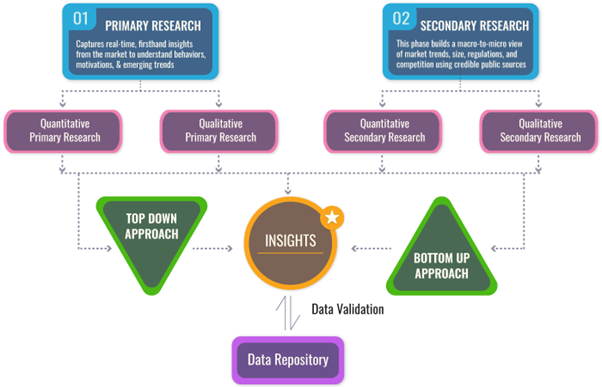
DUAL MODELING: TOP-DOWN + BOTTOM-UP
To ensure robust market estimation, we apply two complementary sizing approaches:
Top-Down Modeling:- Start with broader industry value (e.g., global or regional TAM)
- Apply filters by segment, geography, end-user, or use case
- Adjust with primary insights and validation benchmarks
- Ideal for investor-grade market scans and opportunity mapping
- Aggregate from the ground up using sales volumes, pricing, and unit economics
- Use internal modeling templates aligned with stakeholder data
- Incorporate distributor-level or region-specific inputs
- Most accurate for emerging segments and granular sub-markets
DATA VALIDATION: IN-HOUSE REPOSITORY
We close the loop with proprietary data intelligence built from ongoing projects, industry monitoring, and historical benchmarking. This repository includes:
- Multi-sector market and pricing models
- Key trendlines from past interviews and forecasts
- Benchmarked adoption rates, churn patterns, and ROI indicators
- Industry-specific deviation flags and cross-check logic
- Catches inconsistencies early
- Aligns projections across studies
- Enables consistent, high-trust deliverables