

AI Agents in Financial Services Market Size and Forecast (2025–2033), Global and Regional Trends, Share, and Industry Analysis Report Coverage: By Type (Risk Management Agents, Compliance & Regulatory Agents, Fraud Detection Agents, Customer Service Agents, Credit Scoring Agents, Others), By Institutional Type (Traditional Banks, InsurTech Firms, FinTech Companies, Others), By Technology (Machine Learning & Deep Learning, Large Language Models, Robotic Process Automation, Cloud Computing & APIs, Others), and Geography
2026-01-02
Business & Financial Services
Ekta Chaurasia (Team Lead)
Description
AI Agents in the Financial Services Market Overview
The Global AI Agents in Financial Services Market is witnessing strong growth as financial institutions adopt intelligent automation to enhance decision-making, operational efficiency, and customer experience. AI agents, autonomous or semi-autonomous systems powered by machine learning, LLMs, analytics, and predictive algorithms, are increasingly integrated across banking, insurance, payments, and capital markets. The market reached USD 57.8 billion in 2025 and is projected to reach USD 159.5 billion by 2033, expanding at a CAGR of 13.9%. This growth is propelled by the rapid shift toward digital banking, escalating fraud incidents, and regulatory pressures requiring more advanced compliance technologies. AI agents now handle tasks such as transaction monitoring, credit scoring, risk assessment, underwriting, customer onboarding, and advisory services, significantly reducing human workload and error rates.
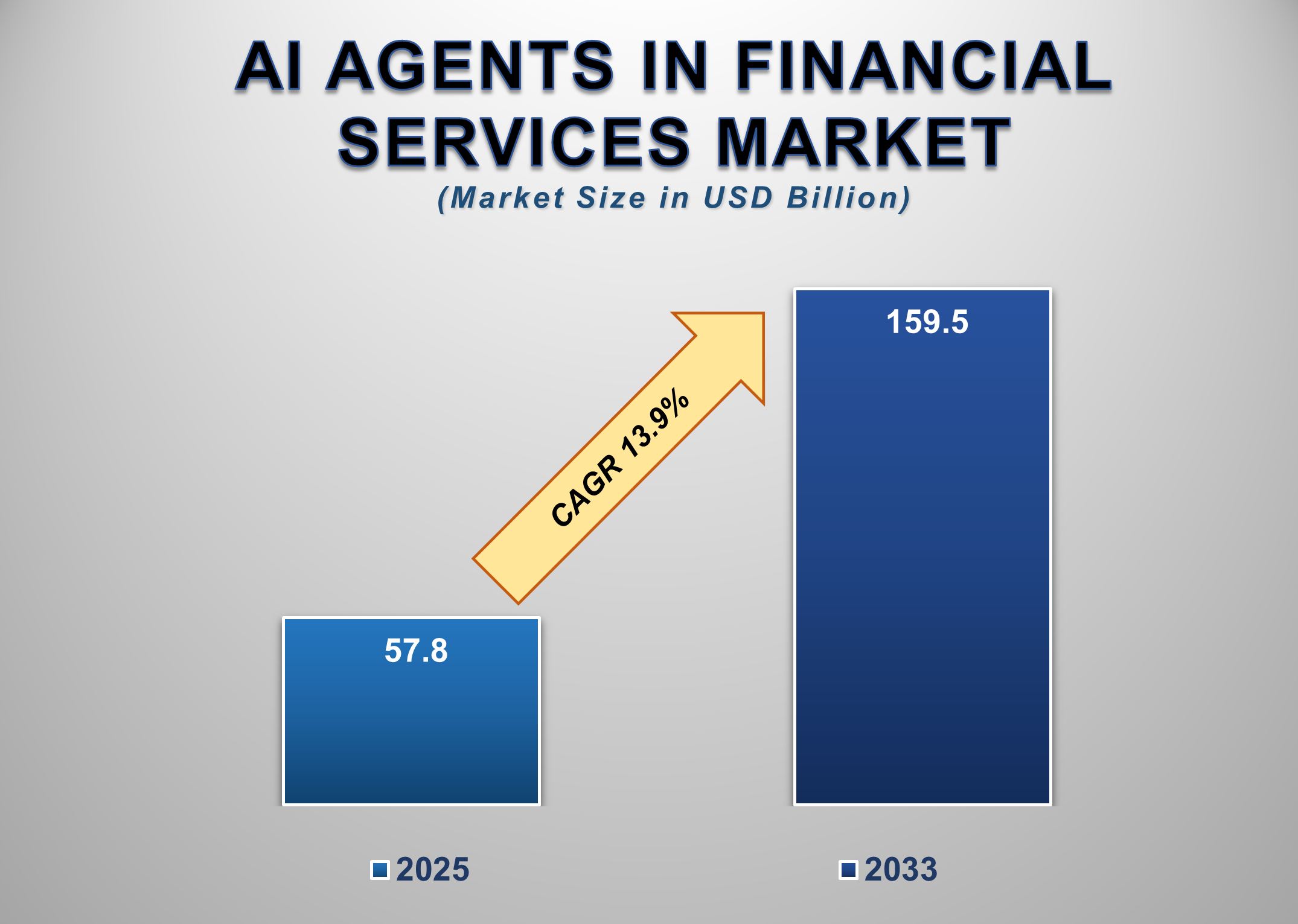
Financial institutions are also
deploying generative AI-driven agents for conversational banking, anomaly
detection, underwriting automation, and investment analytics. North America
currently leads the market with a 41.2% share, supported by high adoption rates
among major banks and established regulatory frameworks.
AI Agents in Financial
Services Market Drivers and Opportunities
Rising Financial Fraud
and Cyberthreats Are Driving the Adoption of AI Agents Across Banks and FinTech
Platforms
Rising fraud incidents,
cyberattacks, and financial crimes are among the strongest drivers accelerating
the adoption of AI agents in the global financial services sector. Traditional
rule-based fraud detection systems are no longer sufficient due to increasingly
sophisticated cyberthreats, identity theft, phishing, synthetic fraud, and
account takeover (ATO) techniques. AI agents equipped with machine learning,
deep learning, natural language processing, and anomaly detection models can
analyze millions of transactions in real time, identify suspicious patterns,
and autonomously block high-risk activities. This significantly enhances fraud
prevention accuracy while reducing false positives, a key challenge faced by
financial institutions. Banks and fintech companies are leveraging AI agents
for behavioral biometrics, transaction scoring, digital identity verification,
and AML monitoring. These agents continuously learn from new data, making them
more effective against emerging fraud typologies. With the exponential rise in
digital transactions, open banking ecosystems, and cross-border payments, the
threat landscape has expanded, making automated risk mitigation a necessity.
Regulators globally are enforcing stricter compliance standards, further
encouraging institutions to adopt AI-powered fraud detection and AML agents. As
security threats grow more complex, AI agents offer the scalable, 24/7
monitoring capabilities required to safeguard digital financial systems, making
fraud prevention one of the most critical growth drivers in this market.
Growing Regulatory Pressure and Complexity in Compliance
Workflows Are Fueling the Demand for AI-Driven Compliance Agents
The increasing stringency of compliance regulations worldwide is
creating substantial demand for AI agents that streamline regulatory reporting,
risk monitoring, and policy adherence. Financial institutions face complex
requirements related to anti-money laundering (AML), know-your-customer (KYC),
customer due diligence (CDD), Basel III rules, IFRS standards, GDPR, and
country-specific banking regulations. Managing compliance manually is
time-consuming, error-prone, and costly. AI-powered compliance and regulatory
agents automate document verification, risk scoring, sanctions screening,
transaction auditing, suspicious activity report (SAR) generation, and
regulatory document interpretation using ML and LLM-based models.
These agents can analyze vast regulatory datasets, detect
discrepancies in real-time, and ensure timely reporting, reducing compliance
breaches and associated penalties. The emergence of regulatory technology
(RegTech) has further accelerated AI adoption, enabling institutions to achieve
continuous compliance with minimal manual intervention. Generative AI agents
capable of interpreting evolving regulatory guidelines, summarizing updates,
and recommending required actions are transforming compliance departments into
AI-augmented units. As global regulatory frameworks become more dynamic,
particularly around digital banking, crypto-assets, ESG reporting, and
cybersecurity, institutions increasingly rely on intelligent agents to maintain
operational integrity. The shift from manual compliance to AI-driven regulatory
intelligence remains a powerful market growth driver for financial institutions
worldwide.
Expanding AI Adoption in Emerging Markets and SME Financial
Services Is Creating Significant Growth Opportunities Worldwide
The accelerating adoption of AI agents in emerging economies
presents major opportunities for market players. Countries across Asia-Pacific,
Latin America, the Middle East, and Africa are modernizing their banking
infrastructures, promoting digital finance, and strengthening financial
inclusion initiatives. Small and mid-sized financial institutions,
traditionally limited by cost and expertise constraints, are increasingly
embracing cloud-based AI agents for fraud monitoring, risk scoring,
underwriting assistance, and customer engagement. The availability of
subscription-based AI solutions and API-driven deployment models is making
advanced financial automation accessible to a broader market. AI agents also
support microfinance, rural banking, and digital lending ecosystems, which are
expanding rapidly in developing regions. These agents enable real-time
creditworthiness assessment for underbanked populations using alternative data
such as mobile usage, transaction history, and digital behavioral patterns. Governments
in several emerging markets are encouraging AI adoption through national AI
strategies, sandboxes, and digitization programs. FinTech startups are
integrating AI agents into payment systems, mobile banking apps, and InsurTech
platforms, further fueling innovation. As emerging economies digitize financial
operations and expand financial inclusion, AI agents offer scalable,
cost-effective, and high-impact solutions, positioning developing regions as
high-growth opportunity hubs for global AI technology vendors.
AI Agents in the
Financial Services Market Scope
|
Report Attributes |
Description |
|
Market Size in 2025 |
USD 57.8 Billion |
|
Market Forecast in 2033 |
USD 159.5 Billion |
|
CAGR % 2025-2033 |
13.9% |
|
Base Year |
2024 |
|
Historic Data |
2020-2024 |
|
Forecast Period |
2025-2033 |
|
Report USP |
Production, Consumption,
Company Share, Company Heatmap, Company Production Capacity, Growth Factors,
and more |
|
Segments Covered |
●
By Type,
Institutional Type, Technology |
|
Regional Scope |
●
North America, ●
Europe, ●
APAC, ●
Latin America ●
Middle East and
Africa |
|
Country Scope |
1)
U.S. 2)
Canada 3)
Germany 4)
UK 5)
France 6)
Spain 7)
Italy 8)
Switzerland 9)
China 10)
Japan 11)
India 12)
Australia 13)
South Korea 14)
Brazil 15)
Mexico 16)
Argentina 17)
South Africa 18)
Saudi Arabia 19)
UAE |
AI Agents in Financial
Services Market Report Segmentation Analysis
The AI Agents in the Financial Services Market are segmented by
type, institutional type, technology, and geography.
Risk Management Agents
Accounted for the Largest Market Share in the Global AI Agents in Financial
Services Market
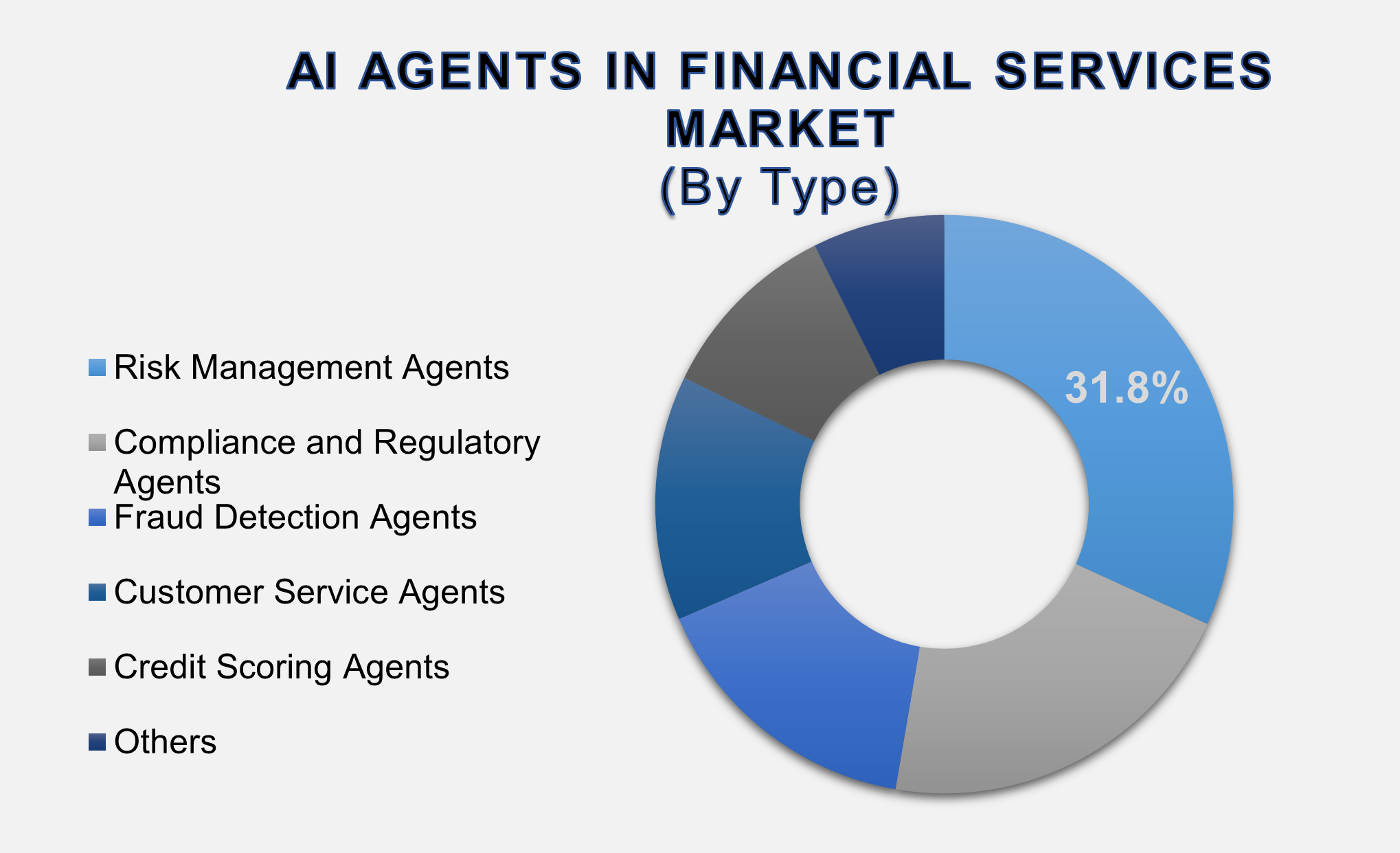
Risk Management Agents accounted for the largest market share in the global AI Agents in Financial Services market, driven by the critical need for accurate, real-time risk profiling and decision support across banking and insurance ecosystems. These agents utilize machine learning models, predictive analytics, and generative AI capabilities to evaluate credit risks, market volatility, liquidity exposure, portfolio risks, and operational vulnerabilities. Financial institutions increasingly rely on AI-driven risk agents to improve forecasting accuracy, automate risk scoring, and optimize capital allocation processes. With rising market instability, fluctuating interest rates, and stricter regulatory frameworks, risk management functions require rapid data analysis and scenario simulation capabilities that AI agents deliver far more efficiently than traditional tools. Adoption is also supported by the growth of algorithmic trading, digital lending, and decentralized finance platforms, where real-time risk insights are crucial. As risk evaluation becomes more data-intensive and complex, the dominance of AI-enabled risk agents is expected to strengthen further.
The Traditional Banks
Segment Accounted for the Largest Market Share in the Global AI Agents in
Financial Services Market
The Traditional Banks segment
accounted for the largest market share in the global AI Agents in Financial
Services market, as large financial institutions continue to lead investments
in AI-driven modernization. Traditional banks manage vast customer bases, high
transaction volumes, and complex regulatory obligations, making AI agents
essential for automating workflows such as KYC verification, customer
onboarding, risk assessment, fraud detection, and portfolio management. With
heightened competition from fintech disruptors, banks are adopting AI agents to
deliver personalized customer experiences, reduce operational costs, and
enhance digital service delivery. Generative AI agents are increasingly
deployed for conversational banking, automated advisory services, and
transaction insights. Additionally, banks face regulatory pressure to maintain
compliance accuracy and improve financial crime surveillance, further
reinforcing AI adoption. Their robust IT infrastructure, access to extensive
historical data, and financial resources enable large-scale integration of
machine learning, LLMs, and cloud-based AI models, solidifying traditional
banks' leadership in market share.
Machine Learning &
Deep Learning Segment Accounted for the Largest Market Share in the Global AI
Agents in Financial Services Market
The Machine Learning (ML) &
Deep Learning segment accounted for the largest market share in the global AI
Agents in Financial Services market, supported by widespread use of predictive
modeling, behavioral analytics, and real-time data processing across financial
workflows. These technologies form the foundation for most AI agent
functionalities, including fraud detection, customer segmentation, credit
scoring, risk modeling, and personalized product recommendations. ML and deep
learning models continuously learn from new datasets, improving accuracy and
adaptability, making them ideal for dynamic financial environments. Their
integration with advanced neural networks enables superior pattern recognition,
anomaly detection, and autonomous decision-making compared with rule-based
systems. Financial institutions also use deep learning to power chatbots,
underwriting automation, sentiment analytics, and high-frequency trading
algorithms. As data volumes grow exponentially and digital financial
interactions increase, ML and deep learning remain the most widely adopted
technologies underlying AI agents, sustaining their dominance in the technology
segment.
The following segments are
part of an in-depth analysis of the global AI Agents in Financial Services
market:
|
Market Segments |
|
|
By Type |
●
Risk Management
Agents ●
Compliance and
Regulatory Agents ●
Fraud Detection
Agents ●
Customer Service
Agents ●
Credit Scoring
Agents ●
Others |
|
By
Institutional Type |
●
Traditional Banks ●
InsurTech Firms ●
FinTech Companies ●
Others |
|
By Technology |
●
Machine Learning
(ML) & Deep Learning ●
Large Language
Models (LLMs) ●
Robotic Process
Automation (RPA) ●
Cloud Computing
& APIs ●
Others |
AI Agents in Financial
Services Market Share Analysis by Region
North America is
anticipated to hold the largest portion of the AI Agents in the Financial
Services Market globally throughout the forecast period.
North America held the largest
share of the global AI Agents in Financial Services market at 41.2% in 2025,
driven by early adoption of AI technologies, a strong presence of major
financial institutions, and advancements in cloud infrastructure. U.S. banks,
fintech companies, and insurance firms have been at the forefront of deploying
AI-driven agents for fraud prevention, risk modeling, automated compliance, and
digital customer engagement. Favorable regulatory frameworks, high digital
banking penetration, and ongoing investments in generative AI and machine
learning platforms further strengthen the region’s leadership.
Asia-Pacific, however, is
projected to witness the highest CAGR through 2033, supported by the rapid
expansion of fintech ecosystems, government-led digital transformation
programs, and strong mobile banking adoption. Countries such as China, India,
Singapore, and Japan are integrating AI agents into digital lending, InsurTech
services, payment gateways, and neobanking platforms. Growing financial
inclusion initiatives and the rise of SME lending are accelerating demand for
intelligent automation. Europe continues to adopt AI agents to enhance
regulatory compliance, cybersecurity resilience, and open banking services
under PSD2 guidelines. Meanwhile, the Middle East and Latin America are
emerging as fast-developing markets due to investments in digital banking
infrastructure and AI-driven financial modernization. Overall, global adoption
is expected to rise significantly across all regions.
AI Agents in Financial
Services Market Competition Landscape Analysis
The competitive landscape of the
AI Agents in the Financial Services market is characterized by strong
participation from global technology companies, cloud service providers, AI
software vendors, fintech firms, and industry-focused solution providers. Key
players are expanding capabilities in generative AI, LLM-based automation,
predictive analytics, and API-driven integration to meet the growing demand for
intelligent financial services.
Global AI Agents in
Financial Services Market Recent Developments News:
- In March 2025,
Oracle Financial Services launched agentic AI capabilities within its
Investigation Hub Cloud Service, enabling financial institutions to
automate complex fraud investigations. The AI agents identify
sophisticated crime patterns, generate detailed narratives, and prioritize
high-value leads, reducing manual
effort and improving investigation efficiency and accuracy globally.
- In March 2025,
Auquan introduced its industry-first risk agent, an autonomous AI
solution for financial risk monitoring. The agent continuously scans over
two million multilingual data sources to detect emerging investment,
credit, and operational risks, automating entire risk workflows and
delivering early warnings to enhance institutional decision-making.
The Global AI Agents in Financial Services Market Is Dominated by a Few Large Companies, such as
●
IBM
●
Google
●
Microsoft
●
Amazon Web Services
●
Oracle
●
SAP
●
Accenture
●
Infosys
●
Capgemini
●
FIS Global
●
Fiserv
●
SS&C Technologies
●
Bloomberg
●
Refinitiv
●
Salesforce
●
NICE Actimize
●
Compliance.ai
●
Kensho
●
AlphaSense
●
Ayasdi
● Others
Frequently Asked Questions
Ekta Chaurasia (Team Lead)
Ekta Chaurasia is a highly experienced Team Lead at M2Square Consultancy with over 7 years of expertise in market research, strategic consulting, competitive benchmarking, and business intelligence solutions. She specializes in ICT, semiconductors & electronics, automotive & transportation, and industrial machinery markets.
She leads end-to-end global research projects focused on market trends, industry analysis, growth forecasting, customer insights, and strategic decision-making. Known for her analytical leadership and industry expertise, Ekta helps businesses uncover growth opportunities, evaluate competitive landscapes, and stay ahead in rapidly evolving markets through accurate and insight-driven research.
1. Global AI Agents in
Financial Services Market Introduction and Market Overview
1.1.
Objectives
of the Study
1.2.
Global
AI Agents in Financial Services Market Scope and Market Estimation
1.2.1.Global AI Agents in
Financial Services Overall Market Size (US$ Bn), Market CAGR (%), Market
forecast (2025 - 2033)
1.2.2.Global AI Agents in
Financial Services Market Revenue Share (%) and Growth Rate (Y-o-Y) from 2020 -
2033
1.3.
Market
Segmentation
1.3.1.Type of Global AI Agents
in Financial Services Market
1.3.2.Institutional Type of
Global AI Agents in Financial Services Market
1.3.3.Technology of Global AI
Agents in Financial Services Market
1.3.4.Region of Global AI Agents
in Financial Services Market
2. Executive
Summary
2.1.
Demand
Side Trends
2.2.
Key
Market Trends
2.3.
Market
Demand (US$ Bn) Analysis 2020 – 2024 and Forecast, 2025 – 2033
2.4.
Demand
and Opportunity Assessment
2.5.
Key
Developments
2.6.
Overview
of Tariff, Regulatory Landscape and Standards
2.7.
Market
Entry Strategies
2.8.
Market
Dynamics
2.8.1.Drivers
2.8.2.Limitations
2.8.3.Opportunities
2.8.4.Impact Analysis of Drivers
and Restraints
2.9.
Porter’s
Five Forces Analysis
2.10.
PEST
Analysis
3. Global
AI Agents in Financial Services Market
Estimates & Historical Trend Analysis (2020 - 2024)
4. Global
AI Agents in Financial Services Market
Estimates & Forecast Trend Analysis, by Type
4.1.
Global
AI Agents in Financial Services Market Revenue (US$ Bn) Estimates and
Forecasts, by Type, 2020 - 2033
4.1.1.Risk Management Agents
4.1.2.Compliance and Regulatory
Agents
4.1.3.Fraud Detection Agents
4.1.4.Customer Service Agents
4.1.5.Credit Scoring Agents
4.1.6.Others
5. Global
AI Agents in Financial Services Market
Estimates & Forecast Trend Analysis, by Institutional
Type
5.1.
Global
AI Agents in Financial Services Market Revenue (US$ Bn) Estimates and
Forecasts, by Institutional Type, 2020 - 2033
5.1.1.Traditional Banks
5.1.2.InsurTech Firms
5.1.3.FinTech Companies
5.1.4.Others
6. Global
AI Agents in Financial Services Market
Estimates & Forecast Trend Analysis, by Technology
6.1.
Global
AI Agents in Financial Services Market Revenue (US$ Bn) Estimates and
Forecasts, by Technology, 2020 - 2033
6.1.1.Machine Learning (ML)
& Deep Learning
6.1.2.Large Language Models
(LLMs)
6.1.3.Robotic Process Automation
(RPA)
6.1.4.Cloud Computing & APIs
6.1.5.Others
7. Global
AI Agents in Financial Services Market
Estimates & Forecast Trend Analysis, by Region
7.1.
Global
AI Agents in Financial Services Market Revenue (US$ Bn) Estimates and
Forecasts, by Region, 2020 - 2033
7.1.1.North America
7.1.2.Europe
7.1.3.Asia Pacific
7.1.4.Middle East & Africa
7.1.5.Latin America
8. North America AI
Agents in Financial Services Market:
Estimates & Forecast Trend Analysis
8.1.
North
America AI Agents in Financial Services Market Assessments & Key Findings
8.1.1.North America AI Agents in
Financial Services Market Introduction
8.1.2.North America AI Agents in
Financial Services Market Size Estimates and Forecast (US$ Billion) (2020 - 2033)
8.1.2.1. By Type
8.1.2.2. By Institutional
Type
8.1.2.3. By Technology
8.1.2.4.
By
Country
8.1.2.4.1. The U.S.
8.1.2.4.2. Canada
9. Europe AI
Agents in Financial Services Market:
Estimates & Forecast Trend Analysis
9.1.
Europe
AI Agents in Financial Services Market Assessments & Key Findings
9.1.1.Europe AI Agents in
Financial Services Market Introduction
9.1.2.Europe AI Agents in
Financial Services Market Size Estimates and Forecast (US$ Billion) (2020 - 2033)
9.1.2.1. By Type
9.1.2.2. By Institutional
Type
9.1.2.3. By Technology
9.1.2.4.
By
Country
9.1.2.4.1.
Germany
9.1.2.4.2.
Italy
9.1.2.4.3.
U.K.
9.1.2.4.4.
France
9.1.2.4.5.
Spain
9.1.2.4.6.
Switzerland
9.1.2.4.7. Rest
of Europe
10. Asia Pacific AI
Agents in Financial Services Market:
Estimates & Forecast Trend Analysis
10.1.
Asia
Pacific Market Assessments & Key Findings
10.1.1.
Asia
Pacific AI Agents in Financial Services Market Introduction
10.1.2.
Asia
Pacific AI Agents in Financial Services Market Size Estimates and Forecast (US$
Billion) (2020 - 2033)
10.1.2.1. By Type
10.1.2.2. By Institutional
Type
10.1.2.3. By Technology
10.1.2.4.
By
Country
10.1.2.4.1. China
10.1.2.4.2. Japan
10.1.2.4.3. India
10.1.2.4.4. Australia
10.1.2.4.5. South Korea
10.1.2.4.6. Rest of Asia Pacific
11. Middle East & Africa AI
Agents in Financial Services Market:
Estimates & Forecast Trend Analysis
11.1.
Middle
East & Africa Market Assessments & Key Findings
11.1.1.
Middle East & Africa AI Agents in Financial Services
Market Introduction
11.1.2.
Middle East & Africa AI Agents in Financial Services
Market Size Estimates and Forecast (US$ Billion) (2020 - 2033)
11.1.2.1. By Type
11.1.2.2. By Institutional
Type
11.1.2.3. By Technology
11.1.2.4.
By
Country
11.1.2.4.1. UAE
11.1.2.4.2. Saudi
Arabia
11.1.2.4.3. South
Africa
11.1.2.4.4. Rest
of MEA
12. Latin America
AI Agents in Financial Services Market:
Estimates & Forecast Trend Analysis
12.1.
Latin
America Market Assessments & Key Findings
12.1.1.
Latin
America AI Agents in Financial Services Market Introduction
12.1.2.
Latin
America AI Agents in Financial Services Market Size Estimates and Forecast (US$
Billion) (2020 - 2033)
12.1.2.1. By Type
12.1.2.2. By Institutional
Type
12.1.2.3. By Technology
12.1.2.4.
By
Country
12.1.2.4.1. Brazil
12.1.2.4.2. Argentina
12.1.2.4.3. Mexico
12.1.2.4.4. Rest
of LATAM
13. Country Wise Market:
Introduction
14.
Competition
Landscape
14.1.
Global
AI Agents in Financial Services Market Product Mapping
14.2.
Global
AI Agents in Financial Services Market Concentration Analysis, by Leading
Players / Innovators / Emerging Players / New Entrants
14.3.
Global
AI Agents in Financial Services Market Tier Structure Analysis
14.4.
Global
AI Agents in Financial Services Market Concentration & Company Market
Shares (%) Analysis, 2024
15.
Company
Profiles
15.1.
IBM
15.1.1.
Company
Overview & Key Stats
15.1.2.
Financial
Performance & KPIs
15.1.3.
Product
Portfolio
15.1.4.
SWOT
Analysis
15.1.5.
Business
Strategy & Recent Developments
* Similar details would be provided for all the players
mentioned below
15.2. Google
15.3. Microsoft
15.4. Amazon
Web Services
15.5. Oracle
15.6. SAP
15.7. Accenture
15.8. Infosys
15.9. Capgemini
15.10. FIS
Global
15.11. Fiserv
15.12. SS&C
Technologies
15.13. Bloomberg
15.14. Refinitiv
15.15. Salesforce
15.16. NICE
Actimize
15.17. Compliance.ai
15.18. Kensho
15.19. AlphaSense
15.20. Ayasdi
15.21. Others
16. Research
Methodology
16.1.
External
Transportations / Databases
16.2.
Internal
Proprietary Database
16.3.
Primary
Research
16.4.
Secondary
Research
16.5.
Assumptions
16.6.
Limitations
16.7.
Report
FAQs
17. Research
Findings & Conclusion
Our Research Methodology
"Insight without rigor is just noise."
We follow a comprehensive, multi-phase research framework designed to deliver accurate, strategic, and decision-ready intelligence. Our process integrates primary and secondary research , both quantitative and qualitative , along with dual modeling techniques ( top-down and bottom-up) and a final layer of validation through our proprietary in-house repository.
PRIMARY RESEARCH
Primary research captures real-time, firsthand insights from the market to understand behaviors, motivations, and emerging trends.
1. Quantitative Primary Research
Objective: Generate statistically significant data directly from market participants.
Approaches:- Structured surveys with customers, distributors, and field agents
- Mobile-based data collection for point-of-sale audits and usage behavior
- Phone-based interviews (CATI) for market sizing and product feedback
- Online polling around industry events and digital campaigns
- Purchase frequency by customer type
- Channel performance across geographies
- Feature demand by application or demographic
2. Qualitative Primary Research
Objective: Explore decision-making drivers, pain points, and market readiness.
Approaches:- In-depth interviews (IDIs) with executives, product managers, and key decision-makers
- Focus groups among end users and early adopters
- Site visits and observational research for consumer products
- Informal field-level discussions for regional and cultural nuances
SECONDARY RESEARCH
This phase helps establish a macro-to-micro understanding of market trends, size, regulation, and competitive dynamics, sourced from credible and public domain information.
1. Quantitative Secondary Research
Objective: Model market value and segment-level forecasts based on published data.
Sources include:- Financial reports and investor summaries
- Government trade data, customs records, and regulatory statistics
- Industry association publications and economic databases
- Channel performance and pricing data from marketplace listings
- Revenue splits, pricing trends, and CAGR estimates
- Supply-side capacity and volume tracking
- Investment analysis and funding benchmarks
2. Qualitative Secondary Research
Objective: Capture strategic direction, innovation signals, and behavioral trends.
Sources include:- Company announcements, roadmaps, and product pipelines
- Publicly available whitepapers, conference abstracts, and academic research
- Regulatory body publications and policy briefs
- Social and media sentiment scanning for early-stage shifts
- Strategic shifts in market positioning
- Unmet needs and white spaces
- Regulatory triggers and compliance impact
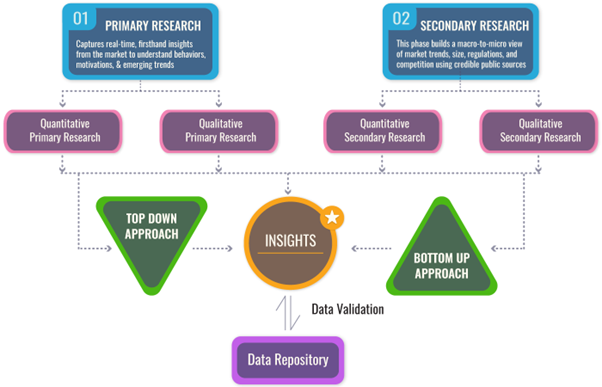
DUAL MODELING: TOP-DOWN + BOTTOM-UP
To ensure robust market estimation, we apply two complementary sizing approaches:
Top-Down Modeling:- Start with broader industry value (e.g., global or regional TAM)
- Apply filters by segment, geography, end-user, or use case
- Adjust with primary insights and validation benchmarks
- Ideal for investor-grade market scans and opportunity mapping
- Aggregate from the ground up using sales volumes, pricing, and unit economics
- Use internal modeling templates aligned with stakeholder data
- Incorporate distributor-level or region-specific inputs
- Most accurate for emerging segments and granular sub-markets
DATA VALIDATION: IN-HOUSE REPOSITORY
We close the loop with proprietary data intelligence built from ongoing projects, industry monitoring, and historical benchmarking. This repository includes:
- Multi-sector market and pricing models
- Key trendlines from past interviews and forecasts
- Benchmarked adoption rates, churn patterns, and ROI indicators
- Industry-specific deviation flags and cross-check logic
- Catches inconsistencies early
- Aligns projections across studies
- Enables consistent, high-trust deliverables