

Anti-Infective Wipes Market Size and Forecast (2020-2033), Global and Regional Growth, Trend, Share, and Industry Analysis Report Coverage: By Product Type (Skin Wipes, Surface Wipes), By Formulation (Alcohol-Based, Quaternary Ammonium Compounds, Chlorhexidine, Others), By Distribution Channel (Business-to-Business [B2B], Business-to-Consumer [B2C]), By End-User (Healthcare, Hospitality, Household, Industrial) And Geography
2025-12-05
Healthcare
Swetal (Research Analyst)
Description
Anti-Infective Wipes Market Overview
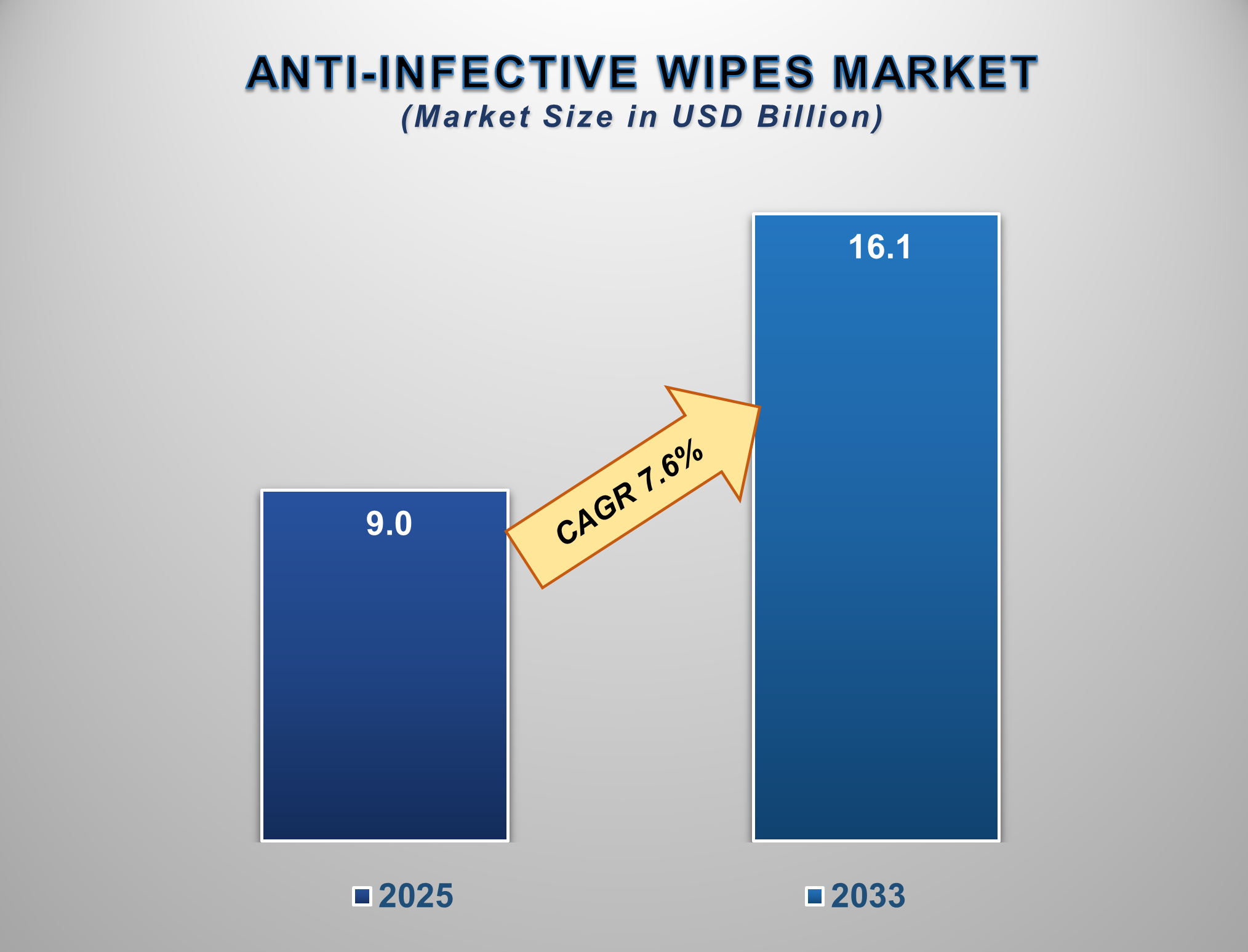
The Anti-Infective Wipes Market is poised for robust and sustained growth from 2025 to 2033, propelled by heightened hygiene awareness, the persistent threat of healthcare-associated infections (HAIs), and increasing usage across diverse industrial and household sectors. The market is projected to be valued at approximately USD 9.0 billion in 2025 and is forecasted to reach nearly USD 16.1 billion by 2033, exhibiting a compound annual growth rate (CAGR) of 7.6% during this period.
Anti-infective wipes are pre-moistened
disposable cloths infused with antimicrobial or disinfectant agents designed to
kill or inhibit the growth of microorganisms on skin or surfaces. The market's
expansion is underpinned by a fundamental and lasting shift in global hygiene
practices, largely accelerated by the COVID-19 pandemic. Stringent regulations
and infection control protocols in healthcare settings, coupled with growing
consumer demand for convenient and effective cleaning solutions, are key growth
pillars. Furthermore, product innovations such as wipes with longer-lasting
efficacy, eco-friendly and biodegradable materials, and formulations safe for
various surfaces are enhancing their appeal. North America currently leads the
market due to strict healthcare regulations and high consumer health
consciousness, while the Asia-Pacific region is anticipated to be the
fastest-growing market, fuelled by improving healthcare infrastructure, rising
disposable incomes, and increasing urbanization.
Anti-Infective
Wipes Market Drivers and Opportunities
Heightened Focus on Infection Control and
Consumer Hygiene Awareness are the Primary Market Drivers
The relentless focus on reducing
Healthcare-Associated Infections (HAIs) is the most significant driver in the
healthcare sector. Regulatory bodies are enforcing stricter hygiene protocols,
making anti-infective wipes a standard tool for surface disinfection and hand
hygiene. Beyond healthcare, a lasting cultural shift towards proactive hygiene
among the general population continues to drive B2C sales. The convenience,
single-use nature, and proven efficacy of these wipes make them a preferred
choice over traditional liquids and sprays for both quick sanitization and
thorough cleaning routines in homes, offices, and public spaces.
Expansion in B2B Applications and Product
Innovation is Fueling Market Expansion
The adoption of anti-infective wipes is rapidly
expanding across various B2B segments beyond healthcare. The hospitality
industry (hotels, restaurants) uses them for cleaning guest rooms and food
preparation areas. The industrial sector employs them for equipment
sanitization in food processing and manufacturing. The corporate sector has
integrated them into daily office cleaning protocols. This diversification
creates a robust and multi-channel demand base. Concurrently, manufacturers are
driving growth through innovation, developing wipes with broader-spectrum
efficacy, milder formulations for sensitive skin, and sustainable attributes to
appeal to environmentally conscious consumers.
Development of Sustainable Solutions and
Smart Packaging Presents Significant
Opportunities
The growing consumer and regulatory pressure for
environmentally responsible products is creating a major growth frontier. Key
opportunities lie in the development of wipes made from biodegradable,
plant-based, or compostable non-woven substrates, along with the use of milder,
environmentally friendly disinfectants. Furthermore, the integration of
technology presents a novel opportunity. This includes smart packaging that
indicates when the wipes are drying out or use-by-date indicators to ensure
efficacy. For manufacturers, investing in R&D for sustainable materials,
securing eco-certifications, and developing differentiated, premium products
for niche applications (e.g., electronics cleaning, veterinary use) are key
strategies to capture market share and build brand loyalty.
Anti-Infective Wipes
Market Scope
|
Report Attributes |
Description |
|
Market Size in 2025 |
USD 9.0 Billion |
|
Market Forecast in 2033 |
USD 16.1 Billion |
|
CAGR % 2025-2033 |
7.6% |
|
Base Year |
2024 |
|
Historic Data |
2020-2024 |
|
Forecast Period |
2025-2033 |
|
Report USP |
Product Portfolio,
Technological Analysis, Company Market Share, Company Heatmap, Pricing
Analysis, Growth Factors and more |
|
Segments Covered |
●
By Product Type ●
By Formulation ●
By Distribution
Channel ●
By End-user |
|
Regional Scope |
●
North America, ●
Europe, ●
APAC, ●
Latin America ●
Middle East and
Africa |
|
Country Scope |
1)
U.S. 2)
Canada 3)
Germany 4)
UK 5)
France 6)
Spain 7)
Italy 8)
Switzerland 9)
China 10)
Japan 11)
India 12)
Australia 13)
South Korea 14)
Brazil 15)
Mexico 16)
Argentina 17)
South Africa 18)
Saudi Arabia 19)
UAE |
Anti-Infective Wipes
Market Report Segmentation Analysis
The global Anti-Infective Wipes
Market industry analysis is segmented by Product Type, by Formulation, by
Distribution Channel, by End-User, and by Region.
The Skin Wipes product type segment is anticipated to
command a significant market share in 2025.
The
Product Type segment is categorized into Skin Wipes and Surface Wipes. The skin
wipes segment, which includes hand sanitizing wipes and patient preoperative
preparation wipes, holds a dominant share. This is driven by the essential
nature of hand hygiene in infection prevention, both in clinical settings and
daily life. The convenience of single-use sanitizing wipes for on-the-go use,
coupled with their mandatory placement in healthcare facilities, restaurants,
and schools, ensures consistent and high-volume demand. The critical role of
skin antisepsis in preventing surgical site infections further solidifies this
segment's leadership.
The
Business-to-Consumer (B2C) distribution channel is projected to hold the
largest market share.
The
Distribution Channel segment is divided into Business-to-Business (B2B) and
Business-to-Consumer (B2C). The B2C segment, which includes sales through
hypermarkets, supermarkets, drugstores, and online platforms, dominates the
market. This is attributable to the massive scale of household and individual
consumption. The pandemic ingrained the habit of keeping anti-infective wipes
at home, in cars, and in personal bags. The easy accessibility, frequent
promotional activities, and wide range of consumer-friendly brands and sizes
make B2C the highest-volume channel, even though B2B wipes may have higher
efficacy specifications.
The
Alcohol-Based formulation segment is projected to maintain its dominance in
revenue.
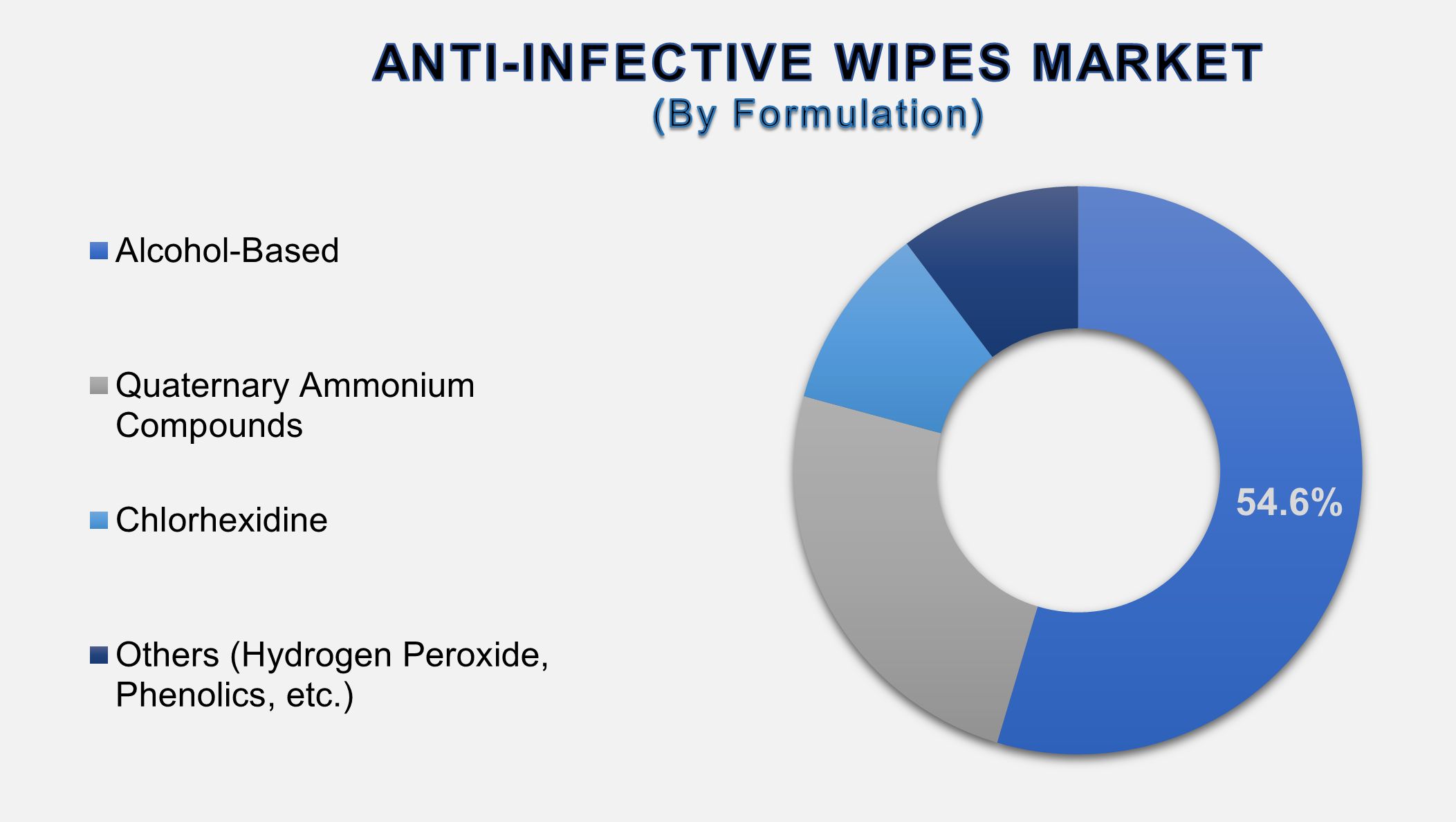
The Formulation segment is split into Alcohol-Based, Quaternary Ammonium Compounds, Chlorhexidine, and Others. Alcohol-based wipes continue to lead the market due to their rapid, broad-spectrum efficacy against a wide range of pathogens, fast evaporation, and well-established safety profile for use on hard surfaces and hands. Their cost-effectiveness and widespread consumer recognition make them the default choice for many applications. While concerns about skin dryness and the rise of non-alcohol alternatives present challenges, the proven performance and versatility of alcohol-based formulations ensure their continued dominance.
The following segments are
part of an in-depth analysis of the global Anti-Infective Wipes Market:
|
Market
Segments |
|
|
By Product
Type |
●
Skin Wipes ●
Surface Wipes |
|
By
Formulation |
●
Alcohol-Based ●
Quaternary Ammonium
Compounds ●
Chlorhexidine ●
Others (Hydrogen
Peroxide, Phenolics, etc.) |
|
By
Distribution Channel |
●
Business-to-Business
(B2B) ●
Business-to-Consumer
(B2C) o
Hypermarkets/Supermarkets o
Drugstores &
Pharmacies o
Online Retail o
Others |
|
By End-user |
●
Healthcare
(Hospitals, Clinics, ASCs) ●
Hospitality ●
Household ●
Industrial (Food
& Beverage, Manufacturing) |
Anti-Infective Wipes
Market Share Analysis by Region
The
North America region is anticipated to hold the largest portion of the
Anti-Infective Wipes Market globally throughout the forecast period
North
America's dominance is fueled by a highly
developed healthcare system with stringent infection control guidelines from
bodies like the CDC and OSHA. High public awareness regarding hygiene, strong
purchasing power, and the presence of major market players like The Clorox
Company and GOJO Industries are key factors. The region was one of the earliest
and most significantly impacted by the pandemic, which led to a permanent
uplift in demand for disinfecting products. Well-established retail and
e-commerce channels ensure easy product availability for consumers. While the
market has matured post-pandemic, it continues to grow steadily, supported by
product innovation in natural and sustainable wipes and sustained hygiene
practices in both B2B and B2C sectors.
Anti-Infective Wipes
Market Competition Landscape Analysis
The global anti-infective wipes
market is fragmented and highly competitive, characterized by the presence of
global consumer goods giants, specialized hygiene companies, and private-label
manufacturers. Competition is intense and based on brand reputation, product
efficacy, price, distribution network strength, and innovation in formulations
and sustainability. Key strategies include portfolio diversification to target
specific end-user segments, strategic mergers and acquisitions to expand
geographic and segment presence, and heavy investment in marketing and consumer
education.
Global Anti-Infective
Wipes Market Recent Developments News:
- In
February 2025, Reckitt Benckiser (Lysol) launched a new line of
plant-based, compostable disinfecting wipes in North America and Europe,
responding to demand for sustainable hygiene products.
- In December 2024, GOJO Industries (maker of PURELL)
secured a multi-year contract to supply its proprietary FORMULA 2.0
sanitizing wipes to a nationwide chain of U.S. airports.
- In October 2024, Kimberly-Clark Corporation
announced an investment to expand its production capacity for Huggies Baby
Wipes and Scott Surface Wipes in the Asia-Pacific region to meet rising
demand.
- In August 2024, a study
published in a prominent infection control journal demonstrated the
superior efficacy of a new quaternary ammonium compound-based wipe against
emerging drug-resistant pathogens, influencing procurement decisions in
healthcare.
The Global Anti-Infective
Wipes Market Is Dominated by a Few Large Companies, such as
●
The Clorox Company
●
Reckitt Benckiser
Group PLC
●
Procter & Gamble
●
Kimberly-Clark
Corporation
●
GOJO Industries, Inc.
●
Nice-Pak Products,
Inc.
●
Johnson & Johnson
●
3M Company
●
GAMA Healthcare Ltd.
●
Whiteley Corporation
●
Metrex Research, LLC
●
Ecolab Inc.
●
Diversey Holdings,
Ltd.
●
Edgewell Personal Care
●
Medline Industries, LP
● Other Prominent Players
Frequently Asked Questions
Swetal (Research Analyst)
Swetal is a Research Analyst with 4+ years of experience specializing in healthcare market research, medical devices, healthcare IT, and medical technology industry analysis. Her expertise includes competitive intelligence, secondary research, market trend forecasting, and healthcare business insights across global healthcare ecosystems.
She contributes to advanced market research reports by analyzing regulatory frameworks, emerging healthcare technologies, competitive landscapes, and innovation trends shaping the medical industry. With a strong focus on accurate market intelligence, strategic insights, and healthcare industry trends, Swetal supports businesses in making informed, data-backed decisions in a rapidly transforming healthcare environment.
1. Global Anti-Infective
Wipes Market Introduction and Market Overview
1.1.
Objectives
of the Study
1.2.
Global
Anti-Infective Wipes Market Scope and Market Estimation
1.2.1.Global Electronic Toll
Collection Overall Market Size (US$ Bn), Market CAGR (%), Market forecast (2025
- 2033)
1.2.2.Global Anti-Infective
Wipes Market Revenue Share (%) and Growth Rate (Y-o-Y) from 2020 - 2033
1.3.
Market
Segmentation
1.3.1.Product Type of Global Anti-Infective
Wipes Market
1.3.2.Formulation of Global Anti-Infective
Wipes Market
1.3.3.Distribution Channel of Global
Anti-Infective Wipes Market
1.3.4.End-user of Global Anti-Infective
Wipes Market
1.3.5.Region of Global Anti-Infective
Wipes Market
2.
Executive Summary
2.1.
Demand
Side Trends
2.2.
Key
Market Trends
2.3.
Market
Demand (US$ Bn) Analysis 2020 – 2024 and forecast, 2025 – 2033
2.4.
Demand
and Opportunity Assessment
2.5.
Technological
Advancements
2.6.
Key
Developments
2.7.
Market
Entry Strategies
2.8.
Market
Dynamics
2.8.1.Drivers
2.8.2.Limitations
2.8.3.Opportunities
2.8.4.Impact Analysis of Drivers
and Restraints
2.9.
Porter’s
Five Forces Analysis
2.10.
PEST
Analysis
3. Global
Anti-Infective Wipes Market Estimates
& Historical Trend Analysis (2020 - 2024)
4. Global
Anti-Infective Wipes Market Estimates
& Forecast Trend Analysis, by Product Type
4.1.
Global
Anti-Infective Wipes Market Revenue (US$ Bn) Estimates and Forecasts, by Product
Type, 2020 - 2033
4.1.1.Skin Wipes
4.1.2.Surface Wipes
5. Global
Anti-Infective Wipes Market Estimates
& Forecast Trend Analysis, by Formulation
5.1.
Global
Anti-Infective Wipes Market Revenue (US$ Bn) Estimates and Forecasts, by Formulation,
2020 - 2033
5.1.1.Alcohol-Based
5.1.2.Quaternary Ammonium
Compounds
5.1.3.Chlorhexidine
5.1.4.Others (Hydrogen Peroxide,
Phenolics, etc.)
6. Global
Anti-Infective Wipes Market Estimates
& Forecast Trend Analysis, by Distribution Channel
6.1.
Global
Anti-Infective Wipes Market Revenue (US$ Bn) Estimates and Forecasts, by
Distribution Channel 2020 - 2033
6.1.1.Business-to-Business (B2B)
6.1.2.Business-to-Consumer (B2C)
6.1.2.1.
Hypermarkets/Supermarkets
6.1.2.2.
Drugstores
& Pharmacies
6.1.2.3.
Online
Retail
6.1.2.4.
Others
7. Global
Anti-Infective Wipes Market Estimates
& Forecast Trend Analysis, by End-user
7.1.
Global
Anti-Infective Wipes Market Revenue (US$ Bn) Estimates and Forecasts, by End-user
2020 - 2033
7.1.1.Healthcare
7.1.2.Hospitality
7.1.3.Household
7.1.4.Industrial
8. Global
Anti-Infective Wipes Market Estimates
& Forecast Trend Analysis, by region
8.1.
Global
Anti-Infective Wipes Market Revenue (US$ Bn) Estimates and Forecasts, by region,
2020 - 2033
8.1.1.North America
8.1.2.Europe
8.1.3.Asia Pacific
8.1.4.Middle East & Africa
8.1.5.Latin America
9. North America Anti-Infective
Wipes Market: Estimates & Forecast
Trend Analysis
9.1. North America Anti-Infective
Wipes Market Assessments & Key Findings
9.1.1.North America Anti-Infective
Wipes Market Introduction
9.1.2.North America Anti-Infective
Wipes Market Size Estimates and Forecast (US$ Billion) (2020 - 2033)
9.1.2.1.
By Product Type
9.1.2.2.
By Formulation
9.1.2.3.
By Distribution Channel
9.1.2.4.
By End-user
9.1.2.5. By Country
9.1.2.5.1. The U.S.
9.1.2.5.2. Canada
10. Europe Anti-Infective
Wipes Market: Estimates & Forecast
Trend Analysis
10.1. Europe Anti-Infective
Wipes Market Assessments & Key Findings
10.1.1. Europe Anti-Infective
Wipes Market Introduction
10.1.2. Europe Anti-Infective
Wipes Market Size Estimates and Forecast (US$ Billion) (2020 - 2033)
10.1.2.1.
By Product Type
10.1.2.2.
By Formulation
10.1.2.3.
By Distribution Channel
10.1.2.4.
By End-user
10.1.2.5. By Country
10.1.2.5.1.
Germany
10.1.2.5.2.
Italy
10.1.2.5.3.
U.K.
10.1.2.5.4.
France
10.1.2.5.5.
Spain
10.1.2.5.6.
Switzerland
10.1.2.5.7. Rest
of Europe
11. Asia Pacific Anti-Infective
Wipes Market: Estimates & Forecast
Trend Analysis
11.1. Asia Pacific Market
Assessments & Key Findings
11.1.1.
Asia
Pacific Anti-Infective Wipes Market Introduction
11.1.2.
Asia
Pacific Anti-Infective Wipes Market Size Estimates and Forecast (US$ Billion) (2020
- 2033)
11.1.2.1.
By Product Type
11.1.2.2.
By Formulation
11.1.2.3.
By Distribution Channel
11.1.2.4.
By End-user
11.1.2.5. By Country
11.1.2.5.1. China
11.1.2.5.2. Japan
11.1.2.5.3. India
11.1.2.5.4. Australia
11.1.2.5.5. South Korea
11.1.2.5.6. Rest of Asia Pacific
12. Middle East & Africa Anti-Infective
Wipes Market: Estimates & Forecast
Trend Analysis
12.1. Middle East & Africa
Market Assessments & Key Findings
12.1.1. Middle
East & Africa
Anti-Infective Wipes Market Introduction
12.1.2. Middle
East & Africa
Anti-Infective Wipes Market Size Estimates and Forecast (US$ Billion) (2020 - 2033)
12.1.2.1.
By Product Type
12.1.2.2.
By Formulation
12.1.2.3.
By Distribution Channel
12.1.2.4.
By End-user
12.1.2.5. By Country
12.1.2.5.1. UAE
12.1.2.5.2. Saudi
Arabia
12.1.2.5.3. South
Africa
12.1.2.5.4. Rest
of MEA
13. Latin America
Anti-Infective Wipes Market: Estimates
& Forecast Trend Analysis
13.1. Latin America Market
Assessments & Key Findings
13.1.1. Latin America Anti-Infective
Wipes Market Introduction
13.1.2. Latin America Anti-Infective
Wipes Market Size Estimates and Forecast (US$ Billion) (2020 - 2033)
13.1.2.1.
By Product Type
13.1.2.2.
By Formulation
13.1.2.3.
By Distribution Channel
13.1.2.4.
By End-user
13.1.2.5. By Country
13.1.2.5.1. Brazil
13.1.2.5.2. Argentina
13.1.2.5.3. Mexico
13.1.2.5.4. Rest
of LATAM
14.
Country
Wise Market: Introduction
15.
Competition
Landscape
15.1. Global Anti-Infective
Wipes Market Product Mapping
15.2. Global Anti-Infective
Wipes Market Concentration Analysis, by Leading Players / Innovators / Emerging
Players / New Entrants
15.3. Global Anti-Infective
Wipes Market Tier Structure Analysis
15.4. Global Anti-Infective
Wipes Market Concentration & Company Market Shares (%) Analysis, 2024
16.
Company
Profiles
16.1.
The Clorox Company
16.1.1.
Company
Overview & Key Stats
16.1.2.
Financial
Performance & KPIs
16.1.3.
Product
Portfolio
16.1.4.
SWOT
Analysis
16.1.5.
Business
Strategy & Recent Developments
* Similar details would be provided for all the players
mentioned below
16.2.
Reckitt Benckiser Group PLC
16.3.
Procter & Gamble
16.4.
Kimberly-Clark Corporation
16.5.
GOJO Industries, Inc.
16.6.
Nice-Pak Products, Inc.
16.7.
Johnson & Johnson
16.8.
3M Company
16.9.
GAMA Healthcare Ltd.
16.10.
Whiteley Corporation
16.11.
Metrex Research, LLC
16.12.
Ecolab Inc.
16.13.
Diversey Holdings, Ltd.
16.14.
Edgewell Personal Care
16.15.
Medline Industries, LP
16.16.
Other Prominent Players
17. Research
Methodology
17.1. External Transportations /
Databases
17.2. Internal Proprietary
Database
17.3. Primary Research
17.4. Secondary Research
17.5. Assumptions
17.6. Limitations
17.7. Report FAQs
18. Research
Findings & Conclusion
Our Research Methodology
"Insight without rigor is just noise."
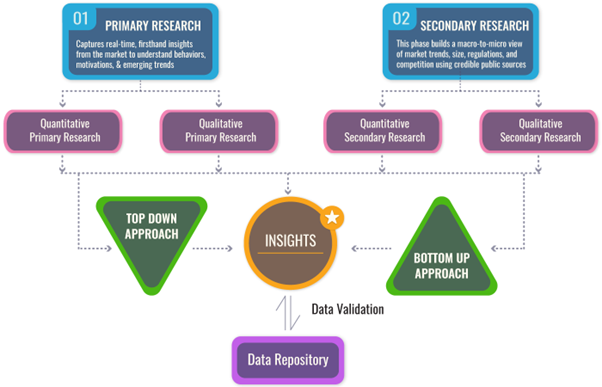
We follow a comprehensive, multi-phase research framework designed to deliver accurate, strategic, and decision-ready intelligence. Our process integrates primary and secondary research , both quantitative and qualitative , along with dual modeling techniques ( top-down and bottom-up) and a final layer of validation through our proprietary in-house repository.
PRIMARY RESEARCH
Primary research captures real-time, firsthand insights from the market to understand behaviors, motivations, and emerging trends.
1. Quantitative Primary Research
Objective: Generate statistically significant data directly from market participants.
Approaches:- Structured surveys with customers, distributors, and field agents
- Mobile-based data collection for point-of-sale audits and usage behavior
- Phone-based interviews (CATI) for market sizing and product feedback
- Online polling around industry events and digital campaigns
- Purchase frequency by customer type
- Channel performance across geographies
- Feature demand by application or demographic
2. Qualitative Primary Research
Objective: Explore decision-making drivers, pain points, and market readiness.
Approaches:- In-depth interviews (IDIs) with executives, product managers, and key decision-makers
- Focus groups among end users and early adopters
- Site visits and observational research for consumer products
- Informal field-level discussions for regional and cultural nuances
SECONDARY RESEARCH
This phase helps establish a macro-to-micro understanding of market trends, size, regulation, and competitive dynamics, sourced from credible and public domain information.
1. Quantitative Secondary Research
Objective: Model market value and segment-level forecasts based on published data.
Sources include:- Financial reports and investor summaries
- Government trade data, customs records, and regulatory statistics
- Industry association publications and economic databases
- Channel performance and pricing data from marketplace listings
- Revenue splits, pricing trends, and CAGR estimates
- Supply-side capacity and volume tracking
- Investment analysis and funding benchmarks
2. Qualitative Secondary Research
Objective: Capture strategic direction, innovation signals, and behavioral trends.
Sources include:- Company announcements, roadmaps, and product pipelines
- Publicly available whitepapers, conference abstracts, and academic research
- Regulatory body publications and policy briefs
- Social and media sentiment scanning for early-stage shifts
- Strategic shifts in market positioning
- Unmet needs and white spaces
- Regulatory triggers and compliance impact
DUAL MODELING: TOP-DOWN + BOTTOM-UP
To ensure robust market estimation, we apply two complementary sizing approaches:
Top-Down Modeling:- Start with broader industry value (e.g., global or regional TAM)
- Apply filters by segment, geography, end-user, or use case
- Adjust with primary insights and validation benchmarks
- Ideal for investor-grade market scans and opportunity mapping
- Aggregate from the ground up using sales volumes, pricing, and unit economics
- Use internal modeling templates aligned with stakeholder data
- Incorporate distributor-level or region-specific inputs
- Most accurate for emerging segments and granular sub-markets
DATA VALIDATION: IN-HOUSE REPOSITORY
We close the loop with proprietary data intelligence built from ongoing projects, industry monitoring, and historical benchmarking. This repository includes:
- Multi-sector market and pricing models
- Key trendlines from past interviews and forecasts
- Benchmarked adoption rates, churn patterns, and ROI indicators
- Industry-specific deviation flags and cross-check logic
- Catches inconsistencies early
- Aligns projections across studies
- Enables consistent, high-trust deliverables