

Anti-Mold Sticker Market Size and Forecast (2026–2034), Global and Regional Growth, Trend, Share and Industry Analysis Report Coverage; By Product Type (Adhesive Anti-Mold Stickers, Hanging Anti-Mold Stickers, Sachet-Style Stickers, Gel-Based Stickers, Others); By Application (Wardrobes & Closets, Bathrooms, Kitchens, Storage Areas, Vehicles, Others); By Material (Paper-Based, Plastic-Based, Nonwoven, Others); By Distribution Channel (Online, Supermarkets and Hypermarkets, Specialty Stores, Convenience Stores, Others); and Geography
2026-09-01
Consumer Products
Aishwarya Panbude (Research Analyst)
Description
Anti-Mold Sticker Market Overview
The global Anti-Mold Sticker Market
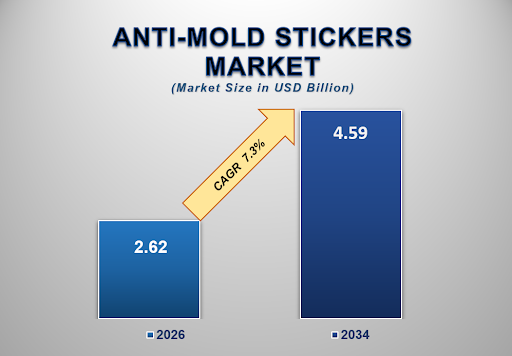
was valued at USD 2.62 billion in 2026 and is projected to reach USD
4.59 billion by 2034, expanding at a CAGR of 7.3% during the forecast
period. The market is witnessing steady growth due to increasing awareness
of household mold prevention, rising humidity-related problems, growing demand
for convenient home-care products, expanding urban housing, increasing consumer
focus on hygiene, and the growing availability of specialized moisture and
mold-control solutions.
Anti-mold stickers are compact products
designed to help prevent or control mold and mildew formation in enclosed or
moisture-prone areas. They are commonly used in wardrobes, cabinets, bathrooms,
kitchens, storage spaces, drawers, shoe cabinets, vehicles, and other locations
where humidity and limited ventilation can contribute to mold growth.
Mold develops more readily in environments
where moisture, warmth, and poor air circulation occur together. Increasing
consumer awareness of these conditions is encouraging households to adopt
preventive products rather than relying exclusively on cleaning after mold has
already appeared.
Anti-mold stickers provide a convenient
format because they can be placed directly inside enclosed spaces without
requiring specialized equipment or complicated installation. Their compact
construction also allows them to be used in areas where conventional
dehumidification products may be impractical.
The increasing focus on household
cleanliness and preventive maintenance is supporting demand. Consumers are
becoming more attentive to unpleasant odors, visible mildew, moisture damage,
and hygiene concerns associated with poorly ventilated storage areas.
Urban housing trends are also contributing
to market opportunities. Apartments and compact residential spaces can contain
enclosed wardrobes, cabinets, bathrooms, and storage areas with limited air
circulation, creating potential demand for localized mold-prevention products.
Product manufacturers are increasingly
developing stickers and related formats with different sizes, fragrances,
adhesive systems, moisture-management characteristics, and application-specific
designs.
The expansion of e-commerce is improving
consumer access to niche household maintenance products. Online platforms allow
consumers to compare product features, pack sizes, prices, usage instructions,
and customer feedback before purchasing.
Commercial applications are also creating
opportunities. Hotels, hostels, storage facilities, vehicle operators, rental
properties, and other businesses may use compact mold-prevention products to
protect enclosed spaces and stored materials.
Sustainability is becoming increasingly
relevant as manufacturers explore reduced-plastic packaging, recyclable
materials, lower-waste formats, and formulations designed to minimize
environmental impact.
The combination of rising humidity-related
concerns, greater hygiene awareness, urbanization, online retail expansion, and
demand for simple preventive solutions is expected to support the global
anti-mold sticker market through 2034.
Anti-Mold Sticker Market Drivers and Opportunities
Increasing Awareness of Household Mold
Prevention Is Driving Market Growth
Growing awareness of mold and mildew
prevention is one of the key factors supporting the anti-mold sticker market.
Consumers increasingly recognize that
moisture accumulation inside wardrobes, bathrooms, cabinets, storage rooms, and
other enclosed spaces can create conditions favorable to mold growth.
Preventive products can help households
address these concerns before extensive mold formation requires more intensive
cleaning or remediation.
The compact nature of anti-mold stickers
makes them suitable for everyday household use. Consumers can place them in
specific areas where ventilation is limited or humidity levels tend to remain
elevated.
The increasing emphasis on preventive
household maintenance is therefore creating a favorable environment for demand.
Product awareness is also being
strengthened through digital content, home-care communities, retailer
education, and social-media discussions focused on cleaning, organization,
moisture management, and household hygiene.
Urbanization and Enclosed Storage Spaces
Are Supporting Market Expansion
Urbanization is increasing the number of
consumers living in apartments and compact residential environments where
efficient storage is important.
Modern homes commonly incorporate enclosed
wardrobes, modular kitchens, shoe cabinets, bathroom storage units, drawers,
and other spaces that may experience restricted airflow.
During humid seasons, these enclosed areas
can become more susceptible to moisture accumulation and unpleasant odors.
Anti-mold stickers offer a localized
solution that can be placed directly inside such spaces without occupying
significant room.
The increasing use of built-in storage
systems and space-efficient furniture is therefore creating additional
applications for compact mold-prevention products.
Demand is expected to remain particularly
relevant in regions experiencing humid climates, seasonal rainfall, or high
indoor moisture levels.
E-Commerce Expansion and Product
Innovation Create Significant Opportunities
The growth of online retail is creating
significant opportunities for anti-mold sticker manufacturers.
Digital marketplaces allow companies to
reach consumers searching for specialized household-care products that may have
limited availability through traditional retail stores.
Online platforms also make it easier for
consumers to purchase multipacks and application-specific products for
different areas of their homes.
Product innovation represents another
opportunity. Manufacturers can develop specialized formats for wardrobes,
bathrooms, shoe cabinets, vehicles, storage containers, and other enclosed
environments.
Companies are also exploring longer-lasting
products, compact packaging, improved adhesion, fragrance options, and more
environmentally responsible materials.
The combination of online accessibility and
product differentiation is expected to support market expansion and encourage
new brands to enter the category.
Anti-Mold Sticker Market Scope
|
Report Attributes |
Description |
|
Market Size
in 2026 |
USD
2.62 Billion |
|
Market
Forecast in 2034 |
USD 4.59 Billion |
|
CAGR %
2026-2034 |
7.3% |
|
Base Year |
2025 |
|
Historic
Data |
2021-2025 |
|
Forecast
Period |
2026-2034 |
|
Report USP |
Production, Consumption,
Company Share, Company Heatmap, Company Production, Service Type, Growth
Factors and more |
|
Segments
Covered |
· By Product Type · By Application · By Material · By Distribution Channel |
|
Regional
Scope |
● North America |
|
Country
Scope |
U.S. |
Anti-Mold Sticker Market Report Segmentation Analysis
The global anti-mold sticker market
industry analysis is segmented into product type, application, material,
distribution channel, and region.
The Adhesive Anti-Mold Stickers Segment
Is Expected to Dominate the Market During the Forecast Period
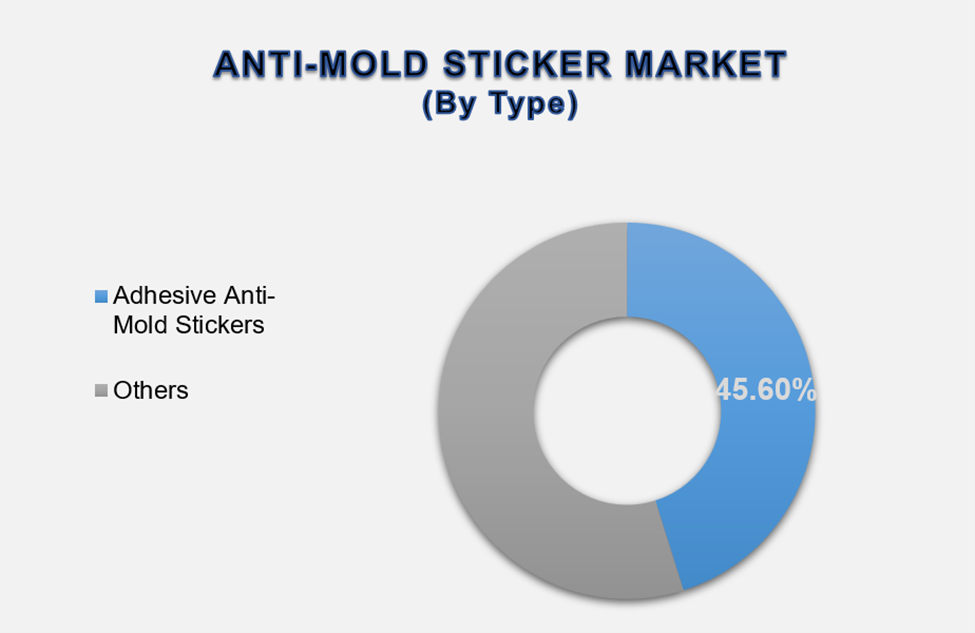
The Adhesive Anti-Mold Stickers
segment is expected to account for the largest share of the global market due
to its ease of installation, compact design, convenient placement, and
suitability for enclosed household spaces.
Adhesive anti-mold stickers can be attached
directly to the interior surfaces of wardrobes, cabinets, drawers, storage
units, and other enclosed areas.
Their compact format allows consumers to
use the products without sacrificing storage space. The adhesive design also
helps keep the product positioned at a selected location rather than allowing
it to move around inside storage areas.
Manufacturers are increasingly offering
different shapes, sizes, packaging formats, and functional characteristics to
address specific household requirements.
The growing preference for convenient,
low-maintenance household products is expected to support continued demand for
adhesive formats.
Wardrobes & Closets Segment Is
Expected to Lead the Market by Application
The Wardrobes & Closets segment
is expected to represent the largest application category.
Wardrobes and closets are frequently
enclosed and may have limited airflow, particularly when tightly packed with
clothing and other personal belongings.
Humidity inside these spaces can contribute
to unpleasant odors and mold or mildew formation, particularly during wet or
humid seasons.
Anti-mold stickers provide a compact
preventive option that can be positioned inside wardrobes without interfering
substantially with clothing storage.
The increasing adoption of modular
wardrobes and organized closet systems is further creating opportunities for
specialized moisture and mold-prevention products.
Plastic-Based Segment Is Expected to
Dominate the Market by Material
The Plastic-Based segment is
expected to account for a significant share of the market because plastic
materials provide flexibility in product construction, moisture resistance,
durability, and cost-effective manufacturing.
Plastic-based formats can be produced in
different shapes and sizes and can be combined with adhesive backing,
protective layers, or functional inserts.
Manufacturers are also exploring recyclable
and reduced-material plastic solutions in response to growing environmental
concerns.
Online Segment Is Expected to Lead the
Market by Distribution Channel
The Online segment is expected to
experience strong growth as consumers increasingly purchase specialized
household maintenance products through digital platforms.
Online retailers offer broad product
availability and allow consumers to compare pack sizes, designs, usage
instructions, prices, and customer reviews.
The relatively compact size and lightweight
nature of anti-mold stickers also make them suitable for e-commerce
fulfillment.
Subscription-style household supply
purchases and multipack offerings can provide additional opportunities for
online retailers and manufacturers.
The following segments are part of an
in-depth analysis of the global Anti-Mold Sticker Market:
|
Market Segments |
|
|
By Product Type |
· Adhesive Anti-Mold Stickers · Hanging Anti-Mold Stickers · Sachet-Style Stickers · Gel-Based Stickers · Others |
|
By
Application |
· Wardrobes & Closets · Bathrooms · Kitchens · Storage Areas · Vehicles · Others |
|
By Material |
· Paper-Based · Plastic-Based · Nonwoven · Others |
|
By Distribution Channel |
· Online · Supermarkets and Hypermarkets · Specialty Stores · Convenience Stores · Others |
Anti-Mold Sticker Market Share Analysis By Region
Asia Pacific
is projected to hold a significant share of the global anti-mold sticker market
over the forecast period.
The region benefits from large consumer
populations, humid climatic conditions across several countries, rapid
urbanization, expanding residential construction, and growing awareness of
household hygiene and moisture management. China, India, Japan, South Korea,
and Australia are important regional markets.
China represents a major opportunity due to
its large consumer base, extensive manufacturing capabilities, and
well-developed e-commerce ecosystem. India is expected to experience increasing
demand as urban households adopt more organized storage systems and consumers
become increasingly aware of preventive home-care products.
North America represents a mature market supported by strong household spending,
established home-care product categories, widespread e-commerce adoption, and
consumer interest in preventive household maintenance. The United States
remains the dominant contributor, while Canada represents an additional
market opportunity.
Europe is
expected to maintain steady growth as consumers increasingly prioritize
household cleanliness, organized living spaces, product convenience, and
sustainable materials. Germany, the U.K., France, Italy, Spain, and
Switzerland are important markets.
Latin America is expected to witness gradual expansion as modern retail and
e-commerce penetration increase and consumers gain greater access to
specialized household maintenance products. Brazil, Mexico, and Argentina
are key markets.
The Middle East & Africa represents an emerging opportunity supported by expanding
residential development, increasing consumer spending, growing retail
infrastructure, and demand for products addressing household moisture and
storage concerns.
Anti-Mold Sticker Market Competition
Landscape Analysis
The global anti-mold sticker market is
characterized by competition based on product effectiveness, durability,
ease of application, design, price, packaging, product lifespan, and
distribution reach.
Manufacturers are increasingly focusing on
compact products that can be integrated into wardrobes, cabinets, drawers,
bathrooms, storage areas, and other enclosed environments.
Product differentiation is becoming
important as companies introduce different shapes, sizes, adhesive systems,
fragrances, packaging configurations, and application-specific designs.
Online retail is allowing smaller and
specialized brands to compete with established household-care companies by
reaching consumers directly through digital marketplaces.
Manufacturers are also responding to
sustainability concerns by exploring recyclable packaging, lower-plastic
designs, and alternative materials.
Brand visibility through social media,
home-organization content, digital advertising, and online reviews is
increasingly influencing consumer awareness and product discovery.
As household hygiene awareness and demand
for preventive moisture-management products increase, competition is expected
to intensify across both established and emerging markets.
Global Anti-Mold Sticker Market Recent
Developments News
· In April 2026 – Household-care
brands expanded compact mold-prevention product formats designed for wardrobes,
cabinets, and other enclosed storage spaces.
· In February 2026 – Online
retailers increased the availability of multipack anti-mold and
moisture-management products for residential applications.
· In November 2025 – Manufacturers
introduced improved packaging and application designs intended to simplify
placement in small and enclosed household spaces.
· In August 2025 – Product
developers increased focus on lower-waste materials and recyclable packaging
for household mold-prevention products.
· In June 2025 – Home-care companies
expanded digital distribution of specialized moisture and mold-control products
across emerging consumer markets.
The Global Anti-Mold Sticker Market is
Dominated by a Few Large Companies, Such As
· 3M Company
· Henkel AG & Co. KGaA
· SC Johnson & Son, Inc.
· Reckitt Benckiser Group plc
· P&G
· Clorox Company
· S.C. Johnson Professional
· Nippon Paint Holdings Co., Ltd.
· Kao Corporation
· Lion Corporation
· Earth Corporation
· Kobayashi Pharmaceutical Co., Ltd.
· DampRid
· Mold Armor
· Concrobium
· Others
Frequently Asked Questions
Aishwarya Panbude (Research Analyst)
Aishwarya Panbude is a skilled Research Analyst with 4+ years of experience in market intelligence, consumer insights, competitive analysis, and industry forecasting across the consumer goods, agriculture, and food & beverage sectors. She specializes in market sizing, trend analysis, growth opportunity mapping, and strategic secondary research for global and regional markets.
Her expertise lies in transforming complex industry data into actionable business strategies that help organizations identify emerging trends, understand customer behavior, and gain a competitive edge. With a strong focus on data-driven insights, business intelligence, and future market trends, Jaya delivers high-quality research solutions aligned with evolving industry demands and market dynamics.
1.
Anti-Mold Sticker Market
Introduction and Market Overview
1.1. Objectives of the Study
1.2. Market Segmentation
1.2.1.
Product Type of Global
Anti-Mold Sticker Market
1.2.2.
Application of Global Anti-Mold
Sticker Market
1.2.3.
Material of Global Anti-Mold
Sticker Market
1.2.4.
Distribution Channel of Global
Anti-Mold Sticker Market
1.2.5.
Region of Global Anti-Mold
Sticker Market
1.3. Competition Coverage List of Market Participants
1.4. Market Definition: Anti-Mold Sticker Market
2.
Executive Summary
2.1. Global Anti-Mold Sticker Market Estimation & Forecast
2.1.1.
Global Anti-Mold Sticker Market
Size (US$ Million) Estimates & Historical Trend Analysis (2021 - 2025)
2.1.2.
Global Anti-Mold Sticker Market
Overall Market Size (US$ Million), Growth Rate (Y-o-Y), Market CAGR (%), Market
Forecast (2026 - 2034)
2.2. Snapshot of Global Anti-Mold Sticker Market
2.3. Global Anti-Mold Sticker Market Revenue Share (%) 2025
2.4. REGIONAL OUTLINE: Revenue CAGR, by Region (%)
2.5. Key Competitors & Key Insights
3.
Market Overview
(Qualitative Analysis)
3.1. Demand Side Trends
3.2. Supply Side Trends / Manufacturing Trends
3.3. Demand and Opportunity Assessment, 2026 - 2034
3.4. Market Dynamics
3.4.1.
Drivers
3.4.2.
Limitations
3.4.3.
Opportunities
3.4.4.
Impact Analysis of Drivers and
Restraints
3.5. Key Developments
3.6. Regulatory Landscape
3.7. Pricing Analysis
3.8. Value Chain / Ecosystem Analysis
3.9. Porter’s Five Forces Analysis
3.9.1.
Bargaining Power of Suppliers
3.9.2.
Bargaining Power of Buyers
3.9.3.
Threat of Substitutes
3.9.4.
Threat of New Entrants
3.9.5.
Intensity of Competitive
Rivalry
3.10.
PEST Analysis
3.10.1.
Political Factors
3.10.2.
Economic Factors
3.10.3.
Social Factors
3.10.4.
Technological Factors
4.
Global Anti-Mold Sticker
Market Estimates & Forecast Trend Analysis, by Product Type
4.1. Global Anti-Mold Sticker Market Assessments & Key Findings, by
Product Type
4.1.1.
Adhesive Anti-Mold Stickers
4.1.2.
Hanging Anti-Mold Stickers
4.1.3.
Sachet-Style Stickers
4.1.4.
Gel-Based Stickers
4.1.5.
Others
5.
Global Anti-Mold Sticker
Market Estimates & Forecast Trend Analysis, by Application
5.1. Global Anti-Mold Sticker Market Assessments & Key Findings, by
Application
5.1.1.
Wardrobes & Closets
5.1.2.
Bathrooms
5.1.3.
Kitchens
5.1.4.
Storage Areas
5.1.5.
Vehicles
5.1.6.
Others
6.
Global Anti-Mold Sticker
Market Estimates & Forecast Trend Analysis, by Material
6.1. Global Anti-Mold Sticker Market Assessments & Key Findings, by
Material
6.1.1.
Paper-Based
6.1.2.
Plastic-Based
6.1.3.
Nonwoven
6.1.4.
Others
7.
Global Anti-Mold Sticker
Market Estimates & Forecast Trend Analysis, by Distribution Channel
7.1. Global Anti-Mold Sticker Market Assessments & Key Findings, by
Distribution Channel
7.1.1.
Online
7.1.2.
Supermarkets and Hypermarkets
7.1.3.
Specialty Stores
7.1.4.
Convenience Stores
7.1.5.
Others
8.
Global Anti-Mold Sticker
Market Estimates & Forecast Trend Analysis, by Region
8.1. Global Anti-Mold Sticker Market Assessments & Key Findings, by
Region
8.1.1.
North America
8.1.2.
Europe
8.1.3.
Asia Pacific
8.1.4.
Middle East & Africa
8.1.5.
Latin America
9.
North America Anti-Mold
Sticker Market: Estimates & Forecast Trend Analysis
9.1. North America Anti-Mold Sticker Market Assessments & Key
Findings
9.1.1.
North America Anti-Mold Sticker
Market Introduction
9.1.2.
North America Anti-Mold Sticker
Market Size Estimates and Forecast (US$ Million) (2021 - 2034)
9.1.2.1.
By Product Type
9.1.2.2.
By Application
9.1.2.3.
By Material
9.1.2.4.
By Distribution Channel
9.1.2.5.
By Country
9.1.2.5.1.
The U.S.
9.1.2.5.2.
Canada
10. Europe Anti-Mold Sticker Market: Estimates & Forecast Trend
Analysis
10.1.
Europe Anti-Mold Sticker Market
Assessments & Key Findings
10.1.1.
Europe Anti-Mold Sticker Market
Introduction
10.1.2.
Europe Anti-Mold Sticker Market
Size Estimates and Forecast (US$ Million) (2021 - 2034)
10.1.2.1.
By Product Type
10.1.2.2.
By Application
10.1.2.3.
By Material
10.1.2.4.
By Distribution Channel
10.1.2.5.
By Country
10.1.2.5.1.
Germany
10.1.2.5.2.
Italy
10.1.2.5.3.
The U.K.
10.1.2.5.4.
France
10.1.2.5.5.
Spain
10.1.2.5.6.
Switzerland
10.1.2.5.7.
Rest of Europe
11. Asia Pacific Anti-Mold Sticker Market: Estimates & Forecast
Trend Analysis
11.1.
Asia Pacific Anti-Mold Sticker
Market Assessments & Key Findings
11.1.1.
Asia Pacific Anti-Mold Sticker
Market Introduction
11.1.2.
Asia Pacific Anti-Mold Sticker
Market Size Estimates and Forecast (US$ Million) (2021 - 2034)
11.1.2.1.
By Product Type
11.1.2.2.
By Application
11.1.2.3.
By Material
11.1.2.4.
By Distribution Channel
11.1.2.5.
By Country
11.1.2.5.1.
China
11.1.2.5.2.
Japan
11.1.2.5.3.
India
11.1.2.5.4.
Australia
11.1.2.5.5.
South Korea
11.1.2.5.6.
Rest of Asia Pacific
12. Middle East & Africa Anti-Mold Sticker Market: Estimates &
Forecast Trend Analysis
12.1.
Middle East & Africa
Anti-Mold Sticker Market Assessments & Key Findings
12.1.1.
Middle East & Africa
Anti-Mold Sticker Market Introduction
12.1.2.
Middle East & Africa
Anti-Mold Sticker Market Size Estimates and Forecast (US$ Million) (2021 -
2034)
12.1.2.1.
By Product Type
12.1.2.2.
By Application
12.1.2.3.
By Material
12.1.2.4.
By Distribution Channel
12.1.2.5.
By Country
12.1.2.5.1.
UAE
12.1.2.5.2.
Saudi Arabia
12.1.2.5.3.
South Africa
12.1.2.5.4.
Rest of Middle East &
Africa
13. Latin America Anti-Mold Sticker Market: Estimates & Forecast
Trend Analysis
13.1.
Latin America Anti-Mold Sticker
Market Assessments & Key Findings
13.1.1.
Latin America Anti-Mold Sticker
Market Introduction
13.1.2.
Latin America Anti-Mold Sticker
Market Size Estimates and Forecast (US$ Million) (2021 - 2034)
13.1.2.1.
By Product Type
13.1.2.2.
By Application
13.1.2.3.
By Material
13.1.2.4.
By Distribution Channel
13.1.2.5.
By Country
13.1.2.5.1.
Brazil
13.1.2.5.2.
Mexico
13.1.2.5.3.
Argentina
13.1.2.5.4.
Rest of Latin America
14. Competition Landscape
14.1.
Global Anti-Mold Sticker Market
Product Mapping
14.2.
Global Anti-Mold Sticker Market
Concentration Analysis, by Leading Players / Innovators / Emerging Players /
New Entrants
14.3.
Global Anti-Mold Sticker Market
Tier Structure Analysis
14.4.
Global Anti-Mold Sticker Market
Concentration & Company Market Shares (%) Analysis, 2026
15. Company Profiles
15.1.
3M Company
15.1.1.
Company Overview & Key
Stats
15.1.2.
Financial Performance &
KPIs
15.1.3.
Product Portfolio
15.1.4.
SWOT Analysis
15.1.5.
Business Strategy & Recent
Developments
*Similar details would be provided for all
the players mentioned below
15.2.
Henkel AG & Co. KGaA
15.3.
SC Johnson & Son, Inc.
15.4.
Reckitt Benckiser Group plc
15.5.
P&G
15.6.
Clorox Company
15.7.
S.C. Johnson Professional
15.8.
Nippon Paint Holdings Co., Ltd.
15.9.
Kao Corporation
15.10.
Lion Corporation
15.11.
Earth Corporation
15.12.
Kobayashi Pharmaceutical Co.,
Ltd.
15.13.
DampRid
15.14.
Mold Armor
15.15.
Concrobium
15.16.
Others
16. Research Findings & Conclusion
17. Assumptions & Acronyms Used
18. Research Methodology
18.1.
External Databases
18.2.
Internal Proprietary Database
18.3.
Primary Research
18.4.
Secondary Research
18.5.
Assumptions
18.6.
Limitations
18.7.
Report FAQs
Our Research Methodology
"Insight without rigor is just noise."
We follow a comprehensive, multi-phase research framework designed to deliver accurate, strategic, and decision-ready intelligence. Our process integrates primary and secondary research , both quantitative and qualitative , along with dual modeling techniques ( top-down and bottom-up) and a final layer of validation through our proprietary in-house repository.
PRIMARY RESEARCH
Primary research captures real-time, firsthand insights from the market to understand behaviors, motivations, and emerging trends.
1. Quantitative Primary Research
Objective: Generate statistically significant data directly from market participants.
Approaches:- Structured surveys with customers, distributors, and field agents
- Mobile-based data collection for point-of-sale audits and usage behavior
- Phone-based interviews (CATI) for market sizing and product feedback
- Online polling around industry events and digital campaigns
- Purchase frequency by customer type
- Channel performance across geographies
- Feature demand by application or demographic
2. Qualitative Primary Research
Objective: Explore decision-making drivers, pain points, and market readiness.
Approaches:- In-depth interviews (IDIs) with executives, product managers, and key decision-makers
- Focus groups among end users and early adopters
- Site visits and observational research for consumer products
- Informal field-level discussions for regional and cultural nuances
SECONDARY RESEARCH
This phase helps establish a macro-to-micro understanding of market trends, size, regulation, and competitive dynamics, sourced from credible and public domain information.
1. Quantitative Secondary Research
Objective: Model market value and segment-level forecasts based on published data.
Sources include:- Financial reports and investor summaries
- Government trade data, customs records, and regulatory statistics
- Industry association publications and economic databases
- Channel performance and pricing data from marketplace listings
- Revenue splits, pricing trends, and CAGR estimates
- Supply-side capacity and volume tracking
- Investment analysis and funding benchmarks
2. Qualitative Secondary Research
Objective: Capture strategic direction, innovation signals, and behavioral trends.
Sources include:- Company announcements, roadmaps, and product pipelines
- Publicly available whitepapers, conference abstracts, and academic research
- Regulatory body publications and policy briefs
- Social and media sentiment scanning for early-stage shifts
- Strategic shifts in market positioning
- Unmet needs and white spaces
- Regulatory triggers and compliance impact
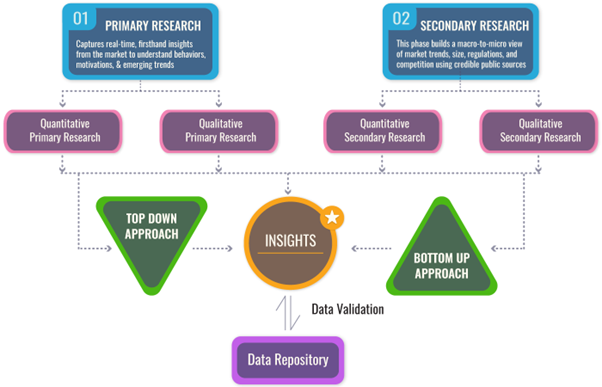
DUAL MODELING: TOP-DOWN + BOTTOM-UP
To ensure robust market estimation, we apply two complementary sizing approaches:
Top-Down Modeling:- Start with broader industry value (e.g., global or regional TAM)
- Apply filters by segment, geography, end-user, or use case
- Adjust with primary insights and validation benchmarks
- Ideal for investor-grade market scans and opportunity mapping
- Aggregate from the ground up using sales volumes, pricing, and unit economics
- Use internal modeling templates aligned with stakeholder data
- Incorporate distributor-level or region-specific inputs
- Most accurate for emerging segments and granular sub-markets
DATA VALIDATION: IN-HOUSE REPOSITORY
We close the loop with proprietary data intelligence built from ongoing projects, industry monitoring, and historical benchmarking. This repository includes:
- Multi-sector market and pricing models
- Key trendlines from past interviews and forecasts
- Benchmarked adoption rates, churn patterns, and ROI indicators
- Industry-specific deviation flags and cross-check logic
- Catches inconsistencies early
- Aligns projections across studies
- Enables consistent, high-trust deliverables