

Anti-Pollution Nasal Spray Market Size and Forecast (2026–2034), Global and Regional Growth, Trend, Share and Industry Analysis Report Coverage: By Product (Pollution Defense/Barrier Nasal Sprays, Saline Cleansing Nasal Sprays, Moisturizing & Hydrating Nasal Sprays, Symptomatic Relief Nasal Sprays (for pollution-induced nasal irritation/congestion), Herbal & Natural Nasal Sprays, and Others), By Distribution Channel (Online/E-commerce, Retail Pharmacies & Drug Stores, Hospital Pharmacies, Supermarkets & Hypermarkets, Specialty Health Stores, and Others) and Geography
2026-08-10
Healthcare
Swetal (Research Analyst)
Description
Anti-Pollution Nasal Spray Market
Overview
The global
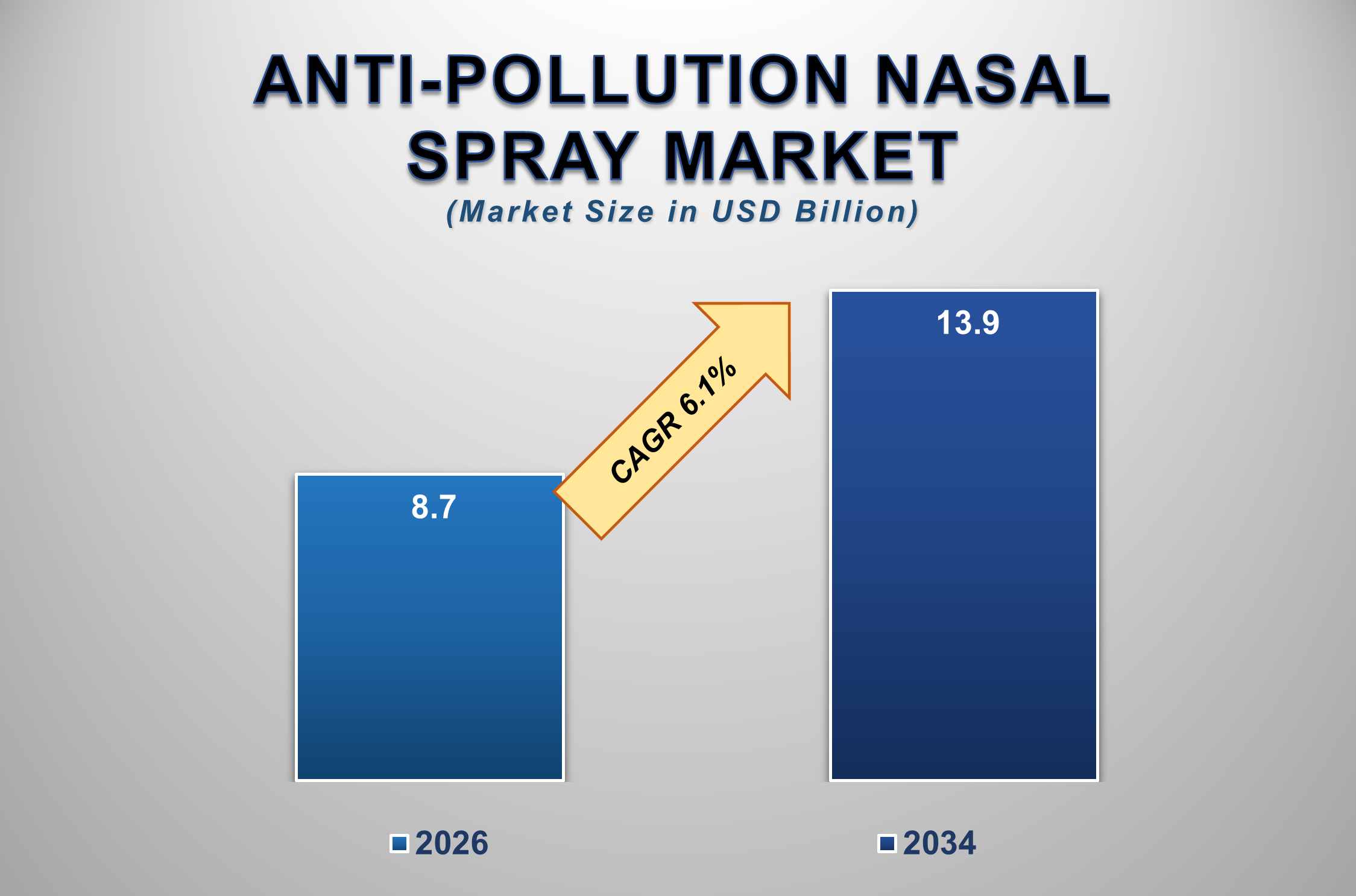
anti-pollution nasal spray market was valued at USD 8.7 billion in 2026 and is
projected to reach USD 13.9 billion by 2034, expanding at a CAGR of 6.1% during
the forecast period. The anti-pollution
nasal spray market includes nasal spray items that help shield, clean, and
humidify nasal cavities from airborne pollutants like dust, particulate matter,
smoke, allergens, and environmental irritants. Barrier nasal mist creates a
protective barrier on the nasal membranes, saline nasal irrigation spray washes
out pollutants, humidifying nasal mist ensures the humidification of the nasal
membranes, and relief nasal mist eases the discomfort and congestion that arise
from bad air. As urban air pollution is on the rise, the incidence of
respiratory and allergic diseases increases, and the number of people aware of
preemptive respiratory healthcare is growing, the market is being stimulated.
Developments of innovative, effective products that contain Natural Components,
Preservative-Free formulas, and improved barrier technologies are also
facilitating expansion of the market.
Anti-Pollution Nasal Spray Market
Drivers and Opportunities
Rising Air Pollution and
Respiratory Health Concerns are Driving Market Growth
One of the most
important factors that drives the growth of the anti-pollution nasal spray
market is the increasing incidence of air pollution and its negative effect on
the health of respiratory organs. The rising use of air pollutants, including
airborne particles (PM2.5 and PM10), discharge from industries, vehicle
exhaust, dust, and gases, is a cause of a significant increase in respiratory
irritation, allergic rhinitis, nasal congestion, and other diseases of the
upper respiratory system seen among people living in urban areas. The worsening
air quality in developed and developing regions leads consumers to start to buy
products that protect them from inhalation of airborne pollutants. As per the
World Health Organization (WHO) (2026), close to 2.1 billion people are
affected by unsafe levels of household air pollution arising from the use of
polluting open fires and simple cooking stoves that burn either kerosene,
biomass (wood, dung of animals, and agricultural residue), or coal. Exposure to
such pollutants is linked to a higher risk of developing respiratory problems,
inflammation of the nose, and respiratory impairment. With rising awareness
about the negative health effects of indoor as well as outdoor air pollution,
consumers are demanding preventive measures for reducing exposure to
pollutants. This trend is leading to the use of anti-pollution nasal sprays, as
these products create a shield against air pollutants, keep the nose hydrated,
and reduce irritation due to these pollutants. The rise in air pollution across
the globe will thus continue to fuel the growth of the anti-pollution nasal
spray market.
Growing Consumer
Preference for Preventive and OTC Respiratory Care Fueling Market Expansion
A growing number of
consumers are emphasizing prevention in healthcare as well as self-care, which
has boosted the demand for nasal sprays that prevent the effects of pollution
on the body. Increased understanding of the medical challenges with air pollution
has led consumers to take preventative measures and to use respiratory care
products before they experience symptoms. Anti-pollution nasal sprays are
gaining in popularity because many consider that they help to clear up the
nose, reduce exposure to pollution, and hydrate the nasal cavity. The fact that
these sprays may easily be found over the counter (OTC) in pharmacies, shops,
and online stores has given consumers the chance to access them more easily and
engage in self-treatment.
Expansion of
Natural and Barrier-Forming Nasal Spray Innovations Presents Significant
Opportunities
The rising need for
natural and drug-free methods of respiratory care benefits the anti-pollution
nasal spray market. The manufacturers are emphasizing new barrier formulations
made of natural substances, including saline, seawater, plant extracts, and cellulose
polymers, leading to the development of barrier films in the nose that prevent
the entry of pollutants, allergens, and particulate matter. As customers are
increasingly choosing natural and safe products to be used regularly, the
market will grow owing to constant improvement of the products and fast
expansion in its distribution through retail and online sources.
Anti-Pollution Nasal Spray Market
Scope
|
Report Attributes |
Description |
|
Market Size in 2026 |
USD 8.7 Billion |
|
Market Forecast in 2034 |
USD 13.9 Billion |
|
CAGR % 2026-2034 |
6.1% |
|
Base Year |
2025 |
|
Historic Data |
2021-2025 |
|
Forecast Period |
2026-2034 |
|
Report USP |
Pricing and Cost Structure Analysis, Product
Innovation Benchmarking, Whitespace Assessment, Company Share, Company
Heatmap, Growth Factors, and more |
|
Segments Covered |
●
By
Product Type ●
By
Distribution Channel |
|
Regional Scope |
●
North
America ●
Europe ●
APAC ●
Latin
America ●
Middle
East and Africa |
|
Country Scope |
●
U.S. ●
Canada ●
U.K. ●
Germany ●
France ●
Italy ●
Spain ●
Russia ●
China ●
India ●
Japan ●
South
Korea ●
Australia
●
Mexico ●
Brazil ●
Saudi
Arabia ●
UAE ●
South
Africa
|
Anti-Pollution Nasal Spray Market
Report Segmentation Analysis
The global
anti-pollution nasal spray market industry analysis is segmented by product, by
distribution channel, and by region.
Pollution
Defense/Barrier Nasal Sprays Segment Is Expected to Dominate the Anti-Pollution
Nasal Spray Market During the Forecast Period
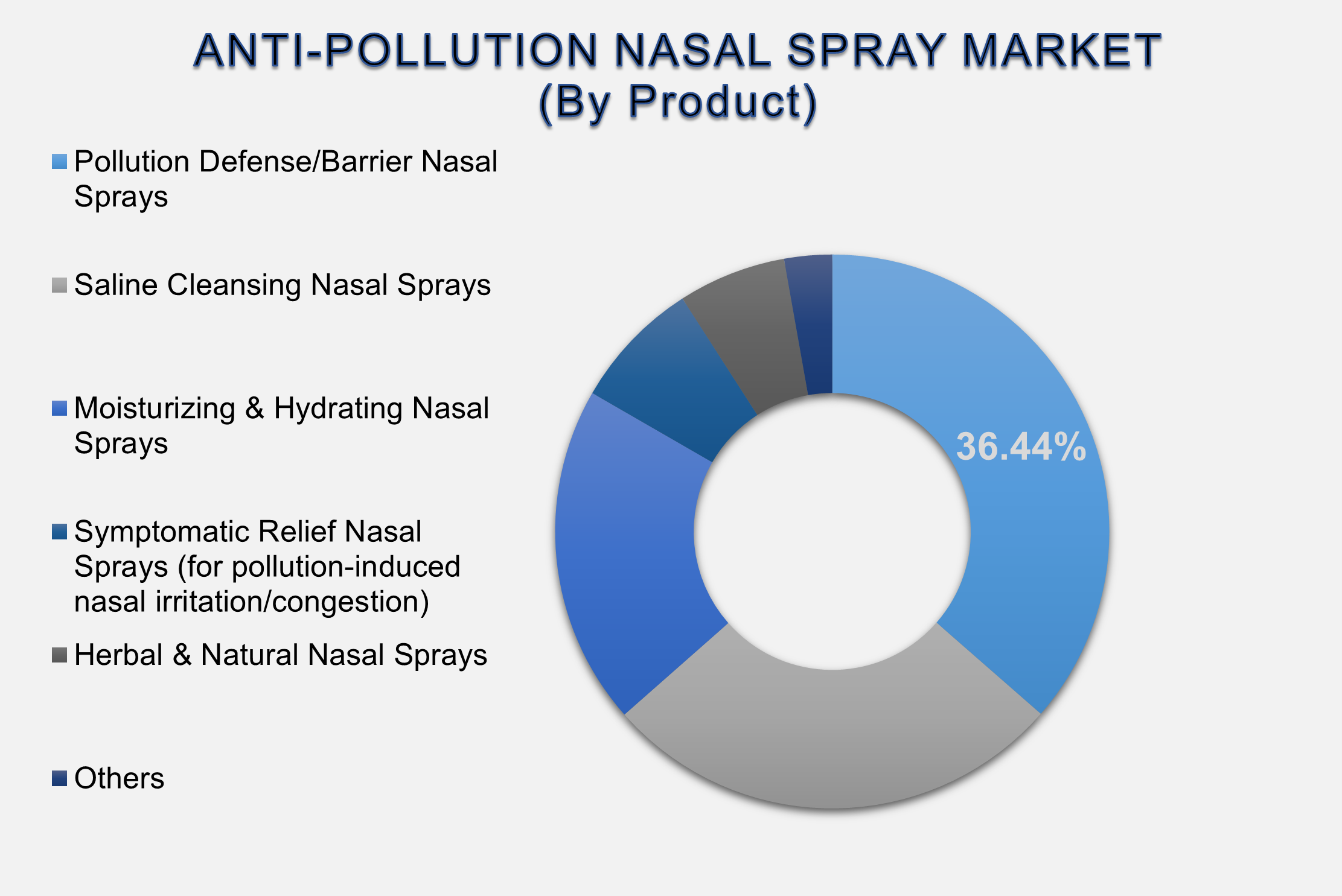
The pollution
defense/barrier nasal sprays category is projected to hold the highest share of
the anti-pollution nasal sprays market throughout the period covered by the
forecast. The reason for the growth of this market segment is attributed to the
growing consumer awareness about the dangers of air pollution and the
increasing preference for preventive care for respiratory problems. Nasal
sprays work by creating a barrier that prevents the particles in the air from
entering the respiratory system. Another factor contributing to the growth of
the sector is the rapid urbanization and decline in air quality, as well as the
increasing access to various chemical-free and natural product options.
Hospital
Pharmacies Segment Is Expected to Lead the Anti-Pollution Nasal Spray Market by
Distribution Channel
During the duration of the forecast period, it
is projected that the anti-pollution nasal spray market will be dominated by
the hospital pharmacies segment, due to the rise in prevalence of respiratory
diseases and increasing hospitalizations due to pollution-related illnesses, as
well as increasing dependence on medical professionals for treatment advice.
Hospital pharmacies constitute an important distribution network for the
clinically recommended nasal sprays, where the product would be guaranteed to be
genuine and obtainable. Moreover, the growing awareness concerning preventive
healthcare practices and expansion in healthcare infrastructure are also likely
to strengthen the segment growth.
The following
segments are part of an in-depth analysis of the global anti-pollution nasal
spray market:
|
Market Segments |
|
|
By Product |
●
Pollution
Defense/Barrier Nasal Sprays ●
Saline
Cleansing Nasal Sprays ●
Moisturizing
& Hydrating Nasal Sprays ●
Symptomatic
Relief Nasal Sprays (for pollution-induced nasal irritation/congestion) ●
Herbal &
Natural Nasal Sprays ●
Others |
|
By Distribution Channel |
●
Online/E-commerce ●
Retail
Pharmacies & Drug Stores ●
Hospital
Pharmacies ●
Supermarkets
& Hypermarkets ●
Specialty
Health Stores ●
Others |
Anti-Pollution Nasal Spray Market
Share Analysis by Region
North America is
projected to hold the largest share of the global anti-pollution nasal spray
market over the forecast period
North America is
expected to have the largest share of the global anti-pollution nasal spray
market during the forecast period. This is due to various factors, including a
high level of public awareness of respiratory health, increasing exposure to
air pollutants and allergens, as well as a strong requirement for novel
formulations. The development of the market is further aided by an advanced
pharmaceutical industry as well as favorable legislation. As an example, ARS
Pharmaceuticals, Inc. announced in August 2024 that its neffy (epinephrine
nasal spray) 2 mg is approved by the U.S. FDA for treating Type I allergic
reactions, including anaphylaxis among adults and children with body weight of
at least 30 kilograms. Although Neffy treats allergic reactions rather than
pollution-related issues, the FDA’s regulation is indicative of the support of
the organization for modern technologies connected with nasal spray products
and growing confidence in delivering drugs through the intranasal route.
Anti-Pollution
Nasal Spray Market Competition Landscape Analysis
The competitive
landscape of the anti-pollution nasal spray market features manufacturers
involved in the production and promotion of nasal sprays that safeguard the
nasal cavity from airborne contaminants. The use of these products is
widespread among urban residents, commuters, workers exposed to industrial
waste, and those suffering from pollution-linked respiratory issues. Companies
in this industry are vying for dominance by developing products that utilize
new technology and fresh ingredients in the production of various formulations.
Global
Anti-Pollution Nasal Spray Market Recent Developments News:
●
In March 2026
- Sandoz Group AG, through its Hexal subsidiary, introduced a fixed-dose
combination azelastine-fluticasone nasal spray in Germany and Switzerland,
addressing the needs of approximately 15 million allergy sufferers in Germany
during the spring allergy season.
●
In March 2026
- Glenmark Pharmaceuticals Limited
(Glenmark) received final approval by the United States Food & Drug
Administration (U.S. FDA) for Fluticasone Propionate Nasal Spray USP, 50 mcg
per spray (OTC).
●
March 2026 -
Beijing Grand Jiuhe Pharmaceutical launched Ryaltris for the treatment of
allergic rhinitis in China, introducing the product across six cities with the
participation of more than 60 experts from multiple medical specialties.
The global
Anti-Pollution Nasal Spray Market is dominated by a few large companies, such
as
●
NeilMed Pharmaceuticals, Inc.
●
Xlear, Inc.
●
Nasaleze International Limited
●
Church & Dwight Co., Inc.
●
Bayer AG
●
Cipla Limited
●
Dr. Reddy's Laboratories Ltd.
●
Sun Pharmaceutical Industries Limited
●
Bausch Health Companies Inc.
●
Aurena Laboratories AB
●
B.F. Ascher and Company, Inc.
●
Himalaya Wellness Company
●
Jadran-Galenski laboratorij d. d.
●
Haleon plc
●
GSK plc
●
Viatris Inc.
●
Laboratoires Fumouze (Stérimar)
●
Gerolymatos International S.A. (Sinomarin)
●
Laboratoire de la Mer (Physiomer)
●
Humer (Urgo Group)
●
Sun Pharmaceutical Industries Limited
●
The Arm and Hammer Company
●
Xlear, Inc.
● Other Prominent Players
Frequently Asked Questions
Swetal (Research Analyst)
Swetal is a Research Analyst with 4+ years of experience specializing in healthcare market research, medical devices, healthcare IT, and medical technology industry analysis. Her expertise includes competitive intelligence, secondary research, market trend forecasting, and healthcare business insights across global healthcare ecosystems.
She contributes to advanced market research reports by analyzing regulatory frameworks, emerging healthcare technologies, competitive landscapes, and innovation trends shaping the medical industry. With a strong focus on accurate market intelligence, strategic insights, and healthcare industry trends, Swetal supports businesses in making informed, data-backed decisions in a rapidly transforming healthcare environment.
1.
Global
Anti-Pollution Nasal Spray Market Introduction and Market Overview
1.1. Objectives of the Study
1.2. Market Segmentation
1.2.1.Product of the Global Anti-Pollution
Nasal Spray Market
1.2.2.Distribution Channel of the
Global Anti-Pollution Nasal Spray Market
1.2.3.Region of the Global Anti-Pollution
Nasal Spray Market
1.3. Competition Coverage List of
Market Participants
1.4. Market Definition: Anti-Pollution
Nasal Spray Market
2.
Executive Summary
2.1. Global Anti-Pollution Nasal
Spray Market Estimation & Forecast
2.1.1.Global Anti-Pollution Nasal
Spray Market Size (US$ Million) Estimates & Historical Trend Analysis (2021
- 2025)
2.1.2.Global Anti-Pollution Nasal
Spray Overall Market Size (US$ Million), Growth Rate (Y-o-Y), Market CAGR (%),
Market Forecast (2026 - 2034)
2.2. Snapshot of Global Anti-Pollution
Nasal Spray Market
2.3. Global Anti-Pollution Nasal
Spray Market Revenue Share (%) 2025
2.4. REGIONAL OUTLINE: Revenue CAGR,
by Region
2.5. Key Competitors & Key
Insights
3.
Market Overview (Qualitative
Analysis)
3.1. Demand Side Trends
3.2. Supply Side Trends /
Manufacturing Trends
3.3. Demand and Opportunity
Assessment, 2026 - 2034
3.4. Market Dynamics
3.4.1.Drivers
3.4.2.Limitations
3.4.3.Opportunities
3.4.4.Impact Analysis of Drivers and
Restraints
3.5. Key Developments
3.6. Regulatory Landscape
3.7. Pricing Analysis
3.8. Supply Chain Analysis
3.9. Porter’s Five Forces Analysis
3.9.1.Bargaining Power of Suppliers
3.9.2.Bargaining Power of Buyers
3.9.3.Threat of Substitutes
3.9.4.Threat of New Entrants
3.9.5.Competitive Rivalry
3.10. PEST Analysis
3.10.1. Political Factors
3.10.2. Economic Factors
3.10.3. Social Factors
3.10.4. Technology Factors
4.
Global Anti-Pollution Nasal
Spray Market Estimates & Forecast Trend Analysis, by Product
4.1. Global Anti-Pollution Nasal
Spray Market Assessments & Key Findings, by Product
4.2. Global Anti-Pollution Nasal
Spray Market Revenue (US$ Million) Estimates and Forecasts, by Product, 2021 -
2034
4.2.1.Pollution Defense/Barrier Nasal
Sprays
4.2.2.Saline Cleansing Nasal Sprays
4.2.3.Moisturizing & Hydrating
Nasal Sprays
4.2.4.Symptomatic Relief Nasal Sprays
(for pollution-induced nasal irritation/congestion)
4.2.5.Herbal & Natural Nasal
Sprays
4.2.6.Others
5.
Global Anti-Pollution Nasal
Spray Market Estimates & Forecast Trend Analysis, by Distribution Channel
5.1. Global Anti-Pollution Nasal
Spray Market Assessments & Key Findings, by Distribution Channel
5.2. Global Anti-Pollution Nasal
Spray Market Revenue (US$ Million) Estimates and Forecasts, by Distribution
Channel, 2021 - 2034
5.2.1.Online/E-commerce
5.2.2.Retail Pharmacies & Drug
Stores
5.2.3.Hospital Pharmacies
5.2.4.Supermarkets & Hypermarkets
5.2.5.Specialty Health Stores
5.2.6.Others
6.
Global Anti-Pollution Nasal Spray
Market Estimates & Forecast Trend Analysis, by Region
6.1.
Global
Anti-Pollution Nasal Spray Market Assessments & Key Findings, by Region
6.2.
Global
Anti-Pollution Nasal Spray Market Revenue (US$ Million) Estimates and
Forecasts, by Region, 2021 - 2034
6.2.1.North America
6.2.2.Europe
6.2.3.Asia Pacific
6.2.4.Middle East & Africa
6.2.5.Latin America
7.
North
America Anti-Pollution Nasal Spray Market: Estimates & Forecast Trend Analysis
7.1. North America Anti-Pollution
Nasal Spray Market Assessments & Key Findings
7.1.1.North America Anti-Pollution
Nasal Spray Market Introduction
7.1.2.North America Anti-Pollution
Nasal Spray Market Size Estimates and Forecast (US$ Million) (2021 - 2034)
7.1.2.2. By Distribution Channel
7.1.2.3. By Country
7.1.2.3.1. The U.S.
7.1.2.3.2. Canada
8.
Europe
Anti-Pollution Nasal Spray Market: Estimates & Forecast Trend Analysis
8.1. Europe Anti-Pollution Nasal
Spray Market Assessments & Key Findings
8.1.1.Europe Anti-Pollution Nasal
Spray Market Introduction
8.1.2.Europe Anti-Pollution Nasal
Spray Market Size Estimates and Forecast (US$ Million) (2021 - 2034)
8.1.2.1. By Product
8.1.2.2. By Distribution Channel
8.1.2.3. By Country
8.1.2.3.1.
Germany
8.1.2.3.2.
Italy
8.1.2.3.3.
U.K.
8.1.2.3.4.
France
8.1.2.3.5.
Spain
8.1.2.3.6.
Switzerland
8.1.2.3.7. Rest
of Europe
9.
Asia
Pacific Anti-Pollution Nasal Spray Market: Estimates & Forecast Trend Analysis
9.1. Asia Pacific Market Assessments
& Key Findings
9.1.1.Asia Pacific Anti-Pollution
Nasal Spray Market Introduction
9.1.2.Asia Pacific Anti-Pollution
Nasal Spray Market Size Estimates and Forecast (US$ Million) (2021 - 2034)
9.1.2.1. By Product
9.1.2.2. By Distribution Channel
9.1.2.3. By Country
9.1.2.3.1. China
9.1.2.3.2. Japan
9.1.2.3.3. India
9.1.2.3.4. Australia
9.1.2.3.5. South Korea
9.1.2.3.6. Rest of Asia Pacific
10. Middle East & Africa Anti-Pollution
Nasal Spray Market: Estimates &
Forecast Trend Analysis
10.1. Middle East & Africa Market
Assessments & Key Findings
10.1.1. Middle
East & Africa Anti-Pollution
Nasal Spray Market Introduction
10.1.2. Middle
East & Africa Anti-Pollution
Nasal Spray Market Size Estimates and Forecast (US$ Million) (2021 - 2034)
10.1.2.1. By Product
10.1.2.2. By Distribution Channel
10.1.2.3. By Country
10.1.2.3.1. South Africa
10.1.2.3.2. UAE
10.1.2.3.3. Saudi Arabia
10.1.2.3.4. Rest of MEA
11. Latin America
Anti-Pollution Nasal Spray Market:
Estimates & Forecast Trend Analysis
11.1. Latin America Market Assessments
& Key Findings
11.1.1. Latin America Anti-Pollution
Nasal Spray Market Introduction
11.1.2. Latin America Anti-Pollution
Nasal Spray Market Size Estimates and Forecast (US$ Million) (2021 - 2034)
11.1.2.1. By Product
11.1.2.2. By Distribution Channel
11.1.2.3. By Country
11.1.2.3.1. Brazil
11.1.2.3.2. Mexico
11.1.2.3.3. Argentina
11.1.2.3.4. Rest of LATAM
12. Competition Landscape
12.1. Global Anti-Pollution Nasal
Spray Market Product Mapping
12.2. Global Anti-Pollution Nasal
Spray Market Concentration Analysis, by Leading Players / Innovators / Emerging
Players / New Entrants
12.3. Global Anti-Pollution Nasal
Spray Market Tier Structure Analysis
12.4. Global Anti-Pollution Nasal
Spray Market Concentration & Company Market Shares (%) Analysis, 2025
13. Company Profiles
13.1. NeilMed Pharmaceuticals, Inc.
13.1.1. Company Overview & Key Stats
13.1.2. Financial Performance & KPIs
13.1.3. Product Portfolio
13.1.4. SWOT Analysis
13.1.5. Business Strategy & Recent
Developments
* Similar details would be provided
for all the players mentioned below
13.2. Xlear, Inc.
13.3. Nasaleze International Limited
13.4. Church & Dwight Co., Inc.
13.5. Bayer AG
13.6. Cipla Limited
13.7. Dr. Reddy's Laboratories Ltd.
13.8. Sun Pharmaceutical Industries
Limited
13.9. Bausch Health Companies Inc.
13.10. Aurena Laboratories AB
13.11. B.F. Ascher and Company, Inc.
13.12. Himalaya Wellness Company
13.13. Jadran-Galenski laboratorij d.d.
13.14. Haleon plc
13.15. GSK plc
13.16. Viatris Inc.
13.17. Laboratoires Fumouze (Stérimar)
13.18. Gerolymatos International S.A.
(Sinomarin)
13.19. Laboratoire de la Mer
(Physiomer)
13.20. Humer (Urgo Group)
13.21. Sun Pharmaceutical Industries
Limited
13.22. The Arm and Hammer Company
13.23. Xlear, Inc.
13.24. Other Prominent Players
14. Research
Findings & Conclusion
15. Assumptions & Acronyms Used
16. Research
Methodology
16.1. External Transportation /
Databases
16.2. Internal Proprietary Database
16.3. Primary Research
16.4. Secondary Research
16.5. Assumptions
16.6. Limitations
16.7. Report FAQs
Our Research Methodology
"Insight without rigor is just noise."
We follow a comprehensive, multi-phase research framework designed to deliver accurate, strategic, and decision-ready intelligence. Our process integrates primary and secondary research , both quantitative and qualitative , along with dual modeling techniques ( top-down and bottom-up) and a final layer of validation through our proprietary in-house repository.
PRIMARY RESEARCH
Primary research captures real-time, firsthand insights from the market to understand behaviors, motivations, and emerging trends.
1. Quantitative Primary Research
Objective: Generate statistically significant data directly from market participants.
Approaches:- Structured surveys with customers, distributors, and field agents
- Mobile-based data collection for point-of-sale audits and usage behavior
- Phone-based interviews (CATI) for market sizing and product feedback
- Online polling around industry events and digital campaigns
- Purchase frequency by customer type
- Channel performance across geographies
- Feature demand by application or demographic
2. Qualitative Primary Research
Objective: Explore decision-making drivers, pain points, and market readiness.
Approaches:- In-depth interviews (IDIs) with executives, product managers, and key decision-makers
- Focus groups among end users and early adopters
- Site visits and observational research for consumer products
- Informal field-level discussions for regional and cultural nuances
SECONDARY RESEARCH
This phase helps establish a macro-to-micro understanding of market trends, size, regulation, and competitive dynamics, sourced from credible and public domain information.
1. Quantitative Secondary Research
Objective: Model market value and segment-level forecasts based on published data.
Sources include:- Financial reports and investor summaries
- Government trade data, customs records, and regulatory statistics
- Industry association publications and economic databases
- Channel performance and pricing data from marketplace listings
- Revenue splits, pricing trends, and CAGR estimates
- Supply-side capacity and volume tracking
- Investment analysis and funding benchmarks
2. Qualitative Secondary Research
Objective: Capture strategic direction, innovation signals, and behavioral trends.
Sources include:- Company announcements, roadmaps, and product pipelines
- Publicly available whitepapers, conference abstracts, and academic research
- Regulatory body publications and policy briefs
- Social and media sentiment scanning for early-stage shifts
- Strategic shifts in market positioning
- Unmet needs and white spaces
- Regulatory triggers and compliance impact

DUAL MODELING: TOP-DOWN + BOTTOM-UP
To ensure robust market estimation, we apply two complementary sizing approaches:
Top-Down Modeling:- Start with broader industry value (e.g., global or regional TAM)
- Apply filters by segment, geography, end-user, or use case
- Adjust with primary insights and validation benchmarks
- Ideal for investor-grade market scans and opportunity mapping
- Aggregate from the ground up using sales volumes, pricing, and unit economics
- Use internal modeling templates aligned with stakeholder data
- Incorporate distributor-level or region-specific inputs
- Most accurate for emerging segments and granular sub-markets
DATA VALIDATION: IN-HOUSE REPOSITORY
We close the loop with proprietary data intelligence built from ongoing projects, industry monitoring, and historical benchmarking. This repository includes:
- Multi-sector market and pricing models
- Key trendlines from past interviews and forecasts
- Benchmarked adoption rates, churn patterns, and ROI indicators
- Industry-specific deviation flags and cross-check logic
- Catches inconsistencies early
- Aligns projections across studies
- Enables consistent, high-trust deliverables