

Artificial Flower Market Size and Forecast (2020 - 2033), Global and Regional Growth, Trend, Share and Industry Analysis Report Coverage; Type (Polyester, Plastic, Paper, Nylon, Silk, and Others); Application (Residential and Commercial); Distribution Channel (Online and Offline); and Geography
2026-02-23
Consumer Products
Jaya Bundele (Research Analyst)
Description
Artificial
Flower Market Overview
The global
artificial flower market is experiencing strong growth, driven by rising demand for
durable and low-maintenance decorative solutions, increasing urbanization,
growing disposable incomes, and expanding home décor and event management
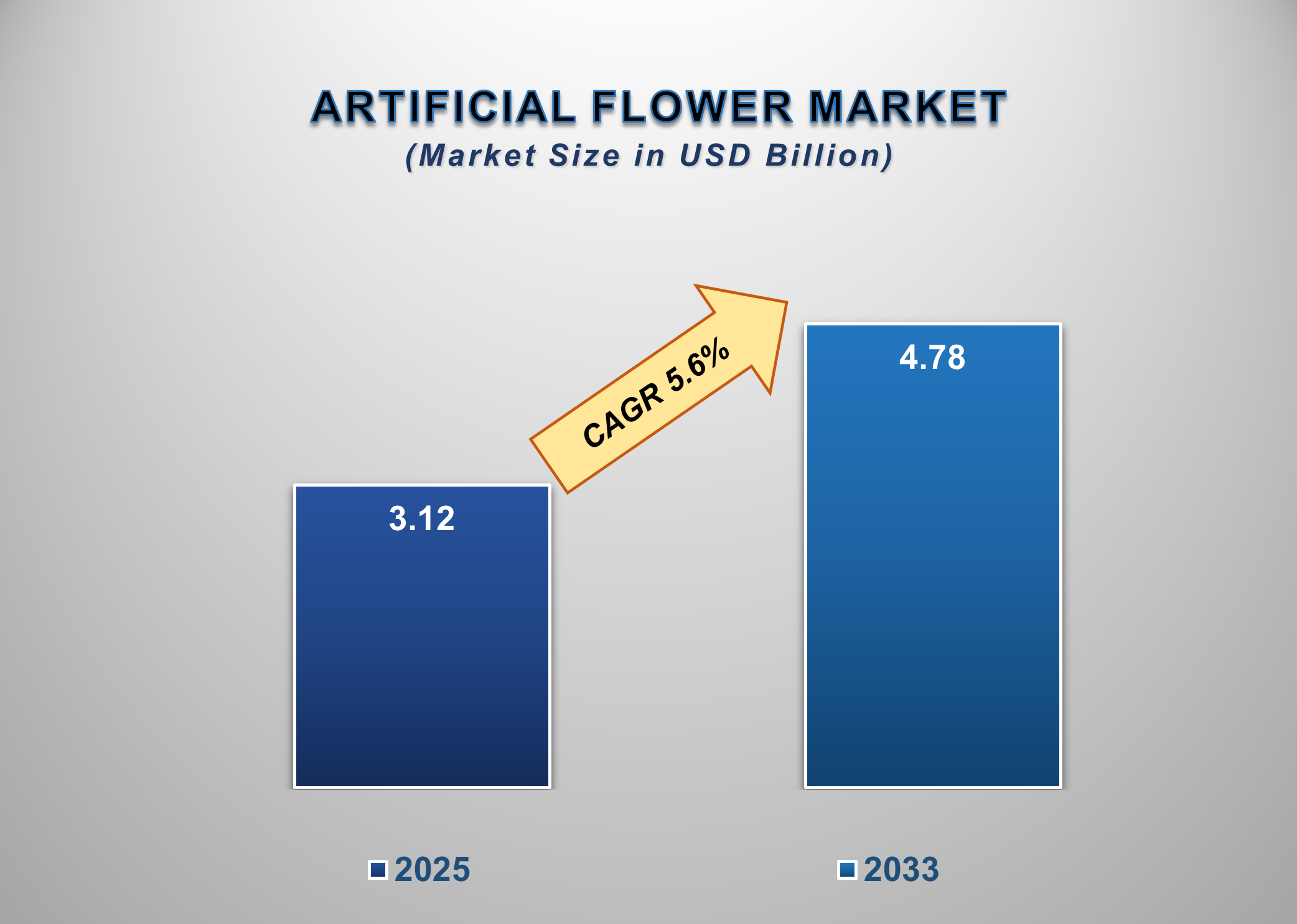
industries. Valued at USD 3.12 billion in 2025, the market is projected
to reach USD 4.78 billion by 2033, growing at a CAGR of 5.6% during the
forecast period.
The growing need for durable, low-maintenance
decorative items for use in residential, commercial, and event settings has
propelled the artificial flower market's recent steady expansion. Due to their
longevity, cost-effectiveness over time, and capacity to retain visual appeal
without the need for water, sunlight, or routine maintenance, artificial
flowers are frequently used in offices, hotels, restaurants, weddings, and
corporate events. Artificial flowers are now more realistic, have a more
consistent texture, and retain their color due to advancements in manufacturing
technologies and materials like polyester, silk, nylon, latex, and premium
plastics.
Key drivers of market expansion are the
expanding urban population, increased disposable income, and growing interest
in interior design. Global trends including DIY décor, house renovation, and
social media impact are encouraging consumers to invest more in aesthetically
pleasant home surroundings. Additionally, artificial flowers are becoming more
and more common in commercial settings where durability and maintenance costs
are important factors, including retail establishments, hospitality venues, and
office buildings.
Artificial flowers are often utilized in
weddings, festivals, exhibits, and corporate events since they are reusable and
available all year round, making the event management sector another
significant driver of market expansion. Additionally, demand is driven by
seasonal decorations, such as holiday décor, especially in North America and
Europe. Additionally, in areas with harsh weather conditions where natural
flowers are either unavailable or have a limited lifespan, artificial flowers
have benefits.
The market for artificial flowers is dominated
by Asia-Pacific, due to China's extensive manufacturing facilities and rising
demand in developing nations like India and Southeast Asia. Significant markets
are also found in North America and Europe, where there is a high demand for
high-end home décor and business interior design. The growing desire for
affordable, environmentally friendly, and aesthetically pleasing decoration
options in both the residential and commercial sectors globally is therefore likely
to support the artificial flower market's continued steady expansion.
Artificial Flower Market Drivers and Opportunities
Growing Demand for Low-Maintenance and Long-Lasting Decorative
Solutions
The growing customer
preference for long-lasting and low-maintenance ornamental products is one of
the main factors propelling the artificial flower market. Artificial
flowers are perfect for hectic urban lifestyles and commercial settings because
they don't need to be watered, exposed to sunlight, or kept at a specific
temperature as actual flowers
do. They provide an extended lifespan, lower replacement costs, and a
year-round uniform appearance. Artificial flowers are preferred by
establishments, including hotels, businesses,
hospitals, and retail stores, in order to
reduce maintenance costs while preserving visual appeal. Artificial flowers
also provide a steady supply because they are not impacted by climate or
seasonal availability. They are a viable substitute for fresh flowers in both
home and commercial settings worldwide due to their dependability and
affordability.
Expansion of the Home Décor and Event Management Industries
The market for artificial
flowers has grown significantly as a result of the rapid growth of the event
planning and home décor sectors. Spending on decorative goods has increased as
a result of urbanization, rising disposable incomes, and growing consumer
interest in interior design. Since artificial flowers are reusable, reasonably
priced, and come in a variety of patterns and hues, they are frequently used in
weddings, corporate gatherings, festivals, and exhibitions. Artificial floral
arrangements have become more popular as a result of social media platforms'
influence on consumers' need for visually appealing interior design.
Furthermore, artificial flowers are being used more and more in commercial
settings like hotels, restaurants, and shopping centers to improve ambience
while preserving long-term aesthetic coherence and cost-effectiveness.
Rising Demand for Sustainable and High-Quality
Artificial Floral Products
The artificial flowers market is expected to
increase significantly as sustainability and eco-friendly products gain more
attention. Manufacturers are increasingly creating artificial flowers with
eco-friendly, recyclable, and biodegradable materials in an effort to lessen
their impact on the environment. Production technology advancements have also
made it possible to create incredibly lifelike artificial flowers that closely
mimic real ones in terms of texture, color, and look. This has increased its acceptability
among premium market sectors and people who care about the environment.
E-commerce platforms' expansion has also increased product accessibility and
global reach, enabling producers to reach new markets. These factors,
especially in developed and rising economies, open doors for market expansion,
product differentiation, and innovation.
Artificial Flower Market Scope
|
Report Attributes |
Description |
|
Market Size in
2025 |
USD 3.12
Billion |
|
Market Forecast
in 2033 |
USD 4.78
Billion |
|
CAGR % 2025-2033 |
5.6% |
|
Base Year |
2024 |
|
Historic Data |
2020-2024 |
|
Forecast Period |
2025-2033 |
|
Report USP |
Comprehensive
global artificial flower market size and forecast analysis, product type
assessment, distribution channel performance evaluation, end-user consumption
trends, regional and country-level market dynamics, competitive landscape,
technological advancements in artificial flower manufacturing, growth
drivers, challenges, opportunities, and strategic insights for manufacturers,
distributors, retailers, and investors |
|
Segments Covered |
●
By Type ●
By
Application ●
By
Distribution Channel |
|
Regional Scope |
●
North
America ●
Europe ●
APAC ●
Latin
America ●
Middle
East and Africa |
|
Country Scope |
1)
U.S. 2)
Canada
3)
U.K. 4)
Germany
5)
France
6)
Italy 7)
Spain 8)
Switzerland
9)
China
10)
India
11)
Japan 12)
South
Korea 13)
Australia 14)
Mexico
15)
Brazil
16)
Argentina
17)
Saudi
Arabia 18)
UAE 19)
South
Africa |
Artificial Flower
Market Report Segmentation Analysis
The global artificial
flower market analysis is segmented by Type, Application, Distribution channel,
and Region.
The Polyester
segment dominated the market in 2025 and is projected to grow at the highest
CAGR during the forecast period.
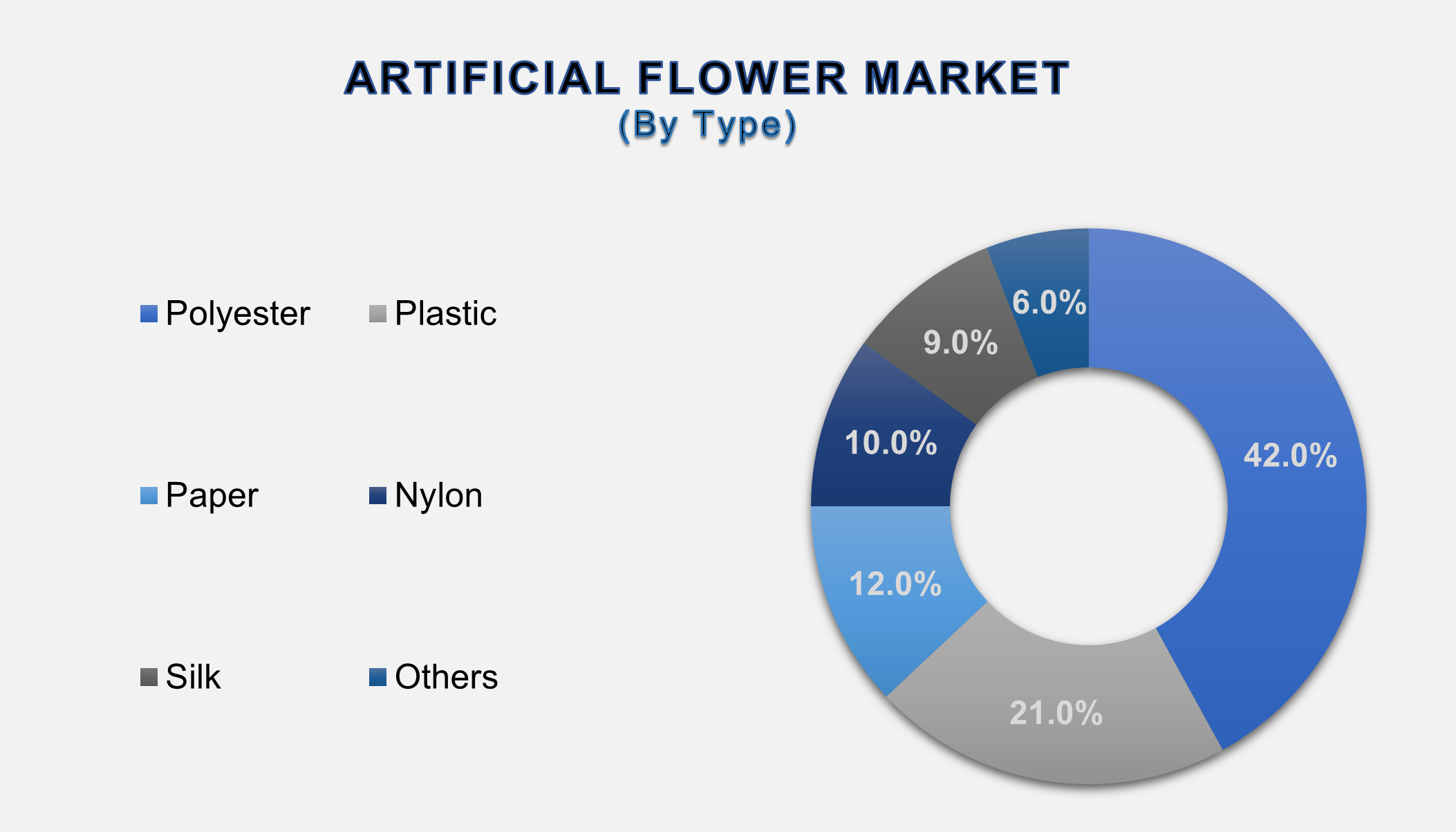
By Type, the
artificial flower market is segmented into polyester, plastic, paper, nylon,
silk, and others. The polyester segment accounts for the largest share of the
global artificial flower market. The most popular material in the artificial
flower industry is polyester, which holds the majority because of its realistic
appearance, flexibility, and durability. Artificial flowers that closely mimic
real flowers in terms of color, texture, and detail can be produced by
manufacturers using polyester materials, which are easily dyed and sculpted.
For long-term indoor and outdoor ornamental uses, the material is appropriate
since it is resistant to wear, fading, and dampness. Polyester is also
affordable and suitable for mass production, which helps producers satisfy the
expanding demand worldwide. Its portability and ease of arrangement are further
benefits of its lightweight design. These benefits have led to the widespread
usage of polyester artificial flowers for events, commercial, and home décor
around the world.
The Commercial
Segment will probably dominate the market during the forecast period
In terms of
Application, the artificial flower market is segmented into residential and
commercial. The commercial segment holds the largest share of the artificial
flower market. Strong demand from sectors like corporate offices, retail,
hospitality, healthcare, and event management is fueling the segment's
expansion. Artificial flowers are used to improve interior aesthetics in
hotels, restaurants, retail centers, and office buildings while lowering
maintenance costs and replacement frequency. Artificial arrangements, in
contrast to actual flowers, are ideal for high-traffic commercial settings
because they maintain their appeal throughout the year and don't need to be
cared for frequently. Additionally, because artificial flowers are affordable
and reusable, they are frequently utilized at business events, weddings, and
exhibitions. This segment's global growth is being supported by the expanding
commercial infrastructure as well as the increased emphasis on interior design
and customer experience.
Offline holds the highest share of the
Distribution Channel Segment over the forecast period
Based on the
Distribution channel, the market is bifurcated into online and offline. The
offline segment accounts for the largest share of the market. Physical retail
establishments like supermarkets, hypermarkets, specialized shops, wholesale
markets, and home décor stores are major contributors to the expansion. The
ability to physically examine the product's quality, texture, color, and
realism before purchase is why consumers favor offline channels. Retail
establishments also offer a large selection, prompt product availability, and
individualized support, all of which improve the entire shopping experience.
Additionally, offline wholesale distributors are frequently used by commercial
purchasers, event coordinators, and interior decorators to make bulk purchases.
The home décor and organized retail sectors' ongoing growth, particularly in
emerging economies, is contributing to the global expansion of the offline
distribution market.
The following
segments are part of an in-depth analysis of the global Artificial Flower
Market:
|
Market Segments |
|
|
By
Type |
●
Polyester ●
Plastic ●
Paper ●
Nylon ●
Silk ●
Others |
|
By
Application |
●
Residential ●
Commercial |
|
By
Distribution channel |
●
Online ●
Offline |
Artificial Flower Market Share Analysis by
Region
The Asia-Pacific
region is projected to hold the largest share of the global Artificial Flower
Market over the forecast period.
Asia-Pacific
is projected to hold the largest share of the global artificial flower market
over the forecast period and is also expected to be the fastest-growing region.
Growing consumer demand and a strong manufacturing base are the primary drivers
of this expansion. China is the world’s largest producer and exporter,
supported by low production costs, a well-established manufacturing
infrastructure, and extensive exports to North America and Europe. Rising
urbanization, an expanding middle class, and increasing interest in interior
design and home décor are driving demand in countries such as India, Japan,
South Korea, and Southeast Asian nations. Additionally, the region’s expanding
hospitality, retail, and event management sectors are contributing to market
growth. The rapid expansion of e-commerce platforms and improved retail
infrastructure has further enhanced product accessibility. Together, these
factors support Asia-Pacific’s leading position and continued growth in the
artificial flower market.
Global
Artificial Flower Market Recent Developments News:
●
In January
2024, RealFlowers introduced a new line of eco-friendly, biodegradable
artificial plants and flowers at the National Home Gardening Show in Chicago,
aligning product strategy with rising sustainability trends among consumers.
●
In March 2024,
Botanic Technologies, a U.S.-based
artificial plant and flower manufacturer, formed a strategic partnership with interior
design firm Studio G to co-create custom artificial plant installations for
commercial design projects, expanding reach into commercial interiors.
●
In August
2024, Nearly Natural launched an expanded eco-friendly artificial plant and flower range using sustainable materials to meet growing
environmentally conscious consumer demand.
The
Global Artificial Flower Market is dominated by a few large companies, such as
●
National Tree
Company, LLC
●
Nearly
Natural, Inc.
●
Vickerman
●
Afloral
●
Dunelm Group
●
IKEA
●
ProFlowers
●
Balsam Hill
●
Blooming
Artificial
●
Greenery
Unlimited
●
Tongxin
Artificial Flowers
●
FuLi Silk
Flower Factory
●
Suqian Hollia
Arts & Crafts
●
J.S. Flower
●
Ngar Tat
●
Qingdao Castle
Industry and Trade Co., Ltd.
●
Qingdao
Yboland Arts and Crafts Co., Ltd.
●
Zhejiang
Ruopei Arts & Crafts Co., Ltd.
●
Zhejiang Jia
Wei Arts And Crafts Co., Ltd.
● Guangzhou Qihao Artificial Arts & Crafts Co., Ltd.
Frequently Asked Questions
Jaya Bundele (Research Analyst)
Jaya Bundele is a skilled Research Analyst with 4+ years of experience in market intelligence, consumer insights, competitive analysis, and industry forecasting across the consumer goods, agriculture, and food & beverage sectors. She specializes in market sizing, trend analysis, growth opportunity mapping, and strategic secondary research for global and regional markets.
Her expertise lies in transforming complex industry data into actionable business strategies that help organizations identify emerging trends, understand customer behavior, and gain a competitive edge. With a strong focus on data-driven insights, business intelligence, and future market trends, Jaya delivers high-quality research solutions aligned with evolving industry demands and market dynamics.
1.
Global Artificial Flower Market Introduction and Market Overview
1.1.
Objectives of the Study
1.2.
Global Artificial Flower Market Scope and Market Estimation
1.2.1.Global Solar
Energy Overall Market Size (US$ Bn), Market CAGR (%), Market forecast (2025 - 2033)
1.2.2.Global Artificial
Flower Market Revenue Share (%) and Growth Rate (Y-o-Y) from 2020 - 2033
1.3.
Market Segmentation
1.3.1.Type of
Global Artificial Flower Market
1.3.2.Application of
Global Artificial Flower Market
1.3.3.Distribution
Channel of Global Artificial Flower Market
1.3.4.Region of
Global Artificial Flower Market
2.
Executive
Summary
2.1.
Demand Side Trends
2.2.
Key Market Trends
2.3.
Market Demand (US$ Bn) Analysis 2020 – 2024 and Forecast, 2025 – 2033
2.4.
Demand and Opportunity Assessment
2.5.
Market Dynamics
2.5.1.Drivers
2.5.2.Limitations
2.5.3.Opportunities
2.5.4.Impact
Analysis of Drivers and Restraints
2.6.
Porter’s Five Forces Analysis
2.7.
PEST Analysis
2.8.
Key Regulation
2.9.
Key Developments
2.10. Value
Chain / Ecosystem Analysis
3.
Global
Artificial Flower Market Estimates & Historical Trend Analysis (2020 - 2024)
4. Global Artificial Flower Market Estimates & Forecast Trend Analysis, by Type
4.1.
Global Artificial Flower Market Revenue (US$ Bn) Estimates and
Forecasts, by Type, 2020 - 2033
4.1.1.Polyester
4.1.2.Plastic
4.1.3.Paper
4.1.4.Nylon
4.1.5.Silk
4.1.6.Others
5. Global Artificial Flower Market Estimates & Forecast Trend Analysis, by Application
5.1.
Global Artificial Flower Market Revenue (US$ Bn) Estimates and
Forecasts, by Application, 2020 - 2033
5.1.1.Residential
5.1.2.Commercial
6. Global Artificial Flower Market Estimates & Forecast Trend Analysis, by Distribution Channel
6.1.
Global Artificial Flower Market Revenue (US$ Bn) Estimates and
Forecasts, by Distribution Channel, 2020 - 2033
6.1.1.Online
6.1.2.Offline
7.
Global
Artificial Flower Market Estimates & Forecast Trend Analysis, by Region
7.1.
Global Artificial Flower Market Revenue (US$ Bn) Estimates and
Forecasts, by Region, 2020 - 2033
7.1.1.North America
7.1.2.Europe
7.1.3.Asia Pacific
7.1.4.Middle East
& Africa
7.1.5.Latin America
8.
North America Artificial
Flower Market: Estimates & Forecast
Trend Analysis
8.1.
North America Artificial Flower Market Assessments & Key
Findings
8.1.1.North America
Artificial Flower Market Introduction
8.1.2.North America
Artificial Flower Market Size Estimates and Forecast (US$ Billion) (2020 - 2033)
8.1.2.1. By Type
8.1.2.2. By Application
8.1.2.3. By Distribution Channel
8.1.2.4.
By Country
8.1.2.4.1.
The U.S.
8.1.2.4.2.
Canada
9.
Europe Artificial
Flower Market: Estimates & Forecast
Trend Analysis
9.1.
Europe Artificial Flower Market Assessments & Key Findings
9.1.1.Europe Artificial
Flower Market Introduction
9.1.2.Europe Artificial
Flower Market Size Estimates and Forecast (US$ Billion) (2020 - 2033)
9.1.2.1. By Type
9.1.2.2. By Application
9.1.2.3. By Distribution Channel
9.1.2.4. By
Country
9.1.2.4.1.
Germany
9.1.2.4.2.
Italy
9.1.2.4.3.
U.K.
9.1.2.4.4.
France
9.1.2.4.5.
Spain
9.1.2.4.6.
Russia
9.1.2.4.7.
Rest
of Europe
10.
Asia Pacific Artificial
Flower Market: Estimates & Forecast
Trend Analysis
10.1. Asia
Pacific Artificial Flower Market Assessments & Key Findings
10.1.1.
Asia Pacific Artificial Flower Market Introduction
10.1.2.
Asia Pacific Artificial Flower Market Size Estimates and Forecast
(US$ Billion) (2020 - 2033)
10.1.2.1. By Type
10.1.2.2. By Application
10.1.2.3. By Distribution Channel
10.1.2.4.
By Country
10.1.2.4.1.
China
10.1.2.4.2.
Japan
10.1.2.4.3.
India
10.1.2.4.4.
Australia
10.1.2.4.5.
South Korea
10.1.2.4.6. Rest
of Asia Pacific
11.
Middle East & Africa Artificial Flower Market:
Estimates & Forecast Trend Analysis
11.1. Middle
East & Africa Artificial Flower Market Assessments & Key Findings
11.1.1.
Middle East & Africa Artificial
Flower Market Introduction
11.1.2.
Middle East & Africa Artificial
Flower Market Size Estimates and Forecast (US$ Billion) (2020 - 2033)
11.1.2.1. By Type
11.1.2.2. By Application
11.1.2.3. By Distribution Channel
11.1.2.4.
By Country
11.1.2.4.1.
UAE
11.1.2.4.2.
Saudi Arabia
11.1.2.4.3.
South Africa
11.1.2.4.4. Rest of MEA
12.
Latin America Artificial
Flower Market: Estimates & Forecast
Trend Analysis
12.1. Latin
America Event Industry Assessments & Key Findings
12.1.1.
Latin America Artificial Flower Market Introduction
12.1.2.
Latin America Artificial Flower Market Size Estimates and Forecast
(US$ Billion) (2020 - 2033)
12.1.2.1. By Type
12.1.2.2. By Application
12.1.2.3. By Distribution Channel
12.1.2.4.
By Country
12.1.2.4.1.
Brazil
12.1.2.4.2.
Mexico
12.1.2.4.3.
Argentina
12.1.2.4.4. Rest of LATAM
13.
Country Wise Market: Introduction
14. Competition
Landscape
14.1. Global
Artificial Flower Market Product Mapping
14.2. Global
Artificial Flower Market Concentration Analysis, by Leading Players /
Innovators / Emerging Players / New Entrants
14.3. Global
Artificial Flower Market Tier Structure Analysis
14.4. Global
Artificial Flower Market Concentration & Company Market Shares (%)
Analysis, 2024
15. Company
Profiles
15.1.
National Tree Company, LLC
15.1.1.
Company Overview & Key Stats
15.1.2.
Financial Performance & KPIs
15.1.3.
Product Portfolio
15.1.4.
SWOT Analysis
15.1.5.
Business Strategy & Recent Developments
*
Similar details would be provided for all the players mentioned below
15.2.
Nearly Natural, Inc.
15.3.
Vickerman
15.4.
Afloral
15.5.
Dunelm Group
15.6.
IKEA
15.7.
ProFlowers
15.8.
Balsam Hill
15.9.
Blooming Artificial
15.10.
Greenery Unlimited
15.11.
Tongxin Artificial Flowers
15.12.
FuLi Silk Flower Factory
15.13.
Suqian Hollia Arts & Crafts
15.14.
J.S. Flower
15.15.
Ngar Tat
15.16.
Qingdao Castle Industry and Trade Co., Ltd.
15.17.
Qingdao Yboland Arts and Crafts Co., Ltd.
15.18.
Zhejiang Ruopei Arts & Crafts Co., Ltd.
15.19.
Zhejiang Jia Wei Arts And Crafts Co., Ltd.
15.20.
Other Prominent Players
16.
Research
Methodology
16.1. External
Transportations / Databases
16.2. Internal
Proprietary Database
16.3. Primary
Research
16.4. Secondary
Research
16.5. Assumptions
16.6. Limitations
16.7. Report
FAQs
17.
Research
Findings & Conclusion
Our Research Methodology
"Insight without rigor is just noise."
We follow a comprehensive, multi-phase research framework designed to deliver accurate, strategic, and decision-ready intelligence. Our process integrates primary and secondary research , both quantitative and qualitative , along with dual modeling techniques ( top-down and bottom-up) and a final layer of validation through our proprietary in-house repository.
PRIMARY RESEARCH
Primary research captures real-time, firsthand insights from the market to understand behaviors, motivations, and emerging trends.
1. Quantitative Primary Research
Objective: Generate statistically significant data directly from market participants.
Approaches:- Structured surveys with customers, distributors, and field agents
- Mobile-based data collection for point-of-sale audits and usage behavior
- Phone-based interviews (CATI) for market sizing and product feedback
- Online polling around industry events and digital campaigns
- Purchase frequency by customer type
- Channel performance across geographies
- Feature demand by application or demographic
2. Qualitative Primary Research
Objective: Explore decision-making drivers, pain points, and market readiness.
Approaches:- In-depth interviews (IDIs) with executives, product managers, and key decision-makers
- Focus groups among end users and early adopters
- Site visits and observational research for consumer products
- Informal field-level discussions for regional and cultural nuances
SECONDARY RESEARCH
This phase helps establish a macro-to-micro understanding of market trends, size, regulation, and competitive dynamics, sourced from credible and public domain information.
1. Quantitative Secondary Research
Objective: Model market value and segment-level forecasts based on published data.
Sources include:- Financial reports and investor summaries
- Government trade data, customs records, and regulatory statistics
- Industry association publications and economic databases
- Channel performance and pricing data from marketplace listings
- Revenue splits, pricing trends, and CAGR estimates
- Supply-side capacity and volume tracking
- Investment analysis and funding benchmarks
2. Qualitative Secondary Research
Objective: Capture strategic direction, innovation signals, and behavioral trends.
Sources include:- Company announcements, roadmaps, and product pipelines
- Publicly available whitepapers, conference abstracts, and academic research
- Regulatory body publications and policy briefs
- Social and media sentiment scanning for early-stage shifts
- Strategic shifts in market positioning
- Unmet needs and white spaces
- Regulatory triggers and compliance impact
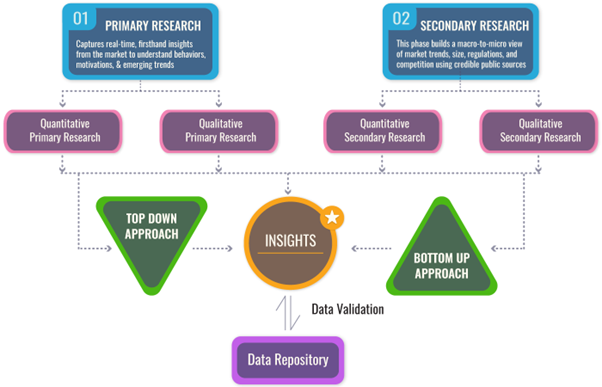
DUAL MODELING: TOP-DOWN + BOTTOM-UP
To ensure robust market estimation, we apply two complementary sizing approaches:
Top-Down Modeling:- Start with broader industry value (e.g., global or regional TAM)
- Apply filters by segment, geography, end-user, or use case
- Adjust with primary insights and validation benchmarks
- Ideal for investor-grade market scans and opportunity mapping
- Aggregate from the ground up using sales volumes, pricing, and unit economics
- Use internal modeling templates aligned with stakeholder data
- Incorporate distributor-level or region-specific inputs
- Most accurate for emerging segments and granular sub-markets
DATA VALIDATION: IN-HOUSE REPOSITORY
We close the loop with proprietary data intelligence built from ongoing projects, industry monitoring, and historical benchmarking. This repository includes:
- Multi-sector market and pricing models
- Key trendlines from past interviews and forecasts
- Benchmarked adoption rates, churn patterns, and ROI indicators
- Industry-specific deviation flags and cross-check logic
- Catches inconsistencies early
- Aligns projections across studies
- Enables consistent, high-trust deliverables