

Asparagus Market Size and Forecast (2026–2034), Global and Regional Growth, Trend, Share and Industry Analysis Report Coverage; By Product Type (Fresh Asparagus, Frozen Asparagus, Canned Asparagus, Processed Asparagus, Others); By Variety (Green Asparagus, White Asparagus, Purple Asparagus, Others); By Farming Method (Conventional Farming, Organic Farming, Controlled Environment Agriculture); By Distribution Channel (Supermarkets and Hypermarkets, Grocery Stores, Specialty Stores, Online Retail, Foodservice and Institutional Distribution, Others); By Application (Household Consumption, Foodservice, Food Processing, Others); and Geography
2026-11-04
Consumer Products
Aishwarya Panbude (Research Analyst)
Description
Asparagus Market Overview
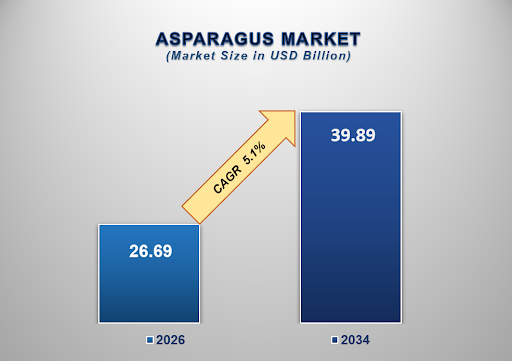
The global Asparagus Market is valued at USD 26.69 billion in 2026 and is projected to reach USD 39.86 billion by 2034, expanding at a CAGR of 5.1% during the forecast period. Market growth is supported by increasing consumer interest in nutritious vegetables, the expanding use of asparagus in contemporary cuisines, growing demand for fresh and convenient food products, the development of processed vegetable offerings, and improvements in cultivation, harvesting, storage, and distribution practices. Asparagus is increasingly incorporated into household meals, restaurant menus, prepared foods, and commercially processed vegetable products, creating demand across fresh-produce and value-added food supply chains.
Asparagus is an edible vegetable obtained primarily from the young shoots of Asparagus officinalis, a perennial plant cultivated for its tender spears. The vegetable is valued for its distinctive flavor, characteristic texture, culinary versatility, and nutritional composition. It can be consumed steamed, roasted, grilled, boiled, sautéed, or incorporated into salads, soups, pasta dishes, rice preparations, and a variety of other recipes. Its versatility allows it to serve both as a principal vegetable ingredient and as a complementary component in prepared meals.
The asparagus market encompasses the cultivation, harvesting, grading, packaging, processing, distribution, and sale of asparagus in different forms. Fresh asparagus constitutes an important part of the market because it is widely used in household cooking, restaurants, hotels, and foodservice operations. Frozen and canned asparagus provide alternatives that can be stored for longer periods under appropriate conditions and used when fresh produce is unavailable, expensive, or less convenient to prepare.
Consumer interest in balanced eating patterns is contributing to the appeal of vegetables that offer a combination of culinary flexibility and nutritional value. Asparagus provides dietary fibre, folate, vitamin K, and other nutrients, although its contribution to an individual's diet depends on serving size and overall food choices. Its inclusion in vegetable-forward meals, plant-focused recipes, and varied dietary patterns supports its position within the broader fresh-produce category.
The increasing popularity of home cooking and recipe experimentation is creating opportunities for asparagus suppliers. Consumers are exploring new ways to prepare vegetables through roasting, grilling, air frying, and combining them with grains, legumes, dairy products, meat, seafood, and plant-based proteins. Asparagus can be incorporated into both simple weekday meals and premium culinary preparations, giving it relevance across different household budgets and eating occasions.
The foodservice industry is another important source of demand. Restaurants, hotels, catering companies, cafés, and institutional kitchens purchase vegetables according to their requirements for freshness, appearance, consistency, preparation time, and cost. Asparagus is used in side dishes, salads, breakfast preparations, pasta, risotto, soups, and seasonal menus. Higher-end restaurants may also use particular spear sizes, varieties, or locally sourced produce to support menu differentiation.
Fresh asparagus requires careful post-harvest handling because its quality can deteriorate when storage and transportation conditions are unsuitable. Harvest timing, temperature management, moisture control, grading, packaging, and transit duration influence the condition of the product delivered to retailers and foodservice customers. Improvements in cold-chain logistics and distribution coordination can help reduce avoidable losses and maintain product quality over longer supply routes.
Seasonality is an important characteristic of asparagus production. Harvesting periods vary by producing country and are influenced by climate, cultivar, cultivation methods, and local growing conditions. Differences in harvest calendars can create opportunities for international trade, allowing importing markets to obtain supplies when domestic production is limited. However, international sourcing also exposes market participants to freight costs, border procedures, weather-related disruptions, and variations in production volumes.
The distinction between green, white, and purple asparagus creates additional product differentiation. Green asparagus develops its color through exposure to sunlight, while white asparagus is cultivated under conditions that limit light exposure. Purple varieties are associated with pigmentation that influences their appearance and, in some cases, flavor characteristics. These varieties may be used differently according to local culinary traditions, consumer familiarity, price positioning, and restaurant requirements.
Production methods also influence the structure of the market. Conventional field cultivation remains an established approach, while organic farming serves consumers seeking products produced under certified organic standards. Controlled-environment cultivation and other protected growing systems may provide opportunities to manage growing conditions, extend production periods, or improve consistency in selected locations. The commercial viability of these methods depends on investment requirements, energy use, labor availability, yields, and achievable selling prices.
Processing creates another route for market expansion. Frozen asparagus can support meal preparation by reducing the need for immediate consumption, while canned products offer ambient storage under appropriate packaging and processing conditions. Other value-added formats may include prepared vegetable mixes, ready-to-cook products, foodservice packs, and asparagus incorporated into soups, sauces, or prepared meals. These formats broaden the potential customer base beyond consumers purchasing fresh spears.
Distribution is becoming increasingly diversified. Traditional produce markets and grocery stores continue to serve local demand, while supermarkets and hypermarkets offer organized purchasing environments and standardized packaging. Online grocery services and direct-to-consumer models provide additional access to fresh and specialty produce, although delivery quality depends on suitable handling, packaging, and logistics. Wholesale distributors and foodservice suppliers remain important for customers purchasing asparagus in commercial quantities.
Sustainability and resource efficiency are also relevant to asparagus production. Growers must manage water availability, soil conditions, fertilizer inputs, pest pressure, labor requirements, and the long-term productivity of perennial crops. Practices such as improved irrigation scheduling, integrated pest management, soil-health management, and efficient handling can help address production challenges. The suitability and benefits of individual practices depend on the local environment and farming system.
Asparagus producers and distributors must also respond to fluctuations in input costs, labor availability, weather conditions, international competition, and retail purchasing requirements. Because fresh produce is perishable, the ability to coordinate harvest volumes with market demand is especially important. Producers that establish reliable buyer relationships, maintain consistent quality, and access efficient distribution systems may be better positioned to manage these challenges.
As demand for diverse vegetable options, convenient food preparation, and value-added produce continues to evolve, the global asparagus market is expected to expand through 2034. Future performance will depend on the balance between consumer demand, production economics, supply-chain efficiency, product quality, and the ability of growers and processors to serve different markets throughout the year.
Asparagus Market Drivers and Opportunities
Growing Interest in Nutritious Foods and Vegetable-Rich Diets Is Supporting Market Growth
Increasing consumer attention to dietary quality is an important factor supporting demand for asparagus and other fresh vegetables. Consumers are showing interest in meals that incorporate a wider variety of vegetables, legumes, whole grains, and other minimally processed ingredients. Asparagus benefits from this broader interest because it can be prepared in multiple ways and included in meals ranging from everyday home cooking to premium restaurant dishes.
The vegetable's nutritional profile contributes to its appeal among consumers seeking variety in their diets. Asparagus provides fiber, folate, vitamin K, and other nutrients that contribute to normal bodily functions. It is also relatively low in calories when prepared without substantial additions of oil, butter, or high-calorie sauces. These characteristics make it suitable for a variety of eating patterns, although the nutritional value of a complete meal depends on the ingredients and preparation methods used.
Food awareness is also being influenced by digital recipe platforms, cooking videos, nutrition-related content, and restaurant menus that introduce consumers to unfamiliar ingredients. These channels can demonstrate practical ways to prepare asparagus, explain differences between varieties, and encourage its use in recipes beyond conventional side dishes. Consumers who previously viewed asparagus as a specialty or restaurant-oriented vegetable may discover additional applications through accessible cooking instructions.
The growing popularity of plant-forward eating is another relevant influence. Consumers do not necessarily need to follow vegetarian or vegan diets to increase their consumption of vegetables. Asparagus can complement fish, poultry, eggs, dairy products, legumes, and plant-based proteins, making it suitable for mixed-diet households and a range of culinary preferences.
Demand from foodservice businesses further supports market development. Restaurants and hotels use asparagus to introduce seasonal ingredients, diversify menu offerings, and improve the visual presentation of dishes. Its recognizable spear shape and distinctive appearance can be useful in plated meals, while its compatibility with different cooking techniques allows chefs to adapt it to local and international cuisines.
However, demand for asparagus depends on more than nutritional awareness alone. Price, freshness, household familiarity, availability, preparation time, and the presence of alternative vegetables influence purchasing decisions. In markets where asparagus is relatively expensive or less familiar, consumer education and accessible pack sizes may help encourage trial.
As awareness of vegetable variety and flexible meal preparation continues to develop, asparagus suppliers can benefit by improving product availability, communicating preparation options, and offering products suited to different consumer preferences. These factors are expected to support the market over the forecast period.
Expansion of Modern Food Retail, Foodservice Demand and Improved Supply Chains Is Driving Market Development
The development of organized food retail is increasing the accessibility of asparagus in markets where consumers have limited access to specialty produce. Supermarkets, hypermarkets, grocery chains, specialty food retailers, and online grocery platforms can provide dedicated fresh-produce sections and standardized packaging that help consumers identify and purchase asparagus more easily.
Modern retail also creates opportunities for suppliers to serve customers who prioritize consistent appearance, product grading, reliable availability, and convenient packaging. Retailers may require specified spear lengths, thickness ranges, freshness standards, packaging formats, and delivery schedules. Producers and distributors that meet these requirements can develop longer-term commercial relationships with organized retailers.
Foodservice demand is expanding the range of purchasing opportunities available to asparagus suppliers. Restaurants, hotels, caterers, and commercial kitchens require dependable deliveries that correspond with their menus and preparation volumes. These customers may purchase fresh asparagus when appearance and texture are central to the dish, while frozen or processed alternatives may be suitable for applications where storage flexibility, standardized portions, or preparation efficiency are more important.
Improvements in cold-chain infrastructure can support the movement of fresh asparagus from production areas to distant consumer markets. Refrigerated transportation, temperature monitoring, suitable packaging, coordinated loading, and efficient distribution schedules help reduce exposure to conditions that may accelerate quality deterioration. Better supply-chain coordination can also help retailers and wholesalers plan replenishment around seasonal production.
International trade is particularly relevant because asparagus production is concentrated in particular growing regions and harvest periods. Exporters can supply markets during periods when domestic production is limited, while importers can diversify their sourcing arrangements. However, international supply chains remain exposed to freight expenses, exchange-rate movements, import requirements, weather-related disruptions, and changes in trade policy.
The growth of online grocery shopping creates additional opportunities for produce suppliers. Digital platforms enable consumers to compare product sizes, origins, prices, and available delivery options. Producers and retailers can also use digital channels to introduce specialty varieties, promote seasonal availability, and provide preparation suggestions. Successful online sales nevertheless require careful attention to delivery timing, packaging, temperature management, and the condition of products received by customers.
The combined influence of modern retail, commercial foodservice demand, international sourcing, and improved logistics is creating opportunities for asparagus suppliers to reach a broader customer base. Companies that coordinate production with purchasing requirements and maintain dependable product quality may be better positioned to benefit from these developments.
Processed Asparagus, Organic Cultivation, and Value-Added Products Create Significant Opportunities
Product diversification presents an important opportunity for businesses operating in the asparagus market. Although fresh asparagus remains central to consumer and foodservice demand, processed formats can address purchasing occasions where longer storage, predictable portions, and preparation convenience are important.
Frozen asparagus is suitable for applications in which consumers want to keep vegetables available without relying on immediate fresh consumption. It can be used in soups, pasta dishes, vegetable mixes, casseroles, and other cooked preparations. Commercial kitchens may also consider frozen products where storage flexibility and portion management are priorities. Product quality depends on the condition of the raw material, processing methods, freezing conditions, packaging, and storage practices.
Canned asparagus provides a different set of advantages. Properly processed and packaged products can be stored at ambient temperatures before opening, subject to the product's instructions. This format can serve consumers, food manufacturers, and institutional buyers seeking shelf-stable ingredients. Texture and flavor differ from those of fresh asparagus, so manufacturers must position canned products for applications in which these characteristics are acceptable.
Organic asparagus offers another area of differentiation. Certified organic production can appeal to consumers who actively seek foods produced under recognized organic standards. However, conversion to organic cultivation may involve changes in soil management, nutrient supply, pest control, certification procedures, and production planning. Growers must assess whether potential price premiums and buyer demand justify the additional operational requirements.
Specialty varieties can also create opportunities. Green asparagus serves broad culinary applications, while white asparagus has established importance in certain European cuisines, and purple varieties may appeal to buyers seeking distinctive color and presentation. Specialty products can be positioned through seasonal promotions, regional culinary traditions, restaurant partnerships, and direct relationships with retailers.
Value-added formats provide further opportunities for processors. Ready-to-cook vegetable packs, mixed vegetables, portioned asparagus, prepared meal ingredients, and foodservice packs can reduce preparation requirements for selected customers. Product developers may also explore asparagus ingredients for soups, sauces, purées, and other processed foods where suitable formulations and processing economics can be established.
Digital marketing and direct distribution can help producers communicate product origin, seasonal availability, cultivation methods, and preparation options. Retailers and foodservice suppliers may also use these channels to coordinate demand and reduce uncertainty surrounding order volumes.
These opportunities depend on market-specific factors, including consumer purchasing power, production costs, processing infrastructure, certification requirements, and access to reliable buyers. Businesses that combine quality management with suitable product formats and efficient distribution may be able to strengthen their market position through 2034.
Asparagus Market Scope
Asparagus Market Report Segmentation Analysis
The global asparagus market is segmented by product type, variety, farming method, distribution channel, application, and region. Product segmentation distinguishes fresh produce from frozen, canned, and other processed formats. Variety segmentation considers the commercial differences between green, white, and purple asparagus. Farming-method segmentation reflects differences between conventional, organic, and controlled-environment production, while distribution and application categories capture the requirements of retail consumers, foodservice businesses, and food processors.
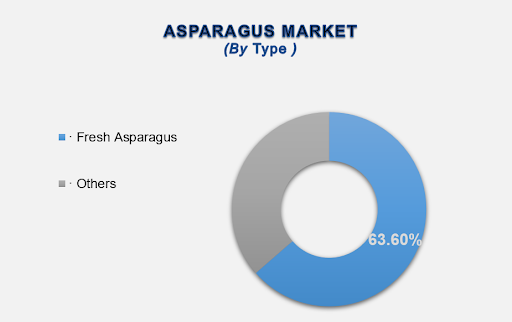
Fresh Asparagus Segment Is Expected to Dominate the Market by Product Type
The Fresh Asparagus segment represents a major product category because fresh spears are widely used in household cooking, restaurants, hotels, and other foodservice applications. Fresh asparagus offers a texture and appearance that are important in preparations where the vegetable is served whole, grilled, roasted, steamed, or incorporated into salads and other dishes.
Fresh products are available through supermarkets, grocery stores, specialty produce retailers, farmers' markets, wholesalers, and direct distribution arrangements. Product selection is often influenced by spear thickness, color, firmness, freshness, pack size, country of origin, and price.
The segment's commercial value depends heavily on post-harvest handling. Asparagus can lose quality when exposed to unsuitable temperatures, excessive moisture loss, or prolonged transportation. Growers, packers, and distributors therefore need to coordinate harvesting, grading, cooling, packaging, and delivery schedules.
Retailers may prefer standardized bundles or packaged spears that provide a consistent appearance and reduce handling requirements. Foodservice customers may have additional specifications based on the intended dish, portion size, preparation method, and required delivery frequency.
Seasonality can create both opportunities and challenges. Domestic production may offer fresh supplies during local harvest periods, while imports can supplement availability at other times of the year. Price and supply conditions can consequently vary with weather, production volumes, labor availability, and international transportation costs.
Fresh asparagus is expected to remain an important market segment because of its versatility, established culinary uses, and relevance to retail and foodservice channels.
Fresh Asparagus
Fresh asparagus is marketed primarily as whole spears that require refrigeration and appropriate handling to preserve quality. Product specifications can vary according to colour, spear length, thickness, straightness, firmness, and visible condition.
Household buyers commonly use fresh asparagus for roasting, steaming, grilling, stir-frying, and incorporating into mixed vegetable dishes. Restaurants may select specific spear sizes according to plating requirements and preparation methods.
Freshness and appearance strongly influence purchasing decisions because deterioration can affect texture, colour, and consumer acceptance. Producers and distributors therefore depend on suitable packaging, temperature management, and timely delivery.
Frozen Asparagus
Frozen asparagus is processed to provide a convenient alternative to fresh produce. The product is generally prepared through cleaning, trimming, and other suitable processing steps before freezing and packaging.
Frozen formats can support household meal preparation by allowing consumers to store asparagus for later use. Food manufacturers and commercial kitchens may also purchase frozen products for soups, prepared meals, vegetable mixes, sauces, and cooked dishes.
The segment benefits from storage convenience and the ability to separate consumption from the immediate harvesting season. However, product texture after thawing or cooking differs from that of fresh asparagus, influencing its suitability for particular recipes.
Canned Asparagus
Canned asparagus is processed and packaged to provide a shelf-stable product under appropriate storage conditions. Its convenience can appeal to households, institutional buyers, and foodservice operators seeking ingredients that do not require refrigerated storage before opening.
Canned asparagus can be used in salads, cooked dishes, prepared meals, and other recipes in which its softer texture is appropriate. Manufacturers compete through pack sizes, product grading, ingredient specifications, packaging, and price.
The segment is influenced by the availability and cost of suitable raw asparagus, processing capacity, packaging expenses, and demand from retail and commercial buyers.
Processed Asparagus
The processed asparagus category includes products beyond the principal frozen and canned formats, depending on how market participants classify their portfolios. These may include prepared asparagus, vegetable mixtures, purées, dehydrated ingredients, and other processed preparations.
Such products can be designed for food manufacturing, commercial kitchens, convenience-oriented meal preparation, and selected specialty applications.
Processing can create additional commercial uses for asparagus that may not meet the appearance requirements of the fresh retail market, provided the raw material remains suitable for the intended application and meets applicable food-safety standards.
Others
Other product formats may include ready-to-cook asparagus packs, trimmed spears, portioned products, and specialized foodservice preparations.
These products are intended to reduce handling or preparation requirements for particular buyers. Their adoption depends on product quality, packaging performance, storage conditions, consumer demand, and the additional cost associated with processing and convenience.
Green Asparagus Segment Is Expected to Represent a Major Share by Variety
The Green Asparagus segment is an important part of the market because green spears are widely used in household meals, restaurants, and commercial food preparation. Their familiar appearance and suitability for multiple cooking techniques support their availability across different retail and foodservice channels.
Green asparagus is generally grown with exposure to sunlight, which supports chlorophyll development. Its flavor and texture vary with cultivar, maturity, growing conditions, spear thickness, and post-harvest handling.
The variety is suitable for grilling, roasting, steaming, stir-frying, and incorporation into pasta, salads, and vegetable-based dishes. These uses provide opportunities for both everyday grocery sales and premium culinary applications.
Retail demand depends on product freshness, visual quality, price, and seasonal availability. Foodservice customers may also require consistent spear sizes and quality specifications for menu preparation.
White Asparagus Segment Is Supported by Specialty Culinary Demand
The White Asparagus segment serves markets and consumers with established preferences for white spears, particularly in parts of Europe. White asparagus is cultivated using methods that restrict light exposure, limiting the development of green pigmentation.
The product is associated with particular seasonal dishes and regional culinary traditions. Its preparation may involve peeling, trimming, and cooking methods suited to its characteristics.
White asparagus can command a different price from green asparagus depending on labour requirements, cultivation practices, seasonal availability, and local demand. Its market position is also influenced by the availability of suitable cultivars and the ability of producers to maintain consistent quality.
Restaurants, specialty retailers, and seasonal food markets provide important channels for white asparagus, particularly where consumer familiarity is high.
Purple Asparagus Segment Offers Opportunities for Specialty Products
The Purple Asparagus segment provides an alternative to conventional green and white varieties. Its pigmentation gives the spears a distinctive appearance that can appeal to consumers and chefs seeking visual differentiation in meals.
Purple asparagus may be used in salads, vegetable dishes, and selected culinary preparations. Its color and flavor characteristics vary according to the variety and the way the vegetable is prepared.
The segment remains dependent on cultivar availability, production suitability, consumer awareness, and access to appropriate retail and foodservice channels. Specialty marketing and culinary education can help communicate the differences between purple asparagus and more familiar varieties.
Conventional Farming Segment Is Expected to Maintain an Important Market Position
The Conventional Farming segment includes asparagus produced through established agricultural systems using farming inputs and practices permitted under the applicable regulatory framework.
Conventional cultivation serves both domestic and export markets and can benefit from established production knowledge, commercial growing infrastructure, and access to standard distribution networks.
Growers must manage soil conditions, water availability, weeds, pests, disease pressure, fertilization, harvesting, and labor requirements. Production performance can vary considerably according to climate, cultivar, farm management, and the age and condition of the crop.
Conventional asparagus may be sold through wholesale markets, supermarkets, foodservice distributors, processors, and export channels. The segment's competitiveness depends on yield, product quality, production cost, and the ability to meet buyer specifications.
Organic Farming Segment Is Creating Opportunities for Differentiated Produce
The Organic Farming segment serves buyers seeking asparagus produced in accordance with applicable organic certification requirements.
Organic production typically involves specific requirements for soil management, nutrient sources, pest management, permitted inputs, recordkeeping, and certification. Growers must assess these requirements against local growing conditions, expected yields, labor needs, and the price premiums available in target markets.
Certified organic asparagus may appeal to consumers who actively seek organic produce and to retailers that maintain dedicated organic product ranges. Restaurants and specialty food retailers can also provide distribution opportunities where customer demand supports the additional production and handling requirements.
Clear labeling and reliable certification are important because consumers and buyers need to distinguish verified organic products from products using broader, unverified environmental descriptions.
Controlled Environment Agriculture Segment Offers Production Opportunities
The Controlled Environment Agriculture segment covers production approaches that use protected or managed growing environments to influence selected cultivation conditions.
Depending on the system, protected structures and controlled environments may help producers manage temperature, moisture, and other growing variables. Such methods can create opportunities for production scheduling or improved consistency in locations where outdoor conditions are challenging.
However, asparagus is a perennial crop, and commercial feasibility depends on factors including establishment costs, suitable cultivars, growing-system design, energy requirements, labor, yields, and the time required to generate productive harvests.
Controlled-environment production is therefore best evaluated according to the characteristics of the specific farming system rather than assumed to be more efficient or economical in every market.
Supermarkets and Hypermarkets Segment Is Expected to Remain an Important Distribution Channel
The Supermarkets and Hypermarkets segment provides consumers with access to asparagus alongside other fresh vegetables, fruit, and grocery products.
Organized retailers can offer standardized displays, packaged produce, promotional pricing, and multiple purchasing options. They may also introduce seasonal asparagus promotions to increase visibility and encourage consumers to experiment with new recipes.
Retail purchasing requirements often include defined quality grades, reliable delivery schedules, product traceability, and packaging specifications. Suppliers that consistently meet these conditions can improve their prospects of maintaining retail relationships.
Fresh asparagus requires careful handling throughout the distribution process, making inventory management and timely replenishment important considerations for retailers.
Grocery Stores and Specialty Stores Continue to Support Market Accessibility
Grocery stores and specialty produce retailers serve consumers seeking everyday vegetables as well as customers interested in particular varieties or locally sourced products.
Independent retailers may purchase through wholesale markets, distributors, producer groups, or direct supplier arrangements. Their purchasing decisions are often influenced by local demand, seasonal supply, available storage facilities, and the freshness of delivered products.
Specialty stores may offer a more differentiated selection of organic asparagus, regional varieties, premium produce, or products sourced from selected growers.
These channels can help smaller producers access customers without establishing their own extensive retail networks.
Online Retail Segment Is Creating Additional Opportunities for Asparagus Sales
The Online Retail segment includes online grocery platforms, supermarket websites, specialist produce stores, and direct-to-consumer sales arrangements.
Digital platforms enable consumers to compare availability, prices, package sizes, and product descriptions. They can also provide recipe suggestions, seasonal information, and details about product origin where these are supplied by the seller.
Online distribution can create opportunities for regional producers and specialty suppliers to reach customers beyond their immediate geographic area. However, fresh asparagus presents specific delivery challenges because its quality depends on suitable handling and transit conditions.
Retailers and suppliers must therefore coordinate packaging, temperature management, delivery windows, and customer service to maintain product quality.
Foodservice and Institutional Distribution Segment Is Supported by Commercial Purchasing Requirements
Foodservice and institutional distribution serves restaurants, hotels, catering businesses, institutional kitchens, and other commercial customers.
These buyers evaluate asparagus according to quality consistency, spear size, preparation requirements, availability, delivery reliability, and cost per usable portion.
Fresh asparagus may be preferred for dishes where appearance and texture are central to the finished meal. Frozen and processed products may be more suitable for other applications where storage convenience and preparation efficiency are important.
Suppliers that offer appropriate product specifications, dependable delivery, and suitable pack sizes can establish relationships with commercial customers whose purchasing volumes are linked to menu planning and operating schedules.
The Following Segments Are Part of an In-Depth Analysis of the Global Asparagus Market:
Asparagus Market Share Analysis by Region
North America represents an important market for asparagus, supported by established fresh-produce distribution networks, supermarket availability, foodservice demand, and consumer interest in a diverse range of vegetables. The region's market includes both domestically produced and imported asparagus, with supply patterns influenced by growing seasons, weather conditions, and international trade. The United States is a key country market because of its large consumer base, developed grocery sector, and extensive restaurant and foodservice industry. Canada contributes through domestic cultivation, imports, retail sales, and commercial foodservice consumption. Demand in the region is influenced by fresh-product quality, price, seasonal availability, and the accessibility of frozen and canned alternatives.
Europe is an established asparagus market with varied preferences for green and white varieties. Seasonal consumption and regional culinary traditions influence purchasing patterns, particularly in countries where asparagus has a recognized place in spring and early-summer cuisine. Germany, France, the U.K., Italy, Spain, and the Netherlands are relevant markets for evaluating consumption, production, distribution, and trade. Germany is particularly associated with white asparagus consumption, while other markets serve a combination of fresh green asparagus, processed products, and imported produce. The region's market performance depends on local harvests, import availability, labor costs, retail pricing, and consumer purchasing preferences.
Asia Pacific offers opportunities through its large population, diverse food cultures, expanding organized retail, and development of modern food distribution networks. Asparagus consumption varies considerably across countries, depending on culinary familiarity, household purchasing power, domestic production, and the availability of imported produce. China, India, Japan, South Korea, and Australia are important markets to consider. China is relevant as both a major agricultural producer and a significant consumer market. Japan and South Korea offer opportunities in retail and foodservice applications where asparagus is used in contemporary and international cuisine. Australia contributes through domestic production, retail demand, and regional produce distribution.
India presents opportunities for the asparagus market through the development of premium grocery retail, urban foodservice businesses, specialty produce suppliers, and consumer interest in international cuisines. However, asparagus remains less familiar than many commonly consumed vegetables in numerous Indian markets. Demand development therefore depends on affordability, reliable availability, consumer education, and the ability of suppliers to deliver fresh produce with suitable quality. Selected hospitality businesses, restaurants, specialty stores, and urban grocery customers can provide demand opportunities without implying uniform consumption across the country.
Latin America participates in the asparagus market through cultivation, processing, exports, and domestic consumption. Regional production conditions and access to international markets influence the commercial position of asparagus growers and exporters. Mexico, Brazil, and Argentina are important markets within the broader regional analysis. Mexico is relevant to cross-border supply relationships and fresh-produce trade, while Brazil and Argentina provide opportunities across domestic retail and foodservice demand. Producers in the region must manage labor requirements, seasonal conditions, export specifications, transport costs, and the need to maintain product quality during distribution.
The Middle East and Africa present opportunities associated with urban retail development, hospitality demand, premium foodservice, and the distribution of imported fresh produce. In countries with limited local production or unsuitable growing conditions, market availability may depend substantially on import channels and refrigerated logistics. Saudi Arabia, the UAE, Egypt, and South Africa are relevant markets for evaluating regional demand and supply. The UAE and Saudi Arabia offer opportunities through hospitality, restaurants, supermarkets, and premium grocery outlets. Egypt and South Africa also merit consideration in relation to agricultural production, domestic consumption, and regional trade. Market development will depend on purchasing power, local production conditions, storage infrastructure, and the affordability of asparagus relative to alternative vegetables.
Asparagus Market Competition Landscape Analysis
The global asparagus market includes agricultural producers, grower cooperatives, exporters, fresh-produce distributors, processors, seed developers, and companies supplying vegetables to retail and foodservice customers. Competitive conditions differ across these groups because the asparagus supply chain includes both agricultural production and downstream activities such as grading, packaging, freezing, canning, and distribution.
Product quality is a major competitive consideration. Buyers evaluate freshness, spear uniformity, color, size, tenderness, visible defects, and the reliability of deliveries. Exporters and suppliers serving organized retailers may also need to meet defined grading, traceability, packaging, and food-safety requirements.
Seasonal production creates additional competitive pressures. Growers must coordinate harvesting and labor availability with buyer demand, while exporters need to align shipments with transportation schedules and market requirements. Unexpected weather conditions or disruptions in logistics can influence volumes, costs, and the availability of marketable produce.
Vertical coordination can help suppliers improve operational performance. Companies that maintain relationships across cultivation, packing, processing, and distribution may be better positioned to plan production, manage quality, and supply customers consistently. Partnerships with retailers, foodservice distributors, and food processors can also provide greater visibility into demand requirements.
Processing is another area of competition. Producers and processors may seek to use suitable raw materials across fresh, frozen, canned, and other value-added channels. Such flexibility can create additional sales opportunities, although the suitability of a particular batch depends on quality specifications, food-safety requirements, and processing economics.
Product differentiation can be achieved through organic certification, specialty varieties, regional origin, production practices, packaging, and the provision of products tailored to retail or commercial customers. These attributes may support premium positioning when customers recognize their value and the associated costs can be recovered through selling prices.
Agricultural technology and production management also influence competitiveness. Growers evaluate cultivars, planting systems, irrigation, soil management, pest control, harvest techniques, and post-harvest handling to improve the reliability and commercial quality of their output. The benefits of particular approaches depend on local conditions, production scale, and available resources.
The competitive landscape also includes seed and plant-development companies that supply asparagus varieties suited to different climates, growing systems, and market requirements. Their contribution is distinct from that of fresh-produce brands and processors but remains relevant to the broader commercial ecosystem.
The market is expected to remain influenced by production economics, seasonality, international trade, retailer specifications, and demand for fresh and processed vegetables. Businesses that maintain dependable supply, manage quality effectively, and develop suitable distribution relationships may strengthen their position through 2034.
Global Asparagus Market Recent Developments News
· In February 2026 – Anusaya Fresh was reported to be expanding commercial asparagus cultivation and export development in South India. The initiative reflects efforts to develop asparagus production and improve its position within regional fresh-produce supply chains. The scale and commercial outcomes of the expansion should be confirmed with the company before publication.
· In 2026 – Market research coverage continued to emphasize fresh, frozen, and canned asparagus as major product categories, reflecting the importance of both fresh-produce distribution and processed formats in meeting different storage and preparation requirements.
· In 2026 – Industry analysis continued to examine green and white asparagus as commercially significant varieties, while specialty varieties such as purple asparagus remained relevant to product differentiation and selected culinary applications.
· During 2025–2026 – Market research identified consumer interest in nutritious foods, organic produce, and vegetable-rich eating patterns as relevant demand themes for asparagus. These factors provide a basis for product positioning and consumer education, although their effects vary by market and purchasing segment.
· During 2025–2026 – Cold-chain management, post-harvest handling, and value-added processing remained important considerations in asparagus market analysis because fresh products are perishable and processed formats offer different storage and distribution characteristics.
The Global Asparagus Market Includes Established Producers, Processors and Suppliers, Such As
· Altar Produce LLC
· DanPer Trujillo S.A.C.
· Dole plc
· Fresh Del Monte Produce Inc.
· Greenyard NV
· Beta SA
· Walker Brothers, Inc.
· Limgroup B.V.
· Jersey Asparagus Farms, Inc.
· Ocean Mist Farms
· Thiermann Spargelhof
· TAL S.A. (Grupo Rocío)
· Agrícola Chapi S.A.
· Sociedad Agrícola Viru S.A.
· Coexa S.A.
· Del Monte Foods, Inc.
· Transplants, Inc.
· Golden Valley Seed
· Sudwestdeutsche Saatzucht GmbH & Co. KG
· Others
Frequently Asked Questions
Aishwarya Panbude (Research Analyst)
Aishwarya Panbude is a skilled Research Analyst with 4+ years of experience in market intelligence, consumer insights, competitive analysis, and industry forecasting across the consumer goods, agriculture, and food & beverage sectors. She specializes in market sizing, trend analysis, growth opportunity mapping, and strategic secondary research for global and regional markets.
Her expertise lies in transforming complex industry data into actionable business strategies that help organizations identify emerging trends, understand customer behavior, and gain a competitive edge. With a strong focus on data-driven insights, business intelligence, and future market trends, Jaya delivers high-quality research solutions aligned with evolving industry demands and market dynamics.
Global Asparagus Market Introduction and Market Overview
Objectives of the Study
Global Asparagus Market Scope and Market Estimation
Global Asparagus Market Size (US$ Million), Market CAGR (%), Market Forecast (2026 - 2034)
Global Asparagus Market Revenue Share (%) and Growth Rate (Y-o-Y) Analysis (2021 - 2034)
Market Segmentation
By Product Type
Fresh Asparagus
Frozen Asparagus
Canned Asparagus
Processed Asparagus
Others
By Variety
Green Asparagus
White Asparagus
Purple Asparagus
Others
By Farming Method
Conventional Farming
Organic Farming
Controlled Environment Agriculture
By Distribution Channel
Supermarkets and Hypermarkets
Grocery Stores
Specialty Stores
Online Retail
Foodservice and Institutional Distribution
Others
By Application
Household Consumption
Foodservice
Food Processing
Others
By Region: North America, Europe, Asia Pacific, Middle East & Africa, Latin America
Competition Coverage List of Market Participants
Market Definition: Asparagus Market
Executive Summary
Demand Side Trends
Key Market Trends
Market Demand (US$ Million) Analysis 2021 – 2025 and Forecast, 2026 – 2034
Demand and Opportunity Assessment
Key Developments
Overview of Regulatory Landscape, Compliance Framework, and Industry Standards
Market Entry Strategies
Market Dynamics
Drivers
Limitations
Opportunities
Impact Analysis of Drivers and Restraints
Porter's Five Forces Analysis
PEST Analysis
Global Asparagus Market Estimates & Historical Trend Analysis (2021 – 2025)
Global Asparagus Market Estimates & Forecast Trend Analysis, by Product Type
Global Asparagus Market Revenue (US$ Million) Estimates and Forecasts, by Product Type, 2021 - 2034
Fresh Asparagus
Frozen Asparagus
Canned Asparagus
Processed Asparagus
Others
Global Asparagus Market Estimates & Forecast Trend Analysis, by Variety
Global Asparagus Market Revenue (US$ Million) Estimates and Forecasts, by Variety, 2021 - 2034
Green Asparagus
White Asparagus
Purple Asparagus
Others
Global Asparagus Market Estimates & Forecast Trend Analysis, by Farming Method
Global Asparagus Market Revenue (US$ Million) Estimates and Forecasts, by Farming Method, 2021 - 2034
Conventional Farming
Organic Farming
Controlled Environment Agriculture
Global Asparagus Market Estimates & Forecast Trend Analysis, by Distribution Channel
Global Asparagus Market Revenue (US$ Million) Estimates and Forecasts, by Distribution Channel, 2021 - 2034
Supermarkets and Hypermarkets
Grocery Stores
Specialty Stores
Online Retail
Foodservice and Institutional Distribution
Others
Global Asparagus Market Estimates & Forecast Trend Analysis, by Application
Global Asparagus Market Revenue (US$ Million) Estimates and Forecasts, by Application, 2021 - 2034
Household Consumption
Foodservice
Food Processing
Others
Global Asparagus Market Estimates & Forecast Trend Analysis, by Region
Revenue (US$ Million) Estimates and Forecasts, by Region, 2021 - 2034
North America
Europe
Asia Pacific
Middle East & Africa
Latin America
North America Asparagus Market Estimates & Forecast Trend Analysis
Assessments & Key Findings
Introduction
North America Asparagus Market Size Estimates and Forecast
North America Asparagus Market Estimates & Forecasts, by Product Type
North America Asparagus Market Estimates & Forecasts, by Variety
North America Asparagus Market Estimates & Forecasts, by Farming Method
North America Asparagus Market Estimates & Forecasts, by Distribution Channel
North America Asparagus Market Estimates & Forecasts, by Application
North America Asparagus Market Estimates & Forecasts, by Country
The U.S.
Canada
Europe Asparagus Market Estimates & Forecast Trend Analysis
Assessments & Key Findings
Introduction
Europe Asparagus Market Size Estimates and Forecast
Europe Asparagus Market Estimates & Forecasts, by Product Type
Europe Asparagus Market Estimates & Forecasts, by Variety
Europe Asparagus Market Estimates & Forecasts, by Farming Method
Europe Asparagus Market Estimates & Forecasts, by Distribution Channel
Europe Asparagus Market Estimates & Forecasts, by Application
Europe Asparagus Market Estimates & Forecasts, by Country
Germany
Italy
The U.K.
France
Spain
Switzerland
Rest of Europe
Asia Pacific Asparagus Market Estimates & Forecast Trend Analysis
Assessments & Key Findings
Introduction
Asia Pacific Asparagus Market Size Estimates and Forecast
Asia Pacific Asparagus Market Estimates & Forecasts, by Product Type
Asia Pacific Asparagus Market Estimates & Forecasts, by Variety
Asia Pacific Asparagus Market Estimates & Forecasts, by Farming Method
Asia Pacific Asparagus Market Estimates & Forecasts, by Distribution Channel
Asia Pacific Asparagus Market Estimates & Forecasts, by Application
Asia Pacific Asparagus Market Estimates & Forecasts, by Country
China
Japan
India
Australia
South Korea
Rest of Asia Pacific
Middle East & Africa Asparagus Market Estimates & Forecast Trend Analysis
Assessments & Key Findings
Introduction
Middle East & Africa Asparagus Market Size Estimates and Forecast
Middle East & Africa Asparagus Market Estimates & Forecasts, by Product Type
Middle East & Africa Asparagus Market Estimates & Forecasts, by Variety
Middle East & Africa Asparagus Market Estimates & Forecasts, by Farming Method
Middle East & Africa Asparagus Market Estimates & Forecasts, by Distribution Channel
Middle East & Africa Asparagus Market Estimates & Forecasts, by Application
Middle East & Africa Asparagus Market Estimates & Forecasts, by Country
UAE
Saudi Arabia
South Africa
Rest of Middle East & Africa
Latin America Asparagus Market Estimates & Forecast Trend Analysis
Assessments & Key Findings
Introduction
Latin America Asparagus Market Size Estimates and Forecast
Latin America Asparagus Market Estimates & Forecasts, by Product Type
Latin America Asparagus Market Estimates & Forecasts, by Variety
Latin America Asparagus Market Estimates & Forecasts, by Farming Method
Latin America Asparagus Market Estimates & Forecasts, by Distribution Channel
Latin America Asparagus Market Estimates & Forecasts, by Application
Latin America Asparagus Market Estimates & Forecasts, by Country
Brazil
Mexico
Argentina
Rest of Latin America
Global Asparagus Market Competition Landscape Analysis
Product Mapping
Concentration by Leading Players, Innovators, Emerging Players, New Entrants
Tier Structure Analysis
Concentration & Company Market Shares (%) Analysis, 2026
Company Profiles
Altar Produce LLC
Company Overview & Key Stats
Financial Performance & KPIs
Product Portfolio
SWOT Analysis
Business Strategy & Recent Developments
DanPer Trujillo S.A.C.
Dole plc
Fresh Del Monte Produce Inc.
Greenyard NV
Beta SA
Walker Brothers, Inc.
Limgroup B.V.
Jersey Asparagus Farms, Inc.
Ocean Mist Farms
Thiermann Spargelhof
TAL S.A. (Grupo Rocío)
Agrícola Chapi S.A.
Sociedad Agrícola Virú S.A.
Coexa S.A.
Del Monte Foods, Inc.
Transplants, Inc.
Golden Valley Seed
Südwestdeutsche Saatzucht GmbH & Co. KG
Others
Research Findings & Conclusion
Assumptions & Acronyms Used
Research Methodology
External Databases
Internal Proprietary Database
Primary Research
Secondary Research
Assumptions
Limitations
Report FAQ
Our Research Methodology
"Insight without rigor is just noise."
We follow a comprehensive, multi-phase research framework designed to deliver accurate, strategic, and decision-ready intelligence. Our process integrates primary and secondary research , both quantitative and qualitative , along with dual modeling techniques ( top-down and bottom-up) and a final layer of validation through our proprietary in-house repository.
PRIMARY RESEARCH
Primary research captures real-time, firsthand insights from the market to understand behaviors, motivations, and emerging trends.
1. Quantitative Primary Research
Objective: Generate statistically significant data directly from market participants.
Approaches:- Structured surveys with customers, distributors, and field agents
- Mobile-based data collection for point-of-sale audits and usage behavior
- Phone-based interviews (CATI) for market sizing and product feedback
- Online polling around industry events and digital campaigns
- Purchase frequency by customer type
- Channel performance across geographies
- Feature demand by application or demographic
2. Qualitative Primary Research
Objective: Explore decision-making drivers, pain points, and market readiness.
Approaches:- In-depth interviews (IDIs) with executives, product managers, and key decision-makers
- Focus groups among end users and early adopters
- Site visits and observational research for consumer products
- Informal field-level discussions for regional and cultural nuances
SECONDARY RESEARCH
This phase helps establish a macro-to-micro understanding of market trends, size, regulation, and competitive dynamics, sourced from credible and public domain information.
1. Quantitative Secondary Research
Objective: Model market value and segment-level forecasts based on published data.
Sources include:- Financial reports and investor summaries
- Government trade data, customs records, and regulatory statistics
- Industry association publications and economic databases
- Channel performance and pricing data from marketplace listings
- Revenue splits, pricing trends, and CAGR estimates
- Supply-side capacity and volume tracking
- Investment analysis and funding benchmarks
2. Qualitative Secondary Research
Objective: Capture strategic direction, innovation signals, and behavioral trends.
Sources include:- Company announcements, roadmaps, and product pipelines
- Publicly available whitepapers, conference abstracts, and academic research
- Regulatory body publications and policy briefs
- Social and media sentiment scanning for early-stage shifts
- Strategic shifts in market positioning
- Unmet needs and white spaces
- Regulatory triggers and compliance impact
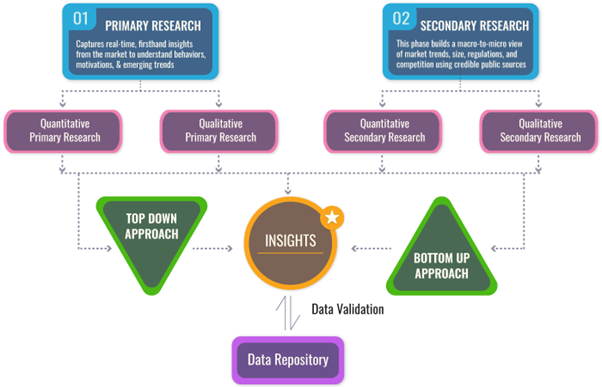
DUAL MODELING: TOP-DOWN + BOTTOM-UP
To ensure robust market estimation, we apply two complementary sizing approaches:
Top-Down Modeling:- Start with broader industry value (e.g., global or regional TAM)
- Apply filters by segment, geography, end-user, or use case
- Adjust with primary insights and validation benchmarks
- Ideal for investor-grade market scans and opportunity mapping
- Aggregate from the ground up using sales volumes, pricing, and unit economics
- Use internal modeling templates aligned with stakeholder data
- Incorporate distributor-level or region-specific inputs
- Most accurate for emerging segments and granular sub-markets
DATA VALIDATION: IN-HOUSE REPOSITORY
We close the loop with proprietary data intelligence built from ongoing projects, industry monitoring, and historical benchmarking. This repository includes:
- Multi-sector market and pricing models
- Key trendlines from past interviews and forecasts
- Benchmarked adoption rates, churn patterns, and ROI indicators
- Industry-specific deviation flags and cross-check logic
- Catches inconsistencies early
- Aligns projections across studies
- Enables consistent, high-trust deliverables