

Australia Biochip Market Size and Forecast (2026–2034), Regional Growth, Trend, Share and Industry Analysis Report Coverage: By Type (DNA Chips, Protein Chips, Lab-on-a-Chip (LOC), Cell Arrays, Others); By Product (Consumables, Instruments, Software and Services); By Application (Disease Diagnostics, Drug Discovery and Development, Genomics, Agricultural Biotechnology, Others); By End User (Biotechnology and Pharmaceutical Companies, Hospitals and Diagnostic Centers, Academic and Research Institutes, Others)
2026-11-16
Healthcare
Swetal (Research Analyst)
Description
Australia Biochip Market Overview
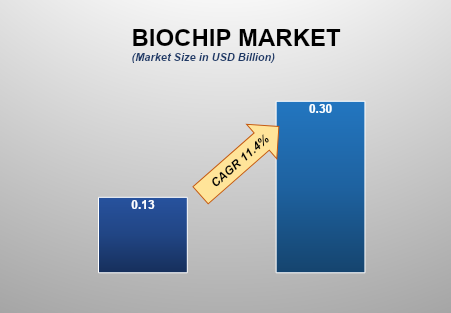
The Australia biochip market is projected to expand from USD 0.13 billion in 2026 to USD 0.30 billion by 2034, registering a CAGR of 11.4% during 2026–2034. Australia biochip market is witnessing growth due to rising use of advanced diagnostics technologies, molecular diagnostics, genomics, proteomics and personal medicine. The rising demand for early detection of diseases, faster diagnosis, and high-throughput testing is driving the use of DNA microarrays, protein biochips, lab-on-a-chip devices, and microfluidics. The well-established healthcare infrastructure, rising biotech sector, and growing R&D initiatives are driving the adoption of biochips in various healthcare, biotech, and pharma applications. Advancements in technology such as miniaturization, automation, high-throughput multiplexing, and point-of-care diagnosis are creating numerous opportunities for manufacturers to design more efficient, sensitive, and affordable biochips. However, dependence on imported technologies, high cost of development, stringent regulations, and the need for technical expertise continue to drive the market.
Australia Biochip Market Growth Drivers
Growing Adoption of Molecular Diagnostics and Precision Medicine
Increased demand for early detection, genetic screening, and targeted treatment options has led to the proliferation of biochip technology within Australia's healthcare and biotechnology industries. DNA microarrays, protein-based biochips, and microfluidics provide high-throughput analysis for various biomarkers, allowing increased efficiency in diagnosis and more informed decision-making. Increasing focus on precision medicine has created new opportunities for manufacturers offering highly sensitive multiplexed biochip options. The Australian Government is continuing to invest in integrating genomics into the health sector via its Genomics Health Futures Mission. This has been allocated around AUD 500.1 million over 10 years via the Medical Research Future Fund. This mission will help to advance genomic research, improve diagnosis of diseases, precision oncology, and genomic discovery. In November 2025, Genomics Australia stated that there were some ongoing research projects supported by the government to help improve diagnosis and treatment. This creates new opportunities for manufacturers to provide DNA microarrays, genomic analysis chips, and other biochips. The increased use of genomic-based healthcare is creating a growing requirement for high-throughput biological analysis, genetic profiling, and biomarker detection. This is supporting the demand for biochip platforms for clinical research, molecular diagnostics, and drug development.
Expansion of Biotechnology Research and Pharmaceutical Drug Development
Biochips are gaining traction in various industries, including biosciences and research, genomics and drug discovery, with increasing investments. This helps reduce the time taken in experimentation and provides faster results for screening, expression profiling, biomarker identification, and drug response by offering high throughput. Furthermore, increasing collaborations between biotech companies, healthcare industry and research facilities. In 2026, the NHMRC announced the MRFF Genomics Health Futures Grant Opportunity, which provides funding for research aiming to develop genomic technologies to identify cancer risk, screening, targeted treatments, liquid biopsies, and multi-omics. This funding opportunity also aims to support research that will increase diagnostic rates and model diseases, allowing targeted treatment. This provides an ideal opportunity for biochip technologies to be used in gene expression analysis, molecular profiling, biomarker identification, and multi-omics. Microarray, protein analysis, and microfluidic manufacturers will see increased research and demand due to increased research funding and drug development. Biochip technologies will be demanded by institutions and companies due to increased research funding and drug development in these areas. High-throughput screening, biomarker identification, and precision drug development will have increased demand for biochip technologies.
Australia Biochip Market Restraint
High Technology Development Costs and Dependence on Imported Components
Biochip manufacture involves specialized equipment, advanced materials, and high levels of research. Due to a lack of local production capacity for some biochip technologies, Australian manufacturers are heavily reliant on overseas manufacturers. This can lead to increased costs associated with purchasing overseas and also make supply times longer. The diagnostic technology industry in Australia has had issues with the supply chain. A 2025 industry report by ADAPT Diagnostics found that there was "a high reliance on overseas sources for raw materials and components" (MTPConnect). This has made Australian manufacturers vulnerable to fluctuations in overseas supply chains, increased shipping costs, and longer purchasing times. This issue can be seen in biochip manufacture. Biochips require specialized materials including substrates, microelectronics, functionalization materials, reagents, and advanced manufacturing. Small manufacturers in Australia may struggle with higher costs and increased purchasing times for these specific products. Import dependence can result in reduced cost competitiveness of Australian-designed biochips, increased manufacturing timeframes, and increased uncertainty during manufacturing. It can also cause issues for emerging Australian manufacturers to increase their production volumes to compete with established global suppliers.
Australia Biochip Market Opportunities
Development of Point-of-Care and Microfluidic Diagnostic Biochips
Increasing interest in decentralized healthcare and quick diagnostics is providing opportunities for manufacturers to produce small and integrated lab-on-a-chip solutions. Microfluidic biochips can be used to perform sample preparation, biological analysis, and diagnostic testing all in one single device. Australian manufacturers and technology developers can focus their efforts on decentralized testing for infectious diseases, chronic disease management, and point-of-care diagnostics. Australian technology developer Archer Materials Limited successfully developed an alpha prototype of its integrated blood potassium Biochip in January 2026. The prototype consists of a biosensor, microfluidic technology, test cartridge, and electronic reader, which can measure blood potassium levels using only around 10 microliters of blood. The technology has been proven to have high accuracy levels of ±0.3 mmol/L and therefore would be useful for point-of-care and home monitoring. The company is moving towards producing a beta prototype of its product. They plan to engage bigger medical tech companies about licensing and contract manufacturing options. This technology would be very beneficial to patients suffering from chronic kidney disease and heart failure, as they need to regularly monitor their potassium levels. This shows that there are emerging business opportunities for integrated microfluidic biochips. Similar technology could be used to decrease the reliance on centralized pathology services. This would provide opportunities for Australian manufacturers to produce disposable test cartridges, biosensors, electronic readers and microfluidic chip parts.
Australia Biochip Market Scope
Australia Biochip Market Report Segmentation Analysis
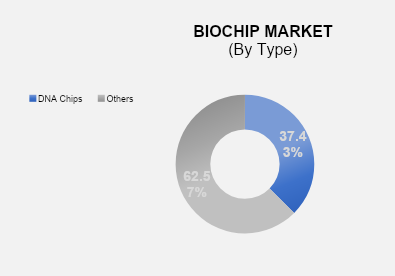
DNA Chips Segment Is Expected to Dominate the Australia Biochip Market During the Forecast Period
DNA chips are expected to dominate the Australia biochip market owing to the increasing adoption of genomic research, molecular diagnosis, and precision medicine. The DNA microarray technology helps analyze thousands of genetic sequences at once. This helps with gene expression profiling, detection of mutations, genotyping, and identification of susceptibility to diseases. There is an increase in the use of genomic tests for cancer research, diagnosis of rare diseases, and personalized treatment. Thus, the DNA chips market is gaining momentum due to rising demand for DNA chip technology by diagnostic labs, pharma companies, and research organizations. Further, Australia has a growing genomics industry, and with government-supported programs to facilitate genomic medicine, DNA-based systems are being encouraged. With existing manufacturers from around the world offering microarray and genomic analysis technology, there is support for the availability of products.
Consumables Segment Is Expected to Dominate the Australia Biochip Market During the Forecast Period
The consumables segment is anticipated to lead the Australia biochip market owing to the consistent demand for disposables like biochip components, assay kits, reagents, cartridges, sample preparation products, and microfluidic consumables. Unlike instrumentation, consumables are used for everyday testing and are essential for regular laboratory testing. The increasing adoption of molecular diagnostics, genomic analysis, protein profiling, and high-throughput screening is increasing the usage of consumables for specific applications. Additionally, the increasing focus on reducing contamination, accurate testing, and standardized laboratory processes is increasing the usage of disposables. This is expected to increase recurring income from biochip consumables.
Disease Diagnostics Segment Is Expected to Dominate the Australia Biochip Market During the Forecast Period
The disease diagnostics segment is set to dominate the Australian biochip market owing to rising demand for early diagnosis and biomarker-based solutions. Biochips can simultaneously detect multiple biomarkers of disease, genetic mutations, and molecular indicators to allow rapid and comprehensive diagnostics. The rising use of biochips in the diagnosis of diseases like Oncology, Infectious Diseases, Cardiology, and Genetic Disorders is driving the use of various types of biochips such as DNA chips, Protein Biochips, and Microfluidic chips. Furthermore, growing adoption of precision medicines and genomics is increasing demand for advanced biochips in pathology labs, hospitals, and diagnostic service providers. This is expected to make disease diagnostics the largest application segment in the market.
Biotechnology and Pharmaceutical Companies Segment Is Expected to Dominate the Australia Biochip Market During the Forecast Period
The biotechnology and pharmaceutical companies’ segment is expected to be dominant in the Australia biochip market owing to increasing applications of biochip technology in drug discovery, genome research, biomarker discovery, toxicity testing, and high-throughput screening. In this context, DNA microarrays, protein biochips and microfluidics are being used by pharmaceutical and biotechnology companies to study biological responses, understand disease pathologies and improve drug discovery. Increasing research activities in the field of precision medicine, molecular biology and target-specific therapeutics are encouraging investment into sophisticated biological techniques. Biochips allow a range of experiments to be conducted using smaller samples and automated analysis. This makes them an attractive tool for Pharmaceutical Companies. Australia has an expanding biotechnology market which will drive demand from these end users.
The following segments are part of an in-depth analysis of the Australia Biochip Market:
Australia Biochip Market Competition Landscape Analysis
The Australia biochip market is highly fragmented to moderately concentrated. It consists of many global life science manufacturers and local technology developers. Thermo Fisher Scientific Inc., Agilent Technologies, Inc., Illumina, Inc., Bio-Rad Laboratories, Inc. and Standard BioTools Inc. have competitive positions in the market due to their wide range of DNA microarrays, genomic analysis systems, protein biochips and microfluidics. Local companies include Trajan Scientific and Medical Limited, Universal Biosensors, Inc. and Archer Materials Limited. These companies are helping to strengthen the local industry through their specific analytical tools, biosensors and new biochip technologies. The competition comes from innovation, accuracy, application, knowledge and partnerships with diagnostic labs, biotech companies and pharmaceuticals.
Australia Biochip Market Recent Developments News:
In January 2026, Archer Materials completed an alpha prototype and laboratory demonstration of its blood-potassium sensing Biochip, integrating the sensor, microfluidic test cartridge and electronic readout system. The prototype demonstrated potassium measurement accuracy within ±0.3 mmol/L using only 10 microliters of blood, supporting potential finger-prick testing for patients with chronic kidney disease and heart failure. The company progressed toward beta-prototype development and potential licensing and contract-manufacturing arrangements.
In September 2025, Archer Materials improved the testing accuracy of its graphene- and silicon-based Biochip technologies, achieving potassium measurement precision within 0.3 mmol/L, aligned with US Clinical Laboratory Improvement Amendments (CLIA) requirements for equivalent pathology testing. The company adopted a dual-technology development strategy, using silicon to support a potentially faster commercialization pathway through established semiconductor manufacturing infrastructure while continuing graphene development for future high-performance applications.
The Australia Biochip Market is dominated by a few large companies, such as
Trajan Scientific and Medical Limited
Universal Biosensors, Inc.
Archer Materials Limited
Smart MCs
Planet Innovation
SCHOTT AG
VitalTrace Pty Ltd
Thermo Fisher Scientific Inc.
Agilent Technologies, Inc.
Illumina, Inc.
Bio-Rad Laboratories, Inc.
F. Hoffmann-La Roche AG
Abbott Laboratories
QIAGEN N.V.
Revvity, Inc.
Standard BioTools Inc.
Oxford Nanopore Technologies plc
bioMérieux SA
Merck KGaA
Tecan Group AG
Other Prominent Players
Frequently Asked Questions
Swetal (Research Analyst)
Swetal is a Research Analyst with 4+ years of experience specializing in healthcare market research, medical devices, healthcare IT, and medical technology industry analysis. Her expertise includes competitive intelligence, secondary research, market trend forecasting, and healthcare business insights across global healthcare ecosystems.
She contributes to advanced market research reports by analyzing regulatory frameworks, emerging healthcare technologies, competitive landscapes, and innovation trends shaping the medical industry. With a strong focus on accurate market intelligence, strategic insights, and healthcare industry trends, Swetal supports businesses in making informed, data-backed decisions in a rapidly transforming healthcare environment.
Australia Biochip Market Introduction and Market Overview
Objectives of the Study
Market Segmentation
Type of the Australian Biochip Market
Products of the Australia Biochip Market
Application of the Australia Biochip Market
End User of the Australia Biochip Market
Competition Coverage List of Market Participants
Market Definition: Biochip Market
Executive Summary
Australia Biochip Market Estimation & Forecast
Australia Biochip Market Size (US$ Million) Estimates & Historical Trend Analysis (2021 - 2025)
Australia Peptide Cancer Vaccine Overall Market Size (US$ Million), Growth Rate (Y-o-Y), Market CAGR (%), Market Forecast (2026 - 2034)
Snapshot of Australia Biochip Market
Australia Biochip Market Revenue Share (%) 2025
Key Competitors & Key Insights
Market Overview (Qualitative Analysis)
Demand Side Trends
Supply Side Trends / Manufacturing Trends
Demand and Opportunity Assessment, 2026 - 2034
Market Dynamics
Drivers
Limitations
Opportunities
Impact Analysis of Drivers and Restraints
Key Developments
Regulatory Landscape
Pricing Analysis
Supply Chain Analysis
Porter’s Five Forces Analysis
Bargaining Power of Suppliers
Bargaining Power of Buyers
Threat of Substitutes
Threat of New Entrants
Competitive Rivalry
PEST Analysis
Political Factors
Economic Factors
Social Factors
Technology Factors
Australia Biochip Market Estimates & Forecast Trend Analysis, by Type
Australia Biochip Market Assessments & Key Findings, by Type
Australia Biochip Market Revenue (US$ Million) Estimates and Forecasts, by Type, 2021 - 2034
Protein Chips
Lab-on-a-Chip (LOC)
Cell Arrays
Others
Australia Biochip Market Estimates & Forecast Trend Analysis, by Product
Australia Biochip Market Assessments & Key Findings, by Product
Australia Biochip Market Revenue (US$ Million) Estimates and Forecasts, by Product, 2021 - 2034
Consumables
Instruments
Software and Services
Australia Biochip Market Estimates & Forecast Trend Analysis, by Application
Australia Biochip Market Assessments & Key Findings, by Application
Australia Biochip Market Revenue (US$ Million) Estimates and Forecasts, by Application, 2021 - 2034
Disease Diagnostics
Drug Discovery and Development
Genomics
Agricultural Biotechnology
Others
Australia Biochip Market Estimates & Forecast Trend Analysis, by End User
Australia Biochip Market Assessments & Key Findings, by End User
Australia Biochip Market Revenue (US$ Million) Estimates and Forecasts, by End User, 2021 - 2034
Biotechnology and Pharmaceutical Companies
Hospitals and Diagnostic Center
Academic and Research Institutes
Others
Competition Landscape
Australia Biochip Market Product Mapping
Australia Biochip Market Concentration Analysis, by Leading Players / Innovators / Emerging Players / New Entrants
Australia Biochip Market Tier Structure Analysis
Australia Biochip Market Concentration & Company Market Shares (%) Analysis, 2025
Company Profiles
Trajan Scientific and Medical Limited
Company Overview & Key Stats
Financial Performance & KPIs
Product Portfolio
SWOT Analysis
Business Strategy & Recent Developments
* Similar details would be provided for all the players mentioned below
Universal Biosensors, Inc.
Archer Materials Limited
Smart MCs
Planet Innovation
SCHOTT AG
VitalTrace Pty Ltd
Thermo Fisher Scientific Inc.
Agilent Technologies, Inc.
Illumina, Inc.
Bio-Rad Laboratories, Inc.
F. Hoffmann-La Roche AG
Abbott Laboratories
QIAGEN N.V.
Revvity, Inc.
Standard BioTools Inc.
Oxford Nanopore Technologies plc
bioMérieux SA
Merck KGaA
Tecan Group AG
Other Prominent Players
Research Findings & Conclusion
Assumptions & Acronyms Used
Research Methodology
External Transportation / Databases
Internal Proprietary Database
Primary Research
Secondary Research
Assumptions
Limitations
Report FAQs
Our Research Methodology
"Insight without rigor is just noise."
We follow a comprehensive, multi-phase research framework designed to deliver accurate, strategic, and decision-ready intelligence. Our process integrates primary and secondary research , both quantitative and qualitative , along with dual modeling techniques ( top-down and bottom-up) and a final layer of validation through our proprietary in-house repository.
PRIMARY RESEARCH
Primary research captures real-time, firsthand insights from the market to understand behaviors, motivations, and emerging trends.
1. Quantitative Primary Research
Objective: Generate statistically significant data directly from market participants.
Approaches:- Structured surveys with customers, distributors, and field agents
- Mobile-based data collection for point-of-sale audits and usage behavior
- Phone-based interviews (CATI) for market sizing and product feedback
- Online polling around industry events and digital campaigns
- Purchase frequency by customer type
- Channel performance across geographies
- Feature demand by application or demographic
2. Qualitative Primary Research
Objective: Explore decision-making drivers, pain points, and market readiness.
Approaches:- In-depth interviews (IDIs) with executives, product managers, and key decision-makers
- Focus groups among end users and early adopters
- Site visits and observational research for consumer products
- Informal field-level discussions for regional and cultural nuances
SECONDARY RESEARCH
This phase helps establish a macro-to-micro understanding of market trends, size, regulation, and competitive dynamics, sourced from credible and public domain information.
1. Quantitative Secondary Research
Objective: Model market value and segment-level forecasts based on published data.
Sources include:- Financial reports and investor summaries
- Government trade data, customs records, and regulatory statistics
- Industry association publications and economic databases
- Channel performance and pricing data from marketplace listings
- Revenue splits, pricing trends, and CAGR estimates
- Supply-side capacity and volume tracking
- Investment analysis and funding benchmarks
2. Qualitative Secondary Research
Objective: Capture strategic direction, innovation signals, and behavioral trends.
Sources include:- Company announcements, roadmaps, and product pipelines
- Publicly available whitepapers, conference abstracts, and academic research
- Regulatory body publications and policy briefs
- Social and media sentiment scanning for early-stage shifts
- Strategic shifts in market positioning
- Unmet needs and white spaces
- Regulatory triggers and compliance impact
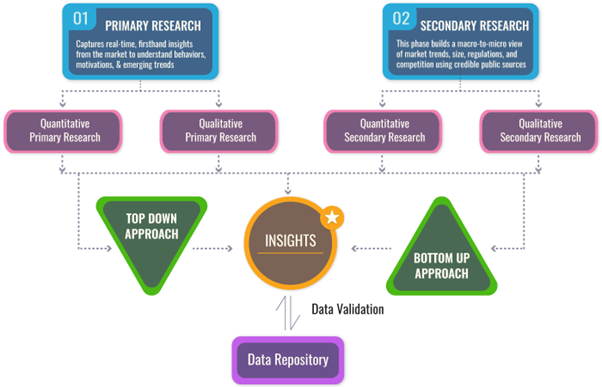
DUAL MODELING: TOP-DOWN + BOTTOM-UP
To ensure robust market estimation, we apply two complementary sizing approaches:
Top-Down Modeling:- Start with broader industry value (e.g., global or regional TAM)
- Apply filters by segment, geography, end-user, or use case
- Adjust with primary insights and validation benchmarks
- Ideal for investor-grade market scans and opportunity mapping
- Aggregate from the ground up using sales volumes, pricing, and unit economics
- Use internal modeling templates aligned with stakeholder data
- Incorporate distributor-level or region-specific inputs
- Most accurate for emerging segments and granular sub-markets
DATA VALIDATION: IN-HOUSE REPOSITORY
We close the loop with proprietary data intelligence built from ongoing projects, industry monitoring, and historical benchmarking. This repository includes:
- Multi-sector market and pricing models
- Key trendlines from past interviews and forecasts
- Benchmarked adoption rates, churn patterns, and ROI indicators
- Industry-specific deviation flags and cross-check logic
- Catches inconsistencies early
- Aligns projections across studies
- Enables consistent, high-trust deliverables