
Australia Bone Health Supplements Market Size and Forecast (2026–2034), Regional Growth, Trend, Share and Industry Analysis Report Coverage: By Ingredient Type (Calcium-Based Supplements, Magnesium-Based Supplements, Vitamin D-Based Supplements, and Others); By Dosage Form (Tablets, Capsules and Softgels, Powders, and Others); By Consumer Group (Infants and Children, 18–49 Years, 50–64 Years, and 65 Years and Above); By Distribution Channel (Pharmacies and Drugstores, Online Retail, Supermarkets and Hypermarkets, and Others)
2026-11-19
Healthcare
Swetal (Research Analyst)
Description
Australia Bone Health Supplements Market Overview
The Australia bone health supplements market is projected to expand from USD 0.19 billion in 2026 to USD 0.33 billion by 2034, registering a CAGR of 7.8% during 2026–2034. The Australian bone health supplements market experiences growth due to the increasing understanding of bone health, the growing interest in preventative healthcare, and demand for nutritional products promoting bone strength and density for all age groups. The focus on a healthy ageing philosophy and osteoporosis prevention, as well as combating age-related deterioration of bones, leads consumers to consume bone health supplements daily. Demand is mainly driven by formulations containing calcium, vitamin D, magnesium, and vitamin K, with companies producing tablets, capsules, powders, and liquids depending on the customers’ preferences. Pharmacies remain a significant distribution channel because of their accessibility and trust by customers, while e-commerce is leading to greater availability of products and greater convenience of purchasing. The key feature of the market is competition among local and foreign manufacturers involved in innovations in product development, offering differentiated compositions, brand positioning, and building distribution networks to establish themselves in the nutritional supplements market of Australia.

Australia Bone Health Supplements Market Growth Drivers
Increasing Prevalence of Osteoporosis and Age-Related Bone Disorders
The rise in prevalence of osteoporosis and age-related bone defects is boosting the requirement for bone supplements in Australia, especially for elderly persons and post-menopausal women. As per Australian Institute of Health and Welfare (AIHW), nearly 853,600 Australians, or about 3.4 percent of the population were suffering from osteoporosis or osteopenia in 2022, with prevalence rising from 0.7 percent in between 35- and 44-years old individuals to 17 percent among people who were aged above 75 years. The disease follows much more among women with 5.5 percent prevalence, while in case of men, this rate is just 1.1 percent. A publication from the year 2026 in the Australian Journal of General Practice notes that around 66% of women over the age of fifty are likely to develop either osteoporosis or osteopenia in Australia, with reduced estrogen levels leading to considerable losses in bone density around the time of menopause. This emphasis on early detection of conditions, prevention of fractures and management of bone health over the long-term has resulted in consumers increasingly looking for calcium, vitamin D, and other types of supplements required for maintaining healthy bones, thus establishing continuous demand for preventive bone health-derived products in the Australian market.
Growing Consumer Awareness of Preventive Healthcare and Nutritional Supplementation
There is a growing realization of the value of preventive health care as well as the essentiality of appropriate nutrition in Australia that has fueled the demand for bone health supplements. People are now taking a more proactive step towards health preservation and monitoring their nutritional habits much more than before, addressing matters such as nutritional deficiencies, healthy ageing, and prevention of different illnesses caused by age and way of living. The statistics from the Australian Bureau of Statistics indicates that in 2023, 33.6% Australians have taken dietary supplements, as compared to the 28.5% in the period of 2011–12, therefore marking the emerging popularity of dietary supplements. The Australian Bureau of Statistics also reported that 63.7% of Australians received insufficient amounts of calcium in their diet in 2023, reflecting a high degree of nutritional deficiency that could create potential demand for specific supplements. Growing awareness among consumers regarding the relationship between calcium, vitamin D, and bone health shapes the trend towards preventive nutrition about dietary supplements, especially for older people, women after menopause, and health-conscious consumers. This trend towards consumption of supplements opens up new opportunities for producers, which subsequently might cause a rise in the demand for calcium-based and multi-nutrient products.
Australia Bone Health Supplements Market Restraint
Regulatory Compliance Requirements and Product Safety Concerns
Australia's Therapeutic Goods Administration (TGA) framework enforces strict regulations and product safety procedures that impose difficulties for manufacturers in the bone health supplements market. Products considered therapeutic goods, such as calcium, vitamin D, magnesium, and other bone-supportive supplements, must follow important requirements regarding product listing, components, production quality, labeling, and advertising. Classification of the product may also determine the need for registration in the Australian Register of Therapeutic Goods (ARTG), good manufacturing practice (GMP) adherence and sufficient evidence of product quality, effectiveness and safety. Additionally, manufacturers must make sure that the health and nutritional claims about their products are true and not false to enhance the possibility of scientific proof, quality checks, and documentation. Laws and rules that must be followed by manufacturers tend to increase the expenses related to product development and manufacturing as well as the time needed to get products to the market. Namely, smaller manufacturers with fewer resources to deal with regulations will face difficulties with compliance. Moreover, many customers may hesitate to buy the goods because of the fears related to taking too much of nutrients, putting together the ingredients and being unsure of the product quality.
Australia Bone Health Supplements Market Opportunities
Development of Targeted and Multifunctional Bone Health Formulations
The increasing demand for niche nutritional products offers many opportunities for producers to make focused and functional bone health supplements, fulfilling the needs of different customer segments in Australia. A higher understanding of age-related bone loss, prevention of osteoporosis, and nutritional deficiencies is boosting the need for solutions meant for older adults, post-menopausal women, and those who are interested in preventive bone health management. Manufacturers can take advantage of the possibilities provided by the market by combining calcium with Vitamin D3, Vitamin K2, magnesium, and other supporting nutrients. There is also a possibility of creating advanced solutions ensuring bone health along with muscle strength, mobility, and healthy aging as older people need complex nutrition. Distinction of products can help companies establish premium product positioning and widen their customer base as well as trigger repeat purchases in the Australian market.
Australia Bone Health Supplements Market Scope
Australia Bone Health Supplements Market Report Segmentation Analysis
Calcium-Based Supplements Segment Is Expected to Dominate the Australia Bone Health Supplements Market During the Forecast Period
The calcium supplement segment will hold on to its top position in the Australian Bone Health Supplements Market, owing to the idea of calcium being an important component in the maintenance of bone density, the strength of the skeleton, and overall bone health. As per information from the Australian Bureau of Statistics (ABS), in 2023, as many as 63.7% of Australians, about 15.7 million, were not receiving adequate amounts of calcium. This group included a larger percentage of women, 75.7%, when compared to 52.1% of men, who were found to be lacking in dietary calcium. The situation is even more serious when it comes to older people and postmenopausal women, as the deficiency in calcium intake is considered to pose a serious problem. For instance, they have increased nutritional needs due to the aging process and deterioration of the bone tissue. As people are starting to recognize the need to prevent osteoporosis and consume enough calcium, their diet is changing. Along with this, the manufacturers of these products offer different combinations of calcium with vitamin D3, vitamin K2, and magnesium, contributing to maximizing all bone health requirements.

Tablets Segment Is Expected to Dominate the Australia Bone Health Supplements Market During the Forecast Period
The tablets sector is anticipated to hold a leading share in the Australia bone health supplements market, as they are favored by consumers for being a convenient, effective, and simple way of getting nutritional supplementation. Tablets have advantages, including exact dosage of the nutrients, good shelf life, portability, and simple storage, making them a good means of taking calcium and vitamin D supplements regularly by the elderly and consumers looking to promote their bones’ health. The fact that they are widely used is also supported by their availability across pharmacies, retailers and e-commerce sites. As Healthy Bones Australia says, a variety of calcium supplements are available in the form of oral tablets, effervescent tablets or soluble powders, whereby tablets remain the most common form of supplementation. Calcium, vitamin D3, magnesium, and other bone-associated components are included in some formulation products produced by manufacturers as tablet formulations. This effectively allows a consumer to obtain several nutrients through a single dosage option. Several indicators give support to the idea that the tablets segment will maintain its leadership position over the entire forecast period due to the above-mentioned factors along with the established level of consumer awareness and the cost efficiency of the manufacturing process.
65 Years and Above Segment Is Expected to Dominate the Australia Bone Health Supplements Market During the Forecast Period
The Australian bone health supplements market will be driven by the significant proportion of its consumers who fall into the 65 years and above age bracket. This is due to the high number suffering from osteoporosis, decreasing bone mineral density, and other age-based disorders. As noted by the Australian Institute of Health and Welfare (AIHW), an individual in the 35-44 age group has a 0.7% chance of suffering from osteoporosis, whereas, at 75 years and above, this chance increases to about 17.3 percent. The proportion is higher among women in this age bracket—26%. The number of people aged 65 years and above in Australia is projected to increase further, with the number expected to reach 4.7 million by 2024. Each of these individuals shows an increasing interest in fracture prevention, maintaining mobility, and a healthy existence. This is leading to the introduction of healthy nutrition habits in the form of various calcium-, vitamin D, and magnesium-based supplements for preventing bone-related illnesses.
Pharmacies and Drugstores Segment Is Expected to Dominate the Australia Bone Health Supplements Market During the Forecast Period
The segment for pharmacies and drugstores is anticipated to be one of the most important in the Australian bone health supplements market, which is explained by the high level of consumer trust, strong access to products, as well as the possibility for a consumer to get help from a pharmacist with the choice of nutritional supplements. Older adults and postmenopausal women, being two of the most relevant consumer groups for this class of products, mostly prefer obtaining calcium, vitamin D3, and any other supplements helping with bone health via pharmacies due to their connection with healthcare services as well as being the most trusted providers of products. Based on the outcomes of the research in the Complementary Medicines Australia Industry Snapshot 2024, pharmacies are responsible for about 62.9% of the sales of vitamins and dietary supplements in Australia, thus forming the biggest distribution channel worth AUD 1.67 billion. The presence of pharmacy chains, independent drugstores, and online pharmacy platforms makes products more widely available to consumers.
The following segments are part of an in-depth analysis of the Australia Bone Health Supplements Market:
Australia Bone Health Supplements Market Competition Landscape Analysis
The competition within the Australian bone health supplements market is characterized by rivalry between leading local supplement companies, multinational nutritional healthcare brands, and specialized complementary medicine providers. Notable competitors in this market include PharmaCare Laboratories, Swisse Wellness, Blackmores Limited, Metagenics Australia, Wagner Health & Nutrition, and Vita Life Sciences. Competition is reliant on factors such as brand image, formulation of the product, quality of the ingredients, costs, standard of compliance, and reach of distribution. Companies are focusing on the production of calcium-based products along with the addition of vitamin D3, vitamin K2, and magnesium to create a unique position in the market while fulfilling the requirements of older people and postmenopausal women. A company with an established brand has a competitive advantage because of good relations with major pharmacies, availability of the product in the retailer's sales points, and awareness and familiarity of consumers with the product. Companies are utilizing their knowledge in the field of e-commerce to increase consumer engagement by making the purchase process easier. The situation in the market can be defined according to its fragmented nature, which gives numerous opportunities for both leading and specialized companies to be present in this industry sector.
Australia Bone Health Supplements Market Recent Developments News:
In September 2026, Opella expanded the product positioning of its Australian Ostelin brand around women's bone health and menopause wellness. Its portfolio includes calcium and vitamin D3, vitamin D3 and K2 with magnesium, and calcium-based combination formulations. The brand also highlights its menopause-friendly positioning through the MTick certification. These developments reflect growing manufacturer focus on addressing the nutritional requirements of postmenopausal women through specialised bone health formulations.
In July 2026, Wagner Health & Nutrition received Australian Therapeutic Goods Administration (TGA) listing for its Wagner Calcium + Vitamin D product (ARTG ID: 528858). The formulation contains calcium carbonate and colecalciferol (vitamin D3). This regulatory listing represents an expansion of its registered bone health supplement portfolio and reinforces the continued commercial relevance of conventional calcium and vitamin D combinations in Australia.
In July 2025, Haleon Australia received TGA listing for Caltrate Bone Muscle & Joint (ARTG ID: 500890). The multifunctional formulation combines calcium, vitamin D3, magnesium, vitamin K2, vitamin C, zinc, copper, and manganese. The product's formulation extends beyond conventional calcium supplementation to address broader bone, muscle, and joint health requirements, reflecting the growing focus on multifunctional nutritional products in the Australian market.
The Australia Bone Health Supplements Market is dominated by a few large companies, such as
PharmaCare Laboratories
Wagner Health & Nutrition
Homart Pharmaceuticals
InterClinical Laboratories
The FPA Group Ltd.
Austar Pharma Pty Ltd.
Emily Health & Beauty Australia Pty Ltd.
Megmilk Snow Brand Co., Ltd.
Talisman Healthcare
Australian NaturalCare
Well-Being Nutrition
Wattle Pharmaceuticals
Melrose Health
Metagenics Australia
PNHE Australia Pty Ltd.
Other Prominent Players
Frequently Asked Questions
Swetal (Research Analyst)
Swetal is a Research Analyst with 4+ years of experience specializing in healthcare market research, medical devices, healthcare IT, and medical technology industry analysis. Her expertise includes competitive intelligence, secondary research, market trend forecasting, and healthcare business insights across global healthcare ecosystems.
She contributes to advanced market research reports by analyzing regulatory frameworks, emerging healthcare technologies, competitive landscapes, and innovation trends shaping the medical industry. With a strong focus on accurate market intelligence, strategic insights, and healthcare industry trends, Swetal supports businesses in making informed, data-backed decisions in a rapidly transforming healthcare environment.
Australia Bone Health Supplements Market Introduction and Market Overview
Objectives of the Study
Market Segmentation
Ingredient Type of the Australia Bone Health Supplements Market
Dosage Form of the Australia Bone Health Supplements Market
Consumer Group of the Australia Bone Health Supplements Market
Distribution Channel of the Australia Bone Health Supplements Market
Competition Coverage List of Market Participants
Market Definition: Bone Health Supplements Market
Executive Summary
Australia Bone Health Supplements Market Estimation & Forecast
Australia Bone Health Supplements Market Size (US$ Million) Estimates & Historical Trend Analysis (2021 - 2025)
Australia Bone Health Supplements Overall Market Size (US$ Million), Growth Rate (Y-o-Y), Market CAGR (%), Market Forecast (2026 - 2034)
Snapshot of Australia Bone Health Supplements Market
Australia Bone Health Supplements Market Revenue Share (%) 2025
Key Competitors & Key Insights
Market Overview (Qualitative Analysis)
Demand Side Trends
Supply Side Trends / Manufacturing Trends
Demand and Opportunity Assessment, 2026 - 2034
Market Dynamics
Drivers
Limitations
Opportunities
Impact Analysis of Drivers and Restraints
Key Developments
Regulatory Landscape
Pricing Analysis
Supply Chain Analysis
Porter’s Five Forces Analysis
Bargaining Power of Suppliers
Bargaining Power of Buyers
Threat of Substitutes
Threat of New Entrants
Competitive Rivalry
PEST Analysis
Political Factors
Economic Factors
Social Factors
Technology Factors
Australia Bone Health Supplements Market Estimates & Forecast Trend Analysis, by Ingredient Type
Australia Bone Health Supplements Market Assessments & Key Findings, by Ingredient Type
Australia Bone Health Supplements Market Revenue (US$ Million) Estimates and Forecasts, by Ingredient Type, 2021 - 2034
Calcium-Based Supplements
Magnesium-Based Supplements
Vitamin D-Based Supplements
Others
Australia Bone Health Supplements Market Estimates & Forecast Trend Analysis, by Dosage Form
Australia Bone Health Supplements Market Assessments & Key Findings, by Dosage Form
Australia Bone Health Supplements Market Revenue (US$ Million) Estimates and Forecasts, by Dosage Form, 2021 - 2034
Tablets
Capsules and Softgels
Powders
Others
Australia Bone Health Supplements Market Estimates & Forecast Trend Analysis, by Consumer Group
Australia Bone Health Supplements Market Assessments & Key Findings, by Consumer Group
Australia Bone Health Supplements Market Revenue (US$ Million) Estimates and Forecasts, by Consumer Group, 2021 - 2034
Infants and Children
18–49 Years
50–64 Years
65 Years and Above
Australia Bone Health Supplements Market Estimates & Forecast Trend Analysis, by Distribution Channel
Australia Bone Health Supplements Market Assessments & Key Findings, by Distribution Channel
Australia Bone Health Supplements Market Revenue (US$ Million) Estimates and Forecasts, by Distribution Channel, 2021 - 2034
Pharmacies and Drugstores
Online Retail
Supermarkets and Hypermarkets
Others
Competition Landscape
Australia Bone Health Supplements Market Product Mapping
Australia Bone Health Supplements Market Concentration Analysis, by Leading Players / Innovators / Emerging Players / New Entrants
Australia Bone Health Supplements Market Tier Structure Analysis
Australia Bone Health Supplements Market Concentration & Company Market Shares (%) Analysis, 2025
Company Profiles
PharmaCare Laboratories
Company Overview & Key Stats
Financial Performance & KPIs
Product Portfolio
SWOT Analysis
Business Strategy & Recent Developments
* Similar details would be provided for all the players mentioned below
Wagner Health & Nutrition
Homart Pharmaceuticals
InterClinical Laboratories
The FPA Group Ltd.
Austar Pharma Pty Ltd.
Emily Health & Beauty Australia Pty Ltd.
Megmilk Snow Brand Co., Ltd.
Talisman Healthcare
Australian NaturalCare
Well-Being Nutrition
Wattle Pharmaceuticals
Melrose Health
Metagenics Australia
PNHE Australia Pty Ltd.
Other Prominent Players
Research Findings & Conclusion
Assumptions & Acronyms Used
Research Methodology
External Transportation / Databases
Internal Proprietary Database
Primary Research
Secondary Research
Assumptions
Limitations
Report FAQs
Our Research Methodology
"Insight without rigor is just noise."
We follow a comprehensive, multi-phase research framework designed to deliver accurate, strategic, and decision-ready intelligence. Our process integrates primary and secondary research , both quantitative and qualitative , along with dual modeling techniques ( top-down and bottom-up) and a final layer of validation through our proprietary in-house repository.
PRIMARY RESEARCH
Primary research captures real-time, firsthand insights from the market to understand behaviors, motivations, and emerging trends.
1. Quantitative Primary Research
Objective: Generate statistically significant data directly from market participants.
Approaches:- Structured surveys with customers, distributors, and field agents
- Mobile-based data collection for point-of-sale audits and usage behavior
- Phone-based interviews (CATI) for market sizing and product feedback
- Online polling around industry events and digital campaigns
- Purchase frequency by customer type
- Channel performance across geographies
- Feature demand by application or demographic
2. Qualitative Primary Research
Objective: Explore decision-making drivers, pain points, and market readiness.
Approaches:- In-depth interviews (IDIs) with executives, product managers, and key decision-makers
- Focus groups among end users and early adopters
- Site visits and observational research for consumer products
- Informal field-level discussions for regional and cultural nuances
SECONDARY RESEARCH
This phase helps establish a macro-to-micro understanding of market trends, size, regulation, and competitive dynamics, sourced from credible and public domain information.
1. Quantitative Secondary Research
Objective: Model market value and segment-level forecasts based on published data.
Sources include:- Financial reports and investor summaries
- Government trade data, customs records, and regulatory statistics
- Industry association publications and economic databases
- Channel performance and pricing data from marketplace listings
- Revenue splits, pricing trends, and CAGR estimates
- Supply-side capacity and volume tracking
- Investment analysis and funding benchmarks
2. Qualitative Secondary Research
Objective: Capture strategic direction, innovation signals, and behavioral trends.
Sources include:- Company announcements, roadmaps, and product pipelines
- Publicly available whitepapers, conference abstracts, and academic research
- Regulatory body publications and policy briefs
- Social and media sentiment scanning for early-stage shifts
- Strategic shifts in market positioning
- Unmet needs and white spaces
- Regulatory triggers and compliance impact
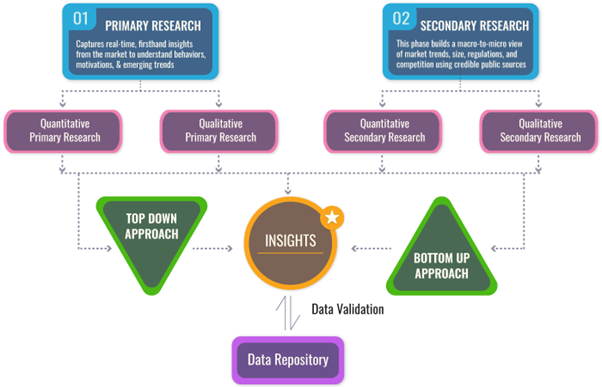
DUAL MODELING: TOP-DOWN + BOTTOM-UP
To ensure robust market estimation, we apply two complementary sizing approaches:
Top-Down Modeling:- Start with broader industry value (e.g., global or regional TAM)
- Apply filters by segment, geography, end-user, or use case
- Adjust with primary insights and validation benchmarks
- Ideal for investor-grade market scans and opportunity mapping
- Aggregate from the ground up using sales volumes, pricing, and unit economics
- Use internal modeling templates aligned with stakeholder data
- Incorporate distributor-level or region-specific inputs
- Most accurate for emerging segments and granular sub-markets
DATA VALIDATION: IN-HOUSE REPOSITORY
We close the loop with proprietary data intelligence built from ongoing projects, industry monitoring, and historical benchmarking. This repository includes:
- Multi-sector market and pricing models
- Key trendlines from past interviews and forecasts
- Benchmarked adoption rates, churn patterns, and ROI indicators
- Industry-specific deviation flags and cross-check logic
- Catches inconsistencies early
- Aligns projections across studies
- Enables consistent, high-trust deliverables