

Automated Parcel Delivery Terminal Market Size and Forecast (2026–2034), Global and Regional Growth, Trend, Share and Industry Analysis Report Coverage; By System (Indoor, Outdoor); By Terminal Type (Standalone, Integrated); By End Use (E-Commerce & Retail, Logistics & Courier Services, Property Management, Others); and Geography
2026-10-28
Consumer Products
Aishwarya Panbude (Research Analyst)
Description
Automated Parcel Delivery Terminal Market Overview
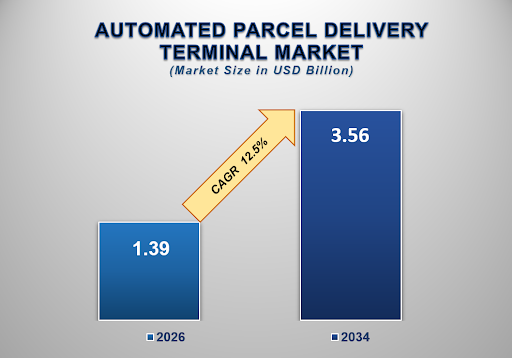
The global automated parcel delivery terminal market was valued at USD 1.39 billion in 2026 and is projected to reach USD 3.56 billion by 2034, expanding at a CAGR of 12.5% from 2026 to 2034. The market is being driven by the continued expansion of e-commerce, increasing parcel volumes, pressure on logistics operators to reduce last-mile delivery costs, growing consumer preference for flexible pickup and return options, and the increasing deployment of unattended delivery infrastructure in residential, retail, transportation and public locations. Automated parcel delivery terminals provide secure compartments, digital authentication, parcel tracking, notifications and automated collection capabilities, allowing parcels to be handled without requiring the recipient and courier to meet at the doorstep.
Automated parcel delivery terminals are self-service infrastructure systems designed to receive, temporarily store, dispense and, increasingly, accept returned parcels. They include smart parcel lockers, automated parcel machines, parcel stations and intelligent collection terminals. These systems can be installed inside buildings or outdoors and can operate as independent units or as integrated components of retail, residential, transportation, or logistics facilities. Current industry definitions distinguish these systems from conventional staffed parcel shops, traditional post office boxes, and warehouse automation equipment.
The expansion of online shopping has increased the number of parcel handoffs that logistics networks must complete every day. Traditional door-to-door delivery can become operationally inefficient when recipients are unavailable, apartment buildings have restricted access, parking and loading space are limited, or multiple delivery attempts are required. Automated terminals consolidate multiple parcels at a shared destination, enabling carriers to complete several deliveries during a single stop while giving customers greater freedom over collection timing.
The market is also moving beyond the traditional concept of a simple parcel locker. Modern terminals increasingly incorporate touchscreen interfaces, QR-code authentication, mobile applications, electronic locks, cameras, sensors, cloud-based management platforms, real-time notifications and automated return functionality. Software has therefore become an increasingly important layer of the terminal ecosystem, connecting retailers, carriers, property managers and consumers through a common digital infrastructure. Global Market Insights indicates that software is projected to grow faster than hardware within the market, reflecting the increasing importance of locker management, authentication, analytics and system integration.
Modular terminal architecture is another important market development. Operators can select different compartment sizes and expand locker capacity as parcel volumes increase rather than installing a completely new system. This approach allows retailers, residential properties and logistics companies to match terminal capacity more closely with local demand. Modular designs are particularly valuable in locations where parcel volumes are still developing or where the physical space available for installation may change over time.
Automated parcel terminals are increasingly being deployed at retail stores, residential communities, corporate offices, railway stations, airports, transit locations, and other high-footfall areas. Retail stores can use them for click-and-collect, delivery and returns, while residential properties can use them to manage growing package volumes without placing additional administrative pressure on building staff. Public-space terminals can extend access beyond traditional business hours and provide consumers with collection points closer to their daily travel routes.
Sustainability is also becoming part of terminal design and network planning. Consolidating several deliveries at one location can reduce the number of individual doorstep stops required by a carrier, while energy-efficient electronics, remote monitoring and solar-powered configurations can reduce operating requirements at suitable outdoor sites. In October 2025, Quadient announced a pilot of its solar-powered X Series parcel locker in the United Kingdom, combining solar generation and battery storage with parcel returns and on-demand label printing.
Europe remains an important center of parcel-locker development because of mature e-commerce activity and widespread consumer familiarity with out-of-home delivery. Geopost reported in 2025 that its European network had reached 140,000 out-of-home points, including 40,000 lockers, while lockers had become the second-most-preferred delivery option among European e-shoppers.
At the same time, Asia Pacific is becoming a major growth center as dense cities, expanding e-commerce markets and high parcel volumes create favorable conditions for shared automated delivery infrastructure. Global Market Insights estimated Asia Pacific as the largest regional market in 2025, accounting for 37.8% of global market value, with China representing a major portion of the regional demand.
Automated Parcel Delivery Terminal Market Drivers and Opportunities
Rapid E-Commerce Expansion and Rising Parcel Volumes Are Accelerating Demand for Automated Delivery Infrastructure
The continuous expansion of e-commerce is one of the strongest structural drivers of the automated parcel delivery terminal market. Online purchases generate a large number of individual delivery events, creating operational pressure on carriers that must move parcels from fulfillment centers to increasingly dispersed consumers. Automated terminals provide a centralized alternative in which multiple shipments can be deposited at one accessible location.
The value proposition becomes particularly strong in high-density urban environments. A courier can deliver several parcels to a single terminal instead of navigating multiple apartment buildings, office buildings or residential streets. Consumers can then retrieve their packages according to their own schedules. This model can reduce the operational impact of missed deliveries, building access restrictions and repeated delivery attempts.
Growing e-commerce activity is also increasing demand for automated return infrastructure. Returns can be deposited directly into lockers rather than requiring customers to remain at home for a collection appointment. Retailers benefit from a standardized handoff process, while consumers gain greater flexibility. The combination of delivery, pickup and returns is therefore increasing the strategic role of automated terminals within the broader e-commerce fulfillment ecosystem.
The growing scale of European locker networks illustrates this shift. InPost reported that its parcel volume reached 1.4 billion parcels in 2025, while its automated parcel machine network reached 61,196 machines, representing a 30% year-on-year increase.
Last-Mile Cost Optimization, Urban Density and Flexible Delivery Preferences Strengthen Terminal Adoption
Last-mile delivery represents a significant operational challenge because individual doorstep deliveries require vehicles, drivers, route planning, parking access and repeated customer interactions. Automated terminals can improve parcel density per stop by allowing multiple shipments to be delivered to a shared endpoint. This can make delivery routes more predictable and potentially reduce the number of failed delivery attempts.
Urbanization further supports this model. Dense residential areas frequently experience limited parking, restricted vehicle access, high traffic and large concentrations of apartment buildings. A strategically positioned terminal can transform these challenges into a consolidated collection model. Residential complexes, shopping areas, transit stations and neighborhood retail locations can serve as convenient hubs for parcel access.
Consumer behavior is also supporting adoption. Modern consumers increasingly value delivery options that allow them to select when and where they receive their purchases. Locker systems can offer 24-hour or extended-hours access without requiring customers to coordinate directly with delivery personnel. Research published in 2025 found that convenience and perceived usefulness are important factors associated with consumer intentions to use parcel lockers.
The business model is consequently shifting from simple hardware deployment toward network-based delivery infrastructure. The commercial value of a terminal depends not only on the physical locker but also on its location, parcel throughput, software connectivity, carrier access, maintenance capability and consumer adoption. Global Market Insights identifies e-commerce expansion, last-mile cost reduction, urbanization and demand for unattended delivery as important market drivers.
Opportunity: Multi-Carrier Networks, Smart Software and Sustainable Locker Technologies Can Expand Market Reach
A major opportunity lies in developing open-access and multi-carrier terminal networks. Instead of dedicating a locker exclusively to one logistics company or retailer, shared systems can accommodate parcels from multiple carriers. This approach can increase terminal utilization and improve the economics of installations in locations where a single carrier might not generate sufficient parcel volume.
The introduction of shared networks in Europe demonstrates this direction. In March 2026, DPD and GLS introduced the “inboxx” brand for an open-access parcel locker network in Germany, with a stated objective of reaching 20,000 shared out-of-home points by the end of 2027, including up to 6,000 parcel lockers.
Software-enabled terminals represent another growth opportunity. Cloud-based locker management platforms can support real-time occupancy monitoring, remote diagnostics, digital authentication, automated notifications, carrier integration, payment functions, returns management and utilization analytics. Such capabilities allow operators to optimize locker capacity and identify underused or overburdened locations.
Sustainable terminal designs can also expand the addressable market. Solar-powered lockers supported by batteries can be deployed in locations where conventional grid connections are difficult or costly. Energy-efficient electronics and remote monitoring can further reduce operational requirements. Quadient's X Series pilot demonstrates how renewable power, battery storage, returns functionality and automated label printing can be combined into a single parcel-locker platform.
Railway stations, airports, universities, housing developments and mixed-use properties offer additional opportunities because consumers already pass through these locations as part of their daily routines. In Japan, Quadient and JR East Smart Logistics expanded parcel functionality through the Multi E Cube locker network, enabling commuters to send and receive parcels through station lockers.
Automated Parcel Delivery Terminal Market Scope
Automated Parcel Delivery Terminal Market Report Segmentation Analysis
The global automated parcel delivery terminal industry analysis is segmented by system, by terminal type, by end use, and by region. System segmentation covers indoor and outdoor terminals, while terminal type includes standalone and integrated configurations. By end use, the market covers e-commerce and retail companies, logistics and courier services, property management companies and other users.
The Indoor Terminal Segment Is Expected to Dominate the Market During the Forecast Period
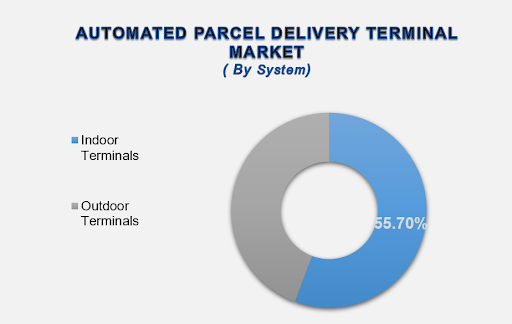
Indoor automated parcel delivery terminals accounted for approximately 55.7% of global market value in 2025, according to Global Market Insights. Their leading position is supported by extensive deployment across retail stores, residential buildings, offices, universities and other controlled environments.
Indoor systems benefit from existing building infrastructure, controlled access conditions and protection from weather exposure. They can often use established electrical and connectivity infrastructure, reducing some of the technical requirements associated with outdoor installations. Indoor terminals are also suitable for properties where security and package management are important concerns.
Residential properties represent a particularly important use case. As apartment communities receive increasing volumes of online purchases, property managers may need dedicated infrastructure to organize deliveries. Automated lockers can provide residents with individual or shared compartments while reducing package congestion in reception areas.
Retail locations provide another important deployment environment. A locker located within or adjacent to a retail store can support click-and-collect orders, returns and third-party parcel pickup. This allows retailers to connect physical store traffic with digital commerce activity.
Outdoor terminals, meanwhile, are gaining importance because they can be installed in public spaces, parking areas, transit-adjacent locations, neighborhood centers and retail exteriors. Global Market Insights estimates that outdoor lockers are growing faster than indoor systems, supported by their greater flexibility in site selection.
The Standalone Terminal Segment Is Expected to Lead the Market by Terminal Type
Standalone automated parcel delivery terminals represented approximately 57.4% of market value in 2025. These systems operate independently and can be deployed at locations where an operator requires a self-contained parcel infrastructure solution.
The standalone configuration is particularly useful for public spaces, retail exteriors, transit areas and dedicated logistics locations. Because the terminal does not need deep integration with a host building, deployment can be relatively straightforward when site preparation, connectivity and permissions are available.
Standalone systems also support network expansion because operators can add new locations without redesigning an existing property-management or access-control system. This flexibility is valuable for logistics providers attempting to increase geographic coverage.
Integrated terminals accounted for approximately 42.6% of market value in 2025 but are projected to grow faster than standalone configurations. Integrated systems can connect with property-management platforms, access-control systems, retail software, building-management infrastructure and logistics platforms.
This integration is increasingly important in residential complexes, commercial buildings and smart-city environments. Instead of functioning as an isolated cabinet, the terminal becomes part of a broader digital ecosystem that can automatically manage access, notifications, occupancy and operational data.
The E-Commerce & Retail Segment Is Expected to Dominate the Market by End Use
E-commerce and retail companies represented approximately 55.4% of automated parcel delivery terminal demand in 2025, making this the largest end-use category. These organizations use automated terminals to support parcel collection, returns, click-and-collect services and alternative delivery models.
The increasing integration of online and offline commerce is strengthening demand from retailers. Customers may place orders online but choose to collect them from a nearby store, locker or designated pickup point. Automated terminals can therefore serve as a physical extension of an e-commerce platform.
Logistics and courier companies are another major end-user group. Their primary motivation is to improve delivery density, reduce repeated delivery attempts and offer customers more flexible collection options. Shared terminals can also help carriers expand their networks without requiring a dedicated staffed facility at every location.
Property management companies represent a growing opportunity, particularly within multifamily residential buildings and mixed-use developments. These users can deploy lockers as building amenities while reducing the volume of parcels handled manually by reception desks or property staff.
The following segments are part of an in-depth analysis of the global Automated Parcel Delivery Terminal Market:
Automated Parcel Delivery Terminal Market Share Analysis By Region
Asia Pacific represented approximately 37.8% of the global automated parcel delivery terminal market in 2025, making it the leading regional market. The region benefits from large urban populations, high e-commerce activity, extensive parcel volumes and increasing investment in automated logistics infrastructure. China represents a particularly important market, while Japan, South Korea, India, Australia and Southeast Asian economies provide additional opportunities.
North America is supported by strong e-commerce penetration, large residential communities and increasing adoption of automated package-management systems. The U.S. market includes deployments in multifamily housing, universities, retail locations, corporate environments and public facilities. Smart locker systems are increasingly being used not only for parcel collection but also for returns and other secure handoff applications. Quadient reported a 16% year-on-year increase in package volumes across its higher-education and multifamily clients during the final quarter of 2024, demonstrating the increasing utilization of automated locker infrastructure in these environments.
Europe represents one of the most mature markets for automated parcel delivery terminals. Consumers in several European countries are already accustomed to collecting packages from lockers and pickup points, while logistics companies continue to expand out-of-home networks. Geopost reported that its European network reached 140,000 out-of-home points in 2025, including 40,000 lockers, while InPost reported more than 61,000 automated parcel machines by the end of 2025.
Germany, France, Poland, the United Kingdom, Italy, Spain and the Netherlands are important European markets. Network density, consumer acceptance, cross-border e-commerce and carrier partnerships are supporting continued deployment. The launch of the DPD and GLS inboxx shared network in Germany further demonstrates the shift toward open-access infrastructure.
Asia Pacific is expected to maintain strong growth throughout the forecast period. China benefits from large-scale e-commerce activity and dense urban delivery networks, while Japan and South Korea have advanced technology ecosystems and strong public-transit infrastructure. India and Southeast Asia provide long-term opportunities as online retail penetration, organized logistics networks and urban populations continue to expand.
Latin America is an emerging opportunity for automated parcel terminals as e-commerce adoption expands and logistics providers seek alternatives to traditional doorstep delivery. Brazil and Mexico are important markets because of their population scale and expanding digital-commerce ecosystems. Locker deployment can be particularly useful in locations where secure package reception and predictable delivery access are challenging.
Middle East & Africa is also developing as logistics operators, retailers and property developers modernize delivery infrastructure. The United Arab Emirates, Saudi Arabia and South Africa represent important markets for smart delivery solutions. High urban concentration in major cities and investment in digitally enabled retail and logistics infrastructure can support adoption of automated terminals.
Automated Parcel Delivery Terminal Market Competition Landscape Analysis
The global automated parcel delivery terminal market is characterized by a combination of specialized parcel-locker manufacturers, logistics companies, technology providers and integrated automation companies. Competition is increasingly shifting from the physical locker cabinet toward complete network capabilities, including software, installation, maintenance, analytics, carrier integration and location management.
InPost, Cleveron, Hive Box, Luxer One and Quadient are among the leading participants identified in current industry research. Global Market Insights estimates that the five leading companies collectively represented approximately 70% of the market in 2025, demonstrating a relatively concentrated competitive environment. InPost was identified as the market leader with more than 23% share in that assessment.
InPost has continued to expand its automated parcel machine network across Europe. Its FY2025 results reported 61,196 automated parcel machines, a 30% year-on-year increase, alongside 1.4 billion parcels handled during the year. This illustrates the increasing importance of network scale and parcel throughput in competitive positioning.
Quadient competes through smart-locker technology across residential, commercial, retail, transportation and educational environments. Its portfolio includes indoor, outdoor, refrigerated, oversized and returns-oriented solutions. The company has also expanded its technology toward energy-autonomous outdoor lockers and transportation-linked deployments.
Cleveron focuses on flexible automated locker technology and has developed solutions addressing oversized parcel requirements. This reflects an important competitive trend because standard locker compartments can restrict the range of products suitable for out-of-home delivery.
Competition is also increasingly influenced by partnerships. DPD and GLS launched their shared inboxx network in Germany in 2026, while Quadient has worked with transportation and retail partners to place lockers in railway stations and stores. These developments indicate that network access and strategic location partnerships can be as important as the terminal hardware itself.
Future competition is expected to focus on multi-carrier interoperability, modular capacity, software integration, automated returns, remote monitoring, energy-efficient operation, larger parcel compartments and improved customer authentication. Providers capable of combining physical infrastructure with scalable digital platforms are likely to address a broader range of deployment requirements.
Global Automated Parcel Delivery Terminal Market Recent Developments News
March 2026 – DPD and GLS launched the “inboxx” network in Germany: The two logistics providers introduced a common open-access out-of-home network, targeting 20,000 shared OOH points by the end of 2027, including up to 6,000 parcel lockers. The development highlights the growing role of shared infrastructure and multi-carrier access.
March 2026 – InPost reported record FY2025 parcel volumes: InPost reported 1.4 billion parcels handled during 2025, with its automated parcel machine network reaching 61,196 units, up 30% year over year. The company's results demonstrate the continued expansion of automated parcel infrastructure across European markets.
January 2026 – Pickup surpassed 6,000 parcel lockers in France: Pickup, a subsidiary of La Poste Group, announced that its French network had exceeded 6,000 lockers. The company stated that its locker count had increased 7.5 times from the end of 2022, supported by strategic partnerships and data-driven location planning.
October 2025 – Quadient introduced its solar-powered autonomous locker pilot: Quadient launched a pilot of the X Series in the United Kingdom, combining solar and battery power with returns functionality and on-demand label printing. The development demonstrates the industry's movement toward autonomous and energy-independent outdoor locker infrastructure.
July 2025 – Quadient expanded parcel shipping capabilities through JR East station lockers: Quadient and JR East Smart Logistics activated parcel shipping services through the Multi E Cube locker network, allowing commuters to send and receive parcels through railway-station infrastructure. The development illustrates how transportation hubs can function as automated parcel collection and dispatch locations.
The Global Automated Parcel Delivery Terminal Market is Dominated by a Few Large Companies, Such As
InPost S.A.
Cleveron AS
Quadient S.A.
Hive Box
Luxer One
KEBA AG
Bell and Howell LLC
TZ Limited
Smartbox Ecommerce Solutions Pvt. Ltd.
ByBox Holdings Limited
Pitney Bowes Inc.
Daifuku Co., Ltd.
Dematic Corporation
Vanderlande Industries B.V.
Murata Machinery Ltd.
OPEX Corporation
Solystic SAS
Winnsen Industry Co., Ltd.
ENGY Company
Fives Group
Others
Frequently Asked Questions
Aishwarya Panbude (Research Analyst)
Aishwarya Panbude is a skilled Research Analyst with 4+ years of experience in market intelligence, consumer insights, competitive analysis, and industry forecasting across the consumer goods, agriculture, and food & beverage sectors. She specializes in market sizing, trend analysis, growth opportunity mapping, and strategic secondary research for global and regional markets.
Her expertise lies in transforming complex industry data into actionable business strategies that help organizations identify emerging trends, understand customer behavior, and gain a competitive edge. With a strong focus on data-driven insights, business intelligence, and future market trends, Jaya delivers high-quality research solutions aligned with evolving industry demands and market dynamics.
Global Automated Parcel Delivery Terminal Market Introduction and Market Overview
Objectives of the Study
Global Automated Parcel Delivery Terminal Market Scope and Market Estimation
Global Automated Parcel Delivery Terminal Market Size (US$ Million), Market CAGR (%), Market Forecast (2026 - 2034)
Global Automated Parcel Delivery Terminal Market Revenue Share (%) and Growth Rate (Y-o-Y) Analysis (2021 - 2034)
Market Segmentation
By System of Global Automated Parcel Delivery Terminal Market
Indoor
Outdoor
By Terminal Type of Global Automated Parcel Delivery Terminal Market
Standalone
Integrated
By End Use of Global Automated Parcel Delivery Terminal Market
E-Commerce & Retail
Logistics & Courier Services
Property Management
Others
Region of Global Automated Parcel Delivery Terminal Market
Competition Coverage List of Market Participants
Market Definition: Automated Parcel Delivery Terminal Market
Executive Summary
Demand Side Trends
Key Market Trends
Market Demand (US$ Million) Analysis 2021 – 2025 and Forecast, 2026 – 2034
Demand and Opportunity Assessment
Key Developments
Overview of Regulatory Landscape, Compliance Framework, and Industry Standards
Market Entry Strategies
Market Dynamics
Drivers
Limitations
Opportunities
Impact Analysis of Drivers and Restraints
Porter's Five Forces Analysis
PEST Analysis
Global Automated Parcel Delivery Terminal Market Estimates & Historical Trend Analysis (2021 – 2025)
Global Automated Parcel Delivery Terminal Market Estimates & Forecast Trend Analysis, by System
Global Automated Parcel Delivery Terminal Market Revenue (US$ Million) Estimates and Forecasts, by System, 2021 - 2034
Indoor
Outdoor
Global Automated Parcel Delivery Terminal Market Estimates & Forecast Trend Analysis, by Terminal Type
Global Automated Parcel Delivery Terminal Market Revenue (US$ Million) Estimates and Forecasts, by Terminal Type, 2021 - 2034
Standalone
Integrated
Global Automated Parcel Delivery Terminal Market Estimates & Forecast Trend Analysis, by End Use
Global Automated Parcel Delivery Terminal Market Revenue (US$ Million) Estimates and Forecasts, by End Use, 2021 - 2034
E-Commerce & Retail
Logistics & Courier Services
Property Management
Others
Global Automated Parcel Delivery Terminal Market Estimates & Forecast Trend Analysis, by Region
Global Automated Parcel Delivery Terminal Market Revenue (US$ Million) Estimates and Forecasts, by Region, 2021 - 2034
North America
Europe
Asia Pacific
Middle East & Africa
Latin America
North America Automated Parcel Delivery Terminal Market: Estimates & Forecast Trend Analysis
North America Automated Parcel Delivery Terminal Market Assessments & Key Findings
North America Automated Parcel Delivery Terminal Market Introduction
North America Automated Parcel Delivery Terminal Market Size Estimates and Forecast (US$ Million) (2021 - 2034)
By System
By Terminal Type
By End Use
By Country
The U.S.
Canada
Europe Automated Parcel Delivery Terminal Market: Estimates & Forecast Trend Analysis
Europe Automated Parcel Delivery Terminal Market Assessments & Key Findings
Europe Automated Parcel Delivery Terminal Market Introduction
Europe Automated Parcel Delivery Terminal Market Size Estimates and Forecast (US$ Million) (2021 - 2034)
By System
By Terminal Type
By End Use
By Country
Germany
Italy
The U.K.
France
Spain
Switzerland
Rest of Europe
Asia Pacific Automated Parcel Delivery Terminal Market: Estimates & Forecast Trend Analysis
Asia Pacific Automated Parcel Delivery Terminal Market Assessments & Key Findings
Asia Pacific Automated Parcel Delivery Terminal Market Introduction
Asia Pacific Automated Parcel Delivery Terminal Market Size Estimates and Forecast (US$ Million) (2021 - 2034)
By System
By Terminal Type
By End Use
By Country
China
Japan
India
Australia
South Korea
Rest of Asia Pacific
Middle East & Africa Automated Parcel Delivery Terminal Market: Estimates & Forecast Trend Analysis
Middle East & Africa Automated Parcel Delivery Terminal Market Assessments & Key Findings
Middle East & Africa Automated Parcel Delivery Terminal Market Introduction
Middle East & Africa Automated Parcel Delivery Terminal Market Size Estimates and Forecast (US$ Million) (2021 - 2034)
By System
By Terminal Type
By End Use
By Country
UAE
Saudi Arabia
South Africa
Rest of Middle East & Africa
Latin America Automated Parcel Delivery Terminal Market: Estimates & Forecast Trend Analysis
Latin America Automated Parcel Delivery Terminal Market Assessments & Key Findings
Latin America Automated Parcel Delivery Terminal Market Introduction
Latin America Automated Parcel Delivery Terminal Market Size Estimates and Forecast (US$ Million) (2021 - 2034)
By System
By Terminal Type
By End Use
By Country
Brazil
Mexico
Argentina
Rest of Latin America
Competition Landscape
Global Automated Parcel Delivery Terminal Market Product Mapping
Global Automated Parcel Delivery Terminal Market Concentration Analysis, by Leading Players
Global Automated Parcel Delivery Terminal Market Concentration Analysis, by Innovators
Global Automated Parcel Delivery Terminal Market Concentration Analysis, by Emerging Players
Global Automated Parcel Delivery Terminal Market Concentration Analysis, by New Entrants
Global Automated Parcel Delivery Terminal Market Tier Structure Analysis
Global Automated Parcel Delivery Terminal Market Concentration & Company Market Shares (%) Analysis, 2026
Company Profiles
InPost S.A.
Company Overview & Key Stats
Financial Performance & KPIs
Product Portfolio
SWOT Analysis
Business Strategy & Recent Developments
*Similar details would be provided for all the players mentioned below
Cleveron AS
Company Overview & Key Stats
Financial Performance & KPIs
Product Portfolio
SWOT Analysis
Business Strategy & Recent Developments
Quadient S.A.
Company Overview & Key Stats
Financial Performance & KPIs
Product Portfolio
SWOT Analysis
Business Strategy & Recent Developments
Hive Box
Company Overview & Key Stats
Financial Performance & KPIs
Product Portfolio
SWOT Analysis
Business Strategy & Recent Developments
Luxer One
Company Overview & Key Stats
Financial Performance & KPIs
Product Portfolio
SWOT Analysis
Business Strategy & Recent Developments
KEBA AG
Company Overview & Key Stats
Financial Performance & KPIs
Product Portfolio
SWOT Analysis
Business Strategy & Recent Developments
Bell and Howell LLC
Company Overview & Key Stats
Financial Performance & KPIs
Product Portfolio
SWOT Analysis
Business Strategy & Recent Developments
TZ Limited
Company Overview & Key Stats
Financial Performance & KPIs
Product Portfolio
SWOT Analysis
Business Strategy & Recent Developments
Smartbox Ecommerce Solutions Pvt. Ltd.
Company Overview & Key Stats
Financial Performance & KPIs
Product Portfolio
SWOT Analysis
Business Strategy & Recent Developments
ByBox Holdings Limited
Company Overview & Key Stats
Financial Performance & KPIs
Product Portfolio
SWOT Analysis
Business Strategy & Recent Developments
Pitney Bowes Inc.
Company Overview & Key Stats
Financial Performance & KPIs
Product Portfolio
SWOT Analysis
Business Strategy & Recent Developments
Daifuku Co., Ltd.
Company Overview & Key Stats
Financial Performance & KPIs
Product Portfolio
SWOT Analysis
Business Strategy & Recent Developments
Dematic Corporation
Company Overview & Key Stats
Financial Performance & KPIs
Product Portfolio
SWOT Analysis
Business Strategy & Recent Developments
Vanderlande Industries B.V.
Company Overview & Key Stats
Financial Performance & KPIs
Product Portfolio
SWOT Analysis
Business Strategy & Recent Developments
Murata Machinery Ltd.
Company Overview & Key Stats
Financial Performance & KPIs
Product Portfolio
SWOT Analysis
Business Strategy & Recent Developments
OPEX Corporation
Company Overview & Key Stats
Financial Performance & KPIs
Product Portfolio
SWOT Analysis
Business Strategy & Recent Developments
Solystic SAS
Company Overview & Key Stats
Financial Performance & KPIs
Product Portfolio
SWOT Analysis
Business Strategy & Recent Developments
Winnsen Industry Co., Ltd.
Company Overview & Key Stats
Financial Performance & KPIs
Product Portfolio
SWOT Analysis
Business Strategy & Recent Developments
ENGY Company
Company Overview & Key Stats
Financial Performance & KPIs
Product Portfolio
SWOT Analysis
Business Strategy & Recent Developments
Fives Group
Company Overview & Key Stats
Financial Performance & KPIs
Product Portfolio
SWOT Analysis
Business Strategy & Recent Developments
Others
Company Overview & Key Stats
Financial Performance & KPIs
Product Portfolio
SWOT Analysis
Business Strategy & Recent Developments
Research Findings & Conclusion
Assumptions & Acronyms Used
Research Methodology
External Databases
Internal Proprietary Database
Primary Research
Secondary Research
Assumptions
Limitations
Report FAQ
Our Research Methodology
"Insight without rigor is just noise."
We follow a comprehensive, multi-phase research framework designed to deliver accurate, strategic, and decision-ready intelligence. Our process integrates primary and secondary research , both quantitative and qualitative , along with dual modeling techniques ( top-down and bottom-up) and a final layer of validation through our proprietary in-house repository.
PRIMARY RESEARCH
Primary research captures real-time, firsthand insights from the market to understand behaviors, motivations, and emerging trends.
1. Quantitative Primary Research
Objective: Generate statistically significant data directly from market participants.
Approaches:- Structured surveys with customers, distributors, and field agents
- Mobile-based data collection for point-of-sale audits and usage behavior
- Phone-based interviews (CATI) for market sizing and product feedback
- Online polling around industry events and digital campaigns
- Purchase frequency by customer type
- Channel performance across geographies
- Feature demand by application or demographic
2. Qualitative Primary Research
Objective: Explore decision-making drivers, pain points, and market readiness.
Approaches:- In-depth interviews (IDIs) with executives, product managers, and key decision-makers
- Focus groups among end users and early adopters
- Site visits and observational research for consumer products
- Informal field-level discussions for regional and cultural nuances
SECONDARY RESEARCH
This phase helps establish a macro-to-micro understanding of market trends, size, regulation, and competitive dynamics, sourced from credible and public domain information.
1. Quantitative Secondary Research
Objective: Model market value and segment-level forecasts based on published data.
Sources include:- Financial reports and investor summaries
- Government trade data, customs records, and regulatory statistics
- Industry association publications and economic databases
- Channel performance and pricing data from marketplace listings
- Revenue splits, pricing trends, and CAGR estimates
- Supply-side capacity and volume tracking
- Investment analysis and funding benchmarks
2. Qualitative Secondary Research
Objective: Capture strategic direction, innovation signals, and behavioral trends.
Sources include:- Company announcements, roadmaps, and product pipelines
- Publicly available whitepapers, conference abstracts, and academic research
- Regulatory body publications and policy briefs
- Social and media sentiment scanning for early-stage shifts
- Strategic shifts in market positioning
- Unmet needs and white spaces
- Regulatory triggers and compliance impact
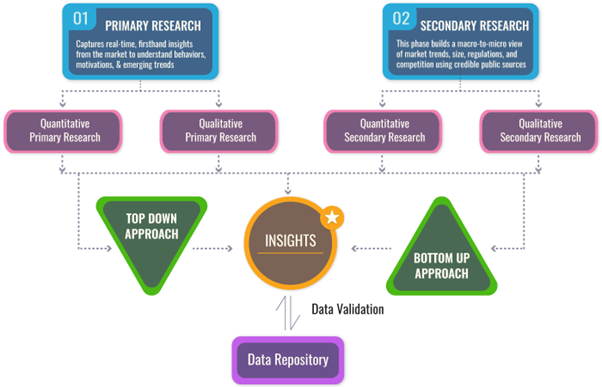
DUAL MODELING: TOP-DOWN + BOTTOM-UP
To ensure robust market estimation, we apply two complementary sizing approaches:
Top-Down Modeling:- Start with broader industry value (e.g., global or regional TAM)
- Apply filters by segment, geography, end-user, or use case
- Adjust with primary insights and validation benchmarks
- Ideal for investor-grade market scans and opportunity mapping
- Aggregate from the ground up using sales volumes, pricing, and unit economics
- Use internal modeling templates aligned with stakeholder data
- Incorporate distributor-level or region-specific inputs
- Most accurate for emerging segments and granular sub-markets
DATA VALIDATION: IN-HOUSE REPOSITORY
We close the loop with proprietary data intelligence built from ongoing projects, industry monitoring, and historical benchmarking. This repository includes:
- Multi-sector market and pricing models
- Key trendlines from past interviews and forecasts
- Benchmarked adoption rates, churn patterns, and ROI indicators
- Industry-specific deviation flags and cross-check logic
- Catches inconsistencies early
- Aligns projections across studies
- Enables consistent, high-trust deliverables