

Automated Test Equipment Market Size And Forecast (2020 - 2033), Global And Regional Growth, Trend, Share And Industry Analysis Report Coverage: By Component (Non-Memory ATE, Memory ATE, Discrete ATE, Others) By Product Type (Integrated Circuit (IC) Testing, Printed Circuit Board (PCB) Testing, Hard Disk Drive Testing, Modules & Others), By Vertical (Semiconductor Fabrication, Consumer Electronics, Automotive & Transportation, Aerospace & Defense, Medical, Others) And Geography
2025-10-14
ICT
Ekta Chaurasia (Team Lead)
Description
Automated Test Equipment Market Overview
The global Automated Test
Equipment (ATE) Market is projected to grow from US$ 7.7 Billion in 2025 to US$
12.0 Billion by 2033, at a CAGR of 6.1% during the forecast period. Growth is
fueled by rising complexity in electronic devices, increasing demand for
advanced semiconductor components, and the expanding applications of consumer
electronics and automotive technologies.

Automated test equipment refers
to systems that perform testing of devices under test (DUT) automatically,
ensuring high precision, efficiency, and speed. With industries worldwide
accelerating digitization and connectivity, the need for fast and accurate
testing solutions is becoming indispensable. Market expansion is strongly
supported by advancements in 5G technology, artificial intelligence (AI), and
automotive electronics, particularly in electric vehicles (EVs) and autonomous
driving systems. Increasing semiconductor demand in smartphones, tablets, and
wearables further underpins the market outlook, alongside the growing
requirement for cost-effective, efficient testing to reduce time-to-market.
Automated Test Equipment
Market Drivers and Opportunities
Rising Demand For Consumer Electronics Is Anticipated To Lift
The Automated Test Equipment Market During The Forecast Period
Increased demand for consumer
devices such as smartphones, tablets, notebooks, and wearable products is a
prime catalyst for driving growth in the global automated test equipment (ATE)
industry. Consumer devices demand complex, highly integrated semiconductor
elements that need to be tested with stringent specifications to guarantee
function, quality, and performance. With increasing demands from consumers in
terms of product performance and reliability, producers are faced with pressure
to produce spotless products at high speed. This is why there is increasing use
of sophisticated ATE platforms capable of performing high-speed, accurate, and
multi-function tests in complex integrated circuits (ICs). The size of the ATE
market is directly linked to production volume in semiconductors, which is
increasing with the widespread use of consumer electronics. Other trending
concepts like 5G connectivity, IoT devices, and augmented/virtual reality are
also propelling this growth, with increasing demands for more capable and
flexible test equipment. ATE solutions are becoming increasingly important in
pinpointing faults early in production to enhance yield rates as well as cut
costs from defective products. With accelerating chip design progress and
growing intricacy, demands for highly efficient and flexible test systems have
never been more severe. Further, ongoing innovation in consumer electronics, in
addition to the necessity for miniaturization and increased processing
abilities, is fostering robust, persistent demand for ATE systems. The trend is
expected to remain in place throughout the forecast period, contributing
significantly to expanding the market.
The Increasing Complexity of Semiconductor Devices is a vital
driver for influencing the growth of the global Automated Test Equipment Market
Growing sophistication in
semiconductor devices is driving growth in the market for automated test
equipment globally. Advanced electronic devices need highly complex
semiconductor chips with more densely integrated transistors,
multi-functionality, and analog-digital combined functionality. Such complex
chips, including system-on-chip (SoC) and multi-core processor chips, need
highly efficient and complex test processes to verify that all functions are
reliable under various conditions. With shrinking technology nodes in
semiconductors to 7 nm, 5 nm, and even down to 3 nm, defect possibilities also
increase, making thorough testing more imperative than before. Automated test
equipment presents an efficient solution to meet this need by providing
high-speed, high-quality testing over a variety of test parameters. ATE machines
have parallel test ability, decreased cycle times, and quality guarantees with
minimal compromise in terms of throughput. The growing use of technologies such
as AI, machine learning, and edge computing in chip design also makes the
demand for sophisticated test equipment more pressing to manage highly dynamic
workloads as well as test cases.
With chip manufacturers competing
to lower their time-to-market with improved reliability, investments in
automation and scalable test systems are fast becoming an essential strategy.
Thus, increased semiconductor architecture complexity is not only propelling
test equipment innovation but also presenting ATE vendors with profitable
growth prospects in the coming years.
Integration of AI and Machine Learning in Testing Processes
is poised to create significant opportunities in the global Automated Test
Equipment Market
The incorporation of artificial
intelligence (AI) and machine learning (ML) in ATE systems is a breakthrough
opportunity for the sector. Semiconductor testing traditionally used static
test cases in accordance with predicted device behavior. Nevertheless, with increasingly
complex ICs and dynamic performance factors, AI and ML technologies have
started being used to maximize test strategies and improve fault detection, as
well as forecast failure trends in real time. ATE systems based on artificial
intelligence can dynamically vary test parameters, accelerate test times, and
optimize overall yield by recognizing patterns missed by human operators. Not
only does this improve test efficiency and accuracy, but it also saves costs by
minimizing redundant retesting and allowing for predictive maintenance. ML can
evaluate massive amounts of test data to identify correlations among test
metrics and device failure, allowing for continuous test protocol improvement.
Furthermore, companies that deliver ATE platforms with embedded AI are likely
to have an advantage in an industry that increasingly demands automation and
smart use of data. Throughout the forecast period, this technological
advancement is likely to be one of the market growth drivers for ATE.
Automated Test Equipment Market Scope
|
Report Attributes |
Description |
|
Market Size in 2025 |
USD 7.7 Billion |
|
Market Forecast in 2033 |
USD 12.0 Billion |
|
CAGR % 2025-2033 |
6.1% |
|
Base Year |
2024 |
|
Historic Data |
2020-2024 |
|
Forecast Period |
2025-2033 |
|
Report USP |
Production, Consumption, company share, company heatmap, company
production capacity, growth factors and more |
|
Segments Covered |
●
By Component ●
By Product Type ●
By Vertical |
|
Regional Scope |
●
North America, ●
Europe, ●
APAC, ●
Latin America ●
Middle East and Africa |
|
Country Scope |
1)
U.S. 2)
Canada 3)
U.K. 4)
Germany 5)
France 6)
Italy 7)
Spain 8)
China 9)
India 10)
Japan 11)
South Korea 12)
Australia 13)
Mexico 14)
Brazil 15)
Argentina 16)
Saudi Arabia 17)
UAE 18)
South Africa
|
Automated Test Equipment Market Report Segmentation Analysis
The Global Automated Test
Equipment Market Industry Analysis Is Segmented By Component, By Product Type,
By Vertical, And By Region.
The Non-Memory ATE Segment Is Anticipated To Hold The Highest
Share Of The Global Automated Test Equipment Market During The Projected
Timeframe.
By component, the global automated test equipment market is segmented into Non-Memory ATE, Memory ATE, Discrete ATE, and Others. Non-memory ATE holds the dominant market share of 59.9% and continues to drive significant demand across the industry. This segment is primarily responsible for testing logic-based integrated circuits (ICs), system-on-chips (SoCs), microprocessors, and other complex semiconductor devices used in consumer electronics, automotive systems, and communication technologies. The widespread deployment of these components in a variety of high-performance applications has substantially increased the need for precise, high-throughput testing solutions.

The Integrated Circuit (IC) Testing Segment Is Anticipated To
Hold The Highest Share Of The Market Over The Forecast Period
In terms of product type, the
global automated test equipment (ATE) market is categorized under Integrated
Circuit (IC) Testing, Printed Circuit Board (PCB) Testing, Hard Disk Drive
Testing, and Modules & Others. Integrated Circuit (IC) Testing leads in the
market due to the tremendous growth in the need for complicated and
miniaturized semiconductor devices. ICs are central to almost all electronic
products, from computers and phones to car control devices and factory
equipment, which makes their efficient testing paramount to maintain
performance and reliability.
The Consumer Electronics Segment Dominated The Market In 2025
And Is Predicted To Grow At The Highest CAGR Over The Forecast Period
Based on verticals, the market is
divided into Semiconductor Fabrication, Consumer Electronics, Automotive &
Transportation, Aerospace & Defense, Medical, and Others. The Consumer
Electronics segment dominates among these due to the immense rise in demand for
smartphones, laptops, tablets, wearable devices, and smart home products. The
consumer electronics segment is also marked by fast product cycles and mass
production, which calls for sophisticated and efficient test solutions to
maintain product quality and minimize time-to-market.
The following segments are part of an in-depth analysis of the global
automated test equipment market:
|
Market Segments |
|
|
By Component |
●
Non-Memory ATE ●
Memory ATE ●
Discrete ATE ●
Others |
|
By Product Type |
●
Integrated Circuit
(IC) Testing ●
Printed Circuit
Board (PCB) Testing ●
Hard Disk Drive
Testing ●
Modules & Others |
|
By Vertical |
●
Semiconductor
Fabrication ●
Consumer Electronics ●
Automotive &
Transportation ●
Aerospace &
Defense ●
Medical ●
Others |
Automated Test Equipment
Market Share Analysis by Region
Asia Pacific is projected
to hold the largest share of the global Automated Test Equipment Market over
the forecast period.
In 2025, the Asia Pacific region is
dominating with 56.7% of the market size in the overall automated test
equipment (ATE) market. The growth is
due to the region's huge and fast-growing electronics manufacturing base.
China, South Korea, Taiwan, and Japan are all major hubs for global fabrication
of semiconductors as well as production of consumer electronics, making the Asia
Pacific a pivotal hub in the supply chain. The region is home to major
semiconductor foundries as well as contract manufacturers, along with
large-scale production of smartphones, computers, and other electronic
products. This demand for efficient and reliable test solutions has grown
proportionally. The region also enjoys cheap labor, friendly government
policies, and huge foreign investments in automation in industry, as well as in
semiconductor infrastructure. The adoption of newer technologies such as IoT,
artificial intelligence, and 5G is happening in the Asia Pacific at a rapid
rate, increasing even more the need for high-performance, automated test
solution sets that are quality-focused and compliant. Region-specific
initiatives such as "Make in India," in addition to China's push for
chip self-sufficiency, are also driving the ATE market's growth. With
increasing manufacturing volumes and test complexity, the Asia Pacific still
leads in revenue creation as well as technological development.
Meanwhile, North America is
expected to have the highest CAGR during the forecast period due to
technological progress and growing investment in R&D in semiconductors, as
well as the resurgence of local chip production.
Automated Test Equipment
Market Competition Landscape Analysis
The global automated test
equipment market is marked by robust competition among key players focusing on
innovation, strategic expansion, and sustainability. Continuous research and
development efforts lead to the introduction of advanced automated test
equipment with improved performance characteristics, catering to evolving
industry demands.
Global Automated Test
Equipment Market Recent Developments News:
●
In June 2024, Chroma
ATE introduced its breakthrough Chroma 3530 Parametric Test System,
revolutionizing wafer testing with superior cost-efficiency and uncompromised
quality. This next-gen solution significantly reduces cost-per-wafer while
ensuring full test coverage, setting a new benchmark in semiconductor testing.
●
In May 2024, Advantest
Corporation expanded its V93000 EXA Scale SoC platform with the DC Scale
XHC32—a high-power 32-channel supply delivering 640A current to meet the
surging demands of AI, HPC, GPUs, and advanced processors. This enhancement
addresses the escalating power needs of next-gen computing architectures.
●
December 2023:
Advantest partnered with Amarisoft to integrate its Micro Line Test (MLT)
software with Amarisoft’s 4G/5G callboxes, enabling operator-validated test
plans for seamless wireless device validation. This collaboration enhances
testing precision for 5G and IoT applications.
The Global Automated Test Equipment Market is dominated by
a few large companies, such as
●
National Instruments
●
Advantest
●
Chroma ATE
●
Roos Instruments
●
Teradyne
●
Xcerra Corporation
●
Cohu Inc.
●
Beijing Huafeng Test
●
Astronics Corporation
●
TBG Solutions
●
Mechatronics GmBH
● Others
Frequently Asked Questions
Ekta Chaurasia (Team Lead)
Ekta Chaurasia is a highly experienced Team Lead at M2Square Consultancy with over 7 years of expertise in market research, strategic consulting, competitive benchmarking, and business intelligence solutions. She specializes in ICT, semiconductors & electronics, automotive & transportation, and industrial machinery markets.
She leads end-to-end global research projects focused on market trends, industry analysis, growth forecasting, customer insights, and strategic decision-making. Known for her analytical leadership and industry expertise, Ekta helps businesses uncover growth opportunities, evaluate competitive landscapes, and stay ahead in rapidly evolving markets through accurate and insight-driven research.
- Global Automated Test Equipment Market Introduction and Market Overview
- Objectives of the Study
- Global Automated Test Equipment Market Scope and Market Estimation
- Global Automated Test Equipment Overall Market Size (US$ Bn), Market CAGR (%), Market forecast (2025 - 2033)
- Global Automated Test Equipment Market Revenue Share (%) and Growth Rate (Y-o-Y) from 2020 - 2033
- Market Segmentation
- Component of Global Automated Test Equipment Market
- Product Type of Global Automated Test Equipment Market
- Vertical of Global Automated Test Equipment Market
- Region of Global Automated Test Equipment Market
- Executive Summary
- Demand Side Trends
- Key Market Trends
- Market Demand (US$ Bn) Analysis 2020 – 2024 and Forecast, 2025 – 2033
- Demand and Opportunity Assessment
- Market Dynamics
- Drivers
- Limitations
- Opportunities
- Impact Analysis of Drivers and Restraints
- Key Product/Brand Analysis
- Technological Advancements
- Key Developments
- Porter’s Five Forces Analysis
- Bargaining Power of Suppliers
- Bargaining Power of Buyers
- Threat of Substitutes
- Threat of New Entrants
- Competitive Rivalry
- PEST Analysis
- Political Factors
- Economic Factors
- Social Factors
- Technology Factors
- Insights on Cost-effectiveness of Automated Test Equipment
- Key Regulation
- Global Automated Test Equipment Market Estimates & Historical Trend Analysis (2020 - 2024)
- Global Automated Test Equipment Market Estimates & Forecast Trend Analysis, by Component
- Global Automated Test Equipment Market Revenue (US$ Bn) Estimates and Forecasts, by Component, 2020 - 2033
- Non-Memory ATE
- Memory ATE
- Discrete ATE
- Others
- Global Automated Test Equipment Market Revenue (US$ Bn) Estimates and Forecasts, by Component, 2020 - 2033
- Global Automated Test Equipment Market Estimates & Forecast Trend Analysis, by Product Type
- Global Automated Test Equipment Market Revenue (US$ Bn) Estimates and Forecasts, by Product Type, 2020 - 2033
- Integrated Circuit (IC) Testing
- Printed Circuit Board (PCB) Testing
- Hard Disk Drive Testing
- Modules & Others
- Global Automated Test Equipment Market Revenue (US$ Bn) Estimates and Forecasts, by Product Type, 2020 - 2033
- Global Automated Test Equipment Market Estimates & Forecast Trend Analysis, by Vertical
- Global Automated Test Equipment Market Revenue (US$ Bn) Estimates and Forecasts, by Vertical, 2020 - 2033
- Semiconductor Fabrication
- Consumer Electronics
- Automotive & Transportation
- Aerospace & Defense
- Medical
- Others
- Global Automated Test Equipment Market Revenue (US$ Bn) Estimates and Forecasts, by Vertical, 2020 - 2033
- Global Automated Test Equipment Market Estimates & Forecast Trend Analysis, by Region
- Global Automated Test Equipment Market Revenue (US$ Bn) Estimates and Forecasts, by Region, 2020 - 2033
- North America
- Europe
- Asia Pacific
- Middle East & Africa
- Latin America
- Global Automated Test Equipment Market Revenue (US$ Bn) Estimates and Forecasts, by Region, 2020 - 2033
- North America Automated Test Equipment Market: Estimates & Forecast Trend Analysis
- North America Automated Test Equipment Market Assessments & Key Findings
- North America Automated Test Equipment Market Introduction
- North America Automated Test Equipment Market Size Estimates and Forecast (US$ Billion) (2020 - 2033)
- By Component
- By Product Type
- By Vertical
- By Country
- The U.S.
- Canada
- North America Automated Test Equipment Market Assessments & Key Findings
- Europe Automated Test Equipment Market: Estimates & Forecast Trend Analysis
- Europe Automated Test Equipment Market Assessments & Key Findings
- Europe Automated Test Equipment Market Introduction
- Europe Automated Test Equipment Market Size Estimates and Forecast (US$ Billion) (2020 - 2033)
- By Component
- By Product Type
- By Vertical
- By Country
- Germany
- Italy
- K.
- France
- Spain
- Rest of Europe
- Europe Automated Test Equipment Market Assessments & Key Findings
- Asia Pacific Automated Test Equipment Market: Estimates & Forecast Trend Analysis
- Asia Pacific Market Assessments & Key Findings
- Asia Pacific Automated Test Equipment Market Introduction
- Asia Pacific Automated Test Equipment Market Size Estimates and Forecast (US$ Billion) (2020 - 2033)
- By Component
- By Product Type
- By Vertical
- By Country
- China
- Japan
- India
- Australia
- South Korea
- Rest of Asia Pacific
- Asia Pacific Market Assessments & Key Findings
- Middle East & Africa Automated Test Equipment Market: Estimates & Forecast Trend Analysis
- Middle East & Africa Market Assessments & Key Findings
- Middle East & Africa Automated Test Equipment Market Introduction
- Middle East & Africa Automated Test Equipment Market Size Estimates and Forecast (US$ Billion) (2020 - 2033)
- By Component
- By Product Type
- By Vertical
- By Country
- UAE
- Saudi Arabia
- South Africa
- Rest of MEA
- Middle East & Africa Market Assessments & Key Findings
- Latin America Automated Test Equipment Market: Estimates & Forecast Trend Analysis
- Latin America Market Assessments & Key Findings
- Latin America Automated Test Equipment Market Introduction
- Latin America Automated Test Equipment Market Size Estimates and Forecast (US$ Billion) (2020 - 2033)
- By Component
- By Product Type
- By Vertical
- By Country
- Brazil
- Argentina
- Mexico
- Rest of LATAM
- Latin America Market Assessments & Key Findings
- Country Wise Market: Introduction
- Competition Landscape
- Global Automated Test Equipment Market Product Mapping
- Global Automated Test Equipment Market Concentration Analysis, by Leading Players / Innovators / Emerging Players / New Entrants
- Global Automated Test Equipment Market Tier Structure Analysis
- Global Automated Test Equipment Market Concentration & Company Market Shares (%) Analysis, 2024
- Company Profiles
- National Instruments
- Company Overview & Key Stats
- Financial Performance & KPIs
- Product Portfolio
- SWOT Analysis
- Business Strategy & Recent Developments
- National Instruments
* Similar details would be provided for all the players mentioned below
- Advantest
- Chroma ATE
- Roos Instruments
- Teradyne
- Xcerra Corporation
- Cohu Inc.
- Beijing Huafeng Test
- Astronics Corporation
- TBG Solutions
- Mechatronics GmBH
- Others
- Research Methodology
- External Transportations / Databases
- Internal Proprietary Database
- Primary Research
- Secondary Research
- Assumptions
- Limitations
- Report FAQs
- Research Findings & Conclusion
Our Research Methodology
"Insight without rigor is just noise."
We follow a comprehensive, multi-phase research framework designed to deliver accurate, strategic, and decision-ready intelligence. Our process integrates primary and secondary research , both quantitative and qualitative , along with dual modeling techniques ( top-down and bottom-up) and a final layer of validation through our proprietary in-house repository.
PRIMARY RESEARCH
Primary research captures real-time, firsthand insights from the market to understand behaviors, motivations, and emerging trends.
1. Quantitative Primary Research
Objective: Generate statistically significant data directly from market participants.
Approaches:- Structured surveys with customers, distributors, and field agents
- Mobile-based data collection for point-of-sale audits and usage behavior
- Phone-based interviews (CATI) for market sizing and product feedback
- Online polling around industry events and digital campaigns
- Purchase frequency by customer type
- Channel performance across geographies
- Feature demand by application or demographic
2. Qualitative Primary Research
Objective: Explore decision-making drivers, pain points, and market readiness.
Approaches:- In-depth interviews (IDIs) with executives, product managers, and key decision-makers
- Focus groups among end users and early adopters
- Site visits and observational research for consumer products
- Informal field-level discussions for regional and cultural nuances
SECONDARY RESEARCH
This phase helps establish a macro-to-micro understanding of market trends, size, regulation, and competitive dynamics, sourced from credible and public domain information.
1. Quantitative Secondary Research
Objective: Model market value and segment-level forecasts based on published data.
Sources include:- Financial reports and investor summaries
- Government trade data, customs records, and regulatory statistics
- Industry association publications and economic databases
- Channel performance and pricing data from marketplace listings
- Revenue splits, pricing trends, and CAGR estimates
- Supply-side capacity and volume tracking
- Investment analysis and funding benchmarks
2. Qualitative Secondary Research
Objective: Capture strategic direction, innovation signals, and behavioral trends.
Sources include:- Company announcements, roadmaps, and product pipelines
- Publicly available whitepapers, conference abstracts, and academic research
- Regulatory body publications and policy briefs
- Social and media sentiment scanning for early-stage shifts
- Strategic shifts in market positioning
- Unmet needs and white spaces
- Regulatory triggers and compliance impact
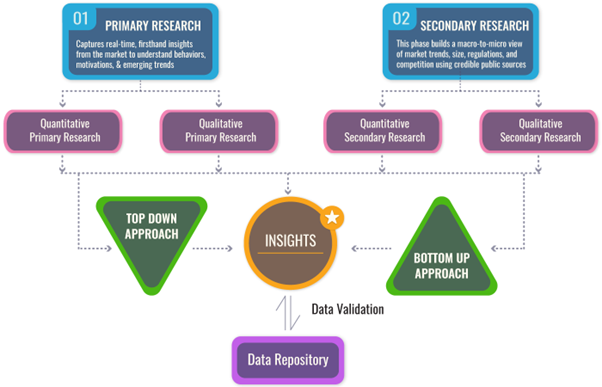
DUAL MODELING: TOP-DOWN + BOTTOM-UP
To ensure robust market estimation, we apply two complementary sizing approaches:
Top-Down Modeling:- Start with broader industry value (e.g., global or regional TAM)
- Apply filters by segment, geography, end-user, or use case
- Adjust with primary insights and validation benchmarks
- Ideal for investor-grade market scans and opportunity mapping
- Aggregate from the ground up using sales volumes, pricing, and unit economics
- Use internal modeling templates aligned with stakeholder data
- Incorporate distributor-level or region-specific inputs
- Most accurate for emerging segments and granular sub-markets
DATA VALIDATION: IN-HOUSE REPOSITORY
We close the loop with proprietary data intelligence built from ongoing projects, industry monitoring, and historical benchmarking. This repository includes:
- Multi-sector market and pricing models
- Key trendlines from past interviews and forecasts
- Benchmarked adoption rates, churn patterns, and ROI indicators
- Industry-specific deviation flags and cross-check logic
- Catches inconsistencies early
- Aligns projections across studies
- Enables consistent, high-trust deliverables