

Automotive Air Compressor Market Size and Forecast (2020 - 2033), Global and Regional Growth, Trend, Share, and Industry Analysis Report Coverage: By Product Type (Reciprocating, Rotary Screw, Centrifugal), By Vehicle Type (Passenger Cars, Light Commercial Vehicles (LCVs), Heavy Commercial Vehicles (HCVs), Electric Vehicles (EVs)), By Application (Air Suspension, Braking Systems, HVAC, Engine Cooling, Others), and Geography
2025-12-19
Automotive & Transportation (Mobility)
Ekta Chaurasia (Team Lead)
Description
Automotive
Air Compressor Market Overview
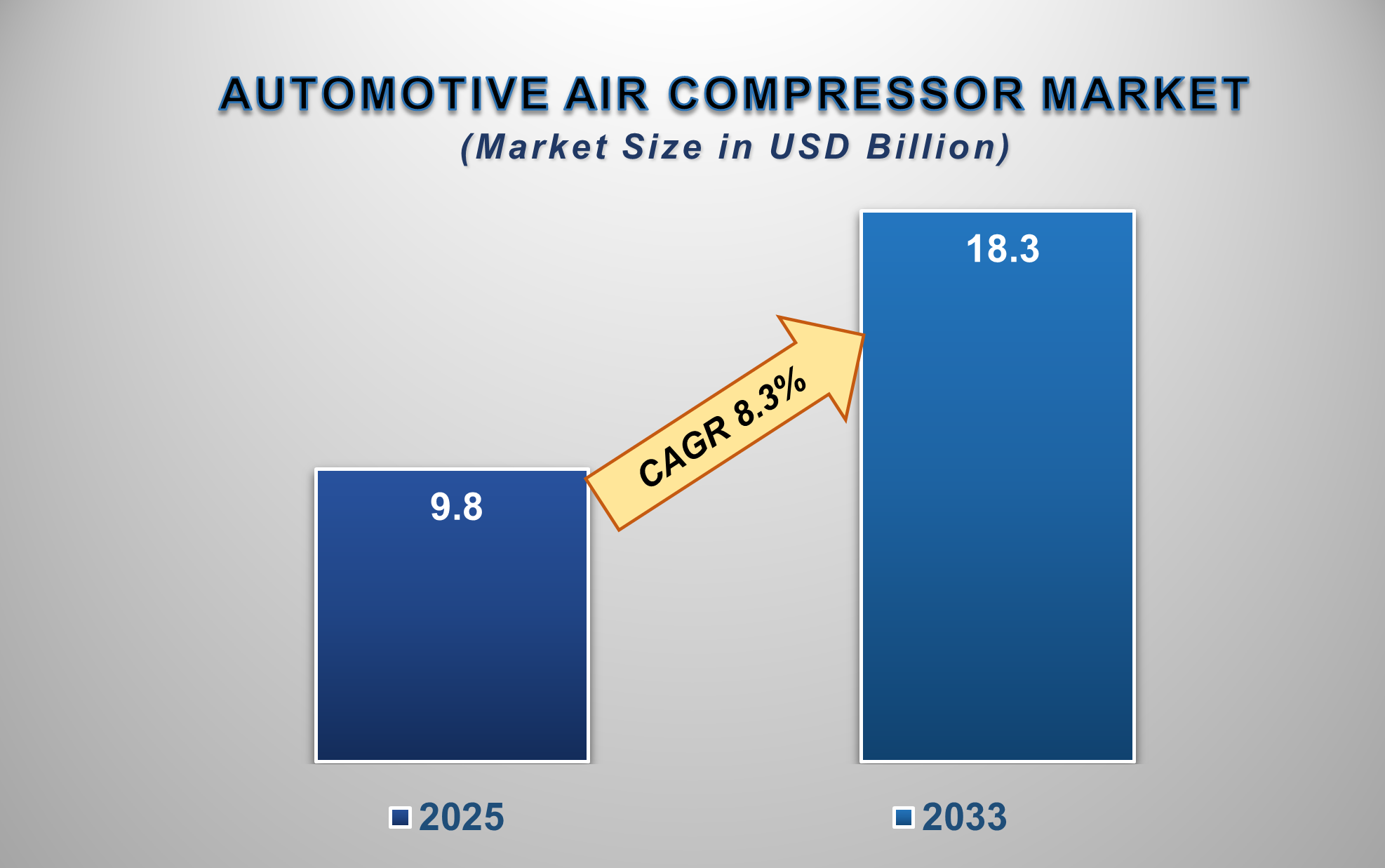
The Automotive Air Compressor Market is set for significant and steady growth from 2025 to 2033, driven by the rising demand for advanced comfort and safety systems, the rapid electrification of vehicle fleets, and the increasing adoption of air suspension in premium and commercial vehicles. The market is projected to be valued at approximately USD 9.8 billion in 2025 and is forecasted to reach nearly USD 18.3 billion by 2033, exhibiting a compound annual growth rate (CAGR) of 8.3% during this period.
An automotive air compressor is a device that converts
power into pressurized air, which is essential for operating various critical
systems in a vehicle, including air brakes, suspension, HVAC, and engine
thermal management. The market's expansion is primarily fueled by the
automotive industry's shift towards enhanced passenger comfort, vehicle
electrification, and stringent safety standards. The growing popularity of air
suspension systems in SUVs and luxury passenger cars for their superior ride
quality and adjustability is a major growth driver.
Furthermore, the transition to electric vehicles (EVs)
necessitates efficient electric-driven compressors for cabin HVAC and battery
thermal management, creating a new, high-value segment. North America and
Europe are significant markets due to the high
penetration of luxury vehicles and advanced commercial fleets, while
Asia-Pacific is the fastest-growing region, propelled by rising vehicle
production and increasing adoption of premium features.
Automotive Air Compressor Market Drivers and
Opportunities
Rising Demand for Vehicle Comfort and Advanced Suspension
Systems:
The pursuit of superior ride quality is fundamentally
reshaping vehicle architectures and directly fueling the air compressor market.
Air suspension systems, which rely on a compressor to inflate and adjust air
springs, offer transformative benefits over traditional steel springs. They
provide a dynamic, adjustable ride height
useful for both aerodynamic efficiency on highways and ground clearance on
rough terrain, along with adaptive damping
that improves handling stability. Crucially, these systems automatically level
the vehicle under varying loads, enhancing safety and comfort. Once exclusive
to luxury sedans and flagship SUVs, this technology is now a key differentiator
in the competitive premium mid-market segment. Consumers increasingly expect a
quiet, smooth, and adaptable ride, making air suspension a sought-after
feature. This rapid democratization of premium comfort features across millions
of new vehicles annually creates sustained, high-volume demand for the
reliable, compact, and efficient air compressors that serve as the heart of
these systems.
Vehicle Electrification and Specialized Thermal Management:
The shift to electric vehicles represents a paradigm shift
for air compressor technology, creating a critical and high-value new
application. Unlike internal combustion engines, EVs lack a significant source
of waste heat for cabin warming, making a dedicated, high-performance electric
compressor essential for efficient heat pump-based HVAC systems. This is vital
for preserving driving range in cold climates. Simultaneously, the sensitive
lithium-ion battery packs require precise thermal management to operate within
an optimal temperature window for maximum performance, fast charging, and
long-term health. Electrically driven scroll or screw compressors are central
to active battery cooling and heating circuits. These EV-specific compressors
are engineering challenges in themselves, demanding exceptional efficiency to
minimize energy draw, high reliability, and quiet operation, all while
integrating with 800V electrical architectures. As EV production scales, the
demand for these advanced thermal management compressors grows proportionally,
making this the market's most dynamic growth frontier.
Stringent Safety Regulations and Commercial Vehicle
Proliferation:
In the commercial vehicle sector, air compressor demand is
underpinned by non-negotiable safety mandates and robust industrial growth. Air
brake systems are legally required on medium-
and heavy-duty trucks and buses globally because of their superior reliability
and stopping power. The compressor is the core component that generates and
maintains the pressurized air for these critical braking systems. Therefore,
every new commercial vehicle produced mandates a heavy-duty air compressor. The
ongoing expansion of global logistics, e-commerce, and infrastructure
development continues to drive the production of freight and construction
vehicles, creating a direct and stable OEM demand. Furthermore, this vast
installed base of commercial vehicles generates a predictable and lucrative
aftermarket. Compressors, as wear items, require periodic maintenance, repair,
and replacement over a vehicle's long service life. This creates a resilient,
recurring revenue stream for manufacturers and distributors, insulating this
segment from cyclical downturns in new vehicle sales.
Automotive Air Compressor Market Scope
|
Report Attributes |
Description |
|
Market Size in 2025 |
USD 9.8 Billion |
|
Market Forecast in 2033 |
USD 18.3 Billion |
|
CAGR % 2025-2033 |
8.3% |
|
Base Year |
2024 |
|
Historic Data |
2020-2024 |
|
Forecast Period |
2025-2033 |
|
Report USP |
Product Portfolio,
Technological Analysis, Company Market Share, Company Heatmap, Pricing
Analysis, Growth Factors and more |
|
Segments Covered |
●
By Product Type ●
By Vehicle Type ●
By Application |
|
Regional Scope |
●
North America ●
Europe ●
APAC ●
Latin America ●
Middle East and
Africa |
|
Country Scope |
1)
U.S. 2)
Canada 3)
Germany 4)
UK 5)
France 6)
Spain 7)
Italy 8)
Switzerland 9)
China 10)
Japan 11)
India 12)
Australia 13)
South Korea 14)
Brazil 15)
Mexico 16)
Argentina 17)
South Africa 18)
Saudi Arabia 19)
UAE |
Automotive Air Compressor Market Report
Segmentation Analysis
The global Automotive Air
Compressor Market industry analysis is segmented by Product Type, Drive Type,
Vehicle Type, Application, and Region.
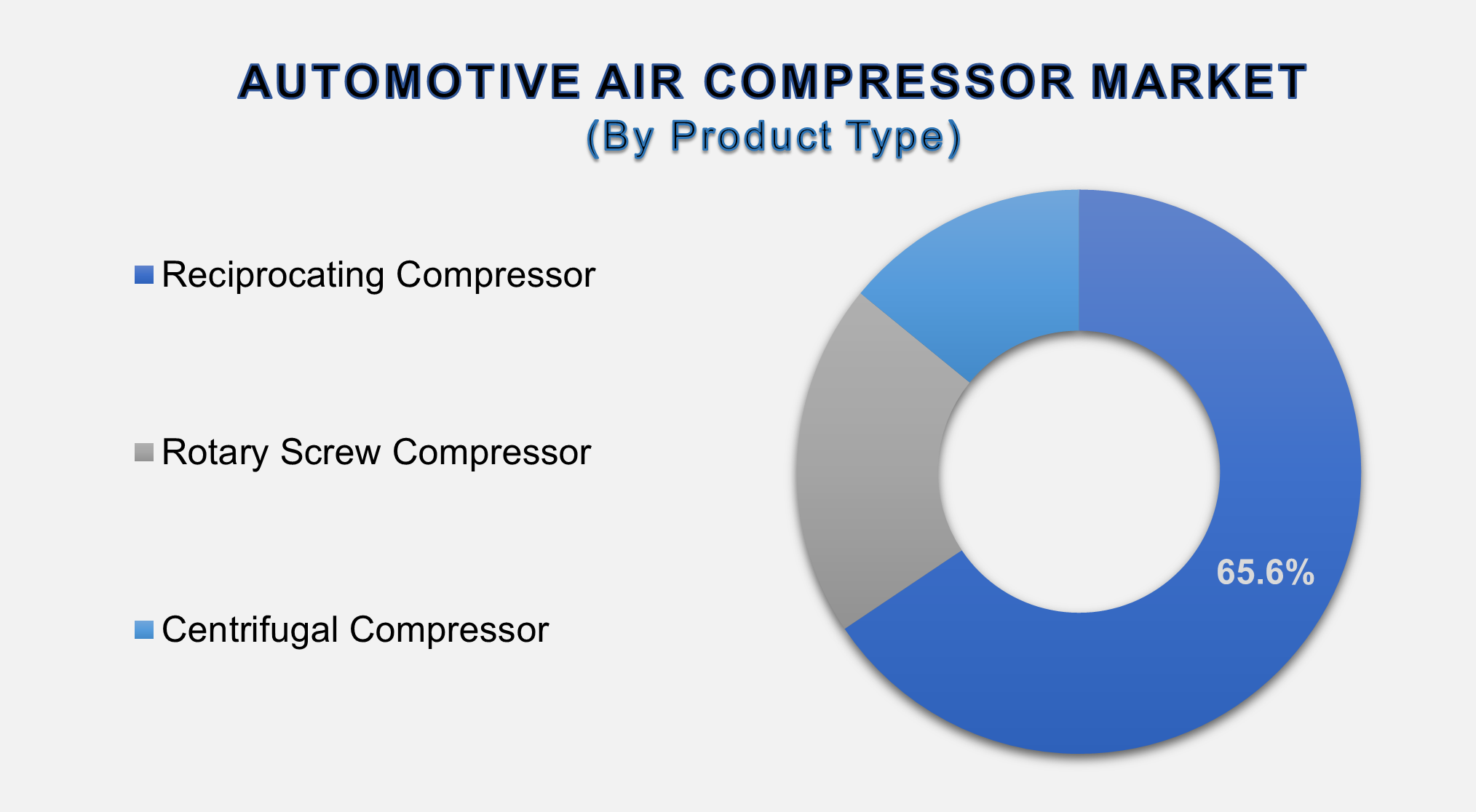
The Reciprocating
Compressor segment is anticipated to hold the largest market share in 2025.
The Product Type segment is categorized into Reciprocating, Rotary Screw, and Centrifugal. Reciprocating compressors dominate due to their robustness, cost-effectiveness, and proven reliability in demanding applications like air brake systems for commercial vehicles. Their simple design and ability to deliver high pressure make them the industry standard for heavy-duty braking and auxiliary air functions. However, rotary screw compressors are gaining traction in air suspension applications for passenger vehicles due to their quieter operation, continuous airflow, and compact size.
The Electric Drive Type
segment is projected to witness the highest growth rate during the forecast
period.
The
Drive Type segment is divided into Electric and Engine-driven. The electric
drive segment is experiencing explosive growth, driven almost entirely by the
electric vehicle revolution. Electric compressors are essential for EV HVAC and
battery cooling, operating independently of the engine. Their growth is further
supported by the trend towards 48V mild-hybrid architectures in conventional
vehicles, which use electric compressors for efficient climate control during
engine start-stop phases.
The Passenger Cars
vehicle type segment holds a dominant market share, while the EV segment shows
phenomenal growth.
The
Vehicle Type segment includes Passenger Cars, LCVs, HCVs, and Electric
Vehicles. Passenger cars lead in volume, attributed to the widespread adoption
of air suspension and advanced HVAC systems. However, the Electric Vehicles
segment, though smaller in absolute volume, is the fastest-growing. Every new
EV platform requires at least one high-voltage electric compressor, creating a
premium, technology-intensive market with significant value addition.
The following segments are
part of an in-depth analysis of the global Automotive Air Compressor Market:
|
Market
Segments |
|
|
By Product
Type |
●
Reciprocating
Compressor ●
Rotary Screw
Compressor ●
Centrifugal
Compressor |
|
By Application |
●
Air Suspension ●
Braking Systems ●
HVAC ●
Engine/Battery
Cooling ●
Others (Tire
Inflation, Pneumatic Tools) |
|
By Vehicle Type |
●
Passenger Cars ●
Light Commercial
Vehicles (LCVs) ●
Heavy Commercial
Vehicles (HCVs) ●
Electric Vehicles
(EVs) |
Automotive
Air Compressor Market Share Analysis by Region
The Asia-Pacific region
is anticipated to hold the largest portion of the Automotive Air Compressor
Market globally throughout the forecast period.
Asia-Pacific's
dominance stems from its undisputed position as the epicenter of global
automotive manufacturing and sales, led by China, Japan, and India. The
region's massive vehicle production volume provides a foundational demand.
China's rapid adoption of electric vehicles, the
largest EV market in the world, directly fuels
demand for advanced electric compressors. Furthermore, the increasing affluence
in the region is driving the uptake of premium features like air suspension in
passenger vehicles. The presence of leading global automotive suppliers and
compressor manufacturers with localized production further solidifies APAC's
leadership.
North
America and Europe remain critical high-value markets. North America's large
commercial vehicle fleet and high penetration of luxury pickups and SUVs with
air suspension drive significant demand. Europe's stringent emissions and
safety regulations, coupled with a strong premium automotive segment and rapid
EV adoption, make it a key region for technological innovation and advanced
compressor adoption.
Automotive Air Compressor Market Competition
Landscape Analysis
The global automotive air
compressor market is moderately consolidated, with a mix of large, diversified
automotive suppliers and specialized compressor manufacturers. Competition is
based on technological innovation (especially in e-compressors), system
integration capabilities, reliability, global supply chain presence, and cost
competitiveness. Key strategies include forming strategic partnerships with EV
manufacturers, investing heavily in R&D for efficient and quiet compressor
technologies, and expanding product portfolios to cover both conventional and
electric vehicle segments. The aftermarket for brake system compressors in
commercial vehicles is also a competitive and fragmented space.
Global Automotive Air Compressor Market Recent Developments
News:
- In February 2025, Hanon Systems launched a new ultra-quiet and
high-efficiency scroll compressor specifically designed for 800V EV
architectures.
- In December 2024, Continental AG secured a major contract to supply
integrated air supply units (compressors + dryers) for a North American
OEM's next-generation full-size SUV platform.
- In October 2024, Valeo and Mahle announced a joint venture to develop
next-generation thermal management systems for EVs, focusing on heat pump
technology that relies on advanced compressors.
- In August 2024, Knorr-Bremse introduced a new generation of
energy-efficient air compressors for commercial vehicles, targeting a 10%
reduction in power consumption.
The Global Automotive Air Compressor Market Is Dominated by a
Few Large Companies, such as
●
Continental AG
●
Knorr-Bremse AG
●
Valeo SA
●
Hanon Systems
●
MAHLE GmbH
●
Toyota Industries
Corporation
●
Hitachi Automotive
Systems, Ltd.
●
WABCO (ZF
Friedrichshafen AG)
●
VIAIR Corporation
●
Denso Corporation
●
Garrett Motion Inc.
●
SPX FLOW, Inc.
●
Bendix Commercial
Vehicle Systems LLC
●
Mitsubishi Heavy
Industries Machinery Systems, Ltd.
● Other Prominent Players
Frequently Asked Questions
Ekta Chaurasia (Team Lead)
Ekta Chaurasia is a highly experienced Team Lead at M2Square Consultancy with over 7 years of expertise in market research, strategic consulting, competitive benchmarking, and business intelligence solutions. She specializes in ICT, semiconductors & electronics, automotive & transportation, and industrial machinery markets.
She leads end-to-end global research projects focused on market trends, industry analysis, growth forecasting, customer insights, and strategic decision-making. Known for her analytical leadership and industry expertise, Ekta helps businesses uncover growth opportunities, evaluate competitive landscapes, and stay ahead in rapidly evolving markets through accurate and insight-driven research.
1. Global Automotive Air
Compressor Market Introduction and Market Overview
1.1.
Objectives
of the Study
1.2.
Global
Automotive Air Compressor Market Scope and Market Estimation
1.2.1.Global Electronic Toll
Collection Overall Market Size (US$ Bn), Market CAGR (%), Market forecast (2025
- 2033)
1.2.2.Global Automotive Air
Compressor Market Revenue Share (%) and Growth Rate (Y-o-Y) from 2020 - 2033
1.3.
Market
Segmentation
1.3.1.Product Type of Global Automotive
Air Compressor Market
1.3.2.Application of Global Automotive
Air Compressor Market
1.3.3.Vehicle Type of Global Automotive
Air Compressor Market
1.3.4.Region of Global Automotive
Air Compressor Market
2. Executive
Summary
2.1.
Demand
Side Trends
2.2.
Key
Market Trends
2.3.
Market
Demand (US$ Bn) Analysis 2020 – 2024 and forecast, 2025 – 2033
2.4.
Demand
and Opportunity Assessment
2.5.
Overview
of Global IVF Treatment and Access
2.6.
Key
Developments
2.7.
Market
Entry Strategies
2.8.
Market
Dynamics
2.8.1.Drivers
2.8.2.Limitations
2.8.3.Opportunities
2.8.4.Impact Analysis of Drivers
and Restraints
2.9.
Porter’s
Five Forces Analysis
2.10.
PEST
Analysis
3. Global
Automotive Air Compressor Market Estimates
& Historical Trend Analysis (2020 - 2024)
4. Global
Automotive Air Compressor Market Estimates
& Forecast Trend Analysis, by Product Type
4.1.
Global
Automotive Air Compressor Market Revenue (US$ Bn) Estimates and Forecasts, by Product
Type, 2020 - 2033
4.1.1.Reciprocating Compressor
4.1.2.Rotary Screw Compressor
4.1.3.Centrifugal Compressor
5. Global
Automotive Air Compressor Market Estimates
& Forecast Trend Analysis, by Application
5.1.
Global
Automotive Air Compressor Market Revenue (US$ Bn) Estimates and Forecasts, by Application,
2020 - 2033
5.1.1.Air Suspension
5.1.2.Braking Systems
5.1.3.HVAC
5.1.4.Engine/Battery Cooling
5.1.5.Others (Tire Inflation,
Pneumatic Tools)
6. Global
Automotive Air Compressor Market Estimates
& Forecast Trend Analysis, by Vehicle Type
6.1.
Global
Automotive Air Compressor Market Revenue (US$ Bn) Estimates and Forecasts, by Vehicle
Type 2020 - 2033
6.1.1.Passenger Cars
6.1.2.Light Commercial Vehicles
(LCVs)
6.1.3.Heavy Commercial Vehicles
(HCVs)
6.1.4.Electric Vehicles (EVs)
7. Global
Automotive Air Compressor Market Estimates
& Forecast Trend Analysis, by region
7.1.
Global
Automotive Air Compressor Market Revenue (US$ Bn) Estimates and Forecasts, by region,
2020 - 2033
7.1.1.North America
7.1.2.Europe
7.1.3.Asia Pacific
7.1.4.Middle East & Africa
7.1.5.Latin America
8. North America Automotive
Air Compressor Market: Estimates &
Forecast Trend Analysis
8.1.
North
America Automotive Air Compressor Market Assessments & Key Findings
8.1.1.North America Automotive
Air Compressor Market Introduction
8.1.2.North America Automotive
Air Compressor Market Size Estimates and Forecast (US$ Billion) (2020 - 2033)
8.1.2.1. By Product
Type
8.1.2.2. By Application
8.1.2.3. By Vehicle
Type
8.1.2.4.
By
Country
8.1.2.4.1. The U.S.
8.1.2.4.2. Canada
9. Europe Automotive
Air Compressor Market: Estimates &
Forecast Trend Analysis
9.1.
Europe
Automotive Air Compressor Market Assessments & Key Findings
9.1.1.Europe Automotive Air
Compressor Market Introduction
9.1.2.Europe Automotive Air
Compressor Market Size Estimates and Forecast (US$ Billion) (2020 - 2033)
9.1.2.1. By Product
Type
9.1.2.2. By Application
9.1.2.3. By Vehicle
Type
9.1.2.4.
By
Country
9.1.2.4.1.
Germany
9.1.2.4.2.
Italy
9.1.2.4.3.
U.K.
9.1.2.4.4.
France
9.1.2.4.5.
Spain
9.1.2.4.6.
Switzerland
9.1.2.4.7. Rest
of Europe
10. Asia Pacific Automotive
Air Compressor Market: Estimates &
Forecast Trend Analysis
10.1.
Asia
Pacific Market Assessments & Key Findings
10.1.1.
Asia
Pacific Automotive Air Compressor Market Introduction
10.1.2.
Asia
Pacific Automotive Air Compressor Market Size Estimates and Forecast (US$ Billion)
(2020 - 2033)
10.1.2.1. By Product
Type
10.1.2.2. By Application
10.1.2.3. By Vehicle
Type
10.1.2.4.
By
Country
10.1.2.4.1. China
10.1.2.4.2. Japan
10.1.2.4.3. India
10.1.2.4.4. Australia
10.1.2.4.5. South Korea
10.1.2.4.6. Rest of Asia Pacific
11. Middle East & Africa Automotive
Air Compressor Market: Estimates &
Forecast Trend Analysis
11.1.
Middle
East & Africa Market Assessments & Key Findings
11.1.1.
Middle East & Africa Automotive Air Compressor Market
Introduction
11.1.2.
Middle East & Africa Automotive Air Compressor Market
Size Estimates and Forecast (US$ Billion) (2020 - 2033)
11.1.2.1. By Product
Type
11.1.2.2. By Application
11.1.2.3. By Vehicle
Type
11.1.2.4.
By
Country
11.1.2.4.1. UAE
11.1.2.4.2. Saudi
Arabia
11.1.2.4.3. South
Africa
11.1.2.4.4. Rest
of MEA
12. Latin America
Automotive Air Compressor Market:
Estimates & Forecast Trend Analysis
12.1.
Latin
America Market Assessments & Key Findings
12.1.1.
Latin
America Automotive Air Compressor Market Introduction
12.1.2.
Latin
America Automotive Air Compressor Market Size Estimates and Forecast (US$ Billion)
(2020 - 2033)
12.1.2.1. By Product
Type
12.1.2.2. By Application
12.1.2.3. By Vehicle
Type
12.1.2.4.
By
Country
12.1.2.4.1. Brazil
12.1.2.4.2. Argentina
12.1.2.4.3. Mexico
12.1.2.4.4. Rest
of LATAM
13. Country Wise Market:
Introduction
14.
Competition
Landscape
14.1.
Global
Automotive Air Compressor Market Product Mapping
14.2.
Global
Automotive Air Compressor Market Concentration Analysis, by Leading Players /
Innovators / Emerging Players / New Entrants
14.3.
Global
Automotive Air Compressor Market Tier Structure Analysis
14.4.
Global
Automotive Air Compressor Market Concentration & Company Market Shares (%)
Analysis, 2024
15.
Company
Profiles
15.1.
Continental AG
15.1.1.
Company
Overview & Key Stats
15.1.2.
Financial
Performance & KPIs
15.1.3.
Product
Portfolio
15.1.4.
SWOT
Analysis
15.1.5.
Business
Strategy & Recent Developments
* Similar details would be provided for all the players
mentioned below
15.2. Knorr-Bremse
AG
15.3. Valeo SA
15.4. Hanon Systems
15.5. MAHLE GmbH
15.6. Toyota
Industries Corporation
15.7. Hitachi
Automotive Systems, Ltd.
15.8. WABCO (ZF
Friedrichshafen AG)
15.9. VIAIR
Corporation
15.10. Denso
Corporation
15.11. Garrett
Motion Inc.
15.12. SPX FLOW,
Inc.
15.13. Bendix
Commercial Vehicle Systems LLC
15.14. Mitsubishi
Heavy Industries Machinery Systems, Ltd.
15.15. Other
Prominent Players
16. Research
Methodology
16.1.
External
Transportations / Databases
16.2.
Internal
Proprietary Database
16.3.
Primary
Research
16.4.
Secondary
Research
16.5.
Assumptions
16.6.
Limitations
16.7.
Report
FAQs
17. Research
Findings & Conclusion
Our Research Methodology
"Insight without rigor is just noise."
We follow a comprehensive, multi-phase research framework designed to deliver accurate, strategic, and decision-ready intelligence. Our process integrates primary and secondary research , both quantitative and qualitative , along with dual modeling techniques ( top-down and bottom-up) and a final layer of validation through our proprietary in-house repository.
PRIMARY RESEARCH
Primary research captures real-time, firsthand insights from the market to understand behaviors, motivations, and emerging trends.
1. Quantitative Primary Research
Objective: Generate statistically significant data directly from market participants.
Approaches:- Structured surveys with customers, distributors, and field agents
- Mobile-based data collection for point-of-sale audits and usage behavior
- Phone-based interviews (CATI) for market sizing and product feedback
- Online polling around industry events and digital campaigns
- Purchase frequency by customer type
- Channel performance across geographies
- Feature demand by application or demographic
2. Qualitative Primary Research
Objective: Explore decision-making drivers, pain points, and market readiness.
Approaches:- In-depth interviews (IDIs) with executives, product managers, and key decision-makers
- Focus groups among end users and early adopters
- Site visits and observational research for consumer products
- Informal field-level discussions for regional and cultural nuances
SECONDARY RESEARCH
This phase helps establish a macro-to-micro understanding of market trends, size, regulation, and competitive dynamics, sourced from credible and public domain information.
1. Quantitative Secondary Research
Objective: Model market value and segment-level forecasts based on published data.
Sources include:- Financial reports and investor summaries
- Government trade data, customs records, and regulatory statistics
- Industry association publications and economic databases
- Channel performance and pricing data from marketplace listings
- Revenue splits, pricing trends, and CAGR estimates
- Supply-side capacity and volume tracking
- Investment analysis and funding benchmarks
2. Qualitative Secondary Research
Objective: Capture strategic direction, innovation signals, and behavioral trends.
Sources include:- Company announcements, roadmaps, and product pipelines
- Publicly available whitepapers, conference abstracts, and academic research
- Regulatory body publications and policy briefs
- Social and media sentiment scanning for early-stage shifts
- Strategic shifts in market positioning
- Unmet needs and white spaces
- Regulatory triggers and compliance impact
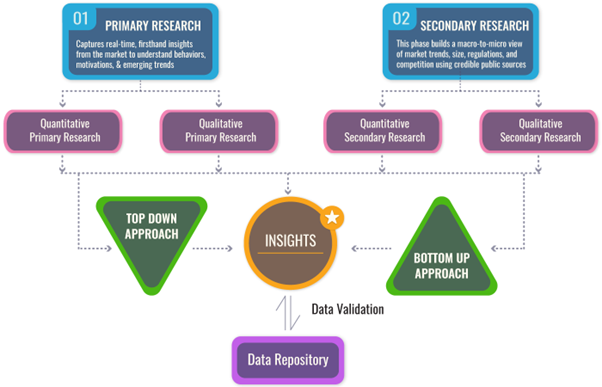
DUAL MODELING: TOP-DOWN + BOTTOM-UP
To ensure robust market estimation, we apply two complementary sizing approaches:
Top-Down Modeling:- Start with broader industry value (e.g., global or regional TAM)
- Apply filters by segment, geography, end-user, or use case
- Adjust with primary insights and validation benchmarks
- Ideal for investor-grade market scans and opportunity mapping
- Aggregate from the ground up using sales volumes, pricing, and unit economics
- Use internal modeling templates aligned with stakeholder data
- Incorporate distributor-level or region-specific inputs
- Most accurate for emerging segments and granular sub-markets
DATA VALIDATION: IN-HOUSE REPOSITORY
We close the loop with proprietary data intelligence built from ongoing projects, industry monitoring, and historical benchmarking. This repository includes:
- Multi-sector market and pricing models
- Key trendlines from past interviews and forecasts
- Benchmarked adoption rates, churn patterns, and ROI indicators
- Industry-specific deviation flags and cross-check logic
- Catches inconsistencies early
- Aligns projections across studies
- Enables consistent, high-trust deliverables