

Automotive Belt Tensioner Pulley Market Size and Forecast (2026–2034), Global and Regional Growth, Trend, Share and Industry Analysis Report Coverage; By Type (Automatic Belt Tensioner Pulleys, Manual Belt Tensioner Pulleys); By Product Type (Serpentine Belt, Timing Belt, V-Belt); By Vehicle Type (Passenger Cars, Commercial Vehicles); and Geography
2026-10-08
Automotive & Transportation (Mobility)
Ekta Chaurasia (Team Lead)
Description
Automotive Belt Tensioner Pulley
Market Overview
The global Automotive
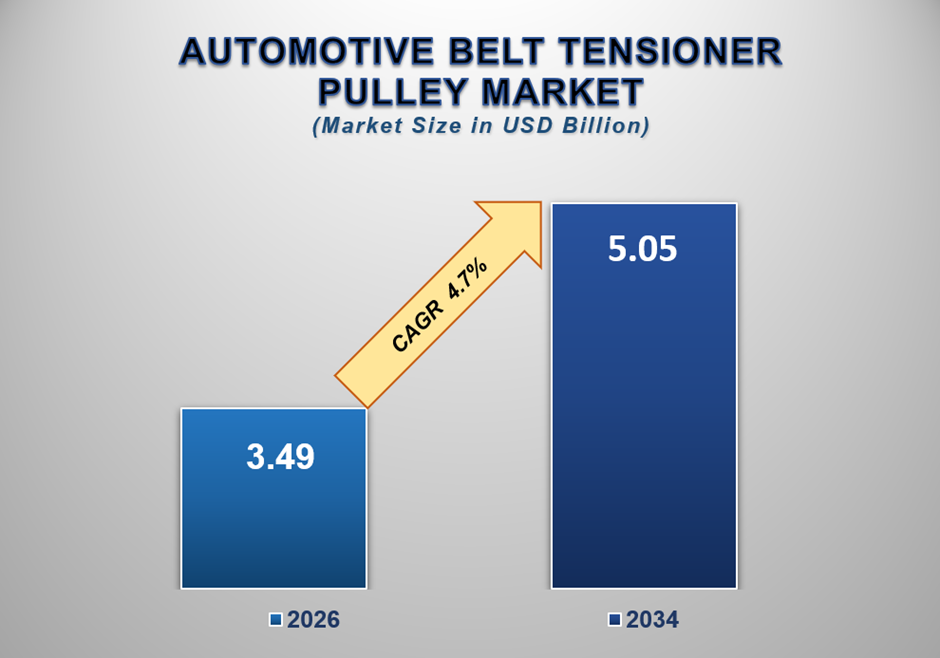
Belt Tensioner Pulley Market was valued at USD 3.49 billion in 2026
and is projected to reach USD 5.05 billion by 2034, expanding at a CAGR
of 4.7% during the forecast period. The market is supported by the
increasing global vehicle parc, continuing demand for replacement components,
growing use of automatic tensioning systems, and the technical requirements
associated with modern accessory-drive and timing-belt systems. A September
2026 industry estimate similarly identifies vehicle-fleet expansion,
independent aftermarket demand, and evolving powertrain architectures as
important market factors.
Automotive belt
tensioner pulleys are components used to maintain appropriate belt tension,
control belt movement, reduce slippage, and support reliable operation of
belt-driven systems. Depending on the vehicle architecture, these components
are used in accessory belt drives, timing-belt systems, and increasingly
specialized hybrid front-end accessory drive systems.
In conventional
accessory-drive systems, the tensioner works with the belt and pulley
arrangement to maintain appropriate tension as operating conditions and belt
loads change. Automatic tensioners are increasingly used because they can
compensate for belt wear and load variations while reducing the need for manual
adjustment. Recent market analysis identifies automatic tensioner pulleys as
the leading product category in terms of market value.
The expanding
global vehicle fleet is supporting aftermarket demand for replacement tensioner
pulleys. As vehicles remain in service for longer periods, wear-related
maintenance requirements for belts, tensioners, idler pulleys, bearings, and
associated components create recurring replacement opportunities.
The increasing
complexity of front-end accessory drive (FEAD) systems is also
influencing product development. Modern belt drives must operate under changing
accessory loads, higher rotational speeds, tighter packaging constraints, and
increasingly demanding noise, vibration, and harshness requirements.
The growth of mild-hybrid
vehicles is creating a specialized opportunity for belt tensioner
suppliers. In 48-volt belt-starter-generator configurations, the belt system
can transmit torque in both directions during engine assistance and
regenerative operation. This creates substantially different tension,
vibration, and slip requirements compared with conventional one-direction
accessory drives. SAE research on mild-hybrid FEAD systems has documented the
changing tight and slack sides of the belt during assist and regeneration modes
and the resulting requirements for tensioner performance.
Manufacturers
are therefore developing specialized tensioners, decouplers, idlers, and pulley
systems for hybrid applications. MUVIQ, for example, currently offers
BSG-specific side-arm and twin-arm tensioners for 48-volt mild-hybrid systems
designed to manage rapid load changes and reduce belt slip, noise, and
vibration.
Material and
bearing technology are also evolving. Suppliers are using steel, forged metal,
powdered metal, and reinforced polymer constructions, together with
high-temperature bearings and sealing systems, to improve durability while
reducing mass and rotational losses. Dayco states that its tensioner and idler
pulleys use multiple construction technologies, including glass-filled polymer
designs, along with lubricated ball bearings and high-temperature seals.
At the same
time, vehicle electrification creates a mixed market impact. Battery-electric
vehicles can eliminate conventional engine accessory-drive requirements in some
architectures, reducing certain traditional tensioner applications. However,
hybrid powertrains, belt-driven starter-generators, remaining
internal-combustion vehicle fleets, and the large global installed base of
conventional vehicles continue to support demand.
The expansion of
organized aftermarket services, increasing preventive maintenance awareness,
wider availability of complete belt-drive repair kits, and continued innovation
in automatic and hybrid-specific tensioner technologies are expected to support
market growth through 2034.
Automotive Belt Tensioner Pulley
Market Drivers and Opportunities
Expansion of
the Global Vehicle Fleet Is Driving Aftermarket Demand
The growing
number of vehicles in operation is one of the fundamental factors supporting
demand for automotive belt tensioner pulleys.
Tensioner
pulleys are wear-sensitive components within belt-drive systems, and
deterioration can result in belt noise, vibration, slippage, premature belt
wear, and damage to associated components.
As vehicles
remain operational for longer periods, replacement demand within the
independent automotive aftermarket is expected to remain important. Current
industry research identifies the expanding vehicle fleet and sustained
independent-aftermarket demand among the key market growth factors.
The replacement
of tensioners together with belts and idler pulleys is also becoming more
common because repair professionals increasingly focus on restoring the
complete belt-drive system rather than replacing only visibly damaged
components.
Increasing
Adoption of Automatic Tensioners Is Supporting Market Growth
Automatic
tensioner pulleys are increasingly preferred in modern belt-drive systems
because they automatically compensate for changes in belt length, wear,
temperature, and accessory loading.
Automatic
tensioners can help maintain more consistent belt force and reduce excessive
belt vibration and slippage. Current industry analysis estimates that automatic
belt tensioner pulleys represented approximately 65.2% of market value in
2025, although this figure belongs to a separate market estimate and should
not be treated as the share of the user's 2026 market base.
Gates' current
DriveAlign automatic tensioner portfolio is designed to maintain proper belt
tension, damp peak loads, and support longer belt and accessory life. The
company uses torsional spring and vibration-damping technologies across its
product range.
Growth of
Mild-Hybrid Vehicles Creates New Product Opportunities
Mild-hybrid
systems are introducing new technical requirements for belt tensioner pulleys.
In a
conventional FEAD system, power generally moves from the engine toward
accessories in one direction. In a belt-starter-generator mild-hybrid system,
torque can move in different directions during starting, engine assistance, and
regenerative braking.
This can cause
rapid changes in belt loading and tension and requires specialized tensioner
and damping solutions. SAE research has demonstrated the relationship among
engine torque, belt slip, belt tension, and tensioner behavior in mild-hybrid
operation.
NTN has
developed a twin-arm automatic tensioner specifically for mild-hybrid
accessory-drive systems to adjust belt tension across different driving modes
while limiting belt runout, vibration, and noise.
These
developments create opportunities for suppliers specializing in
high-dynamic-load tensioners, dual-arm mechanisms, damping systems, decoupler
pulleys, and integrated hybrid belt-drive packages.
Advanced
Materials and Improved Sealing Technologies Present Significant Opportunities
Modern
automotive tensioner pulleys must withstand temperature changes, contamination,
vibration, high rotational speeds, and prolonged operating cycles.
Manufacturers
are therefore improving bearing systems, sealing arrangements, pulley
materials, surface finishes, and vibration-control mechanisms.
Dayco currently
offers steel, powdered-metal, forged-steel, and reinforced-polymer pulley
designs, while Schaeffler has introduced an optimized sealing concept for many
tensioner and deflection pulley bearings to improve resistance to dust, dirt,
and moisture.
Lightweight
reinforced polymers and optimized metal designs can also reduce rotational
inertia and contribute to more efficient belt-drive operation.
Complete
Repair Kits and Independent Aftermarket Expansion Create Additional
Opportunities
The aftermarket
is increasingly shifting toward complete repair solutions that combine belts,
tensioners, idler pulleys, and other related components.
Gates launched
its Smart Kit in September 2026, combining timing and accessory-drive
components in coordinated repair packages. The company positioned the solution
as a response to growing vehicle complexity and the need to simplify
multi-component repairs.
This trend
creates opportunities for tensioner pulley manufacturers to increase sales
through integrated kits rather than individual replacement components.
Automotive Belt Tensioner Pulley
Market Scope
|
Report Attributes |
Description |
|
Market Size in 2026 |
USD 3.49 Billion |
|
Market Forecast in 2034 |
USD 5.05 Billion |
|
CAGR % 2026-2034 |
4.7% |
|
Base Year |
2025 |
|
Historic Data |
2021-2025 |
|
Forecast Period |
2026-2034 |
|
Report USP |
Production, Consumption,
Company Share, Company Heatmap, Company Production, Service Type, Growth
Factors and more |
|
Segments Covered |
● By Type ● By Product Type ●
By Vehicle Type |
|
Regional Scope |
● North America |
|
Country Scope |
U.S. |
Automotive Belt Tensioner Pulley
Market Report Segmentation Analysis
The global
automotive belt tensioner pulley market industry analysis is segmented by type,
by product type, by vehicle type, and by region.
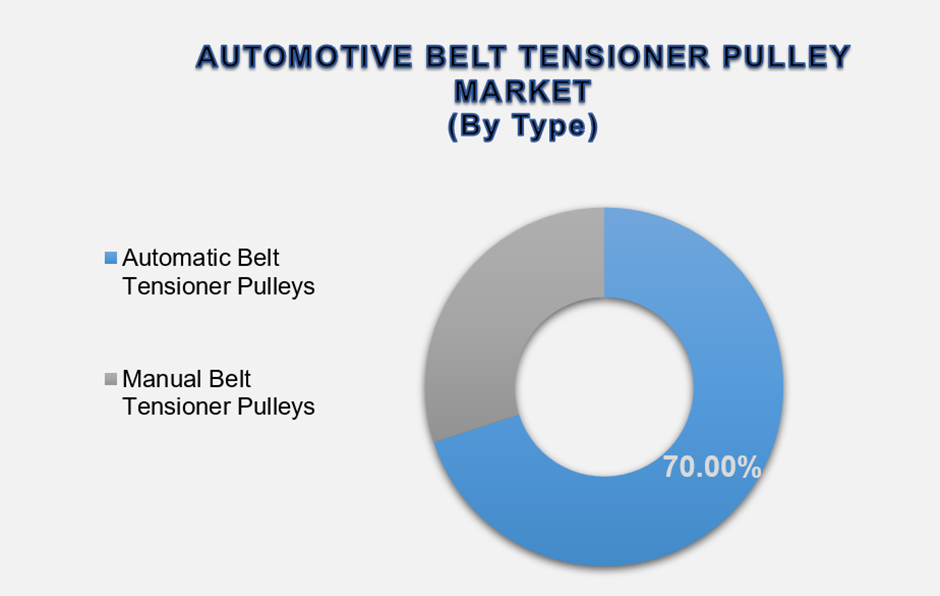
The Automatic
Belt Tensioner Pulleys Segment Is Expected to Dominate the Market During the
Forecast Period
The Automatic
Belt Tensioner Pulleys segment is expected to maintain the leading position
in the global automotive belt tensioner pulley market.
Automatic
tensioners continuously adjust belt tension as operating conditions change,
reducing the need for periodic manual adjustment and helping maintain
consistent belt engagement.
The segment
benefits from broad use across passenger vehicles and commercial vehicles with
modern accessory-drive systems. Automatic tensioners are also increasingly
important in applications where accessory loads fluctuate significantly.
The development
of hydraulic damping, torsional springs, dual-arm systems, and specialized
hybrid tensioners is further expanding the technical scope of automatic
tensioner products.
The
Serpentine Belt Segment Is Expected to Hold a Significant Market Position by
Product Type
The Serpentine
Belt segment represents a major application area because serpentine
accessory-drive systems are widely used to transmit power from the engine to
multiple auxiliary components.
The tensioner
maintains appropriate belt force as accessories operate at different loads and
speeds. In modern systems, it also contributes to controlling vibration and
belt dynamics.
Gates'
DriveAlign product portfolio includes automatic tensioners and idler pulleys
designed for accessory belt drive applications across passenger cars, light
trucks, and other vehicle categories.
The continued
operation of large internal-combustion vehicle fleets and replacement demand
from the aftermarket are expected to support the serpentine-belt-related
segment.
The Passenger
Cars Segment Is Expected to Dominate the Market by Vehicle Type
The Passenger
Cars segment is expected to represent the largest share of automotive belt
tensioner pulley demand.
Passenger
vehicles constitute a large installed fleet and use a broad range of belt-drive
systems for timing, accessory drives, air-conditioning systems, alternators,
water pumps, and other engine-related functions.
The expansion of
hybrid passenger vehicles is also creating new requirements for advanced
tensioner systems. Belt-starter-generator designs can impose bidirectional
torque and high dynamic loads on the accessory drive, leading to the
development of specialized tensioners for these vehicles.
Commercial vehicles are expected to remain an important market because fleet operators place strong emphasis on reliability, preventive maintenance, component durability, and minimizing vehicle downtime.
The Following
Segments Are Part of an In-Depth Analysis of the Global Automotive Belt
Tensioner Pulley Market:
|
Market Segments |
|
|
By Type |
●
Automatic Belt Tensioner Pulleys ●
Manual Belt Tensioner Pulleys |
|
By
Product Type |
●
Serpentine Belt ●
Timing Belt ●
V-Belt |
|
By Vehicle Type |
●
Passenger Cars ●
Commercial Vehicles |
Automotive Belt Tensioner Pulley
Market Share Analysis By Region
Asia Pacific is expected to remain an important regional market for automotive
belt tensioner pulleys, supported by high automotive production volumes, a
large vehicle population, expanding independent aftermarket activity, and
increasing adoption of hybrid technologies. Industry analysis identifies APAC
among the principal geographic markets for automotive belt tensioner pulley
products.
China represents a major contributor due to its large automotive
manufacturing base and extensive vehicle parc. Although battery-electric
vehicle penetration is reshaping the composition of powertrain-related
component demand, conventional and hybrid vehicle production continues to
support belt-driven applications.
Japan and South Korea maintain important positions due to their
established automotive manufacturing industries, advanced component supply
chains, and development of hybrid powertrain technologies.
India is expected to provide additional aftermarket and OEM opportunities
as the vehicle population expands and organized automotive servicing becomes
more widespread. The country's growing passenger-vehicle and commercial-vehicle
markets provide a substantial installed base for replacement belt-drive
components.
North America represents a significant market due to its large vehicle fleet,
substantial independent aftermarket, extensive light-truck population, and high
demand for replacement automotive components.
The United
States accounts for a major share of regional demand. Long vehicle
operating lifetimes and continuing aftermarket servicing create recurring
opportunities for tensioner, pulley, belt, and complete drive-system
replacement products.
Europe maintains a substantial market supported by established automotive
manufacturing, stringent vehicle efficiency requirements, large passenger-car
fleets, and strong aftermarket distribution networks.
Germany,
France, Italy, the U.K., and Spain are important
markets for belt-drive components. European suppliers are also active in
developing advanced tensioner and pulley technologies for conventional, hybrid,
and specialized vehicle architectures.
Latin America is expected to experience steady market growth, supported by
expanding vehicle fleets, maintenance requirements, and development of
organized aftermarket distribution channels. Brazil and Mexico remain
key regional contributors.
Middle East
& Africa represents an emerging market
supported by vehicle fleet expansion, aftermarket servicing, and increasing
availability of branded automotive replacement components. Saudi Arabia, the
UAE, and South Africa are important markets within the region.
The regional outlook is influenced by the changing powertrain mix. The increasing penetration of battery-electric vehicles may reduce certain conventional engine accessory-belt applications over the long term, while hybridization and the continued operation of internal-combustion vehicles support demand for advanced tensioner technologies.
Automotive
Belt Tensioner Pulley Market Competition Landscape Analysis
The automotive
belt tensioner pulley market is competitive and includes global automotive
component suppliers, power-transmission companies, bearing manufacturers,
aftermarket specialists, and OEM-focused component producers.
Competition is
centered on OE-quality performance, durability, bearing reliability,
vibration control, thermal resistance, material engineering, product coverage,
and application-specific design.
Gates maintains a broad automotive tensioner portfolio covering automatic
tensioners, timing tensioners, tensioner kits, and idler pulleys. Its
DriveAlign automatic tensioners incorporate damping and spring technologies
designed to maintain appropriate belt tension under changing operating
conditions.
Schaeffler offers tensioner and deflection pulleys under its established INA
portfolio and maintains a large vehicle-specific catalog. Its current products
include timing-belt tensioner pulleys and complete timing-belt kits containing
tensioners and guide pulleys.
In September
2026, Schaeffler announced an aftermarket brand transformation under which its
FAG, INA, and LuK product brands will progressively transition toward a unified
Schaeffler brand presence beginning in 2027. The company stated that product
specifications and part numbers will remain unchanged through the transition.
Dayco competes through accessory-drive and timing-drive products and
offers tensioner and idler pulleys using metal and reinforced-polymer
constructions. Its product portfolio emphasizes dimensional precision, bearing
performance, sealing, vibration reduction, and long service life.
Litens is focusing on broader aftermarket coverage and technician-oriented
product design. Its 2026 aftermarket expansion included new tensioners using
the Easy Button latch and Technician Assist Pin technology, together with
additional pulleys and complete kits.
NTN and MUVIQ are also active in specialized hybrid tensioner
development. Their products address the higher dynamic loads, bidirectional
torque, vibration, and packaging requirements of belt-starter-generator
systems.
The competitive landscape is therefore evolving from conventional replacement pulleys toward complete belt-drive systems, hybrid-specific tensioners, integrated repair kits, improved sealing technologies, and application-specific OE solutions.
Global
Automotive Belt Tensioner Pulley Market Recent Developments News
●
In September 2026 – Gates introduced its Smart Kit, an integrated repair
solution combining critical timing and accessory-drive components to simplify
increasingly complex vehicle repairs. The offering includes PowerGrip + Micro-V
kits and PowerGrip + Timing Chain kits.
●
In September 2026 – Schaeffler announced a global aftermarket brand
transformation that will progressively bring its FAG, INA, and LuK portfolios
under the Schaeffler brand beginning in Q2 2027, while retaining the existing
product specifications and part numbers.
●
In July 2026 – Litens Aftermarket N.A. announced 29 new SKUs covering
more than 26.6 million vehicles in operation. The expansion included three new
tensioners featuring Easy Button latch and Technician Assist Pin technology and
additional pulley and kit applications.
●
In April 2026 – Dayco received the 2025 Technical Development Award from
Chenzhi Science and Technology in recognition of technological innovation and
product performance in belt-drive systems.
●
In January 2026 – Dayco announced the launch of a new ELA serpentine belt in
North America, continuing its development and expansion of drive-system
products for the automotive replacement market.
● In October 2025 – Schaeffler issued technical information describing an optimized sealing concept for many tensioner and deflection pulley bearings, improving resistance to external contaminants such as dust, dirt, and moisture.
The Global
Automotive Belt Tensioner Pulley Market Includes Major Companies, Such As
●
AB SKF
●
AISIN Corporation
●
Bando Chemical Industries, Ltd.
●
Continental AG
●
Dayco LLC
●
Dorman Products, Inc.
●
Gates Industrial Corporation
plc
●
Goodyear Tire & Rubber
Company
●
Hutchinson S.A.
●
JTEKT Corporation
●
Kanemitsu Corporation
●
Litens Automotive
●
Muhr und Bender KG
●
NTN Corporation
●
Standard Motor Products, Inc.
●
The Timken Company
●
Valeo S.A.
●
Schaeffler AG
●
NSK Ltd.
●
Tsubakimoto Chain Co.
● Others
Frequently Asked Questions
Ekta Chaurasia (Team Lead)
Ekta Chaurasia is a highly experienced Team Lead at M2Square Consultancy with over 7 years of expertise in market research, strategic consulting, competitive benchmarking, and business intelligence solutions. She specializes in ICT, semiconductors & electronics, automotive & transportation, and industrial machinery markets.
She leads end-to-end global research projects focused on market trends, industry analysis, growth forecasting, customer insights, and strategic decision-making. Known for her analytical leadership and industry expertise, Ekta helps businesses uncover growth opportunities, evaluate competitive landscapes, and stay ahead in rapidly evolving markets through accurate and insight-driven research.
1.
Global Automotive Belt
Tensioner Pulley Market Introduction and Market Overview
1.1. Objectives of the Study
1.2. Global Automotive Belt Tensioner Pulley Market Scope and Market
Estimation
1.2.1.
Global Automotive Belt
Tensioner Pulley Market Market Size (US$ Million), Market CAGR (%), Market
Forecast (2026 - 2034)
1.2.2.
Global Automotive Belt
Tensioner Pulley Market Market Revenue Share (%) and Growth Rate (Y-o-Y)
Analysis (2021 - 2034)
1.3. Market Segmentation
1.3.1.
By Type of Global Automotive
Belt Tensioner Pulley Market
1.3.2.
By Product Type of Global
Automotive Belt Tensioner Pulley Market
1.3.3.
By Vehicle Type of Global
Automotive Belt Tensioner Pulley Market
1.3.4.
Region of Global Automotive
Belt Tensioner Pulley Market
1.4. Competition Coverage List of Market Participants
1.5. Market Definition: Automotive Belt Tensioner Pulley Market
2.
Executive Summary
2.1. Demand Side Trends
2.2. Key Market Trends
2.3. Market Demand (US$ Million) Analysis 2021 – 2025 and Forecast, 2026
– 2034
2.4. Demand and Opportunity Assessment
2.5. Key Developments
2.6. Overview of Regulatory Landscape, Compliance Framework, and Industry
Standards
2.7. Market Entry Strategies
2.8. Market Dynamics
2.8.1.
Drivers
2.8.2.
Limitations
2.8.3.
Opportunities
2.8.4.
Impact Analysis of Drivers and
Restraints
2.9. Porter's Five Forces Analysis
2.10.
PEST Analysis
3.
Global Automotive Belt
Tensioner Pulley Market Estimates & Historical Trend Analysis (2021 – 2025)
4.
Global Automotive Belt
Tensioner Pulley Market Estimates & Forecast Trend Analysis, by Type
4.1. Global Automotive Belt Tensioner Pulley Market Revenue (US$ Million)
Estimates and Forecasts, by Type, 2021 - 2034
4.1.1.
Automatic Belt Tensioner
Pulleys
4.1.2.
Manual Belt Tensioner Pulleys
5.
Global Automotive Belt
Tensioner Pulley Market Estimates & Forecast Trend Analysis, by Product
Type
5.1. Global Automotive Belt Tensioner Pulley Market Revenue (US$ Million)
Estimates and Forecasts, by Product Type, 2021 - 2034
5.1.1.
Serpentine Belt
5.1.2.
Timing Belt
5.1.3.
V-Belt
6.
Global Automotive Belt
Tensioner Pulley Market Estimates & Forecast Trend Analysis, by Vehicle
Type
6.1. Global Automotive Belt Tensioner Pulley Market Revenue (US$ Million)
Estimates and Forecasts, by Vehicle Type, 2021 - 2034
6.1.1.
Passenger Cars
6.1.2.
Commercial Vehicles
7.
Global Automotive Belt
Tensioner Pulley Market Estimates & Forecast Trend Analysis, by Region
7.1. Global Automotive Belt Tensioner Pulley Market Revenue (US$ Million)
Estimates and Forecasts, by Region, 2021 - 2034
7.1.1.
North America
7.1.2.
Europe
7.1.3.
Asia Pacific
7.1.4.
Middle East & Africa
7.1.5.
Latin America
8.
North America Automotive
Belt Tensioner Pulley Market: Estimates & Forecast Trend Analysis
8.1. North America Automotive Belt Tensioner Pulley Market Assessments
& Key Findings
8.1.1.
North America Automotive Belt
Tensioner Pulley Market Introduction
8.1.2.
North America Automotive Belt
Tensioner Pulley Market Size Estimates and Forecast (US$ Million) (2021 - 2034)
8.1.2.1.
By Type
8.1.2.2.
By Product Type
8.1.2.3.
By Vehicle Type
8.1.2.4.
By Country
8.1.2.4.1.
The U.S.
8.1.2.4.2.
Canada
9.
Europe Automotive Belt
Tensioner Pulley Market: Estimates & Forecast Trend Analysis
9.1. Europe Automotive Belt Tensioner Pulley Market Assessments & Key
Findings
9.1.1.
Europe Automotive Belt
Tensioner Pulley Market Introduction
9.1.2.
Europe Automotive Belt
Tensioner Pulley Market Size Estimates and Forecast (US$ Million) (2021 - 2034)
9.1.2.1.
By Type
9.1.2.2.
By Product Type
9.1.2.3.
By Vehicle Type
9.1.2.4.
By Country
9.1.2.4.1.
Germany
9.1.2.4.2.
Italy
9.1.2.4.3.
The U.K.
9.1.2.4.4.
France
9.1.2.4.5.
Spain
9.1.2.4.6.
Switzerland
9.1.2.4.7.
Rest of Europe
10. Asia Pacific Automotive Belt Tensioner Pulley Market: Estimates
& Forecast Trend Analysis
10.1.
Asia Pacific Automotive Belt
Tensioner Pulley Market Assessments & Key Findings
10.1.1.
Asia Pacific Automotive Belt
Tensioner Pulley Market Introduction
10.1.2.
Asia Pacific Automotive Belt
Tensioner Pulley Market Size Estimates and Forecast (US$ Million) (2021 - 2034)
10.1.2.1.
By Type
10.1.2.2.
By Product Type
10.1.2.3.
By Vehicle Type
10.1.2.4.
By Country
10.1.2.4.1.
China
10.1.2.4.2.
Japan
10.1.2.4.3.
India
10.1.2.4.4.
Australia
10.1.2.4.5.
South Korea
10.1.2.4.6.
Rest of Asia Pacific
11. Middle East & Africa Automotive Belt Tensioner Pulley Market: Estimates
& Forecast Trend Analysis
11.1.
Middle East & Africa
Automotive Belt Tensioner Pulley Market Assessments & Key Findings
11.1.1.
Middle East & Africa
Automotive Belt Tensioner Pulley Market Introduction
11.1.2.
Middle East & Africa
Automotive Belt Tensioner Pulley Market Size Estimates and Forecast (US$
Million) (2021 - 2034)
11.1.2.1.
By Type
11.1.2.2.
By Product Type
11.1.2.3.
By Vehicle Type
11.1.2.4.
By Country
11.1.2.4.1.
UAE
11.1.2.4.2.
Saudi Arabia
11.1.2.4.3.
South Africa
11.1.2.4.4.
Rest of Middle East &
Africa
12. Latin America Automotive Belt Tensioner Pulley Market: Estimates
& Forecast Trend Analysis
12.1.
Latin America Automotive Belt
Tensioner Pulley Market Assessments & Key Findings
12.1.1.
Latin America Automotive Belt
Tensioner Pulley Market Introduction
12.1.2.
Latin America Automotive Belt
Tensioner Pulley Market Size Estimates and Forecast (US$ Million) (2021 - 2034)
12.1.2.1.
By Type
12.1.2.2.
By Product Type
12.1.2.3.
By Vehicle Type
12.1.2.4.
By Country
12.1.2.4.1.
Brazil
12.1.2.4.2.
Mexico
12.1.2.4.3.
Argentina
12.1.2.4.4.
Rest of Latin America
13. Competition Landscape
13.1.
Global Automotive Belt
Tensioner Pulley Market Product Mapping
13.2.
Global Automotive Belt
Tensioner Pulley Market Concentration Analysis, by Leading Players / Innovators
/ Emerging Players / New Entrants
13.3.
Global Automotive Belt
Tensioner Pulley Market Tier Structure Analysis
13.4.
Global Automotive Belt
Tensioner Pulley Market Concentration & Company Market Shares (%) Analysis,
2026
14. Company Profiles
14.1.
AB SKF
14.1.1.
Company Overview & Key
Stats
14.1.2.
Financial Performance &
KPIs
14.1.3.
Product Portfolio
14.1.4.
SWOT Analysis
14.1.5.
Business Strategy & Recent
Developments
*Similar details would be provided for all
the players mentioned below
14.2.
AISIN Corporation
14.3.
Bando Chemical Industries, Ltd.
14.4.
Continental AG
14.5.
Dayco LLC
14.6.
Dorman Products, Inc.
14.7.
Gates Industrial Corporation
plc
14.8.
Goodyear Tire & Rubber
Company
14.9.
Hutchinson S.A.
14.10.
JTEKT Corporation
14.11.
Kanemitsu Corporation
14.12.
Litens Automotive
14.13.
Muhr und Bender KG
14.14.
NTN Corporation
14.15.
Standard Motor Products, Inc.
14.16.
The Timken Company
14.17.
Valeo S.A.
14.18.
Schaeffler AG
14.19.
NSK Ltd.
14.20.
Tsubakimoto Chain Co.
14.21.
Others
15. Research Findings & Conclusion
16. Assumptions & Acronyms Used
17. Research Methodology
17.1.
External Databases
17.2.
Internal Proprietary Database
17.3.
Primary Research
17.4.
Secondary Research
17.5.
Assumptions
17.6.
Limitations
17.7.
Report FAQ
Our Research Methodology
"Insight without rigor is just noise."
We follow a comprehensive, multi-phase research framework designed to deliver accurate, strategic, and decision-ready intelligence. Our process integrates primary and secondary research , both quantitative and qualitative , along with dual modeling techniques ( top-down and bottom-up) and a final layer of validation through our proprietary in-house repository.
PRIMARY RESEARCH
Primary research captures real-time, firsthand insights from the market to understand behaviors, motivations, and emerging trends.
1. Quantitative Primary Research
Objective: Generate statistically significant data directly from market participants.
Approaches:- Structured surveys with customers, distributors, and field agents
- Mobile-based data collection for point-of-sale audits and usage behavior
- Phone-based interviews (CATI) for market sizing and product feedback
- Online polling around industry events and digital campaigns
- Purchase frequency by customer type
- Channel performance across geographies
- Feature demand by application or demographic
2. Qualitative Primary Research
Objective: Explore decision-making drivers, pain points, and market readiness.
Approaches:- In-depth interviews (IDIs) with executives, product managers, and key decision-makers
- Focus groups among end users and early adopters
- Site visits and observational research for consumer products
- Informal field-level discussions for regional and cultural nuances
SECONDARY RESEARCH
This phase helps establish a macro-to-micro understanding of market trends, size, regulation, and competitive dynamics, sourced from credible and public domain information.
1. Quantitative Secondary Research
Objective: Model market value and segment-level forecasts based on published data.
Sources include:- Financial reports and investor summaries
- Government trade data, customs records, and regulatory statistics
- Industry association publications and economic databases
- Channel performance and pricing data from marketplace listings
- Revenue splits, pricing trends, and CAGR estimates
- Supply-side capacity and volume tracking
- Investment analysis and funding benchmarks
2. Qualitative Secondary Research
Objective: Capture strategic direction, innovation signals, and behavioral trends.
Sources include:- Company announcements, roadmaps, and product pipelines
- Publicly available whitepapers, conference abstracts, and academic research
- Regulatory body publications and policy briefs
- Social and media sentiment scanning for early-stage shifts
- Strategic shifts in market positioning
- Unmet needs and white spaces
- Regulatory triggers and compliance impact
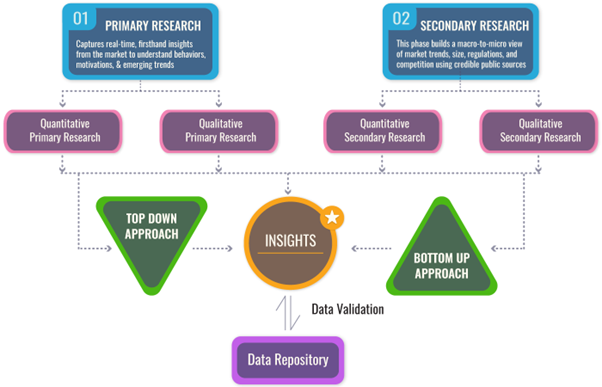
DUAL MODELING: TOP-DOWN + BOTTOM-UP
To ensure robust market estimation, we apply two complementary sizing approaches:
Top-Down Modeling:- Start with broader industry value (e.g., global or regional TAM)
- Apply filters by segment, geography, end-user, or use case
- Adjust with primary insights and validation benchmarks
- Ideal for investor-grade market scans and opportunity mapping
- Aggregate from the ground up using sales volumes, pricing, and unit economics
- Use internal modeling templates aligned with stakeholder data
- Incorporate distributor-level or region-specific inputs
- Most accurate for emerging segments and granular sub-markets
DATA VALIDATION: IN-HOUSE REPOSITORY
We close the loop with proprietary data intelligence built from ongoing projects, industry monitoring, and historical benchmarking. This repository includes:
- Multi-sector market and pricing models
- Key trendlines from past interviews and forecasts
- Benchmarked adoption rates, churn patterns, and ROI indicators
- Industry-specific deviation flags and cross-check logic
- Catches inconsistencies early
- Aligns projections across studies
- Enables consistent, high-trust deliverables