

Automotive Hypervisor Market Size and Forecast (2026–2034), Global and Regional Growth, Trend, Share and Industry Analysis Report Coverage; By Type (Type 1 Hypervisor, Type 2 Hypervisor); By Vehicle Type (Passenger Cars, Commercial Vehicles); By Application (ADAS & Autonomous Driving, Digital Cockpit & Infotainment, Connectivity & Telematics, Powertrain & Vehicle Control, Others); and Geography
2026-10-09
Automotive & Transportation (Mobility)
Ekta Chaurasia (Team Lead)
Description
Automotive Hypervisor Market Overview
The global Automotive
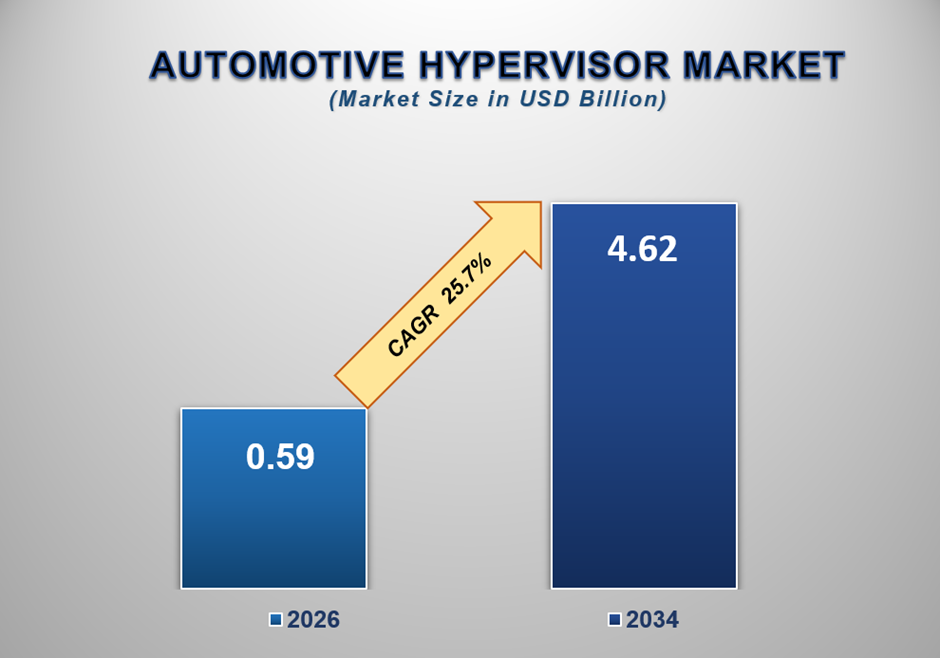
Hypervisor Market was valued at USD 0.591 billion in 2026 and is
projected to reach USD 4.62 billion by 2034, expanding at a stated CAGR
of 25.7% during the forecast period. The market is experiencing rapid
growth as automakers transition from distributed electronic control units
toward domain, zonal, and centralized computing architectures, increasing the
need to securely run multiple operating systems and workloads on shared
automotive computing platforms. Current industry analysis identifies the
consolidation of vehicle computing architectures as a major driver of
automotive hypervisor adoption.
An automotive
hypervisor is a virtualization layer that enables multiple operating systems or
software environments to run on the same physical automotive processor while
maintaining defined levels of isolation between workloads. This allows
safety-critical applications, infotainment software, connectivity functions,
and other workloads to share computing resources without requiring a separate
physical ECU for every software environment. QNX, Wind River, Elektrobit, and
NVIDIA all describe virtualization as a mechanism for running heterogeneous
automotive workloads on shared computing hardware.
The transition
toward software-defined vehicles (SDVs) is one of the strongest factors
supporting market expansion. Vehicle architectures are becoming increasingly
software-centric, with higher computing requirements generated by advanced
driver assistance systems, artificial intelligence, digital cockpits, connected
services, over-the-air updates, and centralized vehicle functions. Hypervisors
provide an architectural mechanism for consolidating these workloads while
maintaining separation between applications with different performance,
security, and safety requirements.
The increasing
shift from numerous distributed ECUs toward domain and zonal controllers
is also supporting demand. Consolidating multiple software functions onto fewer
high-performance computing units can reduce hardware duplication and create
more flexible vehicle architectures. Elektrobit's EB corbos Hypervisor, for
example, is designed to execute multiple guest operating systems on a single
CPU and supports virtualization of peripherals through VIRTIO.
Functional
safety and cybersecurity requirements are becoming
increasingly important in automotive virtualization. Hypervisor-based
architectures can create spatial and temporal separation between workloads,
helping prevent faults in one virtual machine from propagating to another.
Safety-oriented products such as QNX Hypervisor for Safety and Elektrobit's
safety-certified hypervisor are designed for automotive environments where
isolation and certification requirements are critical.
The growth of electric
vehicles and advanced vehicle computing is further expanding the
addressable market. EV platforms increasingly combine sophisticated battery
management, thermal management, ADAS, connectivity, cockpit, and
energy-management functions. At the same time, next-generation automotive
processors are incorporating CPUs, GPUs, AI accelerators, and other
heterogeneous resources, creating demand for software platforms capable of
allocating these resources among different automotive applications.
The increasing
use of Linux, Android Automotive OS, AUTOSAR, real-time operating systems,
and other heterogeneous software environments is creating another
opportunity for hypervisor suppliers. Qualcomm's automotive platforms, for
example, use hardware virtualization and a Type-1 hypervisor architecture to
support multiple guest virtual machines and operating systems on centralized
automotive processors.
The development
of virtual development and testing environments is also expanding the role of
virtualization beyond the vehicle itself. OpenSynergy's COQOS Cloud allows
software-defined vehicle developers to test software on virtualized hardware in
the cloud, while Siemens' PAVE360 supports virtualized system-level development
and testing for automotive software.
As vehicle computing becomes increasingly centralized and software-intensive, demand for safe, secure, scalable, and hardware-efficient virtualization technologies is expected to increase substantially through 2034.
Automotive Hypervisor Market Drivers
and Opportunities
Transition
Toward Software-Defined Vehicles Is Driving Market Growth
The automotive
industry's transition toward software-defined vehicle architectures is one of
the most important growth factors for the automotive hypervisor market.
Modern vehicles
contain increasingly complex software stacks spanning infotainment, instrument
clusters, ADAS, connectivity, telematics, body functions, and vehicle control.
Running every software environment on dedicated hardware can increase ECU
count, integration complexity, wiring requirements, and hardware costs.
Hypervisors
allow different software environments to operate on shared computing platforms.
Wind River's Helix Virtualization Platform, for example, is designed to
consolidate functions with different safety criticality levels onto a single
compute platform.
The expansion of
SDV architectures is therefore increasing the importance of virtualization as a
foundation for software consolidation, hardware abstraction, and multi-OS
operation.
ECU
Consolidation and Centralized Computing Are Supporting Market Expansion
Automakers are
increasingly consolidating vehicle functions into high-performance domain and
central computing platforms.
Instead of using
individual processors for isolated functions, centralized architectures can
host multiple applications on more powerful computing hardware. Hypervisors
provide the isolation and resource-management layer needed to support this
model.
Elektrobit
states that its EB corbos Hypervisor can virtualize multiple physical ECUs into
a single hardware unit and allow legacy and modern operating systems to operate
side by side in isolated virtual machines.
As vehicle
architectures continue moving toward fewer and more capable compute units,
hypervisor technology is expected to become increasingly important for ECU
consolidation.
Functional
Safety and Mixed-Criticality Workloads Create Significant Demand
Automotive
computing platforms frequently need to run workloads with different levels of
safety criticality.
For example, an
instrument cluster or ADAS function may have safety-related requirements, while
infotainment and passenger applications may operate under different assurance
levels. A hypervisor can provide isolation between these environments while
allowing them to share the same processor.
QNX maintains
separate non-safety and safety-oriented hypervisor variants, while QNX
Hypervisor for Safety is assessed for use in systems targeting standards
including ISO 26262 ASIL D and IEC 61508 SIL 3.
This combination
of functional safety, isolation, and hardware consolidation creates
opportunities for suppliers with certified virtualization platforms and
established automotive ecosystems.
AI, ADAS and
High-Performance Computing Present New Opportunities
The rapid
development of ADAS and automated-driving technologies is increasing the
computing intensity of vehicles.
High-performance
automotive processors increasingly combine general-purpose CPU resources with
GPUs, NPUs, AI accelerators, and specialized automotive hardware.
Virtualization can help allocate these computing resources across independent
software environments.
NVIDIA DRIVE OS
includes virtualization and containerization capabilities for workload
isolation and heterogeneous automotive computing, while Qualcomm's Snapdragon
automotive platforms incorporate hardware virtualization and Type-1 hypervisor
support for concurrent workloads.
The development
of AI-powered driver assistance, perception, sensor fusion, cockpit
intelligence, and vehicle automation is expected to create additional demand
for advanced virtualization technologies.
Automotive Hypervisor Market Scope
|
Report Attributes |
Description |
|
Market Size in 2026 |
USD 0.59 Billion |
|
Market Forecast in 2034 |
USD 4.62 Billion |
|
CAGR % 2026-2034 |
25.7% |
|
Base Year |
2025 |
|
Historic Data |
2021-2025 |
|
Forecast Period |
2026-2034 |
|
Report USP |
Production, Consumption,
Company Share, Company Heatmap, Company Production, Service Type, Growth
Factors and more |
|
Segments Covered |
● By Type ● By Vehicle Type ●
By Application |
|
Regional Scope |
● North America |
|
Country Scope |
U.S. |
Automotive Hypervisor Market Report
Segmentation Analysis
The global
automotive hypervisor market industry analysis is segmented by type, vehicle
type, application, and region.
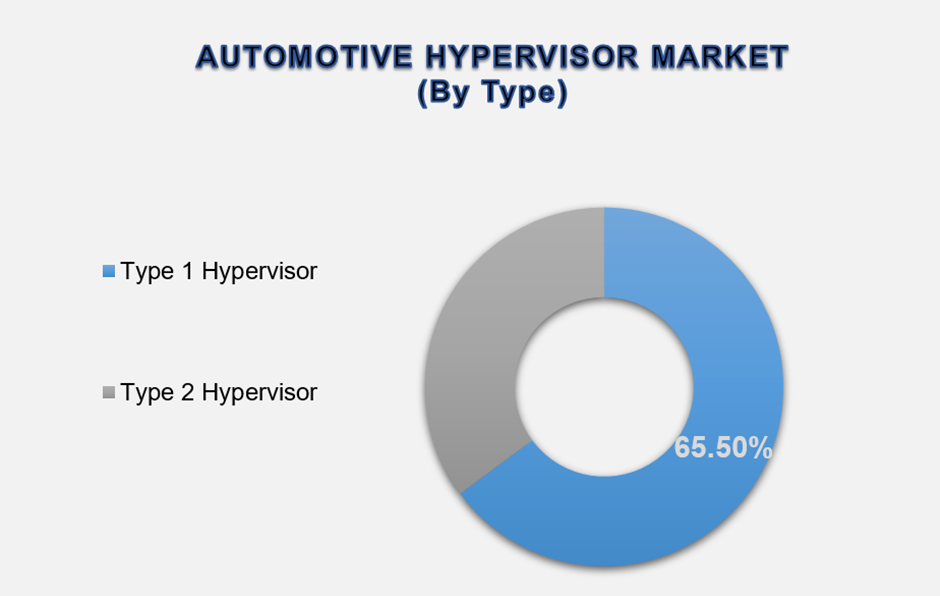
The Type 1
Hypervisor Segment Is Expected to Dominate the Market During the Forecast
Period
The Type 1
Hypervisor segment is expected to maintain a leading position in the
automotive hypervisor market because these hypervisors operate directly on the
underlying hardware and are suited to environments requiring strong isolation,
predictable performance, and efficient resource allocation.
Automotive
applications often require multiple operating systems and workload classes to
run on the same high-performance processor. Type 1 architectures are widely
associated with safety-critical and mixed-criticality automotive use cases.
QNX Hypervisor,
Wind River Helix, and Elektrobit EB Corbos Hypervisor represent examples of
automotive virtualization platforms built around hardware-level virtualization
and multi-OS execution.
The increasing
adoption of centralized and domain computing architectures is expected to
strengthen demand for Type 1 automotive virtualization platforms.
The Passenger
Cars Segment Is Expected to Lead the Market by Vehicle Type
The Passenger
Cars segment is expected to represent the largest share of automotive
hypervisor demand due to the rapid increase in software content, ADAS
functionality, digital cockpit technologies, connected services, and
centralized computing within passenger vehicles.
Modern passenger
cars increasingly combine instrument clusters, infotainment, navigation,
connectivity, driver monitoring, ADAS, and other software-intensive functions.
Hypervisors enable these environments to coexist on consolidated computing
hardware.
The increasing
penetration of premium digital features into mid-range vehicles is expected to
expand the addressable market for automotive virtualization.
Commercial
vehicles are also expected to experience increasing demand as fleets adopt
advanced telematics, driver assistance, autonomous functions, digital
dashboards, and centralized electronic architectures.
The ADAS
& Autonomous Driving Segment Is Expected to Hold a Significant Market
Position by Application
The ADAS
& Autonomous Driving segment represents an important application area
for automotive hypervisor technology because advanced driving systems require
high-performance computing while maintaining strict separation between
safety-critical and non-safety workloads.
ADAS platforms
increasingly integrate camera, radar, lidar, sensor-fusion, perception,
localization, planning, and vehicle-control software. Virtualization can allow
multiple software environments to operate on common compute platforms while
maintaining defined isolation boundaries.
NVIDIA's DRIVE
OS provides virtualization capabilities for automotive workloads, while Wind
River positions its virtualization platform for connected and autonomous
vehicles requiring heterogeneous operating environments and consolidation of
different safety-criticality levels.
The continued
development of autonomous driving and AI-based vehicle functions is expected to
create additional opportunities for hypervisor providers.
The Following Segments Are Part of an In-Depth Analysis of the Global Automotive Hypervisor Market:
|
Market Segments |
|
|
By
Type |
●
Type 1 Hypervisor ●
Type 2 Hypervisor |
|
By Application |
●
ADAS & Autonomous Driving ●
Digital Cockpit & Infotainment ●
Connectivity & Telematics ●
Powertrain & Vehicle Control ●
Others |
|
By Vehicle Type |
●
Passenger Cars ●
Commercial Vehicles |
Automotive Hypervisor Market Share
Analysis By Region
Asia Pacific is expected to represent a major market for automotive hypervisors
during the forecast period, supported by the expansion of automotive
manufacturing, rapid growth in electric vehicles, increasing adoption of
advanced driver assistance technologies, and the development of
software-defined vehicle architectures. Current market analysis identifies Asia
Pacific as the largest regional market for automotive hypervisor solutions.
China represents an important contributor to regional demand due to its
large automotive industry, strong electric vehicle ecosystem, and increasing
integration of advanced digital and autonomous-driving technologies. The
development of centralized vehicle computing platforms is expected to increase
demand for virtualization technologies.
Japan and South Korea remain important markets because of their
established automotive and electronics industries and strong capabilities in
embedded systems, semiconductor technologies, and vehicle software.
India is expected to experience increasing adoption as domestic
automotive manufacturers and technology suppliers expand connected-vehicle, EV,
ADAS, and software-defined vehicle capabilities. Increasing engineering and
software-development activity is creating additional opportunities for
automotive virtualization technologies.
North America represents a significant market because of its advanced
software-defined vehicle development ecosystem, established automotive
industry, semiconductor capabilities, and strong investment in autonomous
driving and connected-car technologies.
The United
States accounts for the majority of regional demand, supported by
technology companies, automotive OEMs, semiconductor manufacturers, and
software suppliers developing high-performance vehicle computing platforms.
NVIDIA, Qualcomm, BlackBerry QNX, Green Hills Software, Wind River, and other
suppliers are active in automotive computing and virtualization ecosystems.
Europe maintains a substantial market share due to its strong automotive
manufacturing base, mature embedded-software ecosystem, and emphasis on
functional safety and automotive cybersecurity.
Germany is particularly important because of its large OEM and Tier-1
ecosystem and the presence of suppliers such as Continental, Elektrobit, Bosch,
and other automotive software and electronics companies. Elektrobit continues
to expand its safety-oriented Linux and virtualization capabilities for
next-generation software-defined vehicles.
France, the
U.K., Italy, and Spain are also important
automotive markets with growing investment in connected vehicles, ADAS,
electrification, and software-centric vehicle architectures.
Latin America is expected to experience steady growth as vehicle connectivity,
advanced electronics, and digital automotive technologies gain adoption. Brazil
and Mexico remain key contributors due to their automotive manufacturing
bases.
Middle East & Africa represents an emerging market for automotive hypervisor solutions. Increasing investment in connected mobility, premium vehicles, intelligent transportation, and advanced automotive technologies is expected to support regional demand over the forecast period.
Automotive
Hypervisor Market Competition Landscape Analysis
The automotive
hypervisor market is competitive, with established automotive software
providers, real-time operating-system companies, semiconductor suppliers,
Tier-1 automotive technology companies, and virtualization specialists
participating in the market.
Competition is
increasingly centered on functional-safety certification, cybersecurity,
processor compatibility, multi-OS support, deterministic performance,
virtualization efficiency, development tools, and ecosystem integration.
BlackBerry QNX
maintains a broad automotive software portfolio around its QNX operating
systems and hypervisor products. Its QNX Hypervisor platform supports multiple
operating systems and is designed to separate critical and non-critical
workloads. The latest QNX Hypervisor 8.0.5 release was dated August 21, 2026.
Elektrobit offers EB corbos Hypervisor, a microkernel-based Type 1 hypervisor
designed to run multiple guest operating systems on one CPU with spatial and
temporal isolation. The company is also expanding its broader safety-oriented
software portfolio for software-defined vehicles.
Wind River competes through its Helix Virtualization Platform, which supports
heterogeneous operating environments and the consolidation of workloads with
different safety requirements onto shared compute platforms.
Green Hills
Software provides INTEGRITY Multivisor and µ-visor
hypervisor technologies as part of its safety- and security-oriented embedded
software portfolio. In May 2026, Green Hills announced collaboration with AMD
around the Versal AI Edge Series Gen 2 platform, combining its safety-certified
software foundation with AMD's adaptive SoC technology for applications
including automotive.
OpenSynergy focuses on automotive virtualization and open-standard approaches,
with its COQOS Hypervisor supporting mixed real-time and open-source
environments. Its virtualization technology has also been used in virtualized
Android Automotive OS development.
Semiconductor
companies are increasingly incorporating virtualization capabilities into their
automotive compute platforms. Qualcomm's Snapdragon Automotive platforms
support hardware virtualization and multiple guest virtual machines, while
NVIDIA provides virtualization and containerization capabilities through DRIVE
OS.
The competitive landscape is therefore evolving from standalone hypervisor licensing toward broader automotive compute platforms, safety-certified software stacks, virtualization-aware middleware, development environments, and complete SDV technology ecosystems.
Global
Automotive Hypervisor Market Recent Developments News
●
In August 2026 – BlackBerry QNX released QNX Hypervisor 8.0.5, continuing
development of its virtualization platform for systems that need to separate
critical and non-critical functions and operate multiple operating systems on
shared hardware.
●
In May 2026 – Red Hat and Nissan announced an engineering initiative for
Nissan's next-generation software-defined vehicle platform, evaluating Red Hat
In-Vehicle Operating System as a standardized Linux foundation for Nissan's
Scalable Open Software Platform.
●
In May 2026 – Green Hills Software and AMD announced a collaboration
combining Green Hills' safety-certified software, including INTEGRITY
Multivisor and µ-visor, with AMD Versal AI Edge Series Gen 2 technology for
safety- and security-critical embedded applications including automotive.
●
In March 2026 – Elektrobit demonstrated its safety-oriented automotive
Linux capabilities at Embedded World 2026, including a safe cockpit platform
built with partners and running on an automotive heterogeneous compute
platform.
●
In March 2026 – Aptiv and Wind River demonstrated a V2X solution using
ADAS sensor data, 5G connectivity, edge computing, and Wind River software
technology, highlighting the increasing role of distributed and virtualized
computing architectures in connected vehicles.
● In December 2025 – Siemens highlighted PAVE360 Automotive at CES 2026 as a system-level digital-twin environment for software-defined vehicle development, including virtualized automotive scenarios for ADAS/AD and IVI applications.
The Global
Automotive Hypervisor Market Includes Major Companies, Such As
●
BlackBerry QNX
●
Green Hills Software
●
Wind River
●
Elektrobit
●
Continental AG
●
OpenSynergy
●
SYSGO GmbH
●
LYNX Software Technologies
●
NVIDIA Corporation
●
NXP Semiconductors N.V.
●
Renesas Electronics Corporation
●
Siemens Digital Industries
Software
●
Vector Informatik GmbH
●
Bosch ETAS
●
Aptiv PLC
●
Qualcomm Technologies, Inc.
●
TTTech Auto
●
Harman International
Industries, Inc.
●
Denso Corporation
●
KPIT Technologies Limited
● Others
Frequently Asked Questions
Ekta Chaurasia (Team Lead)
Ekta Chaurasia is a highly experienced Team Lead at M2Square Consultancy with over 7 years of expertise in market research, strategic consulting, competitive benchmarking, and business intelligence solutions. She specializes in ICT, semiconductors & electronics, automotive & transportation, and industrial machinery markets.
She leads end-to-end global research projects focused on market trends, industry analysis, growth forecasting, customer insights, and strategic decision-making. Known for her analytical leadership and industry expertise, Ekta helps businesses uncover growth opportunities, evaluate competitive landscapes, and stay ahead in rapidly evolving markets through accurate and insight-driven research.
1.
Global Automotive
Hypervisor Market Introduction and Market Overview
1.1. Objectives of the Study
1.2. Global Automotive Hypervisor Market Scope and Market Estimation
1.2.1.
Global Automotive Hypervisor
Market Market Size (US$ Million), Market CAGR (%), Market Forecast (2026 -
2034)
1.2.2.
Global Automotive Hypervisor
Market Market Revenue Share (%) and Growth Rate (Y-o-Y) Analysis (2021 - 2034)
1.3. Market Segmentation
1.3.1.
By Type of Global Automotive
Hypervisor Market
1.3.2.
By Vehicle Type of Global
Automotive Hypervisor Market
1.3.3.
By Application of Global
Automotive Hypervisor Market
1.3.4.
Region of Global Automotive
Hypervisor Market
1.4. Competition Coverage List of Market Participants
1.5. Market Definition: Automotive Hypervisor Market
2.
Executive Summary
2.1. Demand Side Trends
2.2. Key Market Trends
2.3. Market Demand (US$ Million) Analysis 2021 – 2025 and Forecast, 2026
– 2034
2.4. Demand and Opportunity Assessment
2.5. Key Developments
2.6. Overview of Regulatory Landscape, Compliance Framework, and Industry
Standards
2.7. Market Entry Strategies
2.8. Market Dynamics
2.8.1.
Drivers
2.8.2.
Limitations
2.8.3.
Opportunities
2.8.4.
Impact Analysis of Drivers and
Restraints
2.9. Porter's Five Forces Analysis
2.10.
PEST Analysis
3.
Global Automotive
Hypervisor Market Estimates & Historical Trend Analysis (2021 – 2025)
4.
Global Automotive
Hypervisor Market Estimates & Forecast Trend Analysis, by Type
4.1. Global Automotive Hypervisor Market Revenue (US$ Million) Estimates
and Forecasts, by Type, 2021 - 2034
4.1.1.
Type 1 Hypervisor
4.1.2.
Type 2 Hypervisor
5.
Global Automotive
Hypervisor Market Estimates & Forecast Trend Analysis, by Vehicle Type
5.1. Global Automotive Hypervisor Market Revenue (US$ Million) Estimates
and Forecasts, by Vehicle Type, 2021 - 2034
5.1.1.
Passenger Cars
5.1.2.
Commercial Vehicles
6.
Global Automotive
Hypervisor Market Estimates & Forecast Trend Analysis, by Application
6.1. Global Automotive Hypervisor Market Revenue (US$ Million) Estimates
and Forecasts, by Application, 2021 - 2034
6.1.1.
ADAS & Autonomous Driving
6.1.2.
Digital Cockpit &
Infotainment
6.1.3.
Connectivity & Telematics
6.1.4.
Powertrain & Vehicle
Control
6.1.5.
Others
7.
Global Automotive
Hypervisor Market Estimates & Forecast Trend Analysis, by Region
7.1. Global Automotive Hypervisor Market Revenue (US$ Million) Estimates
and Forecasts, by Region, 2021 - 2034
7.1.1.
North America
7.1.2.
Europe
7.1.3.
Asia Pacific
7.1.4.
Middle East & Africa
7.1.5.
Latin America
8.
North America Automotive
Hypervisor Market: Estimates & Forecast Trend Analysis
8.1. North America Automotive Hypervisor Market Assessments & Key
Findings
8.1.1.
North America Automotive
Hypervisor Market Introduction
8.1.2.
North America Automotive
Hypervisor Market Size Estimates and Forecast (US$ Million) (2021 - 2034)
8.1.2.1.
By Type
8.1.2.2.
By Vehicle Type
8.1.2.3.
By Application
8.1.2.4.
By Country
8.1.2.4.1.
The U.S.
8.1.2.4.2.
Canada
9.
Europe Automotive
Hypervisor Market: Estimates & Forecast Trend Analysis
9.1. Europe Automotive Hypervisor Market Assessments & Key Findings
9.1.1.
Europe Automotive Hypervisor
Market Introduction
9.1.2.
Europe Automotive Hypervisor
Market Size Estimates and Forecast (US$ Million) (2021 - 2034)
9.1.2.1.
By Type
9.1.2.2.
By Vehicle Type
9.1.2.3.
By Application
9.1.2.4.
By Country
9.1.2.4.1.
Germany
9.1.2.4.2.
Italy
9.1.2.4.3.
The U.K.
9.1.2.4.4.
France
9.1.2.4.5.
Spain
9.1.2.4.6.
Switzerland
9.1.2.4.7.
Rest of Europe
10. Asia Pacific Automotive Hypervisor Market: Estimates & Forecast
Trend Analysis
10.1.
Asia Pacific Automotive
Hypervisor Market Assessments & Key Findings
10.1.1.
Asia Pacific Automotive
Hypervisor Market Introduction
10.1.2.
Asia Pacific Automotive
Hypervisor Market Size Estimates and Forecast (US$ Million) (2021 - 2034)
10.1.2.1.
By Type
10.1.2.2.
By Vehicle Type
10.1.2.3.
By Application
10.1.2.4.
By Country
10.1.2.4.1.
China
10.1.2.4.2.
Japan
10.1.2.4.3.
India
10.1.2.4.4.
Australia
10.1.2.4.5.
South Korea
10.1.2.4.6.
Rest of Asia Pacific
11. Middle East & Africa Automotive Hypervisor Market: Estimates
& Forecast Trend Analysis
11.1.
Middle East & Africa
Automotive Hypervisor Market Assessments & Key Findings
11.1.1.
Middle East & Africa
Automotive Hypervisor Market Introduction
11.1.2.
Middle East & Africa
Automotive Hypervisor Market Size Estimates and Forecast (US$ Million) (2021 -
2034)
11.1.2.1.
By Type
11.1.2.2.
By Vehicle Type
11.1.2.3.
By Application
11.1.2.4.
By Country
11.1.2.4.1.
UAE
11.1.2.4.2.
Saudi Arabia
11.1.2.4.3.
South Africa
11.1.2.4.4.
Rest of Middle East &
Africa
12. Latin America Automotive Hypervisor Market: Estimates & Forecast
Trend Analysis
12.1.
Latin America Automotive
Hypervisor Market Assessments & Key Findings
12.1.1.
Latin America Automotive
Hypervisor Market Introduction
12.1.2.
Latin America Automotive
Hypervisor Market Size Estimates and Forecast (US$ Million) (2021 - 2034)
12.1.2.1.
By Type
12.1.2.2.
By Vehicle Type
12.1.2.3.
By Application
12.1.2.4.
By Country
12.1.2.4.1.
Brazil
12.1.2.4.2.
Mexico
12.1.2.4.3.
Argentina
12.1.2.4.4.
Rest of Latin America
13. Competition Landscape
13.1.
Global Automotive Hypervisor
Market Product Mapping
13.2.
Global Automotive Hypervisor
Market Concentration Analysis, by Leading Players / Innovators / Emerging
Players / New Entrants
13.3.
Global Automotive Hypervisor
Market Tier Structure Analysis
13.4.
Global Automotive Hypervisor
Market Concentration & Company Market Shares (%) Analysis, 2026
14. Company Profiles
14.1.
BlackBerry QNX
14.1.1.
Company Overview & Key
Stats
14.1.2.
Financial Performance &
KPIs
14.1.3.
Product Portfolio
14.1.4.
SWOT Analysis
14.1.5.
Business Strategy & Recent
Developments
*Similar details would be provided for all
the players mentioned below
14.2.
Green Hills Software
14.3.
Wind River
14.4.
Elektrobit
14.5.
Continental AG
14.6.
OpenSynergy
14.7.
SYSGO GmbH
14.8.
LYNX Software Technologies
14.9.
NVIDIA Corporation
14.10.
NXP Semiconductors N.V.
14.11.
Renesas Electronics Corporation
14.12.
Siemens Digital Industries
Software
14.13.
Vector Informatik GmbH
14.14.
Bosch ETAS
14.15.
Aptiv PLC
14.16.
Qualcomm Technologies, Inc.
14.17.
TTTech Auto
14.18.
Harman International
Industries, Inc.
14.19.
Denso Corporation
14.20.
KPIT Technologies Limited
14.21.
Others
15. Research Findings & Conclusion
16. Assumptions & Acronyms Used
17. Research Methodology
17.1.
External Databases
17.2.
Internal Proprietary Database
17.3.
Primary Research
17.4.
Secondary Research
17.5.
Assumptions
17.6.
Limitations
17.7.
Report FAQ
Our Research Methodology
"Insight without rigor is just noise."
We follow a comprehensive, multi-phase research framework designed to deliver accurate, strategic, and decision-ready intelligence. Our process integrates primary and secondary research , both quantitative and qualitative , along with dual modeling techniques ( top-down and bottom-up) and a final layer of validation through our proprietary in-house repository.
PRIMARY RESEARCH
Primary research captures real-time, firsthand insights from the market to understand behaviors, motivations, and emerging trends.
1. Quantitative Primary Research
Objective: Generate statistically significant data directly from market participants.
Approaches:- Structured surveys with customers, distributors, and field agents
- Mobile-based data collection for point-of-sale audits and usage behavior
- Phone-based interviews (CATI) for market sizing and product feedback
- Online polling around industry events and digital campaigns
- Purchase frequency by customer type
- Channel performance across geographies
- Feature demand by application or demographic
2. Qualitative Primary Research
Objective: Explore decision-making drivers, pain points, and market readiness.
Approaches:- In-depth interviews (IDIs) with executives, product managers, and key decision-makers
- Focus groups among end users and early adopters
- Site visits and observational research for consumer products
- Informal field-level discussions for regional and cultural nuances
SECONDARY RESEARCH
This phase helps establish a macro-to-micro understanding of market trends, size, regulation, and competitive dynamics, sourced from credible and public domain information.
1. Quantitative Secondary Research
Objective: Model market value and segment-level forecasts based on published data.
Sources include:- Financial reports and investor summaries
- Government trade data, customs records, and regulatory statistics
- Industry association publications and economic databases
- Channel performance and pricing data from marketplace listings
- Revenue splits, pricing trends, and CAGR estimates
- Supply-side capacity and volume tracking
- Investment analysis and funding benchmarks
2. Qualitative Secondary Research
Objective: Capture strategic direction, innovation signals, and behavioral trends.
Sources include:- Company announcements, roadmaps, and product pipelines
- Publicly available whitepapers, conference abstracts, and academic research
- Regulatory body publications and policy briefs
- Social and media sentiment scanning for early-stage shifts
- Strategic shifts in market positioning
- Unmet needs and white spaces
- Regulatory triggers and compliance impact
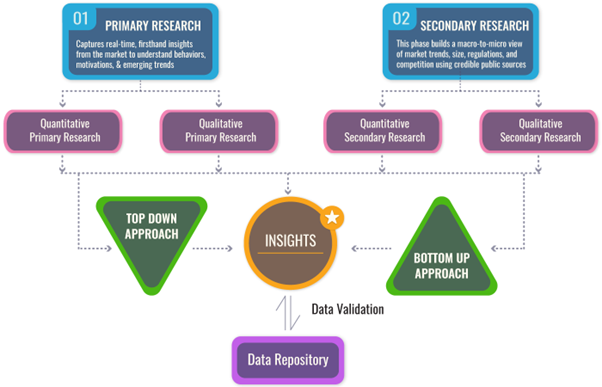
DUAL MODELING: TOP-DOWN + BOTTOM-UP
To ensure robust market estimation, we apply two complementary sizing approaches:
Top-Down Modeling:- Start with broader industry value (e.g., global or regional TAM)
- Apply filters by segment, geography, end-user, or use case
- Adjust with primary insights and validation benchmarks
- Ideal for investor-grade market scans and opportunity mapping
- Aggregate from the ground up using sales volumes, pricing, and unit economics
- Use internal modeling templates aligned with stakeholder data
- Incorporate distributor-level or region-specific inputs
- Most accurate for emerging segments and granular sub-markets
DATA VALIDATION: IN-HOUSE REPOSITORY
We close the loop with proprietary data intelligence built from ongoing projects, industry monitoring, and historical benchmarking. This repository includes:
- Multi-sector market and pricing models
- Key trendlines from past interviews and forecasts
- Benchmarked adoption rates, churn patterns, and ROI indicators
- Industry-specific deviation flags and cross-check logic
- Catches inconsistencies early
- Aligns projections across studies
- Enables consistent, high-trust deliverables