

Automotive Software Market Size and Forecast (2026–2034), Global and Regional Growth, Trend, Share and Industry Analysis Report Coverage; By Software Type (Application Software, Middleware, Operating System); By Vehicle Type (Passenger Cars, Commercial Vehicles); By Application (ADAS & Safety, Infotainment & Instrument Cluster, Engine Management & Powertrain, Body Control & Comfort, Connectivity & Telematics, Others); By Deployment (Embedded, Cloud-Based); and Geography
2026-10-29
Automotive & Transportation (Mobility)
Ekta Chaurasia (Team Lead)
Description
Automotive Software Market Overview
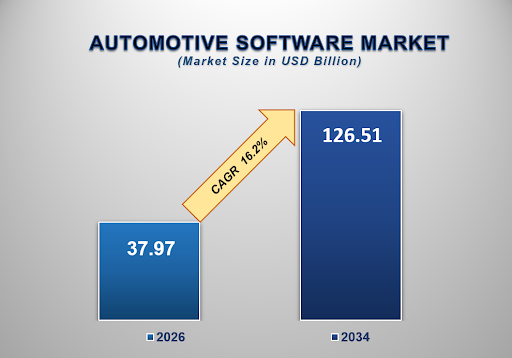
The global Automotive Software Market was valued at USD 37.97 billion in 2026 and is projected to reach USD 126.51 billion by 2034, expanding at a CAGR of 16.2% from 2026 to 2034. The market is being driven by the transition toward software-defined vehicles, rising electronic and software content per vehicle, vehicle electrification, increasing adoption of advanced driver-assistance systems (ADAS), connected infotainment, over-the-air (OTA) updates, centralized computing, cybersecurity requirements, and growing integration of artificial intelligence across automotive functions.
Automotive software includes operating systems, middleware, application software, control algorithms, communication software, cybersecurity software, diagnostics, update management systems, and digital services that enable electronic vehicle functions. Modern automotive software spans vehicle control, battery management, ADAS, digital cockpits, infotainment, telematics, connectivity, body electronics and fleet-management functions.
The automotive industry is moving from vehicles with large numbers of function-specific electronic control units toward architectures based on domain controllers, zonal controllers and centralized high-performance computers. The International Energy Agency notes that software-defined vehicles increasingly rely on more centralized electrical/electronic architectures, allowing a larger share of vehicle functionality to be controlled and updated through software over the vehicle lifecycle.
This transition is increasing the strategic importance of automotive operating systems and middleware. Software is increasingly separated from individual hardware functions, allowing automakers to reuse common software foundations across vehicle programs while introducing additional features through updates. AUTOSAR's Adaptive Platform is also supporting service-oriented automotive software architectures for high-performance computing applications.
The growth of electric vehicles is accelerating automotive software requirements. Battery-electric and hybrid vehicles require software for battery state estimation, thermal management, charging, energy optimization, electric-motor control, regenerative braking and high-voltage safety. The IEA identifies EVs as leading the industry's movement toward vehicles with increasingly centralized software architectures and continuously updateable functions.
ADAS and autonomous-driving systems represent another major source of software demand. Modern vehicles process information from cameras, radar, lidar and other sensors through sophisticated perception, sensor-fusion, localization, planning and control software. The increasing number of sensors and the growth of AI-assisted perception increase both the volume and complexity of automotive software.
The digital cockpit is simultaneously becoming a software platform rather than simply an infotainment unit. Instrument clusters, displays, navigation, voice assistants, smartphone integration, application ecosystems, audio and connected services increasingly operate through integrated software stacks. Automakers are also adopting automotive-grade versions of technologies derived from consumer software platforms, including Android Automotive OS.
Connected vehicles are increasing demand for cloud-connected software and OTA infrastructure. Vehicles can receive software fixes, security patches, feature improvements and new functions without requiring every update to be performed at a service center. This changes vehicle software from a one-time development activity into a continuous lifecycle-management process.
Cybersecurity is consequently becoming a core part of automotive software development. The expanding connection between vehicle networks, mobile devices, cloud infrastructure and external communication systems creates additional attack surfaces. Regulatory frameworks such as UN Regulation No. 155 for cybersecurity and UN Regulation No. 156 for software-update management are reinforcing the need for structured cybersecurity and software-update processes. UNECE working groups continued developing proposals concerning these regulations during 2026.
Artificial intelligence is adding another layer of opportunity. AI is being integrated into ADAS, driver monitoring, voice interfaces, predictive maintenance, personalization, vehicle diagnostics and software-development workflows. The combination of AI, high-performance computing and centralized architectures is increasing software requirements while also creating new requirements for validation, safety and cybersecurity.
The industry's commercial model is also changing. Automakers are increasingly exploring software-enabled features, connected services, subscription offerings, remote diagnostics and feature activation. The IEA notes that vehicles are increasingly evolving into software platforms on which users can access continuously updated and subscription-based features.
Automotive software is therefore becoming a core component of vehicle differentiation, engineering economics and lifecycle revenue. As vehicle platforms become increasingly software-centric, demand for application software, operating systems, middleware, cybersecurity, cloud services and software-development tools is expected to expand significantly through 2034.
Automotive Software Market Drivers and Opportunities
Software-Defined Vehicle Architectures Are Accelerating Automotive Software Demand
The migration toward software-defined vehicle architectures is the most important long-term driver for the automotive software market.
Traditional automotive architectures typically assign specific functions to dedicated ECUs. Software-defined architectures instead use more powerful computing units to control multiple vehicle functions and allow functionality to be modified through software.
This change increases demand across every software layer. Operating systems must support centralized processors, middleware must manage communications and hardware abstraction, while application software must coordinate increasingly complex vehicle functions.
The IEA reports that major automakers are developing increasingly centralized software architectures, with domain and zonal approaches gradually replacing highly distributed vehicle architectures. Centralization also facilitates software updates and reuse across vehicle platforms.
The commercial impact is equally important. A software-defined vehicle can potentially introduce new functionality after vehicle delivery, allowing manufacturers to improve features and address issues without replacing physical components. This expands the role of software from supporting hardware to becoming part of the vehicle's lifecycle value proposition.
Vehicle Electrification Is Increasing Software Content
Electrification is creating new software requirements across the vehicle.
Battery-management software must estimate state of charge and state of health, control charging, manage thermal conditions and protect high-voltage systems. Electric powertrain software also controls torque delivery, regenerative braking and energy optimization.
Hybrid vehicles add another layer of complexity because software must coordinate combustion engines, electric motors, batteries, power electronics and energy-recovery systems.
The IEA identifies battery management and advanced driver assistance among the important applications benefiting from the transition toward centralized vehicle software.
The rising number of software-controlled electrical functions therefore increases demand for embedded software, real-time operating systems, middleware, cybersecurity and validation tools.
ADAS and Autonomous Driving Are Expanding the Application Software Opportunity
ADAS is one of the most software-intensive areas of modern automotive technology.
Functions such as adaptive cruise control, automatic emergency braking, lane keeping, traffic-sign recognition, parking assistance and driver monitoring depend on software algorithms capable of interpreting sensor data and generating vehicle responses.
More advanced automated-driving functions require perception, sensor fusion, prediction, path planning and decision-making software. These applications also demand continuous testing and validation because software behavior must remain reliable across highly variable road, weather and traffic conditions.
The growth of AI-based perception is further increasing computational and software requirements. As centralized computing platforms become more capable, automakers can combine multiple ADAS functions within integrated software environments rather than deploying isolated systems.
The combination of regulatory requirements, consumer safety expectations and technical advancement is expected to make ADAS one of the most important sources of automotive software demand through 2034.
Connected Vehicles and OTA Updates Are Creating Recurring Software Opportunities
Connectivity is transforming the relationship between vehicles and their manufacturers after vehicle sale.
Telematics systems allow vehicles to communicate with cloud platforms, enabling remote diagnostics, navigation updates, fleet monitoring, emergency services, usage analytics and software deployment.
OTA technology extends this capability by allowing software to be updated remotely. Automakers can deploy fixes, optimize vehicle systems, improve infotainment functionality and introduce new features without requiring a physical workshop visit in many cases.
The IEA identifies OTA capability as a central characteristic of software-defined vehicles and notes that software can increasingly improve critical vehicle functions over time.
This creates opportunities not only for embedded software vendors but also for cloud platforms, cybersecurity providers, update-management specialists, diagnostic software companies and data-analytics providers.
Artificial Intelligence Is Creating New Automotive Software Opportunities
AI is becoming increasingly important across automotive software development and vehicle functionality.
In the vehicle, AI can support perception, driver monitoring, voice interaction, personalized recommendations, predictive maintenance and intelligent energy management. Outside the vehicle, AI is increasingly being applied to code generation, testing, simulation, requirements analysis and software validation.
The increasing use of AI also introduces greater software complexity. Generated and machine-assisted code still needs integration, verification, functional-safety assessment and cybersecurity testing before deployment in safety-relevant vehicle systems.
This creates opportunities for companies that combine AI capabilities with automotive domain knowledge, simulation, verification and embedded engineering.
Cybersecurity and Software Lifecycle Management Present Significant Opportunities
Vehicles are becoming connected computing platforms with interfaces to mobile applications, cloud infrastructure, wireless networks, charging infrastructure, and external devices.
Security therefore needs to be integrated across the entire software lifecycle. Authentication, secure boot, encryption, access control, vulnerability management, intrusion detection and secure OTA updates are increasingly important.
UN Regulation No. 155 and UN Regulation No. 156 are strengthening the importance of formal cybersecurity and software-update management. UNECE continued work on proposed amendments and interpretation documents for these regulations during 2026.
This creates recurring demand for cybersecurity platforms, security-management systems, OTA infrastructure, vulnerability monitoring and compliance-support software.
Automotive Software Market Scope
Automotive Software Market Report Segmentation Analysis
The global automotive software industry analysis is segmented by software type, by vehicle type, by application, by deployment, and by region.
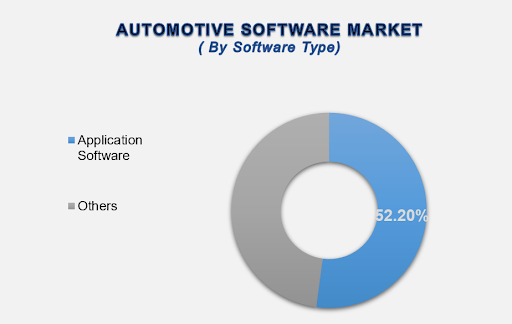
The Application Software Segment Is Expected to Dominate the Market During the Forecast Period
The Application Software segment is expected to maintain a leading position in the automotive software market because vehicle manufacturers use application-layer software across a broad range of functions.
Application software directly manages functions such as ADAS, infotainment, telematics, instrument clusters, powertrain control, battery management and body electronics. This broad addressable base allows application software to remain an important revenue category even as underlying operating systems and middleware evolve.
Application software is also closely linked to vehicle differentiation. Automakers can use software to create distinct user experiences, introduce feature packages, personalize vehicle behavior, and deliver post-sale functionality.
The growth of advanced driving systems, digital cockpits, connected services and EV control systems is expected to broaden the application-software opportunity.
The Passenger Cars Segment Is Expected to Dominate the Market by Vehicle Type
The Passenger Cars segment is expected to account for the largest share of automotive software demand.
Passenger vehicles incorporate a wide range of software-enabled features including digital cockpits, infotainment, ADAS, connectivity, body controls, navigation, cybersecurity and energy management.
The growing presence of software features in mid-range and economy vehicles is further expanding the addressable market beyond luxury vehicles.
Commercial vehicles are also becoming increasingly software-intensive. Fleet operators require telematics, predictive maintenance, route management, driver monitoring, safety functions, fuel and energy optimization, and vehicle-health analytics.
The commercial-vehicle segment therefore represents an important high-growth opportunity, particularly as connected fleets and software-defined truck platforms expand.
The Infotainment & Instrument Cluster Segment Is Expected to Hold a Significant Market Position by Application
The Infotainment & Instrument Cluster segment represents one of the largest established application areas for automotive software.
Modern digital cockpits combine instrument display, navigation, multimedia, voice interaction, smartphone connectivity, vehicle information and increasingly AI-enabled interfaces.
Software is allowing automakers to update user interfaces and add digital services throughout the vehicle's lifecycle. Android Automotive OS and other automotive-grade software platforms are being adopted to support richer application environments and connected experiences.
At the same time, ADAS & Safety is expected to record strong growth as automated emergency braking, lane assistance, driver monitoring and increasingly advanced automated-driving functions expand.
Engine Management & Powertrain remains another important software category, covering engine control, transmission management, emissions control, torque management and energy optimization. In electrified vehicles, the category increasingly includes battery, electric-motor and power-electronics control.
Connectivity & Telematics is also expanding as vehicles become integrated with cloud services, mobile applications, fleet platforms and external communication infrastructure.
The Embedded Segment Is Expected to Dominate the Market by Deployment
The Embedded segment is expected to remain a leading deployment category because core automotive functionality continues to require software running directly within ECUs, domain controllers, zone controllers and central vehicle computers.
Safety-related control, powertrain management, battery systems and many body functions require deterministic operation and direct access to vehicle hardware. This makes embedded software fundamental to automotive architecture.
Cloud-based software is nevertheless becoming increasingly important for fleet analytics, remote diagnostics, digital services, OTA management, cybersecurity monitoring and data processing.
The automotive software ecosystem is consequently developing as a combination of embedded vehicle software and cloud-connected services, rather than a shift entirely toward one deployment model.
The Following Segments Are Part of an In-Depth Analysis of the Global Automotive Software Market:
Automotive Software Market Share Analysis By Region
North America represents a major automotive software market, supported by strong software-development capabilities, established automotive OEMs and technology suppliers, advanced connected-vehicle deployment, and significant activity in autonomous driving and AI.
The United States is the principal market within the region. Its ecosystem includes automakers, semiconductor companies, cloud providers, software suppliers and autonomous-driving developers working across centralized computing, ADAS, connectivity and software-defined vehicle platforms.
The region also benefits from strong development of cloud-connected automotive services and large-scale commercial-vehicle and fleet applications.
Europe represents another important automotive software market because of its large automotive manufacturing base, mature embedded-software ecosystem and strong regulatory emphasis on vehicle safety, cybersecurity and software updates.
Germany is particularly important because of its OEM and Tier-1 supplier concentration and the development of next-generation vehicle operating systems, middleware and ADAS platforms.
The broader European market includes the U.K., France, Italy and Spain, where connected vehicles, electrification, ADAS and digital cockpit adoption are increasing software requirements.
Regulatory developments are especially important in Europe. UNECE's cybersecurity and software-update regulations continue to influence the requirements for vehicle manufacturers and suppliers, while 2026 working-group activity shows that these frameworks are continuing to evolve.
Asia Pacific is expected to register strong growth during the forecast period, supported by large-scale vehicle production, rapid EV adoption, growing software capabilities and increasing consumer demand for intelligent vehicle functions.
China is particularly important because of its large electric-vehicle market and rapid development of intelligent driving and digital cockpit systems. The IEA identifies China as a major center of global EV deployment and notes that EVs are currently at the forefront of more centralized software-defined vehicle architectures.
Japan and South Korea remain important markets because of their advanced automotive electronics industries, semiconductor capabilities and established OEMs.
India is emerging as an increasingly important market for automotive software engineering and SDV development. Automotive technology companies are expanding development capabilities in India, while Qualcomm and Hyundai Mobis specifically identified India as a target market for next-generation ADAS and SDV solutions.
The region is also seeing growing local investment in intelligent-driving software, digital cockpits, connected services and centralized vehicle computing.
Latin America is expected to experience steady growth as connected vehicle technologies, telematics, fleet management and ADAS gradually expand.
Brazil and Mexico are the principal contributors because of their automotive manufacturing, commercial-vehicle fleets and growing connected-mobility ecosystems.
Cost sensitivity remains an important market consideration in the region, encouraging demand for scalable software solutions that can support different vehicle categories and feature levels.
Middle East & Africa represents an emerging automotive software market supported by premium vehicle adoption, connected mobility, commercial fleets, smart-city initiatives and increasing digitalization of transportation.
The UAE and Saudi Arabia provide opportunities through smart-mobility investment and premium connected vehicles, while South Africa remains important because of its automotive manufacturing ecosystem.
Across emerging markets, connected fleet management, telematics, diagnostics and cost-efficient software platforms are expected to represent important adoption areas.
Automotive Software Market Competition Landscape Analysis
The automotive software market is highly competitive and includes automotive OEM software organizations, Tier-1 suppliers, semiconductor companies, operating-system providers, embedded software specialists, engineering-service providers and cloud technology companies.
Competition is increasingly shifting from individual software components toward complete software platforms, reusable architectures, development ecosystems and lifecycle services.
Robert Bosch maintains a broad automotive software portfolio spanning vehicle operating systems, ADAS, infotainment, connected services, vehicle control and cloud-enabled solutions. Current industry analysis identifies Bosch among the leading participants in the automotive software market.
BlackBerry QNX is a significant participant in automotive operating systems and safety-oriented software. In September 2026, BlackBerry reported that QNX automotive revenue increased 27% year over year in its fiscal second quarter. The company also announced a QNX and Vector Alloy Kore design win with Coretura, adding more than USD 100 million to QNX's royalty backlog.
Elektrobit is competing through automotive operating systems, middleware, cybersecurity, ECU software and digital-cockpit solutions. In January 2026, the company launched EB Civion, a software suite intended to accelerate SDV cockpit development and support more efficient collaboration between OEMs, Tier-1 suppliers and technology partners.
Aptiv is expanding its software platform ecosystem through LINC software, real-time operating-system capabilities and vehicle validation technology. In May 2026, Aptiv joined the SDVerse automotive software marketplace and made software, AI and edge-to-cloud solutions available to OEMs and suppliers through the platform.
Qualcomm is increasingly participating in automotive software through its Snapdragon Digital Chassis, vehicle operating-system ecosystem, ADAS platforms and cloud-based development technologies. In January 2026, Qualcomm announced collaborations involving Hyundai Mobis, Volkswagen Group and Google aimed at supporting SDV, ADAS, infotainment and cloud-connected development.
NVIDIA is competing in AI-based automotive computing and software through its DRIVE ecosystem, while NXP, Renesas and Infineon combine processing, networking and embedded-software capabilities.
KPIT Technologies, Tata Technologies, Tata Elxsi, Luxoft and other engineering specialists are expanding automotive software development, systems integration, validation and SDV transformation services.
An important competitive shift is also occurring among OEMs themselves. Automakers such as Tesla, Toyota and BYD maintain substantial in-house software development, while other manufacturers are using partnerships, joint ventures and supplier ecosystems to accelerate software capabilities. The IEA notes that automakers are following different strategies to build and control software capabilities.
The market is therefore becoming an ecosystem competition involving operating systems, middleware, applications, processors, cloud platforms, cybersecurity, engineering tools and system integration rather than a market limited to standalone automotive software products.
Global Automotive Software Market Recent Developments News
In September 2026 – BlackBerry QNX and Vector announced the first design win for Alloy Kore, their foundational vehicle operating-system platform, with Coretura, a software-defined vehicle platform company established by Daimler Truck and Volvo Group. BlackBerry stated that the agreement adds more than USD 100 million to its QNX royalty backlog.
In September 2026 – TRATON GROUP announced that it was opening its TRATON ONE OS software ecosystem to technology partners through a collaboration with Red Hat. The group plans to incorporate Red Hat In-Vehicle Operating System and use a Linux-based foundation for future commercial vehicles.
In August 2026 – Nissan and Honda entered into a joint development agreement covering standardized ECUs, the in-vehicle operating system, middleware and vehicle-control software for next-generation software-defined vehicles. The companies plan to apply the jointly developed architecture to next-generation SDVs from fiscal year 2029 onward.
In January 2026 – Volkswagen Group and Qualcomm Technologies announced a letter of intent covering high-performance SoCs for next-generation infotainment and connectivity within Volkswagen's SDV architecture, with planned deployment beginning in 2027.
The Global Automotive Software Market is Dominated by a Few Large Companies, Such As
Robert Bosch GmbH
Continental AG
Denso Corporation
Aptiv PLC
ZF Friedrichshafen AG
Magna International Inc.
Valeo S.A.
Harman International Industries, Inc.
BlackBerry QNX
Elektrobit
Wind River Systems, Inc.
NVIDIA Corporation
Qualcomm Technologies, Inc.
NXP Semiconductors N.V.
Renesas Electronics Corporation
Infineon Technologies AG
STMicroelectronics N.V.
Vector Informatik GmbH
KPIT Technologies Limited
Tata Elxsi Limited
Tata Technologies Limited
Luxoft Holding, Inc.
TTTech Auto
Siemens Digital Industries Software
Others
Frequently Asked Questions
Ekta Chaurasia (Team Lead)
Ekta Chaurasia is a highly experienced Team Lead at M2Square Consultancy with over 7 years of expertise in market research, strategic consulting, competitive benchmarking, and business intelligence solutions. She specializes in ICT, semiconductors & electronics, automotive & transportation, and industrial machinery markets.
She leads end-to-end global research projects focused on market trends, industry analysis, growth forecasting, customer insights, and strategic decision-making. Known for her analytical leadership and industry expertise, Ekta helps businesses uncover growth opportunities, evaluate competitive landscapes, and stay ahead in rapidly evolving markets through accurate and insight-driven research.
Global Automotive Software Market Introduction and Market Overview
Objectives of the Study
Global Automotive Software Market Scope and Market Estimation
Global Automotive Software Market Size (US$ Million), Market CAGR (%), Market Forecast (2026 - 2034)
Global Automotive Software Market Revenue Share (%) and Growth Rate (Y-o-Y) Analysis (2021 - 2034)
Market Segmentation
By Software Type of Global Automotive Software Market
Application Software
Middleware
Operating System
By Vehicle Type of Global Automotive Software Market
Passenger Cars
Commercial Vehicles
By Application of Global Automotive Software Market
ADAS & Safety
Infotainment & Instrument Cluster
Engine Management & Powertrain
Body Control & Comfort
Connectivity & Telematics
Others
By Deployment of Global Automotive Software Market
Embedded
Cloud-Based
Region of Global Automotive Software Market
Competition Coverage List of Market Participants
Market Definition: Automotive Software Market
Executive Summary
Demand Side Trends
Key Market Trends
Market Demand (US$ Million) Analysis 2021 – 2025 and Forecast, 2026 – 2034
Demand and Opportunity Assessment
Key Developments
Overview of Regulatory Landscape, Compliance Framework, and Industry Standards
Market Entry Strategies
Market Dynamics
Drivers
Limitations
Opportunities
Impact Analysis of Drivers and Restraints
Porter's Five Forces Analysis
PEST Analysis
Global Automotive Software Market Estimates & Historical Trend Analysis (2021 – 2025)
Global Automotive Software Market Estimates & Forecast Trend Analysis, by Software Type
Global Automotive Software Market Revenue (US$ Million) Estimates and Forecasts, by Software Type, 2021 - 2034
Application Software
Middleware
Operating System
Global Automotive Software Market Estimates & Forecast Trend Analysis, by Vehicle Type
Global Automotive Software Market Revenue (US$ Million) Estimates and Forecasts, by Vehicle Type, 2021 - 2034
Passenger Cars
Commercial Vehicles
Global Automotive Software Market Estimates & Forecast Trend Analysis, by Application
Global Automotive Software Market Revenue (US$ Million) Estimates and Forecasts, by Application, 2021 - 2034
ADAS & Safety
Infotainment & Instrument Cluster
Engine Management & Powertrain
Body Control & Comfort
Connectivity & Telematics
Others
Global Automotive Software Market Estimates & Forecast Trend Analysis, by Deployment
Global Automotive Software Market Revenue (US$ Million) Estimates and Forecasts, by Deployment, 2021 - 2034
Embedded
Cloud-Based
Global Automotive Software Market Estimates & Forecast Trend Analysis, by Region
Global Automotive Software Market Revenue (US$ Million) Estimates and Forecasts, by Region, 2021 - 2034
North America
Europe
Asia Pacific
Middle East & Africa
Latin America
North America Automotive Software Market: Estimates & Forecast Trend Analysis
North America Automotive Software Market Assessments & Key Findings
North America Automotive Software Market Introduction
North America Automotive Software Market Size Estimates and Forecast (US$ Million) (2021 - 2034)
By Software Type
By Vehicle Type
By Application
By Deployment
By Country
The U.S.
Canada
Europe Automotive Software Market: Estimates & Forecast Trend Analysis
Europe Automotive Software Market Assessments & Key Findings
Europe Automotive Software Market Introduction
Europe Automotive Software Market Size Estimates and Forecast (US$ Million) (2021 - 2034)
By Software Type
By Vehicle Type
By Application
By Deployment
By Country
Germany
Italy
The U.K.
France
Spain
Switzerland
Rest of Europe
Asia Pacific Automotive Software Market: Estimates & Forecast Trend Analysis
Asia Pacific Automotive Software Market Assessments & Key Findings
Asia Pacific Automotive Software Market Introduction
Asia Pacific Automotive Software Market Size Estimates and Forecast (US$ Million) (2021 - 2034)
By Software Type
By Vehicle Type
By Application
By Deployment
By Country
China
Japan
India
Australia
South Korea
Rest of Asia Pacific
Middle East & Africa Automotive Software Market: Estimates & Forecast Trend Analysis
Middle East & Africa Automotive Software Market Assessments & Key Findings
Middle East & Africa Automotive Software Market Introduction
Middle East & Africa Automotive Software Market Size Estimates and Forecast (US$ Million) (2021 - 2034)
By Software Type
By Vehicle Type
By Application
By Deployment
By Country
UAE
Saudi Arabia
South Africa
Rest of Middle East & Africa
Latin America Automotive Software Market: Estimates & Forecast Trend Analysis
Latin America Automotive Software Market Assessments & Key Findings
Latin America Automotive Software Market Introduction
Latin America Automotive Software Market Size Estimates and Forecast (US$ Million) (2021 - 2034)
By Software Type
By Vehicle Type
By Application
By Deployment
By Country
Brazil
Mexico
Argentina
Rest of Latin America
Competition Landscape
Global Automotive Software Market Product Mapping
Global Automotive Software Market Concentration Analysis, by Leading Players
Global Automotive Software Market Concentration Analysis, by Innovators
Global Automotive Software Market Concentration Analysis, by Emerging Players
Global Automotive Software Market Concentration Analysis, by New Entrants
Global Automotive Software Market Tier Structure Analysis
Global Automotive Software Market Concentration & Company Market Shares (%) Analysis, 2026
Company Profiles
Robert Bosch GmbH
Company Overview & Key Stats
Financial Performance & KPIs
Product Portfolio
SWOT Analysis
Business Strategy & Recent Developments
*Similar details would be provided for all the players mentioned below
Continental AG
Denso Corporation
Aptiv PLC
ZF Friedrichshafen AG
Magna International Inc.
Valeo S.A.
Harman International Industries, Inc.
BlackBerry QNX
Elektrobit
Wind River Systems, Inc.
NVIDIA Corporation
Qualcomm Technologies, Inc.
NXP Semiconductors N.V.
Renesas Electronics Corporation
Infineon Technologies AG
STMicroelectronics N.V.
Vector Informatik GmbH
KPIT Technologies Limited
Tata Elxsi Limited
Tata Technologies Limited
Luxoft Holding, Inc.
TTTech Auto
Siemens Digital Industries Software
Others
Research Findings & Conclusion
Assumptions & Acronyms Used
Research Methodology
External Databases
Internal Proprietary Database
Primary Research
Secondary Research
Assumptions
Limitations
Report FAQ
Our Research Methodology
"Insight without rigor is just noise."
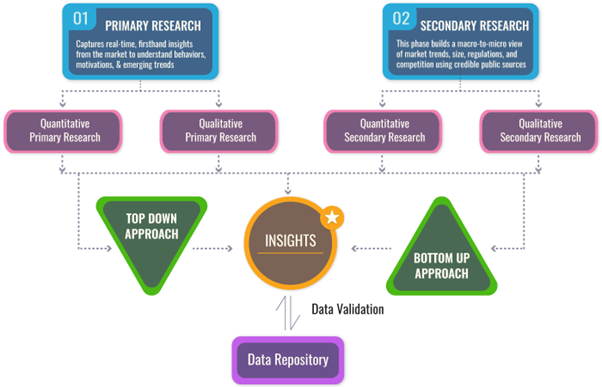
We follow a comprehensive, multi-phase research framework designed to deliver accurate, strategic, and decision-ready intelligence. Our process integrates primary and secondary research , both quantitative and qualitative , along with dual modeling techniques ( top-down and bottom-up) and a final layer of validation through our proprietary in-house repository.
PRIMARY RESEARCH
Primary research captures real-time, firsthand insights from the market to understand behaviors, motivations, and emerging trends.
1. Quantitative Primary Research
Objective: Generate statistically significant data directly from market participants.
Approaches:- Structured surveys with customers, distributors, and field agents
- Mobile-based data collection for point-of-sale audits and usage behavior
- Phone-based interviews (CATI) for market sizing and product feedback
- Online polling around industry events and digital campaigns
- Purchase frequency by customer type
- Channel performance across geographies
- Feature demand by application or demographic
2. Qualitative Primary Research
Objective: Explore decision-making drivers, pain points, and market readiness.
Approaches:- In-depth interviews (IDIs) with executives, product managers, and key decision-makers
- Focus groups among end users and early adopters
- Site visits and observational research for consumer products
- Informal field-level discussions for regional and cultural nuances
SECONDARY RESEARCH
This phase helps establish a macro-to-micro understanding of market trends, size, regulation, and competitive dynamics, sourced from credible and public domain information.
1. Quantitative Secondary Research
Objective: Model market value and segment-level forecasts based on published data.
Sources include:- Financial reports and investor summaries
- Government trade data, customs records, and regulatory statistics
- Industry association publications and economic databases
- Channel performance and pricing data from marketplace listings
- Revenue splits, pricing trends, and CAGR estimates
- Supply-side capacity and volume tracking
- Investment analysis and funding benchmarks
2. Qualitative Secondary Research
Objective: Capture strategic direction, innovation signals, and behavioral trends.
Sources include:- Company announcements, roadmaps, and product pipelines
- Publicly available whitepapers, conference abstracts, and academic research
- Regulatory body publications and policy briefs
- Social and media sentiment scanning for early-stage shifts
- Strategic shifts in market positioning
- Unmet needs and white spaces
- Regulatory triggers and compliance impact
DUAL MODELING: TOP-DOWN + BOTTOM-UP
To ensure robust market estimation, we apply two complementary sizing approaches:
Top-Down Modeling:- Start with broader industry value (e.g., global or regional TAM)
- Apply filters by segment, geography, end-user, or use case
- Adjust with primary insights and validation benchmarks
- Ideal for investor-grade market scans and opportunity mapping
- Aggregate from the ground up using sales volumes, pricing, and unit economics
- Use internal modeling templates aligned with stakeholder data
- Incorporate distributor-level or region-specific inputs
- Most accurate for emerging segments and granular sub-markets
DATA VALIDATION: IN-HOUSE REPOSITORY
We close the loop with proprietary data intelligence built from ongoing projects, industry monitoring, and historical benchmarking. This repository includes:
- Multi-sector market and pricing models
- Key trendlines from past interviews and forecasts
- Benchmarked adoption rates, churn patterns, and ROI indicators
- Industry-specific deviation flags and cross-check logic
- Catches inconsistencies early
- Aligns projections across studies
- Enables consistent, high-trust deliverables