

Autonomous Last Mile Delivery Market Size and Forecast (2026–2034), Global and Regional Growth, Trend, Share and Industry Analysis Report Coverage; By Vehicle Type (Aerial Delivery Drones, Ground Delivery Bots, Self-Driving Trucks & Vans); By Solution (Hardware, Software, Services); By Range (Short Range, Long Range); By Application (Logistics, Healthcare & Pharmaceuticals, Food & Beverages, Retail, Others); and Geography
2026-10-28
Automotive & Transportation (Mobility)
Ekta Chaurasia (Team Lead)
Description
Autonomous Last Mile Delivery Market Overview
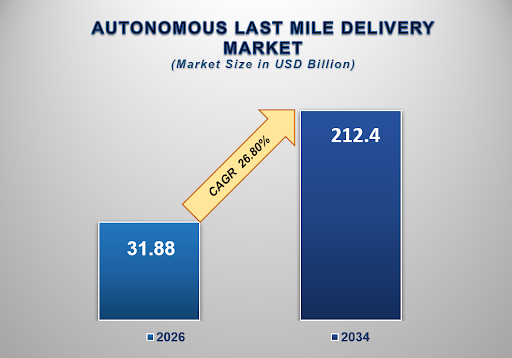
The global Autonomous Last Mile Delivery Market is undergoing rapid transformation as logistics companies, retailers, restaurants, healthcare providers, and technology companies deploy autonomous drones, sidewalk robots, self-driving delivery vehicles, and intelligent logistics platforms to automate the final stage of order fulfillment. The market is estimated at USD 31.88 billion in 2026 and is projected to reach USD 212.46 billion by 2034, registering a CAGR of 26.80% during 2026–2034. Growth is being supported by expanding e-commerce, increasing demand for faster delivery, urban congestion, labor availability challenges, advances in artificial intelligence, improved sensors, autonomous navigation, and increasing investment in automated logistics infrastructure.
Autonomous last mile delivery refers to the use of autonomous systems to transport goods from a local fulfillment point, store, warehouse, restaurant, distribution center, or micro-fulfillment facility to the final customer without requiring a human driver or courier to perform the entire delivery journey. The technology ecosystem includes aerial drones, autonomous sidewalk robots, self-driving vans and trucks, navigation systems, fleet-management platforms, delivery software, sensors, cameras, artificial intelligence, telecommunications, and automated customer handoff systems.
The final stage of logistics is particularly challenging because delivery vehicles must operate within highly variable environments. Unlike long-distance transportation that can follow relatively predictable routes, last-mile delivery involves residential streets, pedestrians, traffic, buildings, intersections, loading zones, weather conditions, parking restrictions, and changing customer locations. Autonomous delivery systems are being developed to manage these variables through perception, mapping, route planning, real-time decision-making, and remote supervision.
The expansion of online commerce is one of the principal forces behind market development. Consumers increasingly expect shorter delivery windows, real-time tracking, flexible drop-off options, and convenient doorstep fulfillment. Same-day and rapid delivery models have increased pressure on logistics providers to improve the productivity of every delivery asset while maintaining acceptable operating costs.
Autonomous technology offers logistics operators a potential method of increasing delivery capacity without proportionally increasing the number of human-operated vehicles. Sidewalk robots can transport small orders across short urban routes, drones can bypass road congestion, and autonomous vans can potentially support larger delivery volumes across longer routes.
Artificial intelligence is becoming central to these systems. Autonomous delivery platforms combine computer vision, lidar, radar, GPS/GNSS, inertial sensors, mapping systems, machine learning, and fleet-management software to identify obstacles, select routes, predict traffic conditions, and determine appropriate delivery actions. These capabilities are allowing autonomous delivery systems to move beyond controlled demonstrations toward recurring commercial operations.
Ground delivery robots have become particularly relevant in dense urban and campus environments. Their relatively compact dimensions allow them to operate on sidewalks and other low-speed pathways while carrying small parcels, groceries, meals, and retail orders. Companies such as Starship Technologies and Serve Robotics have developed commercial fleets that can operate within defined geographic service zones.
Aerial delivery drones provide another route to automation. Drones can travel directly between a merchant or fulfillment point and a customer's designated delivery area without following road networks. This can reduce exposure to traffic congestion and shorten travel distances for lightweight packages. Regulatory developments surrounding commercial drone operations and BVLOS flight are therefore closely connected to the expansion of autonomous last-mile delivery.
Self-driving trucks and vans occupy a different part of the market. These platforms are designed to transport larger loads and can support longer-distance or higher-volume delivery missions. They can also be integrated with conventional logistics networks in which autonomous vehicles handle particular transportation segments while human personnel manage loading, unloading, complex urban interactions, or final handoff.
The market is increasingly moving toward multimodal delivery ecosystems rather than a single autonomous technology. DoorDash, for example, has described a delivery network combining human couriers, its Dot ground robot, drones, and autonomous delivery partners. This model allows the delivery method to be selected according to order characteristics, geography, distance, vehicle availability, and operational conditions.
Autonomous last-mile delivery is also expanding beyond food and parcel transportation. Healthcare, pharmaceuticals, groceries, laundry, retail goods, industrial components, and other recurring local-commerce categories are becoming potential applications. Serve Robotics' 2026 laundry-delivery pilot with NoScrubs demonstrates this diversification beyond prepared-food delivery.
Infrastructure is becoming as important as the autonomous vehicle itself. Successful deployments require charging facilities, launch and landing locations, micro-depots, sidewalk access, customer handoff infrastructure, software platforms, connectivity, maintenance networks, and integration with merchant order-management systems.
The market is consequently developing as an integrated technology and logistics ecosystem. Competition is increasingly based not only on vehicle design but also on autonomous-navigation performance, fleet utilization, delivery density, software integration, safety, regulatory compliance, operating economics, and access to large merchant and consumer networks.
Autonomous Last Mile Delivery Market Drivers and Opportunities
The Expansion of E-Commerce and Consumer Demand for Faster Delivery Are Accelerating Autonomous Last-Mile Adoption
The rapid expansion of e-commerce has increased the number of individual shipments that logistics providers must move to geographically dispersed customers. Unlike traditional bulk transportation, e-commerce generates a high volume of smaller orders that require flexible delivery schedules and increasingly precise doorstep fulfillment.
Consumer expectations have also changed. Same-day, scheduled, and rapid delivery services have become increasingly common in major urban markets, encouraging retailers and logistics companies to reduce the time between order placement and customer receipt. Autonomous delivery technologies can support this objective by operating continuously within defined service areas and automating repetitive delivery tasks.
Urban delivery economics further strengthen the case for automation. A human-operated vehicle may spend considerable time navigating traffic, searching for parking, walking packages to individual addresses, and returning to a distribution point. Autonomous robots can address selected portions of these inefficiencies by operating on sidewalks or designated delivery corridors.
Short-range autonomous delivery is particularly suited to dense urban environments. Ground robots can operate from restaurants, grocery stores, dark stores, micro-fulfillment centers, and local retail outlets to nearby customers. These systems can complete multiple deliveries within relatively small geographic zones, potentially increasing fleet utilization.
Drone delivery provides another response to urban congestion. By traveling through the air, drones can bypass road traffic and provide direct routes between launch locations and designated delivery zones. This is especially relevant for small and lightweight items such as meals, medicines, groceries, and urgent consumer goods.
The growth of quick commerce is creating additional demand for efficient local delivery networks. Retailers increasingly use neighborhood fulfillment locations to position inventory closer to customers. Autonomous delivery vehicles can connect these facilities to nearby households and businesses, creating an integrated automated fulfillment chain.
As delivery volumes continue to increase, companies are evaluating autonomous systems as a way to supplement rather than immediately replace human delivery networks. The resulting hybrid model allows human couriers to handle complex or unsuitable orders while autonomous platforms address predictable routes and standardized deliveries.
Advances in AI, Robotics, Sensors and Autonomous Navigation Are Improving Delivery Performance
Technological progress is improving the ability of autonomous delivery vehicles to operate in complex real-world environments. Modern platforms combine cameras, lidar, radar, GPS/GNSS, ultrasonic sensors, inertial measurement systems, high-performance computing, and machine-learning algorithms.
Computer vision enables autonomous systems to identify pedestrians, vehicles, bicycles, road markings, obstacles, buildings, and other environmental features. Lidar can provide detailed three-dimensional information about nearby objects, while radar can contribute additional perception capability under challenging visibility conditions.
AI-based navigation allows delivery systems to continuously interpret their surroundings and modify their trajectory. Instead of following a fixed route regardless of environmental changes, autonomous systems can respond to blocked sidewalks, temporary construction, pedestrians, traffic changes, and other unexpected conditions.
Fleet-management software adds another layer of optimization. Operators can monitor vehicle locations, battery status, delivery assignments, route progress, customer notifications, and operational exceptions from centralized platforms. Algorithms can allocate orders to available vehicles based on distance, capacity, battery level, delivery priority, and estimated completion time.
The integration of edge computing and advanced connectivity is further increasing autonomy. Local processing allows vehicles to make rapid decisions without continuously depending on remote servers. High-speed cellular connectivity can support fleet monitoring, software updates, remote assistance, and data exchange.
Serve Robotics' work with T-Mobile illustrates the development of connected physical AI, with 5G Advanced and edge computing being used to support real-time processing and human-robot interaction. Such developments demonstrate how telecommunications infrastructure is becoming part of the autonomous-delivery technology stack.
Battery technology is another important factor. Electric autonomous robots and delivery vehicles require sufficient range, rapid charging, thermal management, and reliable battery monitoring to maintain high fleet utilization. Improvements in battery density and charging infrastructure can therefore increase the economic feasibility of autonomous delivery.
As these technologies mature, autonomous delivery platforms can move from tightly controlled pilot environments toward larger geographic networks. Improvements in perception, localization, AI decision-making, and fleet coordination are expected to remain important contributors to market expansion.
Opportunity: Multimodal Autonomous Networks, Micro-Fulfillment and AI-Powered Delivery Platforms Create New Growth Areas
The development of multimodal autonomous delivery networks represents a significant opportunity for companies operating in this market. Instead of relying exclusively on drones or ground robots, logistics platforms can combine aerial vehicles, sidewalk robots, autonomous vans, conventional couriers, and centralized software.
DoorDash's 2026 launch of DoorDash Air illustrates this model. The company received FAA Part 135 air carrier certification and launched an in-house drone program designed to operate alongside its existing delivery network and autonomous ground robot initiatives. The company described its broader system as coordinating multiple delivery modes according to the requirements of each order.
Micro-fulfillment centers can further improve autonomous delivery economics by positioning inventory close to customers. Small automated warehouses or dark stores can serve as launch points for sidewalk robots and drones, reducing travel distances and enabling rapid order fulfillment.
Retailers can also use autonomous delivery systems for recurring local routes. Grocery, pharmacy, restaurant, convenience, laundry, and retail orders can be consolidated into high-density delivery zones where autonomous fleets achieve greater utilization.
Healthcare provides another opportunity. Autonomous systems can transport medicines, laboratory samples, medical supplies, and other time-sensitive items between hospitals, pharmacies, laboratories, and patients. Such operations can benefit from predictable routes, controlled handoff procedures, and the ability to operate outside conventional delivery schedules.
The combination of AI-powered dispatching, autonomous vehicles, micro-depots, real-time inventory systems, and consumer-facing applications can create integrated autonomous-commerce platforms. Rather than selling individual robots, companies can increasingly provide complete delivery-as-a-service solutions.
Autonomous Last Mile Delivery Market Scope
Autonomous Last Mile Delivery Market Report Segmentation Analysis
The global Autonomous Last Mile Delivery Market industry analysis is segmented by vehicle type, by solution, by range, by application, and by region. Vehicle type includes aerial delivery drones, ground delivery bots, and self-driving trucks & vans; solution includes hardware, software, and services; range is divided into short range and long range; while applications include logistics, healthcare & pharmaceuticals, food & beverages, retail, and others.
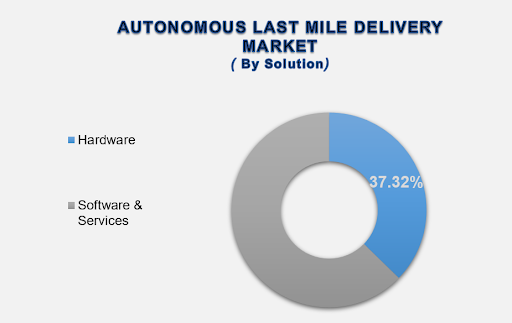
The hardware segment is projected to account for approximately 37.32% of the global market in 2026, supported by demand for autonomous vehicle platforms, airframes, batteries, sensors, cameras, positioning systems, navigation components, computing hardware, and robotic systems.
The Hardware Segment Is Expected to Dominate the Market During the Forecast Period
Hardware represents the physical foundation of autonomous last-mile delivery. A complete autonomous delivery platform can include the vehicle or drone itself, electric propulsion systems, batteries, cameras, lidar, radar, GNSS receivers, communication modules, onboard computers, cargo compartments, safety systems, and automated handoff mechanisms.
Ground robots require compact electric drivetrains, durable wheels, obstacle-detection sensors, secure cargo compartments, navigation computers, and battery systems. Aerial drones require lightweight airframes, propulsion systems, flight controllers, navigation systems, communication modules, and payload-release mechanisms.
Self-driving vans and trucks require a significantly more complex sensor and computing architecture. These vehicles can incorporate cameras, radar, lidar, high-performance processors, redundant systems, autonomous-driving software, steering and braking interfaces, and advanced communication systems.
Hardware demand is therefore increasing as commercial operators expand their fleets. Larger fleets require more vehicles, replacement components, charging systems, spare batteries, and maintenance infrastructure.
Although software is critical to autonomy, the deployment of autonomous delivery networks ultimately requires physical vehicles capable of safely transporting goods. Hardware and software are consequently becoming increasingly integrated, with suppliers designing vehicles around the computational and sensing requirements of their autonomous systems.
The Ground Delivery Bots Segment Is Expected to Maintain Strong Market Importance by Vehicle Type
Ground delivery bots are designed for short-distance autonomous delivery, particularly in urban neighborhoods, campuses, business districts, residential developments, and controlled communities. Their compact form enables them to transport smaller packages while navigating sidewalks and pedestrian environments.
The segment benefits from comparatively straightforward operating environments and the ability to deploy robots from local restaurants, stores, and fulfillment facilities. Ground robots can be supervised through fleet-management platforms and can operate repeatedly within defined geographic zones.
Starship Technologies has demonstrated the commercial viability of this model through large-scale deployments serving restaurants, campuses, and local communities. Serve Robotics is similarly expanding its sidewalk-robot network across multiple U.S. markets.
Ground delivery bots can also support recurring local-commerce categories. Serve's June 2026 partnership with NoScrubs extended its autonomous robot delivery model from prepared food into laundry services, illustrating the potential for higher utilization across multiple categories.
The Short-Range Segment Is Expected to Dominate the Market by Delivery Range
Short-range autonomous delivery represented approximately 74.21% of the market in 2026 in the cited industry assessment. The segment benefits from the relative maturity of urban robot deployments and the suitability of short routes for current autonomous technologies.
Short-range missions generally require lower battery capacity and can be operated from localized fulfillment points. Operators can also establish detailed maps and operating procedures for specific neighborhoods, improving the predictability of autonomous navigation.
Restaurants, convenience stores, pharmacies, grocery stores, and local retailers are well suited to short-range autonomous delivery. Orders can be transported from nearby merchants to customers within a limited radius, making delivery robots and drones practical for rapid fulfillment.
Long-range autonomous delivery is expected to develop as technology, infrastructure, regulation, and vehicle capabilities improve. Longer routes can support wider geographic coverage and larger delivery networks but require greater battery capacity, stronger connectivity, more sophisticated navigation, and more complex regulatory arrangements.
The Logistics Segment Is Expected to Represent a Major Application Area
Logistics represents a fundamental application for autonomous last-mile delivery because parcel volumes continue to increase with e-commerce penetration. Autonomous platforms can potentially handle standardized parcels and recurring delivery routes while human workers focus on exceptions and complex deliveries.
Healthcare and pharmaceutical applications are also important because autonomous systems can transport time-sensitive medical goods. Controlled routes and secure handoff procedures can make autonomous delivery particularly suitable for hospital campuses and medical facilities.
Food and beverage delivery has emerged as one of the most commercially visible applications. Restaurants can use autonomous robots and drones to supplement human couriers during peak periods and deliver smaller orders within defined service areas.
Retail represents another expanding application. Grocery, convenience, electronics, apparel, and other retailers can connect local inventory with customers using autonomous vehicles, particularly when micro-fulfillment facilities are located close to residential areas.
The following segments are part of an in-depth analysis of the global Autonomous Last Mile Delivery Market:
Autonomous Last Mile Delivery Market Share Analysis By Region
North America dominated the global Autonomous Last Mile Delivery Market with approximately 41.22% of the market in 2025, supported by strong e-commerce infrastructure, substantial investment in autonomous mobility, technology development, and commercial deployment of drones and delivery robots.
North America
North America represents the largest regional market due to its strong technology ecosystem, large e-commerce sector, established logistics networks, and significant investment in autonomous delivery systems.
The U.S. is the principal contributor within the region. Companies including Amazon, Wing, DoorDash, Serve Robotics, Starship Technologies, Zipline, Nuro, and others are developing or operating autonomous delivery systems across different geographic and application segments.
Regulatory progress is also supporting commercial drone delivery. In July 2026, DoorDash announced that DoorDash Labs had received FAA Part 135 air carrier certification, allowing the company to commercially operate its own drone delivery service. The company is developing the program alongside its existing human courier and autonomous ground-delivery infrastructure.
The region is also witnessing expansion of sidewalk robots. Serve Robotics has developed partnerships with Uber Eats, DoorDash, and Grubhub, enabling its autonomous robots to access larger restaurant networks.
Canada represents another opportunity, particularly for drone delivery and autonomous logistics in geographically dispersed communities. The country's large distances and remote locations can create practical use cases for autonomous aerial delivery.
Europe
Europe is an important market because of its advanced e-commerce ecosystem, dense urban environments, logistics infrastructure, and growing interest in automated delivery.
The U.K., Germany, France, and other European countries are witnessing commercial trials involving sidewalk robots and drones. European cities can provide favorable environments for short-range autonomous delivery because of high population density and strong demand for efficient urban logistics.
The region is also developing regulatory frameworks for autonomous systems and drone operations. Compliance with aviation, pedestrian safety, data protection, cybersecurity, and transportation requirements remains essential to commercial deployment.
Autonomous ground robots can be particularly useful in university campuses, residential developments, business districts, and controlled urban environments where operating parameters can be clearly defined.
Asia Pacific
Asia Pacific represents a major long-term growth opportunity because of its large population, extensive e-commerce market, high urban density, and strong presence of technology and logistics companies.
China has developed significant autonomous delivery capabilities through companies such as JD.com and Meituan. Autonomous vehicles and delivery robots have been deployed for food, retail, medical, and parcel applications.
Japan is increasingly interested in autonomous delivery because of logistics labor constraints, an aging population, and the need to maintain delivery services across urban and rural areas.
India represents another developing market. The country's rapid e-commerce expansion, quick-commerce sector, dense cities, and increasing investment in robotics create potential demand for autonomous delivery solutions. Local deployment is likely to depend on regulatory development, road and sidewalk conditions, infrastructure availability, and the economics of autonomous fleets.
South Korea and Australia also offer opportunities across e-commerce, food delivery, healthcare logistics, and remote-area operations.
Latin America
Latin America is gradually adopting automated logistics technologies as e-commerce penetration increases. Brazil and Mexico represent the principal markets because of their large consumer populations and expanding digital commerce ecosystems.
Autonomous delivery can support grocery, food, retail, healthcare, and parcel distribution in selected urban areas. However, infrastructure quality, regulatory frameworks, road conditions, and investment requirements remain important considerations.
Brazil's large urban centers and extensive retail ecosystem provide opportunities for localized autonomous delivery networks. Mexico's integration with North American supply chains can similarly support the introduction of autonomous logistics technologies.
Middle East & Africa
The Middle East & Africa region is emerging as a market for autonomous delivery through smart-city programs, logistics modernization, healthcare applications, and technology investment.
The UAE and Saudi Arabia are particularly active in autonomous mobility and drone-related initiatives. Large-scale smart-city developments can provide controlled environments for deploying autonomous robots, drones, and intelligent delivery systems.
Africa presents opportunities associated with healthcare and remote-area logistics. Drones can provide advantages where road infrastructure is limited or where medical supplies must be delivered over difficult terrain.
As autonomous delivery technology becomes more affordable and regulatory frameworks mature, the region can develop applications across healthcare, food, retail, infrastructure, and e-commerce.
Autonomous Last Mile Delivery Market Competition Landscape Analysis
The global Autonomous Last Mile Delivery Market is characterized by competition between technology companies, logistics providers, e-commerce platforms, robotics developers, drone operators, automotive companies, and integrated delivery networks.
Competition is increasingly moving beyond individual vehicle technology toward complete delivery ecosystems. Companies are seeking partnerships with restaurants, retailers, logistics providers, e-commerce marketplaces, telecommunications companies, and local governments to increase order volumes and expand operational areas.
Amazon combines e-commerce demand with autonomous delivery initiatives, including Prime Air and its broader logistics infrastructure. JD.com similarly combines retail demand with autonomous delivery technology, allowing the company to deploy robots and other automated logistics systems within its own commercial ecosystem.
Starship Technologies has developed a large sidewalk-robot network, focusing on dense operating environments such as campuses and urban neighborhoods. Serve Robotics is expanding its platform through partnerships with major delivery marketplaces, while companies such as Kiwibot and Coco focus on localized autonomous ground delivery.
Drone specialists are developing a parallel ecosystem. Wing, Zipline, Flytrex, Matternet, and DroneUp focus on aerial delivery applications, with varying emphasis on food, healthcare, retail, and parcel logistics.
DoorDash is pursuing a multimodal strategy that combines conventional couriers, autonomous ground robots, autonomous delivery partners, and its own drone program. Its 2026 DoorDash Air launch illustrates the movement toward vertically integrated autonomous delivery platforms.
The competitive landscape is also being shaped by fleet economics. Operators must achieve sufficient delivery density to distribute fixed technology, infrastructure, maintenance, and supervision costs across a large number of orders.
Software is therefore becoming an important competitive differentiator. Route optimization, autonomous navigation, fleet dispatching, customer tracking, predictive maintenance, remote assistance, and merchant integration can improve vehicle utilization and operational reliability.
Partnerships are another major competitive factor. Serve's expansion through Uber Eats, DoorDash, and Grubhub demonstrates how autonomous delivery companies can increase utilization by accessing existing consumer and merchant networks rather than building independent marketplaces.
Global Autonomous Last Mile Delivery Recent Developments News
September 2026 – DoorDash expands autonomous ground delivery in Sunnyvale: DoorDash and the City of Sunnyvale finalized steps toward introducing Dot, DoorDash's all-electric autonomous delivery robot, into the community. The initiative is intended to expand autonomous delivery in the Bay Area while incorporating public-safety and community-engagement measures.
July 2026 – DoorDash launches DoorDash Air: DoorDash announced the launch of its in-house drone delivery program after receiving FAA Part 135 air carrier certification. The company is developing its own aircraft and supporting infrastructure while integrating drone delivery into its broader local-commerce network.
August 2026 – Serve Robotics expands through Grubhub: Serve Robotics partnered with Grubhub to introduce autonomous robot delivery across Chicago, Los Angeles, and Alexandria. The expansion added more merchants to Serve's delivery network and was accompanied by additional market launches and micro-depot initiatives.
June 2026 – Serve enters autonomous laundry delivery: Serve Robotics launched a pilot with NoScrubs in Los Angeles, extending autonomous sidewalk-robot delivery beyond prepared food into laundry services. The development demonstrates the potential for autonomous delivery fleets to serve multiple recurring local-commerce categories.
May 2026 – Wing and Papa Johns launch drone-delivery pilot: Wing and Papa Johns began an autonomous drone-delivery pilot in Charlotte, North Carolina, focused initially on Oven Toasted Sandwiches. The initiative combines Wing's autonomous aviation technology with Papa Johns' restaurant network and is designed around scalable restaurant delivery.
The Global Autonomous Last Mile Delivery Market is Dominated by a Few Large Companies, Such As
Amazon.com, Inc.
Starship Technologies
Serve Robotics Inc.
Wing Aviation LLC
Nuro, Inc.
JD.com, Inc.
Zipline International Inc.
Flytrex Inc.
Matternet Inc.
Drone Delivery Canada Corp.
DroneUp, LLC
Kiwibot
Coco Robotics
Cartken Inc.
Ottonomy Inc.
Manna Air Delivery
Avride
Neolix Technologies
Savioke
United Parcel Service, Inc.
DHL International GmbH
DPD Group
DoorDash, Inc.
Alibaba Group
Others
Frequently Asked Questions
Ekta Chaurasia (Team Lead)
Ekta Chaurasia is a highly experienced Team Lead at M2Square Consultancy with over 7 years of expertise in market research, strategic consulting, competitive benchmarking, and business intelligence solutions. She specializes in ICT, semiconductors & electronics, automotive & transportation, and industrial machinery markets.
She leads end-to-end global research projects focused on market trends, industry analysis, growth forecasting, customer insights, and strategic decision-making. Known for her analytical leadership and industry expertise, Ekta helps businesses uncover growth opportunities, evaluate competitive landscapes, and stay ahead in rapidly evolving markets through accurate and insight-driven research.
Global Autonomous Last Mile Delivery Market Introduction and Market Overview
Objectives of the Study
Global Autonomous Last Mile Delivery Market Scope and Market Estimation
Global Autonomous Last Mile Delivery Market Size (US$ Million), Market CAGR (%), Market Forecast (2026 - 2034)
Global Autonomous Last Mile Delivery Market Revenue Share (%) and Growth Rate (Y-o-Y) Analysis (2021 - 2034)
Market Segmentation
By Vehicle Type of Global Autonomous Last Mile Delivery Market
By Solution of Global Autonomous Last Mile Delivery Market
By Range of Global Autonomous Last Mile Delivery Market
By Application of Global Autonomous Last Mile Delivery Market
Region of Global Autonomous Last Mile Delivery Market
Competition Coverage List of Market Participants
Market Definition: Autonomous Last Mile Delivery Market
Executive Summary
Demand Side Trends
Key Market Trends
Market Demand (US$ Million) Analysis 2021 – 2025 and Forecast, 2026 – 2034
Demand and Opportunity Assessment
Key Developments
Overview of Regulatory Landscape, Compliance Framework, and Industry Standards
Market Entry Strategies
Market Dynamics
Drivers
Limitations
Opportunities
Impact Analysis of Drivers and Restraints
Porter's Five Forces Analysis
PEST Analysis
Global Autonomous Last Mile Delivery Market Estimates & Historical Trend Analysis (2021 – 2025)
Global Autonomous Last Mile Delivery Market Estimates & Forecast Trend Analysis, by Vehicle Type
Global Autonomous Last Mile Delivery Market Revenue (US$ Million) Estimates and Forecasts, by Vehicle Type, 2021 - 2034
Aerial Delivery Drones
Ground Delivery Bots
Self-Driving Trucks & Vans
Global Autonomous Last Mile Delivery Market Estimates & Forecast Trend Analysis, by Solution
Global Autonomous Last Mile Delivery Market Revenue (US$ Million) Estimates and Forecasts, by Solution, 2021 - 2034
Hardware
Software
Services
Global Autonomous Last Mile Delivery Market Estimates & Forecast Trend Analysis, by Range
Global Autonomous Last Mile Delivery Market Revenue (US$ Million) Estimates and Forecasts, by Range, 2021 - 2034
Short Range
Long Range
Global Autonomous Last Mile Delivery Market Estimates & Forecast Trend Analysis, by Application
Global Autonomous Last Mile Delivery Market Revenue (US$ Million) Estimates and Forecasts, by Application, 2021 - 2034
Logistics
Healthcare & Pharmaceuticals
Food & Beverages
Retail
Others
Global Autonomous Last Mile Delivery Market Estimates & Forecast Trend Analysis, by Region
Global Autonomous Last Mile Delivery Market Revenue (US$ Million) Estimates and Forecasts, by Region, 2021 - 2034
North America
Europe
Asia Pacific
Middle East & Africa
Latin America
North America Autonomous Last Mile Delivery Market: Estimates & Forecast Trend Analysis
North America Autonomous Last Mile Delivery Market Assessments & Key Findings
North America Autonomous Last Mile Delivery Market Introduction
North America Autonomous Last Mile Delivery Market Size Estimates and Forecast (US$ Million) (2021 - 2034)
By Vehicle Type
By Solution
By Range
By Application
By Country
The U.S.
Canada
Europe Autonomous Last Mile Delivery Market: Estimates & Forecast Trend Analysis
Europe Autonomous Last Mile Delivery Market Assessments & Key Findings
Europe Autonomous Last Mile Delivery Market Introduction
Europe Autonomous Last Mile Delivery Market Size Estimates and Forecast (US$ Million) (2021 - 2034)
By Vehicle Type
By Solution
By Range
By Application
By Country
Germany
Italy
The U.K.
France
Spain
Switzerland
Rest of Europe
Asia Pacific Autonomous Last Mile Delivery Market: Estimates & Forecast Trend Analysis
Asia Pacific Autonomous Last Mile Delivery Market Assessments & Key Findings
Asia Pacific Autonomous Last Mile Delivery Market Introduction
Asia Pacific Autonomous Last Mile Delivery Market Size Estimates and Forecast (US$ Million) (2021 - 2034)
By Vehicle Type
By Solution
By Range
By Application
By Country
China
Japan
India
Australia
South Korea
Rest of Asia Pacific
Middle East & Africa Autonomous Last Mile Delivery Market: Estimates & Forecast Trend Analysis
Middle East & Africa Autonomous Last Mile Delivery Market Assessments & Key Findings
Middle East & Africa Autonomous Last Mile Delivery Market Introduction
Middle East & Africa Autonomous Last Mile Delivery Market Size Estimates and Forecast (US$ Million) (2021 - 2034)
By Vehicle Type
By Solution
By Range
By Application
By Country
UAE
Saudi Arabia
South Africa
Rest of Middle East & Africa
Latin America Autonomous Last Mile Delivery Market: Estimates & Forecast Trend Analysis
Latin America Autonomous Last Mile Delivery Market Assessments & Key Findings
Latin America Autonomous Last Mile Delivery Market Introduction
Latin America Autonomous Last Mile Delivery Market Size Estimates and Forecast (US$ Million) (2021 - 2034)
By Vehicle Type
By Solution
By Range
By Application
By Country
Brazil
Mexico
Argentina
Rest of Latin America
Competition Landscape
Global Autonomous Last Mile Delivery Market Product Mapping
Global Autonomous Last Mile Delivery Market Concentration Analysis, by Leading Players / Innovators / Emerging Players / New Entrants
Global Autonomous Last Mile Delivery Market Tier Structure Analysis
Global Autonomous Last Mile Delivery Market Concentration & Company Market Shares (%) Analysis, 2026
Company Profiles
Amazon.com, Inc.
Company Overview & Key Stats
Financial Performance & KPIs
Product Portfolio
SWOT Analysis
Business Strategy & Recent Developments
*Similar details would be provided for all the players mentioned below
Starship Technologies
Serve Robotics Inc.
Wing Aviation LLC
Nuro, Inc.
JD.com, Inc.
Zipline International Inc.
Flytrex Inc.
Matternet Inc.
Drone Delivery Canada Corp.
DroneUp, LLC
Kiwibot
Coco Robotics
Cartken Inc.
Ottonomy Inc.
Manna Air Delivery
Avride
Neolix Technologies
Savioke
United Parcel Service, Inc.
DHL International GmbH
DPD Group
DoorDash, Inc.
Alibaba Group
Others
Research Findings & Conclusion
Assumptions & Acronyms Used
Research Methodology
External Databases
Internal Proprietary Database
Primary Research
Secondary Research
Assumptions
Limitations
Report FAQ
Our Research Methodology
"Insight without rigor is just noise."
We follow a comprehensive, multi-phase research framework designed to deliver accurate, strategic, and decision-ready intelligence. Our process integrates primary and secondary research , both quantitative and qualitative , along with dual modeling techniques ( top-down and bottom-up) and a final layer of validation through our proprietary in-house repository.
PRIMARY RESEARCH
Primary research captures real-time, firsthand insights from the market to understand behaviors, motivations, and emerging trends.
1. Quantitative Primary Research
Objective: Generate statistically significant data directly from market participants.
Approaches:- Structured surveys with customers, distributors, and field agents
- Mobile-based data collection for point-of-sale audits and usage behavior
- Phone-based interviews (CATI) for market sizing and product feedback
- Online polling around industry events and digital campaigns
- Purchase frequency by customer type
- Channel performance across geographies
- Feature demand by application or demographic
2. Qualitative Primary Research
Objective: Explore decision-making drivers, pain points, and market readiness.
Approaches:- In-depth interviews (IDIs) with executives, product managers, and key decision-makers
- Focus groups among end users and early adopters
- Site visits and observational research for consumer products
- Informal field-level discussions for regional and cultural nuances
SECONDARY RESEARCH
This phase helps establish a macro-to-micro understanding of market trends, size, regulation, and competitive dynamics, sourced from credible and public domain information.
1. Quantitative Secondary Research
Objective: Model market value and segment-level forecasts based on published data.
Sources include:- Financial reports and investor summaries
- Government trade data, customs records, and regulatory statistics
- Industry association publications and economic databases
- Channel performance and pricing data from marketplace listings
- Revenue splits, pricing trends, and CAGR estimates
- Supply-side capacity and volume tracking
- Investment analysis and funding benchmarks
2. Qualitative Secondary Research
Objective: Capture strategic direction, innovation signals, and behavioral trends.
Sources include:- Company announcements, roadmaps, and product pipelines
- Publicly available whitepapers, conference abstracts, and academic research
- Regulatory body publications and policy briefs
- Social and media sentiment scanning for early-stage shifts
- Strategic shifts in market positioning
- Unmet needs and white spaces
- Regulatory triggers and compliance impact
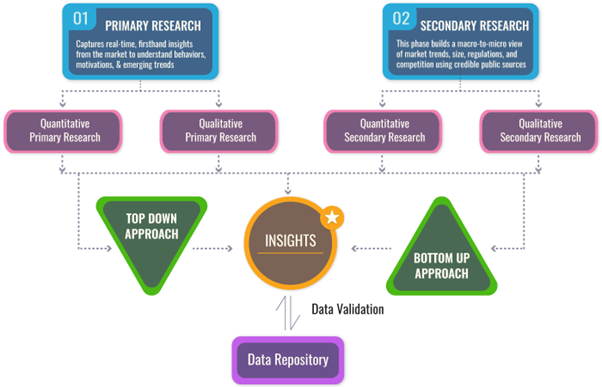
DUAL MODELING: TOP-DOWN + BOTTOM-UP
To ensure robust market estimation, we apply two complementary sizing approaches:
Top-Down Modeling:- Start with broader industry value (e.g., global or regional TAM)
- Apply filters by segment, geography, end-user, or use case
- Adjust with primary insights and validation benchmarks
- Ideal for investor-grade market scans and opportunity mapping
- Aggregate from the ground up using sales volumes, pricing, and unit economics
- Use internal modeling templates aligned with stakeholder data
- Incorporate distributor-level or region-specific inputs
- Most accurate for emerging segments and granular sub-markets
DATA VALIDATION: IN-HOUSE REPOSITORY
We close the loop with proprietary data intelligence built from ongoing projects, industry monitoring, and historical benchmarking. This repository includes:
- Multi-sector market and pricing models
- Key trendlines from past interviews and forecasts
- Benchmarked adoption rates, churn patterns, and ROI indicators
- Industry-specific deviation flags and cross-check logic
- Catches inconsistencies early
- Aligns projections across studies
- Enables consistent, high-trust deliverables