

Global Baby Learning Toys Market Size and Forecast (2020 - 2033), Global and Regional Growth, Trend, Share, and Industry Analysis Report Coverage: By Product Type (Activity Gyms & Playmats, Building Blocks & Construction Sets, Interactive Plush Toys, Musical Toys, Puzzles & Shape Sorters, Others), By Age Group (0-6 Months, 6-12 Months, 1-3 Years, 3-5 Years), By Distribution Channel (Online Retail, Offline Retail [Hypermarkets/Supermarkets, Specialty Stores, Toy Stores]) And Geography
2025-12-12
Consumer Products
Jaya Bundele (Research Analyst)
Description
Baby
Learning Toys Market Overview
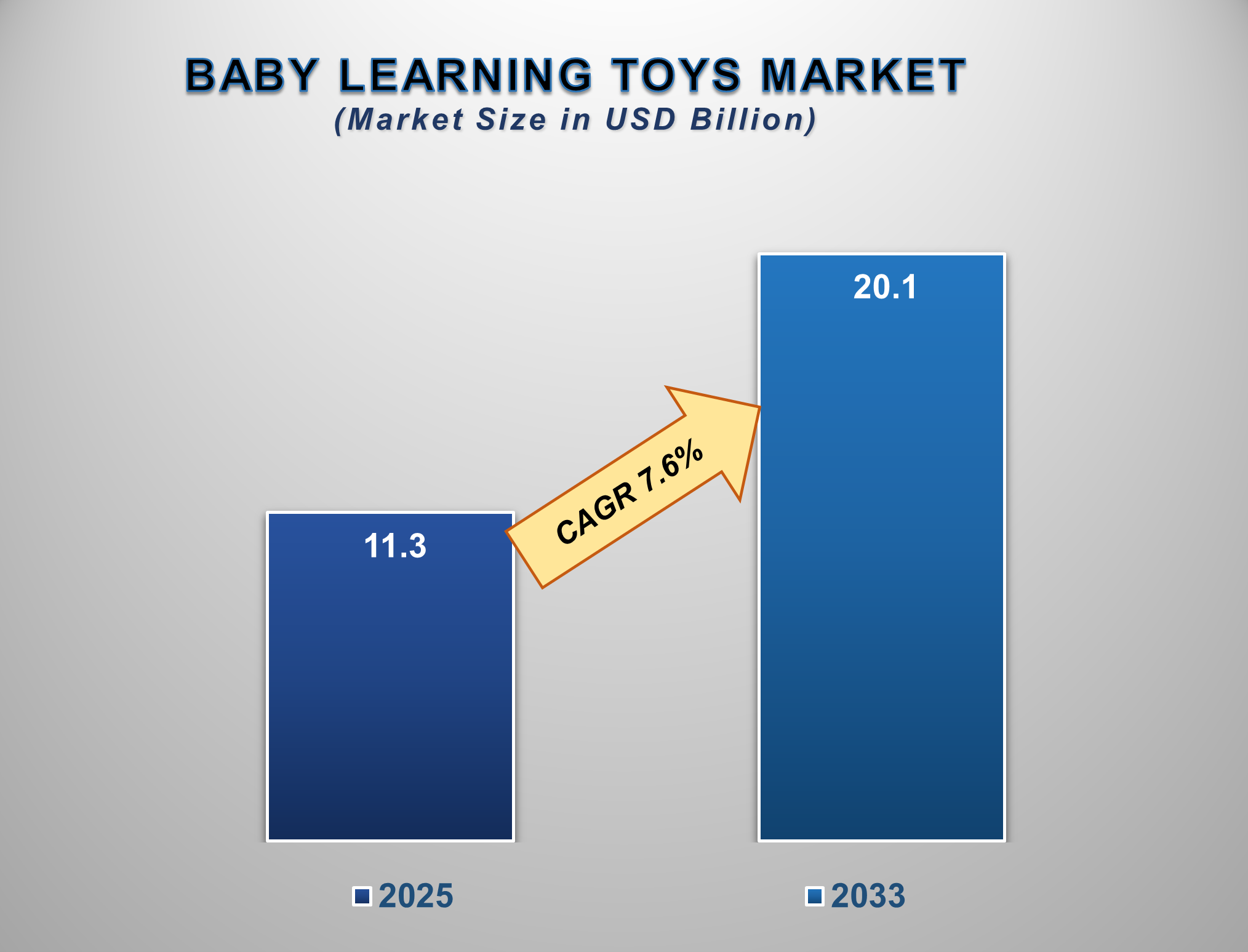
The Baby Learning Toys Market is poised for a period of robust growth from 2025 to 2033, fueled by rising parental awareness of early childhood development, increasing disposable incomes, and the growing influence of "edu-tainment" (education + entertainment). The market is projected to be valued at approximately USD 11.3 billion in 2025 and is forecasted to reach nearly USD 20.1 billion by 2033, exhibiting a compound annual growth rate (CAGR) of 7.6% during this period.
Baby learning toys are specifically designed to
stimulate cognitive, motor, sensory, and social skills in infants and toddlers.
The market's expansion is underpinned by a growing body of research emphasizing
the critical importance of the first five years for brain development. Modern
parents, especially millennial and Gen Z demographics, are increasingly seeking
out toys that offer developmental benefits beyond simple amusement.
Furthermore, technological integration, such as app-connected toys and interactive AR/VR features, is creating new
avenues for engagement and learning. North America and Europe currently lead
the market due to high consumer spending power and strong brand presence, while
the Asia-Pacific region is anticipated to be the fastest-growing market, driven
by a large base of young parents and rapid urbanization.
Baby Learning Toys Market Drivers and
Opportunities
Rising Parental Focus on Early Childhood Development is the
Primary Market Driver
The most significant driver for the baby
learning toys market is the heightened awareness and focus among parents on the
importance of early childhood stimulation for cognitive and motor skill
development. Informed by pediatrician
recommendations and accessible online resources, parents are actively investing
in toys that promote skills like problem-solving, hand-eye coordination, and
language acquisition. This trend is amplified by the competitive nature of
modern parenting, where there is a strong desire to provide children with a
developmental head start. The shift from viewing toys as mere entertainment to
seeing them as essential tools for growth ensures a consistent and expanding
demand for high-quality, educational playthings.
Growing Disposable Income and Nuclear Family Structures are
Accelerating Market Growth
Increasing disposable income, particularly in
emerging economies, allows families to allocate a larger portion of their
budget to premium and educational products for their children. The prevalence
of dual-income households and smaller nuclear families often results in higher
per-child spending. Grandparents are also significant contributors, often
purchasing educational toys for their grandchildren. This financial capacity
enables parents to invest in more sophisticated, durable, and often
higher-priced learning toys from trusted brands, directly contributing to
market revenue growth.
Technological Integration and the Demand for Sustainable Toys
Present Significant Opportunities
The integration of advanced technology with
traditional play concepts is a major growth frontier. Opportunities abound in
developing smart toys that use AI to adapt to a child's learning pace,
AR-enabled books and puzzles that bring static images to life, and
app-connected devices that provide parents with feedback on their child's
progress. Alongside this, the rising demand for eco-friendly and sustainable
toys represents a parallel opportunity. Parents are increasingly seeking
products made from organic cotton, sustainably sourced wood, and non-toxic,
recyclable plastics. For manufacturers, investing in R&D for innovative
tech-driven toys while simultaneously expanding lines of ethically produced,
sustainable products is a key strategy to capture value across different consumer segments.
Baby Learning Toys Market Scope
|
Report Attributes |
Description |
|
Market Size in 2025 |
USD 11.3 Billion |
|
Market Forecast in 2033 |
USD 20.1 Billion |
|
CAGR % 2025-2033 |
7.6% |
|
Base Year |
2024 |
|
Historic Data |
2020-2024 |
|
Forecast Period |
2025-2033 |
|
Report USP |
Product Portfolio,
Technological Analysis, Company Market Share, Company Heatmap, Pricing
Analysis, Growth Factors and more |
|
Segments Covered |
●
By Product Type ●
By Age Group ●
By Distribution
Channel |
|
Regional Scope |
●
North America, ●
Europe, ●
APAC, ●
Latin America ●
Middle East and
Africa |
|
Country Scope |
1)
U.S. 2)
Canada 3)
Germany 4)
UK 5)
France 6)
Spain 7)
Italy 8)
Switzerland 9)
China 10)
Japan 11)
India 12)
Australia 13)
South Korea 14)
Brazil 15)
Mexico 16)
Argentina 17)
South Africa 18)
Saudi Arabia 19)
UAE |
Baby Learning Toys Market Report Segmentation
Analysis
The global Baby Learning Toys
Market industry analysis is segmented by Product Type, by Age Group, by
Distribution Channel, and by region.
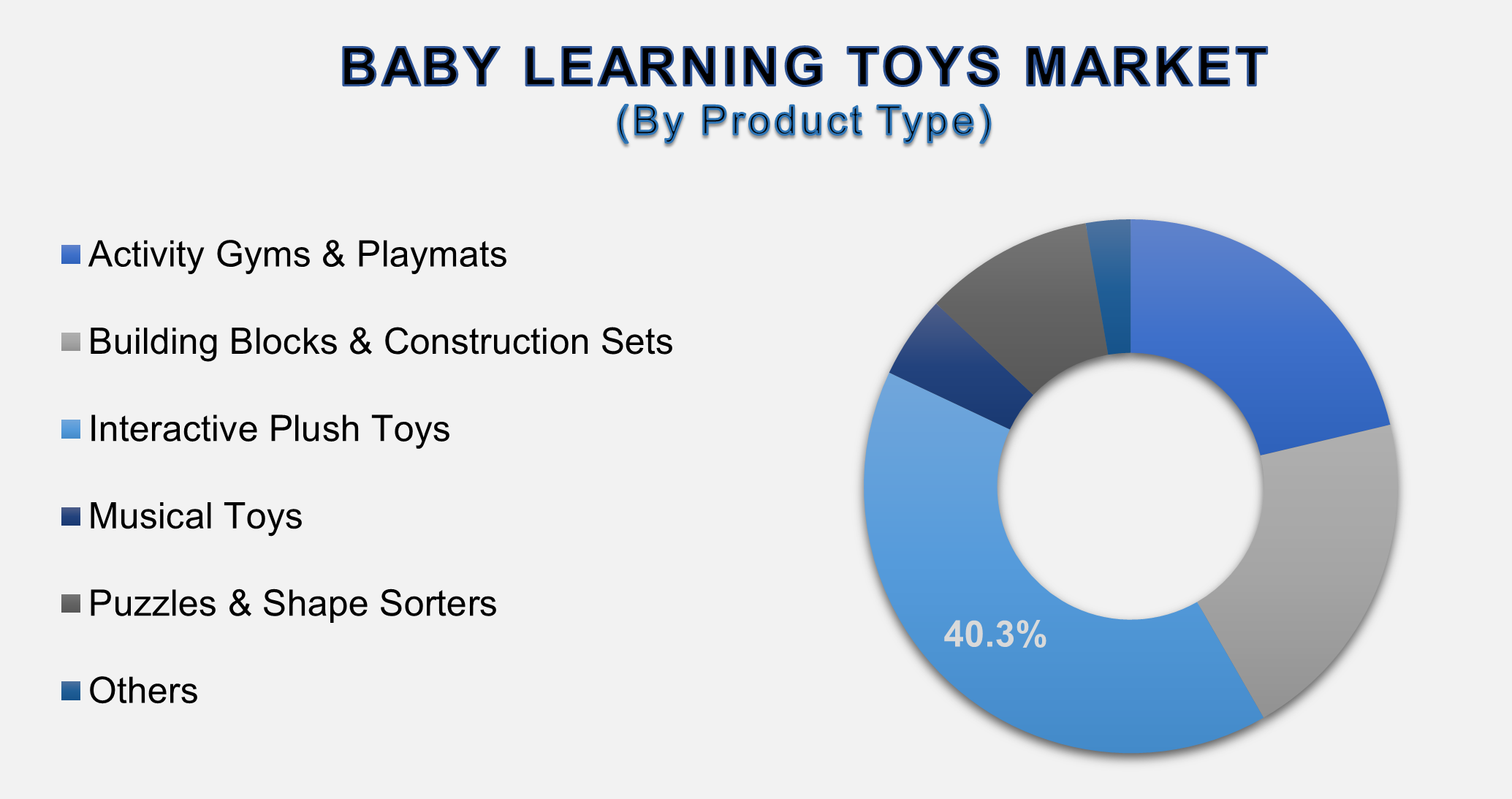
The Interactive Plush
Toys segment is anticipated to command a significant market share in 2025.
The Product Type segment is categorized into Activity Gyms & Playmats, Building Blocks & Construction Sets, Interactive Plush Toys, Musical Toys, Puzzles & Shape Sorters, and Others. Interactive Plush Toys, which often incorporate sounds, lights, and simple phrases to teach numbers, letters, and social skills, are highly popular due to their dual role as a comfort object and a learning tool. Their appeal to a wide age range (from infants to toddlers) and their ability to foster emotional development through imaginative play contribute to their dominant market position. Continuous innovation, such as connectivity to apps for enhanced content, is further propelling this segment's growth.
The 1-3 years age group
segment is projected to hold the largest market share.
The Age
Group segment is divided into 0-6 Months, 6-12 Months, 1-3 Years, and 3-5
Years. The 1-3-year segment is the most
lucrative, as this is a period of rapid development in language, motor skills,
and cognitive abilities. Toddlers in this age group are actively exploring
their environment, and parents are highly motivated to purchase toys that support
walking, talking, and problem-solving. The wide
variety of toys targeting this developmental stage, from push-and-pull toys to simple puzzles and first building
blocks, ensures a high volume of sales and a
continuous refresh cycle as children's skills evolve.
The Online Retail
distribution channel segment is projected to maintain its dominance.
The
Online Retail segment's leading position is driven by the convenience,
extensive product selection, and competitive pricing it offers to time-poor
parents. The ability to read detailed product descriptions and hundreds of
customer reviews before purchasing is a significant advantage for this
category. Subscription boxes for educational toys, which are primarily marketed
and sold online, have also become a major growth vector. While offline retail,
such as specialty stores, remains important for tactile purchasing, the ease of
home delivery and seamless shopping experience solidifies online retail as the
primary distribution channel.
The following segments are
part of an in-depth analysis of the global Baby Learning Toys Market:
|
Market
Segments |
|
|
By Product
Type |
●
Activity Gyms &
Playmats ●
Building Blocks
& Construction Sets ●
Interactive Plush
Toys ●
Musical Toys ●
Puzzles & Shape
Sorters ●
Others |
|
By Age Group |
●
0-6 Months ●
6-12 Months ●
1-3 Years ●
3-5 Years |
|
By Distribution Channel |
●
Online Retail ●
Offline Retail o
Hypermarkets/Supermarkets o
Specialty Stores o
Toy Stores |
Baby Learning Toys Market Share Analysis by
Region
The North America region
is anticipated to hold the largest portion of the Baby Learning Toys Market
globally throughout the forecast period.
North
America's dominance is attributed to its high per-capita disposable income,
strong presence of leading toy manufacturers, and a deeply ingrained consumer
culture that emphasizes early education. Parents in this region are early
adopters of new technologies and are willing to invest in premium, branded
educational toys. Strict safety regulations also bolster consumer confidence in
products from established brands. The region's robust e-commerce infrastructure
further supports market dominance by ensuring easy access to a wide range of
products.
Baby Learning Toys Market Competition Landscape
Analysis
The global baby learning toys
market is fragmented and highly competitive, featuring a mix of large
multinational toy conglomerates and specialized niche players. Competition is
based on brand reputation, product innovation, safety standards, educational
value, and effective marketing. Key strategies include heavy investment in
R&D to create the next generation of smart, connected toys; strategic
licensing of popular children's media characters; expansion into high-growth
emerging markets; and a focus on sustainability to meet evolving consumer
expectations. Maintaining the highest standards of product safety and complying
with international regulations (e.g., ASTM, EN71) are non-negotiable in this
market.
Global Baby Learning Toys
Market Recent Developments News:
- In January 2025, LEGO Education launched a new DUPLO coding train set
for preschoolers, introducing fundamental STEM concepts through tactile,
screen-free play.
- In November 2024, VTech Holdings announced a partnership with a
leading children's streaming service to release a new line of interactive
toys featuring characters from a popular educational show.
- In September 2024, Melissa & Doug, a key player in wooden toys,
expanded its "Steam" (Science, Technology, Engineering, Arts,
Math) line with new kits focusing on engineering and creativity for
toddlers.
- In July 2024, the startup Lovevery secured significant new funding to
expand its direct-to-consumer subscription model internationally,
capitalizing on the demand for age-specific, developmentally appropriate
toy kits.
The Global Baby Learning
Toys Market Is Dominated by a Few Large Companies, such as
●
The LEGO Group
●
VTech
●
Melissa & Doug
●
(Playskool
●
Fisher-Price
●
Kids II, Inc.
●
Hape Holdings AG
●
Manhattan Toy Company
●
B.toys
●
Skip Hop
●
MindWare
●
PlanToys
●
Baby Einstein
●
Fat Brain Toy
● TOMY Company Ltd.
Frequently Asked Questions
Jaya Bundele (Research Analyst)
Jaya Bundele is a skilled Research Analyst with 4+ years of experience in market intelligence, consumer insights, competitive analysis, and industry forecasting across the consumer goods, agriculture, and food & beverage sectors. She specializes in market sizing, trend analysis, growth opportunity mapping, and strategic secondary research for global and regional markets.
Her expertise lies in transforming complex industry data into actionable business strategies that help organizations identify emerging trends, understand customer behavior, and gain a competitive edge. With a strong focus on data-driven insights, business intelligence, and future market trends, Jaya delivers high-quality research solutions aligned with evolving industry demands and market dynamics.
1. Global Baby Learning Toys
Market Introduction and Market Overview
1.1.
Objectives
of the Study
1.2.
Global
Baby Learning Toys Market Scope and Market Estimation
1.2.1.Global Electronic Toll
Collection Overall Market Size (US$ Bn), Market CAGR (%), Market forecast (2025
- 2033)
1.2.2.Global Baby Learning Toys
Market Revenue Share (%) and Growth Rate (Y-o-Y) from 2020 - 2033
1.3.
Market
Segmentation
1.3.1.Product Type of Global Baby
Learning Toys Market
1.3.2.Age Group of Global Baby
Learning Toys Market
1.3.3.Distribution Channel of Global
Baby Learning Toys Market
1.3.4.Region of Global Baby
Learning Toys Market
2. Executive
Summary
2.1.
Demand
Side Trends
2.2.
Key
Market Trends
2.3.
Market
Demand (US$ Bn) Analysis 2020 – 2024 and forecast, 2025 – 2033
2.4.
Demand
and Opportunity Assessment
2.5.
Technological
Advancements
2.6.
Key
Developments
2.7.
Market
Entry Strategies
2.8.
Market
Dynamics
2.8.1.Drivers
2.8.2.Limitations
2.8.3.Opportunities
2.8.4.Impact Analysis of Drivers
and Restraints
2.9.
Porter’s
Five Forces Analysis
2.10.
PEST
Analysis
3. Global
Baby Learning Toys Market Estimates
& Historical Trend Analysis (2020 - 2024)
4. Global
Baby Learning Toys Market Estimates
& Forecast Trend Analysis, by Product Type
4.1.
Global
Baby Learning Toys Market Revenue (US$ Bn) Estimates and Forecasts, by Product
Type, 2020 - 2033
4.1.1.Activity Gyms &
Playmats
4.1.2.Building Blocks &
Construction Sets
4.1.3.Interactive Plush Toys
4.1.4.Musical Toys
4.1.5.Puzzles & Shape
Sorters
4.1.6.Others
5. Global
Baby Learning Toys Market Estimates
& Forecast Trend Analysis, by Age Group
5.1.
Global
Baby Learning Toys Market Revenue (US$ Bn) Estimates and Forecasts, by Age
Group, 2020 - 2033
5.1.1.0-6 Months
5.1.2.6-12 Months
5.1.3.1-3 Years
5.1.4.3-5 Years
6. Global
Baby Learning Toys Market Estimates
& Forecast Trend Analysis, by Distribution Channel
6.1.
Global
Baby Learning Toys Market Revenue (US$ Bn) Estimates and Forecasts, by Distribution
Channel 2020 - 2033
6.1.1.Online Retail
6.1.2.Offline Retail
6.1.2.1.
Hypermarkets/Supermarkets
6.1.2.2.
Specialty
Stores
6.1.2.3.
Toy
Stores
7. Global
Baby Learning Toys Market Estimates
& Forecast Trend Analysis, by region
7.1.
Global
Baby Learning Toys Market Revenue (US$ Bn) Estimates and Forecasts, by region, 2020
- 2033
7.1.1.North America
7.1.2.Europe
7.1.3.Asia Pacific
7.1.4.Middle East & Africa
7.1.5.Latin America
8. North America Baby
Learning Toys Market: Estimates &
Forecast Trend Analysis
8.1.
North
America Baby Learning Toys Market Assessments & Key Findings
8.1.1.North America Baby
Learning Toys Market Introduction
8.1.2.North America Baby
Learning Toys Market Size Estimates and Forecast (US$ Billion) (2020 - 2033)
8.1.2.1. By Product
Type
8.1.2.2. By Age Group
8.1.2.3. By Distribution
Channel
8.1.2.4.
By
Country
8.1.2.4.1. The U.S.
8.1.2.4.2. Canada
9. Europe Baby
Learning Toys Market: Estimates &
Forecast Trend Analysis
9.1.
Europe
Baby Learning Toys Market Assessments & Key Findings
9.1.1.Europe Baby Learning Toys
Market Introduction
9.1.2.Europe Baby Learning Toys
Market Size Estimates and Forecast (US$ Billion) (2020 - 2033)
9.1.2.1. By Product
Type
9.1.2.2. By Age Group
9.1.2.3. By Distribution
Channel
9.1.2.4.
By
Country
9.1.2.4.1.
Germany
9.1.2.4.2.
Italy
9.1.2.4.3.
U.K.
9.1.2.4.4.
France
9.1.2.4.5.
Spain
9.1.2.4.6.
Switzerland
9.1.2.4.7. Rest
of Europe
10. Asia Pacific Baby
Learning Toys Market: Estimates &
Forecast Trend Analysis
10.1.
Asia
Pacific Market Assessments & Key Findings
10.1.1.
Asia
Pacific Baby Learning Toys Market Introduction
10.1.2.
Asia
Pacific Baby Learning Toys Market Size Estimates and Forecast (US$ Billion) (2020
- 2033)
10.1.2.1. By Product
Type
10.1.2.2. By Age Group
10.1.2.3. By Distribution
Channel
10.1.2.4.
By
Country
10.1.2.4.1. China
10.1.2.4.2. Japan
10.1.2.4.3. India
10.1.2.4.4. Australia
10.1.2.4.5. South Korea
10.1.2.4.6. Rest of Asia Pacific
11. Middle East & Africa Baby
Learning Toys Market: Estimates &
Forecast Trend Analysis
11.1.
Middle
East & Africa Market Assessments & Key Findings
11.1.1.
Middle East & Africa Baby Learning Toys Market
Introduction
11.1.2.
Middle East & Africa Baby Learning Toys Market Size Estimates
and Forecast (US$ Billion) (2020 - 2033)
11.1.2.1. By Product
Type
11.1.2.2. By Age Group
11.1.2.3. By Distribution
Channel
11.1.2.4.
By
Country
11.1.2.4.1. UAE
11.1.2.4.2. Saudi
Arabia
11.1.2.4.3. South
Africa
11.1.2.4.4. Rest
of MEA
12. Latin America
Baby Learning Toys Market: Estimates
& Forecast Trend Analysis
12.1.
Latin
America Market Assessments & Key Findings
12.1.1.
Latin
America Baby Learning Toys Market Introduction
12.1.2.
Latin
America Baby Learning Toys Market Size Estimates and Forecast (US$ Billion) (2020
- 2033)
12.1.2.1. By Product
Type
12.1.2.2. By Age Group
12.1.2.3. By Distribution
Channel
12.1.2.4.
By
Country
12.1.2.4.1. Brazil
12.1.2.4.2. Argentina
12.1.2.4.3. Mexico
12.1.2.4.4. Rest
of LATAM
13. Country Wise Market:
Introduction
14.
Competition
Landscape
14.1.
Global
Baby Learning Toys Market Product Mapping
14.2.
Global
Baby Learning Toys Market Concentration Analysis, by Leading Players /
Innovators / Emerging Players / New Entrants
14.3.
Global
Baby Learning Toys Market Tier Structure Analysis
14.4.
Global
Baby Learning Toys Market Concentration & Company Market Shares (%)
Analysis, 2024
15.
Company
Profiles
15.1.
The LEGO Group
15.1.1.
Company
Overview & Key Stats
15.1.2.
Financial
Performance & KPIs
15.1.3.
Product
Portfolio
15.1.4.
SWOT
Analysis
15.1.5.
Business
Strategy & Recent Developments
* Similar details would be provided for all the players
mentioned below
15.2. VTech
15.3. Melissa &
Doug
15.4. (Playskool
15.5. Fisher-Price
15.6. Kids II, Inc.
15.7. Hape Holdings
AG
15.8. Manhattan Toy
Company
15.9. B.toys
15.10. Skip Hop
15.11. MindWare
15.12. PlanToys
15.13. Baby Einstein
15.14. Fat Brain Toy
15.15. TOMY Company
Ltd.
15.16. Other
Prominent Players
16. Research
Methodology
16.1.
External
Transportations / Databases
16.2.
Internal
Proprietary Database
16.3.
Primary
Research
16.4.
Secondary
Research
16.5.
Assumptions
16.6.
Limitations
16.7.
Report
FAQs
17. Research
Findings & Conclusion
Our Research Methodology
"Insight without rigor is just noise."
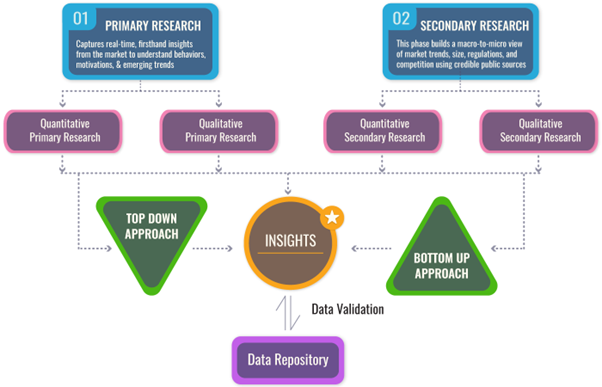
We follow a comprehensive, multi-phase research framework designed to deliver accurate, strategic, and decision-ready intelligence. Our process integrates primary and secondary research , both quantitative and qualitative , along with dual modeling techniques ( top-down and bottom-up) and a final layer of validation through our proprietary in-house repository.
PRIMARY RESEARCH
Primary research captures real-time, firsthand insights from the market to understand behaviors, motivations, and emerging trends.
1. Quantitative Primary Research
Objective: Generate statistically significant data directly from market participants.
Approaches:- Structured surveys with customers, distributors, and field agents
- Mobile-based data collection for point-of-sale audits and usage behavior
- Phone-based interviews (CATI) for market sizing and product feedback
- Online polling around industry events and digital campaigns
- Purchase frequency by customer type
- Channel performance across geographies
- Feature demand by application or demographic
2. Qualitative Primary Research
Objective: Explore decision-making drivers, pain points, and market readiness.
Approaches:- In-depth interviews (IDIs) with executives, product managers, and key decision-makers
- Focus groups among end users and early adopters
- Site visits and observational research for consumer products
- Informal field-level discussions for regional and cultural nuances
SECONDARY RESEARCH
This phase helps establish a macro-to-micro understanding of market trends, size, regulation, and competitive dynamics, sourced from credible and public domain information.
1. Quantitative Secondary Research
Objective: Model market value and segment-level forecasts based on published data.
Sources include:- Financial reports and investor summaries
- Government trade data, customs records, and regulatory statistics
- Industry association publications and economic databases
- Channel performance and pricing data from marketplace listings
- Revenue splits, pricing trends, and CAGR estimates
- Supply-side capacity and volume tracking
- Investment analysis and funding benchmarks
2. Qualitative Secondary Research
Objective: Capture strategic direction, innovation signals, and behavioral trends.
Sources include:- Company announcements, roadmaps, and product pipelines
- Publicly available whitepapers, conference abstracts, and academic research
- Regulatory body publications and policy briefs
- Social and media sentiment scanning for early-stage shifts
- Strategic shifts in market positioning
- Unmet needs and white spaces
- Regulatory triggers and compliance impact
DUAL MODELING: TOP-DOWN + BOTTOM-UP
To ensure robust market estimation, we apply two complementary sizing approaches:
Top-Down Modeling:- Start with broader industry value (e.g., global or regional TAM)
- Apply filters by segment, geography, end-user, or use case
- Adjust with primary insights and validation benchmarks
- Ideal for investor-grade market scans and opportunity mapping
- Aggregate from the ground up using sales volumes, pricing, and unit economics
- Use internal modeling templates aligned with stakeholder data
- Incorporate distributor-level or region-specific inputs
- Most accurate for emerging segments and granular sub-markets
DATA VALIDATION: IN-HOUSE REPOSITORY
We close the loop with proprietary data intelligence built from ongoing projects, industry monitoring, and historical benchmarking. This repository includes:
- Multi-sector market and pricing models
- Key trendlines from past interviews and forecasts
- Benchmarked adoption rates, churn patterns, and ROI indicators
- Industry-specific deviation flags and cross-check logic
- Catches inconsistencies early
- Aligns projections across studies
- Enables consistent, high-trust deliverables