

Baby Monitor Market Size and Forecast (2020-2033), Global and Regional Growth, Trend, Share, and Industry Analysis Report Coverage: By Product (Patient Monitoring Devices, Diagnostic Devices, Therapeutic Devices, Imaging Systems), By Component (Sensors, Batteries, Microprocessors/MCU, Displays, ASICs/FPGAs), By End-User (Hospitals, Diagnostic Centers, Ambulatory Surgical Centers, Home Care Settings), and Geography
2025-11-28
Semiconductor and Electronics
Ekta Chaurasia (Team Lead)
Description
Baby Monitor Market Overview
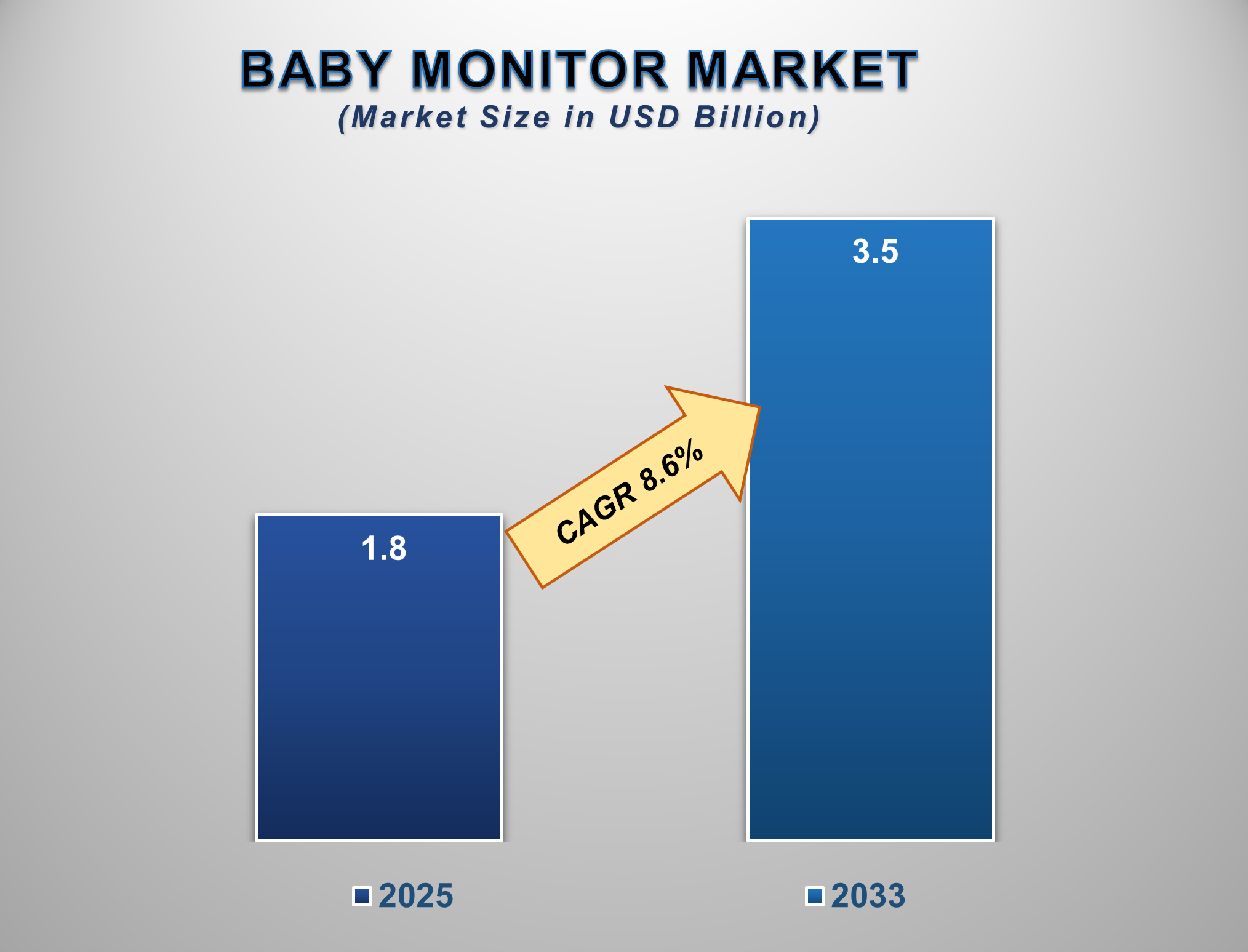
The Baby Monitor Market is poised for a period of robust and innovative growth from 2025 to 2033, fueled by rising parental concerns for infant safety, increasing disposable incomes, and the rapid integration of smart home technologies and AI into childcare solutions. The market is projected to be valued at approximately USD 1.8 billion in 2025 and is forecasted to reach nearly USD 3.5 billion by 2033, exhibiting a compound annual growth rate (CAGR) of 8.6% during this period.
Baby monitors are electronic devices used to
remotely observe and listen to infants and young children. The market's
expansion is primarily driven by the growing emphasis on child safety and
well-being, coupled with the technological evolution from basic audio monitors
to sophisticated smart monitoring systems. The rising number of nuclear
families and dual-income households, where parents seek peace of mind and
efficient childcare solutions, is a key demographic driver. Furthermore,
increasing awareness of Sudden Infant Death Syndrome (SIDS) and other
sleep-related risks is prompting parents to invest in advanced monitors with
vital sign tracking. The proliferation of high-speed internet and smartphone
penetration is enabling the adoption of Wi-Fi-enabled video monitors. North
America currently holds the largest market share due to high technology
adoption rates and strong purchasing power, while the Asia-Pacific region is
expected to witness the fastest growth, driven by its large population of new
parents, urbanization, and growing middle-class aspirations.
Baby Monitor
Market Drivers and Opportunities
The Rising Emphasis on Infant Safety and the
Proliferation of Smart Homes are the Primary
Market drivers for the Baby Monitor Market
The paramount concern for infant safety and
well-being is the most significant force propelling the baby monitor market.
Modern parents are increasingly vigilant about monitoring their children's
sleep environment, breathing, and overall safety. This concern dovetails
perfectly with the global trend of smart home adoption. Parents are now seeking
baby monitors that integrate seamlessly with their connected ecosystems,
allowing for remote monitoring via smartphones, receiving real-time alerts, and
reviewing historical data. This convergence transforms the baby monitor from a
simple audio relay into a central component of the digital nursery, offering
unprecedented levels of oversight and reassurance. The desire for constant,
connected awareness of a child's status provides a solid, emotional foundation
for sustained market growth.
Technological Advancements and AI-Powered
Features are Driving Product Premiumization
The rapid integration of advanced technologies
like Artificial Intelligence (AI), computer vision, and high-sensitivity
sensors is a powerful catalyst for market growth and premiumization. This
technological infusion is leading to a new generation of "smart"
monitors that offer features far beyond basic audio and video. AI algorithms
can now differentiate between routine movements and potential distress, detect
a baby's rollover position, and analyze cry
patterns to suggest possible causes. High-definition night vision, temperature
and humidity sensors, and lullaby-playing capabilities are becoming standard.
This evolution empowers parents with data-driven insights and proactive alerts,
moving the market from reactive monitoring to predictive and interactive care.
The shift from simple devices to comprehensive infant-care platforms is driving
the widespread adoption of advanced, higher-margin baby monitors.
The Expansion into Health Monitoring and the
Untapped Potential in Emerging Markets Present Significant Opportunities
The strategic development of monitors with
integrated health tracking and the tailoring of products for price-sensitive
regions are creating significant growth frontiers. Key opportunities lie in the
burgeoning segment of monitors with non-contact health sensors, which can track
an infant's breathing rate, heart rate, and blood oxygen levels without
wearable attachments, addressing parental
anxiety about SIDS. Furthermore, the rise of ecosystem-based parenting, where
the monitor connects to other smart nursery products like humidifiers, white
noise machines, and smart cribs, presents a lucrative avenue for brand loyalty
and bundled sales. For manufacturers, investing in affordable yet reliable
video monitors for emerging markets, developing sophisticated and clinically
validated health sensors, and creating interoperable systems that integrate
into larger smart home platforms are key strategies to capture untapped market
potential.
Baby Monitor Market Scope
|
Report Attributes |
Description |
|
Market Size in 2025 |
USD 1.8 Billion |
|
Market Forecast in 2033 |
USD 3.5 Billion |
|
CAGR % 2025-2033 |
8.6% |
|
Base Year |
2024 |
|
Historic Data |
2020-2024 |
|
Forecast Period |
2025-2033 |
|
Report USP |
Product Portfolio,
Technological Analysis, Company Market Share, Company Heatmap, Pricing
Analysis, Growth Factors, and more |
|
Segments Covered |
●
By Product ●
By Connectivity ●
By Distribution
Channel |
|
Regional Scope |
●
North America, ●
Europe, ●
APAC, ●
Latin America ●
Middle East and
Africa |
|
Country Scope |
1)
U.S. 2)
Canada 3)
Germany 4)
UK 5)
France 6)
Spain 7)
Italy 8)
Switzerland 9)
China 10)
Japan 11)
India 12)
Australia 13)
South Korea 14)
Brazil 15)
Mexico 16)
Argentina 17)
South Africa 18)
Saudi Arabia 19)
UAE |
Baby Monitor Market
Report Segmentation Analysis
The global Baby Monitor Market
industry analysis is segmented by Product, by Connectivity, by Distribution
Channel, and by region.
The Video Monitors
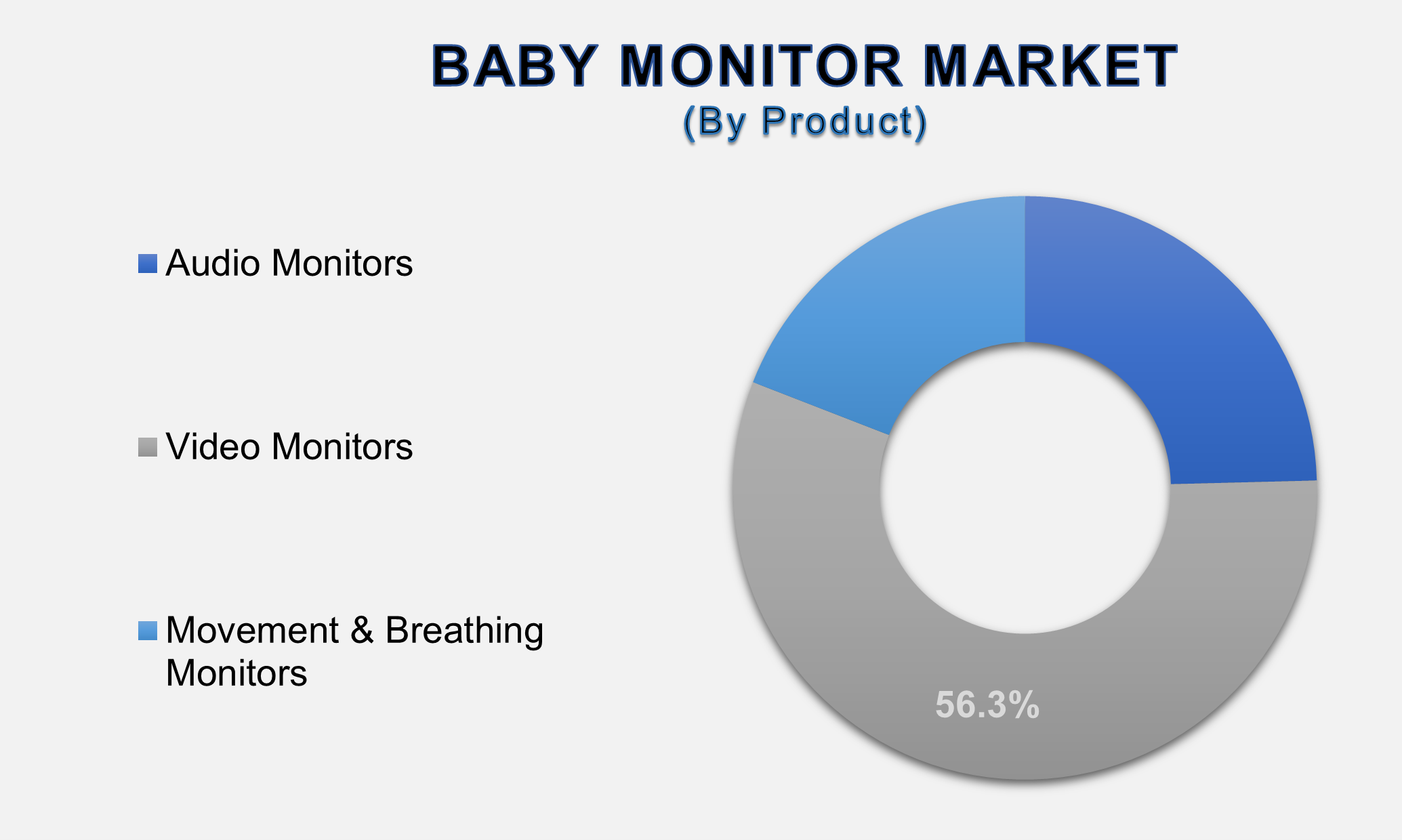
product segment is anticipated to command the largest market share in 2025
The Product segment is categorised into Audio
Monitors, Video Monitors, and Movement & Breathing Monitors. The dominance
of the video monitors segment is attributed to the superior level of
reassurance and information they provide compared to audio-only devices. The
ability for parents to visually confirm their baby's safety, sleeping position,
and overall state without entering the room is a highly valued feature.
Continuous improvements in video quality, night vision capabilities, and the
inclusion of features like pan-tilt-zoom and two-way communication have
solidified video monitors as the standard for modern parenting. The integration
of video feeds directly to smartphones has further enhanced their convenience
and appeal, making this segment the most popular and widely adopted.
The Wi-Fi-based connectivity segment is projected
to grow at a significant CAGR.
The Connectivity segment includes Wi-Fi-Based and
Non-Wi-Fi-Based (DECT). The Wi-Fi-based segment's projected significant growth
is a direct result of the demand for remote access and smart home integration.
Wi-Fi-enabled monitors allow parents to check on their baby from anywhere with
an internet connection, be it another room in the house or their workplace.
This connectivity enables a host of advanced features, including cloud storage
for video clips, sharing access with family members, and integration with
virtual assistants like Amazon Alexa and Google Assistant. While non-Wi-Fi
(DECT) monitors offer enhanced security and reliability without network
congestion, the convenience and feature-rich nature of Wi-Fi models is driving
their rapid adoption, making this the fastest-growing connectivity type.
The E-commerce distribution channel segment is
projected to witness the highest growth rate.
The Distribution Channel segment is divided into
E-commerce and Offline Retail. The E-commerce segment's position as the
fastest-growing channel is firmly rooted in changing consumer purchasing habits
and the nature of the product. Expectant and new parents are heavy users of
online resources for research and reviews, making online platforms a natural
place for purchase. E-commerce offers a wider selection, easier price
comparison, and the convenience of home delivery for bulky items. Detailed
product descriptions, customer reviews, and video demonstrations online help
consumers make informed decisions about these considered purchases. The ability
for direct-to-consumer brands to emerge and thrive primarily through online
channels further propels the explosive growth of this segment.
The following segments are part of an in-depth analysis of
the global Baby Monitor Market:
|
Market
Segments |
|
|
By Product |
●
Audio Monitors ●
Video Monitors ●
Movement &
Breathing Monitors |
|
By
Connectivity |
●
Wi-Fi-Based ●
Non-Wi-Fi-Based
(DECT) |
|
By Distribution Channel |
●
E-commerce ●
Offline Retail |
Baby Monitor Market Share
Analysis by Region
The North America region
is anticipated to hold the largest portion of the Baby Monitor Market globally
throughout the forecast period.
North America's dominance is attributed to its
high disposable income, strong penetration of smart home devices, and a high
level of awareness regarding advanced childcare products. The region has a
culture of early technology adoption, and parents are willing to invest
in premium products that offer enhanced safety and convenience. The presence of
major market players and a robust e-commerce infrastructure further accelerates regional growth. High concerns for child safety and a
significant number of dual-income households, where monitoring provides
essential peace of mind, solidify North America's leading position.
The United States, in particular, is the world's
largest single market for baby monitors, driven by factors such as high birth
rates relative to other developed nations, strong marketing by key brands, and
the widespread availability of a diverse range of products from budget to
high-end. A strong regulatory environment ensures product safety standards,
while a vibrant startup ecosystem continually introduces innovative features,
keeping the market dynamic and competitive.
Baby Monitor Market
Competition Landscape Analysis
The global baby monitor market
is moderately fragmented and highly competitive, featuring a mix of established
electronics brands, specialized juvenile product companies, and emerging tech
startups. Competition is intense and Centers on technological innovation,
product features, brand reputation, and price. Key strategies include heavy
investment in R&D for AI and health-sensing features, strategic
partnerships with parenting influencers and paediatricians for endorsements,
and a strong focus on digital marketing and e-commerce presence. The market
also sees increasing competition from general consumer electronics companies
and smart home device makers expanding their product portfolios to include baby
monitors.
Global Baby Monitor
Market Recent Developments News:
- In January 2025, Nanit Inc. launched a new computer
vision algorithm that can distinguish between a baby's awake and asleep
states with greater accuracy and provide personalized sleep tips.
- In November 2024, Motorola introduced a new
budget-friendly Wi-Fi video monitor with enhanced data encryption,
targeting security-conscious parents in emerging markets.
- In September 2024, Infant Optics partnered with a
major children's hospital to clinically validate the accuracy of its new
non-contact breathing sensor accessory.
- In July 2024, Google Nest announced deeper integration of its Nest
Cam with its Google Home app and Assistant, making it a more seamless
option for parents already within the Google ecosystem.
The Global Baby Monitor
Market Is Dominated by a Few Large Companies, such as
●
Angelcare
●
Dorel Industries Inc.
(Safety 1st)
●
Google LLC (Nest)
●
Infant Optics
●
(Philips Avent)
●
Motorola Mobility LLC
●
Nanit Inc.
●
Summer Infant
●
VTech Holdings Limited
●
iBaby
●
Owlet Baby Care
●
HelloBaby
●
Eufy (Anker
Innovations)
●
Lollipop Baby
●
Miku
● Other Prominent Players
Frequently Asked Questions
Ekta Chaurasia (Team Lead)
Ekta Chaurasia is a highly experienced Team Lead at M2Square Consultancy with over 7 years of expertise in market research, strategic consulting, competitive benchmarking, and business intelligence solutions. She specializes in ICT, semiconductors & electronics, automotive & transportation, and industrial machinery markets.
She leads end-to-end global research projects focused on market trends, industry analysis, growth forecasting, customer insights, and strategic decision-making. Known for her analytical leadership and industry expertise, Ekta helps businesses uncover growth opportunities, evaluate competitive landscapes, and stay ahead in rapidly evolving markets through accurate and insight-driven research.
1. Global Baby Monitor Market
Introduction and Market Overview
1.1.
Objectives
of the Study
1.2.
Global
Baby Monitor Market Scope and Market Estimation
1.2.1.Global Electronic Toll
Collection Overall Market Size (US$ Bn), Market CAGR (%), Market forecast (2025
- 2033)
1.2.2.Global Baby Monitor Market
Revenue Share (%) and Growth Rate (Y-o-Y) from 2020 - 2033
1.3.
Market
Segmentation
1.3.1.Product of Global Baby
Monitor Market
1.3.2.Connectivity of Global Baby
Monitor Market
1.3.3.Distribution Channel of Global
Baby Monitor Market
1.3.4.Region of Global Baby
Monitor Market
2.
Executive Summary
2.1.
Demand
Side Trends
2.2.
Key
Market Trends
2.3.
Market
Demand (US$ Bn) Analysis 2020 – 2024 and forecast, 2025 – 2033
2.4.
Demand
and Opportunity Assessment
2.5.
Pricing
Analysis
2.6.
Key
Developments
2.7.
Market
Entry Strategies
2.8.
Market
Dynamics
2.8.1.Drivers
2.8.2.Limitations
2.8.3.Opportunities
2.8.4.Impact Analysis of Drivers
and Restraints
2.9.
Porter’s
Five Forces Analysis
2.10.
PEST
Analysis
3. Global
Baby Monitor Market Estimates
& Historical Trend Analysis (2020 - 2024)
4. Global
Baby Monitor Market Estimates
& Forecast Trend Analysis, by Product
4.1.
Global
Baby Monitor Market Revenue (US$ Bn) Estimates and Forecasts, by Product, 2020
- 2033
4.1.1.Audio Monitors
4.1.2.Video Monitors
4.1.3.Movement & Breathing
Monitors
5. Global
Baby Monitor Market Estimates
& Forecast Trend Analysis, by Connectivity
5.1.
Global
Baby Monitor Market Revenue (US$ Bn) Estimates and Forecasts, by Connectivity, 2020
- 2033
5.1.1.Wi-Fi-Based
5.1.2.Non-Wi-Fi-Based (DECT)
6. Global
Baby Monitor Market Estimates
& Forecast Trend Analysis, by Distribution Channel
6.1.
Global
Baby Monitor Market Revenue (US$ Bn) Estimates and Forecasts, by Distribution
Channel 2020 - 2033
6.1.1.E-commerce
6.1.2.Offline Retail
7. Global
Baby Monitor Market Estimates
& Forecast Trend Analysis, by region
7.1.
Global
Baby Monitor Market Revenue (US$ Bn) Estimates and Forecasts, by region, 2020 -
2033
7.1.1.North America
7.1.2.Europe
7.1.3.Asia Pacific
7.1.4.Middle East & Africa
7.1.5.Latin America
8. North America Baby
Monitor Market: Estimates &
Forecast Trend Analysis
8.1. North America Baby Monitor
Market Assessments & Key Findings
8.1.1.North America Baby Monitor
Market Introduction
8.1.2.North America Baby Monitor
Market Size Estimates and Forecast (US$ Billion) (2020 - 2033)
8.1.2.1.
By Product
8.1.2.2.
By Connectivity
8.1.2.3.
By Distribution Channel
8.1.2.4. By Country
8.1.2.4.1. The U.S.
8.1.2.4.2. Canada
9. Europe Baby
Monitor Market: Estimates &
Forecast Trend Analysis
9.1. Europe Baby Monitor Market
Assessments & Key Findings
9.1.1.Europe Baby Monitor Market
Introduction
9.1.2.Europe Baby Monitor Market
Size Estimates and Forecast (US$ Billion) (2020 - 2033)
9.1.2.1.
By Product
9.1.2.2.
By Connectivity
9.1.2.3.
By Distribution Channel
9.1.2.4. By Country
9.1.2.4.1.
Germany
9.1.2.4.2.
Italy
9.1.2.4.3.
U.K.
9.1.2.4.4.
France
9.1.2.4.5.
Spain
9.1.2.4.6.
Switzerland
9.1.2.4.7. Rest
of Europe
10. Asia Pacific Baby
Monitor Market: Estimates &
Forecast Trend Analysis
10.1. Asia Pacific Market
Assessments & Key Findings
10.1.1.
Asia
Pacific Baby Monitor Market Introduction
10.1.2.
Asia
Pacific Baby Monitor Market Size Estimates and Forecast (US$ Billion) (2020 - 2033)
10.1.2.1.
By Product
10.1.2.2.
By Connectivity
10.1.2.3.
By Distribution Channel
10.1.2.4. By Country
10.1.2.4.1. China
10.1.2.4.2. Japan
10.1.2.4.3. India
10.1.2.4.4. Australia
10.1.2.4.5. South Korea
10.1.2.4.6. Rest of Asia Pacific
11. Middle East & Africa Baby
Monitor Market: Estimates &
Forecast Trend Analysis
11.1. Middle East & Africa
Market Assessments & Key Findings
11.1.1. Middle
East & Africa
Baby Monitor Market Introduction
11.1.2. Middle
East & Africa
Baby Monitor Market Size Estimates and Forecast (US$ Billion) (2020 - 2033)
11.1.2.1.
By Product
11.1.2.2.
By Connectivity
11.1.2.3.
By Distribution Channel
11.1.2.4. By Country
11.1.2.4.1. UAE
11.1.2.4.2. Saudi
Arabia
11.1.2.4.3. South
Africa
11.1.2.4.4. Rest
of MEA
12. Latin America
Baby Monitor Market: Estimates &
Forecast Trend Analysis
12.1. Latin America Market
Assessments & Key Findings
12.1.1. Latin America Baby Monitor
Market Introduction
12.1.2. Latin America Baby Monitor
Market Size Estimates and Forecast (US$ Billion) (2020 - 2033)
12.1.2.1.
By Product
12.1.2.2.
By Connectivity
12.1.2.3.
By Distribution Channel
12.1.2.4. By Country
12.1.2.4.1. Brazil
12.1.2.4.2. Argentina
12.1.2.4.3. Mexico
12.1.2.4.4. Rest
of LATAM
13.
Country
Wise Market: Introduction
14.
Competition
Landscape
14.1. Global Baby Monitor Market
Product Mapping
14.2. Global Baby Monitor Market
Concentration Analysis, by Leading Players / Innovators / Emerging Players /
New Entrants
14.3. Global Baby Monitor Market
Tier Structure Analysis
14.4. Global Baby Monitor Market
Concentration & Company Market Shares (%) Analysis, 2024
15.
Company
Profiles
15.1.
Angelcare
15.1.1.
Company
Overview & Key Stats
15.1.2.
Financial
Performance & KPIs
15.1.3.
Product
Portfolio
15.1.4.
SWOT
Analysis
15.1.5.
Business
Strategy & Recent Developments
* Similar details would be provided for all the players
mentioned below
15.2.
Dorel Industries Inc. (Safety 1st)
15.3.
Google LLC (Nest)
15.4.
Infant Optics
15.5.
(Philips Avent)
15.6.
Motorola Mobility LLC
15.7.
Nanit Inc.
15.8.
Summer Infant
15.9.
VTech Holdings Limited
15.10.
iBaby
15.11.
Owlet Baby Care
15.12.
HelloBaby
15.13.
Eufy (Anker Innovations)
15.14.
Lollipop Baby
15.15.
Miku
15.16.
Other Prominent Players
16. Research
Methodology
16.1. External Transportations /
Databases
16.2. Internal Proprietary
Database
16.3. Primary Research
16.4. Secondary Research
16.5. Assumptions
16.6. Limitations
16.7. Report FAQs
17. Research
Findings & Conclusion
Our Research Methodology
"Insight without rigor is just noise."
We follow a comprehensive, multi-phase research framework designed to deliver accurate, strategic, and decision-ready intelligence. Our process integrates primary and secondary research , both quantitative and qualitative , along with dual modeling techniques ( top-down and bottom-up) and a final layer of validation through our proprietary in-house repository.
PRIMARY RESEARCH
Primary research captures real-time, firsthand insights from the market to understand behaviors, motivations, and emerging trends.
1. Quantitative Primary Research
Objective: Generate statistically significant data directly from market participants.
Approaches:- Structured surveys with customers, distributors, and field agents
- Mobile-based data collection for point-of-sale audits and usage behavior
- Phone-based interviews (CATI) for market sizing and product feedback
- Online polling around industry events and digital campaigns
- Purchase frequency by customer type
- Channel performance across geographies
- Feature demand by application or demographic
2. Qualitative Primary Research
Objective: Explore decision-making drivers, pain points, and market readiness.
Approaches:- In-depth interviews (IDIs) with executives, product managers, and key decision-makers
- Focus groups among end users and early adopters
- Site visits and observational research for consumer products
- Informal field-level discussions for regional and cultural nuances
SECONDARY RESEARCH
This phase helps establish a macro-to-micro understanding of market trends, size, regulation, and competitive dynamics, sourced from credible and public domain information.
1. Quantitative Secondary Research
Objective: Model market value and segment-level forecasts based on published data.
Sources include:- Financial reports and investor summaries
- Government trade data, customs records, and regulatory statistics
- Industry association publications and economic databases
- Channel performance and pricing data from marketplace listings
- Revenue splits, pricing trends, and CAGR estimates
- Supply-side capacity and volume tracking
- Investment analysis and funding benchmarks
2. Qualitative Secondary Research
Objective: Capture strategic direction, innovation signals, and behavioral trends.
Sources include:- Company announcements, roadmaps, and product pipelines
- Publicly available whitepapers, conference abstracts, and academic research
- Regulatory body publications and policy briefs
- Social and media sentiment scanning for early-stage shifts
- Strategic shifts in market positioning
- Unmet needs and white spaces
- Regulatory triggers and compliance impact
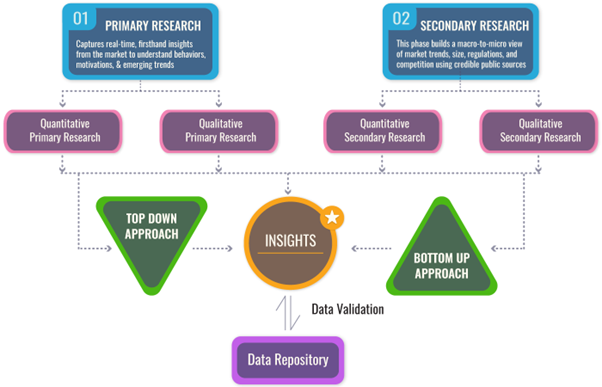
DUAL MODELING: TOP-DOWN + BOTTOM-UP
To ensure robust market estimation, we apply two complementary sizing approaches:
Top-Down Modeling:- Start with broader industry value (e.g., global or regional TAM)
- Apply filters by segment, geography, end-user, or use case
- Adjust with primary insights and validation benchmarks
- Ideal for investor-grade market scans and opportunity mapping
- Aggregate from the ground up using sales volumes, pricing, and unit economics
- Use internal modeling templates aligned with stakeholder data
- Incorporate distributor-level or region-specific inputs
- Most accurate for emerging segments and granular sub-markets
DATA VALIDATION: IN-HOUSE REPOSITORY
We close the loop with proprietary data intelligence built from ongoing projects, industry monitoring, and historical benchmarking. This repository includes:
- Multi-sector market and pricing models
- Key trendlines from past interviews and forecasts
- Benchmarked adoption rates, churn patterns, and ROI indicators
- Industry-specific deviation flags and cross-check logic
- Catches inconsistencies early
- Aligns projections across studies
- Enables consistent, high-trust deliverables