

Barge Transportation Market Size and Forecast (2026–2034), Global and Regional Growth, Trends, Share and Industry Analysis Report Coverage; By Barge Type, Cargo Type, Application, and Geography
2026-11-03
Automotive & Transportation (Mobility)
Ekta Chaurasia (Team Lead)
Description
Barge Transportation Market Overview
The Barge Transportation Market plays an important role in global freight movement by providing a cost-efficient way to transport large cargo volumes across rivers, canals, lakes, coastal routes, and other navigable waterways. Barges are widely used to move bulk commodities, including coal, grains, construction materials, petroleum products, chemicals, metals, and agricultural goods. Their ability to carry substantial loads with comparatively low fuel consumption per tonne-kilometre makes them a relevant option for industries seeking economical and reliable freight solutions.
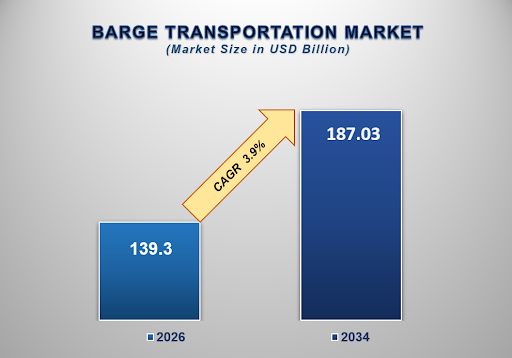
The global Barge Transportation Market is valued at USD 139.36 billion in 2026 and is projected to reach USD 187.03 billion by 2034, registering a CAGR of 3.9% during 2026–2034. Market development is supported by demand for bulk commodity transportation, industrial production, agricultural trade, and the movement of raw materials between ports, industrial facilities, and inland distribution centres.
Barge transportation also supports multimodal logistics by connecting inland production areas with seaports, rail terminals, and road networks. In suitable locations, waterway freight can reduce congestion on highways and rail corridors. However, market performance depends on navigable water levels, waterway infrastructure, seasonal conditions, port capacity, fuel costs, and the availability of efficient cargo-handling facilities.
Barge Transportation Market Drivers and Opportunities
1. Increasing Demand for Cost-Efficient Bulk Cargo Transportation Supports Market Growth
Industries that regularly move heavy and high-volume commodities depend on economical transportation options to manage logistics expenses. Barges can carry substantial quantities of cargo in a single movement, making them suitable for agricultural products, minerals, coal, petroleum, chemicals, and construction materials. Where navigable waterways and loading infrastructure are available, barge transportation can offer cost advantages over road-based freight for suitable long-distance routes.
The expansion of industrial supply chains and the movement of raw materials between inland production centres and coastal ports continue to support demand. Barge operators also benefit from their role in bulk freight networks where cargo volumes are consistent and transport schedules can accommodate waterway operating conditions.
2. Multimodal Logistics and Inland Waterway Infrastructure Are Strengthening Market Potential
The integration of waterways with ports, railways, and road networks is creating opportunities for more coordinated freight transportation. Barges can connect inland manufacturing areas and agricultural regions with major distribution hubs, reducing dependence on individual transport modes. Investments in terminals, navigation channels, locks, loading equipment, and digital logistics systems can improve the reliability and efficiency of barge operations.
In regions with established inland waterways, better infrastructure can support larger cargo movements and improve connections between domestic and international trade routes. However, infrastructure quality, water depth, seasonal disruptions, and terminal accessibility remain important considerations for operators and logistics planners.
3. Fleet Modernization and Cleaner Vessel Technologies Create New Opportunities
Barge operators are exploring fleet modernization, improved propulsion systems, fuel-efficient engines, route optimization, and digital monitoring technologies to improve operating performance. These measures can help manage fuel consumption, maintenance requirements, and emissions while supporting more efficient fleet utilization.
Opportunities also exist in specialized cargo handling, integrated logistics services, and vessels designed for particular commodities. As environmental performance becomes more important to cargo owners and transport providers, investments in lower-emission technologies and operational efficiency may create additional opportunities, depending on regulatory conditions and commercial feasibility.
Barge Transportation Market Scope
Barge Transportation Market Report Segmentation Analysis
The Barge Transportation Market is segmented according to barge type, cargo type, application, and geography. Each category reflects different cargo-handling requirements, waterway conditions, vessel designs, and operational priorities. Cargo type is particularly important because bulk commodities, liquids, containers, and breakbulk goods require different vessel configurations, loading arrangements, and safety procedures.
Dry cargo barges transport materials such as grain, coal, ores, sand, and construction aggregates. Liquid cargo barges are designed for petroleum products, chemicals, and other liquid commodities, while container and specialized barges support particular logistics and industrial requirements. Demand across these categories depends on commodity production, trade flows, inland waterway access, and the availability of compatible terminals.
Dry Bulk Transportation Remains a Core Application for Barge Freight
Dry bulk cargo is an important category within barge transportation because large quantities of agricultural commodities, minerals, coal, and construction materials are frequently moved through inland waterways. Barges can consolidate substantial cargo volumes, supporting transportation between production regions, processing facilities, storage terminals, and ports.
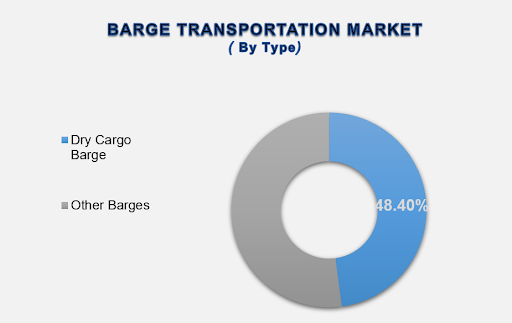
Liquid bulk transportation also contributes to market activity through the movement of fuels, petroleum products, and industrial liquids. Container and specialized barge operations serve routes where waterways can provide efficient links between ports and inland distribution points. However, a reliable numerical share for an individual cargo segment is not assigned here because a verified market-share dataset has not been established.
The Following Segments Are Part of an In-Depth Analysis of the Barge Transportation Market
By Barge Type, Vessel Design Determines Cargo Capacity and Operational Suitability
- Dry Cargo Barges: These barges transport dry commodities such as grain, coal, minerals, sand, and construction aggregates. Their design supports bulk loading and unloading, making them suitable for high-volume industrial and agricultural freight.
- Liquid Cargo Barges: These vessels transport petroleum products, fuels, chemicals, and other liquid commodities in dedicated tanks. Safety procedures, cargo compatibility, tank design, and regulatory compliance are central to their operation.
- Container Barges: Container barges move standardized freight containers between ports, terminals, and inland distribution hubs. They can support intermodal logistics by linking waterborne transport with road and rail networks.
- Hopper Barges: Hopper barges are commonly used for materials such as dredged sediment, sand, gravel, and other bulk cargo. Their cargo-holding configuration supports loading and discharge requirements for construction, dredging, and infrastructure activities.
- Specialized Barges: Specialized barges are configured for particular cargo or project requirements, including heavy equipment, oversized industrial components, and project cargo. Their use depends on route accessibility, lifting capacity, and operational planning.
By Cargo Type, Commodity Movement Influences Transportation Demand
- Dry Bulk: Includes grain, coal, ores, fertilizers, aggregates, and other unpackaged materials. Transportation demand is linked to agricultural output, industrial production, mining activity, and construction requirements.
- Liquid Bulk: Includes petroleum products, fuels, chemicals, and other liquid commodities. These shipments require suitable tank systems, cargo-handling infrastructure, and compliance with applicable safety standards.
- Containerized Cargo: Includes goods packed in standardized shipping containers. Barge transportation can connect inland markets with seaports and support multimodal cargo distribution.
- Breakbulk Cargo: Includes individual or non-containerized goods such as steel products, timber, machinery, and selected industrial materials. Handling requirements depend on cargo dimensions, weight, packaging, and terminal equipment.
- Other Cargo: This category covers cargo that does not fall within the principal classifications, including certain project materials and specialized shipments.
By Application, Industrial and Agricultural Supply Chains Support Barge Utilization
- Agriculture: Barges transport grains, oilseeds, fertilizers, and other agricultural commodities from production areas to storage facilities, processors, and export terminals. Seasonal harvest volumes can influence transportation demand.
- Energy and Petroleum: The movement of coal, fuels, petroleum products, and other energy-related materials supports barge operations along suitable waterways. Demand depends on energy supply chains and the location of production and consumption centres.
- Chemicals: Chemical transportation uses compatible vessels and cargo-handling systems designed for the characteristics of each substance. Safety, containment, and regulatory requirements are important considerations.
- Construction and Infrastructure: Sand, gravel, stone, cement-related materials, and oversized construction cargo can be transported by barge where waterways offer practical access to project locations.
- Metals and Mining: Barges support the movement of ores, metal products, and mining-related bulk materials between extraction sites, processing facilities, and distribution terminals.
- Manufacturing: Manufacturers use barge services to move raw materials, intermediate products, and selected finished goods where inland waterways can be integrated into their supply chains.
- Other Applications: Additional uses include project logistics, waste-related transportation where permitted, and specialized industrial shipments.
North America, Europe, and Asia-Pacific Influence the Barge Transportation Market
North America Benefits from Established Inland Waterway Freight Networks
North America has a significant inland waterway transportation system, particularly in the U.S., where rivers and connected waterways support the movement of agricultural products, energy commodities, chemicals, and industrial materials. Barge transportation can provide an economical option for moving large cargo volumes along suitable routes and connecting inland production areas with ports and terminals.
Canada also uses waterways for selected bulk and industrial transportation activities. Market performance across the region depends on waterway navigability, infrastructure maintenance, seasonal weather, commodity demand, and connections with rail and road networks.
Europe Supports Barge Transportation Through Connected Rivers and Canals
Europe's interconnected river and canal systems support the movement of bulk commodities, industrial cargo, fuels, chemicals, and containerized goods. Inland waterways can provide connections between industrial centres, logistics hubs, and seaports, particularly in countries with established commercial navigation networks.
Germany, France, the Netherlands, and Belgium are relevant to European inland waterway logistics, while other countries contribute through national and cross-border routes. Navigation conditions, infrastructure capacity, environmental policies, and the modernization of vessels influence regional development.
Asia-Pacific Offers Opportunities Through Industrial and Trade Activity
Asia-Pacific's barge transportation potential is influenced by industrial production, agricultural trade, port development, and the use of rivers and coastal waterways for freight movement. China has extensive waterborne freight activity, while India is developing selected national waterways to improve cargo connectivity. Other markets vary in their navigable waterway coverage, infrastructure, and freight requirements.
Expansion depends on the availability of reliable routes, adequate water depths, terminal investment, cargo volumes, and the integration of waterway transport into broader logistics networks.
Latin America Connects Agricultural and Industrial Cargo with Ports
Latin America's barge transportation activity is supported by agricultural production, mineral resources, and the movement of bulk commodities. Brazil has important river-based transportation opportunities, while Mexico and Argentina have freight networks shaped by their respective industrial, agricultural, and port systems.
Waterway conditions, seasonal changes, infrastructure investment, and access to inland terminals influence the commercial feasibility of barge transport in the region.
The Middle East and Africa Present Selective Opportunities for Waterborne Freight
The Middle East and Africa have varied opportunities for barge transportation because navigable inland waterways and suitable commercial routes are not uniformly distributed. Demand may develop around specific river systems, ports, industrial centres, and bulk-cargo operations. Saudi Arabia and the UAE are important logistics and maritime markets, while South Africa has a significant industrial and freight sector.
The regional outlook depends on route suitability, infrastructure availability, cargo-handling facilities, investment priorities, and competition from road, rail, and other maritime transport modes.
Note: Regional descriptions are qualitative. Region-specific market shares are not provided because a consistent, verified regional dataset is not available in this report.
Barge Transportation Market Competition Landscape Analysis
Competition in the Barge Transportation Market includes inland waterway operators, marine logistics providers, vessel owners, liquid and dry bulk carriers, and integrated freight companies. Companies compete through cargo capacity, fleet availability, route coverage, operating efficiency, safety performance, scheduling reliability, and the ability to manage specialized cargo requirements.
The market is influenced by both large operators with extensive fleets and regional companies serving specific waterways or commodity corridors. Fleet modernization, fuel management, digital vessel monitoring, maintenance planning, and improved cargo-handling processes can help operators manage costs and enhance service reliability.
Customer requirements also vary by cargo category. Agricultural and mineral shippers often prioritize capacity and cost efficiency, while liquid cargo customers require suitable tank configurations and rigorous safety controls. Container and project-cargo services place greater emphasis on terminal coordination, route suitability, and intermodal connectivity.
Global Barge Transportation Market Recent Developments News
Fleet Modernization Is Supporting Operational Efficiency
Barge operators continue to focus on maintaining and upgrading vessels to improve reliability, cargo-handling performance, and fuel efficiency. Depending on vessel age and operational needs, upgrades may include engine improvements, navigation equipment, monitoring systems, and maintenance technologies.
Digital Monitoring Is Improving Fleet and Route Management
Digital tools can help operators monitor vessel performance, plan maintenance, coordinate cargo movements, and improve fleet utilization. Better visibility into operating conditions can support more efficient scheduling and help identify potential disruptions along waterway routes.
Multimodal Freight Integration Is Strengthening Inland Connectivity
The integration of barge services with ports, rail terminals, and road-based distribution networks remains important to freight logistics. Coordinated transfers and improved terminal processes can make waterway transportation more practical for shippers seeking to move bulk cargo over longer distances.
Environmental Performance Is Influencing Vessel Investment Decisions
Fuel consumption, emissions, and environmental compliance are increasingly relevant to fleet planning. Operators may evaluate more efficient propulsion, alternative fuels where feasible, and improved operating practices. The pace of adoption depends on technology readiness, infrastructure, regulation, and investment costs.
These points describe broad industry trends rather than verified announcements tied to specific dates or company launches.
The Global Barge Transportation Market Includes Several Established Shipping and Logistics Companies
The competitive ecosystem includes specialized barge operators and larger marine logistics providers serving bulk, liquid, and general cargo transportation needs. Key participants include:
Ingram Barge Company
American Commercial Barge Line (ACBL)
Kirby Corporation
Campbell Transportation Company
Canal Barge Company
Heartland Barge Management
Blessey Marine Services
Amherst Madison
Spliethoff Group
Rhenus Group
HGK Shipping
Imperial Logistics
Danser Group
Van den Bosch
CMA CGM Group
Frequently Asked Questions
Ekta Chaurasia (Team Lead)
Ekta Chaurasia is a highly experienced Team Lead at M2Square Consultancy with over 7 years of expertise in market research, strategic consulting, competitive benchmarking, and business intelligence solutions. She specializes in ICT, semiconductors & electronics, automotive & transportation, and industrial machinery markets.
She leads end-to-end global research projects focused on market trends, industry analysis, growth forecasting, customer insights, and strategic decision-making. Known for her analytical leadership and industry expertise, Ekta helps businesses uncover growth opportunities, evaluate competitive landscapes, and stay ahead in rapidly evolving markets through accurate and insight-driven research.
Global Barge Transportation Market Introduction and Market Overview
Objectives of the Study
Global Barge Transportation Market Scope and Market Estimation
Global Barge Transportation Market Size (US$ Million), Market CAGR (%), Market Forecast (2026 - 2034)
Global Barge Transportation Market Revenue Share (%) and Growth Rate (Y-o-Y) Analysis (2021 - 2034)
Market Segmentation
By Barge Type of Global Barge Transportation Market
Dry Cargo Barges
Liquid Cargo Barges
Container Barges
Hopper Barges
Specialized Barges
By Cargo Type of Global Barge Transportation Market
Dry Bulk
Liquid Bulk
Containerized Cargo
Breakbulk Cargo
Other Cargo
By Application of Global Barge Transportation Market
Agriculture
Energy and Petroleum
Chemicals
Construction and Infrastructure
Metals and Mining
Manufacturing
Other Applications
Region of Global Barge Transportation Market
Competition Coverage List of Market Participants
Market Definition: Barge Transportation Market
Executive Summary
Demand Side Trends
Key Market Trends
Market Demand (US$ Million) Analysis 2021 – 2025 and Forecast, 2026 – 2034
Demand and Opportunity Assessment
Key Developments
Overview of Regulatory Landscape, Compliance Framework, and Industry Standards
Market Entry Strategies
Market Dynamics
Drivers
Limitations
Opportunities
Impact Analysis of Drivers and Restraints
Porter's Five Forces Analysis
PEST Analysis
Global Barge Transportation Market Estimates & Historical Trend Analysis (2021 – 2025)
Global Barge Transportation Market Estimates & Forecast Trend Analysis, by Barge Type
Global Barge Transportation Market Revenue (US$ Million) Estimates and Forecasts, by Barge Type, 2021 - 2034
Dry Cargo Barges
Liquid Cargo Barges
Container Barges
Hopper Barges
Specialized Barges
Global Barge Transportation Market Estimates & Forecast Trend Analysis, by Cargo Type
Global Barge Transportation Market Revenue (US$ Million) Estimates and Forecasts, by Cargo Type, 2021 - 2034
Dry Bulk
Liquid Bulk
Containerized Cargo
Breakbulk Cargo
Other Cargo
Global Barge Transportation Market Estimates & Forecast Trend Analysis, by Application
Global Barge Transportation Market Revenue (US$ Million) Estimates and Forecasts, by Application, 2021 - 2034
Agriculture
Energy and Petroleum
Chemicals
Construction and Infrastructure
Metals and Mining
Manufacturing
Other Applications
Global Barge Transportation Market Estimates & Forecast Trend Analysis, by Region
Global Barge Transportation Market Revenue (US$ Million) Estimates and Forecasts, by Region, 2021 - 2034
North America
Europe
Asia Pacific
Middle East & Africa
Latin America
North America Barge Transportation Market: Estimates & Forecast Trend Analysis
North America Barge Transportation Market Assessments & Key Findings
North America Barge Transportation Market Introduction
North America Barge Transportation Market Size Estimates and Forecast (US$ Million) (2021 - 2034)
By Barge Type
By Cargo Type
By Application
By Country
The U.S.
Canada
Europe Barge Transportation Market: Estimates & Forecast Trend Analysis
Europe Barge Transportation Market Assessments & Key Findings
Europe Barge Transportation Market Introduction
Europe Barge Transportation Market Size Estimates and Forecast (US$ Million) (2021 - 2034)
By Barge Type
By Cargo Type
By Application
By Country
Germany
Italy
The U.K.
France
Spain
Switzerland
Rest of Europe
Asia Pacific Barge Transportation Market: Estimates & Forecast Trend Analysis
Asia Pacific Barge Transportation Market Assessments & Key Findings
Asia Pacific Barge Transportation Market Introduction
Asia Pacific Barge Transportation Market Size Estimates and Forecast (US$ Million) (2021 - 2034)
By Barge Type
By Cargo Type
By Application
By Country
China
Japan
India
Australia
South Korea
Rest of Asia Pacific
Middle East & Africa Barge Transportation Market: Estimates & Forecast Trend Analysis
Middle East & Africa Barge Transportation Market Assessments & Key Findings
Middle East & Africa Barge Transportation Market Introduction
Middle East & Africa Barge Transportation Market Size Estimates and Forecast (US$ Million) (2021 - 2034)
By Barge Type
By Cargo Type
By Application
By Country
UAE
Saudi Arabia
South Africa
Rest of Middle East & Africa
Latin America Barge Transportation Market: Estimates & Forecast Trend Analysis
Latin America Barge Transportation Market Assessments & Key Findings
Latin America Barge Transportation Market Introduction
Latin America Barge Transportation Market Size Estimates and Forecast (US$ Million) (2021 - 2034)
By Barge Type
By Cargo Type
By Application
By Country
Brazil
Mexico
Argentina
Rest of Latin America
Competition Landscape
Global Barge Transportation Market Product Mapping
Global Barge Transportation Market Concentration Analysis, by Leading Players
Global Barge Transportation Market Concentration Analysis, by Innovators
Global Barge Transportation Market Concentration Analysis, by Emerging Players
Global Barge Transportation Market Concentration Analysis, by New Entrants
Global Barge Transportation Market Tier Structure Analysis
Global Barge Transportation Market Concentration & Company Market Shares (%) Analysis, 2026
Company Profiles
Ingram Barge Company
Company Overview & Key Stats
Financial Performance & KPIs
Product Portfolio
SWOT Analysis
Business Strategy & Recent Developments
*Similar details would be provided for all the players mentioned below
American Commercial Barge Line (ACBL)
Kirby Corporation
Campbell Transportation Company
Canal Barge Company
Heartland Barge Management
Blessey Marine Services
Amherst Madison
Spliethoff Group
Rhenus Group
HGK Shipping
Imperial Logistics
Danser Group
Van den Bosch
CMA CGM Group
Research Findings & Conclusion
Assumptions & Acronyms Used
Research Methodology
External Databases
Internal Proprietary Database
Primary Research
Secondary Research
Assumptions
Limitations
Report FAQ
Our Research Methodology
"Insight without rigor is just noise."
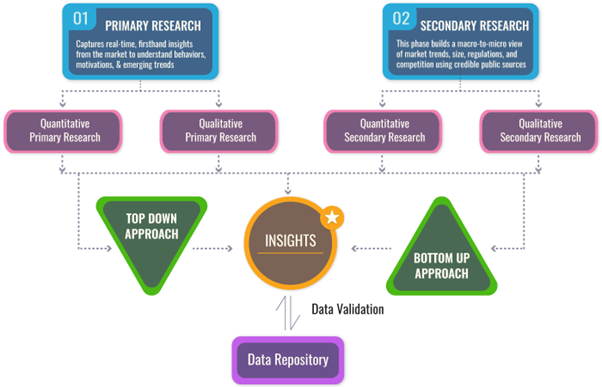
We follow a comprehensive, multi-phase research framework designed to deliver accurate, strategic, and decision-ready intelligence. Our process integrates primary and secondary research , both quantitative and qualitative , along with dual modeling techniques ( top-down and bottom-up) and a final layer of validation through our proprietary in-house repository.
PRIMARY RESEARCH
Primary research captures real-time, firsthand insights from the market to understand behaviors, motivations, and emerging trends.
1. Quantitative Primary Research
Objective: Generate statistically significant data directly from market participants.
Approaches:- Structured surveys with customers, distributors, and field agents
- Mobile-based data collection for point-of-sale audits and usage behavior
- Phone-based interviews (CATI) for market sizing and product feedback
- Online polling around industry events and digital campaigns
- Purchase frequency by customer type
- Channel performance across geographies
- Feature demand by application or demographic
2. Qualitative Primary Research
Objective: Explore decision-making drivers, pain points, and market readiness.
Approaches:- In-depth interviews (IDIs) with executives, product managers, and key decision-makers
- Focus groups among end users and early adopters
- Site visits and observational research for consumer products
- Informal field-level discussions for regional and cultural nuances
SECONDARY RESEARCH
This phase helps establish a macro-to-micro understanding of market trends, size, regulation, and competitive dynamics, sourced from credible and public domain information.
1. Quantitative Secondary Research
Objective: Model market value and segment-level forecasts based on published data.
Sources include:- Financial reports and investor summaries
- Government trade data, customs records, and regulatory statistics
- Industry association publications and economic databases
- Channel performance and pricing data from marketplace listings
- Revenue splits, pricing trends, and CAGR estimates
- Supply-side capacity and volume tracking
- Investment analysis and funding benchmarks
2. Qualitative Secondary Research
Objective: Capture strategic direction, innovation signals, and behavioral trends.
Sources include:- Company announcements, roadmaps, and product pipelines
- Publicly available whitepapers, conference abstracts, and academic research
- Regulatory body publications and policy briefs
- Social and media sentiment scanning for early-stage shifts
- Strategic shifts in market positioning
- Unmet needs and white spaces
- Regulatory triggers and compliance impact
DUAL MODELING: TOP-DOWN + BOTTOM-UP
To ensure robust market estimation, we apply two complementary sizing approaches:
Top-Down Modeling:- Start with broader industry value (e.g., global or regional TAM)
- Apply filters by segment, geography, end-user, or use case
- Adjust with primary insights and validation benchmarks
- Ideal for investor-grade market scans and opportunity mapping
- Aggregate from the ground up using sales volumes, pricing, and unit economics
- Use internal modeling templates aligned with stakeholder data
- Incorporate distributor-level or region-specific inputs
- Most accurate for emerging segments and granular sub-markets
DATA VALIDATION: IN-HOUSE REPOSITORY
We close the loop with proprietary data intelligence built from ongoing projects, industry monitoring, and historical benchmarking. This repository includes:
- Multi-sector market and pricing models
- Key trendlines from past interviews and forecasts
- Benchmarked adoption rates, churn patterns, and ROI indicators
- Industry-specific deviation flags and cross-check logic
- Catches inconsistencies early
- Aligns projections across studies
- Enables consistent, high-trust deliverables