

Battery Thermal Management System Market Size and Forecast (2026–2034), Global and Regional Growth, Trend, Share and Industry Analysis Report Coverage; By Cooling Method (Active System, Passive System, Hybrid System); By Component (Battery Coolers, Thermal Sensors, Thermal Interface Materials, Others); By Battery Type (Lithium-Ion Battery, Nickel-Metal Hydride Battery, Lead-Acid Battery, Solid-State Battery); By Propulsion Type (Battery Electric Vehicles, Plug-In Hybrid Electric Vehicles, Hybrid Electric Vehicles); By Vehicle Type (Passenger Vehicles, Commercial Vehicles); and Geography
2026-10-28
Automotive & Transportation (Mobility)
Ekta Chaurasia (Team Lead)
Description
Battery Thermal Management System Market Overview
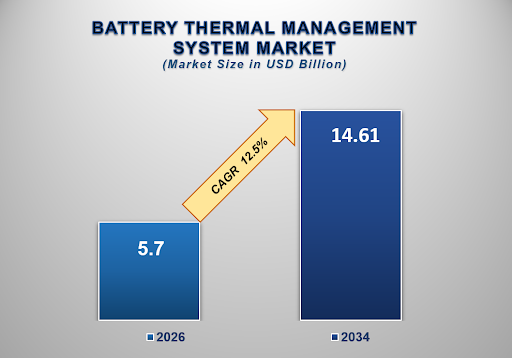
The global Battery Thermal Management System Market was valued at USD 5.7 billion in 2026 and is projected to reach USD 14.61 billion by 2034, expanding at a CAGR of 12.5% from 2026 to 2034. The market is being driven by increasing electric-vehicle adoption, higher battery energy density, faster charging requirements, growing battery-pack sizes, thermal-safety requirements, extreme-weather operation, and the increasing integration of battery thermal management with broader vehicle thermal-management architectures.
A battery thermal management system (BTMS) is a combination of cooling, heating, temperature sensing, thermal-control and associated components used to keep battery cells within an appropriate operating temperature range. The system manages heat generated during charging and discharging while also providing heating or preconditioning when battery temperatures are low.
Lithium-ion batteries are highly sensitive to temperature. Excessive heat can accelerate cell degradation and increase safety risks, while low temperatures can reduce power availability, charging capability and energy efficiency. Valeo notes that lithium-ion batteries require controlled temperature and close temperature uniformity across cells to maintain battery efficiency, durability and reliability.
The transition toward electric vehicles (EVs) is the primary structural factor supporting BTMS demand. Battery-electric vehicles use large traction batteries that must operate efficiently across different driving, charging, and environmental conditions. As battery packs become larger and charging power increases, the amount of heat generated during operation and fast charging also increases.
Fast charging is particularly important for thermal-management development. High-power charging can rapidly increase battery temperature and create thermal gradients between cells. Valeo states that charging at power levels of 150–250 kW can generate significant heat and therefore requires efficient battery cooling to maintain operating conditions and protect battery life.
The market is increasingly moving toward liquid-based and refrigerant-based systems for high-performance battery packs. Liquid cooling provides greater heat-transfer capability than air-based systems and is suitable for larger battery packs and high-power charging applications. Current industry research estimates that liquid coolants accounted for approximately 51.36% of the automotive BTMS market in 2026.
Battery thermal management is also becoming more closely integrated with vehicle-wide thermal systems. Instead of managing the battery independently, modern electric vehicles can connect battery cooling and heating with the cabin HVAC system, heat pump, power electronics and electric motor thermal loops. Integrated architectures can improve energy efficiency by transferring useful heat between vehicle systems.
The increasing use of 800-volt vehicle architectures is another factor supporting advanced BTMS development. Higher-voltage platforms can enable faster charging and improve power-delivery efficiency, but high-power charging increases the importance of controlling battery temperature during charging.
Battery thermal systems are also being developed for hybrid and plug-in hybrid vehicles. Although hybrid vehicles generally use smaller batteries than BEVs, repeated charge-discharge cycles, regenerative braking, and operation across different temperatures still require controlled thermal conditions.
The commercial-vehicle segment is creating an additional high-value opportunity. Electric buses, trucks and specialty vehicles can use substantially larger battery packs and operate continuously under demanding load profiles. Current industry analysis projects commercial-vehicle BTMS demand to grow faster than passenger-vehicle applications because of larger batteries, high utilization rates, and the importance of route reliability.
Battery technology development is also influencing system design. Lithium-ion batteries remain the principal technology used in automotive applications, but manufacturers are continuing to investigate solid-state batteries and other advanced chemistries. Emerging battery technologies may alter thermal requirements, but high-power operation and fast charging will continue to create a need for temperature monitoring and control.
The growing focus on thermal runaway prevention is another major market factor. BTMS architectures increasingly address not only normal operating temperatures but also heat propagation and safety events. Valeo's immersive cooling technology, for example, uses dielectric fluid around battery cells and is designed to improve cooling performance and mitigate thermal-runaway propagation.
Material innovation is also expanding. Battery cooling plates are being optimized for better cell-to-cell temperature uniformity, lower weight, reduced coolant volume, improved packaging, and faster manufacturing. MAHLE began series production of battery cooling plates in Spain in July 2026, with the company stating that the plates maintain temperatures below 40°C and provide uniform heat distribution across battery cells.
The increasing convergence of battery management software, thermal sensors, cooling hardware, power electronics, and vehicle controls is therefore transforming BTMS from a standalone cooling function into a core part of EV architecture.
As electric vehicles move toward larger packs, higher charging rates, greater power density and more integrated thermal systems, the global battery thermal management system market is expected to maintain strong growth through 2034.
Battery Thermal Management System Market Drivers and Opportunities
Increasing Electric Vehicle Adoption Is Accelerating Battery Thermal Management Demand
The expansion of electric vehicles is the primary demand driver for battery thermal management systems.
Battery packs represent one of the most expensive and technically sensitive components of an EV. Their performance depends on maintaining suitable cell temperatures during acceleration, regenerative braking, charging and idle conditions.
The International Energy Agency reported that global electric-car sales exceeded 17 million units in 2024, with EVs accounting for more than one-fifth of global new-car sales. Continued EV deployment is increasing the number of vehicles requiring battery heating, cooling, sensing and thermal-control technologies.
The expansion of EVs also increases the installed base requiring replacement and servicing of pumps, valves, chillers, cooling plates, sensors and other thermal components.
The trend is particularly important in markets where EV production is accelerating rapidly. Asia Pacific has become a major center for EV manufacturing and battery production, supporting demand for localized BTMS supply chains.
Fast Charging and Higher Battery Energy Density Are Supporting Market Growth
Battery packs are becoming larger and charging systems more powerful.
High-power charging creates significant thermal loads because energy is transferred into the battery at a much higher rate. Without appropriate thermal control, elevated temperatures can reduce charging performance, accelerate degradation and create safety concerns.
Valeo's current thermal-management portfolio includes battery coolers, chillers, heat-pump systems and refrigerant-based solutions designed to manage heat during fast charging and vehicle operation.
Higher energy density creates a similar challenge. More energy stored within a given battery volume increases the consequences of inefficient heat removal.
This is driving demand for cooling plates with larger contact areas, optimized coolant channels, improved thermal interface materials and advanced temperature-control software.
Battery Safety and Thermal Runaway Prevention Present Significant Opportunities
Battery safety is becoming an increasingly important area of BTMS development.
Thermal runaway can result in rapid temperature escalation and, under certain conditions, propagation from one cell to adjacent cells. Thermal-management systems therefore increasingly combine normal operating temperature control with measures intended to slow or prevent thermal-event propagation.
Valeo's immersive battery cooling solution uses a dielectric fluid in direct contact with cells and is designed to improve temperature balance and support thermal-runaway mitigation. The company states that the technology can achieve cell-level temperature variation below 2°C and is designed around thermal-runaway propagation requirements.
This development creates opportunities for dielectric fluids, immersion cooling, advanced barriers, thermal interface materials, cooling plates, thermal sensors and battery-safety controls.
Integrated Vehicle Thermal Management Is Creating New Growth Opportunities
The traditional approach of using independent thermal loops is increasingly giving way to integrated vehicle thermal-management systems.
Electric vehicles require temperature control for the battery, electric motor, inverter, onboard charger, DC-DC converter and passenger cabin. Integrated thermal architectures can transfer heat between these systems rather than rejecting or generating heat independently.
Valeo's current technology portfolio includes chillers connected to the air-conditioning loop, battery coolers, heat pumps and broader thermal-management solutions for hybrid and all-electric vehicles.
MAHLE has also developed centralized thermal-management modules intended to control the temperature of multiple vehicle systems simultaneously, demonstrating the industry's movement toward integrated architectures.
The integration of battery, powertrain and cabin thermal management creates opportunities for suppliers offering complete thermal modules rather than isolated cooling components.
Commercial Electric Vehicles Offer High-Value Market Opportunities
Electric buses, delivery vehicles, trucks, construction equipment and other commercial platforms require thermal-management systems designed for larger battery capacity and intensive operating cycles.
Commercial vehicles frequently operate for long periods, often with high payloads, repeated acceleration and braking, and scheduled charging windows. Battery temperature can therefore directly affect vehicle range, charging time and fleet productivity.
Current market analysis estimates the commercial-vehicle BTMS segment to grow at approximately 14.1% CAGR, faster than passenger-vehicle applications.
Webasto's eBTM system, for example, continuously regulates water-cooled traction batteries in buses, trucks, construction machinery and light commercial vehicles and provides both heating and cooling.
This segment provides opportunities for scalable thermal modules that can be adapted to different battery voltages and capacities.
Advanced Materials and Thermal Interface Technologies Present New Opportunities
Cooling performance increasingly depends on how effectively heat can move from battery cells into cooling structures.
Thermal interface materials, conductive pads, adhesives, gap fillers and structural materials are therefore becoming important components within advanced battery packs.
Current industry analysis identifies thermal interface materials as one of the fastest-growing component categories, supported by cell-to-pack architectures and increasing requirements for efficient heat transfer between cells, cooling structures and other battery components.
At the hardware level, suppliers are developing thinner cooling plates, optimized channels, composite materials and improved manufacturing processes.
MAHLE's July 2026 battery-cooling-plate production program demonstrates the continued commercialization of specialized cooling hardware for electric vehicles.
Battery Thermal Management System Market Scope
Battery Thermal Management System Market Report Segmentation Analysis
The global battery thermal management system industry analysis is segmented by cooling method, by component, by battery type, by propulsion type, by vehicle type, and by region.
The Active System Segment Is Expected to Dominate the Market During the Forecast Period
The Active System segment is expected to maintain a leading position in the battery thermal management system market because active systems provide controlled heating and cooling for battery packs under demanding operating conditions.
Current industry analysis estimates active BTMS revenue at approximately USD 1.968 billion in 2025, ahead of passive and hybrid systems in its market assessment. Active systems include liquid cooling, refrigerant-based cooling and other controlled thermal solutions and are particularly important for higher-capacity batteries and fast-charging vehicles.
Liquid cooling remains an important architecture because it provides high heat-transfer capability and can be adapted to different battery-pack layouts.
The Passive System segment is also expected to expand, particularly in lower-power applications where air cooling, phase-change materials, or simpler thermal structures can provide sufficient temperature control at a lower cost.
Hybrid systems combine active and passive techniques and can provide more flexible thermal control for specific vehicle architectures.
The Battery Coolers Segment Is Expected to Hold a Leading Position by Component
The Battery Coolers segment represents a core component category because it directly transfers excess heat from the battery pack to a coolant or refrigerant circuit.
Battery coolers can use cold plates, refrigerant-based cooling, liquid channels or other heat-transfer architectures. Their design is increasingly influenced by battery-cell format, pack structure, thermal density and charging power.
MAHLE's series production of battery cooling plates in 2026 demonstrates the increasing industrial focus on dedicated cooling hardware for EV battery packs. The company stated that the plates were designed to provide uniform temperature distribution across battery cells and support fast charging and battery longevity.
Thermal Sensors represent another important component category because precise temperature information is required for battery-state estimation, charging control and safety monitoring.
Thermal Interface Materials are increasingly important as cell-to-pack and high-energy-density architectures require efficient heat transfer across compact assemblies. Current industry analysis identifies this category as one of the fastest-growing component segments.
The Lithium-Ion Battery Segment Is Expected to Dominate the Market by Battery Type
The Lithium-Ion Battery segment is expected to dominate because lithium-ion chemistry remains the principal battery technology used across modern electric and hybrid vehicles.
Current industry research estimates lithium-ion BTMS applications at approximately USD 2.936 billion in 2025, with continued growth through 2035 as electric-vehicle battery demand increases.
Lithium-ion batteries require careful temperature control because elevated temperatures can accelerate degradation, while low temperatures can restrict charging and power delivery.
LFP batteries are becoming increasingly important within the lithium-ion category. Their growing adoption creates additional requirements for accurate temperature measurement and thermal control because battery behavior differs from nickel-rich chemistries.
Nickel-Metal Hydride batteries remain relevant to conventional hybrid vehicles, particularly in markets where HEVs have a substantial installed base.
Lead-Acid batteries remain relevant in selected low-voltage and mild-hybrid applications, while Solid-State Batteries represent an emerging opportunity for thermal-management suppliers as advanced battery technologies move toward commercialization.
The Battery Electric Vehicle Segment Is Expected to Dominate the Market by Propulsion Type
The Battery Electric Vehicle (BEV) segment represents the largest growth opportunity within propulsion applications.
A current 2026 industry assessment estimates BEVs at approximately 57.36% market share in 2026 for automotive battery thermal management systems. BEVs require substantial thermal control because the traction battery is the primary energy source for propulsion and because high-power charging can create significant heat loads.
BEVs also increasingly use larger batteries, higher charging rates, and sophisticated energy-management systems, increasing the technical content of BTMS.
Plug-In Hybrid Electric Vehicles (PHEVs) represent another important category. Their batteries must support electric-only operation while working alongside internal-combustion powertrains, creating a combination of battery and conventional vehicle thermal requirements.
Hybrid Electric Vehicles (HEVs) use smaller batteries but still require thermal control because batteries experience repeated charging and discharging during regenerative braking and hybrid operation.
The Passenger Vehicles Segment Is Expected to Dominate the Market by Vehicle Type
The Passenger Vehicles segment is expected to dominate the battery thermal management system market due to the large number of passenger vehicles and rapid adoption of EVs in the segment.
Current industry analysis estimates passenger vehicles at approximately 71.91% market share in 2026.
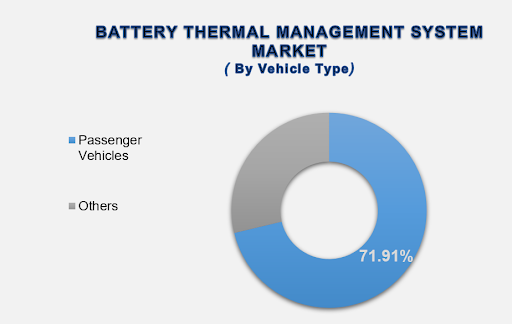
Passenger EVs increasingly feature larger battery packs, high-speed charging, thermal preconditioning, and heat-pump-based climate systems. SUVs and premium electric vehicles can require particularly sophisticated thermal architectures because of their larger battery capacities and higher power requirements.
The Commercial Vehicles segment is expected to grow faster because buses, trucks and other commercial vehicles operate with larger battery packs and demanding duty cycles. Current industry research estimates commercial BTMS demand to grow at approximately 14.1% CAGR through 2035.
The Following Segments Are Part of an In-Depth Analysis of the Global Battery Thermal Management System Market:
Battery Thermal Management System Market Share Analysis By Region
Asia Pacific is projected to hold the largest share of the global battery thermal management system market, supported by large-scale EV production, substantial battery manufacturing capacity, growing electric-vehicle sales and a strong automotive component supply chain.
A current 2025 industry assessment places Asia Pacific at approximately 45.93% of the global automotive BTMS market, making it the largest regional market. The region's market was approximately USD 1.76 billion in 2025 in that assessment.
China is the dominant contributor within Asia Pacific because of its large electric-vehicle market, substantial battery manufacturing capacity and growing use of high-performance thermal systems.
The country's continued deployment of battery-electric passenger vehicles, buses and commercial vehicles is expanding demand for liquid cooling, battery chillers, cooling plates, thermal sensors and thermal-management controls.
Japan remains an important market because of its established hybrid-vehicle industry and automotive electronics capabilities. Hybrid powertrains require thermal management for batteries despite generally using smaller packs than BEVs.
South Korea is a major center for battery technology and electric-vehicle development, supporting demand for advanced cooling plates, heat pumps, chillers and integrated thermal systems.
India represents a rapidly developing market supported by growing EV adoption, domestic vehicle production, battery manufacturing and government-led electrification initiatives. The country's wide range of vehicle applications, from two-wheelers and passenger cars to buses and commercial vehicles, creates demand for different levels of thermal-management technology.
North America represents a significant market supported by high technology adoption, growing electric-vehicle production, large passenger vehicles and increasing deployment of high-capacity batteries.
The United States represented approximately 21.90% of North American automotive BTMS revenue in 2025, according to a current market assessment. North America is also projected to be one of the faster-growing regions in the broader market due to EV technology adoption and investment in battery and thermal systems.
The region's substantial SUV and pickup market creates demand for larger battery packs, while the growing electric commercial-vehicle sector provides opportunities for high-capacity thermal systems.
Europe maintains a substantial market share due to strong automotive manufacturing, EV deployment, stringent emissions requirements and established thermal-management suppliers.
Europe accounted for approximately 23.93% of the global automotive BTMS market in 2025 in a current industry assessment. Germany is the leading European market due to its automotive manufacturing base and high adoption of technologically advanced vehicles.
The U.K., France, Italy and Spain also contribute through EV manufacturing, charging infrastructure development and increasing penetration of electrified vehicles.
Europe's cold-weather markets additionally require efficient battery preconditioning and heating. Thermal systems therefore need to deliver both cooling during high-power operation and heating during low-temperature charging and driving.
Latin America is expected to experience steady growth as electric mobility expands across passenger vehicles, buses and commercial fleets.
Brazil and Mexico are the principal regional contributors. Mexico's automotive manufacturing ecosystem creates opportunities for OEM thermal-system suppliers, while Brazil offers growing opportunities through electric buses, commercial fleets and emerging passenger-EV applications.
Middle East & Africa represents an emerging market. Hot climates create a particularly strong requirement for battery cooling because high ambient temperatures can increase battery thermal loads and reduce charging performance.
The UAE and Saudi Arabia are investing in electrified mobility and transportation modernization, creating opportunities for high-performance battery cooling. South Africa represents another important market because of its automotive manufacturing and commercial-vehicle sectors.
The regional market outlook is therefore being shaped by the combination of EV adoption, local battery production, climatic conditions, charging infrastructure and automotive manufacturing capacity.
Battery Thermal Management System Market Competition Landscape Analysis
The battery thermal management system market is competitive and includes automotive Tier-1 suppliers, thermal-management specialists, electronics companies, battery-system suppliers and component manufacturers.
Competition is increasingly focused on thermal efficiency, compact packaging, fast-charging capability, cell-temperature uniformity, thermal-runaway protection, system integration, energy efficiency and OEM production programs.
Current industry analysis identifies Robert Bosch, Continental, Valeo, Dana, Infineon, MAHLE and Hanon Systems among important market participants. The September 2026 assessment from Global Market Insights estimates Bosch at approximately 12.3% market share in 2025, followed by Continental at approximately 8.2% and Valeo at approximately 6.1%. The top five companies in its assessment collectively held approximately 31% of the market.
Robert Bosch has a broad thermal-management portfolio covering electric and hybrid vehicles and integrates thermal systems with broader vehicle electrification technologies.
Continental participates in battery thermal management through coolant lines, thermal sensors and related vehicle thermal components. Its technology portfolio emphasizes temperature control of lithium-ion batteries and power electronics and integrates cooling circuits with heat-pump and air-conditioning systems.
Valeo has developed a broad thermal-management portfolio covering liquid cooling, refrigerant cooling, chillers, battery coolers and immersive cooling. At Auto China 2026, the company highlighted immersive battery cooling as an enabler of 5C ultra-fast charging and continued to demonstrate integrated thermal-management systems for electrified vehicles.
MAHLE is strengthening its position through cooling plates, thermal-management modules and battery systems. In July 2026, its Montblanc plant in Spain began series production of battery cooling plates for electric vehicles, with planned production peaks of approximately 15,000 units per week.
Dana competes across thermal systems, battery cooling, pumps, heat exchangers, and electrified powertrain technologies.
Hanon Systems focuses heavily on thermal-management systems for electrified vehicles, including battery cooling, heat pumps, compressors and integrated thermal architectures.
BorgWarner competes through battery-management, thermal-management and electrification technologies. Its battery-management system was selected for an expanded global OEM production program covering additional BEV and PHEV passenger cars and light commercial vehicles beginning in 2029.
Webasto maintains a portfolio covering battery thermal management, high-voltage heating, chillers and integrated vehicle thermal systems. Its eBTM platform supports water-cooled batteries in buses, trucks, construction machinery and light commercial vehicles, illustrating the company's focus on both passenger and commercial electrification.
Competition is increasingly moving toward integrated thermal modules rather than standalone coolers. Suppliers are combining battery cooling, heating, heat pumps, pumps, valves, refrigerant circuits and thermal controls into consolidated architectures.
Fast charging and higher-voltage systems are also encouraging suppliers to develop increasingly powerful cooling solutions. At the same time, lightweighting and cost reduction remain important because thermal systems consume packaging space and can affect vehicle efficiency.
The competitive landscape is therefore evolving around complete thermal-management platforms, advanced cooling materials, intelligent controls and OEM-specific system integration.
Global Battery Thermal Management System Market Recent Developments News
In July 2026 – MAHLE started series production of battery cooling plates at its Montblanc plant in Tarragona, Spain. The company stated that the cooling plates maintain battery temperatures below 40°C and provide uniform heat distribution across cells, supporting fast charging, battery life and EV performance.
In June 2026 – Valeo and Calyos signed a memorandum of understanding to develop and industrialize passive two-phase cooling solutions for high-performance chips used in mobility and other applications. The development complements Valeo's broader thermal-management portfolio for electrification and addresses increasing thermal loads associated with software-defined vehicles and high-performance electronics.
In April 2026 – Valeo presented its electrification portfolio at Auto China 2026, including an EV thermal-management architecture and immersive battery cooling designed to support high-power charging. The company stated that its immersive cooling technology can enable 5C ultra-fast charging and 20–80% charging in approximately 12 minutes in relevant applications.
The Global Battery Thermal Management System Market is Dominated by a Few Large Companies, Such As
Robert Bosch GmbH
Continental AG
Valeo S.A.
Dana Incorporated
Infineon Technologies AG
MAHLE GmbH
Hanon Systems
BorgWarner Inc.
DENSO Corporation
LG Electronics Inc.
Modine Manufacturing Company
Webasto SE
VOSS Automotive GmbH
Gentherm Incorporated
Marelli Holdings Co., Ltd.
Schaeffler AG
ZF Friedrichshafen AG
Mitsubishi Heavy Industries Thermal Systems, Ltd.
Sanhua Holding Group
Vitesco Technologies / Schaeffler
Grayson Thermal Systems
Modine Manufacturing Company
Tesla, Inc.
Hyundai Mobis
Niterra Co., Ltd.
Others
Frequently Asked Questions
Ekta Chaurasia (Team Lead)
Ekta Chaurasia is a highly experienced Team Lead at M2Square Consultancy with over 7 years of expertise in market research, strategic consulting, competitive benchmarking, and business intelligence solutions. She specializes in ICT, semiconductors & electronics, automotive & transportation, and industrial machinery markets.
She leads end-to-end global research projects focused on market trends, industry analysis, growth forecasting, customer insights, and strategic decision-making. Known for her analytical leadership and industry expertise, Ekta helps businesses uncover growth opportunities, evaluate competitive landscapes, and stay ahead in rapidly evolving markets through accurate and insight-driven research.
Global Battery Thermal Management System Market Introduction and Market Overview
Objectives of the Study
Global Battery Thermal Management System Market Scope and Market Estimation
Global Battery Thermal Management System Market Size (US$ Million), Market CAGR (%), Market Forecast (2026 - 2034)
Global Battery Thermal Management System Market Revenue Share (%) and Growth Rate (Y-o-Y) Analysis (2021 - 2034)
Market Segmentation
By Cooling Method of Global Battery Thermal Management System Market
By Component of Global Battery Thermal Management System Market
By Battery Type of Global Battery Thermal Management System Market
By Propulsion Type of Global Battery Thermal Management System Market
By Vehicle Type of Global Battery Thermal Management System Market
Region of Global Battery Thermal Management System Market
Competition Coverage List of Market Participants
Market Definition: Battery Thermal Management System Market
Executive Summary
Demand Side Trends
Key Market Trends
Market Demand (US$ Million) Analysis 2021 – 2025 and Forecast, 2026 – 2034
Demand and Opportunity Assessment
Key Developments
Overview of Regulatory Landscape, Compliance Framework, and Industry Standards
Market Entry Strategies
Market Dynamics
Drivers
Limitations
Opportunities
Impact Analysis of Drivers and Restraints
Porter's Five Forces Analysis
PEST Analysis
Global Battery Thermal Management System Market Estimates & Historical Trend Analysis (2021 – 2025)
Global Battery Thermal Management System Market Estimates & Forecast Trend Analysis, by Cooling Method
Global Battery Thermal Management System Market Revenue (US$ Million) Estimates and Forecasts, by Cooling Method, 2021 - 2034
Active System
Passive System
Hybrid System
Global Battery Thermal Management System Market Estimates & Forecast Trend Analysis, by Component
Global Battery Thermal Management System Market Revenue (US$ Million) Estimates and Forecasts, by Component, 2021 - 2034
Battery Coolers
Thermal Sensors
Thermal Interface Materials
Pumps
Valves
Coolant Heaters
Chillers
Heat Exchangers
Others
Global Battery Thermal Management System Market Estimates & Forecast Trend Analysis, by Battery Type
Global Battery Thermal Management System Market Revenue (US$ Million) Estimates and Forecasts, by Battery Type, 2021 - 2034
Lithium-Ion Battery
LFP
NMC
NCA
Others
Nickel-Metal Hydride Battery
Lead-Acid Battery
Solid-State Battery
Global Battery Thermal Management System Market Estimates & Forecast Trend Analysis, by Propulsion Type
Global Battery Thermal Management System Market Revenue (US$ Million) Estimates and Forecasts, by Propulsion Type, 2021 - 2034
Battery Electric Vehicles
Plug-In Hybrid Electric Vehicles
Hybrid Electric Vehicles
Global Battery Thermal Management System Market Estimates & Forecast Trend Analysis, by Vehicle Type
Global Battery Thermal Management System Market Revenue (US$ Million) Estimates and Forecasts, by Vehicle Type, 2021 - 2034
Passenger Vehicles
Commercial Vehicles
Light Commercial Vehicles
Buses
Medium & Heavy Commercial Vehicles
Off-Highway Vehicles
Global Battery Thermal Management System Market Estimates & Forecast Trend Analysis, by Region
Global Battery Thermal Management System Market Revenue (US$ Million) Estimates and Forecasts, by Region, 2021 - 2034
North America
Europe
Asia Pacific
Middle East & Africa
Latin America
North America Battery Thermal Management System Market: Estimates & Forecast Trend Analysis
North America Battery Thermal Management System Market Assessments & Key Findings
North America Battery Thermal Management System Market Introduction
North America Battery Thermal Management System Market Size Estimates and Forecast (US$ Million) (2021 - 2034)
By Cooling Method
By Component
By Battery Type
By Propulsion Type
By Vehicle Type
By Country
The U.S.
Canada
Europe Battery Thermal Management System Market: Estimates & Forecast Trend Analysis
Europe Battery Thermal Management System Market Assessments & Key Findings
Europe Battery Thermal Management System Market Introduction
Europe Battery Thermal Management System Market Size Estimates and Forecast (US$ Million) (2021 - 2034)
By Cooling Method
By Component
By Battery Type
By Propulsion Type
By Vehicle Type
By Country
Germany
Italy
The U.K.
France
Spain
Switzerland
Rest of Europe
Asia Pacific Battery Thermal Management System Market: Estimates & Forecast Trend Analysis
Asia Pacific Battery Thermal Management System Market Assessments & Key Findings
Asia Pacific Battery Thermal Management System Market Introduction
Asia Pacific Battery Thermal Management System Market Size Estimates and Forecast (US$ Million) (2021 - 2034)
By Cooling Method
By Component
By Battery Type
By Propulsion Type
By Vehicle Type
By Country
China
Japan
India
Australia
South Korea
Rest of Asia Pacific
Middle East & Africa Battery Thermal Management System Market: Estimates & Forecast Trend Analysis
Middle East & Africa Battery Thermal Management System Market Assessments & Key Findings
Middle East & Africa Battery Thermal Management System Market Introduction
Middle East & Africa Battery Thermal Management System Market Size Estimates and Forecast (US$ Million) (2021 - 2034)
By Cooling Method
By Component
By Battery Type
By Propulsion Type
By Vehicle Type
By Country
UAE
Saudi Arabia
South Africa
Rest of Middle East & Africa
Latin America Battery Thermal Management System Market: Estimates & Forecast Trend Analysis
Latin America Battery Thermal Management System Market Assessments & Key Findings
Latin America Battery Thermal Management System Market Introduction
Latin America Battery Thermal Management System Market Size Estimates and Forecast (US$ Million) (2021 - 2034)
By Cooling Method
By Component
By Battery Type
By Propulsion Type
By Vehicle Type
By Country
Brazil
Mexico
Argentina
Rest of Latin America
Competition Landscape
Global Battery Thermal Management System Market Product Mapping
Global Battery Thermal Management System Market Concentration Analysis, by Leading Players
Global Battery Thermal Management System Market Concentration Analysis, by Innovators
Global Battery Thermal Management System Market Concentration Analysis, by Emerging Players
Global Battery Thermal Management System Market Concentration Analysis, by New Entrants
Global Battery Thermal Management System Market Tier Structure Analysis
Global Battery Thermal Management System Market Concentration & Company Market Shares (%) Analysis, 2026
Company Profiles
Robert Bosch GmbH
Company Overview & Key Stats
Financial Performance & KPIs
Product Portfolio
SWOT Analysis
Business Strategy & Recent Developments
*Similar details would be provided for all the players mentioned below
Continental AG
Valeo S.A.
Dana Incorporated
Infineon Technologies AG
MAHLE GmbH
Hanon Systems
BorgWarner Inc.
DENSO Corporation
LG Electronics Inc.
Modine Manufacturing Company
Webasto SE
VOSS Automotive GmbH
Gentherm Incorporated
Marelli Holdings Co., Ltd.
Schaeffler AG
ZF Friedrichshafen AG
Mitsubishi Heavy Industries Thermal Systems, Ltd.
Sanhua Holding Group
Vitesco Technologies / Schaeffler
Grayson Thermal Systems
Tesla, Inc.
Hyundai Mobis
Niterra Co., Ltd.
Others
Research Findings & Conclusion
Assumptions & Acronyms Used
Research Methodology
External Databases
Internal Proprietary Database
Primary Research
Secondary Research
Assumptions
Limitations
Report FAQ
Our Research Methodology
"Insight without rigor is just noise."
We follow a comprehensive, multi-phase research framework designed to deliver accurate, strategic, and decision-ready intelligence. Our process integrates primary and secondary research , both quantitative and qualitative , along with dual modeling techniques ( top-down and bottom-up) and a final layer of validation through our proprietary in-house repository.
PRIMARY RESEARCH
Primary research captures real-time, firsthand insights from the market to understand behaviors, motivations, and emerging trends.
1. Quantitative Primary Research
Objective: Generate statistically significant data directly from market participants.
Approaches:- Structured surveys with customers, distributors, and field agents
- Mobile-based data collection for point-of-sale audits and usage behavior
- Phone-based interviews (CATI) for market sizing and product feedback
- Online polling around industry events and digital campaigns
- Purchase frequency by customer type
- Channel performance across geographies
- Feature demand by application or demographic
2. Qualitative Primary Research
Objective: Explore decision-making drivers, pain points, and market readiness.
Approaches:- In-depth interviews (IDIs) with executives, product managers, and key decision-makers
- Focus groups among end users and early adopters
- Site visits and observational research for consumer products
- Informal field-level discussions for regional and cultural nuances
SECONDARY RESEARCH
This phase helps establish a macro-to-micro understanding of market trends, size, regulation, and competitive dynamics, sourced from credible and public domain information.
1. Quantitative Secondary Research
Objective: Model market value and segment-level forecasts based on published data.
Sources include:- Financial reports and investor summaries
- Government trade data, customs records, and regulatory statistics
- Industry association publications and economic databases
- Channel performance and pricing data from marketplace listings
- Revenue splits, pricing trends, and CAGR estimates
- Supply-side capacity and volume tracking
- Investment analysis and funding benchmarks
2. Qualitative Secondary Research
Objective: Capture strategic direction, innovation signals, and behavioral trends.
Sources include:- Company announcements, roadmaps, and product pipelines
- Publicly available whitepapers, conference abstracts, and academic research
- Regulatory body publications and policy briefs
- Social and media sentiment scanning for early-stage shifts
- Strategic shifts in market positioning
- Unmet needs and white spaces
- Regulatory triggers and compliance impact
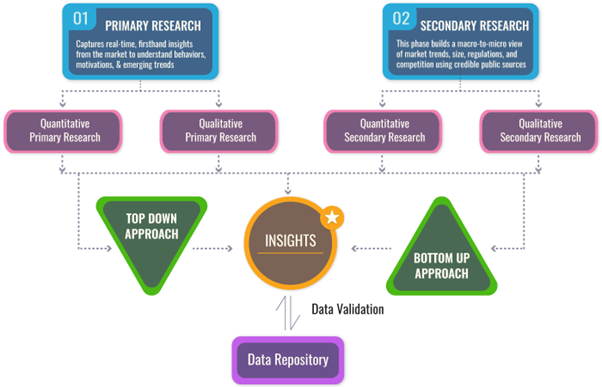
DUAL MODELING: TOP-DOWN + BOTTOM-UP
To ensure robust market estimation, we apply two complementary sizing approaches:
Top-Down Modeling:- Start with broader industry value (e.g., global or regional TAM)
- Apply filters by segment, geography, end-user, or use case
- Adjust with primary insights and validation benchmarks
- Ideal for investor-grade market scans and opportunity mapping
- Aggregate from the ground up using sales volumes, pricing, and unit economics
- Use internal modeling templates aligned with stakeholder data
- Incorporate distributor-level or region-specific inputs
- Most accurate for emerging segments and granular sub-markets
DATA VALIDATION: IN-HOUSE REPOSITORY
We close the loop with proprietary data intelligence built from ongoing projects, industry monitoring, and historical benchmarking. This repository includes:
- Multi-sector market and pricing models
- Key trendlines from past interviews and forecasts
- Benchmarked adoption rates, churn patterns, and ROI indicators
- Industry-specific deviation flags and cross-check logic
- Catches inconsistencies early
- Aligns projections across studies
- Enables consistent, high-trust deliverables