

BBQ Seasoning Market Size and Forecast (2025 – 2033), Global and Regional Growth, Trend, Share and Industry Analysis Report Coverage: By Product (Barbecue Sauces, Barbecue Rubs); By Distribution Channel (Foodservice, Retail, Hypermarkets & Supermarkets, Convenience Stores, Online, Others); and Geography.
2025-12-16
Business & Financial Services
Ekta Chaurasia (Team Lead)
Description
BBQ Seasoning Market Overview
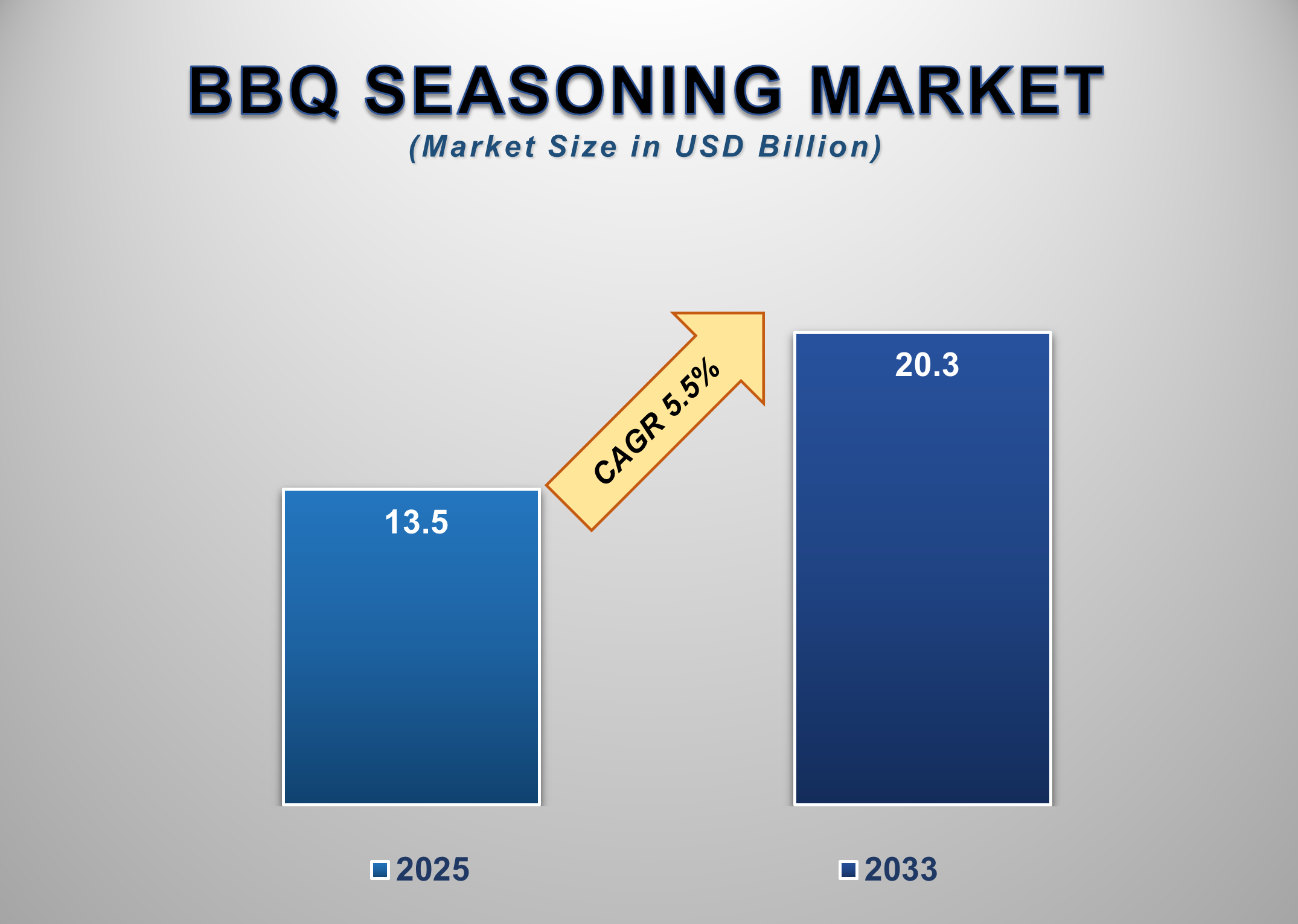
The Global BBQ Seasoning Market Size is projected to Grow from USD 13.5 Billion in 2025 to USD 20.3 Billion by 2033, expanding at a CAGR of 5.5% during the forecast period. The market’s growth is primarily attributed to the increasing popularity of grilled and smoked foods, rising consumer preference for international flavors, and the expanding global foodservice industry. Barbecue seasonings, including rubs, sauces, and spice blends, are now integral to both household and commercial cooking. Consumers’ growing interest in home-style cooking and outdoor grilling, particularly post-pandemic, has accelerated product demand across retail and online channels.
Innovation in flavor
combinations, such as smoky, spicy, and sweet blends, has diversified consumer
appeal. Clean-label and organic barbecue seasonings are witnessing increasing
traction as health-conscious consumers seek natural alternatives without artificial
additives. Moreover, the growing influence of Western cuisine and fast-food
culture across emerging economies further strengthens global demand. Leading
manufacturers are investing in premium and regional barbecue flavors like
Korean, Texas-style, and Mediterranean rubs to cater to evolving palates. With
continued product innovation, rising disposable incomes, and expanding
e-commerce availability, the BBQ seasoning market is positioned for robust and
sustained growth worldwide.
BBQ Seasoning Market Drivers and Opportunities
Rising Popularity of Grilling Culture and Outdoor Cooking
Is Driving Market Growth
The
increasing global popularity of grilling and outdoor cooking is one of the
major factors fueling the BBQ seasoning market. Consumers across North America,
Europe, and the Asia Pacific are showing heightened interest in barbecues,
tailgating, and backyard parties. This lifestyle trend has led to a surge in
demand for barbecue seasonings, rubs, and sauces to enhance flavor and
authenticity in grilled dishes. Barbecue culture is particularly prominent in
the United States, where more than 70% of households reportedly own a grill.
Additionally, social media platforms such as YouTube and Instagram have
popularized home-grilling content and cooking shows, influencing consumer
behavior toward experimenting with diverse BBQ seasonings. The expansion of
restaurant chains specializing in grilled cuisine, coupled with fast-casual
dining concepts, has also contributed to higher seasoning consumption in the
foodservice sector. The increasing number of food festivals and culinary events
celebrating barbecue traditions across the world continues to promote flavor
innovation and cross-cultural fusion. Together, these factors create a strong
foundation for long-term market expansion.
Shift
Toward Natural, Organic, and Clean-Label Ingredients Boosts Market Expansion
Consumers
are increasingly demanding natural and clean-label BBQ seasonings free from
synthetic additives, preservatives, and artificial colorings. This trend is
transforming the landscape of flavor formulations as leading brands shift
toward organic spices, sea salt, and plant-based ingredients. Growing health
consciousness, particularly in developed markets such as the U.S., Canada, and
parts of Europe, is driving manufacturers to reformulate their barbecue blends
with minimal processing and sustainable sourcing. The organic food industry’s
rise has further propelled the adoption of all-natural barbecue rubs and sauces
that maintain authentic flavor profiles without compromising health standards.
Clean-label claims such as “non-GMO,” “gluten-free,” and “no added sugar” are
increasingly appearing on packaging to attract discerning consumers. Small and
medium-sized enterprises (SMEs) are also capitalizing on this movement by
introducing locally sourced, artisanal BBQ products. Moreover, environmentally
responsible packaging and carbon-neutral supply chains are becoming selling
points for premium brands. As this shift continues, clean-label innovation is
set to be a major driver of market differentiation and growth.
Opportunity for the BBQ
Seasoning Market
Expanding Global Foodservice Industry and E-commerce
Platforms Create New Growth Horizons
The
rapid expansion of the global foodservice sector, combined with the
accelerating adoption of digital and e-commerce channels, offers a substantial
growth opportunity for the BBQ seasoning market. As restaurants, catering
services, and quick-service outlets expand across both developed and emerging
regions, demand for bulk BBQ rubs and sauces continues to rise. Foodservice
businesses are increasingly sourcing customizable and pre-mixed seasonings to
maintain flavor consistency while optimizing kitchen operations.
Simultaneously, online retail has become a major sales channel for both
established brands and small-scale producers. E-commerce platforms such as
Amazon, Walmart, and specialty food marketplaces allow direct-to-consumer
sales, making niche and regional BBQ flavors accessible to global audiences.
Subscription-based meal kits and home-delivery barbecue packages further
contribute to product visibility. Additionally, digital marketing and
influencer-driven promotions are boosting brand recognition across younger
demographics. With the combination of expanding global foodservice
infrastructure and the convenience of online shopping, the BBQ seasoning market
is poised to achieve significant new growth over the next decade.
BBQ Seasoning Market
Scope
|
Report Attributes |
Description |
|
Market Size in 2025 |
USD 13.5 Billion |
|
Market Forecast in 2033 |
USD 20.3 Billion |
|
CAGR % 2025-2033 |
5.5% |
|
Base Year |
2024 |
|
Historic Data |
2020-2024 |
|
Forecast Period |
2025-2033 |
|
Report USP |
Production, Consumption,
company share, company heatmap, company production Capacity, growth factors,
and more |
|
Segments Covered |
●
By Product ●
By Distribution
Channel |
|
Regional Scope |
●
North America ●
Europe ●
APAC ●
Latin America ●
Middle East and
Africa |
|
Country Scope |
1)
U.S. 2)
Canada 3)
Germany 4)
UK 5)
France 6)
Spain 7)
Italy 8)
Switzerland 9)
China 10)
Japan 11)
India 12)
Australia 13)
South Korea 14)
Brazil 15)
Mexico 16)
Argentina 17)
South Africa 18)
Saudi Arabia 19)
UAE |
BBQ Seasoning Market
Report Segmentation Analysis
The global BBQ Seasoning market
industry analysis is segmented by product, by distribution channel, and by
region.
Barbecue Rubs Segment Accounted for the Largest Market
Share in the Global BBQ Seasoning Market
By
product, the market is segmented into Barbecue Sauces and Barbecue Rubs.
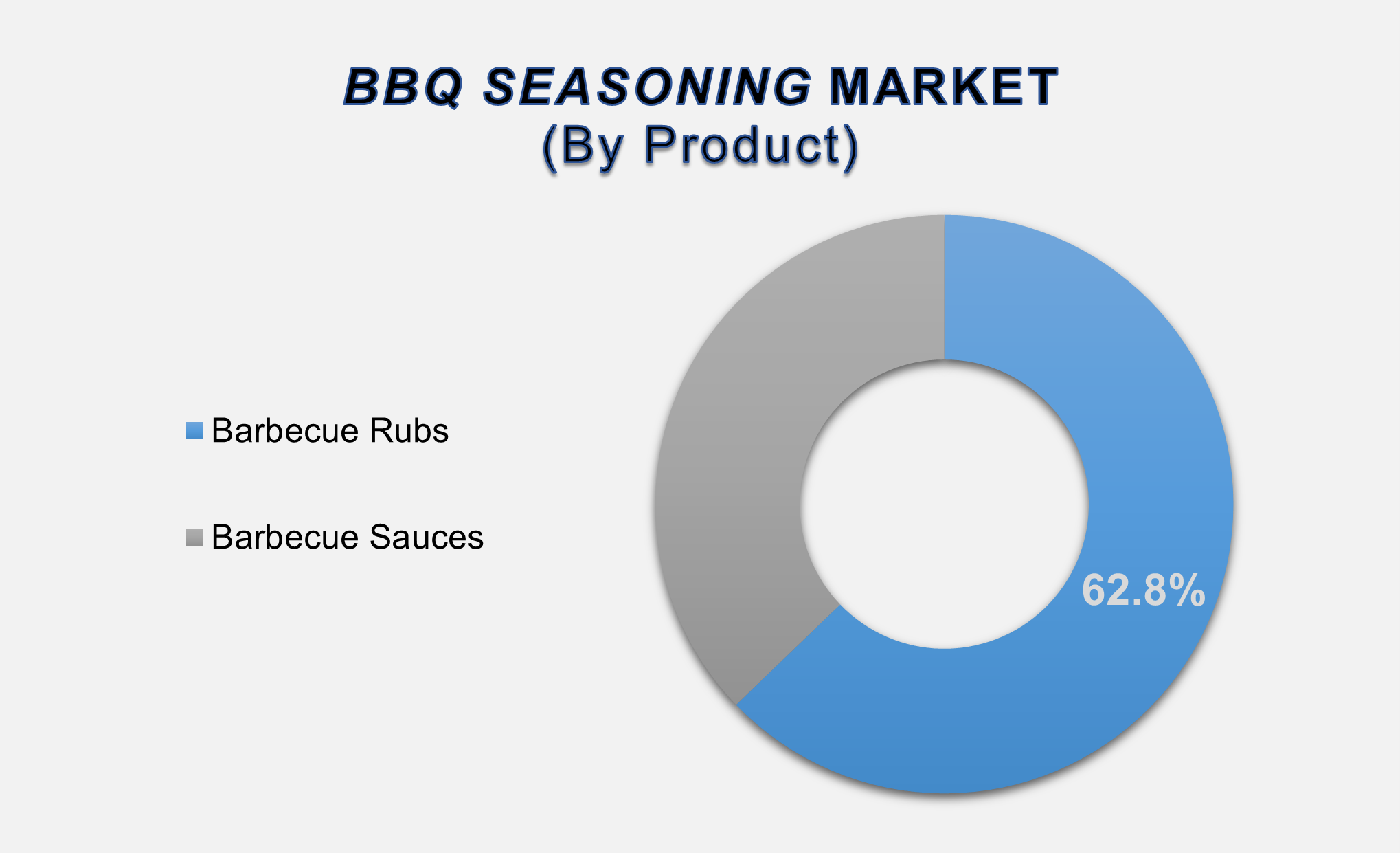
In 2025, the Barbecue Rubs segment dominated the market, accounting for 62.8%
of global revenue. Barbecue rubs—dry mixtures of spices, herbs, and salt—are
preferred by both home cooks and professional chefs for their ability to impart
rich flavors to meat before grilling. Their rising popularity stems from their
versatility in seasoning poultry, pork, beef, and vegetables. Unlike sauces,
rubs enhance the crust texture and allow for longer marination, making them a
key component of authentic barbecue preparation. The segment benefits from
growing consumer experimentation with dry spice blends and regional flavor
variations such as Kansas City-style, Memphis-style, and Korean BBQ. Manufacturers
are also introducing rubs with low-sodium, gluten-free, and organic
formulations to meet diverse dietary preferences. This combination of culinary
appeal and product innovation continues to solidify the dominance of barbecue
rubs in the global market.
Foodservice Segment Accounted for the Largest Market Share by Distribution
Channel in the Global BBQ Seasoning Market
By
distribution channel, the market is divided into Foodservice, Retail,
Hypermarkets & Supermarkets, Convenience Stores, Online, and Others. The
Foodservice segment held the largest share in 2025, driven by the rising
consumption of grilled foods in restaurants, hotels, and catering services. The
global proliferation of fast-casual dining and quick-service barbecue outlets
has substantially increased the use of BBQ seasonings in professional kitchens.
Foodservice providers prefer ready-to-use rubs and sauces to streamline
operations and maintain consistency across high-volume production. Moreover,
partnerships between seasoning manufacturers and restaurant chains have
resulted in custom flavor formulations tailored to specific cuisines. The
rising trend of outdoor dining and commercial barbecues in the hospitality and tourism sectors is also augmenting this
demand. As dining-out culture continues to thrive globally, especially in
emerging economies, the foodservice segment is expected to maintain its dominance
throughout the forecast period.
The following segments are
part of an in-depth analysis of the global BBQ Seasoning Market:
|
Market
Segments |
|
|
By Product |
●
Barbecue Sauces ●
Barbecue Rubs |
|
By
Distribution Channel |
●
Foodservice ●
Retail ●
Hypermarkets & Supermarkets o
Convenience Stores o
Online o
Others |
BBQ Seasoning Market Share Analysis by Region
The North America region
is projected to hold the largest share of the global BBQ Seasoning market over
the forecast period.
North America accounted for the
largest market share of 42.1% in 2025, owing to its long-standing barbecue
culture and widespread adoption of grilling as a leisure activity. The United
States dominates the regional market, with a high concentration of key
manufacturers such as McCormick & Company, Weber Seasonings, and Sweet Baby
Ray’s. The popularity of tailgate parties, backyard cookouts, and weekend
barbecues has made BBQ seasoning an essential part of American households.
Additionally, increasing consumer preference for gourmet and artisanal flavors,
along with strong retail penetration and advanced distribution networks,
reinforces North America’s market leadership.
The
Asia Pacific region is expected to record the fastest CAGR during the forecast
period, driven by evolving culinary trends and the growing adoption of
Western-style dining. Countries such as China, Japan, South Korea, and India
are witnessing rising consumption of grilled meats and sauces, leading to
greater demand for BBQ seasonings. Expanding restaurant chains, increasing
disposable income, and the growing popularity of food delivery platforms are
supporting regional market growth. Local manufacturers are also launching
affordable, region-specific barbecue blends to cater to domestic tastes, which
is further strengthening the region’s position as a key growth hub.
BBQ Seasoning Market Competition Landscape
Analysis
The global BBQ
seasoning market is moderately consolidated, with established players focusing
on flavor innovation, clean-label formulations, and expansion into emerging
markets. Key companies include McCormick & Company, Weber Seasonings,
Stubb’s Legendary Bar-B-Q, Rufus Teague, Kinder’s, Sweet Baby Ray’s, Tony
Chachere’s, and Famous Dave’s.
Global BBQ Seasoning Market Recent Developments
News:
- In August 2024, Hot Pockets
(Nestlé) launched a limited-edition BBQ sauce to accompany the return of
its BBQ Recipe Beef variety. The tangy, smoky sauce was offered through an
online giveaway, enhancing consumer engagement by extending the brand
experience through a complementary condiment.
- In August 2024, Wingstop
introduced Sweet BBQ Blaze, a limited-time flavor combining sweet and
spicy notes through a mix of dry rub and wet sauce. Inspired by Kansas
City and Nashville BBQ styles, the offering aims to strengthen Wingstop’s
position as a destination for bold, innovative chicken flavors.
The Global BBQ Seasoning Market is dominated by a
few large companies, such as
●
McCormick &
Company
●
Weber Seasonings
●
Stubb's Legendary
Bar-B-Q
●
Rufus Teague
●
Kinder's
●
Sweet Baby Ray's
●
Tony Chachere's
●
Famous Dave's
●
Plowboys BBQ
●
Oakridge BBQ
●
Kosmo's BBQ
●
Hardcore Carnivore
●
Meat Church
●
Traeger Grills
●
Spiceology
●
Bad Byron's
●
Pork Barrel BBQ
●
Sucklebusters
●
Lillie's Q
●
The Spice Hunter
● Other Prominent Players
Frequently Asked Questions
Ekta Chaurasia (Team Lead)
Ekta Chaurasia is a highly experienced Team Lead at M2Square Consultancy with over 7 years of expertise in market research, strategic consulting, competitive benchmarking, and business intelligence solutions. She specializes in ICT, semiconductors & electronics, automotive & transportation, and industrial machinery markets.
She leads end-to-end global research projects focused on market trends, industry analysis, growth forecasting, customer insights, and strategic decision-making. Known for her analytical leadership and industry expertise, Ekta helps businesses uncover growth opportunities, evaluate competitive landscapes, and stay ahead in rapidly evolving markets through accurate and insight-driven research.
1. Global BBQ Seasoning
Market Introduction and Market Overview
1.1.
Objectives
of the Study
1.2.
Global
BBQ Seasoning Market Scope and Market Estimation
1.2.1.Global BBQ Seasoning Overall
Market Size (US$ Bn), Market CAGR (%), Market forecast (2025 - 2033)
1.2.2.Global BBQ Seasoning
Market Revenue Share (%) and Growth Rate (Y-o-Y) from 2020 - 2033
1.3.
Market
Segmentation
1.3.1.Product of Global BBQ
Seasoning Market
1.3.2.Distribution Channel of
Global BBQ Seasoning Market
1.3.3.Region of Global BBQ
Seasoning Market
2. Executive
Summary
2.1.
Demand
Side Trends
2.2.
Key
Market Trends
2.3.
Market
Demand (US$ Bn) Analysis 2020 – 2024 and Forecast, 2025 – 2033
2.4.
Demand
and Opportunity Assessment
2.5.
Demand
Supply Scenario
2.6.
Market
Dynamics
2.6.1.Drivers
2.6.2.Limitations
2.6.3.Opportunities
2.6.4.Impact Analysis of Drivers
and Restraints
2.7.
Emerging
Trends for BBQ Seasoning Market
2.8.
Porter’s
Five Forces Analysis
2.9.
PEST
Analysis
2.10.
Key
Regulation
3. Global
BBQ Seasoning Market Estimates
& Historical Trend Analysis (2020 - 2024)
4. Global
BBQ Seasoning Market Estimates
& Forecast Trend Analysis, by Product
4.1.
Global
BBQ Seasoning Market Revenue (US$ Bn) Estimates and Forecasts, by Product, 2020
- 2033
4.1.1.Barbecue Sauces
4.1.2.Barbecue Rubs
5. Global
BBQ Seasoning Market Estimates
& Forecast Trend Analysis, by Distribution Channel
5.1.
Global
BBQ Seasoning Market Revenue (US$ Bn) Estimates and Forecasts, by Distribution
Channel, 2020 - 2033
5.1.1.Foodservice
5.1.2.Retail
5.1.3.Hypermarkets &
Supermarket
5.1.3.1.
Convenience
Stores
5.1.3.2.
Online
5.1.3.3.
Others
6. Global
BBQ Seasoning Market Estimates
& Forecast Trend Analysis, by Region
6.1.
Global
BBQ Seasoning Market Revenue (US$ Bn) Estimates and Forecasts, by Region, 2020
- 2033
6.1.1.North America
6.1.2.Europe
6.1.3.Asia Pacific
6.1.4.Middle East & Africa
6.1.5.Latin America
7. North America BBQ
Seasoning Market: Estimates &
Forecast Trend Analysis
7.1.
North
America BBQ Seasoning Market Assessments & Key Findings
7.1.1.North America BBQ
Seasoning Market Introduction
7.1.2.North America BBQ
Seasoning Market Size Estimates and Forecast (US$ Billion) (2020 - 2033)
7.1.2.1. By Product
7.1.2.2. By Distribution
Channel
7.1.2.3.
By
Country
7.1.2.3.1. The U.S.
7.1.2.3.2. Canada
8. Europe BBQ
Seasoning Market: Estimates &
Forecast Trend Analysis
8.1.
Europe
BBQ Seasoning Market Assessments & Key Findings
8.1.1.Europe BBQ Seasoning
Market Introduction
8.1.2.Europe BBQ Seasoning
Market Size Estimates and Forecast (US$ Billion) (2020 - 2033)
8.1.2.1. By Product
8.1.2.2. By Distribution
Channel
8.1.2.3.
By
Country
8.1.2.3.1.
Germany
8.1.2.3.2.
Italy
8.1.2.3.3.
U.K.
8.1.2.3.4.
France
8.1.2.3.5.
Spain
8.1.2.3.6.
Switzerland
8.1.2.3.7. Rest
of Europe
9. Asia Pacific BBQ
Seasoning Market: Estimates &
Forecast Trend Analysis
9.1.
Asia
Pacific Market Assessments & Key Findings
9.1.1.Asia Pacific BBQ Seasoning
Market Introduction
9.1.2.Asia Pacific BBQ Seasoning
Market Size Estimates and Forecast (US$ Billion) (2020 - 2033)
9.1.2.1. By Product
9.1.2.2. By Distribution
Channel
9.1.2.3.
By
Country
9.1.2.3.1.
China
9.1.2.3.2.
Japan
9.1.2.3.3.
India
9.1.2.3.4.
Australia
9.1.2.3.5.
South
Korea
9.1.2.3.6. Rest of Asia Pacific
10. Middle East & Africa BBQ
Seasoning Market: Estimates &
Forecast Trend Analysis
10.1.
Middle
East & Africa Market Assessments & Key Findings
10.1.1.
Middle East & Africa BBQ Seasoning Market Introduction
10.1.2.
Middle East & Africa BBQ Seasoning Market Size Estimates
and Forecast (US$ Billion) (2020 - 2033)
10.1.2.1. By Product
10.1.2.2. By Distribution
Channel
10.1.2.3.
By
Country
10.1.2.3.1. UAE
10.1.2.3.2. Saudi
Arabia
10.1.2.3.3. South
Africa
10.1.2.3.4. Rest
of MEA
11. Latin America
BBQ Seasoning Market: Estimates &
Forecast Trend Analysis
11.1.
Latin
America Market Assessments & Key Findings
11.1.1.
Latin
America BBQ Seasoning Market Introduction
11.1.2.
Latin
America BBQ Seasoning Market Size Estimates and Forecast (US$ Billion) (2020 - 2033)
11.1.2.1. By Product
11.1.2.2. By Distribution
Channel
11.1.2.3.
By
Country
11.1.2.3.1. Brazil
11.1.2.3.2. Argentina
11.1.2.3.3. Mexico
11.1.2.3.4. Rest
of LATAM
12. Country Wise Market:
Introduction
13.
Competition
Landscape
13.1.
Global
BBQ Seasoning Market Product Mapping
13.2.
Global
BBQ Seasoning Market Concentration Analysis, by Leading Players / Innovators /
Emerging Players / New Entrants
13.3.
Global
BBQ Seasoning Market Tier Structure Analysis
13.4.
Global
BBQ Seasoning Market Concentration & Company Market Shares (%) Analysis,
2024
14.
Company
Profiles
14.1.
McCormick & Company
14.1.1.
Company
Overview & Key Stats
14.1.2.
Financial
Performance & KPIs
14.1.3.
Product
Portfolio
14.1.4.
SWOT
Analysis
14.1.5.
Business
Strategy & Recent Developments
* Similar details would be provided for all the players
mentioned below
14.2. Weber
Seasonings
14.3. Stubb's
Legendary Bar-B-Q
14.4. Rufus
Teague
14.5. Kinder's
14.6. Sweet
Baby Ray's
14.7. Tony
Chachere's
14.8. Famous
Dave's
14.9. Plowboys
BBQ
14.10. Oakridge
BBQ
14.11. Kosmo's
BBQ
14.12. Hardcore
Carnivore
14.13. Meat
Church
14.14. Traeger
Grills
14.15. Spiceology
14.16. Bad
Byron's
14.17. Pork
Barrel BBQ
14.18. Sucklebusters
14.19. Lillie's
Q
14.20. The
Spice Hunter
14.21. Others
15. Research
Methodology
15.1.
External
Transportations / Databases
15.2.
Internal
Proprietary Database
15.3.
Primary
Research
15.4.
Secondary
Research
15.5.
Assumptions
15.6.
Limitations
15.7.
Report
FAQs
16. Research
Findings & Conclusion
Our Research Methodology
"Insight without rigor is just noise."
We follow a comprehensive, multi-phase research framework designed to deliver accurate, strategic, and decision-ready intelligence. Our process integrates primary and secondary research , both quantitative and qualitative , along with dual modeling techniques ( top-down and bottom-up) and a final layer of validation through our proprietary in-house repository.
PRIMARY RESEARCH
Primary research captures real-time, firsthand insights from the market to understand behaviors, motivations, and emerging trends.
1. Quantitative Primary Research
Objective: Generate statistically significant data directly from market participants.
Approaches:- Structured surveys with customers, distributors, and field agents
- Mobile-based data collection for point-of-sale audits and usage behavior
- Phone-based interviews (CATI) for market sizing and product feedback
- Online polling around industry events and digital campaigns
- Purchase frequency by customer type
- Channel performance across geographies
- Feature demand by application or demographic
2. Qualitative Primary Research
Objective: Explore decision-making drivers, pain points, and market readiness.
Approaches:- In-depth interviews (IDIs) with executives, product managers, and key decision-makers
- Focus groups among end users and early adopters
- Site visits and observational research for consumer products
- Informal field-level discussions for regional and cultural nuances
SECONDARY RESEARCH
This phase helps establish a macro-to-micro understanding of market trends, size, regulation, and competitive dynamics, sourced from credible and public domain information.
1. Quantitative Secondary Research
Objective: Model market value and segment-level forecasts based on published data.
Sources include:- Financial reports and investor summaries
- Government trade data, customs records, and regulatory statistics
- Industry association publications and economic databases
- Channel performance and pricing data from marketplace listings
- Revenue splits, pricing trends, and CAGR estimates
- Supply-side capacity and volume tracking
- Investment analysis and funding benchmarks
2. Qualitative Secondary Research
Objective: Capture strategic direction, innovation signals, and behavioral trends.
Sources include:- Company announcements, roadmaps, and product pipelines
- Publicly available whitepapers, conference abstracts, and academic research
- Regulatory body publications and policy briefs
- Social and media sentiment scanning for early-stage shifts
- Strategic shifts in market positioning
- Unmet needs and white spaces
- Regulatory triggers and compliance impact
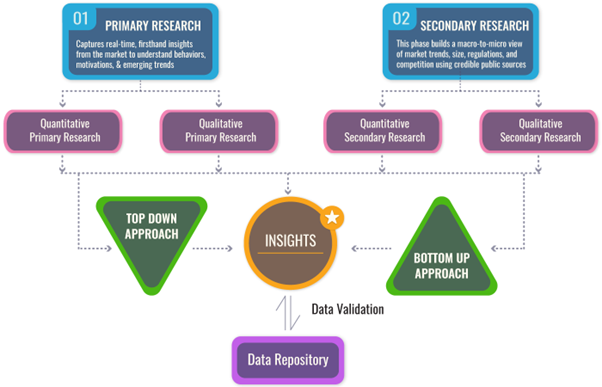
DUAL MODELING: TOP-DOWN + BOTTOM-UP
To ensure robust market estimation, we apply two complementary sizing approaches:
Top-Down Modeling:- Start with broader industry value (e.g., global or regional TAM)
- Apply filters by segment, geography, end-user, or use case
- Adjust with primary insights and validation benchmarks
- Ideal for investor-grade market scans and opportunity mapping
- Aggregate from the ground up using sales volumes, pricing, and unit economics
- Use internal modeling templates aligned with stakeholder data
- Incorporate distributor-level or region-specific inputs
- Most accurate for emerging segments and granular sub-markets
DATA VALIDATION: IN-HOUSE REPOSITORY
We close the loop with proprietary data intelligence built from ongoing projects, industry monitoring, and historical benchmarking. This repository includes:
- Multi-sector market and pricing models
- Key trendlines from past interviews and forecasts
- Benchmarked adoption rates, churn patterns, and ROI indicators
- Industry-specific deviation flags and cross-check logic
- Catches inconsistencies early
- Aligns projections across studies
- Enables consistent, high-trust deliverables