

Beauty Pillowcases Market Size and Forecast (2026–2034), Global and Regional Growth, Trends, Share and Industry Analysis Report Coverage; By Material Type, Product Type, Distribution Channel, Application, and Geography
2026-10-30
Consumer Products
Aishwarya Panbude (Research Analyst)
Description
Beauty Pillowcases Market Overview
The Beauty Pillowcases Market is gaining attention as consumers increasingly incorporate sleep-related products into their skincare, haircare, and personal wellness routines. Beauty pillowcases are designed with smooth fabric surfaces and material characteristics intended to reduce friction between the pillowcase, skin, and hair during sleep. Silk, satin, and bamboo-based fabrics are prominent materials in this category, offering different combinations of softness, breathability, maintenance requirements, and price positioning.
The global Beauty Pillowcases Market is valued at USD 1.09 billion in 2026 and is projected to reach USD 1.83 billion by 2034, registering a CAGR of 6.7% during 2026–2034, based on the supplied figures. Growth is supported by rising interest in beauty sleep, premium bedding products, hair-friction reduction, and the integration of personal-care practices into everyday lifestyles. Social media, beauty influencers, online reviews, and direct-to-consumer brands have also increased awareness of specialized pillowcases.
Silk pillowcases occupy a premium position because of their smooth texture and association with luxury bedding and haircare. Satin products offer a more accessible alternative, particularly when made from synthetic fibers, while bamboo-based options appeal to consumers interested in softness and alternative textile materials. However, product performance varies by fabric composition, manufacturing quality, and care practices. Market expansion also depends on disposable income, product pricing, consumer trust, and the ability of brands to communicate realistic product benefits.

Beauty Pillowcases Market Drivers and Opportunities
1. Growing Interest in Beauty Sleep Is Supporting Market Demand
Consumers are increasingly viewing sleep as part of their broader beauty and wellness routines. This has encouraged interest in products that offer comfort while addressing concerns related to hair tangling, friction, and skin contact during sleep. Beauty pillowcases are positioned within this trend because their surface texture and fabric characteristics can influence the sleeping experience.
Silk and satin pillowcases are particularly visible in beauty-focused retail categories, where consumers compare texture, fabric composition, durability, and care requirements. Growing awareness of specialized bedding through beauty creators, product reviews, and online communities is helping introduce these products to consumers who previously purchased conventional pillowcases.
2. Premium Bedding and E-Commerce Are Expanding Consumer Access
The growth of premium home textiles and online shopping is supporting the availability of beauty pillowcases across different price points. E-commerce platforms allow consumers to compare silk quality, satin composition, closure styles, product dimensions, and maintenance instructions before purchasing. This is especially useful for specialty products that may have limited shelf space in conventional retail stores.
Brands are also using direct-to-consumer models to build recognizable identities around sleep comfort, haircare, and skincare. Product bundles, gifting collections, and coordinated bedding accessories provide additional sales opportunities. At the same time, transparent descriptions and reliable quality are important because consumers may struggle to distinguish genuine silk from synthetic satin through product images alone.
3. Sustainable Materials and Product Innovation Create New Opportunities
Growing interest in material sourcing, product longevity, and responsible consumption is creating opportunities for manufacturers to differentiate their pillowcases. Bamboo-derived fabrics and other textile alternatives can attract consumers seeking different combinations of softness, breathability, and material preferences. Product innovation also includes improved stitching, durable closures, color variety, and designs suited to different pillow sizes.
Brands can strengthen their market position through clearer fabric specifications, appropriate care guidance, traceability, and responsible marketing. Opportunities also exist in premium gifting, hospitality, beauty retail, and coordinated sleep-accessory collections. Companies that balance product quality, credible benefits, and accessible pricing may attract a wider consumer base.
Beauty Pillowcases Market Scope
Beauty Pillowcases Market Report Segmentation Analysis
The Beauty Pillowcases Market is segmented according to material type, product type, distribution channel, application, and geography. Material type is a particularly important dimension because fabric composition influences texture, price, maintenance, durability, and consumer perception of product benefits. Silk is associated with premium positioning, satin offers a smooth surface across a range of price points, and bamboo-derived textiles provide an alternative for consumers evaluating different fabric characteristics.
Product type reflects closure design and convenience, while distribution channels influence product discovery, comparison, and purchasing decisions. Applications include haircare, skincare, and broader beauty-sleep routines. Demand across these categories depends on consumer awareness, product quality, brand reputation, pricing, and the credibility of claims made about skin and hair benefits.
Silk Holds the Largest Share of the Beauty Pillowcases Market by Material Type
Silk is a leading material in the beauty pillowcases category because of its smooth texture, premium appearance, and association with specialized haircare and skincare routines. According to Mordor Intelligence's 2025 segment estimates, silk accounted for 47.83% of the global market by material type. Satin remains an important alternative, particularly in lower-priced synthetic formats, while bamboo and other materials serve consumers with different preferences.
The remaining 52.17% represents all non-silk materials combined, rather than the share of any single alternative material. This distinction is important because the available segment data does not establish a consistent percentage breakdown for satin, bamboo, and other materials individually.

Source basis: Mordor Intelligence's Beauty Pillowcases Market segment estimates for 2025. The percentages represent material-type shares and are not projections for 2026 or 2034.
The Following Segments Are Part of an In-Depth Analysis of the Beauty Pillowcases Market
Market Segments
By Material Type, Silk and Satin Address Different Consumer Preferences
- Silk: Silk pillowcases occupy the premium segment because of their smooth surface, natural fiber composition, and association with luxury bedding. Mulberry silk is commonly used in higher-end products. Consumers evaluate fiber quality, fabric weight, stitching, and care requirements when comparing products. Silk's appeal also comes from its relatively low-friction surface, although individual skincare and haircare outcomes vary.
- Satin: Satin refers to a weave or fabric finish rather than a single fiber. Beauty pillowcases marketed as satin are often made from polyester, although other fibers may also be used. They offer a smooth feel at a range of price points and can appeal to consumers seeking an alternative to premium silk. Fiber composition influences breathability, maintenance, and overall product performance.
- Bamboo: Bamboo-derived fabrics, including bamboo viscose, are used in pillowcases marketed around softness and comfort. These products appeal to consumers exploring alternative textiles and different moisture-management characteristics. Actual performance and environmental impact depend on fiber processing, fabric construction, and manufacturing practices.
- Other Materials: This category includes additional textile materials and blends used in specialized pillowcases. Products may target particular price ranges, care preferences, durability requirements, or aesthetic styles.
By Product Type, Closure Design Influences Convenience and Appearance
- Zippered: Zippered pillowcases use a closure to help keep the pillow inside the cover. The design can create a neat finish and reduce pillow movement during use. Zipper quality, placement, and fabric protection around the closure are important product considerations.
- Envelope: Envelope-style pillowcases use an overlapping fabric panel to hold the pillow in place without a conventional zipper. Their simple construction can appeal to consumers seeking a streamlined appearance and easy removal for washing.
- Other Closure Types: Other formats include alternative fastening designs and specialized constructions suited to particular pillow dimensions or consumer preferences.
By Distribution Channel, Online Retail and Physical Stores Support Product Discovery
- Supermarkets and Hypermarkets: These stores offer consumers convenient access to bedding products alongside household essentials. Product visibility, price comparisons, and established retail distribution can support purchases among shoppers seeking accessible options.
- Specialty Stores: Bedding, home-textile, and beauty retailers can provide more detailed product information and a curated selection of premium materials. Their staff and merchandising may help consumers compare silk quality, satin composition, and care requirements.
- Online Retail: E-commerce platforms allow shoppers to compare prices, materials, customer reviews, product dimensions, and maintenance instructions. Direct-to-consumer websites also enable brands to communicate their product positioning and offer specialized collections.
- Other Channels: Other channels include department stores, selected pharmacies or beauty retailers, hospitality procurement, and gifting-focused businesses where specialty bedding products are offered.
By Application, Hair Care and Skincare Remain Important Purchase Motivations
- Hair Care: Consumers may choose smooth pillowcase fabrics to reduce friction during sleep. Products are often marketed toward people concerned about tangling, frizz, and hair breakage, although outcomes depend on hair type, sleeping habits, and other care practices.
- Skincare: Beauty pillowcases are marketed to consumers seeking comfortable fabrics that interact gently with the skin. Product selection is influenced by softness, fabric care, breathability, and individual skin sensitivities. Pillowcases should not be treated as substitutes for established skincare routines.
- Anti-Aging and Beauty Sleep: This application includes products promoted as part of overnight beauty routines. Consumers may be interested in reducing sleep-related creasing or choosing premium materials for comfort. Claims about preventing wrinkles or changing skin ageing should be evaluated carefully and should not be assumed to be clinically established for every product.
- Other Applications: Additional uses include general sleep comfort, premium bedroom styling, gifting, and hospitality settings where specialty pillowcases may be incorporated into bedding collections.
North America, Europe, and Asia-Pacific Influence the Beauty Pillowcases Market
North America Supports Premium Beauty and Wellness Bedding Demand
North America is an important market for beauty pillowcases due to consumer interest in specialized skincare, haircare, and premium home textiles. Online shopping, influencer-led product discovery, and direct-to-consumer brands help consumers compare different materials and price points. Silk products can appeal to premium buyers, while satin provides a more accessible option.
The U.S. is a key market for beauty and wellness retail, with Canada contributing through online and physical home-textile sales. Demand depends on disposable income, product awareness, brand credibility, and the availability of products that clearly communicate fabric composition and care requirements.
Europe Benefits from Established Home-Textile Retail and Premium Product Demand
Europe's market is supported by established bedding retail, interest in home comfort, and demand for premium textile products. Consumers compare fabric quality, durability, design, and maintenance when selecting specialty pillowcases. Silk and other premium materials can benefit from luxury positioning, while online retailers broaden access to alternative fabrics.
The U.K., Germany, France, Italy, and other European markets provide opportunities across home-textile retailers, specialty stores, and e-commerce. Product differentiation, responsible sourcing claims, and reliable product information can influence purchasing decisions.
Asia-Pacific Offers Opportunities Through Textile Manufacturing and Beauty Consumption
Asia-Pacific has an important role in textile production and consumer markets for beauty-related bedding products. China and India are significant silk-producing countries, while regional manufacturing networks support the availability of varied textile materials. Rising online retail access and expanding beauty and personal-care markets create additional opportunities.
Japan, South Korea, Australia, and other regional markets offer demand across premium bedding and beauty-focused product categories. Adoption varies by consumer purchasing power, retail development, local product preferences, and awareness of specialty pillowcases.
Latin America Presents Opportunities Through Online Retail and Premium Bedding
Latin America's market potential is linked to the expansion of e-commerce, home-textile retail, and consumer interest in beauty and wellness products. Brazil and Mexico are relevant markets for broader consumer goods and personal-care retail, while Argentina and other countries contribute through their respective bedding and online sales channels.
Market development depends on product affordability, import costs, distribution availability, and consumer awareness. Brands that offer clear product descriptions and varied price points can appeal to a broader customer base.
The Middle East and Africa Offer Opportunities in Premium Lifestyle Products
The Middle East and Africa represent varied opportunities for specialty bedding products, particularly where premium retail, beauty services, hospitality, and online shopping are expanding. The UAE and Saudi Arabia provide opportunities through lifestyle and consumer retail channels, while South Africa contributes through established retail and e-commerce networks.
Market growth depends on purchasing power, distribution reach, product availability, and consumer familiarity with the benefits and limitations of different fabrics. Clear product information and reliable quality are important for building consumer confidence.
Note: Regional descriptions are qualitative. The material share percentages presented in Graph 2 should not be interpreted as regional shares.
Beauty Pillowcases Market Competition Landscape Analysis
Competition in the Beauty Pillowcases Market includes specialized silk pillowcase brands, bedding manufacturers, home-textile companies, and direct-to-consumer businesses. Companies compete through fabric quality, product construction, price positioning, brand reputation, distribution reach, and the clarity of product information.
Premium brands often emphasize silk quality, fabric weight, stitching, and product presentation. More affordable manufacturers compete through synthetic satin products, color selection, accessible pricing, and broad online availability. Bamboo-based products provide another point of differentiation for consumers interested in alternative textiles.
Digital marketing and customer reviews play a significant role in product discovery. Brands use beauty content, social media demonstrations, influencer partnerships, and product education to communicate their positioning. However, maintaining trust requires accurate material descriptions and careful wording around skincare and haircare benefits.
Retail availability and after-sales support also influence competition. Companies that provide reliable sizing information, clear care instructions, consistent product quality, and convenient returns can improve the consumer experience. As the category develops, differentiation will depend on balancing premium positioning with credible product claims and value for money.
Global Beauty Pillowcases Market Recent Developments News
Premium Silk Products Continue to Shape Category Positioning
Silk pillowcases remain central to premium beauty-bedding offerings. Brands differentiate their products through fabric specifications, stitching quality, colors, packaging, and care guidance. These attributes help communicate product quality in a category where material authenticity and texture are important purchase considerations.
Online Retail Is Expanding Access to Specialty Pillowcases
E-commerce allows specialty brands to reach consumers beyond traditional bedding stores. Online product pages can explain material composition, fabric weight, closure design, care instructions, and product dimensions. Customer reviews and comparison tools also help shoppers evaluate products before purchase.
Alternative Textile Materials Are Broadening Consumer Choice
Bamboo-derived fabrics and other textile alternatives are expanding the range of products available to consumers. Their appeal depends on factors such as softness, maintenance, breathability, price, and sourcing preferences. Clear descriptions of fiber composition help distinguish materials that may otherwise be marketed with similar comfort claims.
Product Education Is Becoming Important for Consumer Trust
As consumers compare genuine silk, synthetic satin, and alternative fabrics, accurate product information is increasingly important. Brands can strengthen confidence by explaining fabric composition, care requirements, quality indicators, and the realistic scope of beauty-related benefits. Transparent communication can also reduce confusion between material types and product claims.
These points describe broad industry trends rather than verified announcements tied to specific dates or company launches.
The Global Beauty Pillowcases Market Includes Several Established Specialty Bedding and Textile Brands
The competitive ecosystem includes specialist silk brands, premium bedding businesses, and broader textile retailers offering products associated with beauty sleep and comfort. Key participants include:
Blissy
Slip
Fishers Finery
Brooklinen
LilySilk
Alaska Bear
ZIMASILK
Bedsure
Ettitude
Mayfairsilk
Mulberry Park Silks
Kitsch
Celestial Silk
MYK Silk
Gingerlily
Frequently Asked Questions
Aishwarya Panbude (Research Analyst)
Aishwarya Panbude is a skilled Research Analyst with 4+ years of experience in market intelligence, consumer insights, competitive analysis, and industry forecasting across the consumer goods, agriculture, and food & beverage sectors. She specializes in market sizing, trend analysis, growth opportunity mapping, and strategic secondary research for global and regional markets.
Her expertise lies in transforming complex industry data into actionable business strategies that help organizations identify emerging trends, understand customer behavior, and gain a competitive edge. With a strong focus on data-driven insights, business intelligence, and future market trends, Jaya delivers high-quality research solutions aligned with evolving industry demands and market dynamics.
Global Beauty Pillowcases Market Introduction and Market Overview
Objectives of the Study
Global Beauty Pillowcases Market Scope and Market Estimation
Global Beauty Pillowcases Market Size (US$ Million), Market CAGR (%), Market Forecast (2026 - 2034)
Global Beauty Pillowcases Market Revenue Share (%) and Growth Rate (Y-o-Y) Analysis (2021 - 2034)
Market Segmentation
By Material Type of Global Beauty Pillowcases Market
Silk
Satin
Bamboo
Other Materials
By Product Type of Global Beauty Pillowcases Market
Zippered
Envelope
Other Closure Types
By Distribution Channel of Global Beauty Pillowcases Market
Supermarkets and Hypermarkets
Specialty Stores
Online Retail
Other Channels
By Application of Global Beauty Pillowcases Market
Hair Care
Skincare
Anti-Aging and Beauty Sleep
Other Applications
Region of Global Beauty Pillowcases Market
Competition Coverage List of Market Participants
Market Definition: Beauty Pillowcases Market
Executive Summary
Demand Side Trends
Key Market Trends
Market Demand (US$ Million) Analysis 2021 – 2025 and Forecast, 2026 – 2034
Demand and Opportunity Assessment
Key Developments
Overview of Regulatory Landscape, Compliance Framework, and Industry Standards
Market Entry Strategies
Market Dynamics
Drivers
Limitations
Opportunities
Impact Analysis of Drivers and Restraints
Porter's Five Forces Analysis
PEST Analysis
Global Beauty Pillowcases Market Estimates & Historical Trend Analysis (2021 – 2025)
Global Beauty Pillowcases Market Estimates & Forecast Trend Analysis, by Material Type
Global Beauty Pillowcases Market Revenue (US$ Million) Estimates and Forecasts, by Material Type, 2021 - 2034
Silk
Satin
Bamboo
Other Materials
Global Beauty Pillowcases Market Estimates & Forecast Trend Analysis, by Product Type
Global Beauty Pillowcases Market Revenue (US$ Million) Estimates and Forecasts, by Product Type, 2021 - 2034
Zippered
Envelope
Other Closure Types
Global Beauty Pillowcases Market Estimates & Forecast Trend Analysis, by Distribution Channel
Global Beauty Pillowcases Market Revenue (US$ Million) Estimates and Forecasts, by Distribution Channel, 2021 - 2034
Supermarkets and Hypermarkets
Specialty Stores
Online Retail
Other Channels
Global Beauty Pillowcases Market Estimates & Forecast Trend Analysis, by Application
Global Beauty Pillowcases Market Revenue (US$ Million) Estimates and Forecasts, by Application, 2021 - 2034
Hair Care
Skincare
Anti-Aging and Beauty Sleep
Other Applications
Global Beauty Pillowcases Market Estimates & Forecast Trend Analysis, by Region
Global Beauty Pillowcases Market Revenue (US$ Million) Estimates and Forecasts, by Region, 2021 - 2034
North America
Europe
Asia Pacific
Middle East & Africa
Latin America
North America Beauty Pillowcases Market: Estimates & Forecast Trend Analysis
North America Beauty Pillowcases Market Assessments & Key Findings
North America Beauty Pillowcases Market Introduction
North America Beauty Pillowcases Market Size Estimates and Forecast (US$ Million) (2021 - 2034)
By Material Type
By Product Type
By Distribution Channel
By Application
By Country
The U.S.
Canada
Europe Beauty Pillowcases Market: Estimates & Forecast Trend Analysis
Europe Beauty Pillowcases Market Assessments & Key Findings
Europe Beauty Pillowcases Market Introduction
Europe Beauty Pillowcases Market Size Estimates and Forecast (US$ Million) (2021 - 2034)
By Material Type
By Product Type
By Distribution Channel
By Application
By Country
Germany
Italy
The U.K.
France
Spain
Switzerland
Rest of Europe
Asia Pacific Beauty Pillowcases Market: Estimates & Forecast Trend Analysis
Asia Pacific Beauty Pillowcases Market Assessments & Key Findings
Asia Pacific Beauty Pillowcases Market Introduction
Asia Pacific Beauty Pillowcases Market Size Estimates and Forecast (US$ Million) (2021 - 2034)
By Material Type
By Product Type
By Distribution Channel
By Application
By Country
China
Japan
India
Australia
South Korea
Rest of Asia Pacific
Middle East & Africa Beauty Pillowcases Market: Estimates & Forecast Trend Analysis
Middle East & Africa Beauty Pillowcases Market Assessments & Key Findings
Middle East & Africa Beauty Pillowcases Market Introduction
Middle East & Africa Beauty Pillowcases Market Size Estimates and Forecast (US$ Million) (2021 - 2034)
By Material Type
By Product Type
By Distribution Channel
By Application
By Country
UAE
Saudi Arabia
South Africa
Rest of Middle East & Africa
Latin America Beauty Pillowcases Market: Estimates & Forecast Trend Analysis
Latin America Beauty Pillowcases Market Assessments & Key Findings
Latin America Beauty Pillowcases Market Introduction
Latin America Beauty Pillowcases Market Size Estimates and Forecast (US$ Million) (2021 - 2034)
By Material Type
By Product Type
By Distribution Channel
By Application
By Country
Brazil
Mexico
Argentina
Rest of Latin America
Competition Landscape
Global Beauty Pillowcases Market Product Mapping
Global Beauty Pillowcases Market Concentration Analysis, by Leading Players
Global Beauty Pillowcases Market Concentration Analysis, by Innovators
Global Beauty Pillowcases Market Concentration Analysis, by Emerging Players
Global Beauty Pillowcases Market Concentration Analysis, by New Entrants
Global Beauty Pillowcases Market Tier Structure Analysis
Global Beauty Pillowcases Market Concentration & Company Market Shares (%) Analysis, 2026
Company Profiles
Blissy
Company Overview & Key Stats
Financial Performance & KPIs
Product Portfolio
SWOT Analysis
Business Strategy & Recent Developments
*Similar details would be provided for all the players mentioned below
Slip
Company Overview & Key Stats
Financial Performance & KPIs
Product Portfolio
SWOT Analysis
Business Strategy & Recent Developments
Fishers Finery
Company Overview & Key Stats
Financial Performance & KPIs
Product Portfolio
SWOT Analysis
Business Strategy & Recent Developments
Brooklinen
Company Overview & Key Stats
Financial Performance & KPIs
Product Portfolio
SWOT Analysis
Business Strategy & Recent Developments
LilySilk
Company Overview & Key Stats
Financial Performance & KPIs
Product Portfolio
SWOT Analysis
Business Strategy & Recent Developments
Alaska Bear
Company Overview & Key Stats
Financial Performance & KPIs
Product Portfolio
SWOT Analysis
Business Strategy & Recent Developments
ZIMASILK
Company Overview & Key Stats
Financial Performance & KPIs
Product Portfolio
SWOT Analysis
Business Strategy & Recent Developments
Bedsure
Company Overview & Key Stats
Financial Performance & KPIs
Product Portfolio
SWOT Analysis
Business Strategy & Recent Developments
Ettitude
Company Overview & Key Stats
Financial Performance & KPIs
Product Portfolio
SWOT Analysis
Business Strategy & Recent Developments
Mayfairsilk
Company Overview & Key Stats
Financial Performance & KPIs
Product Portfolio
SWOT Analysis
Business Strategy & Recent Developments
Mulberry Park Silks
Company Overview & Key Stats
Financial Performance & KPIs
Product Portfolio
SWOT Analysis
Business Strategy & Recent Developments
Kitsch
Company Overview & Key Stats
Financial Performance & KPIs
Product Portfolio
SWOT Analysis
Business Strategy & Recent Developments
Celestial Silk
Company Overview & Key Stats
Financial Performance & KPIs
Product Portfolio
SWOT Analysis
Business Strategy & Recent Developments
MYK Silk
Company Overview & Key Stats
Financial Performance & KPIs
Product Portfolio
SWOT Analysis
Business Strategy & Recent Developments
Gingerlily
Company Overview & Key Stats
Financial Performance & KPIs
Product Portfolio
SWOT Analysis
Business Strategy & Recent Developments
Research Findings & Conclusion
Assumptions & Acronyms Used
Research Methodology
External Databases
Internal Proprietary Database
Primary Research
Secondary Research
Assumptions
Limitations
Report FAQ
Our Research Methodology
"Insight without rigor is just noise."
We follow a comprehensive, multi-phase research framework designed to deliver accurate, strategic, and decision-ready intelligence. Our process integrates primary and secondary research , both quantitative and qualitative , along with dual modeling techniques ( top-down and bottom-up) and a final layer of validation through our proprietary in-house repository.
PRIMARY RESEARCH
Primary research captures real-time, firsthand insights from the market to understand behaviors, motivations, and emerging trends.
1. Quantitative Primary Research
Objective: Generate statistically significant data directly from market participants.
Approaches:- Structured surveys with customers, distributors, and field agents
- Mobile-based data collection for point-of-sale audits and usage behavior
- Phone-based interviews (CATI) for market sizing and product feedback
- Online polling around industry events and digital campaigns
- Purchase frequency by customer type
- Channel performance across geographies
- Feature demand by application or demographic
2. Qualitative Primary Research
Objective: Explore decision-making drivers, pain points, and market readiness.
Approaches:- In-depth interviews (IDIs) with executives, product managers, and key decision-makers
- Focus groups among end users and early adopters
- Site visits and observational research for consumer products
- Informal field-level discussions for regional and cultural nuances
SECONDARY RESEARCH
This phase helps establish a macro-to-micro understanding of market trends, size, regulation, and competitive dynamics, sourced from credible and public domain information.
1. Quantitative Secondary Research
Objective: Model market value and segment-level forecasts based on published data.
Sources include:- Financial reports and investor summaries
- Government trade data, customs records, and regulatory statistics
- Industry association publications and economic databases
- Channel performance and pricing data from marketplace listings
- Revenue splits, pricing trends, and CAGR estimates
- Supply-side capacity and volume tracking
- Investment analysis and funding benchmarks
2. Qualitative Secondary Research
Objective: Capture strategic direction, innovation signals, and behavioral trends.
Sources include:- Company announcements, roadmaps, and product pipelines
- Publicly available whitepapers, conference abstracts, and academic research
- Regulatory body publications and policy briefs
- Social and media sentiment scanning for early-stage shifts
- Strategic shifts in market positioning
- Unmet needs and white spaces
- Regulatory triggers and compliance impact
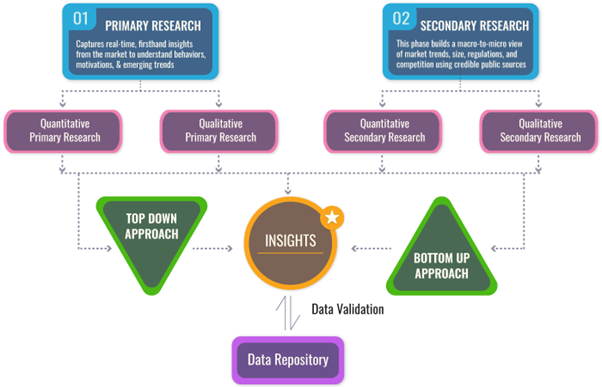
DUAL MODELING: TOP-DOWN + BOTTOM-UP
To ensure robust market estimation, we apply two complementary sizing approaches:
Top-Down Modeling:- Start with broader industry value (e.g., global or regional TAM)
- Apply filters by segment, geography, end-user, or use case
- Adjust with primary insights and validation benchmarks
- Ideal for investor-grade market scans and opportunity mapping
- Aggregate from the ground up using sales volumes, pricing, and unit economics
- Use internal modeling templates aligned with stakeholder data
- Incorporate distributor-level or region-specific inputs
- Most accurate for emerging segments and granular sub-markets
DATA VALIDATION: IN-HOUSE REPOSITORY
We close the loop with proprietary data intelligence built from ongoing projects, industry monitoring, and historical benchmarking. This repository includes:
- Multi-sector market and pricing models
- Key trendlines from past interviews and forecasts
- Benchmarked adoption rates, churn patterns, and ROI indicators
- Industry-specific deviation flags and cross-check logic
- Catches inconsistencies early
- Aligns projections across studies
- Enables consistent, high-trust deliverables