

Biologics Contract Manufacturing Market Size and Forecast (2020 - 2033), Global and Regional Growth, Trend, Share, and Industry Analysis Report Coverage: By Service (Process Development, Analytical & Quality Control Studies, Cell Line Development, API/Biologics Manufacturing, Fill/Finish), By Source (Mammalian, Microbial, Others), By Product (Monoclonal Antibodies, Recombinant Proteins, Vaccines, Cell & Gene Therapies), By End-user (Pharmaceutical Companies, Biotechnology Companies, Research Organizations) And Geography
2025-12-03
Healthcare
Swetal (Research Analyst)
Description
Biologics Contract Manufacturing Market Overview
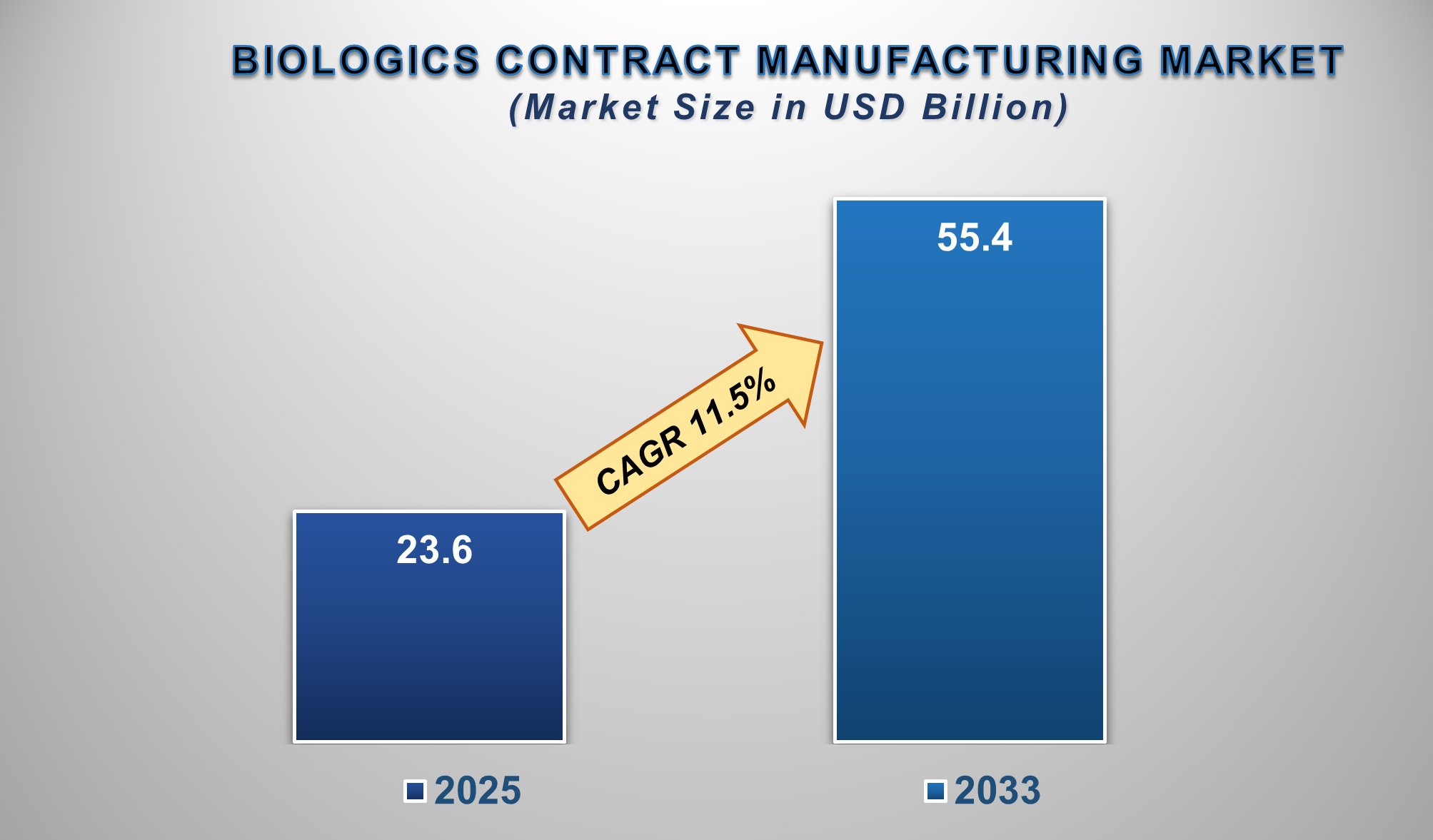
The Biologics Contract Manufacturing Market is poised for exceptional growth from 2025 to 2033, fueled by the booming biopharmaceutical industry, the rising complexity of biologic drugs, and the strategic shift of pharmaceutical companies towards outsourcing to mitigate risk and control costs. The market is projected to be valued at approximately USD 23.6 billion in 2025 and is forecasted to reach nearly USD 55.4 billion by 2033, exhibiting a compound annual growth rate (CAGR) of 11.5% during this period.
Biologics Contract Manufacturing (BCMO) involves partnering
with specialized third-party organizations to handle part or all of the
development and manufacturing processes for biologic drugs, which are large,
complex molecules derived from living organisms. The market's expansion is
primarily driven by the exponential growth in the pipeline of biologic drugs,
including monoclonal antibodies, cell and gene therapies, and vaccines. The
high capital investment required for building in-house biologics manufacturing
facilities, coupled with the need for specialized expertise and regulatory
compliance, makes outsourcing an attractive strategy for both large
pharmaceutical companies and virtual/small biotechs.
Furthermore, the patent expiry of several blockbuster
biologics is spurring the development of biosimilars, a significant segment
that heavily relies on CMOs for cost-effective production. Technological
advancements in single-use bioreactors, continuous manufacturing, and
high-throughput process development are enhancing efficiency and flexibility
for CMOs. North America currently holds the largest market share due to a
strong biopharma R&D base and significant investments in advanced
therapies, while the Asia-Pacific region is expected to witness the fastest
growth due to lower manufacturing costs, skilled labor, and increasing government support for biopharmaceutical
production.
Biologics
Contract Manufacturing Market Drivers and Opportunities
Soaring Demand for Biologics and the High
Cost of In-house Manufacturing are the Primary Market Drivers
The unprecedented demand for novel biologic
therapies, particularly in oncology, autoimmune diseases, and rare disorders,
is the most powerful driver for the BCMO market. Developing and manufacturing
biologics is inherently more complex and expensive than small molecules,
requiring highly specialized infrastructure, technology, and personnel. The
immense capital expenditure for building and maintaining cGMP-compliant
facilities, combined with the operational complexities of scaling up
production, makes it economically unviable for many companies to manage
entirely in-house. This fundamental economic and operational imperative is
pushing pharmaceutical firms to partner with CMOs to access capacity,
expertise, and flexibility without massive upfront investment, creating a
strong, sustained demand for contract manufacturing services.
The Rise of Complex Modalities and the
"Patent Cliff" are Driving Adoption
The rapid emergence of advanced therapeutic
modalities and the wave of biologic patent expirations are critical catalysts
for market growth. The development of cell and gene therapies, viral vectors,
and mRNA-based products requires highly specialized manufacturing capabilities
that most drug developers lack. CMOs with expertise in these niche areas are
becoming essential partners. Concurrently, the "patent cliff" for
major biologic drugs is creating a gold rush for biosimilars. Biosimilar developers,
aiming to enter the market quickly and cost-effectively, are heavily reliant on
CMOs to avoid the time and expense of building their own manufacturing plants,
thereby accelerating the adoption of BCMO services.
Expansion into High-Growth Modalities and
Integrated Service Offerings Presents
Significant Opportunities
The strategic expansion into next-generation
biologics and the provision of end-to-end services are creating substantial
growth frontiers. A key opportunity lies in the cell and gene therapy and mRNA
vaccine/therapy space, where manufacturing complexity is a major bottleneck.
CMOs who can master these platforms and offer
scalable, reliable production are in high demand. Furthermore, there is immense
potential in moving beyond mere production to offer integrated services
spanning from cell line development and process optimization to regulatory
support and commercial-scale fill/finish. This "one-stop-shop" model
provides immense value to clients by simplifying the supply chain. For vendors,
investing in flexible and modular manufacturing technologies (like single-use
systems), developing expertise in complex modalities, and forming strategic
partnerships with biopharma companies are key strategies to capture market
share.
Biologics Contract Manufacturing Market Scope
|
Report Attributes |
Description |
|
Market Size in 2025 |
USD 23.6 Billion |
|
Market Forecast in 2033 |
USD 55.4 Billion |
|
CAGR % 2025-2033 |
11.5% |
|
Base Year |
2024 |
|
Historic Data |
2020-2024 |
|
Forecast Period |
2025-2033 |
|
Report USP |
Product Portfolio,
Technological Analysis, Company Market Share, Company Heatmap, Pricing
Analysis, Growth Factors and more |
|
Segments Covered |
●
By Service ●
By Product ●
By Source ●
By End-user |
|
Regional Scope |
●
North America, ●
Europe, ●
APAC, ●
Latin America ●
Middle East and
Africa |
|
Country Scope |
1)
U.S. 2)
Canada 3)
Germany 4)
UK 5)
France 6)
Spain 7)
Italy 8)
Switzerland 9)
China 10)
Japan 11)
India 12)
Australia 13)
South Korea 14)
Brazil 15)
Mexico 16)
Argentina 17)
South Africa 18)
Saudi Arabia 19)
UAE |
Biologics Contract Manufacturing Market Report Segmentation
Analysis
The global
Biologics Contract Manufacturing Market industry analysis is segmented by
Service, by Source, by Product, by End-user, and by Region.
The
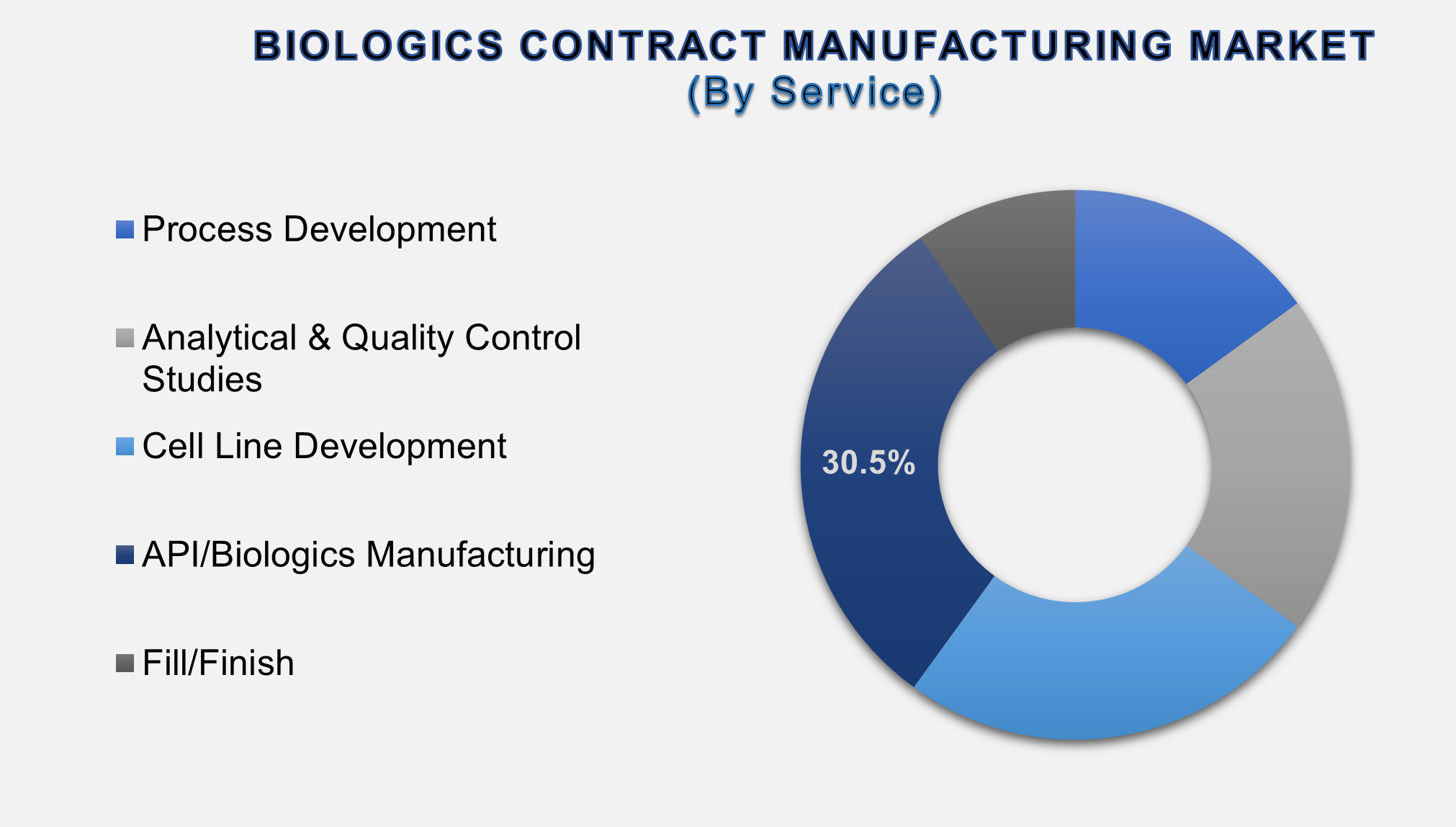
API/Biologics Manufacturing segment is anticipated to command the largest
market share in 2025.
The Service segment is categorised into Process
Development, Analytical & Quality Control Studies, Cell Line Development,
API/Biologics Manufacturing, and Fill/Finish. The dominance of the
API/Biologics Manufacturing segment is attributed to it being the core, most
capital-intensive, and capacity-critical stage of production. This segment
involves the actual large-scale fermentation and cell culture to produce the
active pharmaceutical ingredient. Given the massive investment in bioreactors,
purification systems, and clean-room facilities required, it is the most
frequently outsourced activity. The high cost and complexity of maintaining
this infrastructure in-house secure its position as the segment with the
largest market share.
The Mammalian-based systems segment is projected to grow at
a significant CAGR.
The Source segment includes Mammalian, Microbial, and
Others. The mammalian systems segment's projected significant growth is driven
by its critical role in producing the most prevalent and successful class of
biologics: complex glycosylated proteins like monoclonal antibodies (mAbs).
Mammalian cells (e.g., CHO cells) are essential for producing these
therapeutics with the correct post-translational modifications and biological
activity. As the pipeline for mAbs and other complex proteins continues to dominate
biopharmaceutical R&D, the demand for mammalian-based manufacturing
capacity will continue to outpace other expression systems, making it the
fastest-growing source segment.
The Monoclonal Antibodies product segment is projected to
witness the highest growth rate.
The Product segment is divided into Monoclonal Antibodies,
Recombinant Proteins, Vaccines, and Cell & Gene Therapies. The Monoclonal
Antibodies (mAbs) segment's position as the fastest-growing channel is a result
of its well-established dominance in the biologic drug market. mAbs are the
backbone of modern treatment for cancer, autoimmune diseases, and other chronic
conditions. The continued robust pipeline of new mAb candidates, coupled with
the intense development of biosimilars for blockbuster mAbs that have lost
patent protection, creates an enormous and sustained demand for manufacturing
capacity. This high volume and continuous innovation solidify the mAb segment
as the primary growth engine for BCMOs.
The
following segments are part of an in-depth analysis of the global Biologics
Contract Manufacturing Market:
|
Market
Segments |
|
|
By Service |
●
Process Development ●
Analytical &
Quality Control Studies ●
Cell Line
Development ●
API/Biologics
Manufacturing ●
Fill/Finish |
|
By Product |
●
Monoclonal
Antibodies ●
Recombinant Proteins ●
Vaccines ●
Cell & Gene
Therapies |
|
By Source |
●
Mammalian ●
Microbial ●
Others |
|
By End-user |
●
Hospitals ●
Clinics ●
Healthcare
Institutions ●
Clinical
Laboratories |
Biologics Contract Manufacturing Market Share Analysis by
Region
The North America region is anticipated to hold the largest
portion of the Biologics Contract Manufacturing Market globally throughout the
forecast period.
North
America's dominance is driven by the presence of a massive biopharmaceutical
industry, a high concentration of innovator biotech companies, and significant
R&D funding. The region has a mature regulatory framework (FDA) that
encourages advanced manufacturing technologies. High healthcare expenditure and
early adoption of complex and expensive therapies like cell and gene therapies
create immediate demand for local, high-quality manufacturing capacity. The
presence of many leading CMOs with state-of-the-art facilities and strong
partnerships with pharmaceutical giants solidifies North America's leadership
position.
The United
States is a key growth engine within the North American region. The
country is the world's largest biopharma market, with unparalleled private and
public investment in life sciences R&D. The high number of virtual and
small biotech companies, which form the core clientele for CMOs, coupled with
the FDA's proactive engagement in facilitating advanced therapy development,
makes the U.S. the most significant and dynamic market for biologics contract
manufacturing.
Biologics Contract Manufacturing Market Competition Landscape
Analysis
The global biologics contract manufacturing
market is highly competitive and fragmented, featuring a mix of large,
diversified CMOs, specialized players focusing on niche technologies, and the
in-house capacity of big pharma companies. Competition is based on
manufacturing capacity, technological expertise (especially in advanced
modalities), quality and regulatory track record, geographic location, and
pricing. Key strategies include significant capital investment in capacity
expansion, technological acquisitions to bolster service portfolios, and
forming long-term strategic partnerships with biopharma clients to secure
predictable revenue streams.
Global Biologics Contract Manufacturing Market Recent
Developments News:
- In February 2025, Lonza Group AG announced a major
expansion of its mammalian cell culture capacity in the U.S. to meet
growing demand for monoclonal antibody production.
o In December 2024,
Catalent, Inc. completed the acquisition of a specialized gene therapy CMO to
strengthen its viral vector and cell therapy manufacturing capabilities.
o In October 2024, Samsung
Biologics signed a long-term partnership with a top-10 pharmaceutical company
for the large-scale commercial manufacturing of a new biologic drug.
o In August 2024, Fujifilm
Diosynth Biotechnologies invested in a new facility in the UK dedicated to
continuous biomanufacturing processes, enhancing efficiency and flexibility for
clients.
The Global Biologics Contract
Manufacturing Market Is Dominated by a Few Large Companies, such as
●
Lonza Group
●
Samsung Biologics
●
WuXi Biologics
●
Catalent, Inc.
●
Boehringer Ingelheim
BioXcellence
●
Fujifilm Diosynth
Biotechnologies
●
Thermo Fisher
Scientific (Patheon)
●
AGC Biologics
●
AbbVie Contract
Manufacturing
●
Rentschler Biopharma
●
Novasep
●
KBI Biopharma
●
Cytiva
●
Charles River
Laboratories
●
Emergent BioSolutions
● Other Prominent Players
Frequently Asked Questions
Swetal (Research Analyst)
Swetal is a Research Analyst with 4+ years of experience specializing in healthcare market research, medical devices, healthcare IT, and medical technology industry analysis. Her expertise includes competitive intelligence, secondary research, market trend forecasting, and healthcare business insights across global healthcare ecosystems.
She contributes to advanced market research reports by analyzing regulatory frameworks, emerging healthcare technologies, competitive landscapes, and innovation trends shaping the medical industry. With a strong focus on accurate market intelligence, strategic insights, and healthcare industry trends, Swetal supports businesses in making informed, data-backed decisions in a rapidly transforming healthcare environment.
1. Global Biologics Contract
Manufacturing Market Introduction and Market Overview
1.1.
Objectives
of the Study
1.2.
Global
Biologics Contract Manufacturing Market Scope and Market Estimation
1.2.1.Global Electronic Toll
Collection Overall Market Size (US$ Bn), Market CAGR (%), Market forecast (2025
- 2033)
1.2.2.Global Biologics Contract
Manufacturing Market Revenue Share (%) and Growth Rate (Y-o-Y) from 2020 - 2033
1.3.
Market
Segmentation
1.3.1.Service of Global Biologics
Contract Manufacturing Market
1.3.2.Product of Global Biologics
Contract Manufacturing Market
1.3.3.Source of Global Biologics
Contract Manufacturing Market
1.3.4.End-user of Global Biologics
Contract Manufacturing Market
1.3.5.Region of Global Biologics
Contract Manufacturing Market
2.
Executive Summary
2.1.
Demand
Side Trends
2.2.
Key
Market Trends
2.3.
Market
Demand (US$ Bn) Analysis 2020 – 2024 and forecast, 2025 – 2033
2.4.
Demand
and Opportunity Assessment
2.5.
Key
Developments
2.6.
Market
Entry Strategies
2.7.
Market
Dynamics
2.7.1.Drivers
2.7.2.Limitations
2.7.3.Opportunities
2.7.4.Impact Analysis of Drivers
and Restraints
2.8.
Porter’s
Five Forces Analysis
2.9.
PEST
Analysis
3. Global
Biologics Contract Manufacturing Market
Estimates & Historical Trend Analysis (2020 - 2024)
4. Global
Biologics Contract Manufacturing Market
Estimates & Forecast Trend Analysis, by Service
4.1.
Global
Biologics Contract Manufacturing Market Revenue (US$ Bn) Estimates and
Forecasts, by Service, 2020 - 2033
4.1.1.Process Development
4.1.2.Analytical & Quality
Control Studies
4.1.3.Cell Line Development
4.1.4.API/Biologics
Manufacturing
4.1.5.Fill/Finish
5. Global
Biologics Contract Manufacturing Market
Estimates & Forecast Trend Analysis, by Product
5.1.
Global
Biologics Contract Manufacturing Market Revenue (US$ Bn) Estimates and
Forecasts, by Product, 2020 - 2033
5.1.1.Monoclonal Antibodies
5.1.2.Recombinant Proteins
5.1.3.Vaccines
5.1.4.Cell & Gene Therapies
6. Global
Biologics Contract Manufacturing Market
Estimates & Forecast Trend Analysis, by Source
6.1.
Global
Biologics Contract Manufacturing Market Revenue (US$ Bn) Estimates and
Forecasts, by Source 2020 - 2033
6.1.1.Mammalian
6.1.2.Microbial
6.1.3.Others
7. Global
Biologics Contract Manufacturing Market
Estimates & Forecast Trend Analysis, by End-user
7.1.
Global
Biologics Contract Manufacturing Market Revenue (US$ Bn) Estimates and
Forecasts, by End-user 2020 - 2033
7.1.1.Pharmaceutical Companies
7.1.2.Biotechnology Companies
7.1.3.Research Organizations
8. Global
Biologics Contract Manufacturing Market
Estimates & Forecast Trend Analysis, by region
8.1.
Global
Biologics Contract Manufacturing Market Revenue (US$ Bn) Estimates and
Forecasts, by region, 2020 - 2033
8.1.1.North America
8.1.2.Europe
8.1.3.Asia Pacific
8.1.4.Middle East & Africa
8.1.5.Latin America
9. North America Biologics
Contract Manufacturing Market:
Estimates & Forecast Trend Analysis
9.1. North America Biologics
Contract Manufacturing Market Assessments & Key Findings
9.1.1.North America Biologics
Contract Manufacturing Market Introduction
9.1.2.North America Biologics
Contract Manufacturing Market Size Estimates and Forecast (US$ Billion) (2020 -
2033)
9.1.2.1.
By Service
9.1.2.2.
By Product
9.1.2.3.
By Source
9.1.2.4.
By End-user
9.1.2.5. By Country
9.1.2.5.1. The U.S.
9.1.2.5.2. Canada
10. Europe Biologics
Contract Manufacturing Market:
Estimates & Forecast Trend Analysis
10.1. Europe Biologics Contract
Manufacturing Market Assessments & Key Findings
10.1.1. Europe Biologics Contract
Manufacturing Market Introduction
10.1.2. Europe Biologics Contract
Manufacturing Market Size Estimates and Forecast (US$ Billion) (2020 - 2033)
10.1.2.1.
By Service
10.1.2.2.
By Product
10.1.2.3.
By Source
10.1.2.4.
By End-user
10.1.2.5. By Country
10.1.2.5.1.
Germany
10.1.2.5.2.
Italy
10.1.2.5.3.
U.K.
10.1.2.5.4.
France
10.1.2.5.5.
Spain
10.1.2.5.6.
Switzerland
10.1.2.5.7. Rest
of Europe
11. Asia Pacific Biologics
Contract Manufacturing Market:
Estimates & Forecast Trend Analysis
11.1. Asia Pacific Market
Assessments & Key Findings
11.1.1.
Asia
Pacific Biologics Contract Manufacturing Market Introduction
11.1.2.
Asia
Pacific Biologics Contract Manufacturing Market Size Estimates and Forecast
(US$ Billion) (2020 - 2033)
11.1.2.1.
By Service
11.1.2.2.
By Product
11.1.2.3.
By Source
11.1.2.4.
By End-user
11.1.2.5. By Country
11.1.2.5.1. China
11.1.2.5.2. Japan
11.1.2.5.3. India
11.1.2.5.4. Australia
11.1.2.5.5. South Korea
11.1.2.5.6. Rest of Asia Pacific
12. Middle East & Africa Biologics
Contract Manufacturing Market:
Estimates & Forecast Trend Analysis
12.1. Middle East & Africa
Market Assessments & Key Findings
12.1.1. Middle
East & Africa
Biologics Contract Manufacturing Market Introduction
12.1.2. Middle
East & Africa
Biologics Contract Manufacturing Market Size Estimates and Forecast (US$ Billion)
(2020 - 2033)
12.1.2.1.
By Service
12.1.2.2.
By Product
12.1.2.3.
By Source
12.1.2.4.
By End-user
12.1.2.5. By Country
12.1.2.5.1. UAE
12.1.2.5.2. Saudi
Arabia
12.1.2.5.3. South
Africa
12.1.2.5.4. Rest
of MEA
13. Latin America
Biologics Contract Manufacturing Market:
Estimates & Forecast Trend Analysis
13.1. Latin America Market
Assessments & Key Findings
13.1.1. Latin America Biologics
Contract Manufacturing Market Introduction
13.1.2. Latin America Biologics
Contract Manufacturing Market Size Estimates and Forecast (US$ Billion) (2020 -
2033)
13.1.2.1.
By Service
13.1.2.2.
By Product
13.1.2.3.
By Source
13.1.2.4.
By End-user
13.1.2.5. By Country
13.1.2.5.1. Brazil
13.1.2.5.2. Argentina
13.1.2.5.3. Mexico
13.1.2.5.4. Rest
of LATAM
14.
Country
Wise Market: Introduction
15.
Competition
Landscape
15.1. Global Biologics Contract
Manufacturing Market Product Mapping
15.2. Global Biologics Contract
Manufacturing Market Concentration Analysis, by Leading Players / Innovators /
Emerging Players / New Entrants
15.3. Global Biologics Contract
Manufacturing Market Tier Structure Analysis
15.4. Global Biologics Contract
Manufacturing Market Concentration & Company Market Shares (%) Analysis,
2024
16.
Company
Profiles
16.1.
Lonza Group
16.1.1.
Company
Overview & Key Stats
16.1.2.
Financial
Performance & KPIs
16.1.3.
Product
Portfolio
16.1.4.
SWOT
Analysis
16.1.5.
Business
Strategy & Recent Developments
* Similar details would be provided for all the players
mentioned below
16.2.
Samsung Biologics
16.3.
WuXi Biologics
16.4.
Catalent, Inc.
16.5.
Boehringer Ingelheim BioXcellence
16.6.
Fujifilm Diosynth Biotechnologies
16.7.
Thermo Fisher Scientific (Patheon)
16.8.
AGC Biologics
16.9.
AbbVie Contract Manufacturing
16.10.
Rentschler Biopharma
16.11.
Novasep
16.12.
KBI Biopharma
16.13.
Cytiva
16.14.
Charles River Laboratories
16.15.
Emergent BioSolutions
16.16.
Other Prominent Players
17. Research
Methodology
17.1. External Transportations /
Databases
17.2. Internal Proprietary
Database
17.3. Primary Research
17.4. Secondary Research
17.5. Assumptions
17.6. Limitations
17.7. Report FAQs
18. Research
Findings & Conclusion
Our Research Methodology
"Insight without rigor is just noise."
We follow a comprehensive, multi-phase research framework designed to deliver accurate, strategic, and decision-ready intelligence. Our process integrates primary and secondary research , both quantitative and qualitative , along with dual modeling techniques ( top-down and bottom-up) and a final layer of validation through our proprietary in-house repository.
PRIMARY RESEARCH
Primary research captures real-time, firsthand insights from the market to understand behaviors, motivations, and emerging trends.
1. Quantitative Primary Research
Objective: Generate statistically significant data directly from market participants.
Approaches:- Structured surveys with customers, distributors, and field agents
- Mobile-based data collection for point-of-sale audits and usage behavior
- Phone-based interviews (CATI) for market sizing and product feedback
- Online polling around industry events and digital campaigns
- Purchase frequency by customer type
- Channel performance across geographies
- Feature demand by application or demographic
2. Qualitative Primary Research
Objective: Explore decision-making drivers, pain points, and market readiness.
Approaches:- In-depth interviews (IDIs) with executives, product managers, and key decision-makers
- Focus groups among end users and early adopters
- Site visits and observational research for consumer products
- Informal field-level discussions for regional and cultural nuances
SECONDARY RESEARCH
This phase helps establish a macro-to-micro understanding of market trends, size, regulation, and competitive dynamics, sourced from credible and public domain information.
1. Quantitative Secondary Research
Objective: Model market value and segment-level forecasts based on published data.
Sources include:- Financial reports and investor summaries
- Government trade data, customs records, and regulatory statistics
- Industry association publications and economic databases
- Channel performance and pricing data from marketplace listings
- Revenue splits, pricing trends, and CAGR estimates
- Supply-side capacity and volume tracking
- Investment analysis and funding benchmarks
2. Qualitative Secondary Research
Objective: Capture strategic direction, innovation signals, and behavioral trends.
Sources include:- Company announcements, roadmaps, and product pipelines
- Publicly available whitepapers, conference abstracts, and academic research
- Regulatory body publications and policy briefs
- Social and media sentiment scanning for early-stage shifts
- Strategic shifts in market positioning
- Unmet needs and white spaces
- Regulatory triggers and compliance impact

DUAL MODELING: TOP-DOWN + BOTTOM-UP
To ensure robust market estimation, we apply two complementary sizing approaches:
Top-Down Modeling:- Start with broader industry value (e.g., global or regional TAM)
- Apply filters by segment, geography, end-user, or use case
- Adjust with primary insights and validation benchmarks
- Ideal for investor-grade market scans and opportunity mapping
- Aggregate from the ground up using sales volumes, pricing, and unit economics
- Use internal modeling templates aligned with stakeholder data
- Incorporate distributor-level or region-specific inputs
- Most accurate for emerging segments and granular sub-markets
DATA VALIDATION: IN-HOUSE REPOSITORY
We close the loop with proprietary data intelligence built from ongoing projects, industry monitoring, and historical benchmarking. This repository includes:
- Multi-sector market and pricing models
- Key trendlines from past interviews and forecasts
- Benchmarked adoption rates, churn patterns, and ROI indicators
- Industry-specific deviation flags and cross-check logic
- Catches inconsistencies early
- Aligns projections across studies
- Enables consistent, high-trust deliverables