

Black Granite Market Size and Forecast (2026–2034), Global and Regional Growth, Trend, Share, and Industry Analysis Report Coverage; By Product Type (Absolute Black Granite, Black Galaxy Granite, Black Pearl Granite, Others); By Application (Kitchen Countertops, Flooring & Walling, Paving Stone, Stair Treads, Monuments, Others); By Form (Slabs, Tiles, Cut-to-Size); By Distribution Channel (Direct Sales, Distributors, Online Retail, Others); and Geography
2026-09-01
Real Estate & Infrastructure
Aishwarya Panbude (Research Analyst)
Description
Black Granite Market Overview
The global Black
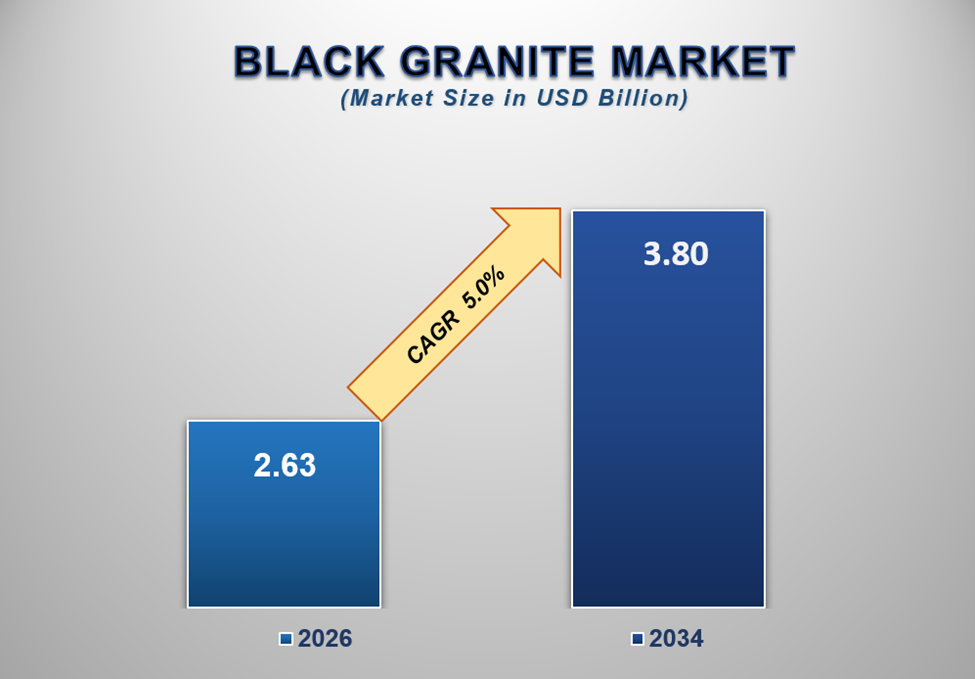
Granite Market was valued at approximately USD 2.63 Billion in 2026
and is projected to reach approximately USD 3.80 Billion by 2034,
expanding at a CAGR of approximately 5.0% during the forecast period.
The market is supported by increasing construction activity, rising demand for
premium natural stone surfaces, residential renovation, commercial development,
growing preference for durable architectural materials, and expanding
applications of black granite across interiors, exteriors, monuments, and
landscaping.
Black granite is
a dark-colored natural dimension stone valued for its durability, distinctive
appearance, resistance to wear, and ability to achieve polished, honed, flamed,
and other surface finishes.
The material is
widely used in residential and commercial construction, particularly for
kitchen countertops, flooring, wall applications, staircases, paving,
monuments, facades, and decorative architectural features.
The growing
preference for natural materials in premium residential interiors is supporting
demand for black granite. Homeowners and designers increasingly use dark stone
surfaces to create contemporary, minimalist, and high-contrast interior
environments.
Black granite is
also valued for its long service life. Its resistance to scratching, heat, and
general wear makes it suitable for high-use surfaces where both appearance and
durability are important.
Absolute Black
Granite, Black Galaxy Granite, and Black Pearl Granite represent prominent
varieties within the market. Differences in color uniformity, mineral patterns,
availability, origin, and finish allow suppliers to serve different
architectural and pricing requirements.
The commercial
construction sector is another important source of demand. Hotels, restaurants,
offices, retail stores, airports, institutional buildings, and luxury
developments frequently incorporate natural stone in entrance areas, reception
spaces, flooring, counters, wall surfaces, and decorative installations.
Renovation and
remodeling activity is creating recurring demand for granite products.
Consumers upgrading kitchens, bathrooms, outdoor spaces, and residential
interiors increasingly consider natural stone as a durable premium finishing
material.
The availability
of processed slabs and cut-to-size products is also improving the accessibility
of black granite. Fabricators can provide customized dimensions and finishes
according to project requirements, reducing material wastage and simplifying
installation.
India, Brazil,
China, Scandinavia, and other granite-producing regions play important roles in
the international supply chain. India is particularly important for black
granite production and exports, with varieties such as Absolute Black and Black
Galaxy serving domestic and international markets.
Sustainability
considerations are increasingly influencing the natural-stone industry. Quarry
operators and processors are adopting improved resource utilization,
water-management practices, waste reduction, and more responsible extraction
methods.
As construction,
renovation, premium interior design, and architectural applications continue
expanding, the global black granite market is expected to register steady
growth through 2034.
Black Granite Market Drivers and
Opportunities
Increasing
Construction and Renovation Activity Is Driving Market Growth
Growing
construction activity is one of the key factors supporting black granite
demand.
Residential
buildings, commercial properties, hospitality projects, institutional
facilities, and public infrastructure require durable finishing materials for
floors, walls, counters, stairs, facades, and decorative applications.
Black granite is
particularly attractive for premium projects because it combines natural
appearance with strong mechanical performance.
Renovation
activity is also creating recurring demand. Kitchen remodeling, bathroom
upgrades, commercial refurbishment, and hospitality renovations provide
opportunities for granite suppliers and fabricators.
As property
owners increasingly seek materials capable of combining aesthetics with
long-term durability, black granite is expected to maintain its position within
the premium natural-stone segment.
Growing
Preference for Premium Natural Stone Is Supporting Market Expansion
Architects,
interior designers, and consumers are increasingly incorporating natural
materials into high-end residential and commercial projects.
Black granite
offers a distinctive visual appearance that can complement modern, minimalist,
traditional, and luxury architectural styles.
Different
varieties provide a range of design characteristics. Uniform black surfaces are
suitable for contemporary interiors, while varieties containing metallic or
contrasting mineral patterns can create more decorative visual effects.
The ability to
select between polished, honed, leathered, flamed, and other finishes further
increases the material's design flexibility.
Growing demand
for premium kitchens, luxury bathrooms, hotel interiors, retail environments,
and statement architectural surfaces is therefore supporting market expansion.
Premium
Architectural Applications and Product Customization Create Significant
Opportunities
Product
customization represents an important opportunity for black granite suppliers.
Cut-to-size
slabs, customized countertops, stair components, wall panels, paving elements,
and architectural pieces allow manufacturers and fabricators to serve projects
with specific dimensions and design requirements.
The hospitality
and luxury real-estate sectors provide additional opportunities because
developers often use distinctive natural stone to create visually recognizable
interiors and exterior features.
Export
opportunities are also expanding for producing countries with established
quarrying and processing capabilities.
Digital product
catalogs, online stone marketplaces, 3D visualization, and direct-to-consumer
channels are improving access to granite products and allowing buyers to
compare colors, finishes, dimensions, and pricing before purchase.
Increasing
interest in responsibly sourced natural stone may further benefit suppliers
that can demonstrate transparent quarrying, processing, and environmental
practices.
Black Granite Market Scope
|
Report Attributes |
Description |
|
Market Size
in 2026 |
USD 2.63 Billion |
|
Market
Forecast in 2034 |
USD 3.80
Billion |
|
CAGR %
2026-2034 |
5.0% |
|
Base Year |
2025 |
|
Historic
Data |
2021-2025 |
|
Forecast
Period |
2026-2034 |
|
Report USP |
Production,
Consumption, Company Share, Company Heatmap, Company Production, Service
Type, Growth Factors, and more |
|
Segments
Covered |
• By Product Type |
|
Regional
Scope |
● North America |
|
Country
Scope |
U.S. |
Black Granite Market Report
Segmentation Analysis
The global black
granite market industry analysis is segmented by product type, application,
form, distribution channel, and region.
The Absolute
Black Granite Segment Is Expected to Dominate the Market During the Forecast
Period
The Absolute
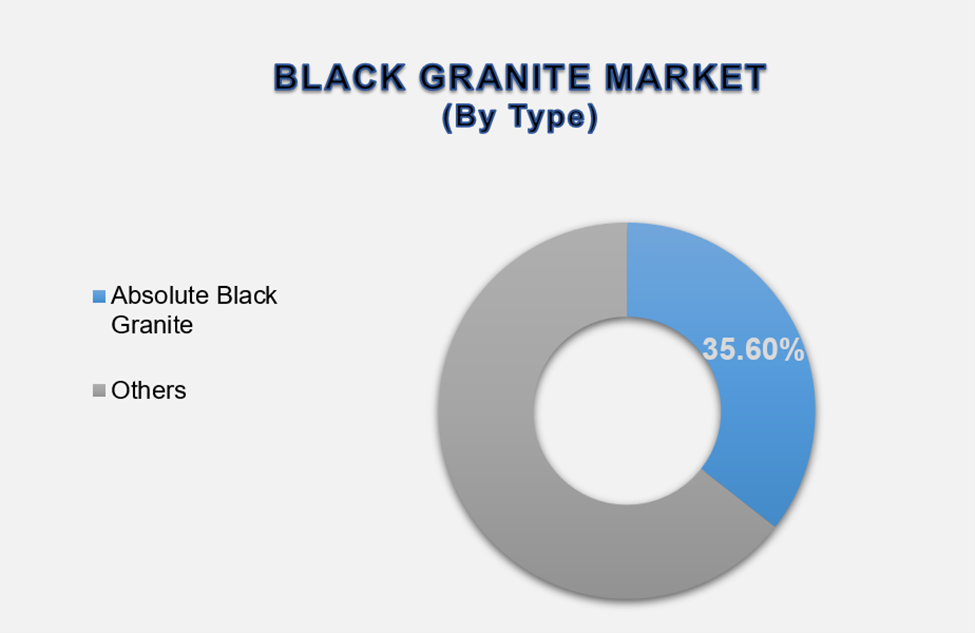
Black Granite segment accounted for approximately 35.6% of the
global black granite market, making it the leading product category.
Absolute Black
Granite is characterized by its predominantly uniform deep-black appearance and
relatively limited visible veining.
Its clean visual
profile makes it particularly attractive for contemporary residential
interiors, premium countertops, commercial spaces, wall applications, and
architectural installations.
The material is
valued for its durability and ability to achieve a high-quality polished
finish.
Its use across
minimalist and luxury design concepts is supporting demand among architects,
interior designers, contractors, and homeowners.
Availability
from established producing regions, particularly India and other major
granite-producing markets, is also supporting its commercial presence.
The segment is
expected to maintain its leading position as demand for premium, visually
consistent natural stone continues increasing.
The Kitchen
Countertops Segment Is Expected to Lead the Market by Application
The Kitchen
Countertops segment is expected to represent a major application category
within the black granite market.
Black granite is
widely selected for countertops because of its durability, heat resistance,
ease of cleaning, and premium appearance.
Dark surfaces
can create strong visual contrast with lighter cabinetry and are increasingly
incorporated into contemporary and luxury kitchen designs.
Demand is also
supported by residential renovation and kitchen-remodeling activity.
Fabricators
increasingly offer customized countertop dimensions, edge profiles, surface
finishes, and sink cutouts, allowing black granite to serve a broad range of
residential and commercial kitchen requirements.
The Slabs
Segment Is Expected to Dominate the Market by Form
The Slabs
segment is expected to account for the largest share by form.
Large granite
slabs provide fabricators with flexibility when producing countertops, wall
panels, flooring components, and other architectural surfaces.
The availability
of large-format slabs can reduce visible joints and provide a more continuous
visual appearance in premium installations.
Technological
improvements in cutting, polishing, surface treatment, and slab handling are
further supporting the availability of higher-quality finished products.
Growing demand
for customized architectural surfaces is expected to sustain the importance of
slab-based products.
The Direct
Sales Segment Is Expected to Dominate the Market by Distribution Channel
The Direct
Sales segment is expected to maintain a leading position because large
construction and architectural projects frequently involve direct procurement
between quarry operators, processors, distributors, contractors, fabricators,
and project developers.
Direct
procurement can provide buyers with greater control over product
specifications, quantity, quality, delivery schedules, and customization
requirements.
Large-volume
commercial and infrastructure projects also tend to prefer established supply
relationships because natural stone sourcing requires careful coordination
between quarrying, processing, transportation, and installation.
However,
distributors and online platforms are becoming increasingly important for
smaller buyers and residential customers.
The following
segments are part of an in-depth analysis of the global Black Granite Market:
|
Market Segments |
|
|
By Product Type |
●
Absolute Black Granite ●
Black Galaxy Granite ●
Black Pearl Granite ●
Others |
|
By
Application |
●
Kitchen Countertops ●
Flooring & Walling ●
Paving Stone ●
Stair Treads ●
Monuments ●
Others |
|
By
Form |
●
Slabs ●
Tiles ●
Cut-to-Size |
|
By Distribution Channel |
●
Direct Sales ●
Distributors ●
Online Retail ●
Others |
Black Granite Market Share Analysis
By Region
Asia Pacific is projected to hold the largest share of the global black granite
market over the forecast period. The region benefits from extensive granite
production, expanding construction activity, rising residential development,
growing infrastructure investment, and increasing consumption of premium
natural stone. One published market analysis estimates Asia Pacific at
approximately 42.8% of global black granite revenue.
China represents an important regional market because of its large
construction sector, extensive stone-processing industry, and strong domestic
demand for architectural materials.
India is a major producer and exporter of black granite. The country's
established quarrying and processing ecosystem supports domestic consumption as
well as exports of varieties such as Absolute Black and Black Galaxy. Indian
black granite production also has a significant role in the international
natural-stone supply chain.
Japan, South
Korea, and Australia represent additional regional
markets supported by construction, renovation, commercial development, and
premium architectural applications.
North America represents a significant market due to strong demand from
residential remodeling, luxury housing, hospitality projects, commercial
construction, and premium kitchen applications. The United States
remains the principal contributor.
Europe has sustained demand for natural stone because of its established
architectural industry, renovation activity, premium residential construction,
hospitality projects, and preference for high-quality architectural materials. Germany,
the U.K., France, Italy, Spain, and Switzerland are important markets.
Latin America is expected to experience steady development, supported by
construction activity and the presence of important granite-producing
countries. Brazil is particularly significant because of its granite
resources and established stone-export industry.
The Middle
East & Africa represents an emerging
opportunity driven by luxury real estate projects, hospitality development,
commercial construction, and infrastructure investment. The UAE and Saudi
Arabia are important markets because of their large-scale premium
construction and tourism developments.
Black Granite
Market Competition Landscape Analysis
The global black
granite market is characterized by a large number of quarry operators, stone
processors, exporters, fabricators, distributors, and architectural-surface
suppliers.
Companies
compete through stone quality, variety availability, finish quality,
customization, pricing, supply reliability, quarry resources, processing
capabilities, and international distribution networks.
Vertical
integration is becoming increasingly valuable. Companies capable of controlling
multiple stages from quarrying and block processing to slab production and
distribution can improve supply consistency and manage product quality more
effectively.
Product
differentiation is another important competitive factor. Suppliers offer
varieties with different shades, mineral patterns, finishes, slab dimensions,
and applications to serve architects, designers, contractors, and homeowners.
Sustainability
is becoming increasingly relevant within the competitive environment.
Responsible quarrying, efficient water usage, waste reduction, recycling of
stone by-products, and improved resource utilization are receiving greater
attention from buyers and project developers.
Indian and
Brazilian suppliers continue to benefit from strong production capabilities and
established export networks, while European and North American companies
maintain advantages in premium fabrication, design services, and distribution.
The market is
expected to remain fragmented, with regional suppliers continuing to play an
important role alongside larger international natural-stone companies.
Global Black
Granite Market Recent Developments News
●
In April 2026 – Granite processors expanded automated cutting and polishing
capabilities to improve slab consistency and reduce material wastage.
●
In February 2026 – Natural-stone suppliers increased focus on premium black granite
varieties for residential renovation and luxury commercial interiors.
●
In November 2025 – Granite exporters strengthened international distribution
networks to serve rising demand for architectural stone products.
●
In August 2025 – Stone-processing companies expanded digital catalog and
visualization capabilities to help customers select granite varieties and
finishes remotely.
●
In June 2025 – Quarry and processing companies increased adoption of
resource-efficiency measures aimed at reducing water consumption and
stone-processing waste.
The Global
Black Granite Market is Dominated by a Few Large Companies, Such As
●
Gem Granites
●
Pokarna Limited
●
Madhav Marbles & Granites
Limited
●
Cosentino Group
●
Levantina y Asociados de
Minerales, S.A.
●
Polycor Inc.
●
Coldspring
●
Antolini Luigi & C. S.p.A.
●
Rock of Ages Corporation
●
Williams Stone Company
●
R.E.D. Graniti S.p.A.
●
Swenson Granite
●
Tab India Granites
●
Aravali India
●
SMG
● Others
Frequently Asked Questions
Aishwarya Panbude (Research Analyst)
Aishwarya Panbude is a skilled Research Analyst with 4+ years of experience in market intelligence, consumer insights, competitive analysis, and industry forecasting across the consumer goods, agriculture, and food & beverage sectors. She specializes in market sizing, trend analysis, growth opportunity mapping, and strategic secondary research for global and regional markets.
Her expertise lies in transforming complex industry data into actionable business strategies that help organizations identify emerging trends, understand customer behavior, and gain a competitive edge. With a strong focus on data-driven insights, business intelligence, and future market trends, Jaya delivers high-quality research solutions aligned with evolving industry demands and market dynamics.
1.
Global Black Granite
Market Introduction and Market Overview
1.1. Objectives of the Study
1.2. Market Segmentation
1.2.1.
Product Type of Global Black
Granite Market
1.2.2.
Application of Global Black
Granite Market
1.2.3.
Form of Global Black Granite
Market
1.2.4.
Distribution Channel of Global
Black Granite Market
1.2.5.
Region of Global Black Granite
Market
1.3. Competition Coverage List of Market Participants
1.4. Market Definition: Black Granite Market
2.
Executive Summary
2.1. Global Black Granite Market Estimation & Forecast
2.1.1.
Global Black Granite Market
Size (US$ Million) Estimates & Historical Trend
2.1.1.1.1.1.1.
Analysis (2021 - 2025)
2.1.2.
Global Black Granite Market
Overall Market Size (US$ Million), Growth Rate
2.1.2.1.1.1.1.
(Y-o-Y), Market CAGR (%),
Market Forecast (2026 - 2034)
2.2. Snapshot of Global Black Granite Market
2.3. Global Black Granite Market Revenue Share (%) 2025
2.4. REGIONAL OUTLINE: Revenue CAGR, by Region
2.5. Key Competitors & Key Insights
3.
Market Overview
(Qualitative Analysis)
3.1. Demand Side Trends
3.2. Supply Side Trends / Quarrying, Processing & Natural Stone
Trends
3.3. Demand and Opportunity Assessment, 2026 - 2034
3.4. Market Dynamics
3.4.1.
Drivers
3.4.2.
Limitations
3.4.3.
Opportunities
3.4.4.
Impact Analysis of Drivers and
Restraints
3.5. Key Developments
3.6. Regulatory Landscape
3.7. Pricing Analysis
3.8. Value Chain / Ecosystem Analysis
3.9. Porter's Five Forces Analysis
3.9.1.
Bargaining Power of Suppliers
3.9.2.
Bargaining Power of Buyers
3.9.3.
Threat of Substitutes
3.9.4.
Threat of New Entrants
3.9.5.
Intensity of Competitive
Rivalry
3.10.
PEST Analysis
3.10.1.
Political Factors
3.10.2.
Economic Factors
3.10.3.
Social Factors
3.10.4.
Technology Factors
4.
Global Black Granite
Market Estimates & Forecast Trend Analysis, by Product Type
4.1. Global Black Granite Market Assessments & Key Findings, by
Product Type
4.2. Global Black Granite Market Revenue (US$ Million) Estimates and
Forecasts, by
4.2.1.1.1.
Product Type, 2021 - 2034
4.2.2.
Absolute Black Granite
4.2.3.
Black Galaxy Granite
4.2.4.
Black Pearl Granite
4.2.5.
Others
5.
Global Black Granite
Market Estimates & Forecast Trend Analysis, by Application
5.1. Global Black Granite Market Assessments & Key Findings, by
Application
5.2. Global Black Granite Market Revenue (US$ Million) Estimates and
Forecasts, by
5.2.1.1.1.
Application, 2021 - 2034
5.2.2.
Kitchen Countertops
5.2.3.
Flooring & Walling
5.2.4.
Paving Stone
5.2.5.
Stair Treads
5.2.6.
Monuments
5.2.7.
Others
6.
Global Black Granite
Market Estimates & Forecast Trend Analysis, by Form
6.1. Global Black Granite Market Assessments & Key Findings, by Form
6.2. Global Black Granite Market Revenue (US$ Million) Estimates and
Forecasts, by
6.2.1.1.1.
Form, 2021 - 2034
6.2.2.
Slabs
6.2.3.
Tiles
6.2.4.
Cut-to-Size
7.
Global Black Granite
Market Estimates & Forecast Trend Analysis, by Distribution
7.1.1.
Channel
7.2. Global Black Granite Market Assessments & Key Findings, by
Distribution Channel
7.3. Global Black Granite Market Revenue (US$ Million) Estimates and
Forecasts, by
7.3.1.1.1.
Distribution Channel, 2021 -
2034
7.3.2.
Direct Sales
7.3.3.
Distributors
7.3.4.
Online Retail
7.3.5.
Others
8.
Global Black Granite
Market Estimates & Forecast Trend Analysis, by Region
8.1. Global Black Granite Market Assessments & Key Findings, by
Region
8.2. Global Black Granite Market Revenue (US$ Million) Estimates and
Forecasts, by
8.2.1.1.1.
Region, 2021 - 2034
8.2.2.
North America
8.2.3.
Europe
8.2.4.
Asia Pacific
8.2.5.
Middle East & Africa
8.2.6.
Latin America
9.
North America Black
Granite Market: Estimates & Forecast Trend Analysis
9.1. North America Black Granite Market Assessments & Key Findings
9.1.1.
North America Black Granite
Market Introduction
9.1.2.
North America Black Granite
Market Size Estimates and Forecast
9.1.2.1.1.1.1.
(US$ Million) (2021 - 2034)
9.1.2.2.
By Product Type
9.1.2.3.
By Application
9.1.2.4.
By Form
9.1.2.5.
By Distribution Channel
9.1.2.6.
By Country
9.1.2.6.1.
The U.S.
9.1.2.6.2.
Canada
10. Europe Black Granite Market: Estimates & Forecast Trend Analysis
10.1.
Europe Black Granite Market
Assessments & Key Findings
10.1.1.
Europe Black Granite Market
Introduction
10.1.2.
Europe Black Granite Market
Size Estimates and Forecast
10.1.2.1.1.1.1.
(US$ Million) (2021 - 2034)
10.1.2.2.
By Product Type
10.1.2.3.
By Application
10.1.2.4.
By Form
10.1.2.5.
By Distribution Channel
10.1.2.6.
By Country
10.1.2.6.1.
Germany
10.1.2.6.2.
The U.K.
10.1.2.6.3.
France
10.1.2.6.4.
Italy
10.1.2.6.5.
Spain
10.1.2.6.6.
Switzerland
10.1.2.6.7.
Rest of Europe
11. Asia Pacific Black Granite Market: Estimates & Forecast Trend
Analysis
11.1.
Asia Pacific Black Granite
Market Assessments & Key Findings
11.1.1.
Asia Pacific Black Granite
Market Introduction
11.1.2.
Asia Pacific Black Granite
Market Size Estimates and Forecast
11.1.2.1.1.1.1.
(US$ Million) (2021 - 2034)
11.1.2.2.
By Product Type
11.1.2.3.
By Application
11.1.2.4.
By Form
11.1.2.5.
By Distribution Channel
11.1.2.6.
By Country
11.1.2.6.1.
China
11.1.2.6.2.
India
11.1.2.6.3.
Japan
11.1.2.6.4.
South Korea
11.1.2.6.5.
Australia
11.1.2.6.6.
Rest of Asia Pacific
12. Middle East & Africa Black Granite Market: Estimates &
Forecast Trend Analysis
12.1.
Middle East & Africa Black
Granite Market Assessments & Key Findings
12.1.1.
Middle East & Africa Black
Granite Market Introduction
12.1.2.
Middle East & Africa Black
Granite Market Size Estimates and Forecast
12.1.2.1.1.1.1.
(US$ Million) (2021 - 2034)
12.1.2.2.
By Product Type
12.1.2.3.
By Application
12.1.2.4.
By Form
12.1.2.5.
By Distribution Channel
12.1.2.6.
By Country
12.1.2.6.1.
Saudi Arabia
12.1.2.6.2.
UAE
12.1.2.6.3.
South Africa
12.1.2.6.4.
Rest of Middle East &
Africa
13. Latin America Black Granite Market: Estimates & Forecast Trend
Analysis
13.1.
Latin America Black Granite
Market Assessments & Key Findings
13.1.1.
Latin America Black Granite
Market Introduction
13.1.2.
Latin America Black Granite
Market Size Estimates and Forecast
13.1.2.1.1.1.1.
(US$ Million) (2021 - 2034)
13.1.2.2.
By Product Type
13.1.2.3.
By Application
13.1.2.4.
By Form
13.1.2.5.
By Distribution Channel
13.1.2.6.
By Country
13.1.2.6.1.
Brazil
13.1.2.6.2.
Mexico
13.1.2.6.3.
Argentina
13.1.2.6.4.
Rest of Latin America
14. Competition Landscape
14.1.
Global Black Granite Market
Product Mapping
14.2.
Global Black Granite Market
Concentration Analysis, by Leading Players /
14.2.1.1.1.
Innovators / Emerging Players /
New Entrants
14.3.
Global Black Granite Market
Tier Structure Analysis
14.4.
Global Black Granite Market
Concentration & Company Market Shares (%)
14.4.1.1.1.
Analysis, 2026
15. Company Profiles
15.1.
Gem Granites
15.1.1.
Company Overview & Key
Stats
15.1.2.
Financial Performance &
KPIs
15.1.3.
Product Portfolio
15.1.4.
SWOT Analysis
15.1.5.
Business Strategy & Recent
Developments
*Similar details would be provided for all
the players mentioned below
15.2.
Pokarna Limited
15.3.
Madhav Marbles & Granites
Limited
15.4.
Cosentino Group
15.5.
Levantina y Asociados de
Minerales, S.A.
15.6.
Polycor Inc.
15.7.
Coldspring
15.8.
Antolini Luigi & C. S.p.A.
15.9.
Rock of Ages Corporation
15.10.
Williams Stone Company
15.11.
R.E.D. Graniti S.p.A.
15.12.
Swenson Granite
15.13.
Tab India Granites
15.14.
Aravali India
15.15.
Others
16. Research Findings & Conclusion
17. Assumptions & Acronyms Used
18. Research Methodology
18.1.
External Databases
18.2.
Internal Proprietary Database
18.3.
Primary Research
18.4.
Secondary Research
18.5.
Assumptions
18.6.
Limitations
18.7.
Report FAQs
Our Research Methodology
"Insight without rigor is just noise."
We follow a comprehensive, multi-phase research framework designed to deliver accurate, strategic, and decision-ready intelligence. Our process integrates primary and secondary research , both quantitative and qualitative , along with dual modeling techniques ( top-down and bottom-up) and a final layer of validation through our proprietary in-house repository.
PRIMARY RESEARCH
Primary research captures real-time, firsthand insights from the market to understand behaviors, motivations, and emerging trends.
1. Quantitative Primary Research
Objective: Generate statistically significant data directly from market participants.
Approaches:- Structured surveys with customers, distributors, and field agents
- Mobile-based data collection for point-of-sale audits and usage behavior
- Phone-based interviews (CATI) for market sizing and product feedback
- Online polling around industry events and digital campaigns
- Purchase frequency by customer type
- Channel performance across geographies
- Feature demand by application or demographic
2. Qualitative Primary Research
Objective: Explore decision-making drivers, pain points, and market readiness.
Approaches:- In-depth interviews (IDIs) with executives, product managers, and key decision-makers
- Focus groups among end users and early adopters
- Site visits and observational research for consumer products
- Informal field-level discussions for regional and cultural nuances
SECONDARY RESEARCH
This phase helps establish a macro-to-micro understanding of market trends, size, regulation, and competitive dynamics, sourced from credible and public domain information.
1. Quantitative Secondary Research
Objective: Model market value and segment-level forecasts based on published data.
Sources include:- Financial reports and investor summaries
- Government trade data, customs records, and regulatory statistics
- Industry association publications and economic databases
- Channel performance and pricing data from marketplace listings
- Revenue splits, pricing trends, and CAGR estimates
- Supply-side capacity and volume tracking
- Investment analysis and funding benchmarks
2. Qualitative Secondary Research
Objective: Capture strategic direction, innovation signals, and behavioral trends.
Sources include:- Company announcements, roadmaps, and product pipelines
- Publicly available whitepapers, conference abstracts, and academic research
- Regulatory body publications and policy briefs
- Social and media sentiment scanning for early-stage shifts
- Strategic shifts in market positioning
- Unmet needs and white spaces
- Regulatory triggers and compliance impact
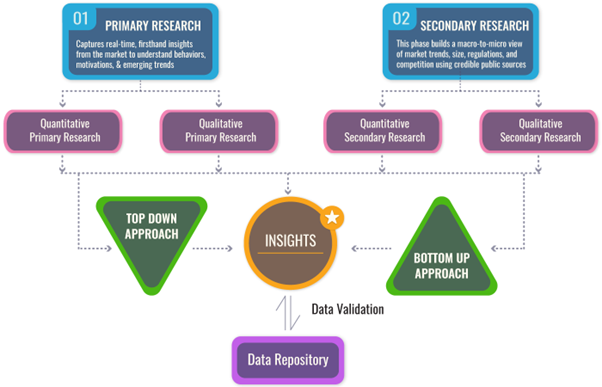
DUAL MODELING: TOP-DOWN + BOTTOM-UP
To ensure robust market estimation, we apply two complementary sizing approaches:
Top-Down Modeling:- Start with broader industry value (e.g., global or regional TAM)
- Apply filters by segment, geography, end-user, or use case
- Adjust with primary insights and validation benchmarks
- Ideal for investor-grade market scans and opportunity mapping
- Aggregate from the ground up using sales volumes, pricing, and unit economics
- Use internal modeling templates aligned with stakeholder data
- Incorporate distributor-level or region-specific inputs
- Most accurate for emerging segments and granular sub-markets
DATA VALIDATION: IN-HOUSE REPOSITORY
We close the loop with proprietary data intelligence built from ongoing projects, industry monitoring, and historical benchmarking. This repository includes:
- Multi-sector market and pricing models
- Key trendlines from past interviews and forecasts
- Benchmarked adoption rates, churn patterns, and ROI indicators
- Industry-specific deviation flags and cross-check logic
- Catches inconsistencies early
- Aligns projections across studies
- Enables consistent, high-trust deliverables