

Blood Lactate Analyzer Market Size and Forecast (2020 - 2033), Global and Regional Growth, Trend, Share, and Industry Analysis Report Coverage: By Product Type (Portable/Handheld Analyzers, Benchtop Analyzers), By Application (Critical Care, Sports Medicine, Others), By End-User (Hospitals & Diagnostic Centers, Sports & Athletics Centers, Home Care Settings) And Geography
2025-12-12
Healthcare
Swetal (Research Analyst)
Description
Blood
Lactate Analyzer Market Overview
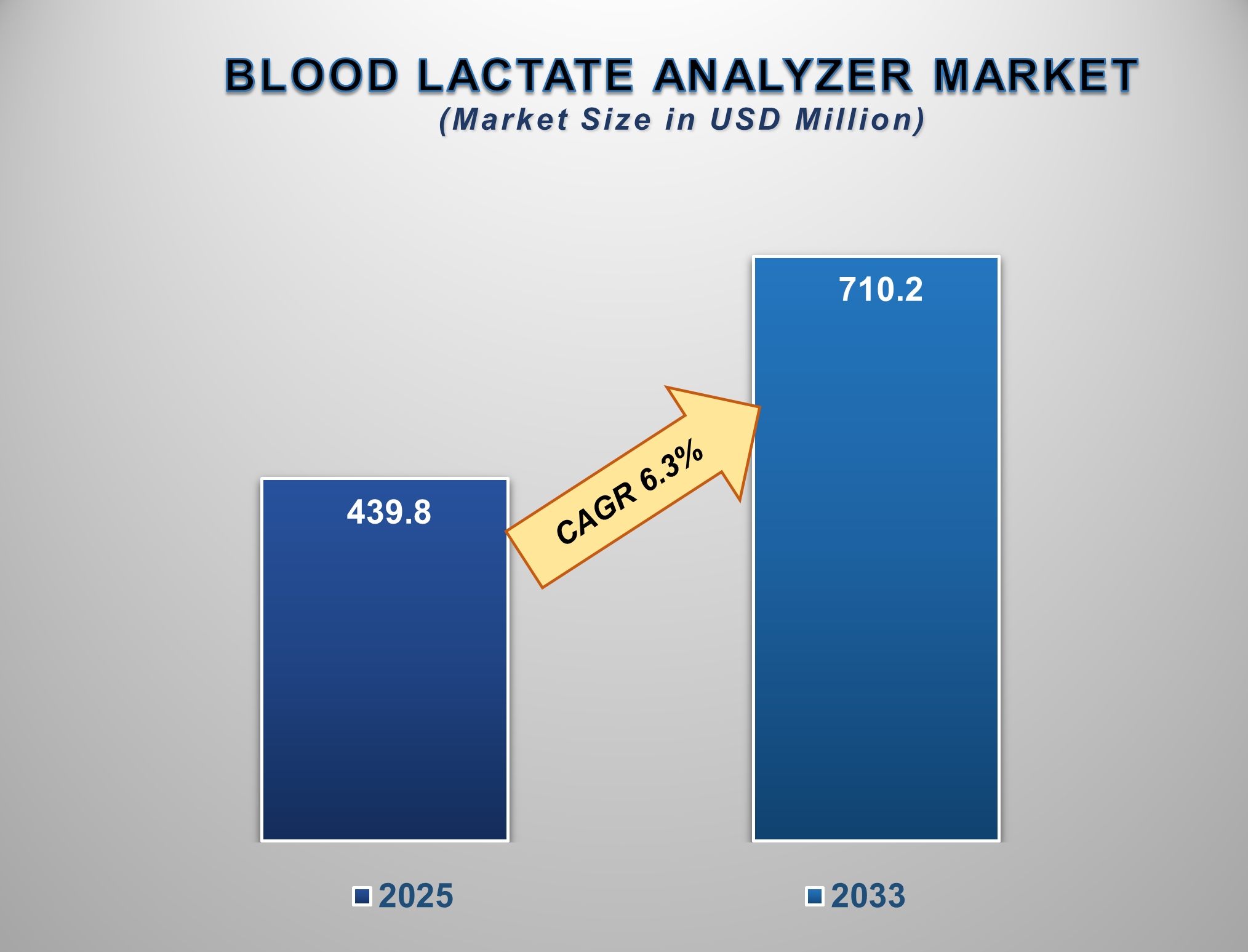
The Blood Lactate Analyzer Market is positioned for significant growth from 2025 to 2033, driven by the critical importance of lactate measurement in clinical diagnostics and athletic performance monitoring. The market is projected to be valued at approximately USD 439.8 million in 2025 and is forecasted to reach nearly USD 710.2 million by 2033, exhibiting a compound annual growth rate (CAGR) of 6.3% during this period.
Blood lactate analyzers are specialized
point-of-care (POC) testing devices used to measure the concentration of
lactate in the blood, a key biomarker for tissue hypoxia and metabolic stress.
The market's expansion is underpinned by the growing recognition of lactate's
role in diagnosing and managing critical conditions like sepsis, shock, and
trauma in hospital settings, where rapid results can guide life-saving
interventions. Simultaneously, in sports medicine, these devices are
indispensable for optimizing athletic training, determining lactate threshold,
and preventing overtraining.
Factors such as the rising prevalence of
critical illnesses, the increasing number of surgical procedures, and the
growing global emphasis on professional and amateur athletics are key
contributors to demand. Technological advancements leading to more accurate,
user-friendly, and connected portable analyzers are further propelling market
adoption. North America holds the largest market share, while the Asia-Pacific
region is expected to be the fastest-growing, fueled by improving healthcare
infrastructure and rising health consciousness.
Blood Lactate Analyzer Market Drivers and
Opportunities
Increasing Incidence of Sepsis and Critical Care Admissions
is the Primary Market Driver
The rising global incidence of life-threatening
conditions such as sepsis, septic shock, trauma, and cardiac arrest is the most
significant driver for the blood lactate analyzer market. Lactate level is a
crucial prognostic marker and a key component of clinical protocols like the
Surviving Sepsis Campaign guidelines, used for early diagnosis, risk
stratification, and monitoring treatment response. The time-sensitive nature of
these conditions necessitates rapid, point-of-care testing, making handheld lactate
analyzers essential tools in emergency departments and intensive care units
(ICUs). The global focus on improving patient outcomes in critical care is
creating a sustained demand for reliable and quick lactate measurement
solutions.
The incidence of sepsis and critical care
admissions in the United States represents a significant and persistent public
health burden. Sepsis, the body's life-threatening response to infection, is a
leading cause of hospitalization and mortality, often necessitating admission
to an Intensive Care Unit (ICU). Current estimates indicate there are
approximately 1.7 million adult cases of sepsis annually in the U.S., with
nearly 270,000 cases proving fatal. This high incidence directly fuels critical
care admissions, with sepsis being one of the most common reasons for an ICU
stay. The aging population, with a higher prevalence of chronic comorbidities,
and the increasing antimicrobial resistance are key factors contributing to
this trend.
The financial impact is staggering, with sepsis
care costing the U.S. healthcare system tens of billions of dollars each year.
In response, nationwide initiatives like the "Surviving Sepsis
Campaign" have been implemented, emphasizing early detection and
protocolized management, which often includes mandatory lactate testing. This
high volume of sepsis and critical care cases is a primary driver for the blood
lactate analyzer market, as rapid lactate measurement is a cornerstone of
sepsis bundles for diagnosis, risk stratification, and guiding resuscitation
efforts in ICUs across the country.
The Proliferation of Sports Science and Personalized Athletic
Training is Driving Market Evolution
The expanding field of sports medicine and the
growing culture of elite fitness are major catalysts for market growth.
Athletes and coaches increasingly rely on lactate threshold testing to design
personalized training regimens, enhance performance, and accelerate recovery.
The availability of portable, easy-to-use analyzers has moved this testing from
specialized labs to the field, gyms, and training centers. Furthermore, the rise of substandard athletics and the
wellness trend has created a new consumer segment
interested in data-driven health monitoring, pushing manufacturers to develop
affordable and accessible devices for a broader user base.
Technological Integration and Expansion into Home Care
Present Significant Opportunities
The integration of advanced technologies such as
Bluetooth connectivity, data management software, and smartphone apps presents
a significant growth frontier. Key opportunities lie in developing smart
analyzers that can seamlessly log results, track trends over time, and
integrate with electronic health records (EHR) or personal training apps. This
enhances clinical decision-making and athlete coaching. Simultaneously, the
growing trend of home-based healthcare management for patients with chronic
conditions creates an opportunity for simple monitoring devices. For
manufacturers, investing in R&D for connected, data-rich platforms and
exploring indications for chronic disease management are key strategies to
capture new market segments and add value.
Blood Lactate Analyzer Market Scope
|
Report Attributes |
Description |
|
Market Size in 2025 |
USD 439.8 Million |
|
Market Forecast in 2033 |
USD 710.2 Million |
|
CAGR % 2025-2033 |
6.3% |
|
Base Year |
2024 |
|
Historic Data |
2020-2024 |
|
Forecast Period |
2025-2033 |
|
Report USP |
Product Portfolio,
Technological Analysis, Company Market Share, Company Heatmap, Pricing
Analysis, Growth Factors, and more |
|
Segments Covered |
●
By Product Type ●
By Application ●
By End-user |
|
Regional Scope |
●
North America, ●
Europe, ●
APAC, ●
Latin America ●
Middle East and
Africa |
|
Country Scope |
1)
U.S. 2)
Canada 3)
Germany 4)
UK 5)
France 6)
Spain 7)
Italy 8)
Switzerland 9)
China 10)
Japan 11)
India 12)
Australia 13)
South Korea 14)
Brazil 15)
Mexico 16)
Argentina 17)
South Africa 18)
Saudi Arabia 19)
UAE |
Blood Lactate Analyzer Market Report Segmentation
Analysis
The global Blood Lactate Analyzer
Market industry analysis is segmented by Product Type, by Application, by
End-User, and by Region.
The Portable Blood
Lactate Analyzers segment is anticipated to command a dominant market share in
2025.
The
Product Type segment is categorized into Portable/Handheld Analyzers and
Benchtop Analyzers. The Portable/Handheld Analyzers segment commands a dominant
market share due to a fundamental shift towards point-of-care testing (POCT)
across healthcare and sports. Their supremacy is anchored in the critical need
for immediate, on-the-spot diagnostic results to guide time-sensitive
decisions. In clinical settings like emergency rooms and ICUs, the ability to
obtain a lactate level in seconds from a single drop of blood is indispensable
for rapidly diagnosing conditions like sepsis and monitoring treatment
efficacy.
This
eliminates the delays associated with sending samples to a central lab.
Similarly, in sports medicine, coaches and trainers can instantly assess an
athlete's lactate threshold mid-workout to optimize performance and prevent
overtraining. Continuous advancements have made these devices remarkably
accurate, reliable, and user-friendly, solidifying their role as the primary
tool for lactate analysis in fast-paced, decentralized environments where speed
and convenience are paramount.
The Sports and Athletics
Centers segment is projected to be the fastest-growing.
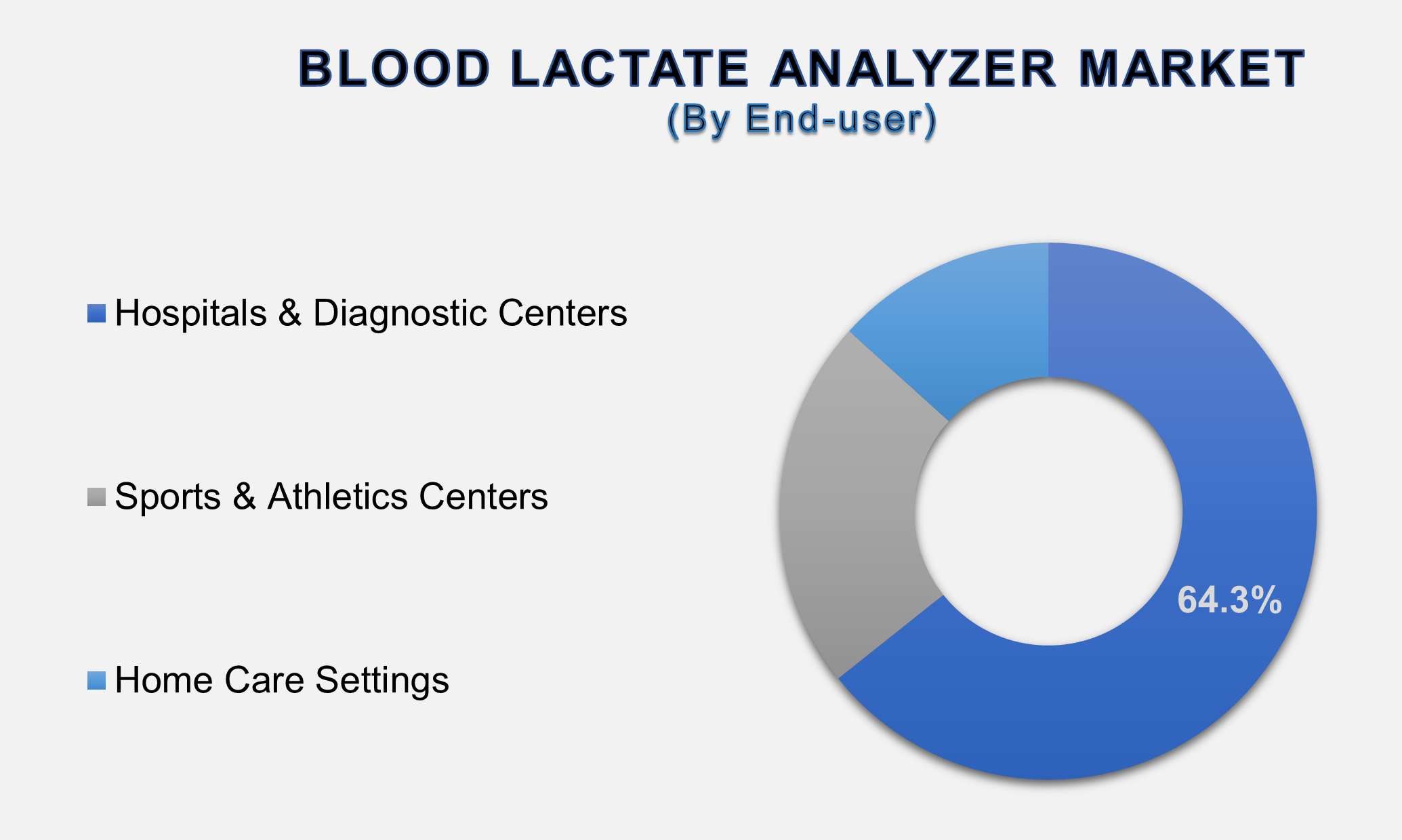
The End-User segment is divided into Hospitals & Diagnostic Centers, Sports & Athletics Centers, and Home Care Settings. The Sports & Athletics Centers segment is projected to be the fastest-growing end-user, driven by the rapid commercialization and scientification of athletic training. What was once a tool confined to elite research labs is now proliferating in professional teams, university sports programs, and even high-end fitness centers. The driving force is the growing understanding that lactate threshold is a crucial metric for tailoring training intensity, enhancing endurance, and speeding up recovery. Both professional and amateur athletes are increasingly adopting this data-driven approach to gain a competitive edge. The availability of affordable, portable analyzers has democratized access to this technology, moving it from a niche service to an integral part of modern coaching.
The Critical Care
application segment is projected to exhibit strong growth.
The
Application segment includes Critical Care, Sports Medicine, and Others. The
Critical Care application segment exhibits strong growth because lactate
measurement has become a non-negotiable, protocol-driven standard in managing
life-threatening conditions. Its clinical utility is firmly established in
global guidelines, such as the Surviving Sepsis Campaign, which mandates lactate testing for early diagnosis, risk stratification,
and guiding resuscitation in septic shock. This institutionalization ensures
consistent and high-volume usage in emergency departments and ICUs worldwide.
Furthermore, the global increase in the incidence of critical illnesses like
sepsis, trauma, and post-surgical complications directly expands the patient
pool requiring lactate monitoring. As healthcare systems continue to emphasize
early intervention and protocolized care to improve patient outcomes and reduce
mortality, the demand for rapid lactate testing within critical care settings
is guaranteed to experience steady and robust growth for the foreseeable
future.
The following segments are
part of an in-depth analysis of the global Blood Lactate Analyzer Market:
|
Market
Segments |
|
|
By Product
Type |
●
Portable/Handheld
Analyzers ●
Benchtop Analyzers |
|
By Application |
●
Critical Care ●
Sports Medicine ●
Others |
|
By End-user |
●
Hospitals &
Diagnostic Centers ●
Sports &
Athletics Centers ●
Home Care Settings |
Blood Lactate Analyzer Market Share Analysis by
Region
The North America region
is anticipated to hold the largest portion of the Blood Lactate Analyzer Market
globally throughout the forecast period.
North
America's dominance is attributed to its well-established healthcare
infrastructure, high healthcare expenditure, and early adoption of advanced
medical technologies. The presence of major global players, stringent clinical
guidelines promoting lactate testing in critical care, and a highly developed
sports industry with numerous professional teams and athletic institutions drives the market. Furthermore, favorable reimbursement scenarios and significant R&D
investments in the U.S. and Canada solidify North America's position as the
largest regional market.
In
addition, the Asia-Pacific region is poised to
be the fastest-growing market for blood lactate analyzers. This growth is
fueled by improving healthcare infrastructure, rising medical tourism,
increasing investments in critical care facilities, and a growing focus on sports
and fitness. Countries like China, India, Japan, and Australia are key
contributors. The large population base, rising disposable incomes, and
increasing awareness about advanced diagnostic tools are creating immense
growth potential for both clinical and sports medicine applications in the
region.
Blood Lactate Analyzer Market Competition
Landscape Analysis
The global blood lactate
analyzer market is moderately consolidated and characterized by the presence of
several established multinational medical device companies and specialized
diagnostic firms. Competition is based on product accuracy, reliability, portability,
test strip cost, data management capabilities, and brand reputation. Key
strategies include continuous product innovation to enhance ease-of-use and
connectivity, strategic partnerships with sports teams and hospital groups, and
expansion into emerging markets with high growth potential.
Global Blood Lactate Analyzer Market Recent
Developments News:
- In March 2025, Nova Biomedical launched a new generation of its
StatStrip Lactate meter with enhanced connectivity features for seamless
EHR integration in hospital settings.
- In January 2025, EKF Diagnostics Holdings PLC received FDA clearance
for an upgraded version of its Lactate Scout+ analyzer, expanding its
claims for use in pre-hospital settings.
- In October 2024, Roche Diagnostics partnered with a major European
football league to become the official provider of lactate testing
solutions for all league teams.
- In August 2024, Arkray, Inc.,
introduced a new, more cost-effective lactate test strip for its
PocketChem BA line, aimed at increasing adoption in price-sensitive
markets.
The Global Blood Lactate Analyzer Market Is
Dominated by a Few Large Companies, such as
●
Nova Biomedical
●
EKF Diagnostics
Holdings PLC
●
Roche Diagnostics
●
Arkray, Inc.
●
ApexBio
●
Analox Ltd.
●
Quest Diagnostics
●
Nipro Corporation
●
Siemens Healthineers
●
Beckman Coulter, Inc.
(Danaher)
●
Johnson & Johnson
●
Abbott Laboratories
●
F. Hoffmann-La Roche
Ltd
●
Instrumentation
Laboratory
● Other Prominent Players
Frequently Asked Questions
Swetal (Research Analyst)
Swetal is a Research Analyst with 4+ years of experience specializing in healthcare market research, medical devices, healthcare IT, and medical technology industry analysis. Her expertise includes competitive intelligence, secondary research, market trend forecasting, and healthcare business insights across global healthcare ecosystems.
She contributes to advanced market research reports by analyzing regulatory frameworks, emerging healthcare technologies, competitive landscapes, and innovation trends shaping the medical industry. With a strong focus on accurate market intelligence, strategic insights, and healthcare industry trends, Swetal supports businesses in making informed, data-backed decisions in a rapidly transforming healthcare environment.
1. Global Blood Lactate
Analyzer Market Introduction and Market Overview
1.1.
Objectives
of the Study
1.2.
Global
Blood Lactate Analyzer Market Scope and Market Estimation
1.2.1.Global Electronic Toll
Collection Overall Market Size (US$ Mn), Market CAGR (%), Market forecast (2025
- 2033)
1.2.2.Global Blood Lactate
Analyzer Market Revenue Share (%) and Growth Rate (Y-o-Y) from 2020 - 2033
1.3.
Market
Segmentation
1.3.1.Product Type of Global Blood
Lactate Analyzer Market
1.3.2.Application of Global Blood
Lactate Analyzer Market
1.3.3.End-user of Global Blood
Lactate Analyzer Market
1.3.4.Region of Global Blood
Lactate Analyzer Market
2. Executive
Summary
2.1.
Demand
Side Trends
2.2.
Key
Market Trends
2.3.
Market
Demand (US$ Mn) Analysis 2020 – 2024 and forecast, 2025 – 2033
2.4.
Demand
and Opportunity Assessment
2.5.
Technological
Advancements
2.6.
Pricing
Analysis
2.7.
Regulatory
Scenario by Region
2.8.
Key
Developments
2.9.
Market
Entry Strategies
2.10.
Market
Dynamics
2.10.1.
Drivers
2.10.2.
Limitations
2.10.3.
Opportunities
2.10.4.
Impact
Analysis of Drivers and Restraints
2.11.
Porter’s
Five Forces Analysis
2.12.
PEST
Analysis
3. Global
Blood Lactate Analyzer Market Estimates
& Historical Trend Analysis (2020 - 2024)
4. Global
Blood Lactate Analyzer Market Estimates
& Forecast Trend Analysis, by Product Type
4.1.
Global
Blood Lactate Analyzer Market Revenue (US$ Mn) Estimates and Forecasts, by Product
Type, 2020 - 2033
4.1.1.Portable/Handheld
Analyzers
4.1.2.Benchtop Analyzers
5. Global
Blood Lactate Analyzer Market Estimates
& Forecast Trend Analysis, by Application
5.1.
Global
Blood Lactate Analyzer Market Revenue (US$ Mn) Estimates and Forecasts, by Application,
2020 - 2033
5.1.1.Critical Care
5.1.2.Sports Medicine
5.1.3.Others
6. Global
Blood Lactate Analyzer Market Estimates
& Forecast Trend Analysis, by End-user
6.1.
Global
Blood Lactate Analyzer Market Revenue (US$ Mn) Estimates and Forecasts, by End-user
2020 - 2033
6.1.1.Hospitals & Diagnostic
Centers
6.1.2.Sports & Athletics
Centers
6.1.3.Home Care Settings
7. Global
Blood Lactate Analyzer Market Estimates
& Forecast Trend Analysis, by region
7.1.
Global
Blood Lactate Analyzer Market Revenue (US$ Mn) Estimates and Forecasts, by region,
2020 - 2033
7.1.1.North America
7.1.2.Europe
7.1.3.Asia Pacific
7.1.4.Middle East & Africa
7.1.5.Latin America
8. North America Blood
Lactate Analyzer Market: Estimates
& Forecast Trend Analysis
8.1.
North
America Blood Lactate Analyzer Market Assessments & Key Findings
8.1.1.North America Blood
Lactate Analyzer Market Introduction
8.1.2.North America Blood
Lactate Analyzer Market Size Estimates and Forecast (US$ Billion) (2020 - 2033)
8.1.2.1. By Product
Type
8.1.2.2. By Application
8.1.2.3. By End-user
8.1.2.4.
By
Country
8.1.2.4.1. The U.S.
8.1.2.4.2. Canada
9. Europe Blood
Lactate Analyzer Market: Estimates
& Forecast Trend Analysis
9.1.
Europe
Blood Lactate Analyzer Market Assessments & Key Findings
9.1.1.Europe Blood Lactate
Analyzer Market Introduction
9.1.2.Europe Blood Lactate
Analyzer Market Size Estimates and Forecast (US$ Billion) (2020 - 2033)
9.1.2.1. By Product
Type
9.1.2.2. By Application
9.1.2.3. By End-user
9.1.2.4.
By
Country
9.1.2.4.1.
Germany
9.1.2.4.2.
Italy
9.1.2.4.3.
U.K.
9.1.2.4.4.
France
9.1.2.4.5.
Spain
9.1.2.4.6.
Switzerland
9.1.2.4.7. Rest
of Europe
10. Asia Pacific Blood
Lactate Analyzer Market: Estimates
& Forecast Trend Analysis
10.1.
Asia
Pacific Market Assessments & Key Findings
10.1.1.
Asia
Pacific Blood Lactate Analyzer Market Introduction
10.1.2.
Asia
Pacific Blood Lactate Analyzer Market Size Estimates and Forecast (US$ Billion)
(2020 - 2033)
10.1.2.1. By Product
Type
10.1.2.2. By Application
10.1.2.3. By End-user
10.1.2.4.
By
Country
10.1.2.4.1. China
10.1.2.4.2. Japan
10.1.2.4.3. India
10.1.2.4.4. Australia
10.1.2.4.5. South Korea
10.1.2.4.6. Rest of Asia Pacific
11. Middle East & Africa Blood
Lactate Analyzer Market: Estimates
& Forecast Trend Analysis
11.1.
Middle
East & Africa Market Assessments & Key Findings
11.1.1.
Middle East & Africa Blood Lactate Analyzer Market
Introduction
11.1.2.
Middle East & Africa Blood Lactate Analyzer Market Size Estimates
and Forecast (US$ Billion) (2020 - 2033)
11.1.2.1. By Product
Type
11.1.2.2. By Application
11.1.2.3. By End-user
11.1.2.4.
By
Country
11.1.2.4.1. UAE
11.1.2.4.2. Saudi
Arabia
11.1.2.4.3. South
Africa
11.1.2.4.4. Rest
of MEA
12. Latin America
Blood Lactate Analyzer Market:
Estimates & Forecast Trend Analysis
12.1.
Latin
America Market Assessments & Key Findings
12.1.1.
Latin
America Blood Lactate Analyzer Market Introduction
12.1.2.
Latin
America Blood Lactate Analyzer Market Size Estimates and Forecast (US$ Billion)
(2020 - 2033)
12.1.2.1. By Product
Type
12.1.2.2. By Application
12.1.2.3. By End-user
12.1.2.4.
By
Country
12.1.2.4.1. Brazil
12.1.2.4.2. Argentina
12.1.2.4.3. Mexico
12.1.2.4.4. Rest
of LATAM
13. Country Wise Market:
Introduction
14.
Competition
Landscape
14.1.
Global
Blood Lactate Analyzer Market Product Mapping
14.2.
Global
Blood Lactate Analyzer Market Concentration Analysis, by Leading Players /
Innovators / Emerging Players / New Entrants
14.3.
Global
Blood Lactate Analyzer Market Tier Structure Analysis
14.4.
Global
Blood Lactate Analyzer Market Concentration & Company Market Shares (%)
Analysis, 2024
15.
Company
Profiles
15.1.
Nova Biomedical
15.1.1.
Company
Overview & Key Stats
15.1.2.
Financial
Performance & KPIs
15.1.3.
Product
Portfolio
15.1.4.
SWOT
Analysis
15.1.5.
Business
Strategy & Recent Developments
* Similar details would be provided for all the players
mentioned below
15.2. EKF
Diagnostics Holdings PLC
15.3. Roche
Diagnostics
15.4. Arkray, Inc.
15.5. ApexBio
15.6. Analox Ltd.
15.7. Quest
Diagnostics
15.8. Nipro
Corporation
15.9. Siemens
Healthineers
15.10. Beckman
Coulter, Inc. (Danaher)
15.11. Johnson &
Johnson
15.12. Abbott
Laboratories
15.13. F.
Hoffmann-La Roche Ltd
15.14. Instrumentation
Laboratory
15.15. Other Players
16. Research
Methodology
16.1.
External
Transportations / Databases
16.2.
Internal
Proprietary Database
16.3.
Primary
Research
16.4.
Secondary
Research
16.5.
Assumptions
16.6.
Limitations
16.7.
Report
FAQs
17. Research
Findings & Conclusion
Our Research Methodology
"Insight without rigor is just noise."
We follow a comprehensive, multi-phase research framework designed to deliver accurate, strategic, and decision-ready intelligence. Our process integrates primary and secondary research , both quantitative and qualitative , along with dual modeling techniques ( top-down and bottom-up) and a final layer of validation through our proprietary in-house repository.
PRIMARY RESEARCH
Primary research captures real-time, firsthand insights from the market to understand behaviors, motivations, and emerging trends.
1. Quantitative Primary Research
Objective: Generate statistically significant data directly from market participants.
Approaches:- Structured surveys with customers, distributors, and field agents
- Mobile-based data collection for point-of-sale audits and usage behavior
- Phone-based interviews (CATI) for market sizing and product feedback
- Online polling around industry events and digital campaigns
- Purchase frequency by customer type
- Channel performance across geographies
- Feature demand by application or demographic
2. Qualitative Primary Research
Objective: Explore decision-making drivers, pain points, and market readiness.
Approaches:- In-depth interviews (IDIs) with executives, product managers, and key decision-makers
- Focus groups among end users and early adopters
- Site visits and observational research for consumer products
- Informal field-level discussions for regional and cultural nuances
SECONDARY RESEARCH
This phase helps establish a macro-to-micro understanding of market trends, size, regulation, and competitive dynamics, sourced from credible and public domain information.
1. Quantitative Secondary Research
Objective: Model market value and segment-level forecasts based on published data.
Sources include:- Financial reports and investor summaries
- Government trade data, customs records, and regulatory statistics
- Industry association publications and economic databases
- Channel performance and pricing data from marketplace listings
- Revenue splits, pricing trends, and CAGR estimates
- Supply-side capacity and volume tracking
- Investment analysis and funding benchmarks
2. Qualitative Secondary Research
Objective: Capture strategic direction, innovation signals, and behavioral trends.
Sources include:- Company announcements, roadmaps, and product pipelines
- Publicly available whitepapers, conference abstracts, and academic research
- Regulatory body publications and policy briefs
- Social and media sentiment scanning for early-stage shifts
- Strategic shifts in market positioning
- Unmet needs and white spaces
- Regulatory triggers and compliance impact
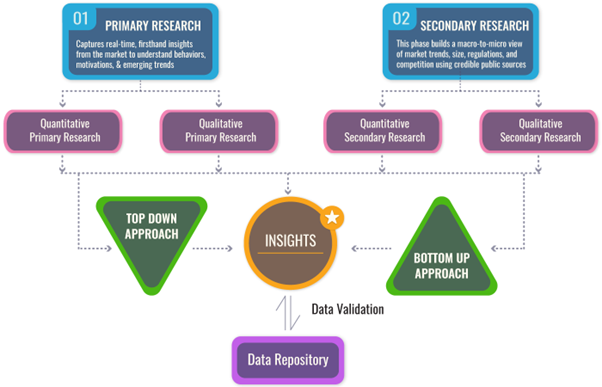
DUAL MODELING: TOP-DOWN + BOTTOM-UP
To ensure robust market estimation, we apply two complementary sizing approaches:
Top-Down Modeling:- Start with broader industry value (e.g., global or regional TAM)
- Apply filters by segment, geography, end-user, or use case
- Adjust with primary insights and validation benchmarks
- Ideal for investor-grade market scans and opportunity mapping
- Aggregate from the ground up using sales volumes, pricing, and unit economics
- Use internal modeling templates aligned with stakeholder data
- Incorporate distributor-level or region-specific inputs
- Most accurate for emerging segments and granular sub-markets
DATA VALIDATION: IN-HOUSE REPOSITORY
We close the loop with proprietary data intelligence built from ongoing projects, industry monitoring, and historical benchmarking. This repository includes:
- Multi-sector market and pricing models
- Key trendlines from past interviews and forecasts
- Benchmarked adoption rates, churn patterns, and ROI indicators
- Industry-specific deviation flags and cross-check logic
- Catches inconsistencies early
- Aligns projections across studies
- Enables consistent, high-trust deliverables