

Boat and Ship Telematics Market Size and Forecast (2026–2034), Global and Regional Growth, Trend, Share and Industry Analysis Report Coverage; By Component (Hardware, Software, Services); By Technology (Satellite Telematics, Cellular Telematics, Hybrid Systems); By Function (Navigation & Positioning, Fleet Management & Monitoring, Safety & Security, Communication & Connectivity, Environmental Compliance & Reporting, Cargo & Asset Tracking); By Vessel Type (Commercial Cargo Vessels, Passenger Vessels, Fishing & Aquaculture Vessels, Offshore & Energy Vessels, Government & Military Vessels, Leisure & Recreational Boats); By Sales Channel (OEM, Aftermarket); and Geography
2026-10-09
Automotive & Transportation (Mobility)
Ekta Chaurasia (Team Lead)
Description
Boat and Ship Telematics Market
Overview
The global Boat
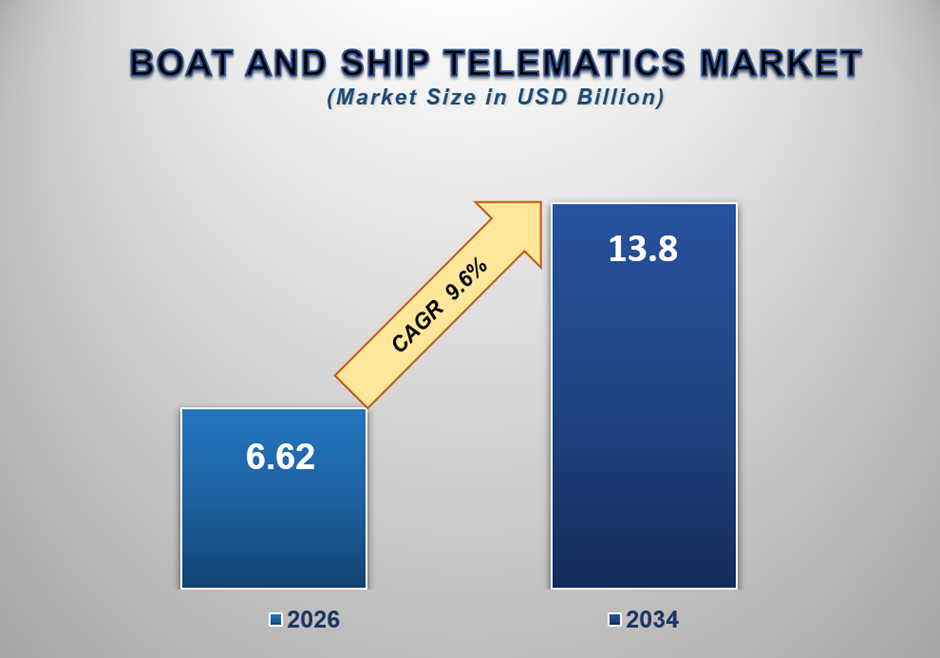
and Ship Telematics Market was valued at USD 6.62 billion in 2026
and is projected to reach USD 13.8 billion by 2034, expanding at a CAGR
of 9.6% during the forecast period. The market is experiencing strong
growth as vessel owners, fleet operators, ports, and marine-service providers
increasingly adopt connected technologies for real-time vessel monitoring,
navigation, fuel management, predictive maintenance, safety, compliance, and
remote fleet operations.
Boat and ship
telematics combines onboard sensors, positioning systems, communication
equipment, connectivity technologies, data platforms, and analytics to collect
and transmit operational information between vessels and shore-based systems.
These technologies increasingly connect navigation, propulsion, machinery, fuel
consumption, safety systems, cargo, environmental information, and
fleet-management workflows.
The increasing digitalization
of maritime operations is one of the primary factors supporting market
expansion. Vessel operators are moving from isolated onboard systems toward
connected architectures capable of transferring operational information to
centralized platforms. The International Maritime Organization approved an
overarching strategy on maritime digitalization in March 2026, emphasizing
interoperability, system standardization, data-sharing, and data governance
across the maritime sector.
The growing
emphasis on fuel efficiency and operating-cost reduction is further
increasing demand for telematics. Connected vessel platforms can combine
position, route, weather, machinery, fuel, and performance information to
support voyage optimization and operational decision-making. Wärtsilä
identifies digitalization, big data, and analytics as major forces shaping
shipping in 2026, particularly as vessel systems become more complex and
operators seek better fuel and emissions performance.
Environmental
regulations are also strengthening demand for reliable vessel data. Shipowners
increasingly need accurate operational information for emissions monitoring,
carbon-intensity management, environmental reporting, and regulatory
documentation. The growing importance of connected data therefore extends
telematics adoption beyond fleet visibility into compliance-related workflows.
The adoption of satellite
and hybrid connectivity is expanding the addressable market across
ocean-going vessels. Satellite telematics remains essential for vessels
operating outside terrestrial network coverage, while cellular connectivity is
increasingly useful close to shore, in ports, on inland waterways, and for
recreational boats. Hybrid systems can combine both connectivity types to
improve coverage and manage communication costs.
The market is
also benefiting from the increasing deployment of IoT sensors and connected
onboard equipment. Sensors can capture engine condition, fuel consumption,
vessel position, cargo conditions, environmental parameters, and safety
information, enabling remote monitoring and predictive maintenance. As software
platforms become more capable, the commercial value of telematics is
increasingly shifting toward data analytics, fleet optimization, and managed
services in addition to hardware deployment.
The development
of autonomous and remotely operated vessels represents another major
opportunity. In May 2026, the IMO adopted the first global Code for Maritime
Autonomous Surface Ships, covering areas including software principles,
connectivity, remote operations, navigation, and safety. The Code took effect on
1 July 2026 for applicable cargo ships, strengthening the regulatory framework
around connected and remotely operated maritime systems.
Increasing adoption of cloud-based fleet-management platforms, higher-bandwidth maritime communication, connected recreational boats, AI-enabled analytics, and remote vessel operations is expected to support continued market growth through 2034.
Boat and Ship Telematics Market
Drivers and Opportunities
Increasing
Maritime Digitalization Is Driving Market Growth
The transition
toward digitally connected maritime operations is one of the key factors
supporting the boat and ship telematics market.
Fleet operators
increasingly require centralized access to vessel location, engine condition,
fuel consumption, voyage progress, maintenance information, and safety alerts.
Telematics systems provide the data infrastructure required to connect
vessel-level information with shore-based operational platforms.
The IMO's 2026
Maritime Digitalization Strategy emphasizes interoperability, standardized
systems, data-sharing, and effective data governance. This regulatory focus
reinforces the broader movement toward integrated digital maritime operations.
The increasing
use of digital fleet platforms is also changing the competitive structure of
the industry, with suppliers expanding from individual tracking products toward
integrated monitoring, analytics, connectivity, and optimization ecosystems.
Fuel
Efficiency and Voyage Optimization Are Supporting Market Expansion
Fuel represents
a major operating expense for many commercial vessels, making fuel monitoring,
route optimization, speed management, weather routing, and
machinery-performance analytics important applications for telematics.
Connected
systems can combine real-time vessel position with operational and
environmental data, enabling operators to identify inefficient operating
patterns and make adjustments during voyages.
Wärtsilä
highlights real-time voyage optimization, fuel-efficiency forecasting,
emissions tracking, predictive maintenance, and data analytics as increasingly
important applications for maritime digitalization.
The increasing
pressure to reduce both operating expenses and emissions is therefore
encouraging operators to invest in telematics platforms that convert vessel
data into actionable operational information.
Environmental
Regulations Are Creating Additional Demand
Environmental
compliance is becoming an increasingly important application for vessel
telematics.
Connected
systems can collect and organize fuel consumption, voyage, engine, emissions,
and other operational data needed for reporting and performance monitoring.
This is particularly relevant as international and regional regulations make
emissions measurement increasingly important to commercial shipping.
The IMO's
carbon-intensity framework and maritime emissions requirements create demand
for reliable data collection and reporting workflows, while digital systems can
reduce dependence on fragmented manual records.
The Environmental
Compliance & Reporting segment is therefore expected to register strong
growth as operators move from basic reporting toward continuous emissions and
efficiency monitoring.
Growth of
Hybrid and Multi-Network Connectivity Presents Significant Opportunities
Satellite
connectivity remains essential for open-ocean operations, but cellular networks
are increasingly useful in coastal and port environments.
A hybrid model
enables vessels to use terrestrial cellular networks where available and shift
to satellite connectivity when vessels move beyond cellular coverage. This
approach can improve connectivity continuity while reducing the amount of
high-cost satellite bandwidth used for non-critical information.
The combination
of satellite, cellular, edge processing, and cloud platforms creates
opportunities for providers offering integrated connectivity management rather
than standalone communication hardware. Current market analysis identifies
hybrid telematics as an increasingly important architecture as operators
balance coverage, reliability, and communication costs.
AI,
Predictive Maintenance and Remote Operations Create New Opportunities
Artificial
intelligence and advanced analytics are expanding the functionality of maritime
telematics beyond conventional vessel tracking.
AI-assisted
platforms can analyze operational data to identify potential equipment issues,
estimate maintenance requirements, improve voyage decisions, and identify
deviations from expected vessel performance.
Wärtsilä's
current marine digitalization approach combines AI, advanced diagnostics,
real-time communication, and predictive operations to support asset reliability
and reduce unplanned downtime.
Kongsberg has
likewise identified digitalization, remote operations, and AI-driven
optimization as important areas shaping maritime technology development.
The expansion of
autonomous and remotely operated ships is expected to further increase the
requirement for continuous, trusted, and secure vessel data.
Boat and Ship Telematics Market Scope
|
Report
Attributes |
Description |
|
Market Size
in 2026 |
USD 6.62 Billion |
|
Market
Forecast in 2034 |
USD 13.8 Billion |
|
CAGR %
2026-2034 |
9.6% |
|
Base Year |
2025 |
|
Historic
Data |
2021-2025 |
|
Forecast
Period |
2026-2034 |
|
Report USP |
Production,
Consumption, Company Share, Company Heatmap, Company Production, Service
Type, Growth Factors and more |
|
Segments
Covered |
By
Component By
Technology By Function By Vessel
Type By Sales
Channel |
|
Regional
Scope |
● North America |
|
Country
Scope |
U.S. |
Boat and Ship Telematics Market
Report Segmentation Analysis
The global boat
and ship telematics market industry analysis is segmented by component, by
technology, by function, by vessel type, by sales channel, and by region.
The Hardware
Segment Is Expected to Dominate the Market During the Forecast Period
The Hardware
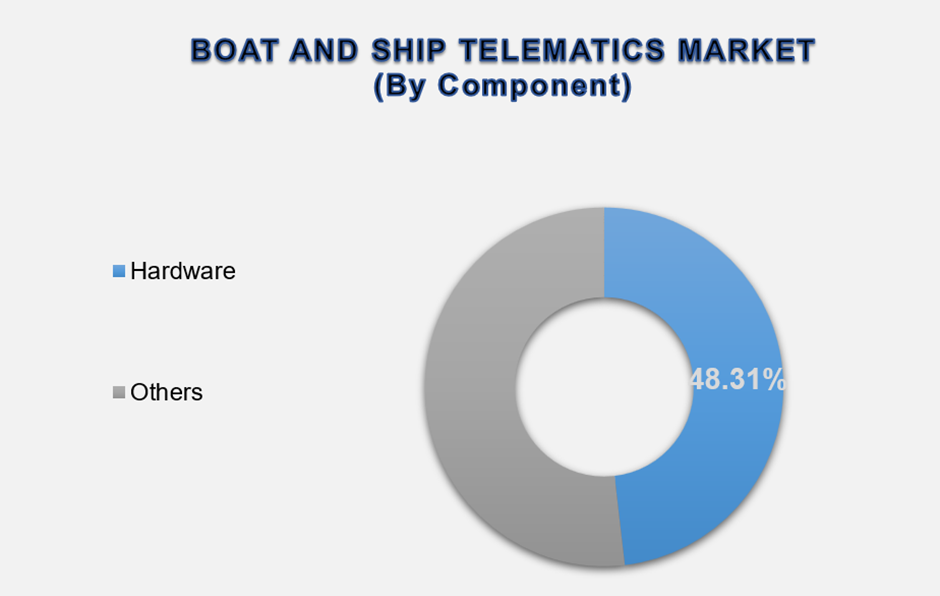
segment accounted for approximately 48.31% of the global market revenue
in 2025, making it the leading component category. The segment includes GPS and
navigation systems, sensors and IoT devices, satellite transponders, antennas,
communication modems, onboard displays, and telematics control equipment.
Hardware remains
essential because connected maritime applications require physical equipment to
capture, process, and transmit vessel data.
The growing
deployment of AIS transponders, GNSS receivers, onboard sensors, communication
terminals, marine antennas, and connected interfaces continues to support
hardware demand across commercial and recreational vessels.
However, the Software
segment is expected to record faster growth as fleet operators increasingly
adopt cloud-based fleet-management systems, predictive-maintenance platforms,
route optimization tools, environmental reporting applications, and AI-enabled
analytics.
The Satellite
Telematics Segment Is Expected to Dominate the Market by Technology
The Satellite
Telematics segment held approximately 54.8% of the market in 2025,
representing the largest technology category.
Satellite
telematics remains essential for ocean-going vessels operating beyond
terrestrial network coverage. Commercial cargo vessels, tankers, offshore
vessels, naval fleets, and other long-distance maritime operations require
reliable connectivity for tracking, communication, safety, and operational
monitoring.
The Cellular
Telematics segment is expected to experience strong growth as LTE and 5G
coverage expands across coastal waters, ports, inland waterways, ferries, and
recreational boating environments.
Hybrid systems
are also gaining adoption because they combine satellite and cellular
connectivity to maintain continuity while optimizing bandwidth costs.
The Fleet
Management & Monitoring Segment Is Expected to Dominate the Market by
Function
The Fleet
Management & Monitoring segment accounted for approximately 25.6%
of market revenue in 2025 and represented the largest functional category.
Fleet-management
platforms allow operators to monitor vessel location, engine condition, fuel
consumption, maintenance requirements, voyage progress, and operational
performance from shore-based systems.
The increasing
complexity of commercial fleets is strengthening demand for centralized fleet
visibility. Connected platforms enable operators to compare vessel performance,
identify exceptions, manage maintenance, and coordinate operations across
multiple ships.
The Environmental
Compliance & Reporting segment is expected to register faster growth as
operators increasingly require automated systems for emissions, fuel, and
regulatory data collection.
The
Commercial Cargo Vessels Segment Is Expected to Dominate the Market by Vessel
Type
The Commercial
Cargo Vessels segment accounted for approximately 38.5% of the
market in 2025, making it the leading vessel category.
Container ships,
bulk carriers, tankers, and other commercial cargo vessels increasingly use
telematics for fuel optimization, voyage management, cargo visibility,
predictive maintenance, safety, and regulatory reporting.
The global
seaborne trade environment also creates a broad installed base for
connected-vessel technologies. Telematics is increasingly used to transform
vessel data into operational information that can support more predictable
voyages and improved asset utilization.
The Leisure
& Recreational Boats segment is expected to record rapid growth as
connected navigation, remote monitoring, geofencing, theft protection,
smartphone-based vessel management, and safety functions become more accessible
to recreational boat owners.
The OEM
Segment Is Expected to Dominate the Market by Sales Channel
The OEM
segment accounted for approximately 63.7% of market revenue in 2025,
representing the largest sales channel.
Shipbuilders and
vessel manufacturers increasingly integrate navigation equipment, communication
systems, telematics hardware, sensors, and monitoring platforms during vessel
construction.
Factory-installed
systems can simplify integration, improve interoperability, and reduce the
complexity associated with installing multiple independent systems after vessel
commissioning.
The Aftermarket
segment is expected to experience strong growth as aging commercial and
recreational fleets are retrofitted with new connectivity systems, cloud
platforms, monitoring equipment, and upgraded navigation technologies.
The Following Segments Are Part of an In-Depth Analysis of the Global Boat and Ship Telematics Market:
|
Market Segments |
|
|
By Component |
●
Hardware o GPS & Navigation
Systems o Sensors & IoT
Devices o Satellite
Transponders & Antennas o Communication Modems
& Systems o Onboard Display &
Interface Devices ●
Software o Fleet Management
Software o Route Optimization
Platforms o Remote Monitoring
& Diagnostics Software o Predictive
Maintenance Applications o Security &
Surveillance Software ●
Services o Installation &
Integration Services o Managed Connectivity
Services o Data Analytics &
Reporting Services |
|
By
Technology |
●
Satellite Telematics ●
Cellular Telematics ●
Hybrid Systems |
|
By
Function |
●
Navigation & Positioning ●
Fleet Management & Monitoring ●
Safety & Security ●
Communication & Connectivity ●
Environmental Compliance & Reporting ●
Cargo & Asset Tracking |
|
By Vessel Type |
●
Commercial Cargo Vessels ●
Passenger Vessels ●
Fishing & Aquaculture Vessels ●
Offshore & Energy Vessels ●
Government & Military Vessels ●
Leisure & Recreational Boats |
|
By Sales
Channel |
●
OEM ●
Aftermarket |
Boat and Ship Telematics Market Share
Analysis By Region
North America is projected to hold a leading share of the global boat and ship
telematics market, supported by established commercial shipping activity,
extensive inland waterways, a large recreational boating sector, and relatively
early adoption of connected vessel technologies. Current industry analysis
identifies North America as the largest regional market and Asia Pacific as the
fastest-growing region.
The United
States is the dominant contributor within North America. It represented
approximately 83.6% of the North American market in 2025, according to
current industry analysis. Demand is supported by commercial fleet monitoring,
recreational boating, offshore operations, connected navigation, remote
monitoring, and growing investment in autonomous and AI-enabled maritime
technologies.
Canada represents an additional market opportunity because of its
extensive coastline, inland waterways, commercial marine activity, and growing
use of connected navigation and fleet-management technologies.
Europe maintains a substantial market share due to its large maritime
shipping sector, major ports, advanced vessel-manufacturing ecosystem, and
emphasis on environmental performance and digitalization.
The U.K.,
Germany, France, Italy, Spain, the Netherlands, Belgium, and Scandinavian
maritime markets are important contributors.
European operators are increasingly investing in connected vessel monitoring,
predictive maintenance, digital fleet platforms, and environmental reporting.
The region also
benefits from regulatory developments that encourage data-based maritime
operations and digital reporting.
Asia Pacific is expected to experience the fastest growth during the forecast
period. The region combines major shipbuilding capabilities, extensive shipping
routes, expanding port infrastructure, large commercial fleets, and increasing
maritime digitalization.
China represents a major regional market because of its large shipping,
shipbuilding, port, and offshore industries. The country's extensive commercial
fleet and investments in connected maritime infrastructure are creating
opportunities for telematics providers.
Japan and South Korea remain important markets because of their
established shipbuilding and marine-equipment industries and their increasing
adoption of automation and digital vessel technologies.
India is expected to create additional opportunities through port
modernization, maritime trade growth, coastal shipping, inland waterway
development, and increasing adoption of digital fleet technologies.
Latin America is expected to experience steady market growth, supported by
commercial shipping, offshore oil and gas activities, fishing fleets, port
development, and recreational boating. Brazil and Mexico remain
important regional contributors.
Brazil is particularly relevant because of its extensive offshore energy
activity and large maritime operating environment, creating demand for vessel
tracking, fleet monitoring, navigation, communications, and safety
technologies.
Middle East
& Africa represents an emerging market
supported by maritime trade, offshore energy projects, port investments,
commercial shipping, and fleet modernization.
The expansion of digital ports, offshore operations, connected logistics, and maritime communications is expected to provide additional opportunities across Saudi Arabia, the UAE, and South Africa.
Boat and Ship
Telematics Market Competition Landscape Analysis
The boat and
ship telematics market is competitive, with satellite communication providers,
marine electronics manufacturers, maritime technology companies, software
suppliers, and fleet-management providers competing across different layers of
the connected-vessel ecosystem.
Competition is
increasingly focused on connectivity reliability, data integration, fleet
analytics, navigation capabilities, cybersecurity, AI-enabled optimization,
remote monitoring, and interoperability with existing vessel systems.
Viasat maintains a significant market position through maritime satellite
communications, connectivity, vessel monitoring, fleet analytics, and related
digital services. Current industry analysis identifies Viasat as the largest
individual company by market share, with approximately 13.59% in 2025.
Wärtsilä competes through a broad marine technology portfolio encompassing
vessel performance, voyage optimization, automation, navigation,
communications, fleet services, and digital solutions. The company identifies
digitalization, AI, and data analytics as important areas for improving vessel
performance and lifecycle optimization.
Kongsberg
Maritime has a strong presence in marine
automation, navigation, propulsion, vessel integration, and digitalization. In
2026, Kongsberg highlighted digitalization, remote operations, AI-driven
optimization, and energy efficiency as key maritime technology priorities.
ORBCOMM focuses strongly on IoT connectivity and remote monitoring,
including asset and cargo applications. The company competes through connected
devices, satellite and cellular communications, and cloud-based monitoring
platforms.
Inmarsat
Maritime, a Viasat company, remains a major
provider of maritime satellite connectivity. In January 2026, Evergreen Marine
announced a fleetwide transition to Inmarsat's NexusWave bonded connectivity
solution following successful trials. The agreement is intended to improve
vessel connectivity, crew experience, cybersecurity, and digitalization across
Evergreen's fleet.
Iridium
Communications competes through global satellite
connectivity and IoT capabilities, particularly in remote and high-latitude
areas where terrestrial connectivity is unavailable.
Navico Group, Garmin, and Furuno Electric are particularly
relevant in connected marine electronics, navigation, communication,
monitoring, and recreational boating applications.
The competitive
environment is increasingly moving toward integrated solutions that combine satellite
and cellular networks, onboard IoT devices, cloud analytics, AI, navigation,
predictive maintenance, and remote fleet management instead of standalone
vessel-tracking products.
Cybersecurity is also becoming a greater differentiating factor. Increasing dependence on satellite-connected and digitally integrated onboard systems is creating additional requirements around access control, network security, data protection, and resilient vessel operations. Recent maritime cybersecurity reporting has highlighted growing attacks against connected vessel systems and satellite-linked equipment, increasing attention to secure-by-design telematics architectures.
Global Boat
and Ship Telematics Market Recent Developments News
●
In September 2026 – The IMO launched a global survey seeking industry and stakeholder
feedback on the implementation of Maritime Single Windows, reinforcing the
continuing role of digital information exchange between ships, ports, and
government agencies.
●
In May 2026 – The IMO adopted the first global Code of Safety for Maritime
Autonomous Surface Ships (MASS Code). The framework addresses areas
including software principles, connectivity, remote operations, navigation,
safety, and cybersecurity-related requirements for autonomous and remotely
controlled commercial ships.
●
In March 2026 – The IMO approved its Strategy on Maritime Digitalization,
emphasizing interoperability, standardization, data-sharing, and data
governance across maritime operations. The same session also approved measures
addressing cybersecurity for maritime single-window systems.
●
In January 2026 – Evergreen Marine confirmed a fleetwide rollout of Inmarsat
Maritime's NexusWave bonded connectivity system following trials. The
deployment is intended to accelerate digitalization and provide secure,
high-performance connectivity across the company's vessels.
●
In April 2026 – Wärtsilä and Erik Thun Group announced a partnership covering
technical and operational services across Erik Thun Group's fleet, including
proactive maintenance and lifecycle support, reflecting the increasing adoption
of data-driven and digitally supported vessel operations.
● In February 2026 – KONGSBERG highlighted strong demand for maritime technologies addressing safety, energy efficiency, and operational decision-making and announced preparations for Kongsberg Maritime's separation as an independent listed company.
The Global
Boat and Ship Telematics Market is Dominated by a Few Large Companies, Such As
●
Viasat, Inc.
●
Wärtsilä Corporation
●
Kongsberg Maritime
●
ORBCOMM Inc.
●
Navico Group
●
Inmarsat Maritime
●
Iridium Communications Inc.
●
KVH Industries, Inc.
●
Garmin Ltd.
●
Furuno Electric Co., Ltd.
●
Marlink AS
●
Intellian Technologies Inc.
●
Thales Group
●
L3Harris Technologies, Inc.
●
Teledyne Technologies
Incorporated
●
Applied Satellite Technology
Ltd.
●
Japan Radio Co., Ltd.
●
Pole Star Space Applications
Limited
●
NSSLGlobal Ltd.
●
Satcom Global Ltd.
● Others
Frequently Asked Questions
Ekta Chaurasia (Team Lead)
Ekta Chaurasia is a highly experienced Team Lead at M2Square Consultancy with over 7 years of expertise in market research, strategic consulting, competitive benchmarking, and business intelligence solutions. She specializes in ICT, semiconductors & electronics, automotive & transportation, and industrial machinery markets.
She leads end-to-end global research projects focused on market trends, industry analysis, growth forecasting, customer insights, and strategic decision-making. Known for her analytical leadership and industry expertise, Ekta helps businesses uncover growth opportunities, evaluate competitive landscapes, and stay ahead in rapidly evolving markets through accurate and insight-driven research.
1.
Global Boat and Ship
Telematics Market Introduction and Market Overview
1.1. Objectives of the Study
1.2. Global Boat and Ship Telematics Market Scope and Market Estimation
1.2.1.
Global Boat and Ship Telematics
Market Size (US$ Million), Market CAGR (%), Market Forecast (2026 - 2034)
1.2.2.
Global Boat and Ship Telematics
Market Revenue Share (%) and Growth Rate (Y-o-Y) Analysis (2021 - 2034)
1.3. Market Segmentation
1.3.1.
By Component of Global Boat and
Ship Telematics Market
1.3.2.
By Technology of Global Boat
and Ship Telematics Market
1.3.3.
By Function of Global Boat and
Ship Telematics Market
1.3.4.
By Vessel Type of Global Boat
and Ship Telematics Market
1.3.5.
By Sales Channel of Global Boat
and Ship Telematics Market
1.3.6.
Region of Global Boat and Ship
Telematics Market
1.4. Competition Coverage List of Market Participants
1.5. Market Definition: Boat and Ship Telematics Market
2.
Executive Summary
2.1. Demand Side Trends
2.2. Key Market Trends
2.3. Market Demand (US$ Million) Analysis 2021 – 2025 and Forecast, 2026
– 2034
2.4. Demand and Opportunity Assessment
2.5. Key Developments
2.6. Overview of Regulatory Landscape, Compliance Framework, and Industry
Standards
2.7. Market Entry Strategies
2.8. Market Dynamics
2.8.1.
Drivers
2.8.2.
Limitations
2.8.3.
Opportunities
2.8.4.
Impact Analysis of Drivers and
Restraints
2.9. Porter's Five Forces Analysis
2.10.
PEST Analysis
3.
Global Boat and Ship Telematics
Market Estimates & Historical Trend Analysis (2021 – 2025)
4.
Global Boat and Ship
Telematics Market Estimates & Forecast Trend Analysis, by Component
4.1. Global Boat and Ship Telematics Market Revenue (US$ Million)
Estimates and Forecasts, by Component, 2021 - 2034
4.1.1.
Hardware
4.1.2.
Software
4.1.3.
Services
5.
Global Boat and Ship
Telematics Market Estimates & Forecast Trend Analysis, by Technology
5.1. Global Boat and Ship Telematics Market Revenue (US$ Million)
Estimates and Forecasts, by Technology, 2021 - 2034
5.1.1.
Satellite Telematics
5.1.2.
Cellular Telematics
5.1.3.
Hybrid Systems
6.
Global Boat and Ship
Telematics Market Estimates & Forecast Trend Analysis, by Function
6.1. Global Boat and Ship Telematics Market Revenue (US$ Million)
Estimates and Forecasts, by Function, 2021 - 2034
6.1.1.
Navigation & Positioning
6.1.2.
Fleet Management &
Monitoring
6.1.3.
Safety & Security
6.1.4.
Communication &
Connectivity
6.1.5.
Environmental Compliance &
Reporting
6.1.6.
Cargo & Asset Tracking
7.
Global Boat and Ship
Telematics Market Estimates & Forecast Trend Analysis, by Vessel Type
7.1. Global Boat and Ship Telematics Market Revenue (US$ Million)
Estimates and Forecasts, by Vessel Type, 2021 - 2034
7.1.1.
Commercial Cargo Vessels
7.1.2.
Passenger Vessels
7.1.3.
Fishing & Aquaculture
Vessels
7.1.4.
Offshore & Energy Vessels
7.1.5.
Government & Military
Vessels
7.1.6.
Leisure & Recreational
Boats
8.
Global Boat and Ship
Telematics Market Estimates & Forecast Trend Analysis, by Sales Channel
8.1. Global Boat and Ship Telematics Market Revenue (US$ Million)
Estimates and Forecasts, by Sales Channel, 2021 - 2034
8.1.1.
OEM
8.1.2.
Aftermarket
9.
Global Boat and Ship
Telematics Market Estimates & Forecast Trend Analysis, by Region
9.1. Global Boat and Ship Telematics Market Revenue (US$ Million)
Estimates and Forecasts, by Region, 2021 - 2034
9.1.1.
North America
9.1.2.
Europe
9.1.3.
Asia Pacific
9.1.4.
Middle East & Africa
9.1.5.
Latin America
10. North America Boat and Ship Telematics Market: Estimates &
Forecast Trend Analysis
10.1.
North America Boat and Ship
Telematics Market Assessments & Key Findings
10.1.1.
North America Boat and Ship
Telematics Market Introduction
10.1.2.
North America Boat and Ship
Telematics Market Size Estimates and Forecast (US$ Million) (2021 - 2034)
10.1.2.1.
By Component
10.1.2.2.
By Technology
10.1.2.3.
By Function
10.1.2.4.
By Vessel Type
10.1.2.5.
By Sales Channel
10.1.2.6.
By Country
10.1.2.6.1.
The U.S.
10.1.2.6.2.
Canada
11. Europe Boat and Ship Telematics Market: Estimates & Forecast
Trend Analysis
11.1.
Europe Boat and Ship Telematics
Market Assessments & Key Findings
11.1.1.
Europe Boat and Ship Telematics
Market Introduction
11.1.2.
Europe Boat and Ship Telematics
Market Size Estimates and Forecast (US$ Million) (2021 - 2034)
11.1.2.1.
By Component
11.1.2.2.
By Technology
11.1.2.3.
By Function
11.1.2.4.
By Vessel Type
11.1.2.5.
By Sales Channel
11.1.2.6.
By Country
11.1.2.6.1.
Germany
11.1.2.6.2.
Italy
11.1.2.6.3.
The U.K.
11.1.2.6.4.
France
11.1.2.6.5.
Spain
11.1.2.6.6.
Switzerland
11.1.2.6.7.
Rest of Europe
12. Asia Pacific Boat and Ship Telematics Market: Estimates &
Forecast Trend Analysis
12.1.
Asia Pacific Boat and Ship
Telematics Market Assessments & Key Findings
12.1.1.
Asia Pacific Boat and Ship
Telematics Market Introduction
12.1.2.
Asia Pacific Boat and Ship
Telematics Market Size Estimates and Forecast (US$ Million) (2021 - 2034)
12.1.2.1.
By Component
12.1.2.2.
By Technology
12.1.2.3.
By Function
12.1.2.4.
By Vessel Type
12.1.2.5.
By Sales Channel
12.1.2.6.
By Country
12.1.2.6.1.
China
12.1.2.6.2.
Japan
12.1.2.6.3.
India
12.1.2.6.4.
Australia
12.1.2.6.5.
South Korea
12.1.2.6.6.
Rest of Asia Pacific
13. Middle East & Africa Boat and Ship Telematics Market: Estimates
& Forecast Trend Analysis
13.1.
Middle East & Africa Boat
and Ship Telematics Market Assessments & Key Findings
13.1.1.
Middle East & Africa Boat
and Ship Telematics Market Introduction
13.1.2.
Middle East & Africa Boat
and Ship Telematics Market Size Estimates and Forecast (US$ Million) (2021 -
2034)
13.1.2.1.
By Component
13.1.2.2.
By Technology
13.1.2.3.
By Function
13.1.2.4.
By Vessel Type
13.1.2.5.
By Sales Channel
13.1.2.6.
By Country
13.1.2.6.1.
UAE
13.1.2.6.2.
Saudi Arabia
13.1.2.6.3.
South Africa
13.1.2.6.4.
Rest of Middle East &
Africa
14. Latin America Boat and Ship Telematics Market: Estimates &
Forecast Trend Analysis
14.1.
Latin America Boat and Ship
Telematics Market Assessments & Key Findings
14.1.1.
Latin America Boat and Ship
Telematics Market Introduction
14.1.2.
Latin America Boat and Ship Telematics
Market Size Estimates and Forecast (US$ Million) (2021 - 2034)
14.1.2.1.
By Component
14.1.2.2.
By Technology
14.1.2.3.
By Function
14.1.2.4.
By Vessel Type
14.1.2.5.
By Sales Channel
14.1.2.6.
By Country
14.1.2.6.1.
Brazil
14.1.2.6.2.
Mexico
14.1.2.6.3.
Argentina
14.1.2.6.4.
Rest of Latin America
15. Competition Landscape
15.1.
Global Boat and Ship Telematics
Market Product Mapping
15.2.
Global Boat and Ship Telematics
Market Concentration Analysis, by Leading Players / Innovators / Emerging
Players / New Entrants
15.3.
Global Boat and Ship Telematics
Market Tier Structure Analysis
15.4.
Global Boat and Ship Telematics
Market Concentration & Company Market Shares (%) Analysis, 2026
16. Company Profiles
16.1.
Viasat, Inc.
16.1.1.
Company Overview & Key
Stats
16.1.2.
Financial Performance &
KPIs
16.1.3.
Product Portfolio
16.1.4.
SWOT Analysis
16.1.5.
Business Strategy & Recent
Developments
*Similar details would be provided for all
the players mentioned below
16.2.
Wärtsilä Corporation
16.3.
Kongsberg Maritime
16.4.
ORBCOMM Inc.
16.5.
Navico Group
16.6.
Inmarsat Maritime
16.7.
Iridium Communications Inc.
16.8.
KVH Industries, Inc.
16.9.
Garmin Ltd.
16.10.
Furuno Electric Co., Ltd.
16.11.
Marlink AS
16.12.
Intellian Technologies Inc.
16.13.
Thales Group
16.14.
L3Harris Technologies, Inc.
16.15.
Teledyne Technologies
Incorporated
16.16.
Applied Satellite Technology
Ltd.
16.17.
Japan Radio Co., Ltd.
16.18.
Pole Star Space Applications
Limited
16.19.
NSSLGlobal Ltd.
16.20.
Satcom Global Ltd.
16.21.
Others
17. Research Findings & Conclusion
18. Assumptions & Acronyms Used
19. Research Methodology
19.1.
External Databases
19.2.
Internal Proprietary Database
19.3.
Primary Research
19.4.
Secondary Research
19.5.
Assumptions
19.6.
Limitations
19.7.
Report FAQ
Our Research Methodology
"Insight without rigor is just noise."
We follow a comprehensive, multi-phase research framework designed to deliver accurate, strategic, and decision-ready intelligence. Our process integrates primary and secondary research , both quantitative and qualitative , along with dual modeling techniques ( top-down and bottom-up) and a final layer of validation through our proprietary in-house repository.
PRIMARY RESEARCH
Primary research captures real-time, firsthand insights from the market to understand behaviors, motivations, and emerging trends.
1. Quantitative Primary Research
Objective: Generate statistically significant data directly from market participants.
Approaches:- Structured surveys with customers, distributors, and field agents
- Mobile-based data collection for point-of-sale audits and usage behavior
- Phone-based interviews (CATI) for market sizing and product feedback
- Online polling around industry events and digital campaigns
- Purchase frequency by customer type
- Channel performance across geographies
- Feature demand by application or demographic
2. Qualitative Primary Research
Objective: Explore decision-making drivers, pain points, and market readiness.
Approaches:- In-depth interviews (IDIs) with executives, product managers, and key decision-makers
- Focus groups among end users and early adopters
- Site visits and observational research for consumer products
- Informal field-level discussions for regional and cultural nuances
SECONDARY RESEARCH
This phase helps establish a macro-to-micro understanding of market trends, size, regulation, and competitive dynamics, sourced from credible and public domain information.
1. Quantitative Secondary Research
Objective: Model market value and segment-level forecasts based on published data.
Sources include:- Financial reports and investor summaries
- Government trade data, customs records, and regulatory statistics
- Industry association publications and economic databases
- Channel performance and pricing data from marketplace listings
- Revenue splits, pricing trends, and CAGR estimates
- Supply-side capacity and volume tracking
- Investment analysis and funding benchmarks
2. Qualitative Secondary Research
Objective: Capture strategic direction, innovation signals, and behavioral trends.
Sources include:- Company announcements, roadmaps, and product pipelines
- Publicly available whitepapers, conference abstracts, and academic research
- Regulatory body publications and policy briefs
- Social and media sentiment scanning for early-stage shifts
- Strategic shifts in market positioning
- Unmet needs and white spaces
- Regulatory triggers and compliance impact
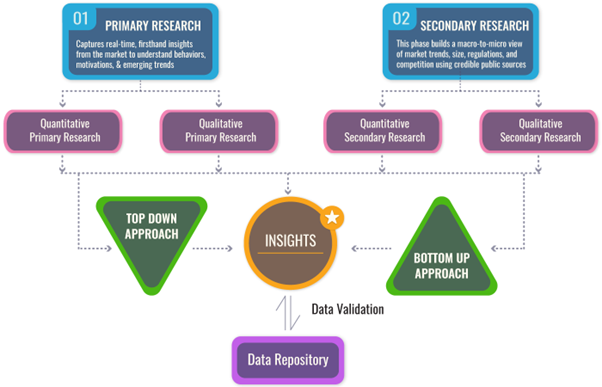
DUAL MODELING: TOP-DOWN + BOTTOM-UP
To ensure robust market estimation, we apply two complementary sizing approaches:
Top-Down Modeling:- Start with broader industry value (e.g., global or regional TAM)
- Apply filters by segment, geography, end-user, or use case
- Adjust with primary insights and validation benchmarks
- Ideal for investor-grade market scans and opportunity mapping
- Aggregate from the ground up using sales volumes, pricing, and unit economics
- Use internal modeling templates aligned with stakeholder data
- Incorporate distributor-level or region-specific inputs
- Most accurate for emerging segments and granular sub-markets
DATA VALIDATION: IN-HOUSE REPOSITORY
We close the loop with proprietary data intelligence built from ongoing projects, industry monitoring, and historical benchmarking. This repository includes:
- Multi-sector market and pricing models
- Key trendlines from past interviews and forecasts
- Benchmarked adoption rates, churn patterns, and ROI indicators
- Industry-specific deviation flags and cross-check logic
- Catches inconsistencies early
- Aligns projections across studies
- Enables consistent, high-trust deliverables