

Bone & Joint Health Supplements Market Size And Forecast (2020–2033), Global And Regional Growth, Trend, Share, and Industry Analysis Report Coverage: By Product (Vitamins, Minerals, Collagen, Omega-3, Glucosamine, Others), By Formulation (Capsules, Tablets, Powders, Softgels, Others), By Application (Bone Density Support, Bone Strength Support, Mobility & Physical Function, Muscle Health & Recovery, Performance Enhancement, Pain Relief & Inflammation Management), By Consumer Group (Infants, Children, Adults, Pregnant Women, Geriatric Population), By Sales Channel (Brick & Mortar, E-Commerce) And Geography
2025-12-18
Healthcare
Swetal (Research Analyst)
Description
Bone & Joint Health Supplements Market Overview
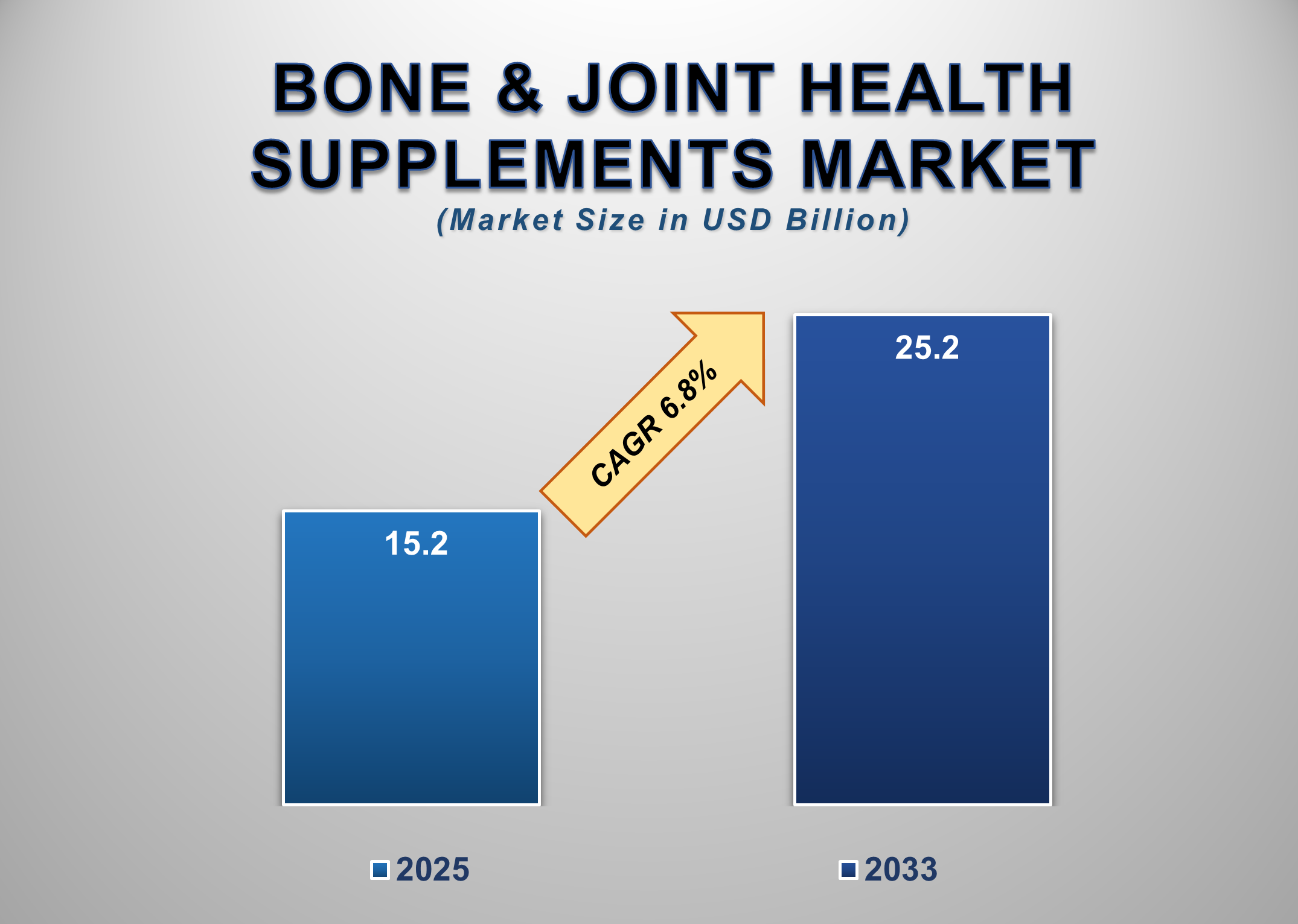
The global Bone & Joint Health Supplements Market is positioned for steady growth between 2025 and 2033, driven by rising musculoskeletal health concerns, increasing aging populations, growing sports nutrition demand, and expanding awareness of preventive healthcare. The market is estimated at USD 15.2 billion in 2025 and is projected to reach USD 25.2 billion by 2033, reflecting a moderate yet consistent CAGR of 6.8% during the forecast period. Rising incidences of osteoporosis, osteoarthritis, joint degeneration, mobility impairments, and nutrient deficiencies, especially among adults and seniors, are key factors influencing market expansion. The growing consumer shift toward lifestyle management, holistic wellness, and long-term bone health maintenance is also fueling the demand for supplements such as vitamins (D, K2), calcium, magnesium, collagen peptides, glucosamine, chondroitin, omega-3 fatty acids, and herbal anti-inflammatory blends.
Additionally,
increasing adoption of plant-based and clean-label nutritional supplements,
supported by strong distribution growth through pharmacies, supermarkets,
health specialist stores, and e-commerce platforms, is accelerating
consumption. Government and healthcare initiatives promoting nutrition for bone
development in children and bone mass preservation in adults are further
boosting industry uptake. The rise of personalized nutrition, clinically
validated formulations, and mobility-focused supplements tailored for athletes
and geriatric users is reshaping the competitive landscape. With growing
investments in R&D, clinical evidence, and digital retail channels, the
Bone & Joint Health Supplements Market is set to offer significant
expansion opportunities globally over the next decade.
Bone & Joint Health
Supplements Market Drivers and Opportunities
Rising Prevalence of Osteoporosis and Joint Disorders Is
Accelerating Demand for Bone & Joint Health Supplements Worldwide
The
rapidly increasing prevalence of osteoporosis, osteopenia, arthritis, and
mobility-related health disorders is one of the strongest drivers of the global
Bone & Joint Health Supplements Market. Sedentary lifestyles, vitamin D
deficiency, unhealthy dietary patterns, and rising obesity levels are major
contributing factors to weak bone density and chronic joint pain among both
younger and older populations. According to international health agencies, more
than 200 million people worldwide suffer from osteoporosis, with women and
older adults at significantly higher risk. Similarly, the incidence of
osteoarthritis is growing due to aging demographics and higher physical
workloads among working-class individuals. These health burdens are promoting
greater adoption of clinically supported supplements such as calcium, vitamin
D, magnesium, collagen peptides, glucosamine, chondroitin, and omega-3 fatty
acids, which help improve bone mineral density, strengthen connective tissues,
and enhance joint lubrication. Moreover, increased physician recommendations
for preventive bone health supplementation, along with growing participation in
health screening programs, are further driving
global demand. Consumers are increasingly opting for long-term supplementation
to slow down bone degeneration and support mobility. With bone health becoming
a core component of preventive healthcare, the demand for scientifically validated,
high-absorption, and targeted bone & joint health supplements is expected
to strengthen significantly during the forecast period.
Growing
Focus on Preventive Healthcare and Active Lifestyles Is Driving Market
Expansion
A
global shift toward preventive healthcare, wellness, and active living is
significantly boosting the Bone & Joint Health Supplements Market.
Consumers across age groups, especially millennials and middle-aged adults, are
proactively investing in nutritional supplements to maintain musculoskeletal
strength, reduce inflammation, and enhance long-term mobility. Increased health
awareness, better access to medical information, and rising participation in
fitness, sports, yoga, and strength training activities are stimulating demand
for supplements that support cartilage repair, muscle recovery, and joint
flexibility. Healthcare professionals are increasingly recommending vitamin D3,
calcium, magnesium, collagen peptides, and omega-3 fatty acids as part of routine
bone and joint care plans. The global surge in sports participation also
contributes significantly to market growth. Athletes and fitness enthusiasts
frequently consume mobility-enhancing supplements to prevent injuries, expedite
recovery, and support ligament strength. Simultaneously, the rapid rise of
personalized nutrition and online consultation platforms is making supplement
selection more customized and accessible. The pandemic further accelerated
preventive health spending, with consumers placing higher emphasis on overall
immunity and musculoskeletal strength. As a result, preventive supplementation
is becoming a standard lifestyle habit rather than a reactive solution, driving
sustained market growth for bone & joint health supplements.
Emerging
Economies’ Adoption of Nutritional Supplements Is Creating Strong Growth
Opportunities in the Global Market
Emerging economies across the Asia-Pacific, Latin America, and the
Middle East & Africa present significant growth opportunities for the Bone
& Joint Health Supplements Market. Rapid urbanization, rising middle-class
populations, growing disposable incomes, and expanding healthcare access are
driving higher awareness and consumption of nutritional supplements. Countries
such as India, China, Indonesia, Brazil, and the UAE are witnessing increasing
incidences of vitamin deficiencies, early-onset joint pain, and
lifestyle-induced musculoskeletal problems, creating strong demand for
affordable bone & joint health solutions. Government-led nutrition
programs, preventive health campaigns, and initiatives promoting maternal and
child health are accelerating adoption. Additionally, the booming e-commerce
sector in these regions enables direct access to a wide variety of supplements,
bridging the gap between global brands and consumers in remote areas.
International supplement manufacturers are expanding their footprint through
partnerships, product localization, clean-label innovations, and pricing
strategies tailored for developing markets. With growing emphasis on
nutritional literacy, digital health platforms, and preventive wellness
culture, emerging economies are expected to become major contributors to market
revenue growth over the next decade.
Bone & Joint Health
Supplements Market Scope
|
Report Attributes |
Description |
|
Market Size in 2025 |
USD 15.2 Billion |
|
Market Forecast in 2033 |
USD 25.2 Billion |
|
CAGR % 2025-2033 |
6.8% |
|
Base Year |
2024 |
|
Historic Data |
2020-2024 |
|
Forecast Period |
2025-2033 |
|
Report USP |
Production, Consumption,
Company Share, Company Heatmap, Company Production Capacity, Growth Factors,
and more |
|
Segments Covered |
●
Product,
Formulation, Application, Consumer Group, Sales Channel |
|
Regional Scope |
●
North America, ●
Europe, ●
APAC, ●
Latin America ●
Middle East and
Africa |
|
Country Scope |
1)
U.S. 2)
Canada 3)
Germany 4)
UK 5)
France 6)
Spain 7)
Italy 8)
Switzerland 9)
China 10)
Japan 11)
India 12)
Australia 13)
South Korea 14)
Brazil 15)
Mexico 16)
Argentina 17)
South Africa 18)
Saudi Arabia 19)
UAE |
Bone & Joint Health Supplements Market Report
Segmentation Analysis
The global Bone & Joint
Health Supplements Market is segmented by product, formulation, application,
consumer group, sales channel, and region.
The
Vitamins Segment Accounted for the Largest Market
Share in the Global Bone & Joint Health Supplements Market
Based
on product, the market is segmented into Vitamins, Minerals, Collagen, Omega-3,
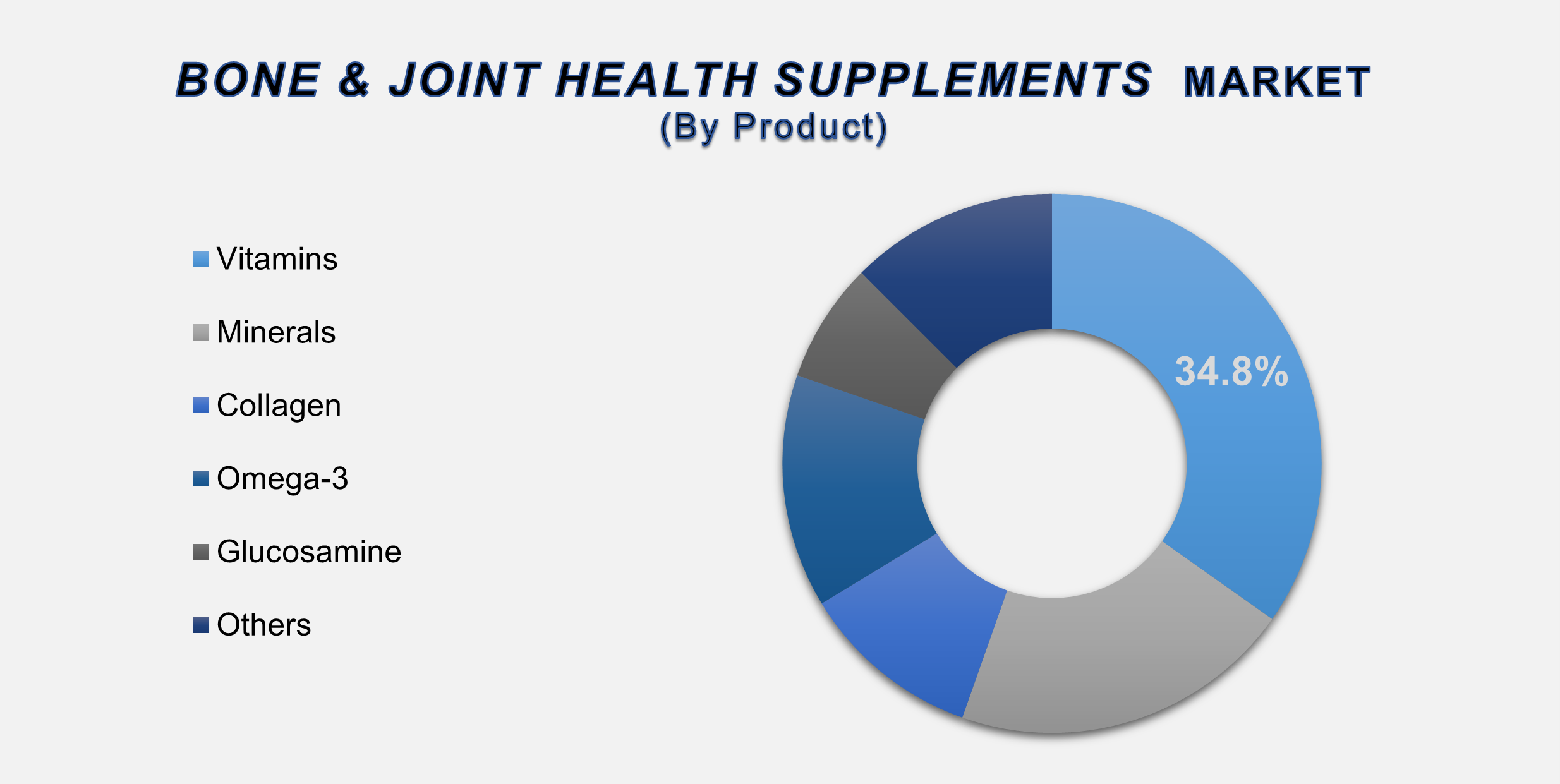
Glucosamine, and Others. The Vitamins segment holds a dominant 34.8% share in
2025, driven by strong consumer demand for vitamin D3, vitamin K2, and
multivitamin complexes that support calcium absorption, bone mineralization,
and muscle function. Vitamin deficiencies are increasingly common worldwide,
especially vitamin D deficiency, which significantly impacts bone density,
immunity, and mobility. Rising medical recommendations, higher fortification
initiatives, and widespread use among children, adults, and geriatric
populations further strengthen this segment.
Additionally, evolving product innovations such as high-absorption
microencapsulation, vegan vitamin D3, and combined D3+K2 formulations are
enhancing market growth.
Capsules Segment Dominated the Bone & Joint Health Supplements Market
By
formulation, the market is categorized into Capsules, Tablets, Powders,
Softgels, and Others, with Capsules emerging as the leading formulation in
2025. Capsules are widely preferred due to their ease of swallowing, controlled
release capabilities, faster absorption, and better stability of active
ingredients. They are commonly used for multivitamins, mineral blends, collagen
peptides, glucosamine-chondroitin, and herbal anti-inflammatory supplements.
Manufacturers are increasingly adopting plant-based capsules, gelatin-free
variants, and clinically dosed capsule formulations to appeal to
health-conscious and vegan consumers. Capsules also provide better dosing
flexibility, making them the top choice for long-term bone & joint support
regimens.
Bone
Density Support Leads the Application Segment and Will Continue to Dominate
By
application, the market includes Bone Density Support, Bone Strength Support,
Mobility & Physical Function, Muscle Health & Recovery, Performance
Enhancement, and Pain Relief & Inflammation Management. Bone Density
Support remains the leading application area, driven by increasing risks of
osteoporosis, hormonal imbalances, calcium deficiency, and age-related bone
loss. This segment is especially prominent among women aged 40+, geriatric
individuals, and individuals with vitamin D deficiency. Supplements targeting
bone density improvement typically include calcium, vitamin D3, magnesium,
collagen peptides, vitamin K2, and mineral complexes. Rising awareness through
medical recommendations, corporate wellness programs, and public health
initiatives is further boosting the adoption of bone density enhancement
supplements worldwide.
The following segments are
part of an in-depth analysis of the global Bone & Joint Health Supplements
market:
|
Market Segments |
|
|
By Product |
●
Vitamins ●
Minerals ●
Collagen ●
Omega-3 ●
Glucosamine ●
Others |
|
By Formulation |
●
Capsules ●
Tablets ●
Powders ●
Softgels ●
Others |
|
By Application |
●
Bone Density
Support ●
Bone Strength
Support ●
Mobility &
Physical Function ●
Muscle Health &
Recovery ●
Performance
Enhancement (Sports & Endurance) ●
Pain Relief &
Inflammation Management |
|
By Consumer
Group |
●
Infants ●
Children ●
Adults ●
Pregnant Women ●
Geriatric Population |
|
By Sales
Channel |
●
Bricks and Mortar o
Direct Selling o
Chemists/Pharmacies o
Health Food Shops o
Hypermarkets o
Supermarkets ●
E-commerce |
Bone & Joint Health
Supplements Market Share Analysis by Region
North America is
anticipated to hold the biggest portion of the Bone & Joint Health
Supplements Market globally throughout the forecast period.
North America accounted for the
largest share of 40.11% in 2025, driven by high healthcare awareness, strong
consumer preference for dietary supplements, and widespread availability of
advanced bone & joint formulations. The U.S. leads the region due to high
osteoporosis prevalence, strong e-commerce penetration, and increasing demand
for collagen peptides, glucosamine, and vitamin D supplements. Robust clinical
research activities, high purchasing power, and strong regulatory oversight
further support market growth. Major supplement brands and private-label
product expansions also contribute to North America’s leadership.
The Asia-Pacific (APAC) region is
expected to witness the highest CAGR throughout the forecast period due to
rapid urbanization, growing middle-class populations, and rising
lifestyle-related bone and joint issues. Countries such as China, India, Japan,
and South Korea are experiencing increasing rates of vitamin D deficiency,
early joint degeneration, and a surge in functional food and nutraceutical
consumption. Expanding retail channels, digital health platforms, and growing
preference for natural, herbal, and Ayurvedic bone care solutions are expected
to further accelerate APAC’s growth. Government-led health awareness
initiatives and rising sports participation are also contributing to the rapid
expansion of the bone & joint health supplements sector in the region.
Bone & Joint Health
Supplements Market Competition Landscape Analysis
The global Bone & Joint
Health Supplements Market is characterized by strong competition among
established nutraceutical companies, pharmaceutical manufacturers, and emerging
natural supplement brands. Companies are focusing heavily on R&D innovation,
clinical validation, clean-label ingredients, botanical actives, and
personalized formulations to strengthen market presence. Strategic
collaborations, e-commerce expansion, and product diversification into vegan,
allergen-free, and high-bioavailability formulations are shaping competitive
dynamics. Manufacturers are also investing in advanced packaging, quality
certifications, and targeted marketing to differentiate their offerings in a
crowded marketplace.
Global Bone & Joint
Health Supplements Market Recent Developments News:
- In February 2022,
Amway expanded its Nutrilite product line with the introduction of jelly
strips, offering consumers a convenient and innovative format for dietary
supplements.
- In December 2021,
ADM strengthened its flavor and specialty ingredients portfolio in
Latin America and the Caribbean through the acquisition of Flavor Infusion
International (FISA), enhancing its ability to deliver tailored solutions
across the food and beverage sector.
The Global Bone & Joint Health
Supplements Market Is Dominated by a Few Large Companies, such as
●
Pfizer
●
Bayer AG
●
Abbott Laboratories
●
GlaxoSmithKline
●
Amway
●
Reckitt Benckiser
●
Arkopharma
●
NOW Foods
●
Nature's Bounty
●
Swisse Wellness
●
GNC Holdings
●
Puritan's Pride
●
Jarrow Formulas
●
Doctor's Best
●
Solgar
●
MegaFood
●
Nature Made
●
Rainbow Light
●
Osteo Bi-Flex
●
Move Free
● Others
Frequently Asked Questions
Swetal (Research Analyst)
Swetal is a Research Analyst with 4+ years of experience specializing in healthcare market research, medical devices, healthcare IT, and medical technology industry analysis. Her expertise includes competitive intelligence, secondary research, market trend forecasting, and healthcare business insights across global healthcare ecosystems.
She contributes to advanced market research reports by analyzing regulatory frameworks, emerging healthcare technologies, competitive landscapes, and innovation trends shaping the medical industry. With a strong focus on accurate market intelligence, strategic insights, and healthcare industry trends, Swetal supports businesses in making informed, data-backed decisions in a rapidly transforming healthcare environment.
1. Global Bone & Joint
Health Supplements Market Introduction and Market Overview
1.1.
Objectives
of the Study
1.2.
Global
Bone & Joint Health Supplements Market Scope and Market Estimation
1.2.1.Global Bone & Joint
Health Supplements Overall Market Size (US$ Bn), Market CAGR (%), Market
forecast (2025 - 2033)
1.2.2.Global Bone & Joint
Health Supplements Market Revenue Share (%) and Growth Rate (Y-o-Y) from 2020 -
2033
1.3.
Market
Segmentation
1.3.1.Product of Global Bone
& Joint Health Supplements Market
1.3.2.Formulation of Global Bone
& Joint Health Supplements Market
1.3.3.Application of Global Bone
& Joint Health Supplements Market
1.3.4.Consumer Group of Global Bone
& Joint Health Supplements Market
1.3.5.Sales Channel of Global Bone
& Joint Health Supplements Market
1.3.6.Region of Global Bone
& Joint Health Supplements Market
2. Executive
Summary
2.1.
Demand
Side Trends
2.2.
Key
Market Trends
2.3.
Market
Demand (US$ Bn) Analysis 2020 – 2024 and Forecast, 2025 – 2033
2.4.
Demand
and Opportunity Assessment
2.5.
Demand
Supply Scenario
2.6.
Market
Dynamics
2.7.
Drivers
2.8.
Limitations
2.9.
Opportunities
2.10.
Impact
Analysis of Drivers and Restraints
2.11.
Emerging
Trends for Lithium-ion Battery Recycling Market
2.12.
Porter’s
Five Forces Analysis
2.13.
PEST
Analysis
2.14.
Key
Regulation
3. Global
Bone & Joint Health Supplements Market
Estimates & Historical Trend Analysis (2020 - 2024)
4.
Global Bone & Joint
Health Supplements Market Estimates
& Forecast Trend Analysis, by Product
4.1.
Global
Bone & Joint Health Supplements Market Revenue (US$ Bn) Estimates and
Forecasts, by Product, 2020 - 2033
4.1.1.Vitamins
4.1.2.Minerals
4.1.3.Collagen
4.1.4.Omega-3
4.1.5.Glucosamine
4.1.6.Others
5.
Global Bone & Joint
Health Supplements Market Estimates
& Forecast Trend Analysis, by Formulation
5.1.
Global
Bone & Joint Health Supplements Market Revenue (US$ Bn) Estimates and
Forecasts, by Formulation, 2020 - 2033
5.1.1.Capsules
5.1.2.Tablets
5.1.3.Powders
5.1.4.Softgels
5.1.5.Others
6.
Global Bone & Joint
Health Supplements Market Estimates
& Forecast Trend Analysis, by Application
6.1.
Global
Bone & Joint Health Supplements Market Revenue (US$ Bn) Estimates and
Forecasts, by Form, 2020 - 2033
6.1.1.Bone Density Support
6.1.2.Bone Strength
Support
6.1.3.Mobility & Physical
Function
6.1.4.Muscle Health &
Recovery
6.1.5.Performance Enhancement
(Sports & Endurance)
6.1.6.Pain Relief &
Inflammation Management
7.
Global Bone & Joint
Health Supplements Market Estimates
& Forecast Trend Analysis, by Consumer Group
7.1.
Global
Bone & Joint Health Supplements Market Revenue (US$ Bn) Estimates and
Forecasts, by Consumer Group, 2020 - 2033
7.1.1.Infants
7.1.2.Children
7.1.3.Adults
7.1.4.Pregnant Women
7.1.5.Geriatric Population
8. Global
Bone & Joint Health Supplements Market
Estimates & Forecast Trend Analysis, by Sales
Channel
8.1.
Global
Bone & Joint Health Supplements Market Revenue (US$ Bn) Estimates and
Forecasts, by Sales Channel, 2020 - 2033
8.1.1.Bricks and Mortar
8.1.1.1.
Direct
Selling
8.1.1.2.
Chemists/Pharmacies
8.1.1.3.
Health
Food Shops
8.1.1.4.
Hypermarkets
8.1.1.5.
Supermarkets
8.1.2.E-commerce
9. Global
Bone & Joint Health Supplements Market
Estimates & Forecast Trend Analysis, by Region
9.1.
Global
Bone & Joint Health Supplements Market Revenue (US$ Bn) Estimates and
Forecasts, by Region, 2020 - 2033
9.1.1.North America
9.1.2.Europe
9.1.3.Asia Pacific
9.1.4.Middle East & Africa
9.1.5.Latin America
10. North America Bone
& Joint Health Supplements Market:
Estimates & Forecast Trend Analysis
10.1.
North
America Bone & Joint Health Supplements Market Assessments & Key
Findings
10.1.1.
North
America Bone & Joint Health Supplements Market Introduction
10.1.2.
North
America Bone & Joint Health Supplements Market Size Estimates and Forecast
(US$ Billion) (2020 - 2033)
10.1.2.1. By Product
10.1.2.2. By Formulation
10.1.2.3. By Application
10.1.2.4. By Consumer
Group
10.1.2.5. By Sales
Channel
10.1.2.6.
By
Country
10.1.2.6.1. The U.S.
10.1.2.6.2. Canada
11. Europe Bone
& Joint Health Supplements Market:
Estimates & Forecast Trend Analysis
11.1.
Europe
Bone & Joint Health Supplements Market Assessments & Key Findings
11.1.1.
Europe
Bone & Joint Health Supplements Market Introduction
11.1.2.
Europe
Bone & Joint Health Supplements Market Size Estimates and Forecast (US$ Billion)
(2020 - 2033)
11.1.2.1. By Product
11.1.2.2. By Formulation
11.1.2.3. By Application
11.1.2.4. By Consumer
Group
11.1.2.5. By Sales
Channel
11.1.2.6.
By
Country
11.1.2.6.1.
Germany
11.1.2.6.2.
Italy
11.1.2.6.3.
U.K.
11.1.2.6.4.
France
11.1.2.6.5.
Spain
11.1.2.6.6.
Switzerland
11.1.2.6.7. Rest
of Europe
12. Asia Pacific Bone
& Joint Health Supplements Market:
Estimates & Forecast Trend Analysis
12.1.
Asia
Pacific Market Assessments & Key Findings
12.1.1.
Asia
Pacific Bone & Joint Health Supplements Market Introduction
12.1.2.
Asia
Pacific Bone & Joint Health Supplements Market Size Estimates and Forecast
(US$ Billion) (2020 - 2033)
12.1.2.1. By Product
12.1.2.2. By Formulation
12.1.2.3. By Application
12.1.2.4. By Consumer
Group
12.1.2.5. By Sales
Channel
12.1.2.6.
By
Country
12.1.2.6.1. China
12.1.2.6.2. Japan
12.1.2.6.3. India
12.1.2.6.4. Australia
12.1.2.6.5. South Korea
12.1.2.6.6. Rest of Asia Pacific
13. Middle East & Africa Bone
& Joint Health Supplements Market:
Estimates & Forecast Trend Analysis
13.1.
Middle
East & Africa Market Assessments & Key Findings
13.1.1.
Middle East & Africa Bone & Joint Health Supplements
Market Introduction
13.1.2.
Middle East & Africa Bone & Joint Health Supplements
Market Size Estimates and Forecast (US$ Billion) (2020 - 2033)
13.1.2.1. By Product
13.1.2.2. By Formulation
13.1.2.3. By Application
13.1.2.4. By Consumer
Group
13.1.2.5. By Sales
Channel
13.1.2.6.
By
Country
13.1.2.6.1. UAE
13.1.2.6.2. Saudi
Arabia
13.1.2.6.3. South
Africa
13.1.2.6.4. Rest
of MEA
14. Latin America
Bone & Joint Health Supplements Market: Estimates & Forecast Trend Analysis
14.1.
Latin
America Market Assessments & Key Findings
14.1.1.
Latin
America Bone & Joint Health Supplements Market Introduction
14.1.2.
Latin
America Bone & Joint Health Supplements Market Size Estimates and Forecast
(US$ Billion) (2020 - 2033)
14.1.2.1. By Product
14.1.2.2. By Formulation
14.1.2.3. By Application
14.1.2.4. By Consumer
Group
14.1.2.5.
By Sales Channel
14.1.2.6.
By
Country
14.1.2.6.1. Brazil
14.1.2.6.2. Argentina
14.1.2.6.3. Mexico
14.1.2.6.4. Rest
of LATAM
15. Country Wise Market:
Introduction
16.
Competition
Landscape
16.1.
Global
Bone & Joint Health Supplements Market Product Mapping
16.2.
Global
Bone & Joint Health Supplements Market Concentration Analysis, by Leading
Players / Innovators / Emerging Players / New Entrants
16.3.
Global
Bone & Joint Health Supplements Market Tier Structure Analysis
16.4.
Global
Bone & Joint Health Supplements Market Concentration & Company Market
Shares (%) Analysis, 2024
17.
Company
Profiles
17.1. Pfizer
17.1.1.
Company
Overview & Key Stats
17.1.2.
Financial
Performance & KPIs
17.1.3.
Product
Portfolio
17.1.4.
SWOT
Analysis
17.1.5.
Business
Strategy & Recent Developments
* Similar details would be provided for all the players
mentioned below
17.2. Bayer AG
17.3. Abbott
Laboratories
17.4. GlaxoSmithKline
17.5. Amway
17.6. Reckitt
Benckiser
17.7. Arkopharma
17.8. NOW Foods
17.9. Nature's
Bounty
17.10. Swisse
Wellness
17.11. GNC Holdings
17.12. Puritan's
Pride
17.13. Jarrow
Formulas
17.14. Doctor's Best
17.15. Solgar
17.16. MegaFood
17.17. Nature Made
17.18. Rainbow Light
17.19. Osteo Bi-Flex
17.20. Move Free
17.21. Others
18. Research
Methodology
18.1.
External
Transportations / Databases
18.2.
Internal
Proprietary Database
18.3.
Primary
Research
18.4.
Secondary
Research
18.5.
Assumptions
18.6.
Limitations
18.7.
Report
FAQs
19. Research Findings & Conclusion
Our Research Methodology
"Insight without rigor is just noise."
We follow a comprehensive, multi-phase research framework designed to deliver accurate, strategic, and decision-ready intelligence. Our process integrates primary and secondary research , both quantitative and qualitative , along with dual modeling techniques ( top-down and bottom-up) and a final layer of validation through our proprietary in-house repository.
PRIMARY RESEARCH
Primary research captures real-time, firsthand insights from the market to understand behaviors, motivations, and emerging trends.
1. Quantitative Primary Research
Objective: Generate statistically significant data directly from market participants.
Approaches:- Structured surveys with customers, distributors, and field agents
- Mobile-based data collection for point-of-sale audits and usage behavior
- Phone-based interviews (CATI) for market sizing and product feedback
- Online polling around industry events and digital campaigns
- Purchase frequency by customer type
- Channel performance across geographies
- Feature demand by application or demographic
2. Qualitative Primary Research
Objective: Explore decision-making drivers, pain points, and market readiness.
Approaches:- In-depth interviews (IDIs) with executives, product managers, and key decision-makers
- Focus groups among end users and early adopters
- Site visits and observational research for consumer products
- Informal field-level discussions for regional and cultural nuances
SECONDARY RESEARCH
This phase helps establish a macro-to-micro understanding of market trends, size, regulation, and competitive dynamics, sourced from credible and public domain information.
1. Quantitative Secondary Research
Objective: Model market value and segment-level forecasts based on published data.
Sources include:- Financial reports and investor summaries
- Government trade data, customs records, and regulatory statistics
- Industry association publications and economic databases
- Channel performance and pricing data from marketplace listings
- Revenue splits, pricing trends, and CAGR estimates
- Supply-side capacity and volume tracking
- Investment analysis and funding benchmarks
2. Qualitative Secondary Research
Objective: Capture strategic direction, innovation signals, and behavioral trends.
Sources include:- Company announcements, roadmaps, and product pipelines
- Publicly available whitepapers, conference abstracts, and academic research
- Regulatory body publications and policy briefs
- Social and media sentiment scanning for early-stage shifts
- Strategic shifts in market positioning
- Unmet needs and white spaces
- Regulatory triggers and compliance impact
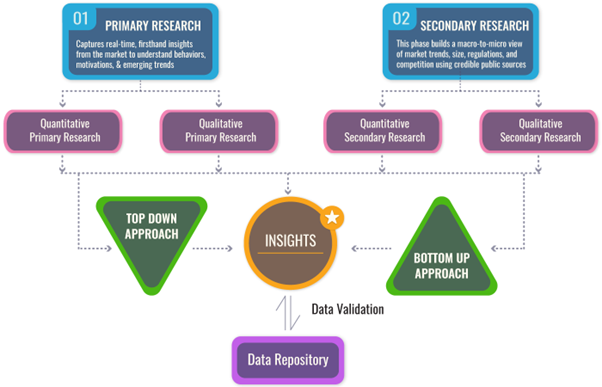
DUAL MODELING: TOP-DOWN + BOTTOM-UP
To ensure robust market estimation, we apply two complementary sizing approaches:
Top-Down Modeling:- Start with broader industry value (e.g., global or regional TAM)
- Apply filters by segment, geography, end-user, or use case
- Adjust with primary insights and validation benchmarks
- Ideal for investor-grade market scans and opportunity mapping
- Aggregate from the ground up using sales volumes, pricing, and unit economics
- Use internal modeling templates aligned with stakeholder data
- Incorporate distributor-level or region-specific inputs
- Most accurate for emerging segments and granular sub-markets
DATA VALIDATION: IN-HOUSE REPOSITORY
We close the loop with proprietary data intelligence built from ongoing projects, industry monitoring, and historical benchmarking. This repository includes:
- Multi-sector market and pricing models
- Key trendlines from past interviews and forecasts
- Benchmarked adoption rates, churn patterns, and ROI indicators
- Industry-specific deviation flags and cross-check logic
- Catches inconsistencies early
- Aligns projections across studies
- Enables consistent, high-trust deliverables