

Brazil Telemedicine Market Size and Forecast (2026–2034), Regional Growth, Trend, Share, and Industry Analysis Report Coverage: By Components (Product {Hardware, Software, and Others}, and Services {Tele-consulting, Tele-monitoring, Tele-education}), By Modality (Store and forward, Real-time, and Others); By Application (Teleradiology, Telepsychiatry, Telepathology, Teledermatology, Telecardiology, and Others) and By End User (Hospitals & Health Systems, Clinics & Physician Practices, Patients/Homecare, Payers, and Others)
2026-09-17
Healthcare
Swetal (Research Analyst)
Description
Brazil
Telemedicine Market Overview
The Brazil
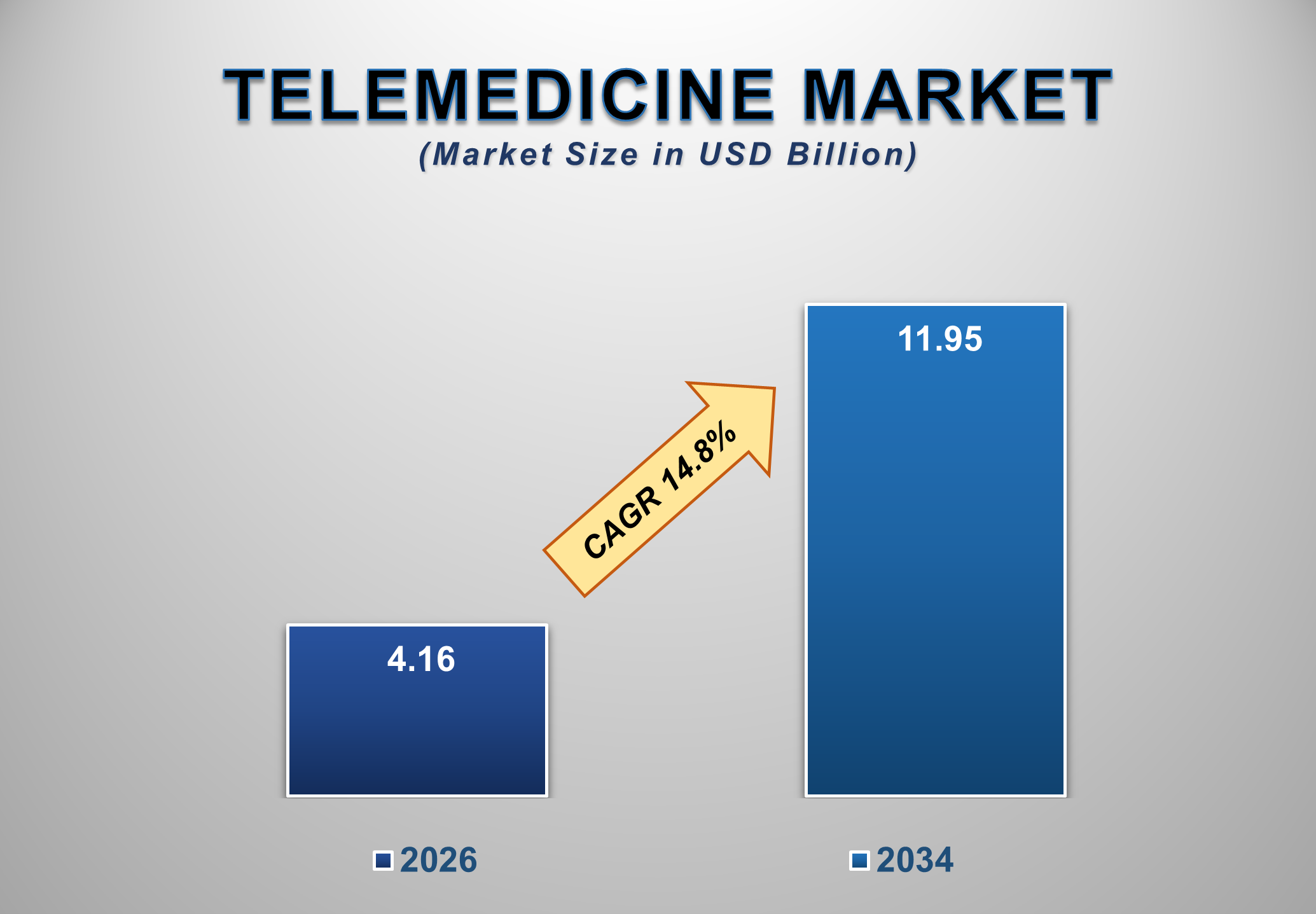
telemedicine market is projected to expand from USD 4.16 billion in 2026 to USD
11.95 billion by 2034, registering a CAGR of 14.8% during 2026–2034.
Brazil
Telemedicine Market Drivers and Impact Analysis
|
Driver |
Market
Impact |
|
Expansion of Telehealth Across the SUS |
Government-backed
expansion of telehealth is widening the addressable patient base beyond
private virtual-care platforms. Brazil's Ministry of Health is using
telehealth for teleconsultation, teleinterconsultation, teleconsulting, and
tele-diagnosis, particularly to connect primary-care facilities with
specialists. |
|
Persistent Geographic Gaps in Specialist
Healthcare Access |
Large geographic distances and uneven
distribution of healthcare professionals make remote consultations and
telediagnosis commercially attractive, particularly in underserved and remote
regions. Telemedicine allows healthcare providers to extend specialist
coverage without replicating physical infrastructure. |
|
High Smartphone and Internet Penetration |
Widespread
mobile and internet access reduces the infrastructure barrier to app-based
consultations, digital prescriptions, remote follow-ups, and patient
engagement, supporting a shift from facility-based care toward hybrid digital
models. |
|
Permanent Legal Recognition of Telehealth |
Law No. 14,510/2022 established a nationwide
legal framework for telehealth, providing greater certainty for providers and
technology companies to invest in virtual-care infrastructure and services. |
|
Rising Demand for Convenient and Faster Care |
Patients
increasingly value reduced travel, shorter waiting times, and easier access
to primary and follow-up consultations. This particularly supports
telemedicine for routine, chronic-care, and post-consultation interactions
where physical examination is not always required. |
|
Growing Chronic Disease Management
Requirements |
Increasing demand for continuous management
of chronic conditions creates a need for remote follow-up, connected
monitoring, digital adherence tools, and recurring virtual consultations
rather than one-time clinical encounters. |
|
Integration of Telemedicine with Existing
Digital Health Infrastructure |
Electronic
health records, digital prescriptions, and connected diagnostic technologies
are making telemedicine less of a standalone consultation channel and more of
an integrated component of the broader care pathway. SUS telehealth
regulations already require electronic documentation and compliance with
health-information interoperability standards. |
Expansion of
Telehealth Across the SUS
Telehealth
Expansion within the SUS framework constitutes a crucial structural enabler for
the development of Brazil’s telemedicine industry, as the government is taking
steps to transform telehealth into an integral part of the delivery of public
healthcare rather than standalone projects. Within the context of the SUS
Digital and the Agora Tem Especialistas program, the Ministry of Health has
been actively promoting teleconsultation, teleinterconsultaion, telediagnosis,
telemonitoring, and teleconsulting services, especially in those regions where
there is a lack of specialists and difficult access. In 2025, the government
also decided to invest money at the federal level to install Telehealth Centers
and allocate funds for 7,000 teleconsultation kit equipment for primary care
facilities, thus increasing the installed base needed to provide virtual care
services. In turn, increased adoption has already brought some results: Brazil
reached 5.74 million cumulative attendances with the help of telehealth
services in 2025, exceeding the government target by 36.6%, whereas the first
four months of 2026 brought even more activity. The practical implication is
clear: greater adoption among the SUS increases the demand for teleconsultation
platforms, video-consultation infrastructure, connected diagnostic devices,
remote-monitoring devices, interoperability solutions, and digital health
platforms.
Brazil Telemedicine Market Restraint
and Impact Analysis
|
Restraint |
Market
Impact |
|
Uneven Digital Infrastructure Across Regions |
Connectivity
quality and access to suitable devices remain weaker in some rural and lower-income
areas, limiting consistent adoption despite strong national internet
penetration. |
|
Data Privacy and Cybersecurity Requirements |
Telemedicine providers must comply with
Brazil's LGPD and specific confidentiality, consent, and information-security
requirements, increasing technology, compliance, and cybersecurity costs. |
|
Limitations of Remote Clinical Examination |
Conditions
requiring physical examination, procedures, imaging, or laboratory testing
cannot always be managed virtually, restricting telemedicine's applicability
and reinforcing the need for hybrid care. |
|
Digital Divide and Patient Usability
Barriers |
Older patients and individuals with limited
digital literacy may face difficulties navigating applications,
authentication, video consultations, and connected devices, reducing adoption
among some patient groups. |
|
Physician Preference for In-Person Care in Complex
Cases |
Clinical
judgment remains central to determining whether telemedicine is appropriate.
Brazil's framework explicitly preserves healthcare professionals'
independence to choose in-person care when clinically necessary. |
Uneven Digital
Infrastructure Across Regions
The uneven development of Brazil's information and communication
technologies (ICTs), especially in the case of regions outside of its major
cities, continues to be a critical obstacle in the adoption of telemedicine
services. While the number of people with access to the internet in the country
has greatly increased in the past few years, it is important to note that
internet connectivity still falls short when it comes to rural and Northern and
Northeastern regions, where video conferencing, remote diagnosis, and
monitoring would become difficult to conduct. According to data from 2025,
95.8% of urban households have internet access, while the rate for rural
households stood at 88.0%. Similarly, the rate of mobile network access in
rural households is 68.0%, while it is 96.1% in urban areas. Such deficiencies
may cause unstable connections, a lack of high-quality video transmission
capability, and an inability to transmit diagnostic data, thus making it
impossible to implement technology-heavy telemedicine services in disadvantaged
regions. Consequently, providers would have to resort to lower-bandwidth
services, local telehealth facilities, and mixed approaches where virtual
visits will be supplemented by physical health centers, thus causing additional
challenges for the consistent development of the Brazilian telemedicine market.
Brazil Telemedicine Market
Opportunities and Impact Analysis
|
Opportunity |
Business
Implication |
|
Government Procurement and SUS Telehealth
Expansion |
Expansion
of telehealth within public healthcare creates opportunities for telemedicine
platforms, connected diagnostic equipment, teleconsultation infrastructure,
and interoperability solutions. The Ministry of Health issued 2025 public
calls specifically to expand telehealth services and bring private providers
into complementary SUS delivery. |
|
Remote Patient Monitoring for Chronic
Diseases |
Connected BP monitors, ECGs, pulse
oximeters, glucose-monitoring systems, and wearable devices can extend telemedicine
from episodic consultation toward continuous disease management. |
|
AI-Enabled Telemedicine and Clinical
Decision Support |
AI
can improve triage, symptom assessment, clinical documentation, and
prioritization of patients, helping providers handle higher consultation
volumes without proportionally increasing administrative workload. |
|
Hospital-at-Home and Virtual Ward Models |
Combining teleconsultations with connected
monitoring devices can support post-discharge monitoring and selected hospital-at-home
models, creating new revenue opportunities beyond conventional video
consultations. |
Government
Procurement and SUS Telehealth Expansion
The increase in the
utilization of government procurement and the spread of telehealth through SUS
offer a great opportunity for Brazil’s telemedicine market in terms of
increased demand in the public sector for digital healthcare and providing an
opportunity for suppliers to operate in a larger and well-structured healthcare
system. Teleconsultation, teleinterconsultation, telediagnosis, and
telemonitoring are being increasingly integrated by the government into the
provision of healthcare, especially to make specialist services more accessible
to the residents of remote locations and help healthcare institutions situated
in remote locations. There are opportunities for the suppliers of telemedicine
platforms, devices for remote diagnosis, remote monitoring, and digital
healthcare technologies to provide their products to public healthcare
institutions. The use of public procurement and partnerships with private firms
also makes it possible for technology companies to reach demand that does not
reside in the major cities, while integration of the technology into the
digital infrastructure of SUS makes the need for interoperable platforms,
secure data exchange, and remote diagnostic devices more necessary.
Brazil Telemedicine Market Scope
|
Report Attributes |
Description |
|
Market Size in 2026 |
USD
4.16 Billion |
|
Market Forecast in 2034 |
USD 11.95 Billion |
|
CAGR % 2026-2034 |
14.8% |
|
Market Concentration |
Moderately Concentrated |
|
Base Year |
2025 |
|
Historic Data |
2021-2025 |
|
Forecast Period |
2026-2034 |
|
Report USP |
Production, Consumption, company share,
company heatmap, company production capacity, growth factors, and more |
|
Geography |
Brazil |
|
Segments Covered |
●
By
Component ●
By
Modality ●
By
Application ●
By End
User |
|
Key Demand Side Trends |
●
Shift From
One-Time Teleconsultation to Hybrid Care ●
Increasing
Demand for Chronic-Care Follow-Up ●
Preference
for Mobile-First Healthcare Access |
|
Key Supply Side Trends |
●
Expansion of
Public Telehealth Infrastructure ●
Convergence
of Telemedicine and Remote Monitoring ●
Greater
Interoperability With Electronic Health Records |
|
Major Players |
●
GE
HealthCare ●
Medtronic
plc ●
Abbott Laboratories ●
Boston
Scientific Corporation ●
Nihon Kohden
Corporation |
Brazil Telemedicine Market Report
Segmentation Analysis
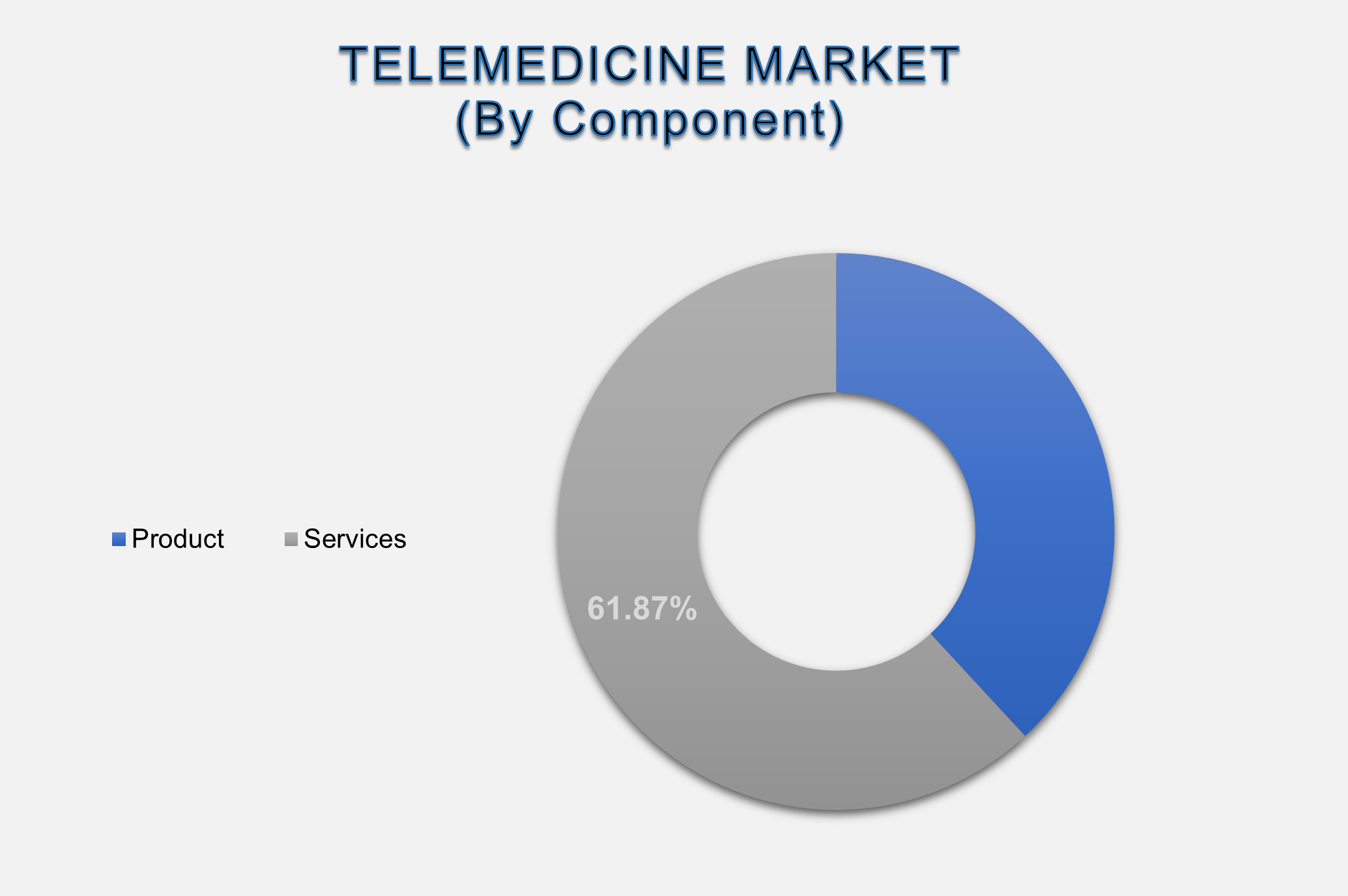
The Services
Segment Is Expected to Dominate Brazil Telemedicine Market During the Forecast
Period
The services segment dominates the Brazil telemedicine market over the forecast period due to increasing use of teleconsultation, teleinterconsultation, telediagnosis, telemonitoring, and other forms of virtual care services by healthcare providers to increase accessibility to clinical expertise without the need for patients to visit healthcare institutions. The implementation of telehealth within the framework of SUS is driving this trend, connecting primary care centers with specialists and facilitating the remote provision of various healthcare services, especially in those areas where there is a lack of access to specialists. Moreover, growing integration of telemedicine solutions with digital health records, patient management systems, and remote care processes is driving the adoption of telemedicine services, from individual virtual consultations to more comprehensive healthcare services. The development of a digital health framework in Brazil also allows private telehealth providers to participate via integrated platforms, allowing service providers to increase coverage in both public and private healthcare systems.
Store and
Forward Segment Is Expected to Grow in the Brazil Telemedicine Market
A greater potential
for store-and-forward is seen in the case of Brazil, since there are more
instances in which the asynchronous exchange of medical information, images,
lab tests, and patient files for diagnostic purposes can be observed in Brazil
due to the growing implementation of teleconsultations, in which there is no
need for real-time interaction. It should be noted that such a model is highly
suitable for telediagnosis and teleinterconsultations because, in the latter
situation, the clinical information can be collected in one healthcare facility
and then assessed by specialists who work in other facilities. The SUS
telehealth model of Brazil supports asynchronous teleconsultation and the
transfer of clinical, laboratory, and imaging data for remote diagnosis.
Thereby, it is likely that the development of store-and-forward applications
will be facilitated in Brazil. It should be noted that the implementation of
store-and-forward technology may help solve the problems related to the
shortage of specialists and unequal access to healthcare services because
specialists can assess cases from another place and cover several healthcare
facilities simultaneously.
The
Teleradiology Segment Is Expected to Witness Steady Growth in Brazil
Telemedicine Market
The teleradiology
market will continue to grow steadily within the Brazilian telemedicine market
due to the increased use of digital technology in the delivery of imaging
services. This allows imaging services conducted in hospitals, diagnostic
centers, and other geographically dispersed healthcare facilities to be viewed
and analyzed remotely by radiologists. The approach can help overcome the
problem associated with unequal distribution of specialist radiologists and
enable faster diagnosis. Telediagnosis, which includes the remote transfer of
images and information for diagnostic reports, is officially recognized in
Brazil under the framework of the SUS Digital–Telessaúde initiative, and
telehealth services are being incorporated into the primary care and specialist
networks, electronic medical records, and the country’s national health
information system. The continued development of imaging, PACS solutions, cloud
computing for reporting, and telehealth systems should drive adoption,
especially in underserved areas where there are fewer specialist radiologists
available.
The Hospital and
Health System Segment Is Expected to Grow in the Brazil Telemedicine Market
The segment of
hospitals and health systems is forecast to register growth in the telemedicine
industry in Brazil as hospitals make use of virtual technology to ensure better
access to specialists, facilitate remote diagnostics, allow for patient monitoring,
and deliver healthcare remotely. Growth in adoption among hospitals is also
being facilitated by the expansion of the digital SUS program in Brazil through
the integration of telemedicine and telehealth with electronic medical records,
interoperability of health-data infrastructure, and connections of healthcare
facilities. The Telessaúde model of the Brazilian Ministry of Health also
identifies hospitals, specialized hospitals, diagnostic centers, and other
healthcare institutions as possible Telehealth Points, thus allowing these
facilities to link up to specialist networks and gain access to
teleconsultation, teleinterconsultation, telediagnosis, and telemonitoring
services. Thus, adoption of telemedicine platforms, connected devices, digital
diagnostics, and telemedicine capabilities is being encouraged in Brazilian
hospitals. With the growing adoption of telemedicine not limited to stand-alone
virtual consultations but becoming part of the clinical processes of the
hospitals, the segment is forecast to continue being an important source of
demand in the telemedicine market in Brazil.
The following
segments are part of an in-depth analysis of the Brazil telemedicine market:
|
Market Segments |
|
|
By
Components |
●
Product o
Hardware o
Software o
Others ●
Services o
Tele-consulting o
Tele-monitoring o
Tele-education |
|
By
Modality |
●
Store and
forward ●
Real-time ●
Others |
|
By
Application |
●
Teleradiology ●
Telepsychiatry ●
Telepathology ●
Teledermatology ●
Telecardiology ●
Others |
|
By End
User |
●
Hospitals
& Health Systems ●
Clinics
& Physician Practices ●
Patients/Homecare ●
Payers ●
Others |
Brazil Telemedicine Market Competition
Landscape Analysis
Brazil's
telemedicine industry is marked by a fragmented and growing competitive
environment, including local digital health platforms, hospitals and health
systems, private healthcare organizations, specialized telemedicine
organizations, and technology companies. Competition is increasingly moving
from simple teleconsultations to more complex solutions such as
teleconsultation, teleinterconsulation, tele-diagnosis, remote monitoring,
electronic health records, and integrated digital health platforms. The growth
in Brazil of the SUS Digital and Telessaúde initiatives expands the competitive
field by linking healthcare facilities to specialist networks as well as
promoting interoperability with Brazil’s national health data infrastructure.
This means that doctor and specialist network quality, healthcare provider
partnerships, interoperability, data security, clinical coverage, and
integration with both public and private health care systems are becoming
important competitive factors. Local organizations have advantages in terms of
understanding the local market and established health care networks, while
international technology and medical device companies bring advanced platforms
and connected devices as well as remote monitoring capabilities.
Brazil Telemedicine Market Recent
Developments News:
▪
In September
2026, Brazil’s Ministry of Health announced plans to expand telehealth coverage
to 100% of SUS healthcare units over the next four years, strengthening the
role of teleconsultation and other remote-care services across the public
healthcare network.
▪
In September
2026, Brazil’s Ministry of Health launched a connected ICU monitoring
initiative through the Hospital das Clínicas da USP, linking intensive-care
beds across six Brazilian capitals to a centralized platform for real-time
patient monitoring and AI-supported identification of clinical deterioration.
The Brazil
Telemedicine Market is dominated by a few large companies, such as
●
GE HealthCare
●
Medtronic plc
●
Masimo
Corporation
●
Nihon Kohden Corporation
●
BIOTRONIK SE
& Co. KG
●
Shenzhen
Mindray Bio-Medical Electronics Co., Ltd.
●
Drägerwerk AG
& Co. KGaA
●
Abbott
Laboratories
●
Boston
Scientific Corporation
●
OMRON
Healthcare, Inc.
●
Cardios
Sistemas Ltda.
●
TEB Tecnologia
Eletrônica Brasileira Ltda.
●
Icelera
●
Ventrix
●
Bionica
●
CMOS Drake
●
Magnamed
Tecnologia Médica S.A.
● Other Prominent Players
Frequently Asked Questions
Swetal (Research Analyst)
Swetal is a Research Analyst with 4+ years of experience specializing in healthcare market research, medical devices, healthcare IT, and medical technology industry analysis. Her expertise includes competitive intelligence, secondary research, market trend forecasting, and healthcare business insights across global healthcare ecosystems.
She contributes to advanced market research reports by analyzing regulatory frameworks, emerging healthcare technologies, competitive landscapes, and innovation trends shaping the medical industry. With a strong focus on accurate market intelligence, strategic insights, and healthcare industry trends, Swetal supports businesses in making informed, data-backed decisions in a rapidly transforming healthcare environment.
1.
Brazil
Telemedicine Market Introduction and Market Overview
1.1. Objectives of the Study
1.2. Market Segmentation
1.2.1.Components of the Brazil
Telemedicine Market
1.2.2.Modality of the Brazil
Telemedicine Market
1.2.3.Application of Brazil
Telemedicine Market
1.2.4.End User of Brazil Telemedicine
Market
1.3. Competition Coverage List of
Market Participants
1.4. Market Definition: Telemedicine Market
2.
Executive Summary
2.1. Brazil Telemedicine Market
Estimation & Forecast
2.1.1.Brazil Telemedicine Market Size
(US$ Million) Estimates & Historical Trend Analysis (2021 - 2025)
2.1.2.Brazil Telemedicine Overall
Market Size (US$ Million), Growth Rate (Y-o-Y), Market CAGR (%), Market
forecast (2026 - 2034)
2.2. Snapshot of Brazil Telemedicine
Market
2.3. Brazil Telemedicine Market
Revenue Share (%) 2025
2.4. Key Competitors & Key
Insights
3.
Market Overview (Qualitative
Analysis)
3.1. Demand Side Trends
3.2. Supply Side Trends /
Manufacturing Trends
3.3. Demand and Opportunity
Assessment, 2026 - 2034
3.4. Market Dynamics
3.4.1.Drivers
3.4.2.Limitations
3.4.3.Opportunities
3.4.4.Impact Analysis of Drivers and
Restraints
3.5. Key Developments
3.6. Regulatory Landscape
3.7. Pricing Analysis
3.8. Supply Chain Analysis
3.9. Porter’s Five Forces Analysis
3.9.1.Bargaining Power of Suppliers
3.9.2.Bargaining Power of Buyers
3.9.3.Threat of Substitutes
3.9.4.Threat of New Entrants
3.9.5.Competitive Rivalry
3.10. PEST Analysis
3.10.1. Political Factors
3.10.2. Economic Factors
3.10.3. Social Factors
3.10.4. Technology Factors
4.
Brazil Telemedicine Market
Estimates & Forecast Trend Analysis, by Components
4.1. Brazil Telemedicine Market
Assessments & Key Findings, by Components
4.2. Brazil Telemedicine Market
Revenue (US$ Million) Estimates and Forecasts, by Components, 2021 - 2034
4.2.1. Product
4.2.1.1.
Hardware
4.2.1.2.
Software
4.2.1.3.
Others
4.2.2. Services
4.2.2.1.
Tele-consulting
4.2.2.2.
Tele-monitoring
4.2.2.3.
Tele-education
5.
Brazil Telemedicine Market
Estimates & Forecast Trend Analysis, by Modality
5.1. Brazil Telemedicine Market
Assessments & Key Findings, by Modality
5.2. Brazil Telemedicine Market
Revenue (US$ Million) Estimates and Forecasts, by Modality, 2021 - 2034
5.2.1.Store and forward
5.2.2.Real-time
5.2.3.Others
6.
Brazil Telemedicine Market
Estimates & Forecast Trend Analysis, by Application
6.1. Brazil Telemedicine Market
Assessments & Key Findings, by Application
6.2. Brazil Telemedicine Market
Revenue (US$ Million) Estimates and Forecasts, by Application, 2021 - 2034
6.2.1.Teleradiology
6.2.2.Telepsychiatry
6.2.3.Telepathology
6.2.4.Teledermatology
6.2.5.Telecardiology
6.2.6.Others
7.
Brazil Telemedicine Market
Estimates & Forecast Trend Analysis, by End User
7.1. Brazil Telemedicine Market
Assessments & Key Findings, by End User
7.2. Brazil Telemedicine Market
Revenue (US$ Million) Estimates and Forecasts, by End User, 2021 - 2034
7.2.1.Hospitals & Health Systems
7.2.2.Clinics & Physician
Practices
7.2.3.Patients/Homecare
7.2.4.Payers
7.2.5.Others
8. Competition Landscape
8.1. Brazil Telemedicine Market Product
Mapping
8.2. Brazil Telemedicine Market
Concentration Analysis, by Leading Players / Innovators / Emerging Players /
New Entrants
8.3. Brazil Telemedicine Market Tier
Structure Analysis
8.4. Brazil Telemedicine Market
Concentration & Company Market Shares (%) Analysis, 2025
9. Company Profiles
9.1. GE HealthCare
9.1.1.Company Overview & Key Stats
9.1.2.Financial Performance & KPIs
9.1.3.Product Portfolio
9.1.4.SWOT Analysis
9.1.5.Business Strategy & Recent
Developments
* Similar details would be provided
for all the players mentioned below
9.2.
Medtronic plc
9.3.
Masimo Corporation
9.4.
Nihon Kohden Corporation
9.5.
BIOTRONIK SE & Co. KG
9.6.
Shenzhen Mindray Bio-Medical
Electronics Co., Ltd.
9.7.
Drägerwerk AG & Co. KGaA
9.8.
Abbott Laboratories
9.9.
Boston Scientific Corporation
9.10.
OMRON Healthcare, Inc.
9.11.
Cardios Sistemas Ltda.
9.12.
TEB Tecnologia Eletrônica
Brasileira Ltda.
9.13.
Icelera
9.14.
Ventrix
9.15.
Bionica
9.16.
CMOS Drake
9.17.
Magnamed Tecnologia Médica S.A.
9.18. Other Prominent Players
10. Research
Findings & Conclusion
11. Assumption & Acronyms Used
12. Research
Methodology
12.1. External Transportations /
Databases
12.2. Internal Proprietary Database
12.3. Primary Research
12.4. Secondary Research
12.5. Assumptions
12.6. Limitations
12.7. Report FAQs
Our Research Methodology
"Insight without rigor is just noise."
We follow a comprehensive, multi-phase research framework designed to deliver accurate, strategic, and decision-ready intelligence. Our process integrates primary and secondary research , both quantitative and qualitative , along with dual modeling techniques ( top-down and bottom-up) and a final layer of validation through our proprietary in-house repository.
PRIMARY RESEARCH
Primary research captures real-time, firsthand insights from the market to understand behaviors, motivations, and emerging trends.
1. Quantitative Primary Research
Objective: Generate statistically significant data directly from market participants.
Approaches:- Structured surveys with customers, distributors, and field agents
- Mobile-based data collection for point-of-sale audits and usage behavior
- Phone-based interviews (CATI) for market sizing and product feedback
- Online polling around industry events and digital campaigns
- Purchase frequency by customer type
- Channel performance across geographies
- Feature demand by application or demographic
2. Qualitative Primary Research
Objective: Explore decision-making drivers, pain points, and market readiness.
Approaches:- In-depth interviews (IDIs) with executives, product managers, and key decision-makers
- Focus groups among end users and early adopters
- Site visits and observational research for consumer products
- Informal field-level discussions for regional and cultural nuances
SECONDARY RESEARCH
This phase helps establish a macro-to-micro understanding of market trends, size, regulation, and competitive dynamics, sourced from credible and public domain information.
1. Quantitative Secondary Research
Objective: Model market value and segment-level forecasts based on published data.
Sources include:- Financial reports and investor summaries
- Government trade data, customs records, and regulatory statistics
- Industry association publications and economic databases
- Channel performance and pricing data from marketplace listings
- Revenue splits, pricing trends, and CAGR estimates
- Supply-side capacity and volume tracking
- Investment analysis and funding benchmarks
2. Qualitative Secondary Research
Objective: Capture strategic direction, innovation signals, and behavioral trends.
Sources include:- Company announcements, roadmaps, and product pipelines
- Publicly available whitepapers, conference abstracts, and academic research
- Regulatory body publications and policy briefs
- Social and media sentiment scanning for early-stage shifts
- Strategic shifts in market positioning
- Unmet needs and white spaces
- Regulatory triggers and compliance impact
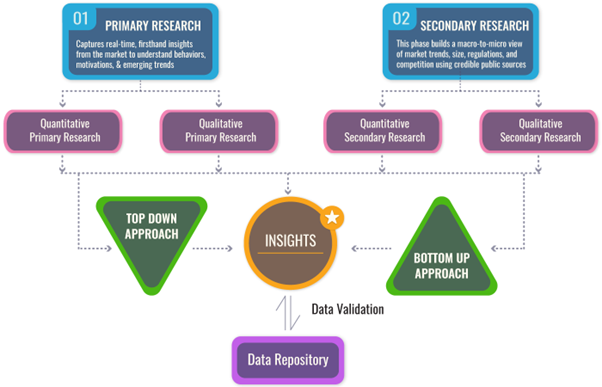
DUAL MODELING: TOP-DOWN + BOTTOM-UP
To ensure robust market estimation, we apply two complementary sizing approaches:
Top-Down Modeling:- Start with broader industry value (e.g., global or regional TAM)
- Apply filters by segment, geography, end-user, or use case
- Adjust with primary insights and validation benchmarks
- Ideal for investor-grade market scans and opportunity mapping
- Aggregate from the ground up using sales volumes, pricing, and unit economics
- Use internal modeling templates aligned with stakeholder data
- Incorporate distributor-level or region-specific inputs
- Most accurate for emerging segments and granular sub-markets
DATA VALIDATION: IN-HOUSE REPOSITORY
We close the loop with proprietary data intelligence built from ongoing projects, industry monitoring, and historical benchmarking. This repository includes:
- Multi-sector market and pricing models
- Key trendlines from past interviews and forecasts
- Benchmarked adoption rates, churn patterns, and ROI indicators
- Industry-specific deviation flags and cross-check logic
- Catches inconsistencies early
- Aligns projections across studies
- Enables consistent, high-trust deliverables