

Brick Liquid Cartons Market Size and Forecast (2025–2033), Global and Regional Trends, Share, and Industry Analysis Report Coverage: By Material (Paper, Plastic, Aluminum, Others), By Opening Type (Straw Hole, Clip, Twist, Cut), By End-use Industry (Food & Beverages, Personal Care & Cosmetics, Pharmaceuticals, Others), and Geography
2026-01-02
Packaging Industry
Jaya Bundele (Research Analyst)
Description
Brick Liquid Cartons Market Overview
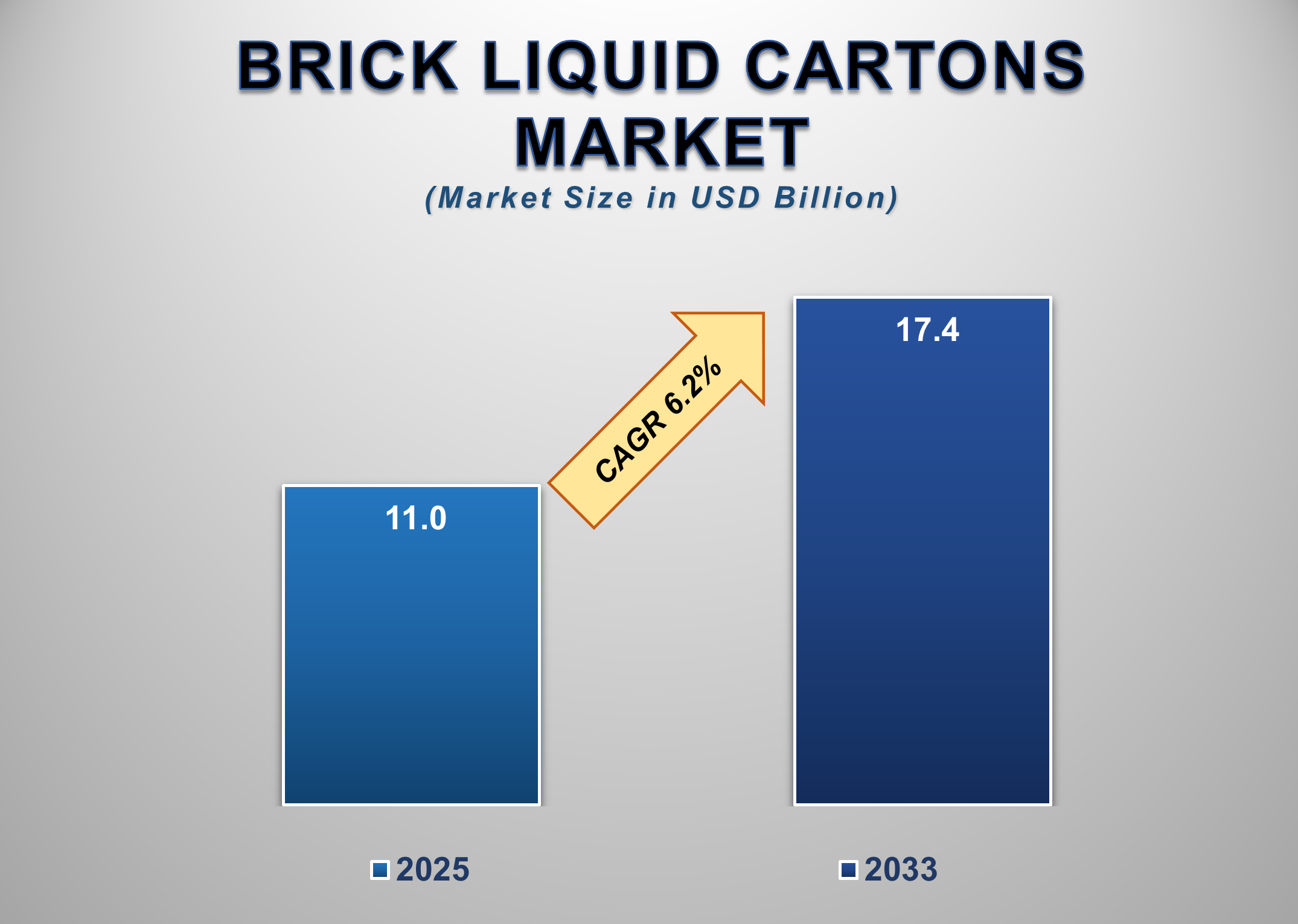
The Global Brick Liquid Cartons Market is experiencing consistent growth as consumer preference shifts toward eco-friendly, convenient, and lightweight beverage and liquid packaging formats. Brick liquid cartons, characterized by their rectangular, space-efficient shape, are widely used for milk, juices, plant-based beverages, liquid foods, and select personal care and pharmaceutical products. The market was valued at USD 11.0 billion in 2025 and is expected to grow to USD 17.4 billion by 2033, reflecting a CAGR of 6.2%. Key factors supporting this growth include rising demand for sustainable packaging, increased consumption of ready-to-drink beverages, and expanding distribution of aseptic liquid food products globally.
Paper-based brick cartons
continue to dominate due to their recyclability, low carbon footprint, and
strong performance in aseptic filling processes. Manufacturers are investing in
renewable materials, high-barrier coatings, and advanced filling technologies
to improve product protection and shelf life.
Brick Liquid Cartons
Market Drivers and Opportunities
Rising Demand for
Sustainable and Recyclable Packaging Materials Is Driving the Brick Liquid
Cartons Market Growth
Growing global focus on sustainable packaging is a major driver
accelerating the adoption of brick liquid cartons. Consumers, brands, and
governments are increasingly shifting away from plastic packaging toward
renewable, fiber-based alternatives due to environmental concerns and
tightening regulations. Brick cartons, primarily made from paperboard, offer
high recyclability, lower carbon emissions, and reduced reliance on
fossil-based materials. Their multi-layer structure provides excellent product
protection while supporting aseptic technology, allowing beverages to remain
shelf-stable without refrigeration, further reducing environmental impact. As
sustainability becomes a key differentiator in FMCG and beverage markets,
manufacturers are prioritizing brick cartons to enhance brand perception and
meet regulatory compliance. Regulatory interventions such as plastic taxes,
extended producer responsibility (EPR), and recycling targets in Europe, North
America, and parts of Asia are accelerating this shift. The beverage and dairy
industries are replacing PET bottles with cartons to reduce waste and improve
recyclability rates. The rise of plant-based beverages, organic juices, and
functional drinks/products typically marketed with sustainability-focused positioning
further boosts carton adoption. With continuous innovations in renewable
polymers, bio-based coatings, and FSC-certified paperboard, brick liquid
cartons are increasingly preferred for companies seeking to achieve
sustainability goals while maintaining high-quality packaging performance.
Increasing Consumption of Ready-to-Drink Beverages and Dairy
Products Is Boosting Market Expansion
The expanding consumption of ready-to-drink (RTD) beverages, dairy
products, and functional drinks is another major driver supporting the brick
liquid cartons market. Changing lifestyles, urbanization, and rising health
consciousness have driven demand for packaged juices, flavored milk,
plant-based beverages, liquid nutritional supplements, and herbal drinks. Brick
liquid cartons offer an ideal packaging format for these products due to their
lightweight structure, portability, and efficient storage. Their rectangular
shape optimizes logistics, reduces transportation costs, and supports extended
shelf life, critical for RTD beverages sold in retail and e-commerce channels.
The dairy sector, particularly in emerging markets, increasingly
relies on aseptic cartons to distribute milk and dairy-based beverages without
refrigeration, expanding market access in rural and semi-urban regions. Brick
cartons are also gaining traction in premium beverage categories such as
cold-pressed juices, organic drinks, and fortified beverages due to their
sustainability appeal and excellent product protection. As consumers shift
toward convenient, hygienic, and nutritionally enriched beverage formats,
demand for safe and reliable packaging solutions continues to rise. This trend
significantly strengthens the adoption of brick liquid cartons across various
beverage categories, driving consistent market expansion.
Expanding Packaging Use in Personal Care and Pharmaceuticals
Offers Significant Opportunities for Brick Liquid Cartons Market Growth
While food and beverages remain the primary end-use segment,
personal care and pharmaceutical applications are emerging as high-potential
growth areas for brick liquid cartons. Increasingly, brands are exploring
sustainable alternatives to plastic tubes and bottles for liquid soaps,
lotions, serums, and sanitizers. Brick cartons offer benefits such as reduced
plastic usage, enhanced recyclability, and strong barrier protection for
sensitive formulations. In pharmaceuticals, cartons are gaining attention for
packaging liquid medicines, oral solutions, syrups, and dietary supplements due
to improved shelf stability and tamper-evident properties. Rising environmental
awareness among consumers and stricter sustainability requirements among
multinational personal care companies create opportunities for carton adoption.
Furthermore, growing e-commerce penetration is pushing brands to choose
packaging that provides superior protection during transit; brick cartons excel
due to their structural stability and box-like shape. In emerging markets,
cost-effective and lightweight packaging solutions are increasingly favored by
pharmaceutical distributors and cosmetic manufacturers. As research continues
in bio-based linings, high-barrier coatings, and improved aseptic compatibility,
brick liquid cartons have the potential to capture a greater share of non-food
applications, unlocking significant long-term market opportunities.
Brick Liquid Cartons
Market Scope
|
Report Attributes |
Description |
|
Market Size in 2025 |
USD 11.0 Billion |
|
Market Forecast in 2033 |
USD 17.4 Billion |
|
CAGR % 2025-2033 |
6.2% |
|
Base Year |
2024 |
|
Historic Data |
2020-2024 |
|
Forecast Period |
2025-2033 |
|
Report USP |
Production, Consumption,
Company Share, Company Heatmap, Company Production Capacity, Growth Factors,
and more |
|
Segments Covered |
●
By Material,
Opening Type, End-use Industry |
|
Regional Scope |
●
North America, ●
Europe, ●
APAC, ●
Latin America ●
Middle East and
Africa |
|
Country Scope |
1)
U.S. 2)
Canada 3)
Germany 4)
UK 5)
France 6)
Spain 7)
Italy 8)
Switzerland 9)
China 10)
Japan 11)
India 12)
Australia 13)
South Korea 14)
Brazil 15)
Mexico 16)
Argentina 17)
South Africa 18)
Saudi Arabia 19)
UAE |
Brick Liquid Cartons
Market Report Segmentation Analysis
The Brick Liquid Cartons Market is segmented based on material
composition, opening type, end-use, and geography.
Paper Segment Accounted
for the Largest Market Share in the Global Brick Liquid Cartons Market
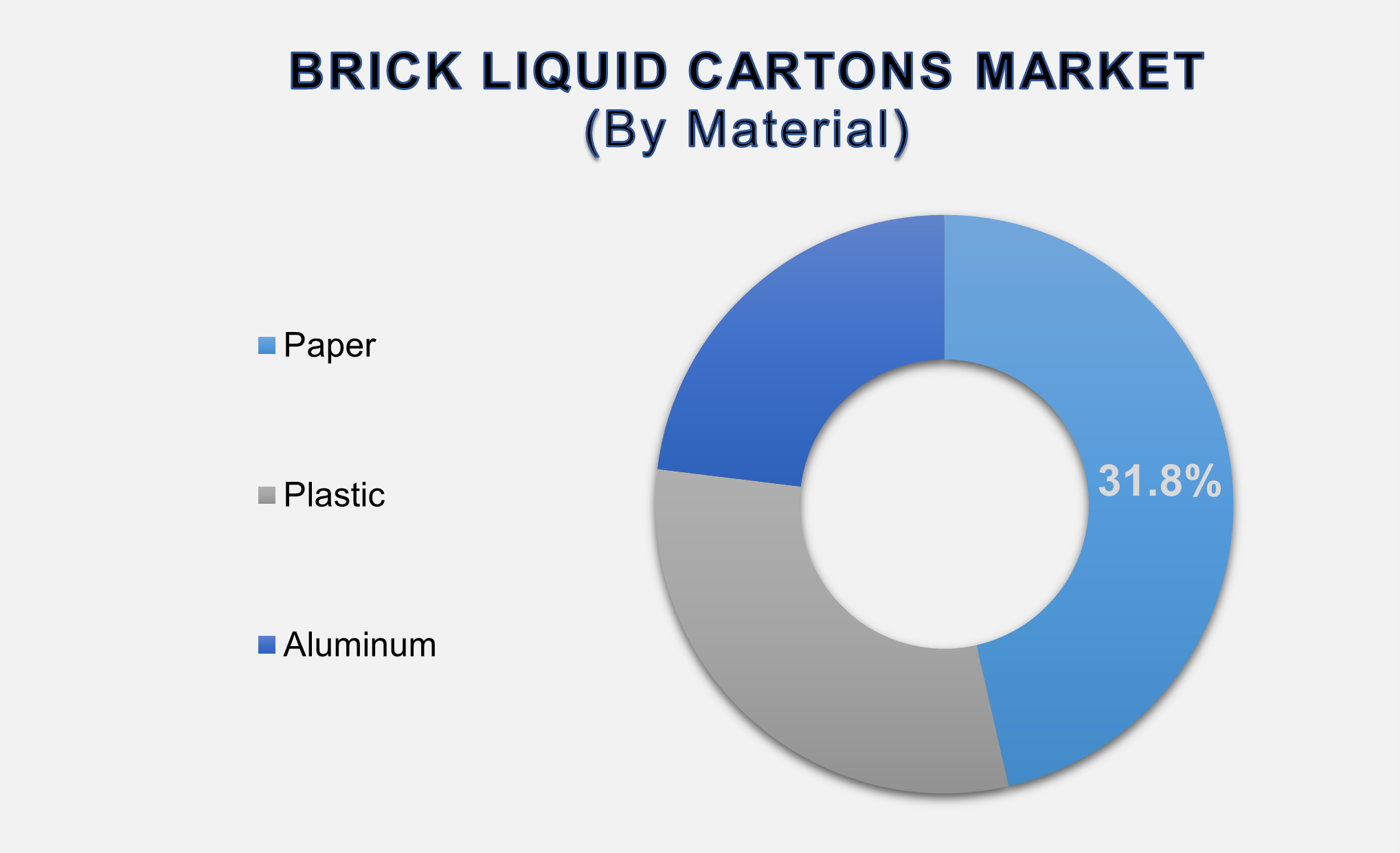
The Paper segment accounted for the largest market share in the global Brick Liquid Cartons market, driven by its high recyclability, renewable composition, and strong consumer preference for eco-friendly packaging. Paperboard forms the structural backbone of brick cartons, offering durability, printability, and compatibility with aseptic filling technologies. Its lower environmental impact compared with plastic bottles and metal containers has made paper-based cartons the preferred choice among beverage manufacturers. Regulatory pressure to reduce single-use plastics further boosts demand for fiber-based packaging solutions. Advancements in multilayer paperboard, bio-based coatings, and renewable barrier technologies are enhancing the performance of paper cartons, enabling longer product shelf life and improved product safety. As sustainability becomes a top priority across industries, the dominance of the paper segment is expected to strengthen further.
Straw Hole Segment
Accounted for the Largest Market Share in the Global Brick Liquid Cartons
Market
The
Straw Hole segment accounted for the largest market share in the global Brick
Liquid Cartons market, primarily due to its extensive use in juice boxes,
flavored milk beverages, and children’s drinks. Straw-hole cartons offer
consumer convenience, portability, and mess-free consumption, making them the
preferred choice for single-serve beverage packaging. Their compatibility with
aseptic carton structures and long shelf-life products makes them particularly
suitable for school milk programs and on-the-go beverage categories. As demand
for small-format, portion-controlled beverages increases, the use of straw-hole
brick cartons has grown significantly. Manufacturers continue to innovate with
eco-friendly paper straws and tethered straw systems to meet sustainability
regulations, especially in Europe. This ensures that the straw-hole format
remains the most widely adopted opening type in the market.
Food & Beverages
Segment Accounted for the Largest Market Share in the Global Brick Liquid
Cartons Market
The Food & Beverages segment
accounted for the largest market share in the global Brick Liquid Cartons
market, supported by growing consumption of packaged dairy, juices, plant-based
drinks, and functional beverages. Brick cartons offer superior protection for
liquid foods, maintaining freshness and nutritional integrity through
high-barrier layers and aseptic processing. Their lightweight structure, space
efficiency, and ease of transport make them ideal for large-scale beverage
distribution and retail sales. The rise of health-oriented drinks, organic
juices, and shelf-stable milk products further contributes to the segment’s
dominance. Food and beverage companies increasingly prefer brick cartons to
achieve sustainability goals, reduce plastic usage, and appeal to
environmentally conscious consumers. As demand for high-quality, shelf-stable
liquid food products continues to rise worldwide, the food and beverage segment
is expected to maintain its leading position.
The following segments are
part of an in-depth analysis of the global Brick Liquid Cartons market:
|
Market Segments |
|
|
By Material |
●
Paper ●
Plastic ●
Aluminum |
|
By Opening
Type |
●
Straw Hole ●
Clip ●
Twist ●
Cut |
|
By End-use
Industry |
●
Food & Beverages ●
Personal Care &
Cosmetics ●
Pharmaceuticals ●
Others |
Brick Liquid Cartons
Market Share Analysis by Region
Asia-Pacific is
anticipated to hold the biggest portion of the Brick Liquid Cartons Market
globally throughout the forecast period.
Asia-Pacific dominated the Brick
Liquid Cartons Market with a 41.2% share in 2025, supported by rapid
urbanization, high consumption of packaged beverages, and expansion of dairy
and juice production. Countries such as China, India, Indonesia, and Vietnam
have witnessed a surge in demand for shelf-stable milk, RTD beverages, and
nutritional drinks, all of which commonly use brick cartons due to their
affordability and suitability for aseptic distribution. Growing middle-class
populations and increasing adoption of modern retail formats further support
regional growth.
North America is expected to
record the highest CAGR through 2033, driven by strong regulatory focus on
sustainability, reduction of plastic waste, and growing consumer preference for
recyclable packaging formats. The U.S. market is experiencing rising adoption
of liquid cartons for plant-based beverages, premium juices, and organic dairy
products, supported by sustainable packaging commitments from major brands.
Europe maintains steady growth due to established recycling infrastructure,
strict environmental regulations, and high penetration of carton packaging in
the dairy and beverage sectors. Meanwhile, Latin America and the Middle East
& Africa are emerging as expanding markets due to increasing beverage
consumption and investments in modern packaging solutions. Overall, global
demand for sustainable liquid packaging supports strong regional adoption of
brick liquid cartons.
Brick Liquid Cartons
Market Competition Landscape Analysis
The competitive landscape of the
Brick Liquid Cartons Market is dominated by major global packaging companies,
beverage packaging specialists, and material suppliers focused on sustainable
carton formats. Leading players are investing in renewable materials, enhanced
barrier layers, and recyclable closures to meet growing sustainability
expectations.
Global Brick Liquid
Cartons Market Recent Developments News:
- In April 2024,
Nampak Liquid Cartons, in partnership with Woodlands Dairy, launched
South Africa’s first tethered cap carton, designed to reduce plastic waste
by keeping the cap attached throughout the product’s lifecycle, including
recycling.
- In November 2023,
Ariake introduced its premium liquid broths in SIG carton packs,
becoming the first company in Belgium to use aseptic filling for food
products in this format. The rollout, featuring SIG Slimline cartons,
supports Ariake’s expansion of high-quality, sustainably packaged broth
offerings.
The Global Brick Liquid Cartons Market Is Dominated by a Few Large Companies, such as
●
Tetra Pak
●
SIG Combibloc
●
Elopak
●
Evergreen Packaging
●
Nippon Paper
Industries
●
Weyerhaeuser
●
Liqui-Box
●
Pactiv
●
Adam Pack
●
Krones
●
IPI s.r.l.
●
Violet Pack
●
Jielong Yongfa
●
Skylong
●
Xiamen Forest
Packaging
●
Stora Enso
●
Uflex
●
Refresco
●
Kartridg Pak
●
Greatview Aseptic
Packaging
● Others
Frequently Asked Questions
Jaya Bundele (Research Analyst)
Jaya Bundele is a skilled Research Analyst with 4+ years of experience in market intelligence, consumer insights, competitive analysis, and industry forecasting across the consumer goods, agriculture, and food & beverage sectors. She specializes in market sizing, trend analysis, growth opportunity mapping, and strategic secondary research for global and regional markets.
Her expertise lies in transforming complex industry data into actionable business strategies that help organizations identify emerging trends, understand customer behavior, and gain a competitive edge. With a strong focus on data-driven insights, business intelligence, and future market trends, Jaya delivers high-quality research solutions aligned with evolving industry demands and market dynamics.
1. Global Brick Liquid
Cartons Market Introduction and Market Overview
1.1.
Objectives
of the Study
1.2.
Global
Brick Liquid Cartons Market Scope and Market Estimation
1.2.1.Global Brick Liquid
Cartons Overall Market Size (US$ Bn), Market CAGR (%), Market forecast (2025 - 2033)
1.2.2.Global Brick Liquid
Cartons Market Revenue Share (%) and Growth Rate (Y-o-Y) from 2020 - 2033
1.3.
Market
Segmentation
1.3.1.Material of Global Brick
Liquid Cartons Market
1.3.2.Opening Type of Global Brick
Liquid Cartons Market
1.3.3.Technology of Global Brick
Liquid Cartons Market
1.3.4.Region of Global Brick
Liquid Cartons Market
2. Executive
Summary
2.1.
Demand
Side Trends
2.2.
Key
Market Trends
2.3.
Market
Demand (US$ Bn) Analysis 2020 – 2024 and Forecast, 2025 – 2033
2.4.
Demand
and Opportunity Assessment
2.5.
Key
Developments
2.6.
Overview
of Tariff, Regulatory Landscape and Standards
2.7.
Market
Entry Strategies
2.8.
Market
Dynamics
2.8.1.Drivers
2.8.2.Limitations
2.8.3.Opportunities
2.8.4.Impact Analysis of Drivers
and Restraints
2.9.
Porter’s
Five Forces Analysis
2.10.
PEST
Analysis
3. Global
Brick Liquid Cartons Market Estimates
& Historical Trend Analysis (2020 - 2024)
4. Global
Brick Liquid Cartons Market Estimates
& Forecast Trend Analysis, by Material
4.1.
Global
Brick Liquid Cartons Market Revenue (US$ Bn) Estimates and Forecasts, by Material,
2020 - 2033
4.1.1.Paper
4.1.2.Plastic
4.1.3.Aluminum
5. Global
Brick Liquid Cartons Market Estimates
& Forecast Trend Analysis, by Opening Type
5.1.
Global
Brick Liquid Cartons Market Revenue (US$ Bn) Estimates and Forecasts, by Opening
Type, 2020 - 2033
5.1.1.Straw Hole
5.1.2.Clip
5.1.3.Twist
5.1.4.Cut
6. Global
Brick Liquid Cartons Market Estimates
& Forecast Trend Analysis, by Technology
6.1.
Global
Brick Liquid Cartons Market Revenue (US$ Bn) Estimates and Forecasts, by Technology,
2020 - 2033
6.1.1.Food & Beverages
6.1.2.Personal Care &
Cosmetics
6.1.3.Pharmaceuticals
6.1.4.Others
7. Global
Brick Liquid Cartons Market Estimates
& Forecast Trend Analysis, by Region
7.1.
Global
Brick Liquid Cartons Market Revenue (US$ Bn) Estimates and Forecasts, by Region,
2020 - 2033
7.1.1.North America
7.1.2.Europe
7.1.3.Asia Pacific
7.1.4.Middle East & Africa
7.1.5.Latin America
8. North America Brick
Liquid Cartons Market: Estimates &
Forecast Trend Analysis
8.1.
North
America Brick Liquid Cartons Market Assessments & Key Findings
8.1.1.North America Brick Liquid
Cartons Market Introduction
8.1.2.North America Brick Liquid
Cartons Market Size Estimates and Forecast (US$ Billion) (2020 - 2033)
8.1.2.1. By Material
8.1.2.2. By Opening
Type
8.1.2.3. By Technology
8.1.2.4.
By
Country
8.1.2.4.1. The U.S.
8.1.2.4.2. Canada
9. Europe Brick
Liquid Cartons Market: Estimates &
Forecast Trend Analysis
9.1.
Europe
Brick Liquid Cartons Market Assessments & Key Findings
9.1.1.Europe Brick Liquid
Cartons Market Introduction
9.1.2.Europe Brick Liquid
Cartons Market Size Estimates and Forecast (US$ Billion) (2020 - 2033)
9.1.2.1. By Material
9.1.2.2. By Opening
Type
9.1.2.3. By Technology
9.1.2.4.
By
Country
9.1.2.4.1.
Germany
9.1.2.4.2.
Italy
9.1.2.4.3.
U.K.
9.1.2.4.4.
France
9.1.2.4.5.
Spain
9.1.2.4.6.
Switzerland
9.1.2.4.7. Rest
of Europe
10. Asia Pacific Brick
Liquid Cartons Market: Estimates &
Forecast Trend Analysis
10.1.
Asia
Pacific Market Assessments & Key Findings
10.1.1.
Asia
Pacific Brick Liquid Cartons Market Introduction
10.1.2.
Asia
Pacific Brick Liquid Cartons Market Size Estimates and Forecast (US$ Billion) (2020
- 2033)
10.1.2.1. By Material
10.1.2.2. By Opening
Type
10.1.2.3. By Technology
10.1.2.4.
By
Country
10.1.2.4.1. China
10.1.2.4.2. Japan
10.1.2.4.3. India
10.1.2.4.4. Australia
10.1.2.4.5. South Korea
10.1.2.4.6. Rest of Asia Pacific
11. Middle East & Africa Brick
Liquid Cartons Market: Estimates &
Forecast Trend Analysis
11.1.
Middle
East & Africa Market Assessments & Key Findings
11.1.1.
Middle East & Africa Brick Liquid Cartons Market
Introduction
11.1.2.
Middle East & Africa Brick Liquid Cartons Market Size Estimates
and Forecast (US$ Billion) (2020 - 2033)
11.1.2.1. By Material
11.1.2.2. By Opening
Type
11.1.2.3. By Technology
11.1.2.4.
By
Country
11.1.2.4.1. UAE
11.1.2.4.2. Saudi
Arabia
11.1.2.4.3. South
Africa
11.1.2.4.4. Rest
of MEA
12. Latin America
Brick Liquid Cartons Market: Estimates
& Forecast Trend Analysis
12.1.
Latin
America Market Assessments & Key Findings
12.1.1.
Latin
America Brick Liquid Cartons Market Introduction
12.1.2.
Latin
America Brick Liquid Cartons Market Size Estimates and Forecast (US$ Billion) (2020
- 2033)
12.1.2.1. By Material
12.1.2.2. By Opening
Type
12.1.2.3. By Technology
12.1.2.4.
By
Country
12.1.2.4.1. Brazil
12.1.2.4.2. Argentina
12.1.2.4.3. Mexico
12.1.2.4.4. Rest
of LATAM
13. Country Wise Market:
Introduction
14.
Competition
Landscape
14.1.
Global
Brick Liquid Cartons Market Product Mapping
14.2.
Global
Brick Liquid Cartons Market Concentration Analysis, by Leading Players /
Innovators / Emerging Players / New Entrants
14.3.
Global
Brick Liquid Cartons Market Tier Structure Analysis
14.4.
Global
Brick Liquid Cartons Market Concentration & Company Market Shares (%)
Analysis, 2024
15.
Company
Profiles
15.1.
Tetra Pak
15.1.1.
Company
Overview & Key Stats
15.1.2.
Financial
Performance & KPIs
15.1.3.
Product
Portfolio
15.1.4.
SWOT
Analysis
15.1.5.
Business
Strategy & Recent Developments
* Similar details would be provided for all the players
mentioned below
15.2. SIG
Combibloc
15.3. Elopak
15.4. Evergreen
Packaging
15.5. Nippon
Paper Industries
15.6. Weyerhaeuser
15.7. Liqui-Box
15.8. Pactiv
15.9. Adam
Pack
15.10. Krones
15.11. IPI
s.r.l.
15.12. Violet
Pack
15.13. Jielong
Yongfa
15.14. Skylong
15.15. Xiamen
Forest Packaging
15.16. Stora
Enso
15.17. Uflex
15.18. Refresco
15.19. Kartridg
Pak
15.20. Greatview
Aseptic Packaging
15.21. Others
16. Research
Methodology
16.1.
External
Transportations / Databases
16.2.
Internal
Proprietary Database
16.3.
Primary
Research
16.4.
Secondary
Research
16.5.
Assumptions
16.6.
Limitations
16.7.
Report
FAQs
17. Research
Findings & Conclusion
Our Research Methodology
"Insight without rigor is just noise."
We follow a comprehensive, multi-phase research framework designed to deliver accurate, strategic, and decision-ready intelligence. Our process integrates primary and secondary research , both quantitative and qualitative , along with dual modeling techniques ( top-down and bottom-up) and a final layer of validation through our proprietary in-house repository.
PRIMARY RESEARCH
Primary research captures real-time, firsthand insights from the market to understand behaviors, motivations, and emerging trends.
1. Quantitative Primary Research
Objective: Generate statistically significant data directly from market participants.
Approaches:- Structured surveys with customers, distributors, and field agents
- Mobile-based data collection for point-of-sale audits and usage behavior
- Phone-based interviews (CATI) for market sizing and product feedback
- Online polling around industry events and digital campaigns
- Purchase frequency by customer type
- Channel performance across geographies
- Feature demand by application or demographic
2. Qualitative Primary Research
Objective: Explore decision-making drivers, pain points, and market readiness.
Approaches:- In-depth interviews (IDIs) with executives, product managers, and key decision-makers
- Focus groups among end users and early adopters
- Site visits and observational research for consumer products
- Informal field-level discussions for regional and cultural nuances
SECONDARY RESEARCH
This phase helps establish a macro-to-micro understanding of market trends, size, regulation, and competitive dynamics, sourced from credible and public domain information.
1. Quantitative Secondary Research
Objective: Model market value and segment-level forecasts based on published data.
Sources include:- Financial reports and investor summaries
- Government trade data, customs records, and regulatory statistics
- Industry association publications and economic databases
- Channel performance and pricing data from marketplace listings
- Revenue splits, pricing trends, and CAGR estimates
- Supply-side capacity and volume tracking
- Investment analysis and funding benchmarks
2. Qualitative Secondary Research
Objective: Capture strategic direction, innovation signals, and behavioral trends.
Sources include:- Company announcements, roadmaps, and product pipelines
- Publicly available whitepapers, conference abstracts, and academic research
- Regulatory body publications and policy briefs
- Social and media sentiment scanning for early-stage shifts
- Strategic shifts in market positioning
- Unmet needs and white spaces
- Regulatory triggers and compliance impact
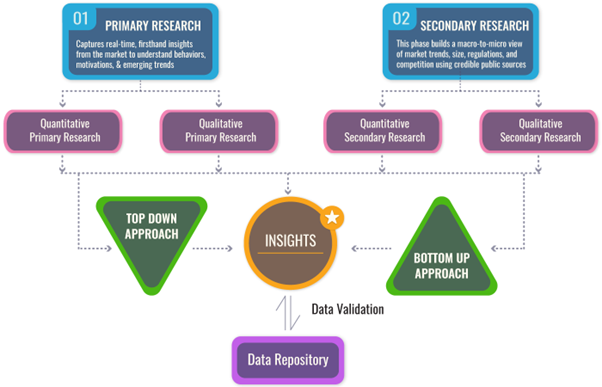
DUAL MODELING: TOP-DOWN + BOTTOM-UP
To ensure robust market estimation, we apply two complementary sizing approaches:
Top-Down Modeling:- Start with broader industry value (e.g., global or regional TAM)
- Apply filters by segment, geography, end-user, or use case
- Adjust with primary insights and validation benchmarks
- Ideal for investor-grade market scans and opportunity mapping
- Aggregate from the ground up using sales volumes, pricing, and unit economics
- Use internal modeling templates aligned with stakeholder data
- Incorporate distributor-level or region-specific inputs
- Most accurate for emerging segments and granular sub-markets
DATA VALIDATION: IN-HOUSE REPOSITORY
We close the loop with proprietary data intelligence built from ongoing projects, industry monitoring, and historical benchmarking. This repository includes:
- Multi-sector market and pricing models
- Key trendlines from past interviews and forecasts
- Benchmarked adoption rates, churn patterns, and ROI indicators
- Industry-specific deviation flags and cross-check logic
- Catches inconsistencies early
- Aligns projections across studies
- Enables consistent, high-trust deliverables