
Canada Bone Health Supplements Market Size and Forecast (2026–2034), Regional Growth, Trend, Share and Industry Analysis Report Coverage: By Ingredient Type (Calcium-Based Supplements, Magnesium-Based Supplements, Vitamin D-Based Supplements, and Others); By Dosage Form (Tablets, Capsules and Softgels, Powders, and Others); By Consumer Group (Infants and Children, 18–49 Years, 50–64 Years, and 65 Years and Above); By Distribution Channel (Pharmacies and Drugstores, Online Retail, Supermarkets and Hypermarkets, and Others)
2026-11-19
Healthcare
Swetal (Research Analyst)
Description
Canada Bone Health Supplements Market Overview
The Canada bone health supplements market is projected to expand from USD 0.42 billion in 2026 to USD 0.74 billion by 2034, registering a CAGR of 7.8% during 2026–2034. Market growth is being fueled by increasing consumer bone health awareness, growing demands for preventive health care services, and increasing prevalence of age-associated conditions such as osteoporosis and osteopenia. The main driver of market development is represented by aging population, especially females who lose bone density post-menopause period, as well as by the growing interest of both younger and elderly consumers in keeping their skeletons healthy. Calcium and vitamin D continue to dominate as the key components due to proven effectiveness in bone preservation. At the same time, the market pays growing attention to magnesium, vitamin K2, collagen, and multi-formulas due to increasing consumer interest in more advanced bone care solutions. Tablets and capsules retain their significance as the key forms due to convenient use and consumer habits. Pharmacies, health food stores, and online channels provide a diverse selection of available products. Canada bone health supplements market includes competitive rivalry between local Canadian supplement producers and global brands, with differentiation becoming increasingly important as being based on unique combination of ingredients.

Canada Bone Health Supplements Market Growth Drivers
Rising Prevalence of Osteoporosis and Low Bone Mineral Density
The rise in osteoporosis prevalence and reduction in bone mineral density in Canada's aging population have increased the need for bone supplement products that help prevent osteoporosis. The rising incidence of age-related bone loss among senior adults and postmenopausal women has prompted the need for consumption of bone health supplements such as calcium, vitamin D3, magnesium, and vitamin K2 supplements to keep bones healthy and avoid bone problems. For example, according to the Canadian Health Measures Survey (2022-2024) by Statistics Canada that was published in October 2026, 52% of Canadian adults aged 40-79 years old had poor bone mineral density levels including 13% suffering from osteoporosis and/or BMD showing signs of osteoporosis and 39% with low bone mass. Also, it was reported by Osteoporosis Canada that 2.3 million people were suffering from osteoporosis in Canada, and one in three women and one in five men will suffer from an osteoporotic fracture at some point in their life. Therefore, the burden of poor bone health has increased awareness of preventive nutritional care.
Growing Awareness of Preventive Healthcare and Nutritional Bone Support
More attention being paid to preventive medicine and public awareness about the management of bone health in the long term is prompting Canadians to engage in nutritional supplementation on a proactive basis. Government initiatives to promote evidence-based preventive healthcare, along with campaigns to educate the public on the prevention of osteoporosis, have made Canadians aware of the importance of proper nutrition, especially with regard to calcium and vitamin D intake. For example, in June 2026, the Public Health Agency of Canada established the National Advisory Committee on Preventive Health Services (NACPHS). In a similar vein, the 2025-2026 Impact Report of Osteoporosis Canada brought into focus its expanding efforts on public education and awareness programs that had over 900,000 site users and more than 4.2 million page views, along with 20 webinars related to education that registered over 9,400 users and digital bone health tools that had about 209,000 views. Such initiatives are helping to raise awareness about bone and muscle health, nutritional needs, and prevention of osteoporosis among the general public. This is leading to favorable demand conditions for calcium, Vitamin D3, magnesium, and Vitamin K2 supplements.
Canada Bone Health Supplements Market Restraint
Limited Consumer Awareness of Supplement Effectiveness and Appropriate Dosage
Consumer ignorance regarding the efficacy, proper dosage, and nutritional needs for bone health supplements could act as a barrier to market uptake. Many consumers are unsure regarding the distinctions between single nutrients, their combinations, and the appropriateness of certain formulations among various ages and bone health concerns. The inconsistencies in the claims, concentration of ingredients, and lack of knowledge about supplement use for extended periods can further hinder the purchasing process. Another issue is that consumers could find it difficult to determine whether to buy a supplement for maintaining bone health or for treatment along with medical intervention for osteoporosis.
Canada Bone Health Supplements Market Opportunities
Development of Multi-Ingredient Bone Health Formulations
Due to the increasing need for all-rounded solutions regarding bone care, many opportunities are being presented for brands to come up with supplements that contain ingredients such as calcium, Vitamin D3, magnesium, Vitamin K2, zinc as well as many others. Consumers have developed a preference for supplements that cater for more than one nutritional requirement as opposed to buying several different products to address several needs, making manufacturers diversify their range of combination products. As an example, the Canadian brand Orimed Pharma added more strengths of Vitamin D3 – 5,000 IU, 10,000 IU, 25,000 IU, and 50,000 IU to its PrLuxa-D brand portfolio in May 2026. In addition, the company markets SoluCal D+1000, which is a combination of calcium and vitamin D, thus providing an example of the existence of combination formulations for bone health in the Canadian market. Further, the Food Fortification Policy for August 2026 from Health Canada is another piece of information that adds to the regulatory framework for vitamins and minerals fortification in certain food types, including plant-based beverages; but these regulations apply to fortified foods and not dietary supplements. Thus, there is room for supplement manufacturers to differentiate their multi-nutrient formulations, dosing, and packaging.
Expansion of Targeted Bone Health Supplements for Age-Specific Consumers
Nutritional needs of people belonging to different age groups are presenting possibilities for the manufacture of bone health supplements that would cater to distinct consumer segments. Different levels of absorption of calcium, maintenance of bone density and age-related nutritional needs are prompting consumers to look at formulas containing distinct combinations of ingredients, dosages and delivery systems. The manufacturers can use this opportunity by formulating products specifically designed for bone development, bone strength and age-related bone deterioration. Through such products, the companies can widen their consumer base and improve their brand positioning within the Canadian market for bone health supplements.
Canada Bone Health Supplements Market Scope
Canada Bone Health Supplements Market Report Segmentation Analysis
Calcium-Based Supplements Segment Is Expected to Dominate the Canada Bone Health Supplements Market During the Forecast Period
Calcium-based supplements are predicted to remain dominant in the Canadian bone health supplements market due to the existing involvement of the mineral in bone formation, bone density, and bone structure. Increased understanding of the prevention of osteoporosis, aging and bone degradation, and the importance of fulfilling the daily calcium needs of an individual are contributing to increased demand among consumers. The aging population, postmenopausal women, and those suffering from low levels of calcium consumption are some of the major consumer categories propelling segment growth. Increased availability of calcium supplements in stand-alone and combination forms, such as calcium D3 and calcium magnesium formulations, is boosting demand in the segment. Consumers’ familiarity with the segment is predicted to maintain dominance through the forecast period.
Tablets Segment Is Expected to Dominate the Canada Bone Health Supplements Market During the Forecast Period
Tablets will continue to hold significant dominance in terms of market share within the Canadian bone health supplements market owing to their easy consumption and storage properties along with long shelf life. Bone health supplements containing calcium, Vitamin D3, magnesium, as well as combination bone health supplements are extensively available as tablets and thus facilitate adoption among the older age groups and those in need of nutritional supplementation. It is also cost-efficient, and there exist various manufacturing and production methods for them, besides the fact that they are available in various dosage forms as well. Due to such factors, tablets are expected to remain dominant throughout the forecast period.
65 Years and Above Segment Is Expected to Dominate the Canada Bone Health Supplements Market During the Forecast Period
The 65 years and above age group is anticipated to occupy a significant position in the Canadian bone health supplements market because of the increased susceptibility of the elderly to bone density loss, osteoporosis, and bone fractures. The natural loss of bone mass that occurs with ageing, along with decreased calcium absorption and changing nutritional needs, is prompting more people to rely on dietary supplements for their bone health. Post-menopausal bone loss in women forms a major consumer base in this age group. Rising consciousness regarding osteoporosis prevention and the necessity to remain mobile is also contributing to the rising demand for calcium, vitamin D3, magnesium, and bone health combinations. Therefore, the increasing elderly population, along with their increased requirement for preventative nutrition, will continue to maintain the dominance of the 65 years and above age group during the forecast period.
Pharmacies and Drugstores Segment Is Expected to Dominate the Canada Bone Health Supplements Market During the Forecast Period
Pharmacies and drug stores are anticipated to retain their leadership status within the Canadian market for bone health supplements owing to their traditional position in supplying readily available nutritional and healthcare products to consumers. Consumers, especially older persons and those having osteoporosis risks, tend to prefer pharmacies as places of buying bone health supplements such as calcium, Vitamin D3, etc., due to the availability of professional advice from pharmacists in choosing the appropriate products. The existence of chain pharmacies, a wide variety of products, and easy availability of prescription as well as non-prescription healthcare products further facilitate the growth of this channel. Consumer faith in the product quality of the channel, along with regular purchasing of nutritional supplements, is predicted to drive demand through this channel throughout the forecast period.
The following segments are part of an in-depth analysis of the Canada Bone Health Supplements Market:
Canada Bone Health Supplements Market Competition Landscape Analysis
The Canada bone health supplements market is competitive with existing manufacturers of supplements in Canada, natural health product specialists, and international consumer healthcare brands. The competitive advantage of Jamieson Wellness, WN Pharmaceuticals (Webber Naturals), and Natural Factors is provided by their established brand reputation, diversified product range, and wide distribution network through Canadian pharmacies and drug stores. In addition, CanPrev Natural Health Products, Advanced Orthomolecular Research (AOR), and Flora Manufacturing & Distributing are competitive due to specific formulations aimed at bone density and mineral support. Competition within the industry is provided by international manufacturers, such as Haleon, NOW Health Group, and Nestlé Health Science, due to their established line of nutritional supplements. Competition in the industry is mainly based on product quality, ingredient combination, innovation of formulas, prices, brand reputation, and distribution network. Manufacturers are increasingly paying attention to multivitamin formulas that include calcium, vitamin D3, vitamin K2, and magnesium, as well as target supplements for older adults and post-menopausal women.
Canada Bone Health Supplements Market Recent Developments News:
In August 2026, Mantra Pharma announced the Canadian launch of Qosequ (denosumab injection), its first biosimilar and a biosimilar to Prolia, for the management of osteoporosis in eligible patients. Administered through a subcutaneous injection every six months, Qosequ expands the company's existing bone health portfolio, which includes mcal calcium and vitamin D supplements available in multiple formats. The launch is supported by a patient assistance program and reflects Mantra Pharma's strategy to strengthen its presence in osteoporosis management by combining nutritional supplementation, pharmaceutical treatment, and patient support services.
The Canada Bone Health Supplements Market is dominated by a few large companies, such as
Jamieson Wellness
WN Pharmaceuticals
Natural Factors
Organika Health Products
CanPrev Natural Health Products
Advanced Orthomolecular Research (AOR)
Platinum Naturals
Flora Manufacturing & Distributing
New Roots Herbal
Prairie Naturals
Bell Lifestyle Products
Enerex Botanicals
Cyto-Matrix
Kasha Nutrition
Preferred Nutrition
VNDL Project
Naka Herb & Spice
Haleon
Nestlé Health Science
NOW Health Group
Other Prominent Players
Frequently Asked Questions
Swetal (Research Analyst)
Canada Bone Health Supplements Market Introduction and Market Overview
Objectives of the Study
Market Segmentation
Ingredient Type of the Canada Bone Health Supplements Market
Dosage Form of the Canada Bone Health Supplements Market
Consumer Group of the Canada Bone Health Supplements Market
Distribution Channel of Canada Bone Health Supplements Market
Competition Coverage List of Market Participants
Market Definition: Bone Health Supplements Market
Executive Summary
Canada Bone Health Supplements Market Estimation & Forecast
Canada Bone Health Supplements Market Size (US$ Million) Estimates & Historical Trend Analysis (2021 - 2025)
Canada Bone Health Supplements Overall Market Size (US$ Million), Growth Rate (Y-o-Y), Market CAGR (%), Market Forecast (2026 - 2034)
Snapshot of Canada Bone Health Supplements Market
Canada Bone Health Supplements Market Revenue Share (%) 2025
Key Competitors & Key Insights
Market Overview (Qualitative Analysis)
Demand Side Trends
Supply Side Trends / Manufacturing Trends
Demand and Opportunity Assessment, 2026 - 2034
Market Dynamics
Drivers
Limitations
Opportunities
Impact Analysis of Drivers and Restraints
Key Developments
Regulatory Landscape
Pricing Analysis
Supply Chain Analysis
Porter’s Five Forces Analysis
Bargaining Power of Suppliers
Bargaining Power of Buyers
Threat of Substitutes
Threat of New Entrants
Competitive Rivalry
PEST Analysis
Political Factors
Economic Factors
Social Factors
Technology Factors
Canada Bone Health Supplements Market Estimates & Forecast Trend Analysis, by Ingredient Type
Canada Bone Health Supplements Market Assessments & Key Findings, by Ingredient Type
Canada Bone Health Supplements Market Revenue (US$ Million) Estimates and Forecasts, by Ingredient Type, 2021 - 2034
Calcium-Based Supplements
Magnesium-Based Supplements
Vitamin D-Based Supplements
Others
Canada Bone Health Supplements Market Estimates & Forecast Trend Analysis, by Dosage Form
Canada Bone Health Supplements Market Assessments & Key Findings, by Dosage Form
Canada Bone Health Supplements Market Revenue (US$ Million) Estimates and Forecasts, by Dosage Form, 2021 - 2034
Tablets
Capsules and Softgels
Powders
Others
Canada Bone Health Supplements Market Estimates & Forecast Trend Analysis, by Consumer Group
Canada Bone Health Supplements Market Assessments & Key Findings, by Consumer Group
Canada Bone Health Supplements Market Revenue (US$ Million) Estimates and Forecasts, by Consumer Group, 2021 - 2034
Infants and Children
18–49 Years
50–64 Years
65 Years and Above
Canada Bone Health Supplements Market Estimates & Forecast Trend Analysis, by Distribution Channel
Canada Bone Health Supplements Market Assessments & Key Findings, by Distribution Channel
Canada Bone Health Supplements Market Revenue (US$ Million) Estimates and Forecasts, by Distribution Channel, 2021 - 2034
Pharmacies and Drugstores
Online Retail
Supermarkets and Hypermarkets
Others
Competition Landscape
Canada Bone Health Supplements Market Product Mapping
Canada Bone Health Supplements Market Concentration Analysis, by Leading Players / Innovators / Emerging Players / New Entrants
Canada Bone Health Supplements Market Tier Structure Analysis
Canada Bone Health Supplements Market Concentration & Company Market Shares (%) Analysis, 2025
Company Profiles
Jamieson Wellness
Company Overview & Key Stats
Financial Performance & KPIs
Product Portfolio
SWOT Analysis
Business Strategy & Recent Developments
* Similar details would be provided for all the players mentioned below
WN Pharmaceuticals
Natural Factors
Organika Health Products
CanPrev Natural Health Products
Advanced Orthomolecular Research (AOR)
Platinum Naturals
Flora Manufacturing & Distributing
New Roots Herbal
Prairie Naturals
Bell Lifestyle Products
Enerex Botanicals
Cyto-Matrix
Kasha Nutrition
Preferred Nutrition
VNDL Project
Naka Herb & Spice
Haleon
Nestlé Health Science
NOW Health Group
Other Prominent Players
Research Findings & Conclusion
Assumptions & Acronyms Used
Research Methodology
External Transportation / Databases
Internal Proprietary Database
Primary Research
Secondary Research
Assumptions
Limitations
Report FAQs
Our Research Methodology
"Insight without rigor is just noise."
We follow a comprehensive, multi-phase research framework designed to deliver accurate, strategic, and decision-ready intelligence. Our process integrates primary and secondary research , both quantitative and qualitative , along with dual modeling techniques ( top-down and bottom-up) and a final layer of validation through our proprietary in-house repository.
PRIMARY RESEARCH
Primary research captures real-time, firsthand insights from the market to understand behaviors, motivations, and emerging trends.
1. Quantitative Primary Research
Objective: Generate statistically significant data directly from market participants.
Approaches:- Structured surveys with customers, distributors, and field agents
- Mobile-based data collection for point-of-sale audits and usage behavior
- Phone-based interviews (CATI) for market sizing and product feedback
- Online polling around industry events and digital campaigns
- Purchase frequency by customer type
- Channel performance across geographies
- Feature demand by application or demographic
2. Qualitative Primary Research
Objective: Explore decision-making drivers, pain points, and market readiness.
Approaches:- In-depth interviews (IDIs) with executives, product managers, and key decision-makers
- Focus groups among end users and early adopters
- Site visits and observational research for consumer products
- Informal field-level discussions for regional and cultural nuances
SECONDARY RESEARCH
This phase helps establish a macro-to-micro understanding of market trends, size, regulation, and competitive dynamics, sourced from credible and public domain information.
1. Quantitative Secondary Research
Objective: Model market value and segment-level forecasts based on published data.
Sources include:- Financial reports and investor summaries
- Government trade data, customs records, and regulatory statistics
- Industry association publications and economic databases
- Channel performance and pricing data from marketplace listings
- Revenue splits, pricing trends, and CAGR estimates
- Supply-side capacity and volume tracking
- Investment analysis and funding benchmarks
2. Qualitative Secondary Research
Objective: Capture strategic direction, innovation signals, and behavioral trends.
Sources include:- Company announcements, roadmaps, and product pipelines
- Publicly available whitepapers, conference abstracts, and academic research
- Regulatory body publications and policy briefs
- Social and media sentiment scanning for early-stage shifts
- Strategic shifts in market positioning
- Unmet needs and white spaces
- Regulatory triggers and compliance impact
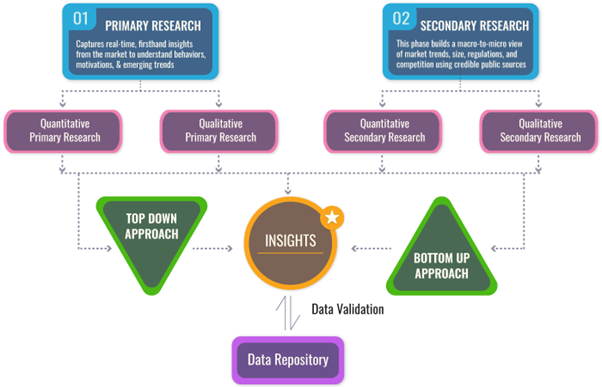
DUAL MODELING: TOP-DOWN + BOTTOM-UP
To ensure robust market estimation, we apply two complementary sizing approaches:
Top-Down Modeling:- Start with broader industry value (e.g., global or regional TAM)
- Apply filters by segment, geography, end-user, or use case
- Adjust with primary insights and validation benchmarks
- Ideal for investor-grade market scans and opportunity mapping
- Aggregate from the ground up using sales volumes, pricing, and unit economics
- Use internal modeling templates aligned with stakeholder data
- Incorporate distributor-level or region-specific inputs
- Most accurate for emerging segments and granular sub-markets
DATA VALIDATION: IN-HOUSE REPOSITORY
We close the loop with proprietary data intelligence built from ongoing projects, industry monitoring, and historical benchmarking. This repository includes:
- Multi-sector market and pricing models
- Key trendlines from past interviews and forecasts
- Benchmarked adoption rates, churn patterns, and ROI indicators
- Industry-specific deviation flags and cross-check logic
- Catches inconsistencies early
- Aligns projections across studies
- Enables consistent, high-trust deliverables