

Carbon Nanomaterials Market Size and Forecast (2020 - 2033), Global and Regional Growth, Trend, Share, and Industry Analysis Report Coverage: By Type (Carbon Nanotubes, Graphene, Carbon Nanofibers, Fullerenes, and Others), By Application (Electronics & Semiconductors, Energy Storage & Generation, Composites, Aerospace & Defence, Healthcare & Life Sciences, and Others), And Geography
2025-11-28
Chemicals & Materials
Jaya Bundele (Research Analyst)
Description
Carbon Nanomaterials Market Overview
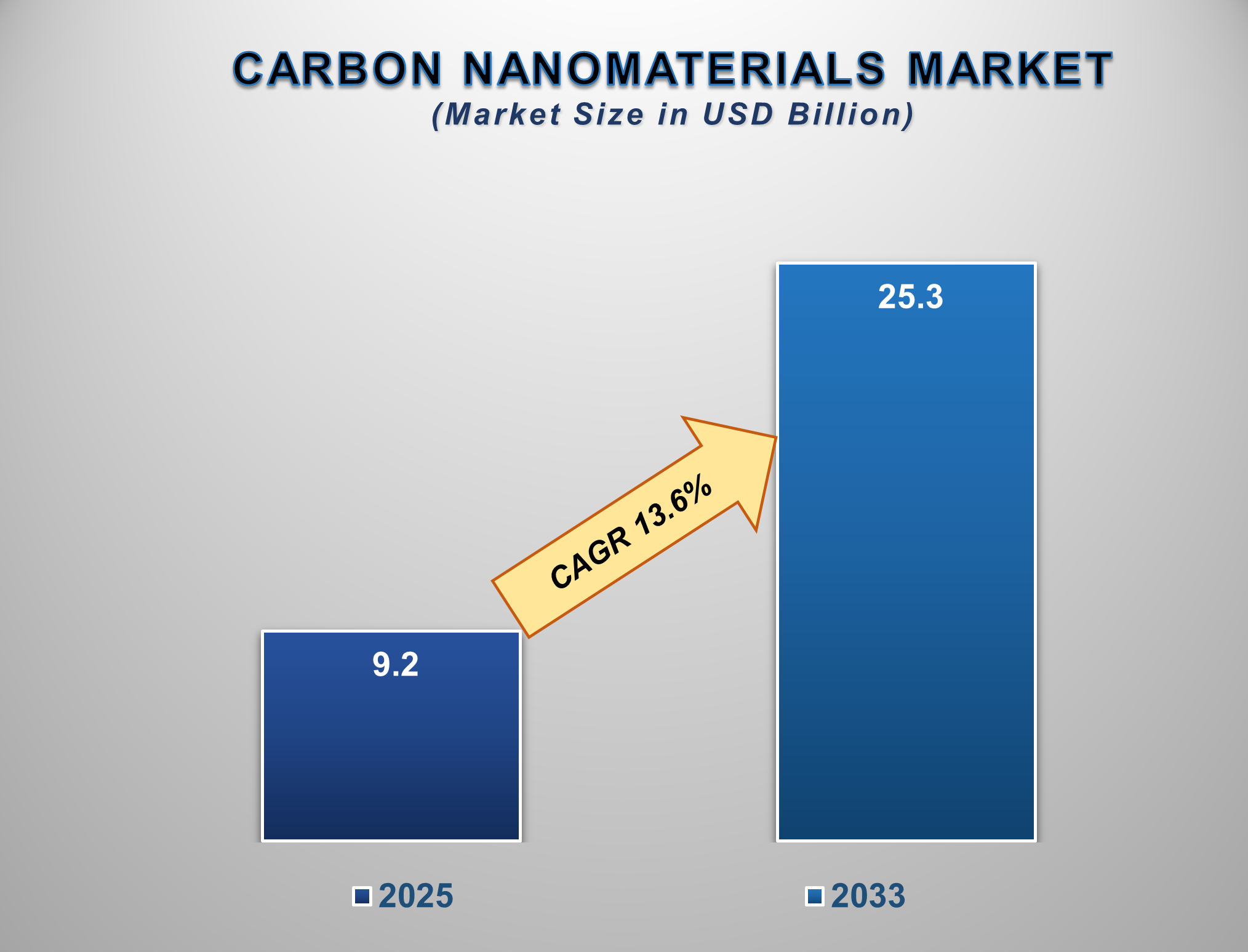
The Carbon Nanomaterials Market is positioned for a period of exceptional and rapid expansion from 2025 to 2033, fueled by the relentless pursuit of advanced material properties, the global transition to new energy systems, and continuous technological breakthroughs across multiple industries. The market is projected to be valued at approximately USD 9.2 billion in 2025 and is forecasted to reach nearly USD 25.3 billion by 2033, exhibiting a robust compound annual growth rate (CAGR) of 13.6% during this period.
Carbon nanomaterials, which include structures
like carbon nanotubes (CNTs), graphene, and carbon nanofibers (CNFs), are
characterized by their exceptional strength, electrical and thermal
conductivity, and lightweight properties. These unique characteristics
distinguish them from conventional materials and unlock transformative
potential across a wide array of applications. The market's significant
expansion is primarily driven by the escalating demand in the electronics
sector for smaller, faster, and more efficient components, as well as the
critical role of carbon nanomaterials in enhancing the performance of energy
storage devices like lithium-ion batteries and fuel cells.
Furthermore, their application in high-strength,
lightweight composites is revolutionizing the aerospace, automotive, and wind
energy industries. The growing investment in research and development from both
public and private sectors is continuously uncovering new application areas,
from medical diagnostics to water purification. North America and Europe are
significant markets due to strong R&D infrastructure and early adoption in
advanced industries, while the Asia-Pacific region is expected to witness the
fastest growth, driven by its massive electronics manufacturing base and
aggressive investments in new energy and technology sectors.
Carbon
Nanomaterials Market Drivers and Opportunities
The Demand for Advanced Material Properties
in Electronics and Energy Storage is the Primary Market Driver
The insatiable demand for higher performance in
electronics and more efficient energy storage solutions is the most powerful
force propelling the carbon nanomaterials market. In the electronics and
semiconductor industry, the miniaturization of transistors and the need for
better thermal management materials have made carbon nanotubes and graphene
indispensable. Their superior electrical conductivity and nanoscale dimensions
are critical for developing next-generation chips, flexible displays, and high-frequency
sensors. Simultaneously, the global energy transition is heavily reliant on
improving battery technology. Carbon nanomaterials, particularly graphene and
CNTs, are used as conductive additives in lithium-ion battery anodes,
significantly enhancing charge capacity, charging speed, and cycle life. This
application is vital for the advancement of electric vehicles (EVs) and
grid-scale energy storage, creating a massive and sustained demand driver for
the market.
The global market for advanced materials in
energy storage is witnessing unprecedented growth. The lithium-ion battery
market, a key consumer of carbon nanomaterials, is projected to exceed USD 300
billion by 2030, with annual demand growth rates consistently above 20%. This
surge is directly linked to the EV revolution, where global sales are expected
to account for over half of all new car sales by 2030 in leading markets.
The Proliferation in Composite Materials and
Biomedical Applications is Driving Strategic Adoption
The integration of carbon nanomaterials into
composite materials represents a major growth vector for the market. When added
to polymers, metals, or ceramics, CNTs and graphene dramatically enhance
mechanical strength, stiffness, and lightweight properties without a significant weight penalty. This is revolutionizing
industries such as aerospace, where lightweight composites directly translate
to fuel savings and increased payload, and automotive, where they contribute to
vehicle light-weighting for improved EV range. The sports equipment industry is
also a key early adopter. In parallel, the biomedical sector is emerging as a
high-growth frontier. Functionalized carbon nanomaterials are being developed
for targeted drug delivery, bio-imaging, cancer therapy, and advanced
biosensors due to their unique optical properties and biocompatibility, opening
up new, high-value markets.
Technological Advancements and Scalable
Production Innovations Present Significant Opportunities
Breakthroughs in synthesis methods and
cost-reduction strategies are creating significant growth frontiers for the
carbon nanomaterials market. Key opportunities lie in overcoming the primary
challenge of high-volume, consistent, and low-cost production. Advancements in
chemical vapor deposition (CVD) for CNTs and scalable exfoliation techniques
for graphene are crucial for making these materials more accessible for
mass-market applications like concrete strengthening and plastic composites.
Furthermore, the development of hybrid nanomaterials—combining, for instance,
graphene with CNTs or metals—can create multifunctional materials with
synergistic properties. For manufacturers and investors, the strategic focus is
on R&D to improve production yields, reduce energy consumption, and develop
application-specific grades of nanomaterials to bridge the gap between
laboratory promise and commercial-scale reality.
Carbon Nanomaterials
Market Scope
|
Report Attributes |
Description |
|
Market Size in 2025 |
USD 9.2 Billion |
|
Market Forecast in 2033 |
USD 25.3 Billion |
|
CAGR % 2025-2033 |
13.6% |
|
Base Year |
2024 |
|
Historic Data |
2020-2024 |
|
Forecast Period |
2025-2033 |
|
Report USP |
Product Portfolio,
Technological Analysis, Company Market Share, Company Heatmap, Pricing
Analysis, Growth Factors and more |
|
Segments Covered |
●
By Type ●
By Application |
|
Regional Scope |
●
North America, ●
Europe, ●
APAC, ●
Latin America ●
Middle East and
Africa |
|
Country Scope |
1)
U.S. 2)
Canada 3)
Germany 4)
UK 5)
France 6)
Spain 7)
Italy 8)
Switzerland 9)
China 10)
Japan 11)
India 12)
Australia 13)
South Korea 14)
Brazil 15)
Mexico 16)
Argentina 17)
South Africa 18)
Saudi Arabia 19)
UAE |
Carbon Nanomaterials
Market Report Segmentation Analysis
The global Carbon Nanomaterials
Market industry analysis is segmented by Type, by Application, and by region.
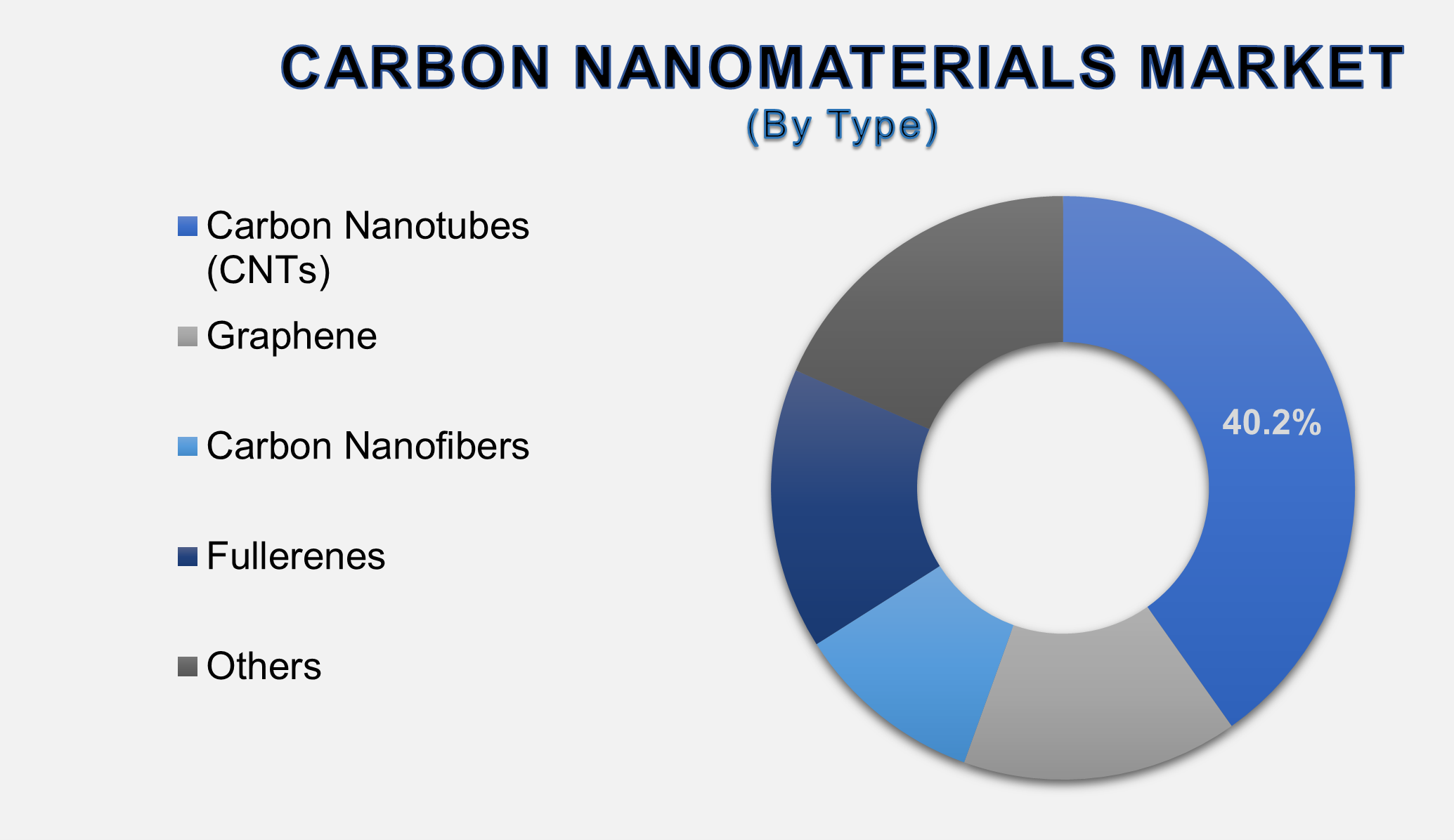
The Carbon Nanotubes (CNTs) Type segment is
anticipated to command a significant market share in 2025
The Type segment is categorized
into Carbon Nanotubes (CNTs), Graphene, Carbon Nanofibers, Fullerenes, and
Others. The Carbon Nanotubes segment holds a substantial and leading share,
driven by their well-established commercial production and diverse high-value
applications. CNTs offer an unparalleled combination of mechanical strength
and electrical and thermal conductivity, making them
a versatile material. Their largest application is as conductive additives in
lithium-ion batteries, a market with explosive growth. Additionally, their use
in polymer composites for automotive and aerospace components, as well as in
electronics for thermal management and conductive films, provides multiple
robust revenue streams. The maturity of CNT production technology compared to
other nanomaterials like graphene has allowed it to achieve greater commercial
penetration and cost-effectiveness for specific applications, securing its
dominant position.
The Energy Storage & Generation Application
segment is projected to grow at a significant CAGR.
The Application segment includes Electronics
& Semiconductors, Energy Storage & Generation, Composites, Aerospace
& Defense, Healthcare & Life Sciences, and Others. The Energy Storage
& Generation segment's projected significant growth is directly linked to
the global energy transition. The imperative to improve the performance,
capacity, and safety of batteries for electric vehicles and consumer
electronics is paramount. Carbon nanomaterials, especially CNTs and graphene,
are critical enablers in this space, used as conductive networks in anodes and
cathodes to facilitate faster electron transfer and improve structural
integrity. Beyond batteries, their application in supercapacitors for rapid
energy storage/release and in fuel cells as catalyst supports further broadens
the segment's growth potential. As investments in green energy technologies
soar, this segment is poised to be the primary engine of growth for the carbon
nanomaterials market.
The Electronics & Semiconductors end-user
segment is projected to witness the highest growth rate.
The Electronics & Semiconductors segment's
position as the fastest-growing channel is a direct consequence of the
industry's constant drive toward miniaturization and performance enhancement.
The unique properties of carbon nanomaterials are essential for overcoming the
physical limitations of silicon-based technology. Graphene's high electron
mobility makes it a candidate for post-silicon transistors, while CNTs are
being developed for vias and interconnects in integrated circuits due to their
high current-carrying capacity. Furthermore, the growth of flexible and
wearable electronics relies on materials like graphene for creating
transparent, flexible, and conductive electrodes. The immense R&D
investments from leading semiconductor companies and the continuous emergence
of new electronic device concepts are powerful forces propelling the explosive
growth of carbon nanomaterials within this industry.
The following segments are part of an in-depth analysis of
the global Carbon Nanomaterials Market:
|
Market
Segments |
|
|
By Type |
●
Carbon Nanotubes
(CNTs) ●
Graphene ●
Carbon Nanofibers ●
Fullerenes ●
Others |
|
By Application
|
●
Electronics &
Semiconductors ●
Energy Storage &
Generation ●
Composites ●
Aerospace &
Defence ●
Healthcare &
Life Sciences ●
Others |
Carbon Nanomaterials
Market Share Analysis by Region
The Asia-Pacific region
is anticipated to hold the largest portion of the Carbon Nanomaterials Market
globally throughout the forecast period.
Asia-Pacific's dominance is attributed to its
position as the global hub for electronics manufacturing and battery
production. Countries like China, South Korea, and Japan are home to the
world's largest manufacturers of consumer electronics, semiconductors, and
lithium-ion batteries—all key consumers of carbon nanomaterials. Strong
government support for advanced materials research and the presence of major
market players with extensive manufacturing capabilities create a powerful
ecosystem for market growth. The region's aggressive push towards electric
vehicle adoption and renewable energy infrastructure further fuels the demand
for high-performance materials, solidifying its leading position.
China, in particular, is a critical hub for the
carbon nanomaterials market. The Chinese government has consistently
prioritized the development of advanced materials in its national industrial
policy, leading to massive domestic production capacity for CNTs and graphene.
Chinese companies are not only major suppliers but also increasingly
sophisticated consumers, integrating these materials into batteries,
composites, and electronics for both domestic use and export. This control over
the supply chain, combined with a vast domestic market for end products,
ensures China's central and influential role in the global carbon nanomaterials
landscape.
Carbon Nanomaterials
Market Competition Landscape Analysis
The global carbon
nanomaterials market is fragmented and characterized by a high level of
competition, featuring a diverse mix of specialized nanomaterial producers,
large chemical conglomerates, and numerous research-driven startups. The
competitive intensity is high and revolves around product quality (purity,
functionality), production capacity, patent portfolios, and cost-effectiveness.
Key strategies include significant investment in R&D to develop new
production methods and application-specific grades, forming strategic
partnerships and joint ventures with end-users in the battery and composites
industries, and pursuing vertical integration to control the supply chain from
raw materials to finished products.
Global Carbon
Nanomaterials Market Recent Developments News:
- In January 2025, a leading South Korean electronics
giant announced a partnership with a graphene producer to develop
next-generation flexible displays for its flagship smartphones, targeting
a commercial launch by 2026.
- In November 2024, Arkema S.A. commissioned a new
multi-million euro production line for its specialty carbon nanotube
grades targeted at the high-performance composites market for aerospace.
- In September 2024, Cabot Corporation expanded its
global footprint by opening a new conductive carbon additive facility in
China, specifically focusing on materials for EV batteries.
- In July 2024, NanoXplore Inc. signed a long-term supply agreement
with a European automotive OEM to provide graphene-enhanced composite
materials for interior components, reducing weight and improving
durability.
The Global Carbon Nanomaterials Market Is Dominated by a Few
Large Companies, such as
●
Arkema S.A.
●
Cabot Corporation
●
LG Chem Ltd.
●
SHOWA DENKO K.K.
(Showa Denko Materials)
●
Nanocyl S.A.
●
Thomas Swan & Co.
Ltd.
●
Bayer AG
●
Hyperion Catalysis
International
●
CNT Co., Ltd.
●
NanoXplore Inc.
●
Graphenea S.A.
●
XG Sciences
●
Toray Industries, Inc.
●
Mitsubishi Chemical
Holdings Corporation
●
Other Prominent
Players
FAQs
Frequently Asked Questions
Jaya Bundele (Research Analyst)
Jaya Bundele is a skilled Research Analyst with 4+ years of experience in market intelligence, consumer insights, competitive analysis, and industry forecasting across the consumer goods, agriculture, and food & beverage sectors. She specializes in market sizing, trend analysis, growth opportunity mapping, and strategic secondary research for global and regional markets.
Her expertise lies in transforming complex industry data into actionable business strategies that help organizations identify emerging trends, understand customer behavior, and gain a competitive edge. With a strong focus on data-driven insights, business intelligence, and future market trends, Jaya delivers high-quality research solutions aligned with evolving industry demands and market dynamics.
1. Global Carbon
Nanomaterials Market Introduction and Market Overview
1.1.
Objectives
of the Study
1.2.
Global
Carbon Nanomaterials Market Scope and Market Estimation
1.2.1.Global Electronic Toll
Collection Overall Market Size (US$ Bn), Market CAGR (%), Market forecast (2025
- 2033)
1.2.2.Global Carbon
Nanomaterials Market Revenue Share (%) and Growth Rate (Y-o-Y) from 2020 - 2033
1.3.
Market
Segmentation
1.3.1.Type of Global Carbon
Nanomaterials Market
1.3.2.Application of Global Carbon
Nanomaterials Market
1.3.3.Region of Global Carbon
Nanomaterials Market
2.
Executive Summary
2.1.
Demand
Side Trends
2.2.
Key
Market Trends
2.3.
Market
Demand (US$ Bn) Analysis 2020 – 2024 and forecast, 2025 – 2033
2.4.
Demand
and Opportunity Assessment
2.5.
Key
Developments
2.6.
Market
Entry Strategies
2.7.
Market
Dynamics
2.7.1.Drivers
2.7.2.Limitations
2.7.3.Opportunities
2.7.4.Impact Analysis of Drivers
and Restraints
2.8.
Porter’s
Five Forces Analysis
2.9.
PEST
Analysis
3. Global
Carbon Nanomaterials Market Estimates
& Historical Trend Analysis (2020 - 2024)
4. Global
Carbon Nanomaterials Market Estimates
& Forecast Trend Analysis, by Type
4.1.
Global
Carbon Nanomaterials Market Revenue (US$ Bn) Estimates and Forecasts, by Type,
2020 - 2033
4.1.1.Carbon Nanotubes (CNTs)
4.1.2.Graphene
4.1.3.Carbon Nanofibers
4.1.4.Fullerenes
4.1.5.Others
5. Global
Carbon Nanomaterials Market Estimates
& Forecast Trend Analysis, by Application
5.1.
Global
Carbon Nanomaterials Market Revenue (US$ Bn) Estimates and Forecasts, by Application,
2020 - 2033
5.1.1.Electronics &
Semiconductors
5.1.2.Energy Storage &
Generation
5.1.3.Composites
5.1.4.Aerospace & Defense
5.1.5.Healthcare & Life
Sciences
5.1.6.Others
6. Global
Carbon Nanomaterials Market Estimates
& Forecast Trend Analysis, by region
6.1.
Global
Carbon Nanomaterials Market Revenue (US$ Bn) Estimates and Forecasts, by region,
2020 - 2033
6.1.1.North America
6.1.2.Europe
6.1.3.Asia Pacific
6.1.4.Middle East & Africa
6.1.5.Latin America
7. North America Carbon
Nanomaterials Market: Estimates &
Forecast Trend Analysis
7.1. North America Carbon
Nanomaterials Market Assessments & Key Findings
7.1.1.North America Carbon
Nanomaterials Market Introduction
7.1.2.North America Carbon
Nanomaterials Market Size Estimates and Forecast (US$ Billion) (2020 - 2033)
7.1.2.1.
By Type
7.1.2.2.
By Application
7.1.2.3. By Country
7.1.2.3.1. The U.S.
7.1.2.3.2. Canada
8. Europe Carbon
Nanomaterials Market: Estimates &
Forecast Trend Analysis
8.1. Europe Carbon
Nanomaterials Market Assessments & Key Findings
8.1.1.Europe Carbon
Nanomaterials Market Introduction
8.1.2.Europe Carbon
Nanomaterials Market Size Estimates and Forecast (US$ Billion) (2020 - 2033)
8.1.2.1.
By Type
8.1.2.2.
By Application
8.1.2.3. By Country
8.1.2.3.1.
Germany
8.1.2.3.2.
Italy
8.1.2.3.3.
U.K.
8.1.2.3.4.
France
8.1.2.3.5.
Spain
8.1.2.3.6.
Switzerland
8.1.2.3.7. Rest
of Europe
9. Asia Pacific Carbon
Nanomaterials Market: Estimates &
Forecast Trend Analysis
9.1. Asia Pacific Market
Assessments & Key Findings
9.1.1.Asia Pacific Carbon
Nanomaterials Market Introduction
9.1.2.Asia Pacific Carbon
Nanomaterials Market Size Estimates and Forecast (US$ Billion) (2020 - 2033)
9.1.2.1.
By Type
9.1.2.2.
By Application
9.1.2.3. By Country
9.1.2.3.1.
China
9.1.2.3.2.
Japan
9.1.2.3.3.
India
9.1.2.3.4.
Australia
9.1.2.3.5.
South
Korea
9.1.2.3.6. Rest of Asia Pacific
10. Middle East & Africa Carbon
Nanomaterials Market: Estimates &
Forecast Trend Analysis
10.1. Middle East & Africa
Market Assessments & Key Findings
10.1.1. Middle
East & Africa
Carbon Nanomaterials Market Introduction
10.1.2. Middle
East & Africa
Carbon Nanomaterials Market Size Estimates and Forecast (US$ Billion) (2020 - 2033)
10.1.2.1.
By Type
10.1.2.2.
By Application
10.1.2.3. By Country
10.1.2.3.1. UAE
10.1.2.3.2. Saudi
Arabia
10.1.2.3.3. South
Africa
10.1.2.3.4. Rest
of MEA
11. Latin America
Carbon Nanomaterials Market: Estimates
& Forecast Trend Analysis
11.1. Latin America Market
Assessments & Key Findings
11.1.1. Latin America Carbon
Nanomaterials Market Introduction
11.1.2. Latin America Carbon
Nanomaterials Market Size Estimates and Forecast (US$ Billion) (2020 - 2033)
11.1.2.1.
By Type
11.1.2.2.
By Application
11.1.2.3. By Country
11.1.2.3.1. Brazil
11.1.2.3.2. Argentina
11.1.2.3.3. Mexico
11.1.2.3.4. Rest
of LATAM
12.
Country
Wise Market: Introduction
13.
Competition
Landscape
13.1. Global Carbon
Nanomaterials Market Product Mapping
13.2. Global Carbon
Nanomaterials Market Concentration Analysis, by Leading Players / Innovators /
Emerging Players / New Entrants
13.3. Global Carbon
Nanomaterials Market Tier Structure Analysis
13.4. Global Carbon
Nanomaterials Market Concentration & Company Market Shares (%) Analysis,
2024
14.
Company
Profiles
14.1.
Arkema S.A.
14.1.1.
Company
Overview & Key Stats
14.1.2.
Financial
Performance & KPIs
14.1.3.
Product
Portfolio
14.1.4.
SWOT
Analysis
14.1.5.
Business
Strategy & Recent Developments
* Similar details would be provided for all the players
mentioned below
14.2.
Cabot Corporation
14.3.
LG Chem Ltd.
14.4.
SHOWA DENKO K.K. (Showa Denko Materials)
14.5.
Nanocyl S.A.
14.6.
Thomas Swan & Co. Ltd.
14.7.
Bayer AG (Currenta GmbH & Co. OHG)
14.8.
Hyperion Catalysis International
14.9.
CNT Co., Ltd.
14.10.
NanoXplore Inc.
14.11.
Graphenea S.A.
14.12.
XG Sciences
14.13.
Toray Industries, Inc.
14.14.
Mitsubishi Chemical Holdings Corporation
14.15.
Other Prominent Players
15. Research
Methodology
15.1. External Transportations /
Databases
15.2. Internal Proprietary
Database
15.3. Primary Research
15.4. Secondary Research
15.5. Assumptions
15.6. Limitations
15.7. Report FAQs
16. Research
Findings & Conclusion
Our Research Methodology
"Insight without rigor is just noise."
We follow a comprehensive, multi-phase research framework designed to deliver accurate, strategic, and decision-ready intelligence. Our process integrates primary and secondary research , both quantitative and qualitative , along with dual modeling techniques ( top-down and bottom-up) and a final layer of validation through our proprietary in-house repository.
PRIMARY RESEARCH
Primary research captures real-time, firsthand insights from the market to understand behaviors, motivations, and emerging trends.
1. Quantitative Primary Research
Objective: Generate statistically significant data directly from market participants.
Approaches:- Structured surveys with customers, distributors, and field agents
- Mobile-based data collection for point-of-sale audits and usage behavior
- Phone-based interviews (CATI) for market sizing and product feedback
- Online polling around industry events and digital campaigns
- Purchase frequency by customer type
- Channel performance across geographies
- Feature demand by application or demographic
2. Qualitative Primary Research
Objective: Explore decision-making drivers, pain points, and market readiness.
Approaches:- In-depth interviews (IDIs) with executives, product managers, and key decision-makers
- Focus groups among end users and early adopters
- Site visits and observational research for consumer products
- Informal field-level discussions for regional and cultural nuances
SECONDARY RESEARCH
This phase helps establish a macro-to-micro understanding of market trends, size, regulation, and competitive dynamics, sourced from credible and public domain information.
1. Quantitative Secondary Research
Objective: Model market value and segment-level forecasts based on published data.
Sources include:- Financial reports and investor summaries
- Government trade data, customs records, and regulatory statistics
- Industry association publications and economic databases
- Channel performance and pricing data from marketplace listings
- Revenue splits, pricing trends, and CAGR estimates
- Supply-side capacity and volume tracking
- Investment analysis and funding benchmarks
2. Qualitative Secondary Research
Objective: Capture strategic direction, innovation signals, and behavioral trends.
Sources include:- Company announcements, roadmaps, and product pipelines
- Publicly available whitepapers, conference abstracts, and academic research
- Regulatory body publications and policy briefs
- Social and media sentiment scanning for early-stage shifts
- Strategic shifts in market positioning
- Unmet needs and white spaces
- Regulatory triggers and compliance impact

DUAL MODELING: TOP-DOWN + BOTTOM-UP
To ensure robust market estimation, we apply two complementary sizing approaches:
Top-Down Modeling:- Start with broader industry value (e.g., global or regional TAM)
- Apply filters by segment, geography, end-user, or use case
- Adjust with primary insights and validation benchmarks
- Ideal for investor-grade market scans and opportunity mapping
- Aggregate from the ground up using sales volumes, pricing, and unit economics
- Use internal modeling templates aligned with stakeholder data
- Incorporate distributor-level or region-specific inputs
- Most accurate for emerging segments and granular sub-markets
DATA VALIDATION: IN-HOUSE REPOSITORY
We close the loop with proprietary data intelligence built from ongoing projects, industry monitoring, and historical benchmarking. This repository includes:
- Multi-sector market and pricing models
- Key trendlines from past interviews and forecasts
- Benchmarked adoption rates, churn patterns, and ROI indicators
- Industry-specific deviation flags and cross-check logic
- Catches inconsistencies early
- Aligns projections across studies
- Enables consistent, high-trust deliverables