

Cardamom Oils Market Size and Forecast (2020 - 2033), Global and Regional Growth, Trend, Share, and Industry Analysis Report Coverage: By Product Type (Green Cardamom Oil, Black Cardamom Oil), By Extraction Method (Steam Distillation, CO2 Extraction, Solvent Extraction), By Application (Food & Beverages, Aromatherapy, Pharmaceuticals, Personal Care & Cosmetics, Others), And Geography
2025-11-26
Consumer Products
Jaya Bundele (Research Analyst)
Description
Cardamom Oils Market
Overview
The Cardamom Oils Market is positioned for a
period of robust and steady growth from 2025 to 2033, driven by rising consumer
demand for natural ingredients, the expansion of the aromatherapy sector, and
the growing popularity of ethnic and exotic flavors. The market is projected to
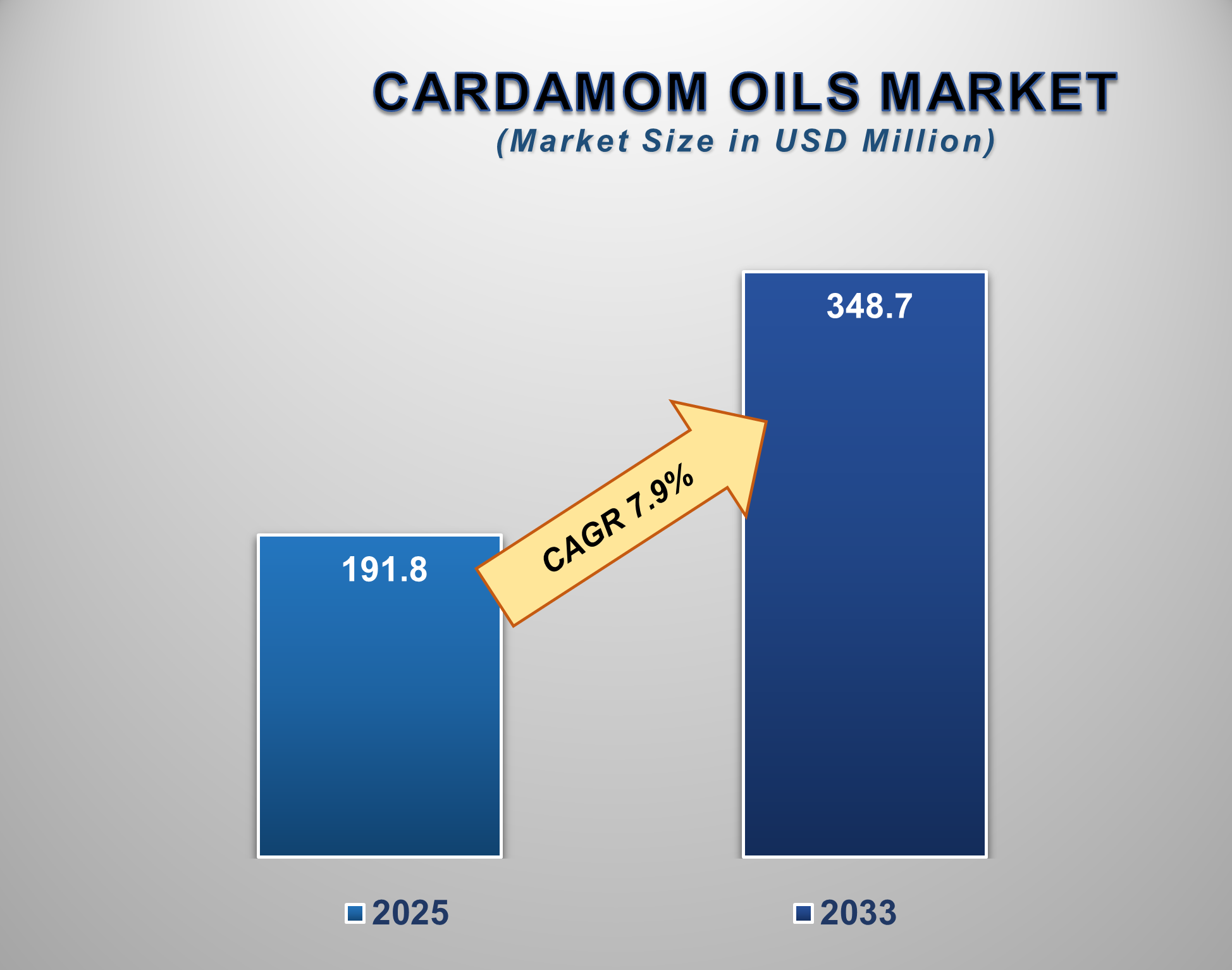
be valued at approximately USD 191.8 million
in 2025 and is forecasted to surge to nearly USD 348.7 million by 2033, exhibiting a healthy compound annual growth rate
(CAGR) of 7.9% during this period.
Cardamom oil is an essential oil extracted from the seeds of cardamom plants, primarily Elettaria cardamomum (green) and Amomum subulatum (black). It is highly prized for its rich, spicy aroma, therapeutic properties, and versatile applications. The market growth is primarily fuelled by the global shift towards clean-label and natural products, increasing consumer awareness of the health benefits associated with essential oils, and the growing disposable income in emerging economies.
The unique flavor
profile of cardamom oil makes it a sought-after ingredient in gourmet foods and
beverages, while its soothing properties drive its use in wellness products.
Challenges such as price volatility of raw cardamom and the high cost of
extraction are balanced by opportunities in product innovation and untapped
markets. Europe and North America are mature markets with high demand from the
food and cosmetics industries, while the Asia-Pacific region is emerging as the
fastest-growing market due to its large population, traditional use of spices,
and expanding middle class. With the continued trend of holistic well-being and
natural living, the Cardamom Oils Market is set to experience sustained demand
over the next decade.
Cardamom Oils Market Drivers and
Opportunities
The Surging Demand for
Natural and Organic Products is the Core Driver for the Cardamom Oils Market
Consumers are increasingly scrutinizing product
labels, showing a strong preference for natural ingredients over synthetic
additives. This trend is powerfully influencing the food & beverage,
personal care, and pharmaceutical industries. Cardamom oil, as a pure,
plant-derived extract, aligns perfectly with this demand. It serves as a
natural flavoring agent, a fragrant component
in cosmetics, and an active principle in herbal remedies. This shift away from
artificial ingredients is creating a stable, long-term growth foundation for
cardamom oil and other essential oils, as brands reformulate their products to
meet consumer expectations.
The Expansion of the
Wellness and Aromatherapy Sector is Catalyzing Significant Market Growth
The global wellness industry is booming, with
aromatherapy establishing itself as a mainstream method for stress relief, mood
enhancement, and holistic health. Cardamom oil, known for its warm,
stimulating, and digestive properties, is a popular choice in diffuser blends,
massage oils, and inhalation therapies. Its use in spa treatments and at-home
wellness routines is expanding rapidly. Furthermore, growing scientific
interest in the potential therapeutic benefits of essential oils, including
cardamom's antimicrobial and anti-inflammatory properties, is lending
credibility and driving its adoption in complementary medicine and self-care
regimens.
Product Diversification
and Geographic Expansion are Unlocking New Opportunities
Manufacturers are exploring new applications and
innovative formulations to capture value and differentiate their offerings. The
development of customized oil blends for specific culinary, therapeutic, or
fragrant uses presents a significant opportunity. The rising popularity of
ethnic cuisines, particularly Middle Eastern and South Asian, in Western
markets is opening new avenues for cardamom oil in the food service and
packaged food sectors. Additionally, there is substantial growth potential in
penetrating emerging markets in Latin America and Africa, where awareness is
growing but market penetration is still low. E-commerce platforms are also
providing a key opportunity for suppliers to reach a global customer base
directly.
Cardamom Oils Market Scope
|
Report Attributes |
Description |
|
Market Size in 2025 |
USD 191.8 Million |
|
Market Forecast in 2033 |
USD 348.7 Million |
|
CAGR % 2025-2033 |
7.9% |
|
Base Year |
2024 |
|
Historic Data |
2020-2024 |
|
Forecast Period |
2025-2033 |
|
Report USP |
Product Portfolio, Technological Analysis, Company Market Share,
Company Heatmap, Pricing Analysis, Growth Factors and more |
|
Segments Covered |
●
By Product Type ●
By Application ●
By Extraction Method |
|
Regional Scope |
●
North America, ●
Europe, ●
APAC, ●
Latin America ●
Middle East and Africa |
|
Country Scope |
1)
U.S. 2)
Canada 3)
Germany 4)
UK 5)
France 6)
Spain 7)
Italy 8)
Switzerland 9)
China 10)
Japan 11)
India 12)
Australia 13)
South Korea 14)
Brazil 15)
Mexico 16)
Argentina 17)
South Africa 18)
Saudi Arabia 19) UAE |
Cardamom Oils Market Report Segmentation Analysis
The global Cardamom Oils Market
industry analysis is segmented by Product Type, by Extraction Method, by
Application, and by region.
The Green Cardamom Oil segment is anticipated to command the
largest share in the global Cardamom Oils Market during the forecast period.
Based on Product Type, the market is divided into
Green Cardamom Oil and Black Cardamom Oil. The Green Cardamom Oil segment
dominates, accounting for the vast majority of the market share. This
is attributed to its sweeter, more complex, and highly aromatic profile, which
is more versatile and widely preferred in food applications, perfumery, and
high-end aromatherapy blends compared to the smokier, more medicinal notes of black
cardamom oil.
The dominance of the Green Cardamom Oil segment is firmly rooted in its superior sensory characteristics and broader global appeal. Often referred to as the "Queen of Spices," green cardamom yields an oil that is sweeter, more floral, and less pungent than its black counterpart. This makes it an indispensable and premium ingredient in a wide array of products, from Scandinavian baked goods and Middle Eastern coffees to fine fragrances and luxury skincare. Its widespread cultivation in Guatemala, India, and Sri Lanka, coupled with established supply chains, ensures consistent availability, cementing its position as the product of choice for a majority of end-use industries.
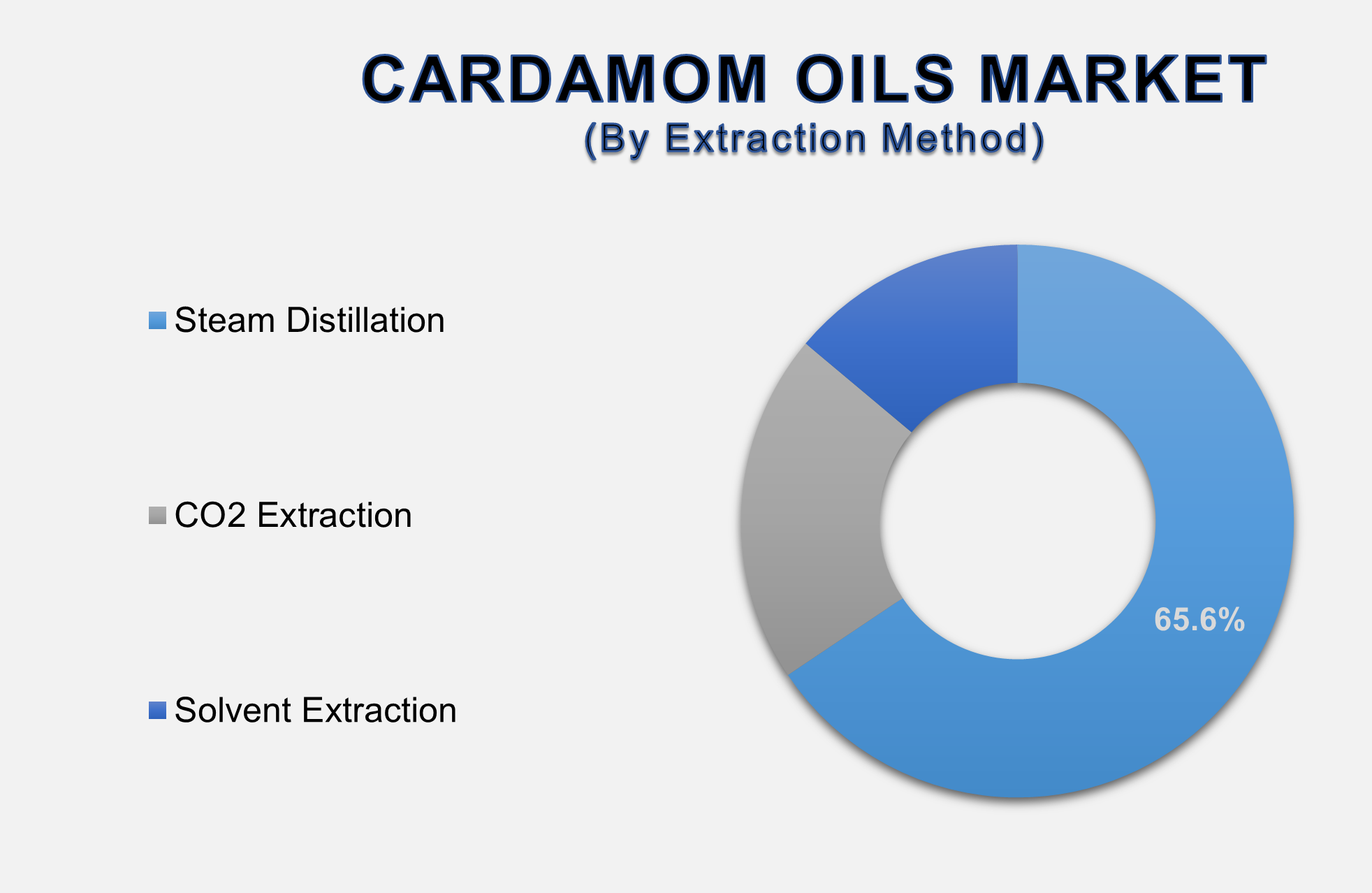
The Steam Distillation segment dominated the market in 2025
and is projected to maintain its lead.
Based on the Extraction Method, the market
is segmented into Steam Distillation, CO₂ extraction, and Solvent Extraction. The Steam Distillation segment
holds the largest share. This dominance is driven by its cost-effectiveness,
scalability for large-volume production, and its status as a traditional and
well-regarded method for obtaining high-quality, pure essential oils without
chemical residues.
The Steam Distillation segment's leadership is a
direct result of its balance of efficiency, cost, and quality. It is the most
common and widely accepted method for extracting essential oils on an
industrial scale. The process is well-understood, and the equipment is
relatively standardized, making it accessible for many producers. For a widely
consumed oil like cardamom, where price points are competitive, steam
distillation offers the most economically viable path to market without
significantly compromising on the oil's aromatic and therapeutic properties.
While CO₂ extraction can yield a superior olfactory profile, its
higher cost limits its use to niche, premium segments.
The Food & Beverages segment is expected to hold a
significant market share in 2025.
By Application, the market is divided into Food
& Beverages, Aromatherapy, Pharmaceuticals, Personal Care & Cosmetics,
and Others. The Food & Beverages segment is the major contributor, as
cardamom oil is extensively used as a natural flavoring agent in baked
goods, confectionery, beverages, and savory dishes, capitalizing on the global
trend towards authentic and exotic flavors.
The Food & Beverages application segment's
significant market share stems from the irreplaceable and potent flavor that
cardamom oil imparts. A small quantity can flavor large batches of products, making it efficient for industrial food
manufacturing. It is a key ingredient in creating authentic chai tea,
Scandinavian pastries, spiced liquors, and savory sauce blends.
The consumer demand for "natural flavors"
on ingredient labels directly benefits cardamom oil, as it serves as a
clean-label alternative to synthetic flavoring
compounds, driving its sustained and dominant use in the F&B industry. The
Personal Care & Cosmetics segment is projected to grow at the highest CAGR.
This is driven by the increasing infusion of essential oils and
"spice-based" ingredients in skincare, haircare, and fragrance
products, where cardamom oil is valued for its warm, exotic scent and potential
antioxidant properties.
The following segments
are part of an in-depth analysis of the global Cardamom Oils Market:
|
Market Segments |
|
|
By Product Type |
●
Green Cardamom Oil ●
Black Cardamom Oil |
|
By Extraction Method |
●
Steam Distillation ●
CO2 Extraction ●
Solvent Extraction |
|
By Application |
●
Food & Beverages ●
Aromatherapy ●
Pharmaceuticals ●
Personal Care &
Cosmetics ●
Others |
Cardamom Oils Market Share Analysis by Region
The Europe region is anticipated to hold the largest portion
of the Cardamom Oils Market globally throughout the forecast period.
Europe is the leading segment, holding a dominant
share. This is a direct result of the region's well-established food &
beverage industry, particularly in Scandinavia and Germany, where
cardamom is a traditional baking spice, coupled with a mature and sophisticated
market for aromatherapy and natural cosmetics. High consumer spending on
premium, organic, and natural products further consolidates its leadership.
The leadership of Europe is deeply connected to
its culinary traditions and early adoption of holistic wellness trends.
Countries like Sweden, Finland, and Germany have a long-standing cultural
affinity for cardamom in their breads, pastries, and festive foods, creating a
stable, high-volume demand from the food sector. Simultaneously, the European
market is a global hub for aromatherapy and natural personal care, with
consumers who are highly educated about the benefits of essential oils and
willing to pay a premium for quality. This powerful combination of traditional
use and modern wellness trends creates a uniquely strong and consistent demand
base for cardamom oil.
Cardamom Oils Market Competition Landscape Analysis
The global cardamom oils market
is moderately fragmented, featuring a mix of large multinational essential oil
companies and specialized regional players. The market competition is based on
factors such as product purity, price, sourcing sustainability, and organic
certifications. Key strategies include vertical integration with cardamom
growers to ensure a consistent and high-quality supply, investment in advanced
extraction technologies to improve yield and quality, and obtaining
certifications like Organic, GRAS, and ISO to meet stringent international
standards. Partnerships with food, beverage, and cosmetic brands for custom
formulations are also common strategies to secure long-term contracts.
Global Cardamom Oils
Market Recent Developments News:
- In February 2025, doTERRA International LLC
announced a new Co-Impact Sourcing initiative for green cardamom in
Guatemala, aiming to improve supply chain transparency and farmer
livelihoods.
- In January 2025, Young Living Essential Oils
launched a limited-edition essential oil blend featuring green cardamom as
a key note, targeting the stress-relief segment of the aromatherapy
market.
- In December 2024, Robertet SA invested in a new CO₂ extraction facility in Madagascar to
enhance its portfolio of high-fidelity natural extracts, including
cardamom oil.
- In October 2024, Synthite Industries Ltd., a major player in spice
extracts, secured a long-term supply contract with a European beverage
giant for its cardamom oil, signaling strong demand from the F&B
sector.
The Global Cardamom Oils Market Is Dominated by a
Few Large Companies, such as
●
Young Living Essential
Oils
●
doTERRA International
LLC
●
Synthite Industries
Ltd.
●
Robertet SA
●
Treatt PLC
●
Mane SA
●
International Flavors
& Fragrances Inc. (IFF)
●
Symrise AG
●
Givaudan SA
●
Mountain Rose Herbs
●
Plant Therapy
Essential Oils
●
AOS Products Pvt. Ltd.
●
Aromaaz International
●
Greenleaf Extractions
● Other Prominent Players
Frequently Asked Questions
Jaya Bundele (Research Analyst)
Jaya Bundele is a skilled Research Analyst with 4+ years of experience in market intelligence, consumer insights, competitive analysis, and industry forecasting across the consumer goods, agriculture, and food & beverage sectors. She specializes in market sizing, trend analysis, growth opportunity mapping, and strategic secondary research for global and regional markets.
Her expertise lies in transforming complex industry data into actionable business strategies that help organizations identify emerging trends, understand customer behavior, and gain a competitive edge. With a strong focus on data-driven insights, business intelligence, and future market trends, Jaya delivers high-quality research solutions aligned with evolving industry demands and market dynamics.
1. Global Cardamom Oils
Market Introduction and Market Overview
1.1.
Objectives
of the Study
1.2.
Global
Defense Cybersecurity Market Scope and Market Estimation
1.2.1.Global Electronic Toll
Collection Overall Market Size (US$ Bn), Market CAGR (%), Market forecast (2025
- 2033)
1.2.2.Global Cardamom Oils
Market Revenue Share (%) and Growth Rate (Y-o-Y) from 2020 - 2033
1.3.
Market
Segmentation
1.3.1.Product Type of Global Cardamom
Oils Market
1.3.2.Extraction Method of
Global Cardamom Oils Market
1.3.3.Application of Global Cardamom
Oils Market
1.3.4.Region of Global Cardamom
Oils Market
2.
Executive Summary
2.1.
Demand
Side Trends
2.2.
Key
Market Trends
2.3.
Market
Demand (US$ Bn) Analysis 2020 – 2024 and Forecast, 2025 – 2033
2.4.
Demand
and Opportunity Assessment
2.5.
Key
Developments
2.6.
Market
Entry Strategies
2.7.
Market
Dynamics
2.7.1.Drivers
2.7.2.Limitations
2.7.3.Opportunities
2.7.4.Impact Analysis of Drivers
and Restraints
2.8.
Porter’s
Five Forces Analysis
2.9.
PEST
Analysis
3. Global
Cardamom Oils Market Estimates
& Historical Trend Analysis (2020 - 2024)
4. Global
Cardamom Oils Market Estimates
& Forecast Trend Analysis, by Product Type
4.1.
Global
Cardamom Oils Market Revenue (US$ Bn) Estimates and Forecasts, by Product Type,
2020 - 2033
4.1.1.Green Cardamom Oil
4.1.2.Black Cardamom Oil
5. Global
Cardamom Oils Market Estimates
& Forecast Trend Analysis, by Extraction Method
5.1.
Global
Cardamom Oils Market Revenue (US$ Bn) Estimates and Forecasts, by Extraction
Method, 2020 - 2033
5.1.1.Steam Distillation
5.1.2.CO2 Extraction
5.1.3.Solvent Extraction
6. Global
Cardamom Oils Market Estimates
& Forecast Trend Analysis, by Application
6.1.
Global
Cardamom Oils Market Revenue (US$ Bn) Estimates and Forecasts, by Application,
2020 - 2033
6.1.1.Food & Beverages
6.1.2.Aromatherapy
6.1.3.Pharmaceuticals
6.1.4.Personal Care &
Cosmetics
6.1.5.Others
7. Global
Cardamom Oils Market Estimates
& Forecast Trend Analysis, by region
7.1.
Global
Cardamom Oils Market Revenue (US$ Bn) Estimates and Forecasts, by region, 2020
- 2033
7.1.1.North America
7.1.2.Europe
7.1.3.Asia Pacific
7.1.4.Middle East & Africa
7.1.5.Latin America
8. North America Cardamom
Oils Market: Estimates & Forecast
Trend Analysis
8.1. North America Cardamom
Oils Market Assessments & Key Findings
8.1.1.North America Cardamom
Oils Market Introduction
8.1.2.North America Cardamom
Oils Market Size Estimates and Forecast (US$ Billion) (2020 - 2033)
8.1.2.1.
By Product Type
8.1.2.2.
By Extraction Method
8.1.2.3.
By Application
8.1.2.4. By Country
8.1.2.4.1. The U.S.
8.1.2.4.2. Canada
9. Europe Cardamom
Oils Market: Estimates & Forecast
Trend Analysis
9.1. Europe Cardamom Oils
Market Assessments & Key Findings
9.1.1.Europe Cardamom Oils
Market Introduction
9.1.2.Europe Cardamom Oils
Market Size Estimates and Forecast (US$ Billion) (2020 - 2033)
9.1.2.1.
By Product Type
9.1.2.2.
By Extraction Method
9.1.2.3.
By Application
9.1.2.4. By Country
9.1.2.4.1.
Germany
9.1.2.4.2.
Italy
9.1.2.4.3.
U.K.
9.1.2.4.4.
France
9.1.2.4.5.
Spain
9.1.2.4.6.
Switzerland
9.1.2.4.7. Rest
of Europe
10. Asia Pacific Cardamom
Oils Market: Estimates & Forecast
Trend Analysis
10.1. Asia Pacific Market
Assessments & Key Findings
10.1.1.
Asia
Pacific Cardamom Oils Market Introduction
10.1.2.
Asia
Pacific Cardamom Oils Market Size Estimates and Forecast (US$ Billion) (2020 - 2033)
10.1.2.1.
By Product Type
10.1.2.2.
By Extraction Method
10.1.2.3.
By Application
10.1.2.4. By Country
10.1.2.4.1. China
10.1.2.4.2. Japan
10.1.2.4.3. India
10.1.2.4.4. Australia
10.1.2.4.5. South Korea
10.1.2.4.6. Rest of Asia Pacific
11. Middle East & Africa Cardamom
Oils Market: Estimates & Forecast
Trend Analysis
11.1. Middle East & Africa
Market Assessments & Key Findings
11.1.1. Middle
East & Africa
Cardamom Oils Market Introduction
11.1.2. Middle
East & Africa
Cardamom Oils Market Size Estimates and Forecast (US$ Billion) (2020 - 2033)
11.1.2.1.
By Product Type
11.1.2.2.
By Extraction Method
11.1.2.3.
By Application
11.1.2.4. By Country
11.1.2.4.1. UAE
11.1.2.4.2. Saudi
Arabia
11.1.2.4.3. South
Africa
11.1.2.4.4. Rest
of MEA
12. Latin America
Cardamom Oils Market: Estimates &
Forecast Trend Analysis
12.1. Latin America Market
Assessments & Key Findings
12.1.1. Latin America Cardamom
Oils Market Introduction
12.1.2. Latin America Cardamom
Oils Market Size Estimates and Forecast (US$ Billion) (2020 - 2033)
12.1.2.1.
By Product Type
12.1.2.2.
By Extraction Method
12.1.2.3.
By Application
12.1.2.4. By Country
12.1.2.4.1. Brazil
12.1.2.4.2. Argentina
12.1.2.4.3. Mexico
12.1.2.4.4. Rest
of LATAM
13.
Country
Wise Market: Introduction
14.
Competition
Landscape
14.1. Global Cardamom Oils
Market Product Mapping
14.2. Global Cardamom Oils
Market Concentration Analysis, by Leading Players / Innovators / Emerging
Players / New Entrants
14.3. Global Cardamom Oils
Market Tier Structure Analysis
14.4. Global Cardamom Oils
Market Concentration & Company Market Shares (%) Analysis, 2024
15.
Company
Profiles
15.1.
Young Living Essential Oils
15.1.1.
Company
Overview & Key Stats
15.1.2.
Financial
Performance & KPIs
15.1.3.
Product
Portfolio
15.1.4.
SWOT
Analysis
15.1.5.
Business
Strategy & Recent Developments
* Similar details would be provided for all the players
mentioned below
15.2.
doTERRA International LLC
15.3.
Synthite Industries Ltd.
15.4.
Robertet SA
15.5.
Treatt PLC
15.6.
Mane SA
15.7.
International Flavors & Fragrances Inc. (IFF)
15.8.
Symrise AG
15.9.
Givaudan SA
15.10.
Mountain Rose Herbs
15.11.
Plant Therapy Essential Oils
15.12.
AOS Products Pvt. Ltd.
15.13.
Aromaaz International
15.14.
Greenleaf Extractions
15.15.
Other Prominent Players
16. Research
Methodology
16.1. External Transportations /
Databases
16.2. Internal Proprietary
Database
16.3. Primary Research
16.4. Secondary Research
16.5. Assumptions
16.6. Limitations
16.7. Report FAQs
17. Research
Findings & Conclusion
Our Research Methodology
"Insight without rigor is just noise."
We follow a comprehensive, multi-phase research framework designed to deliver accurate, strategic, and decision-ready intelligence. Our process integrates primary and secondary research , both quantitative and qualitative , along with dual modeling techniques ( top-down and bottom-up) and a final layer of validation through our proprietary in-house repository.
PRIMARY RESEARCH
Primary research captures real-time, firsthand insights from the market to understand behaviors, motivations, and emerging trends.
1. Quantitative Primary Research
Objective: Generate statistically significant data directly from market participants.
Approaches:- Structured surveys with customers, distributors, and field agents
- Mobile-based data collection for point-of-sale audits and usage behavior
- Phone-based interviews (CATI) for market sizing and product feedback
- Online polling around industry events and digital campaigns
- Purchase frequency by customer type
- Channel performance across geographies
- Feature demand by application or demographic
2. Qualitative Primary Research
Objective: Explore decision-making drivers, pain points, and market readiness.
Approaches:- In-depth interviews (IDIs) with executives, product managers, and key decision-makers
- Focus groups among end users and early adopters
- Site visits and observational research for consumer products
- Informal field-level discussions for regional and cultural nuances
SECONDARY RESEARCH
This phase helps establish a macro-to-micro understanding of market trends, size, regulation, and competitive dynamics, sourced from credible and public domain information.
1. Quantitative Secondary Research
Objective: Model market value and segment-level forecasts based on published data.
Sources include:- Financial reports and investor summaries
- Government trade data, customs records, and regulatory statistics
- Industry association publications and economic databases
- Channel performance and pricing data from marketplace listings
- Revenue splits, pricing trends, and CAGR estimates
- Supply-side capacity and volume tracking
- Investment analysis and funding benchmarks
2. Qualitative Secondary Research
Objective: Capture strategic direction, innovation signals, and behavioral trends.
Sources include:- Company announcements, roadmaps, and product pipelines
- Publicly available whitepapers, conference abstracts, and academic research
- Regulatory body publications and policy briefs
- Social and media sentiment scanning for early-stage shifts
- Strategic shifts in market positioning
- Unmet needs and white spaces
- Regulatory triggers and compliance impact
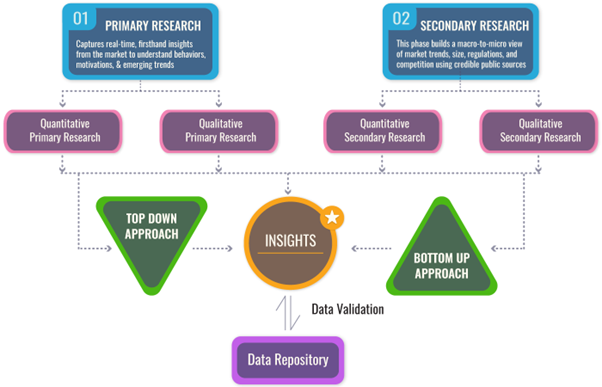
DUAL MODELING: TOP-DOWN + BOTTOM-UP
To ensure robust market estimation, we apply two complementary sizing approaches:
Top-Down Modeling:- Start with broader industry value (e.g., global or regional TAM)
- Apply filters by segment, geography, end-user, or use case
- Adjust with primary insights and validation benchmarks
- Ideal for investor-grade market scans and opportunity mapping
- Aggregate from the ground up using sales volumes, pricing, and unit economics
- Use internal modeling templates aligned with stakeholder data
- Incorporate distributor-level or region-specific inputs
- Most accurate for emerging segments and granular sub-markets
DATA VALIDATION: IN-HOUSE REPOSITORY
We close the loop with proprietary data intelligence built from ongoing projects, industry monitoring, and historical benchmarking. This repository includes:
- Multi-sector market and pricing models
- Key trendlines from past interviews and forecasts
- Benchmarked adoption rates, churn patterns, and ROI indicators
- Industry-specific deviation flags and cross-check logic
- Catches inconsistencies early
- Aligns projections across studies
- Enables consistent, high-trust deliverables