Cash Recycler Market Size and Forecast (2026–2034), Global and Regional Growth, Trend, Share and Industry Analysis Report Coverage; By Product Type, Application, End User, Deployment; and Geography
2026-10-09
Business & Financial Services
Ekta Chaurasia (Team Lead)
Description
Cash Recycler Market Overview
The global Cash
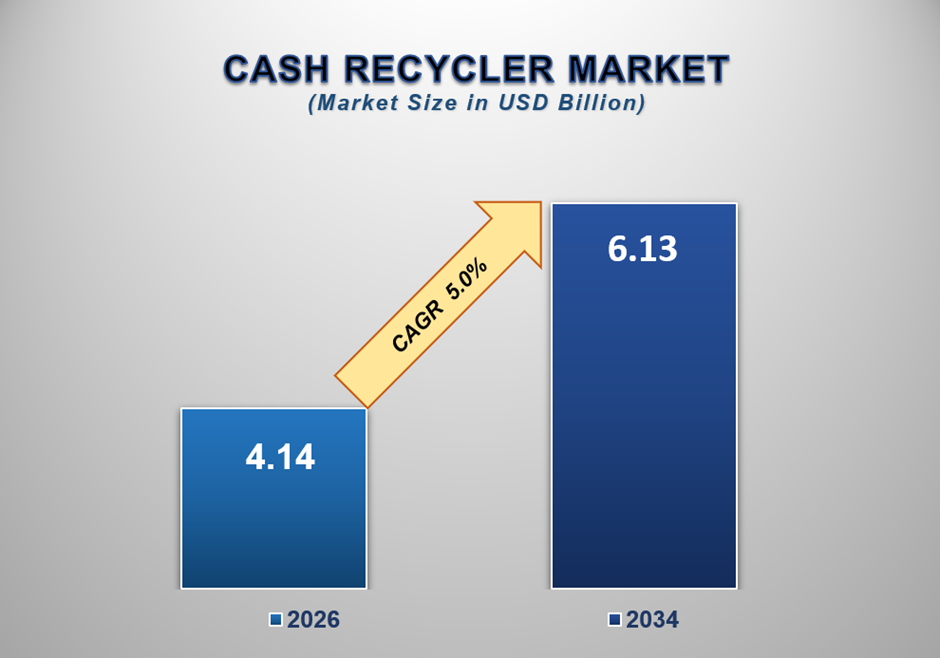
Recycler Market is projected to reach USD 4.14 billion in 2026 and is
expected to reach USD 6.13 billion by 2034, expanding at a CAGR of
5.0% during 2026–2034. Cash recyclers are automated systems that
authenticate, count, store and dispense banknotes, allowing deposited currency
to be reused for subsequent transactions instead of being handled through
separate deposit, storage and dispensing processes.
The technology
is used across banking branches, ATMs, retail stores, gaming establishments,
and other environments where large quantities of physical currency must be
processed securely. Unlike conventional cash dispensers, recycling systems
create a two-way cash cycle: currency entering the machine can be validated and
retained for future withdrawals. This reduces the need to repeatedly transport
and reload cash from external sources.
Cash recyclers
are becoming particularly relevant as financial institutions attempt to
modernize physical banking infrastructure without eliminating cash services.
The continued use of cash in many markets means banks still need efficient
systems for deposits, withdrawals, reconciliation and cash storage. At the same
time, institutions are under pressure to reduce branch operating costs and move
employees away from repetitive cash-counting activities.
The technology
is also changing the economics of ATM networks. In July 2026, Datos Insights
reported that global ATM shipments increased by 1% in 2025 to approximately
293,400 units, with cash recyclers accounting for 60% of shipments. The
research indicated that recyclers remained an important source of growth even
as ATM markets differed substantially by region.
Cash recycling
is not limited to banking. Retailers increasingly use closed-loop systems in
which cash collected at checkout can be automatically verified and transferred
securely to back-office recycling equipment. Glory's CASHINFINITY ecosystem,
for example, connects point-of-sale and back-office cash handling and is
designed to reduce manual counting, improve cash accuracy and limit unnecessary
cash-in-transit activity.
The growing
sophistication of cash recyclers is also changing their role within branch
operations. Modern teller recyclers can provide automated cash verification and
inventory visibility while supporting faster teller transactions. Glory's
GLR-100 and GLR-200 series are designed around this model, with applications
spanning branch transformation, cash control and teller efficiency.
Another
important development is the convergence of cash recycling with digital
banking. Cash recyclers can now form part of multifunction ATMs and intelligent
self-service environments that combine deposits, withdrawals, recycling,
contactless authentication and other transactions. NCR Atleos' SelfServ
portfolio, for example, includes cash-recycling configurations alongside
contactless capabilities, enhanced telemetry and remote service functionality.
The growth
opportunity is therefore not simply linked to the number of ATMs installed
globally. Replacement of aging machines, modernization of bank branches, retail
cash automation, ATM-as-a-Service models and demand for improved cash
visibility are creating additional routes for adoption.
The market
nevertheless operates alongside the rapid expansion of digital payments. This
creates a more selective investment environment: cash recyclers are
increasingly deployed where physical currency remains operationally important
and where automation can reduce the cost and risk of handling it. India
illustrates this transition clearly. While the country's overall ATM network
has contracted as digital payments have expanded, banks are simultaneously
moving toward cash-recycling machines in locations where cash demand remains
substantial.
The combination
of branch modernization, ATM replacement, retail cash automation, labor-cost
pressures and the need for more controlled cash cycles is expected to sustain
demand for cash recycling equipment through 2034.
Cash Recycler Market Drivers and
Opportunities
Growing Need
to Automate Cash Handling and Reduce Operational Work
Manual cash
handling creates several operational requirements, including counting, sorting,
reconciliation, secure storage and movement between front-office and
back-office locations. Each additional manual step creates an opportunity for
discrepancies, delays or security incidents.
Cash recyclers
automate much of this workflow. Banknotes can be authenticated when deposited,
recorded within the machine's inventory and subsequently dispensed when
required. This allows institutions to reduce repetitive cash-handling work
while maintaining a controlled audit trail.
The value is
particularly visible in branches with frequent cash transactions. Teller cash
recyclers can shorten transaction processing and allow employees to spend more
time on customer-facing activities. A Glory case study involving Alpine Bank
describes the use of a GLR-100 teller recycler to improve cash visibility and
streamline branch cash operations.
Retail
environments face a similar challenge. Employees traditionally count and
transfer cash between checkout areas, safes and bank deposits. Closed-loop cash
automation reduces direct handling and can connect point-of-sale activity with
back-office cash management.
Modernization
of ATM Networks and Increasing Adoption of Cash Recycling
A major source
of market demand is the replacement of traditional cash dispensers with
multifunction machines capable of accepting and recycling deposits.
Cash recycling
changes the operating model of an ATM because deposited notes can remain within
the machine and be reused for withdrawals. This can improve cash utilization
and potentially reduce the frequency of external cash replenishment, depending
on transaction patterns and machine configuration.
India is
currently demonstrating this transition. The Economic Times reported in July
2026 that more than 15,000 ATM units were expected to be covered by
cash-recycler RFPs, with public-sector banks representing roughly 77% of the
expected units. The shift was linked to ATM modernization and cash shortages in
some tier-2 and tier-3 locations.
Business
Standard similarly reported in May 2026 that increased deployment of cash
recycling machines was slowing the transition toward cassette-swap loading
systems because recyclers can accept deposits and reuse the currency for
withdrawals.
The development
is significant because it shows that the market is increasingly being driven by
replacement and modernization, rather than simply by growth in the total
number of ATMs.
Opportunity:
Integrated Cash Management, Intelligent ATMs and Managed Services
The next stage
of market development is moving toward integrated cash-management ecosystems
rather than standalone machines.
Cash recyclers
can be connected with software that monitors cash levels, transaction flows,
machine status, and collection requirements. This allows banks and retailers to
make decisions based on actual cash positions instead of relying solely on
scheduled replenishment routines.
Glory's UBIQULAR
Manage platform, for example, can track cash held in retail recyclers and
support daily provisional credit, potentially reducing the frequency of
cash-in-transit collections and eliminating the need for store managers to make
daily bank deposits.
ATM providers
are also adding remote monitoring and predictive-service capabilities. NCR
Atleos' current cash-recycling systems incorporate telemetry and digital-first
servicing features intended to improve machine availability and simplify
maintenance.
This creates
opportunities for vendors to generate recurring revenue through software,
monitoring, maintenance, and managed services alongside hardware sales. The
long-term market opportunity therefore extends beyond the physical recycler
itself.
Cash Recycler Market Scope
|
Report Attributes |
Description |
|
Market Size in 2026 |
USD 4.14 Billion |
|
Market Forecast in 2034 |
USD 6.13 Billion |
|
CAGR % 2026-2034 |
5.0% |
|
Base Year |
2025 |
|
Historic Data |
2021-2025 |
|
Forecast Period |
2026-2034 |
|
Report USP |
Production, Consumption,
Company Share, Company Heatmap, Company Production, Service Type, Growth
Factors and more |
|
Segments Covered |
By Product Type |
|
Regional Scope |
● North America |
|
Country Scope |
U.S. |
Cash Recycler Market Report
Segmentation Analysis
The Cash
Recycler Market is analyzed across product type, application, end user and
deployment. These categories capture the differences between branch-based cash
automation, ATM recycling, retail cash management and other environments
requiring automated currency processing.
The
Standalone Cash Recycler Segment Is Expected to Dominate the Market
Standalone cash
recyclers are designed as dedicated cash-management systems capable of
receiving, validating, storing and dispensing currency. They are used in
environments where automated cash processing is required independently of a
conventional teller workstation or integrated ATM configuration.
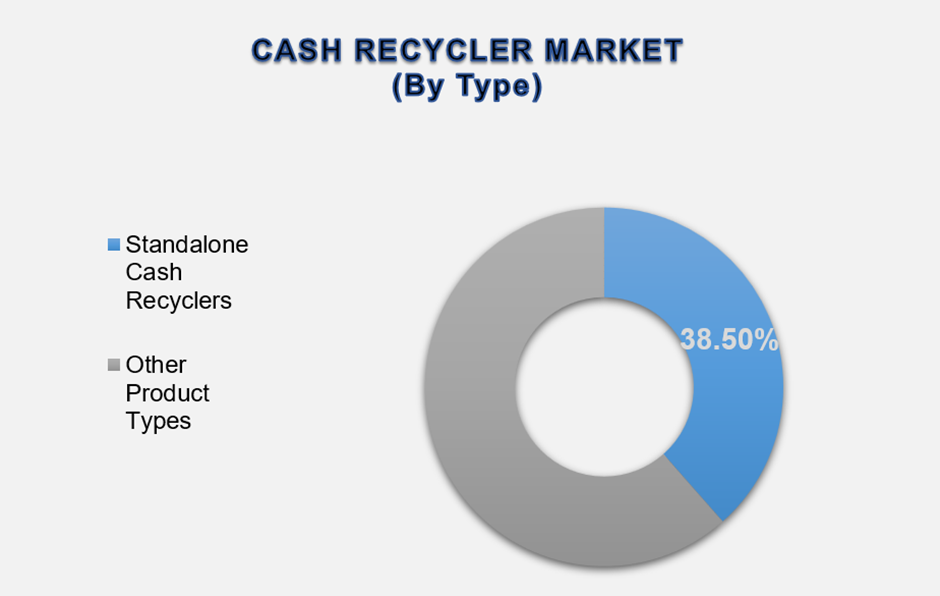
A June 2026
market assessment estimated standalone cash recyclers at 38.5% of the global
product market, making them the largest individual product category, with
other product configurations accounting for the remaining 61.5%.
The appeal of
standalone systems comes from their flexibility. They can be positioned within
branches, retail environments and other cash-intensive operations without
requiring the entire operating environment to be redesigned.
Teller Cash
Recyclers
Teller cash
recyclers are designed for branch environments where employees continue to
interact directly with customers. Instead of manually counting and storing
notes at individual teller positions, the recycler verifies and records cash
while maintaining a controlled inventory.
The technology
can support branch transformation by reducing the physical cash footprint
around teller stations. It can also make cash availability more transparent to
branch managers and improve reconciliation processes.
Self-Service
Cash Recyclers
Self-service
recyclers are incorporated into automated banking machines that can accept
deposits and dispense cash. Their ability to reuse deposited notes makes them
particularly suitable for locations with both cash-in and cash-out activity.
Modern
self-service systems increasingly combine recycling with contactless
interfaces, remote diagnostics and multifunction transaction capabilities. NCR
Atleos' SelfServ 80 series, for example, combines cash dispensing, deposits and
recycling with additional self-service functions.
Banking
Banking remains
a central application because cash recyclers can improve the efficiency of
branch and ATM cash operations. Banks can use the technology for teller
transactions, deposits, withdrawals, ATM networks and cash-position management.
The current
modernization cycle is particularly important because many institutions are
replacing aging ATM hardware with multifunction equipment rather than simply
adding more conventional cash dispensers.
Retail
Retailers use
cash recyclers to control the movement of cash between checkout points,
back-office areas, and external cash-management partners. Closed-loop systems
can reduce the number of employees directly handling currency and can improve
visibility over store-level cash positions.
Glory's retail
solutions are designed to connect point-of-sale and back-office cash handling
with automated verification and secure movement of cash through the store.
Gaming
Casinos and
gaming establishments manage significant volumes of physical currency and
require strong controls over counting, authentication, storage and
reconciliation. Cash recyclers can automate portions of this workflow while
maintaining controlled access and transaction records.
The sector can
also benefit from high-capacity systems capable of processing multiple
denominations and managing cash across different operational points.
Banks
Banks are
adopting recyclers as part of broader branch and ATM modernization programs.
The technology can support both customer transactions and internal cash
management, reducing reliance on manual processing.
Credit Unions
Credit unions,
particularly those operating smaller branch networks, can use teller and
self-service recyclers to modernize cash handling while maintaining personal
service. The technology allows employees to spend less time on repetitive cash
processing.
Retailers
Retailers are
increasingly using automated cash management to reduce discrepancies and
improve employee productivity. Cash recyclers can form part of a larger
closed-loop architecture linking checkout systems, secure back-office storage
and cash-in-transit services.
Casinos
Casinos require
rapid and highly controlled currency processing. Cash recycling can reduce
manual counting and improve the visibility of cash balances across
gaming-related operations.
Onsite
Deployment
Onsite systems
are installed within the premises where the cash is generated or handled.
Banks, branches, and retail stores can deploy recyclers directly at the point
of operation, allowing immediate access to the equipment and its cash
inventory.
Offsite
Deployment
Offsite
deployments support locations outside traditional branch environments. These
can include independent ATM networks, retail locations and other distributed
sites where cash services need to be delivered without a conventional bank
branch.
The Following Segments Are Part of an In-Depth Analysis of the Cash Recycler Market
|
Market Segments |
|
|
By Product Type |
●
Standalone Cash Recyclers ●
Teller Cash Recyclers ●
Self-Service Cash Recyclers |
|
By
Deployment |
●
Onsite ●
Offsite |
|
By
Application |
●
Banking ●
Retail ●
Gaming ●
Others |
|
By End User |
●
Banks ●
Credit Unions ●
Retailers ●
Casinos ●
Others |
Cash Recycler Market Share Analysis
By Region
North America
North America is
a mature market for automated cash handling, supported by established banking
networks, retail cash-management infrastructure and ATM modernization programs.
Credit unions and regional banks are among the institutions upgrading aging self-service
equipment.
Datos Insights
reported that U.S. ATM shipments increased by more than 5,000 units, or 13%, in
2025, with growth linked partly to ATM refresh activity among financial
institutions and expansion of retail ATM networks.
The region also
presents opportunities for teller cash recyclers. In June 2026, NCR Atleos
announced a U.S. reseller collaboration with Sesami to offer Sesami's CM-Series
Intelligent Teller Cash Recycler solutions to banks and credit unions,
supported by Atleos' field-service infrastructure.
Europe
Europe has a
strong installed base of automated banking and cash-management equipment. Banks
are balancing the continued need for physical cash services with branch-network
optimization and increased digital banking adoption.
Retail cash
automation is also relevant across the region because retailers continue to
seek ways to reduce manual cash handling, improve security and connect
store-level cash activity with banking and cash-in-transit partners.
Asia-Pacific
Asia-Pacific
represents an important growth region because cash remains significant across
several major economies while banks and retailers are simultaneously investing
in automation.
India is a
particularly important market. Banks are upgrading ATM fleets toward recycling
technology, while cash demand in smaller cities and towns continues to create a
need for reliable physical-cash infrastructure. The Economic Times reported
substantial expected RFP activity for cash recyclers among Indian public-sector
banks in 2026.
China, Japan,
South Korea and Australia also contribute to regional demand through banking
modernization, retail automation and self-service infrastructure.
Latin America
Latin American
markets provide opportunities for cash recycling because physical currency
remains important in many consumer and retail transactions. Banks and
independent ATM operators can use recyclers to improve cash availability while
controlling replenishment and servicing requirements.
The expansion of
digital banking does not eliminate the need for cash infrastructure,
particularly in areas where cash remains an important payment method. This
creates a dual market in which financial institutions invest simultaneously in
digital channels and more efficient physical-cash systems.
Middle East
and Africa
The Middle East
and Africa offer opportunities through banking expansion, financial inclusion
initiatives, retail modernization and ATM deployment. Cash recyclers can
support locations where cash access must be maintained while minimizing the
operational burden associated with frequent replenishment.
Markets with
dispersed branch or ATM networks can particularly benefit from systems capable
of improving cash visibility and reducing unnecessary service visits.
Cash Recycler
Market Competition Landscape Analysis
The competitive
landscape consists of ATM manufacturers, cash-management technology companies,
teller-equipment specialists and integrated financial-technology providers.
Competition is increasingly shifting from the basic ability to count and
dispense cash toward system reliability, automation, remote monitoring,
software integration, security and lifecycle support.
NCR Atleos
maintains a broad portfolio of cash-recycling ATMs, including interior,
exterior and drive-up configurations. Its current systems combine recycling
modules with remote service capabilities, contactless functionality and other
self-service technologies.
Glory has a
broad portfolio spanning teller cash recyclers, retail point-of-sale recyclers
and large back-office systems. Its CASHINFINITY platform connects front- and
back-office cash processes and supports automated note verification and secure
cash movement.
The competitive
environment is also moving toward recurring-service models. Hardware suppliers
are increasingly combining machines with software, remote monitoring,
maintenance, cash-management services and ATM-as-a-Service arrangements.
NCR Atleos
reported in its first-quarter 2026 results that self-service banking revenue
increased approximately 12% year over year, while ATM-as-a-Service revenue grew
about 30%. The company also stated that adoption of recycling technology was
contributing to hardware-order growth.
Major
Companies Operating in the Cash Recycler Market
●
Glory Global Solutions
●
NCR Atleos Corporation
●
Diebold Nixdorf
●
Hyosung Innovue
●
Gunnebo
●
Sesami
●
GRG Banking
●
Hitachi Channel Solutions
●
Fujitsu
●
OKI Electric Industry
●
Cash Processing Solutions
●
Talaris
●
SUZOHAPP
●
ARCA
●
CMS Info Systems
●
Fiserv
●
Brinks
●
Loomis
●
G4S
●
Prosegur
Global Cash
Recycler Market Recent Developments News
NCR Atleos
and Sesami — June 2026: NCR Atleos announced a U.S.
reseller collaboration with Sesami for CM-Series Intelligent Teller Cash
Recycler solutions. The arrangement extends NCR Atleos' offering to banks and
credit unions while using its field-service organization to support the equipment.
NCR Atleos —
First Quarter 2026: NCR Atleos reported 7%
year-over-year total revenue growth in Q1 2026. Its self-service banking
revenue increased approximately 12%, with ATM-as-a-Service growing around 30%
and hardware revenue increasing 23%; the company also noted accelerating adoption
of recycling technology.
Glory — 2026: Glory continues to expand its closed-loop cash-management ecosystem
through the CASHINFINITY portfolio, linking point-of-sale and back-office cash
handling. Its current systems emphasize automated verification, secure cash
movement and reduced manual intervention.
India ATM
modernization — July 2026: Indian public-sector
banks were reported to be preparing significant procurement activity for cash
recyclers, with more than 15,000 ATM units expected to be covered by RFPs. The
development reflects a broader shift toward recycling-capable machines in place
of aging conventional cash dispensers.
Global ATM
shipments — July 2026: Datos Insights reported that
worldwide ATM shipments rose 1% in 2025 to approximately 293,400 units and that
cash recyclers represented 60% of shipments. The finding highlights the growing
role of recycling technology in ATM replacement and deployment decisions.
The Global
Cash Recycler Market is Dominated by a Few Large Companies, Such As
Glory Global
Solutions, NCR Atleos Corporation, Diebold Nixdorf, Hyosung Innovue, Gunnebo,
Sesami, GRG Banking, Hitachi Channel Solutions, Fujitsu, OKI Electric Industry,
SUZOHAPP, ARCA, CMS Info Systems, Brinks, Loomis, G4S, Prosegur, and other
regional cash-management and automated banking technology providers.
Competition is expected to increasingly revolve around integrated cash-management capabilities rather than hardware alone. Vendors that combine reliable recycling mechanisms with software monitoring, remote diagnostics, security, ATM management and managed services can address a wider portion of the banking and retail cash lifecycle.
Frequently Asked Questions
Ekta Chaurasia (Team Lead)
Ekta Chaurasia is a highly experienced Team Lead at M2Square Consultancy with over 7 years of expertise in market research, strategic consulting, competitive benchmarking, and business intelligence solutions. She specializes in ICT, semiconductors & electronics, automotive & transportation, and industrial machinery markets.
She leads end-to-end global research projects focused on market trends, industry analysis, growth forecasting, customer insights, and strategic decision-making. Known for her analytical leadership and industry expertise, Ekta helps businesses uncover growth opportunities, evaluate competitive landscapes, and stay ahead in rapidly evolving markets through accurate and insight-driven research.
1.
Global Cash Recycler
Market Introduction and Market Overview
1.1. Objectives of the Study
1.2. Global Cash Recycler Market Scope and Market Estimation
1.2.1.
Global Cash Recycler Market
Size (US$ Million), Market CAGR (%), Market Forecast (2026 - 2034)
1.2.2.
Global Cash Recycler Market
Revenue Share (%) and Growth Rate (Y-o-Y) Analysis (2021 - 2034)
1.3. Market Segmentation
1.3.1.
By Product Type of Global Cash
Recycler Market
1.3.2.
By Application of Global Cash
Recycler Market
1.3.3.
By Deployment of Global Cash
Recycler Market
1.3.4.
By End User of Global Cash
Recycler Market
1.3.5.
Region of Global Cash Recycler
Market
1.4. Competition Coverage List of Market Participants
1.5. Market Definition: Cash Recycler Market
2.
Executive Summary
2.1. Demand Side Trends
2.2. Key Market Trends
2.3. Market Demand (US$ Million) Analysis 2021 – 2025 and Forecast, 2026
– 2034
2.4. Demand and Opportunity Assessment
2.5. Key Developments
2.6. Overview of Regulatory Landscape, Compliance Framework, and Industry
Standards
2.7. Market Entry Strategies
2.8. Market Dynamics
2.8.1.
Drivers
2.8.2.
Limitations
2.8.3.
Opportunities
2.8.4.
Impact Analysis of Drivers and
Restraints
2.9. Porter's Five Forces Analysis
2.10.
PEST Analysis
3.
Global Cash Recycler
Market Estimates & Historical Trend Analysis (2021 – 2025)
4.
Global Cash Recycler
Market Estimates & Forecast Trend Analysis, by Product Type
4.1. Global Cash Recycler Market Revenue (US$ Million) Estimates and
Forecasts, by Product Type, 2021 - 2034
4.1.1.
Standalone Cash Recyclers
4.1.2.
Teller Cash Recyclers
4.1.3.
Self-Service Cash Recyclers
5.
Global Cash Recycler
Market Estimates & Forecast Trend Analysis, by Application
5.1. Global Cash Recycler Market Revenue (US$ Million) Estimates and
Forecasts, by Application, 2021 - 2034
5.1.1.
Banking
5.1.2.
Retail
5.1.3.
Gaming
5.1.4.
Others
6.
Global Cash Recycler
Market Estimates & Forecast Trend Analysis, by Deployment
6.1. Global Cash Recycler Market Revenue (US$ Million) Estimates and
Forecasts, by Deployment, 2021 - 2034
6.1.1.
Onsite
6.1.2.
Offsite
7.
Global Cash Recycler
Market Estimates & Forecast Trend Analysis, by End User
7.1. Global Cash Recycler Market Revenue (US$ Million) Estimates and
Forecasts, by End User, 2021 - 2034
7.1.1.
Banks
7.1.2.
Credit Unions
7.1.3.
Retailers
7.1.4.
Casinos
7.1.5.
Others
8.
Global Cash Recycler
Market Estimates & Forecast Trend Analysis, by Region
8.1. Global Cash Recycler Market Revenue (US$ Million) Estimates and
Forecasts, by Region, 2021 - 2034
8.1.1.
North America
8.1.2.
Europe
8.1.3.
Asia Pacific
8.1.4.
Middle East & Africa
8.1.5.
Latin America
9.
North America Cash
Recycler Market: Estimates & Forecast Trend Analysis
9.1. North America Cash Recycler Market Assessments & Key Findings
9.1.1.
North America Cash Recycler
Market Introduction
9.1.2.
North America Cash Recycler
Market Size Estimates and Forecast (US$ Million) (2021 - 2034)
9.1.2.1.
By Product Type
9.1.2.2.
By Application
9.1.2.3.
By Deployment
9.1.2.4.
By End User
9.1.2.5.
By Country
9.1.2.5.1.
The U.S.
9.1.2.5.2.
Canada
10. Europe Cash Recycler Market: Estimates & Forecast Trend Analysis
10.1.
Europe Cash Recycler Market
Assessments & Key Findings
10.1.1.
Europe Cash Recycler Market
Introduction
10.1.2.
Europe Cash Recycler Market
Size Estimates and Forecast (US$ Million) (2021 - 2034)
10.1.2.1.
By Product Type
10.1.2.2.
By Application
10.1.2.3.
By Deployment
10.1.2.4.
By End User
10.1.2.5.
By Country
10.1.2.5.1.
Germany
10.1.2.5.2.
Italy
10.1.2.5.3.
The U.K.
10.1.2.5.4.
France
10.1.2.5.5.
Spain
10.1.2.5.6.
Switzerland
10.1.2.5.7.
Rest of Europe
11. Asia Pacific Cash Recycler Market: Estimates & Forecast Trend
Analysis
11.1.
Asia Pacific Cash Recycler
Market Assessments & Key Findings
11.1.1.
Asia Pacific Cash Recycler
Market Introduction
11.1.2.
Asia Pacific Cash Recycler
Market Size Estimates and Forecast (US$ Million) (2021 - 2034)
11.1.2.1.
By Product Type
11.1.2.2.
By Application
11.1.2.3.
By Deployment
11.1.2.4.
By End User
11.1.2.5.
By Country
11.1.2.5.1.
China
11.1.2.5.2.
Japan
11.1.2.5.3.
India
11.1.2.5.4.
Australia
11.1.2.5.5.
South Korea
11.1.2.5.6.
Rest of Asia Pacific
12. Middle East & Africa Cash Recycler Market: Estimates &
Forecast Trend Analysis
12.1.
Middle East & Africa Cash
Recycler Market Assessments & Key Findings
12.1.1.
Middle East & Africa Cash
Recycler Market Introduction
12.1.2.
Middle East & Africa Cash
Recycler Market Size Estimates and Forecast (US$ Million) (2021 - 2034)
12.1.2.1.
By Product Type
12.1.2.2.
By Application
12.1.2.3.
By Deployment
12.1.2.4.
By End User
12.1.2.5.
By Country
12.1.2.5.1.
UAE
12.1.2.5.2.
Saudi Arabia
12.1.2.5.3.
South Africa
12.1.2.5.4.
Rest of Middle East &
Africa
13. Latin America Cash Recycler Market: Estimates & Forecast Trend
Analysis
13.1.
Latin America Cash Recycler
Market Assessments & Key Findings
13.1.1.
Latin America Cash Recycler
Market Introduction
13.1.2.
Latin America Cash Recycler
Market Size Estimates and Forecast (US$ Million) (2021 - 2034)
13.1.2.1.
By Product Type
13.1.2.2.
By Application
13.1.2.3.
By Deployment
13.1.2.4.
By End User
13.1.2.5.
By Country
13.1.2.5.1.
Brazil
13.1.2.5.2.
Mexico
13.1.2.5.3.
Argentina
13.1.2.5.4.
Rest of Latin America
14.
14.1.
Global Cash Recycler Market
Product Mapping
14.2.
Global Cash Recycler Market
Concentration Analysis, by Leading Players / Innovators / Emerging Players /
New Entrants
14.3.
Global Cash Recycler Market
Tier Structure Analysis
14.4.
Global Cash Recycler Market
Concentration & Company Market Shares (%) Analysis, 2026
15. Company Profiles
15.1.
Glory Global Solutions
15.1.1.
Company Overview & Key
Stats
15.1.2.
Financial Performance &
KPIs
15.1.3.
Product Portfolio
15.1.4.
SWOT Analysis
15.1.5.
Business Strategy & Recent
Developments
*Similar details would be provided for all
the players mentioned below
15.2.
NCR Atleos Corporation
15.3.
Diebold Nixdorf
15.4.
Hyosung Innovue
15.5.
Gunnebo
15.6.
Sesami
15.7.
GRG Banking
15.8.
Hitachi Channel Solutions
15.9.
Fujitsu
15.10.
OKI Electric Industry
15.11.
Cash Processing Solutions
15.12.
Talaris
15.13.
SUZOHAPP
15.14.
ARCA
15.15.
CMS Info Systems
15.16.
Fiserv
15.17.
Brinks
15.18.
Loomis
15.19.
G4S
15.20.
Prosegur
16. Research Findings & Conclusion
17. Assumptions & Acronyms Used
18. Research Methodology
18.1.
External Databases
18.2.
Internal Proprietary Database
18.3.
Primary Research
18.4.
Secondary Research
18.5.
Assumptions
18.6.
Limitations
18.7.
Report FAQ
Our Research Methodology
"Insight without rigor is just noise."
We follow a comprehensive, multi-phase research framework designed to deliver accurate, strategic, and decision-ready intelligence. Our process integrates primary and secondary research , both quantitative and qualitative , along with dual modeling techniques ( top-down and bottom-up) and a final layer of validation through our proprietary in-house repository.
PRIMARY RESEARCH
Primary research captures real-time, firsthand insights from the market to understand behaviors, motivations, and emerging trends.
1. Quantitative Primary Research
Objective: Generate statistically significant data directly from market participants.
Approaches:- Structured surveys with customers, distributors, and field agents
- Mobile-based data collection for point-of-sale audits and usage behavior
- Phone-based interviews (CATI) for market sizing and product feedback
- Online polling around industry events and digital campaigns
- Purchase frequency by customer type
- Channel performance across geographies
- Feature demand by application or demographic
2. Qualitative Primary Research
Objective: Explore decision-making drivers, pain points, and market readiness.
Approaches:- In-depth interviews (IDIs) with executives, product managers, and key decision-makers
- Focus groups among end users and early adopters
- Site visits and observational research for consumer products
- Informal field-level discussions for regional and cultural nuances
SECONDARY RESEARCH
This phase helps establish a macro-to-micro understanding of market trends, size, regulation, and competitive dynamics, sourced from credible and public domain information.
1. Quantitative Secondary Research
Objective: Model market value and segment-level forecasts based on published data.
Sources include:- Financial reports and investor summaries
- Government trade data, customs records, and regulatory statistics
- Industry association publications and economic databases
- Channel performance and pricing data from marketplace listings
- Revenue splits, pricing trends, and CAGR estimates
- Supply-side capacity and volume tracking
- Investment analysis and funding benchmarks
2. Qualitative Secondary Research
Objective: Capture strategic direction, innovation signals, and behavioral trends.
Sources include:- Company announcements, roadmaps, and product pipelines
- Publicly available whitepapers, conference abstracts, and academic research
- Regulatory body publications and policy briefs
- Social and media sentiment scanning for early-stage shifts
- Strategic shifts in market positioning
- Unmet needs and white spaces
- Regulatory triggers and compliance impact
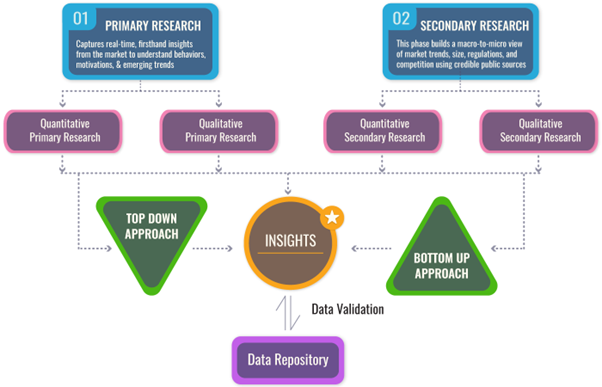
DUAL MODELING: TOP-DOWN + BOTTOM-UP
To ensure robust market estimation, we apply two complementary sizing approaches:
Top-Down Modeling:- Start with broader industry value (e.g., global or regional TAM)
- Apply filters by segment, geography, end-user, or use case
- Adjust with primary insights and validation benchmarks
- Ideal for investor-grade market scans and opportunity mapping
- Aggregate from the ground up using sales volumes, pricing, and unit economics
- Use internal modeling templates aligned with stakeholder data
- Incorporate distributor-level or region-specific inputs
- Most accurate for emerging segments and granular sub-markets
DATA VALIDATION: IN-HOUSE REPOSITORY
We close the loop with proprietary data intelligence built from ongoing projects, industry monitoring, and historical benchmarking. This repository includes:
- Multi-sector market and pricing models
- Key trendlines from past interviews and forecasts
- Benchmarked adoption rates, churn patterns, and ROI indicators
- Industry-specific deviation flags and cross-check logic
- Catches inconsistencies early
- Aligns projections across studies
- Enables consistent, high-trust deliverables