

Ceramics Market Size and Forecast (2025–2033), Global and Regional Growth, Trend, Share and Industry Analysis Report Coverage: By Type (Traditional, Advanced), By Application (Tiles, Sanitary Wares, Abrasives, Pottery, Bricks & Pipes, Others), By End-Use Industry (Building & Construction, Industrial, Medical, Others), and Geography
2026-02-25
Chemicals & Materials
Jaya Bundele (Research Analyst)
Description
Ceramics Market Overview
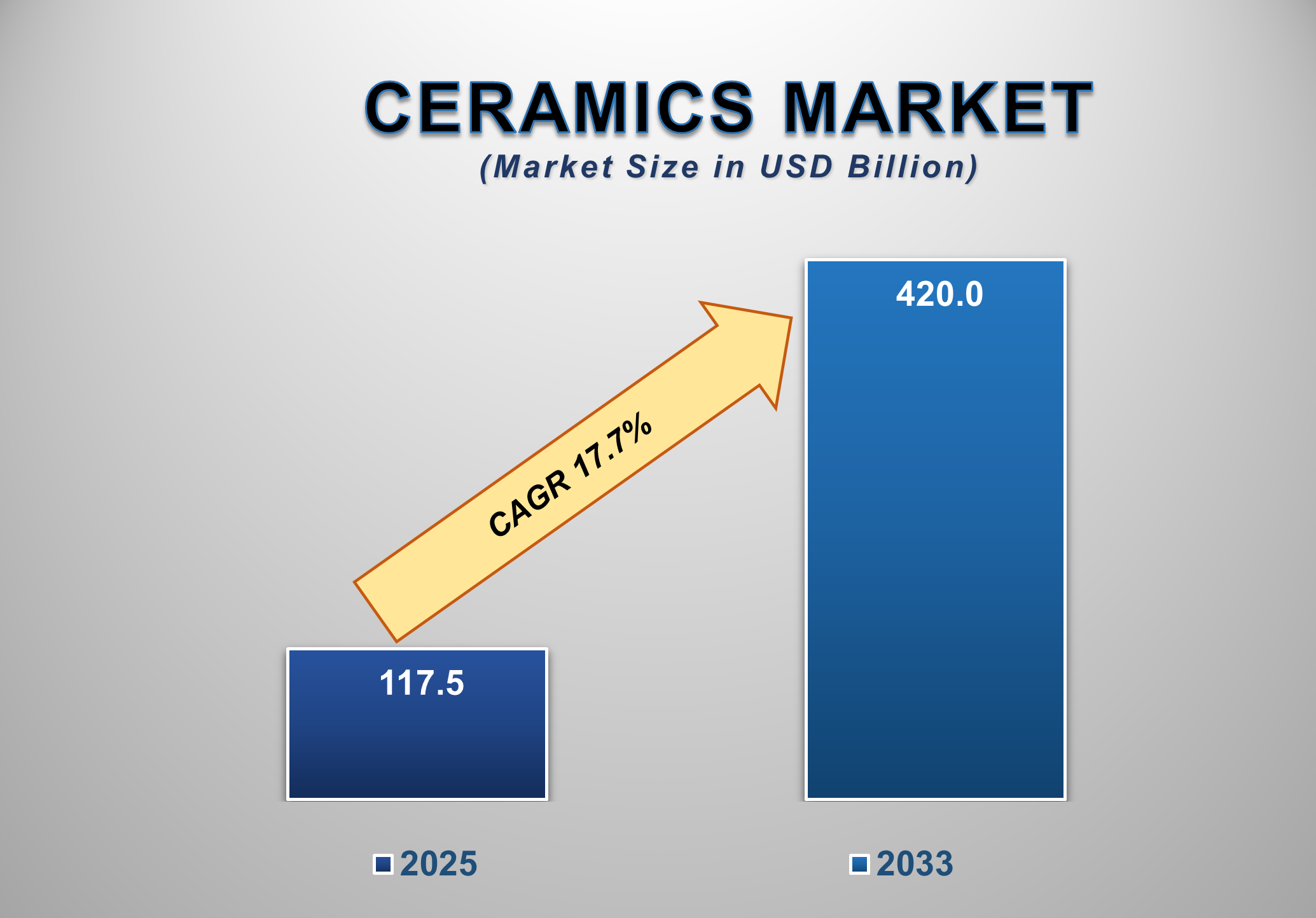
The global ceramics market was valued at USD 117.5 billion in 2025 and is projected to reach USD 420.0 billion by 2033, expanding at a strong CAGR of 17.7% during the forecast period. This significant growth is primarily driven by rapid urbanization, large-scale infrastructure development, rising demand from the construction sector, and increasing adoption of advanced ceramics across industrial and medical applications. Ceramics remain a foundational material across residential, commercial, and industrial value chains due to their durability, thermal resistance, and aesthetic versatility.
Traditional ceramics continue to
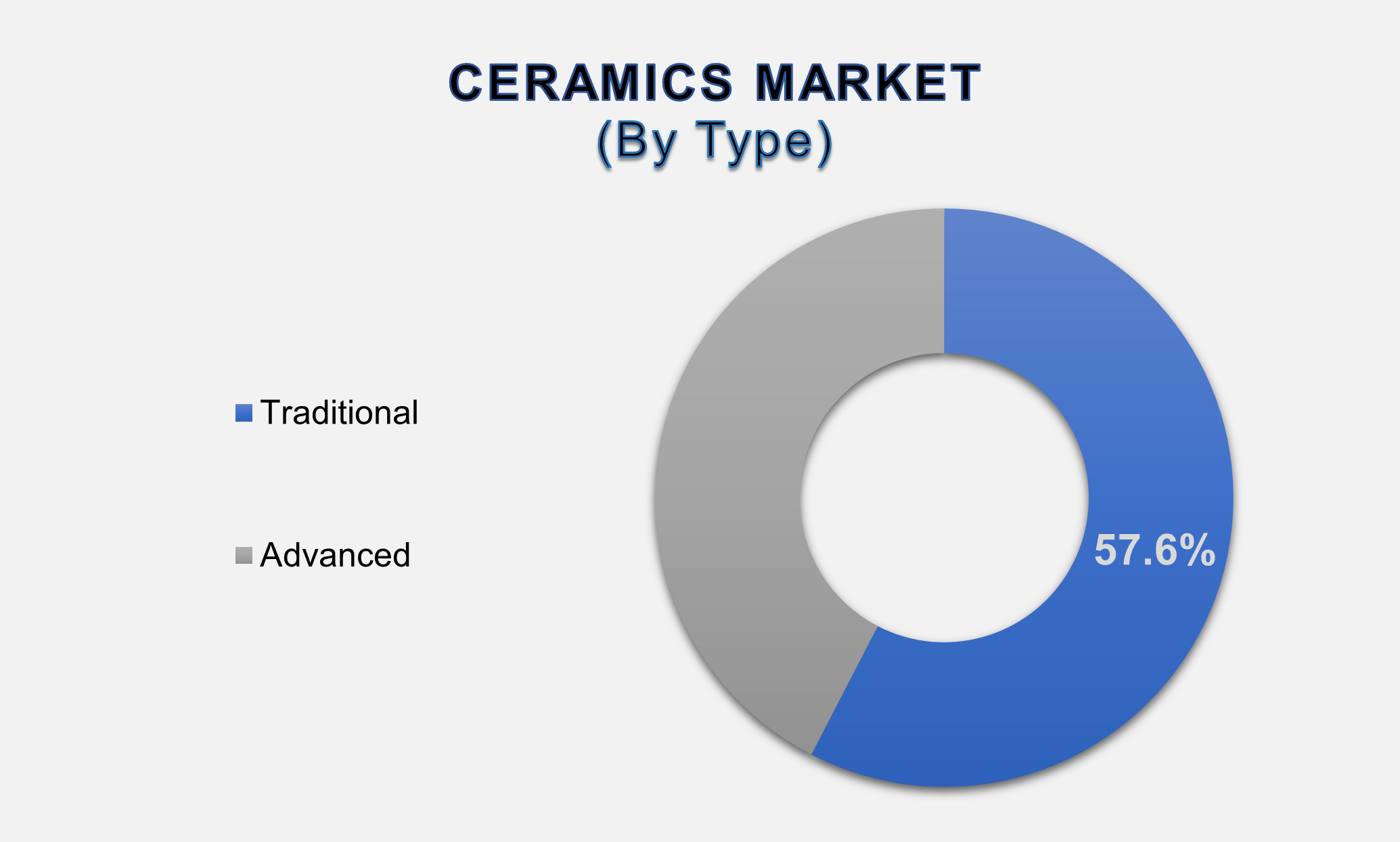
dominate the market, accounting for 57.6% of total revenue, supported by
widespread usage in tiles, sanitary ware, bricks, and pipes. Meanwhile,
advanced ceramics are gaining traction in high-performance applications such as
electronics, medical implants, aerospace components, and energy systems. The
growing emphasis on sustainable construction materials and long-lasting
infrastructure solutions is further strengthening ceramics demand globally.
Ceramics Market Drivers
and Opportunities
Rapid Urbanization and
Construction Activity Are Driving Market Growth
One of the primary drivers of the ceramics market is the rapid
pace of urbanization and construction activity worldwide. Growing population
density in urban areas, coupled with increasing investments in residential,
commercial, and public infrastructure projects, has significantly boosted
demand for ceramic tiles, sanitary ware, and structural ceramic products.
Governments across emerging economies are prioritizing housing development,
transportation networks, and urban infrastructure, directly contributing to
ceramics consumption.
Ceramic tiles are extensively used in flooring, wall cladding, and
exterior applications due to their durability, water resistance, and low
maintenance requirements. The rising preference for aesthetically appealing and
long-lasting building materials has further strengthened the role of ceramics
in modern construction. Additionally, renovation and remodeling activities in
developed economies are driving replacement demand for ceramic products.
Technological advancements such as digital printing on tiles, large-format
slabs, and customized ceramic designs have expanded product offerings and
increased adoption in premium construction projects. As construction activity
continues to rise globally, ceramics are expected to remain a core material
supporting infrastructure and real estate development.
Expanding Industrial and Medical Applications Are
Strengthening Market Expansion
The growing adoption of ceramics in industrial and medical
applications is another major growth driver for the ceramics market. Advanced
ceramics exhibit superior properties such as high thermal resistance,
electrical insulation, chemical stability, and mechanical strength, making them
ideal for demanding industrial environments. Industries such as electronics,
automotive, aerospace, and energy increasingly rely on ceramic components for
enhanced performance and durability.
In the medical sector, ceramics are widely used in dental
implants, orthopedic implants, prosthetics, and surgical instruments due to
their biocompatibility and wear resistance. The rising prevalence of chronic
diseases, aging populations, and increasing healthcare expenditure are
contributing to steady demand for medical ceramics. Additionally, ceramics are
gaining importance in renewable energy applications, including fuel cells,
solar panels, and battery systems. As industries continue to seek high-performance
materials capable of withstanding extreme conditions, the role of advanced
ceramics in industrial and medical sectors is expected to expand significantly.
Technological Innovation in Advanced Ceramics Presents Major
Growth Opportunities
Technological innovation represents a significant opportunity for
the ceramics market, particularly in the development and commercialization of
advanced ceramics. Continuous research and development efforts are leading to
the creation of high-purity, lightweight, and high-strength ceramic materials
with enhanced functional properties. These innovations are enabling ceramics to
penetrate new application areas such as semiconductor manufacturing, electric
vehicles, and next-generation medical devices.
Additive manufacturing and 3D printing of ceramics are emerging as transformative technologies, allowing for complex geometries, reduced material waste, and customized product designs. These advancements are particularly beneficial for aerospace, defense, and healthcare applications, where precision and performance are critical. Furthermore, the growing focus on sustainability is encouraging manufacturers to develop energy-efficient production processes and recyclable ceramic materials. As technological advancements continue to accelerate, advanced ceramics are expected to unlock new revenue streams and elevate the overall market growth trajectory
Ceramics Market Scope
|
Report Attributes |
Description |
|
Market Size in 2025 |
USD 117.5 Billion |
|
Market Forecast in 2035 |
USD 420.0 Billion |
|
CAGR % 2025-2035 |
17.7% |
|
Base Year |
2024 |
|
Historic Data |
2020-2024 |
|
Forecast Period |
2025-2035 |
|
Report USP |
Production, Consumption,
Company Share, Company Heatmap, Company Production Capacity, Growth Factors,
and more |
|
Segments Covered |
●
By Type ●
By Application ●
By End-Use
Industry |
|
Regional Scope |
●
North America, ●
Europe, ●
APAC, ●
Latin America ●
Middle East and
Africa |
|
Country Scope |
1)
U.S. 2)
Canada 3)
Germany 4)
UK 5)
France 6)
Spain 7)
Italy 8)
Switzerland 9)
China 10)
Japan 11)
India 12)
Australia 13)
South Korea 14)
Brazil 15)
Mexico 16)
Argentina 17)
South Africa 18)
Saudi Arabia 19)
UAE |
Ceramics Market Report
Segmentation Analysis
The Global Ceramics Market
Industry Analysis Is Segmented By Type, By Application, By End-Use Industry,
and By Region.
The
Traditional Ceramics Segment Is Expected to Dominate
the Global Ceramics Market During the Forecast Period
The traditional ceramics segment accounted for approximately 57.6% of the global ceramics market, driven by extensive usage in tiles, sanitary ware, bricks, pipes, and pottery. Traditional ceramics are widely preferred in construction applications due to their cost-effectiveness, durability, and ease of manufacturing. High demand from residential and commercial construction projects continues to support segment dominance. Ceramic tiles represent the largest application within traditional ceramics, benefiting from the rising demand for flooring and wall solutions in urban housing and infrastructure projects. Sanitary ware products such as toilets, washbasins, and bidets also contribute significantly to segment revenue, particularly in developing economies with expanding sanitation infrastructure. Despite increasing adoption of advanced ceramics, traditional ceramics are expected to maintain their leading position due to their broad applicability and strong demand fundamentals.
Tiles
Segment Is Expected to Dominate the Ceramics Market During the Forecast Period
The
tiles segment represents the largest application area in the ceramics market,
driven by widespread adoption in building and construction. Ceramic tiles are
favored for their resistance to moisture, stains, and wear, making them ideal
for residential, commercial, and industrial spaces. The availability of diverse
designs, textures, and finishes has further enhanced tile adoption.
Large-format tiles and digitally printed designs are gaining popularity in
premium construction projects, supporting higher value growth. Additionally,
increasing renovation activity in mature markets is contributing to replacement
demand for ceramic tiles. As urbanization and infrastructure development
continue, the tiles segment is expected to remain the dominant application within
the ceramics market.
Building
& Construction End-Use Industry Is Expected to Lead the Ceramics Market
Through 2033
The
building and construction segment accounts for the largest share of the
ceramics market, supported by strong demand for tiles, sanitary ware, bricks,
and pipes. Rapid urban development, housing projects, and commercial
construction are key contributors to segment growth. Ceramics are increasingly
used in sustainable and green building initiatives due to their long lifespan,
recyclability, and low maintenance requirements. As governments and private
developers invest in smart cities and infrastructure modernization, demand from
the building and construction sector is expected to remain robust.
The following segments are
part of an in-depth analysis of the global Ceramics Market:
|
Market Segments |
|
|
By Type |
●
Traditional ●
Advanced |
|
By Application |
●
Tiles ●
Sanitary Wares ●
Abrasives ●
Pottery ●
Bricks & Pipes ●
Others |
|
By End-Use
Industry |
●
Building &
Construction ●
Industrial ●
Medical ●
Others |
Ceramics Market Share
Analysis by Region
North America is
anticipated to hold the biggest portion of the Ceramics Market globally
throughout the forecast period.
Asia Pacific accounted for
approximately 38.0% of the global ceramics market in 2025, making it the
largest regional market. The region’s dominance is driven by rapid
urbanization, strong construction activity, and a well-established ceramics
manufacturing base. Countries such as China, India, and Southeast Asian nations
are witnessing large-scale infrastructure development, housing projects, and
industrial expansion, which significantly boost ceramics demand. Additionally,
the availability of raw materials, low production costs, and high domestic
consumption support regional market leadership.
Europe is expected to register
the highest CAGR during the forecast period, driven by growing demand for
advanced ceramics and sustainable construction materials. Increasing renovation
activities, stringent energy efficiency regulations, and rising adoption of
high-performance ceramics in industrial and medical applications are supporting
market growth. Countries such as Germany, Italy, and Spain are at the forefront
of technological innovation in ceramics manufacturing, positioning Europe as
the fastest-growing regional market through 2033.
Ceramics Market
Competition Landscape Analysis
The ceramics market is moderately
fragmented, with the presence of global manufacturers and strong regional
players. Competition is based on product quality, design innovation,
technological capabilities, pricing, and distribution reach. Strategic expansions,
capacity additions, and investments in advanced ceramics are key competitive
strategies.
Global Ceramics Market
Recent Developments News:
- In March 2024 – Landmark Ceramics celebrated a USD
72 million investment to expand its logistics and production capabilities
near Nashville, Tennessee. The project includes a new logistics hub and
expanded tile production capacity in the U.S.
- In April 2024 – Meghna Ceramic Industries invested
USD 45 million to increase production capacity at its factory near Dhaka,
Bangladesh. Since July 2023, the facility has been producing 51,000 square
meters of “Fresh Ceramics” tiles daily, strengthening the company’s
position in the tile market.
The Global Ceramics Market Is
Dominated by a Few Large Companies, such as
●
LIXIL Group
●
Kohler
●
Mohawk Industries
●
TOTO
●
Geberit
●
Roca
●
Kyocera Corporation
●
Saint-Gobain
●
Coorstek
●
3M Company
●
Villeroy & Boch
●
Lamosa
●
Cersanit
●
RAK Ceramics
●
NGK Spark
●
Arrow Group
●
Ceramtec
●
Iris Ceramica
●
Morgan Advanced
Materials
●
Kajaria
●
Florim
●
Nabel Ceramics
●
SCG
●
Fortune Brands Home
& Security
●
Casalgrande Padana
● Others
Frequently Asked Questions
Jaya Bundele (Research Analyst)
Jaya Bundele is a skilled Research Analyst with 4+ years of experience in market intelligence, consumer insights, competitive analysis, and industry forecasting across the consumer goods, agriculture, and food & beverage sectors. She specializes in market sizing, trend analysis, growth opportunity mapping, and strategic secondary research for global and regional markets.
Her expertise lies in transforming complex industry data into actionable business strategies that help organizations identify emerging trends, understand customer behavior, and gain a competitive edge. With a strong focus on data-driven insights, business intelligence, and future market trends, Jaya delivers high-quality research solutions aligned with evolving industry demands and market dynamics.
1. Global Ceramics Market
Introduction and Market Overview
1.1.
Objectives
of the Study
1.2.
Global
Ceramics Market Scope and Market Estimation
1.2.1.Global Ceramics Overall
Market Size (US$ Bn), Market CAGR (%), Market forecast (2025 - 2033)
1.2.2.Global Ceramics Market
Revenue Share (%) and Growth Rate (Y-o-Y) from 2020 - 2033
1.3.
Market
Segmentation
1.3.1.Type of Global Ceramics
Market
1.3.2.Application of Global Ceramics
Market
1.3.3.End-Use Industry of Global
Ceramics Market
1.3.4.Region of Global Ceramics
Market
2. Executive
Summary
2.1.
Demand
Side Trends
2.2.
Key
Market Trends
2.3.
Market
Demand (US$ Bn) Analysis 2020 – 2024 and Forecast, 2025 – 2033
2.4.
Demand
and Opportunity Assessment
2.5.
Key
Developments
2.6.
Overview
of Tariff, Regulatory Landscape and Standards
2.7.
Market
Entry Strategies
2.8.
Market
Dynamics
2.8.1.Drivers
2.8.2.Limitations
2.8.3.Opportunities
2.8.4.Impact Analysis of Drivers
and Restraints
2.9.
Porter’s
Five Forces Analysis
2.10.
PEST
Analysis
3. Global
Ceramics Market Estimates
& Historical Trend Analysis (2020 - 2024)
4. Global
Ceramics Market Estimates
& Forecast Trend Analysis, by Type
4.1.
Global
Ceramics Market Revenue (US$ Bn) Estimates and Forecasts, by Type, 2020 - 2033
4.1.1.Traditional
4.1.2.Advanced
5. Global
Ceramics Market Estimates
& Forecast Trend Analysis, by Application
5.1.
Global
Ceramics Market Revenue (US$ Bn) Estimates and Forecasts, by Application, 2020
- 2033
5.1.1.Tiles
5.1.2.Sanitary Wares
5.1.3.Abrasives
5.1.4.Pottery
5.1.5.Bricks & Pipes
5.1.6.Others
6. Global
Ceramics Market Estimates
& Forecast Trend Analysis, by End-Use Industry
6.1.
Global
Ceramics Market Revenue (US$ Bn) Estimates and Forecasts, by End-Use Industry,
2020 - 2033
6.1.1.Building &
Construction
6.1.2.Industrial
6.1.3.Medical
6.1.4.Others
7. Global
Ceramics Market Estimates
& Forecast Trend Analysis, by Region
7.1.
Global
Ceramics Market Revenue (US$ Bn) Estimates and Forecasts, by Region, 2020 - 2033
7.1.1.North America
7.1.2.Europe
7.1.3.Asia Pacific
7.1.4.Middle East & Africa
7.1.5.Latin America
8. North America Ceramics
Market: Estimates & Forecast Trend
Analysis
8.1.
North
America Ceramics Market Assessments & Key Findings
8.1.1.North America Ceramics
Market Introduction
8.1.2.North America Ceramics
Market Size Estimates and Forecast (US$ Billion) (2020 - 2033)
8.1.2.1. By Type
8.1.2.2. By Application
8.1.2.3. By End-Use
Industry
8.1.2.4.
By
Country
8.1.2.4.1. The U.S.
8.1.2.4.2. Canada
9. Europe Ceramics
Market: Estimates & Forecast Trend
Analysis
9.1.
Europe
Ceramics Market Assessments & Key Findings
9.1.1.Europe Ceramics Market
Introduction
9.1.2.Europe Ceramics Market
Size Estimates and Forecast (US$ Billion) (2020 - 2033)
9.1.2.1. By Type
9.1.2.2. By Application
9.1.2.3. By End-Use
Industry
9.1.2.4.
By
Country
9.1.2.4.1.
Germany
9.1.2.4.2.
Italy
9.1.2.4.3.
U.K.
9.1.2.4.4.
France
9.1.2.4.5.
Spain
9.1.2.4.6.
Switzerland
9.1.2.4.7. Rest
of Europe
10. Asia Pacific Ceramics
Market: Estimates & Forecast Trend
Analysis
10.1.
Asia
Pacific Market Assessments & Key Findings
10.1.1.
Asia
Pacific Ceramics Market Introduction
10.1.2.
Asia
Pacific Ceramics Market Size Estimates and Forecast (US$ Billion) (2020 - 2033)
10.1.2.1. By Type
10.1.2.2. By Application
10.1.2.3. By End-Use
Industry
10.1.2.4.
By
Country
10.1.2.4.1. China
10.1.2.4.2. Japan
10.1.2.4.3. India
10.1.2.4.4. Australia
10.1.2.4.5. South Korea
10.1.2.4.6. Rest of Asia Pacific
11. Middle East & Africa Ceramics
Market: Estimates & Forecast Trend
Analysis
11.1.
Middle
East & Africa Market Assessments & Key Findings
11.1.1.
Middle East & Africa Ceramics Market Introduction
11.1.2.
Middle East & Africa Ceramics Market Size Estimates and
Forecast (US$ Billion) (2020 - 2033)
11.1.2.1. By Type
11.1.2.2. By Application
11.1.2.3. By End-Use
Industry
11.1.2.4.
By
Country
11.1.2.4.1. UAE
11.1.2.4.2. Saudi
Arabia
11.1.2.4.3. South
Africa
11.1.2.4.4. Rest
of MEA
12. Latin America
Ceramics Market: Estimates &
Forecast Trend Analysis
12.1.
Latin
America Market Assessments & Key Findings
12.1.1.
Latin
America Ceramics Market Introduction
12.1.2.
Latin
America Ceramics Market Size Estimates and Forecast (US$ Billion) (2020 - 2033)
12.1.2.1. By Type
12.1.2.2. By Application
12.1.2.3. By End-Use
Industry
12.1.2.4.
By
Country
12.1.2.4.1. Brazil
12.1.2.4.2. Argentina
12.1.2.4.3. Mexico
12.1.2.4.4. Rest
of LATAM
13. Country Wise Market:
Introduction
14.
Competition
Landscape
14.1.
Global
Ceramics Market Product Mapping
14.2.
Global
Ceramics Market Concentration Analysis, by Leading Players / Innovators /
Emerging Players / New Entrants
14.3.
Global
Ceramics Market Tier Structure Analysis
14.4.
Global
Ceramics Market Concentration & Company Market Shares (%) Analysis, 2024
15.
Company
Profiles
15.1.
LIXIL Group
15.1.1.
Company
Overview & Key Stats
15.1.2.
Financial
Performance & KPIs
15.1.3.
Product
Portfolio
15.1.4.
SWOT
Analysis
15.1.5.
Business
Strategy & Recent Developments
* Similar details would be provided for all the players
mentioned below
15.2. Kohler
15.3. Mohawk
Industries
15.4. TOTO
15.5. Geberit
15.6. Roca
15.7. Kyocera
Corporation
15.8. Saint-Gobain
15.9. Coorstek
15.10. 3M
Company
15.11. Villeroy
& Boch
15.12. Lamosa
15.13. Cersanit
15.14. RAK
Ceramics
15.15. NGK
Spark
15.16. Arrow
Group
15.17. Ceramtec
15.18. Iris
Ceramica
15.19. Morgan
Advanced Materials
15.20. Kajaria
15.21. Florim
15.22. Nabel
Ceramics
15.23. SCG
15.24. Fortune
Brands Home & Security
15.25. Casalgrande
Padana
15.26. Others
16. Research
Methodology
16.1.
External
Transportations / Databases
16.2.
Internal
Proprietary Database
16.3.
Primary
Research
16.4.
Secondary
Research
16.5.
Assumptions
16.6.
Limitations
16.7.
Report
FAQs
17. Research
Findings & Conclusion
Our Research Methodology
"Insight without rigor is just noise."
We follow a comprehensive, multi-phase research framework designed to deliver accurate, strategic, and decision-ready intelligence. Our process integrates primary and secondary research , both quantitative and qualitative , along with dual modeling techniques ( top-down and bottom-up) and a final layer of validation through our proprietary in-house repository.
PRIMARY RESEARCH
Primary research captures real-time, firsthand insights from the market to understand behaviors, motivations, and emerging trends.
1. Quantitative Primary Research
Objective: Generate statistically significant data directly from market participants.
Approaches:- Structured surveys with customers, distributors, and field agents
- Mobile-based data collection for point-of-sale audits and usage behavior
- Phone-based interviews (CATI) for market sizing and product feedback
- Online polling around industry events and digital campaigns
- Purchase frequency by customer type
- Channel performance across geographies
- Feature demand by application or demographic
2. Qualitative Primary Research
Objective: Explore decision-making drivers, pain points, and market readiness.
Approaches:- In-depth interviews (IDIs) with executives, product managers, and key decision-makers
- Focus groups among end users and early adopters
- Site visits and observational research for consumer products
- Informal field-level discussions for regional and cultural nuances
SECONDARY RESEARCH
This phase helps establish a macro-to-micro understanding of market trends, size, regulation, and competitive dynamics, sourced from credible and public domain information.
1. Quantitative Secondary Research
Objective: Model market value and segment-level forecasts based on published data.
Sources include:- Financial reports and investor summaries
- Government trade data, customs records, and regulatory statistics
- Industry association publications and economic databases
- Channel performance and pricing data from marketplace listings
- Revenue splits, pricing trends, and CAGR estimates
- Supply-side capacity and volume tracking
- Investment analysis and funding benchmarks
2. Qualitative Secondary Research
Objective: Capture strategic direction, innovation signals, and behavioral trends.
Sources include:- Company announcements, roadmaps, and product pipelines
- Publicly available whitepapers, conference abstracts, and academic research
- Regulatory body publications and policy briefs
- Social and media sentiment scanning for early-stage shifts
- Strategic shifts in market positioning
- Unmet needs and white spaces
- Regulatory triggers and compliance impact
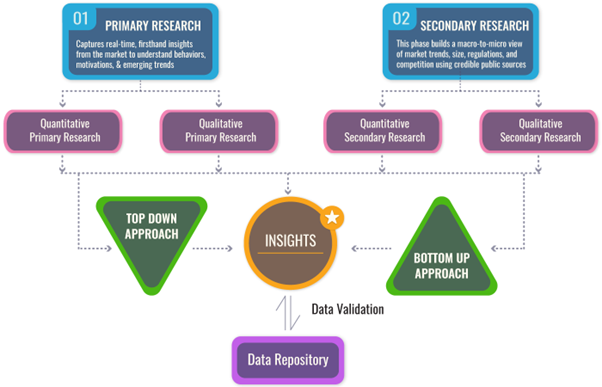
DUAL MODELING: TOP-DOWN + BOTTOM-UP
To ensure robust market estimation, we apply two complementary sizing approaches:
Top-Down Modeling:- Start with broader industry value (e.g., global or regional TAM)
- Apply filters by segment, geography, end-user, or use case
- Adjust with primary insights and validation benchmarks
- Ideal for investor-grade market scans and opportunity mapping
- Aggregate from the ground up using sales volumes, pricing, and unit economics
- Use internal modeling templates aligned with stakeholder data
- Incorporate distributor-level or region-specific inputs
- Most accurate for emerging segments and granular sub-markets
DATA VALIDATION: IN-HOUSE REPOSITORY
We close the loop with proprietary data intelligence built from ongoing projects, industry monitoring, and historical benchmarking. This repository includes:
- Multi-sector market and pricing models
- Key trendlines from past interviews and forecasts
- Benchmarked adoption rates, churn patterns, and ROI indicators
- Industry-specific deviation flags and cross-check logic
- Catches inconsistencies early
- Aligns projections across studies
- Enables consistent, high-trust deliverables