

Cervical Cancer Diagnostic Market Size and Forecast (2026–2034), Global and Regional Growth, Trend, Share and Industry Analysis Report Coverage: By Test Type (Pap Smear Testing, HPV Testing, Colposcopy, Cervical Biopsies and Endocervical Curettage, Others (Dual-Stain Cytology, Biomarker-based Tests, etc.)), By Technology (Liquid-Based Cytology, Molecular Diagnostics, Digital Cytology and AI-Assisted Imaging, Immunohistochemistry and Biomarker Testing, Others (Fluorescence Imaging, Computer-Aided Diagnosis (CAD), etc.)), By End User (Hospitals, Specialty Clinics, Diagnostic Centers, Cancer and Radiation Therapy Centers, and Others (Academic & Research Institutes, Community Screening Programs, etc.)), and Geography
2026-07-30
Healthcare
Swetal (Research Analyst)
Description
Cervical Cancer Diagnostic Market
Overview
The global cervical
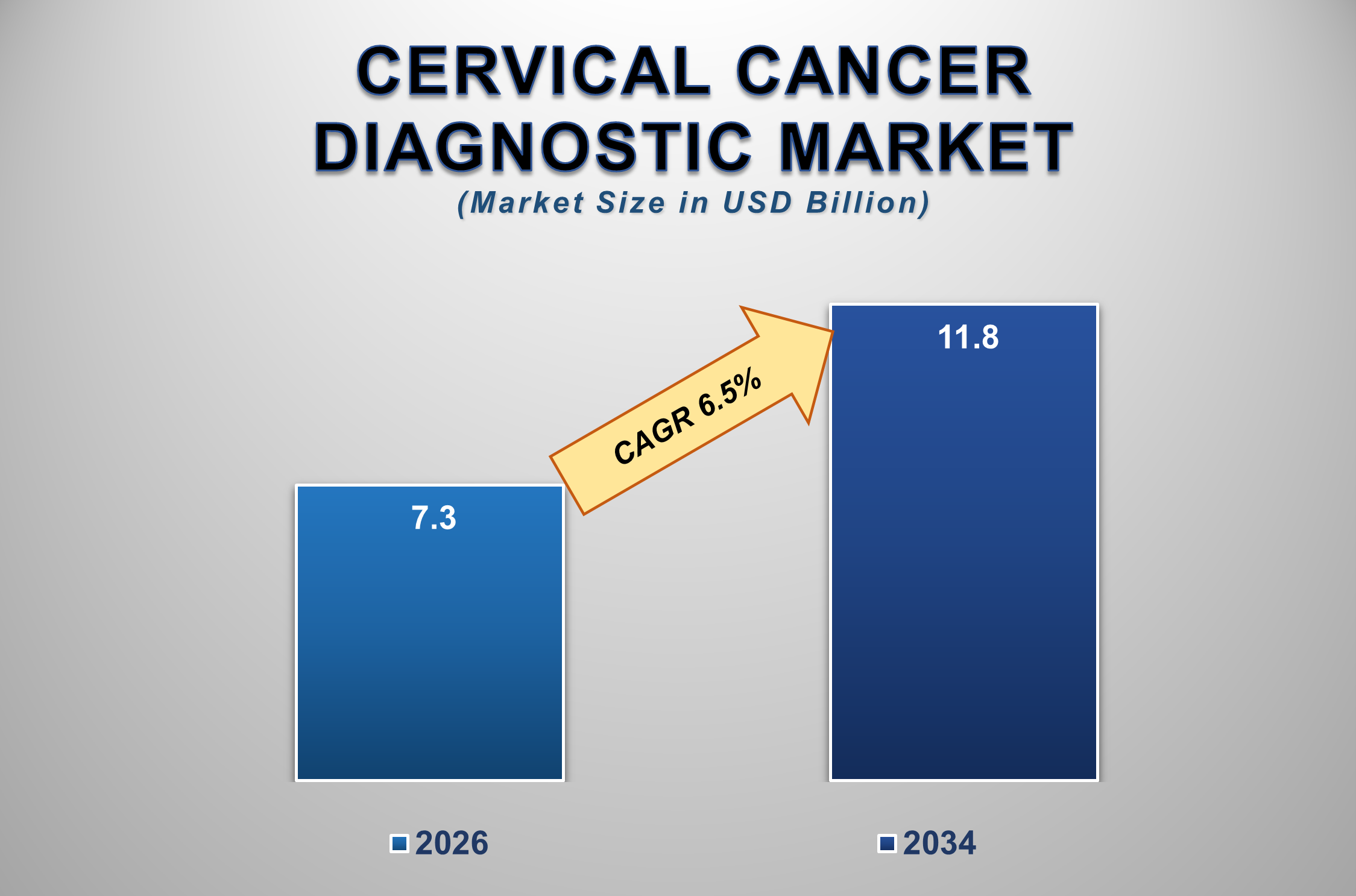
cancer diagnostic market was valued at USD 7.3 billion in 2026 and is projected
to reach USD 11.8 billion by 2034, expanding at a CAGR of 6.5% during the
forecast period. The cervical cancer diagnosis market, worldwide, is set to
experience stable growth in the years to come, primarily due to an increase in
the incidence rate of cervical cancer. An increase in the level of awareness
concerning early detection of cancer and growth in the number of
government-sponsored cancer screening programs are key factors bolstering
market growth. Cervical cancer is counted as one of the largest sources of
cancer mortality in the female gender; it contributes substantially in
low-developed countries due to poor health care services available for this
cancer. Women's screening attendance is progressively growing as the public
increasingly adopts cancer screening procedures, public health education
initiatives, and superior health care facilities are developing.
Technological advances within molecular diagnostics, HPV diagnostics, liquid-based cytology, biomarker diagnostics, and artificial intelligence-based diagnostics have changed the world of cervical cancer diagnostics by increasing the precision and effectiveness of diagnostic programs. Besides, advances such as automation in laboratories, point-of-care diagnostics, and digital pathology will assist the industry in achieving quick diagnoses with an efficient process. Furthermore, increased research and development investments within diagnostics, increased reimbursements in developed countries, and collaborations between diagnostic companies and health care and public health organizations will be driving the cervical cancer diagnostics market during the forecast period.
Cervical Cancer Diagnostic Market
Drivers and Opportunities
Growing Adoption
of HPV-Based Primary Screening Programs Is Driving Market Growth
Adoption of
HPV-based primary screening initiatives is an important factor that drives
growth in the market for cervical cancer diagnostics. In comparison to
cytology-based screening methods, HPV DNA testing provides improved sensitivity
for high-risk HPV infection detection, which helps to identify women who are at
risk of developing cervical cancer in the future. More governments and
international health organizations recognize the importance of HPV-based
screenings within their country's cervical cancer prevention initiatives, which
will result in increased adoption of molecular diagnostic solutions. For
example, in March 2026, the Government of India reiterated its commitment to
multifaceted efforts related to the prevention and management of cervical cancer
through the implementation of initiatives aimed at widespread cervical cancer
screening, early diagnosis, and timely treatment to reduce the cervical cancer
disease burden among women. Also in March 2026, the World Health Organization
issued revised guidelines for cervical pre-cancer screening and treatment and
recommended the use of HPV DNA genotyping as a solution that can enhance risk
stratification and optimize cervical cancer prevention programs.
Rising Burden of
Cervical Cancer and Growing Awareness of Early Detection Fueling Market
Expansion
Increased global
incidences of cervical cancer and heightened awareness about the need for
timely diagnosis form the core of the cervical cancer diagnostics market
drivers. There is an increased number of high-risk human papillomavirus (HPV)
infections and cervical cancer incidences that have made governments and health
authorities enhance their efforts to provide more screening opportunities and
better diagnostic tools. Raising awareness campaigns to emphasize the need for
timely screening and early detection helps to make sure that more people join
the prevention program for cervical cancer, which means that the demand for Pap
smear tests, HPV DNA testing, liquid-based cytology, and other types of tests
will be higher. According to the World Health Organization (WHO), cervical
cancer ranked as the fifth most common cancer among women worldwide until July
2026, with 604,000 new cases being diagnosed in 2024 and deaths reaching up to
280,000.
Expansion of
AI-Enabled and Self-Sampling Cervical Cancer Screening Presents Significant
Opportunities
The confluence of AI, digital pathology, and self-sampling solutions is leading to one of the most disruptive trends in the diagnostics market for cervical cancer. Manual analysis and diagnosis of cervical cytology slides are predominantly performed by specialized pathologists and often require substantial amounts of time and labor and may lead to some degree of inter-observer variance. As the volume of cervical cancer screening continues to increase in conjunction with the lack of skilled professionals in the field, AI-driven diagnosis is likely to become one of the viable solutions in the future.
AI-based digital
cytology solutions have the ability to automatically interpret cervical
cytology images, rank abnormal cases for additional scrutiny, and help identify
precancerous changes with more precision. Not only do these solutions save
time, but they also facilitate greater lab productivity by automating some
routine processes. Integration of cloud-based digital pathology platforms makes
these solutions available for healthcare institutions located in underserved
areas. Another area of expansion would be an increase in the use of HPV
self-sampling. With the help of kits, which make it possible for women to
collect cervical or vaginal samples at home or community health clinics, all
barriers that hinder the use of HPV screening in clinics can be overcome. The
barriers are limited travel opportunities, fear of stigmatization, lack of
scheduling appointments, and the embarrassment of having to undergo a pelvic
examination. Clinical trials have shown that self-collected samples, when
tested for HPV DNA using validated molecular assays, provide the same
diagnostic quality as clinically collected samples. This led some countries to
include self-sampling in the national cervical cancer screening programs to
reach out to those women who have never been screened or need a cervical cancer
screening.
The potential is especially great in developing and low-income countries where the number of women suffering from cervical cancer is disproportionately large, and there are not enough medical facilities to perform screening based on cytology. By combining HPV self-sampling, molecular diagnostic methods, and the assistance of AI in interpreting the results, the implementation of the massive screening program would require fewer clinical staff. For the diagnostic industry and technology players, there are several ways to capitalize on this changing scenario. Investments in AI-powered imaging software, automated slide scanning systems, molecular HPV testing platforms, cloud-integrated diagnostics, and convenient self-collection technologies are being made. It is anticipated that strategic partnerships among diagnostic companies, digital health companies, healthcare organizations, and public health organizations will lead to an increase in adoption and business expansion. As the reimbursement models change and the approval processes advance, the role of AI-powered diagnostics and self-sampling technologies will become essential for the next generation of cervical cancer screening programs.
Cervical Cancer Diagnostic Market
Scope
|
Report Attributes |
Description |
|
Market Size in
2026 |
USD 7.3
Billion |
|
Market Forecast
in 2034 |
USD 11.8 Billion |
|
CAGR % 2026-2034 |
6.5% |
|
Base Year |
2025 |
|
Historic Data |
2021-2025 |
|
Forecast Period |
2026-2034 |
|
Report USP |
Patent &
Exclusivity Assessment, Pricing & Reimbursement Analysis, Technology
& Innovation Assessment, Whitespace Assessment, Company Share, Company
Heatmap, Growth Factors and more |
|
Segments Covered |
●
By Test
Type ●
By
Technology ●
By End
User |
|
Regional Scope |
●
North
America ●
Europe ●
APAC ●
Latin
America ●
Middle
East and Africa |
|
Country Scope |
●
U.S. ●
Canada ●
U.K. ●
Germany ●
France ●
Italy ●
Spain ●
Russia ●
China ●
India ●
Japan ●
South
Korea ●
Australia
●
Mexico ●
Brazil ●
Saudi
Arabia ●
UAE ●
South
Africa |
Cervical Cancer Diagnostic Market
Report Segmentation Analysis
The global cervical
cancer diagnostic market industry analysis is segmented by test type, by
technology, by end user, and by region.
Pap Smear
Testing Segment Is Expected to Dominate the Cervical Cancer Diagnostic Market
During the Forecast Period
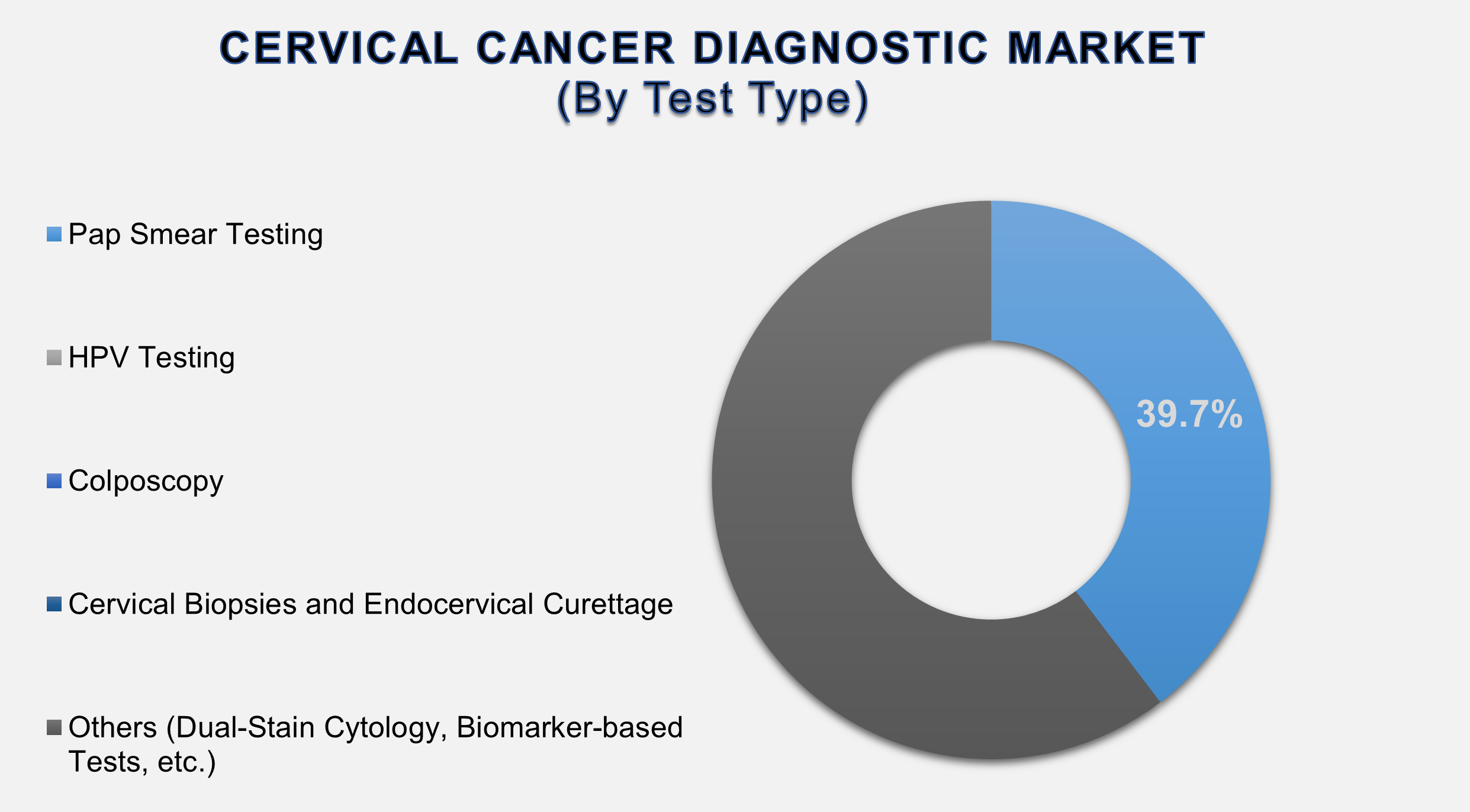
The Pap smear
testing segment will continue to lead the cervical cancer diagnostics market
through the forecast period on account of its extensive use as a screening
test, its effectiveness, and its adoption in national programs for cervical
cancer screening in both developed and developing nations. Pap smear testing is
still an effective and economical method for identifying precancerous
conditions and cervical cancer and helps in ensuring prompt treatment and
improved patient outcomes. The presence of this test in hospitals, diagnostic
laboratories, gynecology clinics, and primary healthcare facilities, along with
favorable reimbursement policies in certain nations, will drive up the number
of tests conducted. In addition, rising awareness about cervical cancer
screening, government-sponsored screening campaigns, and expanding preventive
healthcare programs are contributing to the growing demand for the Pap smear
test. While HPV DNA testing is gaining popularity at a fast pace as a screening
test in many regions, the already accepted clinical utility,
cost-effectiveness, and wide availability of Pap smear testing are expected to
help it retain its dominant position in the global cervical cancer diagnostic
market through the forecast period.
Molecular
Diagnostics Segment Is Expected to Lead the Cervical Cancer Diagnostic Market
by Technology
Molecular
diagnostics accounted for the largest share in terms of technology in the
market for cervical cancer diagnosis because of an increased use of HPV DNA
tests and HPV mRNA tests in the initial screening of cervical cancer. The
molecular diagnostic test is much more sensitive and specific than the
cytological test; therefore, early detection of HPV infection can be achieved
through the molecular diagnostic test. There are many reasons behind the
growing adoption of the molecular diagnostic test, which include
recommendations provided by health organizations on an international level,
implementation of the HPV screening program at a national level, and precision
in diagnosis. Moreover, advancements in PCR, NGS, multiplexing, and automation
of molecular diagnostics are also improving the performance of this technology
in the global cervical cancer diagnostic market.
Hospitals
Segment Is Expected to Dominate the End User Segment
The hospitals segment will lead in the cervical cancer diagnostic market by end user during the forecast period due to the presence of well-equipped diagnostic setups, trained healthcare professionals, and integrated patient care services. Hospitals act as a focal point of care for cervical cancer diagnosis, confirmation, treatment, and follow-up services that provide a variety of diagnostic techniques such as Pap smear tests, HPV DNA testing, colposcopy, and biopsies. It is becoming increasingly evident that there is an increasing number of diagnostic tests in hospitals because of the increase in the number of screening programs, the rising tendency towards centralization in health care service providers, and increased initiatives by the government to improve the quality of women’s health care. Moreover, the use of molecular diagnosis platforms, automation of laboratories, and digital pathology in hospitals has made the process of diagnosis more efficient. All these factors would help maintain the dominance of the hospital segment in the cervical cancer diagnostics market worldwide during the forecast period.
The following
segments are part of an in-depth analysis of the global cervical cancer
diagnostic market:
|
Market Segments |
|
|
By
Test Type |
●
Pap Smear
Testing ●
HPV Testing ●
Colposcopy ●
Cervical
Biopsies and Endocervical Curettage ●
Others
(Dual-Stain Cytology, Biomarker-based Tests, etc.) |
|
By
Technology |
●
Liquid-Based
Cytology ●
Molecular
Diagnostics ●
Digital
Cytology and AI-Assisted Imaging ●
Immunohistochemistry
and Biomarker Testing ●
Others
(Fluorescence Imaging, Computer-Aided Diagnosis (CAD), etc.) |
|
By End
User |
●
Hospitals ●
Specialty
Clinics ●
Diagnostic
Centers ●
Cancer and
Radiation Therapy Centers ●
Others
(Academic & Research Institutes, Community Screening Programs, etc.) |
Cervical Cancer Diagnostic Market Share
Analysis by Region
North America is
projected to hold the largest share of the global cervical cancer diagnostic
market over the forecast period
North America is
projected to dominate the cervical cancer diagnostic market on account of the
high prevalence of cervical cancer, established screening infrastructure,
supportive reimbursement policies, and rapid adoption of technologically
advanced diagnostic solutions. North America has been able to benefit due to
extensive adoption of organized screening programs, growing awareness regarding
preventive health care, and the presence of prominent players in the diagnostic
industry that keep on launching their innovative diagnostic solutions.
According to the American Cancer Society (ACS), the U.S. is predicted to
witness an occurrence of 13,490 new cases of invasive cervical cancer and
around 4,200 deaths due to cervical cancer in 2026. Backing this trend, in June
2026, SNT Biotech launched its go-to-market solution with the aim of bringing
nationwide accessibility of an at-home cervical cancer screening solution after
FDA clearance of the Onclarity HPV Self-Collection Kit that was made possible
with the help of the BD Onclarity HPV Assay. In the same month, Color Health
also unveiled the Onclarity HPV Self-Collection Kit, which has received FDA
clearance to be used with the nationwide virtual cancer care platform that
enables women to get themselves tested for HPV from home.
In the upcoming
years, the Asia-Pacific region is expected to become the leading growing
regional market for cervical cancer diagnostics owing to the high prevalence of
cervical cancer; the presence of a sufficient number of females being at risk;
increased government screenings; and enhanced healthcare infrastructure in
various nations like China, India, Japan, and South Korea. Some of the major
driving factors that are contributing towards the growth of the cervical cancer
diagnostics market in the Asia-Pacific region include increased awareness about
the prevention of cervical cancer, availability of HPV vaccines and test kits,
and molecular diagnostics. Also, the efforts made by governments and public
health organizations towards arranging screening programs for early diagnosis
and lowering deaths from cervical cancer in developing countries, which have a
very heavy load of this disease, are driving the market. Besides, high
healthcare spending, the setting up of new diagnostic centers, the availability
of HPV DNA tests, and regulations favorable to diagnostic technologies are
offering many opportunities for growth in the region.
Cervical Cancer
Diagnostic Market Competition Landscape Analysis
The diagnostic
industry for cervical cancer is highly competitive, and the diagnostic firms,
molecular diagnostic companies, and medical technology companies are focusing
more on innovation and product development to strengthen their market position.
The market players are making use of advanced technologies in diagnostic
procedures such as HPV DNA and mRNA tests, liquid-based cytology tests,
biomarker tests, and automated cytology aided by AI and automation in labs to
improve cervical cancer screening. Product diversification in terms of
regulatory approval, collaboration, mergers and acquisitions, and geographic
expansion by market players to cater to the increasing global demand for
cervical cancer screening is another trend prevalent in the market. Adoption of
self-collection HPV test kits, digital pathology solutions, and integrated
workflow solutions is helping in better screening uptake, and market players
are benefiting from government-led screening programs and increased cervical
cancer awareness.
Global Cervical
Cancer Diagnostic Market Recent Developments News:
● In April 2026 – Waters Corporation announced that the U.S. Food and Drug Administration (FDA) has cleared the Onclarity HPV Self-Collection Kit and approved the BD Onclarity HPV Assay with extended genotyping for at-home use, marking a significant milestone in expanding access to cervical cancer screening and removing barriers that currently prevent many individuals from receiving routine screening.
● In April 2026 – the American College of Obstetricians & Gynecologists (ACOG) released new guidance on cervical cancer screening that endorses the updated recommendations from the Health Resources and Services Administration’s Women’s Preventive Services Initiative.
●
In February
2026 – Hologic, Inc. announced that its Aptima HPV Assay received FDA approval
for clinician-collected HPV primary screening. Hologic’s human papillomavirus
(HPV) test is the only FDA-approved mRNA-based assay, designed specifically to
detect infections most likely to lead to cervical cancer.
● In February 2026 – TruScreen Group Ltd. secured its first sales contract in Uzbekistan, shipping eight AI-enabled cervical cancer screening devices and 8,280 single-use sensors to support a 500-patient pilot in Tashkent and training for both public programs and private clinics.
The Global
Cervical Cancer Diagnostic Market is dominated by a few large companies, such
as
●
Abbott Laboratories
●
Agilent Technologies, Inc.
●
BGI Genomics Co., Ltd.
●
bioMerieux SA
●
Carl Zeiss Meditec AG
●
CooperSurgical, Inc.
●
Danaher Corporation
●
F. Hoffmann-La Roche Ltd
●
Femasys Inc.
●
Guided Therapeutics, Inc.
●
Hologic, Inc.
●
Olympus Corporation
●
QIAGEN N.V.
●
Quest Diagnostics Incorporated
●
Seegene Inc.
●
Siemens Healthineers AG
●
Thermo Fisher Scientific Inc.
● Other Prominent Players
Frequently Asked Questions
Swetal (Research Analyst)
Swetal is a Research Analyst with 4+ years of experience specializing in healthcare market research, medical devices, healthcare IT, and medical technology industry analysis. Her expertise includes competitive intelligence, secondary research, market trend forecasting, and healthcare business insights across global healthcare ecosystems.
She contributes to advanced market research reports by analyzing regulatory frameworks, emerging healthcare technologies, competitive landscapes, and innovation trends shaping the medical industry. With a strong focus on accurate market intelligence, strategic insights, and healthcare industry trends, Swetal supports businesses in making informed, data-backed decisions in a rapidly transforming healthcare environment.
1.
Global
Cervical Cancer Diagnostic Market Introduction and Market Overview
1.1. Objectives of the Study
1.2. Market Segmentation
1.2.1.Test Type of the Global Cervical
Cancer Diagnostic Market
1.2.2.Technology of the Global Cervical
Cancer Diagnostic Market
1.2.3.End User of Global Cervical
Cancer Diagnostic Market
1.2.4.Region of Global Cervical Cancer
Diagnostic Market
1.3. Competition Coverage List of
Market Participants
1.4. Market Definition: Cervical
Cancer Diagnostic Market
2.
Executive Summary
2.1. Global Cervical Cancer Diagnostic
Market Estimation & Forecast
2.1.1.Global Cervical Cancer
Diagnostic Market Size (US$ Million) Estimates & Historical Trend Analysis
(2021 - 2025)
2.1.2.Global Cervical Cancer
Diagnostic Overall Market Size (US$ Million), Growth Rate (Y-o-Y), Market CAGR
(%), Market forecast (2026 - 2034)
2.2. Snapshot of Global Cervical
Cancer Diagnostic Market
2.3. Global Cervical Cancer
Diagnostic Market Revenue Share (%) 2025
2.4. REGIONAL OUTLINE: Revenue CAGR,
by Region
2.5. Key Competitors & Key
Insights
3.
Market Overview (Qualitative
Analysis)
3.1. Demand Side Trends
3.2. Supply Side Trends /
Manufacturing Trends
3.3. Demand and Opportunity
Assessment, 2026 - 2034
3.4. Market Dynamics
3.4.1.Drivers
3.4.2.Limitations
3.4.3.Opportunities
3.4.4.Impact Analysis of Drivers and
Restraints
3.5. Key Developments
3.6. Regulatory Landscape
3.7. Pricing Analysis
3.8. Supply Chain Analysis
3.9. Porter’s Five Forces Analysis
3.9.1.Bargaining Power of Suppliers
3.9.2.Bargaining Power of Buyers
3.9.3.Threat of Substitutes
3.9.4.Threat of New Entrants
3.9.5.Competitive Rivalry
3.10. PEST Analysis
3.10.1. Political Factors
3.10.2. Economic Factors
3.10.3. Social Factors
3.10.4. Technology Factors
4.
Global Cervical Cancer
Diagnostic Market Estimates & Forecast Trend Analysis, by Test Type
4.1. Global Cervical Cancer
Diagnostic Market Assessments & Key Findings, by Test Type
4.2. Global Cervical Cancer
Diagnostic Market Revenue (US$ Million) Estimates and Forecasts, by Test Type, 2021
- 2034
4.2.1.Pap Smear Testing
4.2.2.HPV Testing
4.2.3.Colposcopy
4.2.4.Cervical Biopsies and
Endocervical Curettage
4.2.5.Others (Dual-Stain Cytology,
Biomarker-based Tests, etc.)
5.
Global Cervical Cancer Diagnostic
Market Estimates & Forecast Trend Analysis, by Technology
5.1. Global Cervical Cancer
Diagnostic Market Assessments & Key Findings, by Technology
5.2. Global Cervical Cancer
Diagnostic Market Revenue (US$ Million) Estimates and Forecasts, by Technology,
2021 - 2034
5.2.1.Liquid-Based Cytology
5.2.2.Molecular Diagnostics
5.2.3.Digital Cytology and AI-Assisted
Imaging
5.2.4.Immunohistochemistry and
Biomarker Testing
5.2.5.Others (Fluorescence Imaging,
Computer-Aided Diagnosis (CAD), etc.)
6.
Global Cervical Cancer
Diagnostic Market Estimates & Forecast Trend Analysis, by End User
6.1. Global Cervical Cancer
Diagnostic Market Assessments & Key Findings, by End User
6.2. Global Cervical Cancer
Diagnostic Market Revenue (US$ Million) Estimates and Forecasts, by End User, 2021
- 2034
6.2.1.Hospitals
6.2.2.Specialty Clinics
6.2.3.Diagnostic Centers
6.2.4.Cancer and Radiation Therapy
Centers
6.2.5.Others (Academic & Research
Institutes, Community Screening Programs, etc.)
7.
Global Cervical Cancer
Diagnostic Market Estimates & Forecast Trend Analysis, by Region
7.1. Global Cervical Cancer
Diagnostic Market Assessments & Key Findings, by Region
7.2. Global Cervical Cancer
Diagnostic Market Revenue (US$ Million) Estimates and Forecasts, by Region, 2021
- 2034
7.2.1.North America
7.2.2.Europe
7.2.3.Asia Pacific
7.2.4.Middle East & Africa
7.2.5.Latin America
8.
North
America Cervical Cancer Diagnostic Market: Estimates & Forecast Trend Analysis
8.1.
North
America Cervical Cancer Diagnostic Market Assessments & Key Findings
8.1.1.North America Cervical Cancer
Diagnostic Market Introduction
8.1.2.North America Cervical Cancer Diagnostic
Market Size Estimates and Forecast (US$ Million) (2021 - 2034)
8.1.2.1. By Test Type
8.1.2.2. By Technology
8.1.2.3. By End User
8.1.2.4. By Country
8.1.2.4.1. The U.S.
8.1.2.4.2. Canada
9.
Europe
Cervical Cancer Diagnostic Market: Estimates & Forecast Trend Analysis
9.1. Europe Cervical Cancer Diagnostic
Market Assessments & Key Findings
9.1.1.Europe Cervical Cancer
Diagnostic Market Introduction
9.1.2.Europe Cervical Cancer
Diagnostic Market Size Estimates and Forecast (US$ Million) (2021 - 2034)
9.1.2.1. By Test Type
9.1.2.2. By Technology
9.1.2.3. By End User
9.1.2.4.
By
Country
9.1.2.4.1.
Germany
9.1.2.4.2.
Italy
9.1.2.4.3.
U.K.
9.1.2.4.4.
France
9.1.2.4.5.
Spain
9.1.2.4.6.
Switzerland
9.1.2.4.7. Rest
of Europe
10. Asia Pacific Cervical
Cancer Diagnostic Market: Estimates
& Forecast Trend Analysis
10.1. Asia Pacific Market Assessments
& Key Findings
10.1.1. Asia Pacific Cervical Cancer
Diagnostic Market Introduction
10.1.2. Asia Pacific Cervical Cancer
Diagnostic Market Size Estimates and Forecast (US$ Million) (2021 - 2034)
10.1.2.1. By Test Type
10.1.2.2. By Technology
10.1.2.3. By End User
10.1.2.4. By Country
10.1.2.4.1. China
10.1.2.4.2. Japan
10.1.2.4.3. India
10.1.2.4.4. Australia
10.1.2.4.5. South Korea
10.1.2.4.6. Rest of Asia Pacific
11. Middle East & Africa Cervical
Cancer Diagnostic Market: Estimates
& Forecast Trend Analysis
11.1. Middle East & Africa Market
Assessments & Key Findings
11.1.1. Middle
East & Africa Cervical
Cancer Diagnostic Market Introduction
11.1.2. Middle
East & Africa Cervical
Cancer Diagnostic Market Size Estimates and Forecast (US$ Million) (2021 - 2034)
11.1.2.1. By Test Type
11.1.2.2. By Technology
11.1.2.3. By End User
11.1.2.4. By Country
11.1.2.4.1. South Africa
11.1.2.4.2. UAE
11.1.2.4.3. Saudi Arabia
11.1.2.4.4. Rest of MEA
12. Latin America
Cervical Cancer Diagnostic Market:
Estimates & Forecast Trend Analysis
12.1. Latin America Market Assessments
& Key Findings
12.1.1. Latin America Cervical Cancer
Diagnostic Market Introduction
12.1.2. Latin America Cervical Cancer
Diagnostic Market Size Estimates and Forecast (US$ Million) (2021 - 2034)
12.1.2.1. By Test Type
12.1.2.2. By Technology
12.1.2.3. By End User
12.1.2.4. By Country
12.1.2.4.1. Brazil
12.1.2.4.2. Mexico
12.1.2.4.3. Argentina
12.1.2.4.4. Rest of LATAM
13. Competition Landscape
13.1. Global Cervical Cancer
Diagnostic Market Product Mapping
13.2. Global Cervical Cancer
Diagnostic Market Concentration Analysis, by Leading Players / Innovators /
Emerging Players / New Entrants
13.3. Global Cervical Cancer
Diagnostic Market Tier Structure Analysis
13.4. Global Cervical Cancer
Diagnostic Market Concentration & Company Market Shares (%) Analysis, 2025
14. Company Profiles
14.1. Abbott Laboratories
14.1.1. Company Overview & Key Stats
14.1.2. Financial Performance & KPIs
14.1.3. Product Portfolio
14.1.4. SWOT Analysis
14.1.5. Business Strategy & Recent
Developments
* Similar details would be provided
for all the players mentioned below
14.2.
Agilent Technologies, Inc.
14.3.
BGI Genomics Co., Ltd.
14.4.
bioMerieux SA
14.5.
Carl Zeiss Meditec AG
14.6.
CooperSurgical, Inc.
14.7.
Danaher Corporation
14.8.
F. Hoffmann-La Roche Ltd
14.9.
Femasys Inc.
14.10.
Guided Therapeutics, Inc.
14.11.
Hologic, Inc.
14.12.
Olympus Corporation
14.13.
QIAGEN N.V.
14.14.
Quest Diagnostics Incorporated
14.15.
Seegene Inc.
14.16.
Siemens Healthineers AG
14.17. Thermo Fisher Scientific Inc.
14.18. Other Prominent Players
15. Research
Findings & Conclusion
16. Assumption & Acronyms Used
17. Research
Methodology
17.1. External Transportations /
Databases
17.2. Internal Proprietary Database
17.3. Primary Research
17.4. Secondary Research
17.5. Assumptions
17.6. Limitations
17.7. Report FAQs
Our Research Methodology
"Insight without rigor is just noise."
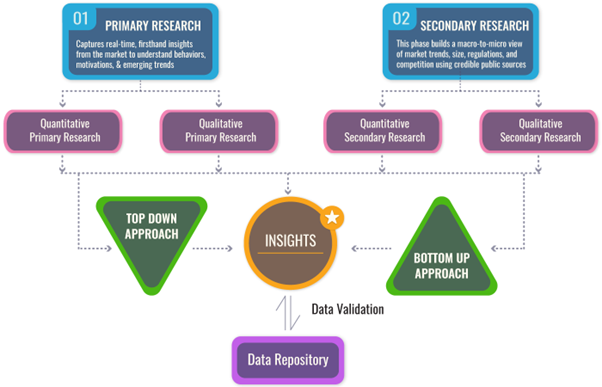
We follow a comprehensive, multi-phase research framework designed to deliver accurate, strategic, and decision-ready intelligence. Our process integrates primary and secondary research , both quantitative and qualitative , along with dual modeling techniques ( top-down and bottom-up) and a final layer of validation through our proprietary in-house repository.
PRIMARY RESEARCH
Primary research captures real-time, firsthand insights from the market to understand behaviors, motivations, and emerging trends.
1. Quantitative Primary Research
Objective: Generate statistically significant data directly from market participants.
Approaches:- Structured surveys with customers, distributors, and field agents
- Mobile-based data collection for point-of-sale audits and usage behavior
- Phone-based interviews (CATI) for market sizing and product feedback
- Online polling around industry events and digital campaigns
- Purchase frequency by customer type
- Channel performance across geographies
- Feature demand by application or demographic
2. Qualitative Primary Research
Objective: Explore decision-making drivers, pain points, and market readiness.
Approaches:- In-depth interviews (IDIs) with executives, product managers, and key decision-makers
- Focus groups among end users and early adopters
- Site visits and observational research for consumer products
- Informal field-level discussions for regional and cultural nuances
SECONDARY RESEARCH
This phase helps establish a macro-to-micro understanding of market trends, size, regulation, and competitive dynamics, sourced from credible and public domain information.
1. Quantitative Secondary Research
Objective: Model market value and segment-level forecasts based on published data.
Sources include:- Financial reports and investor summaries
- Government trade data, customs records, and regulatory statistics
- Industry association publications and economic databases
- Channel performance and pricing data from marketplace listings
- Revenue splits, pricing trends, and CAGR estimates
- Supply-side capacity and volume tracking
- Investment analysis and funding benchmarks
2. Qualitative Secondary Research
Objective: Capture strategic direction, innovation signals, and behavioral trends.
Sources include:- Company announcements, roadmaps, and product pipelines
- Publicly available whitepapers, conference abstracts, and academic research
- Regulatory body publications and policy briefs
- Social and media sentiment scanning for early-stage shifts
- Strategic shifts in market positioning
- Unmet needs and white spaces
- Regulatory triggers and compliance impact
DUAL MODELING: TOP-DOWN + BOTTOM-UP
To ensure robust market estimation, we apply two complementary sizing approaches:
Top-Down Modeling:- Start with broader industry value (e.g., global or regional TAM)
- Apply filters by segment, geography, end-user, or use case
- Adjust with primary insights and validation benchmarks
- Ideal for investor-grade market scans and opportunity mapping
- Aggregate from the ground up using sales volumes, pricing, and unit economics
- Use internal modeling templates aligned with stakeholder data
- Incorporate distributor-level or region-specific inputs
- Most accurate for emerging segments and granular sub-markets
DATA VALIDATION: IN-HOUSE REPOSITORY
We close the loop with proprietary data intelligence built from ongoing projects, industry monitoring, and historical benchmarking. This repository includes:
- Multi-sector market and pricing models
- Key trendlines from past interviews and forecasts
- Benchmarked adoption rates, churn patterns, and ROI indicators
- Industry-specific deviation flags and cross-check logic
- Catches inconsistencies early
- Aligns projections across studies
- Enables consistent, high-trust deliverables