

China Bone Health Supplements Market Size and Forecast (2026–2034), Regional Growth, Trend, Share and Industry Analysis Report Coverage: By Ingredient Type (Calcium-Based Supplements, Magnesium-Based Supplements, Vitamin D-Based Supplements, and Others); By Dosage Form (Tablets, Capsules and Softgels, Powders, and Others); By Consumer Group (Infants and Children, 18–49 Years, 50–64 Years, and 65 Years and Above); By Distribution Channel (Pharmacies and Drugstores, Online Retail, Supermarkets and Hypermarkets, and Others)
2026-11-19
Healthcare
Swetal (Research Analyst)
Description
China Bone Health Supplements Market Overview
The China bone health supplements market is projected to expand from USD 1.35 billion in 2026 to USD 2.58 billion by 2034, registering a CAGR of 8.9% during 2026–2034. The market for bone health supplements in China is steadily growing owing to factors such as an ageing population, growing prevalence of osteoporosis and other bone ailments, and greater interest in preventive health care and nutrition supplementation. The market drivers include consumption of calcium supplements, which may be in the form of calcium carbonate, calcium citrate, and calcium with vitamin D3. Formulations that combine vitamin K2 and magnesium in addition to calcium have become popular for their comprehensive effects on bone health. Demand for the product is diversifying into various target markets, including children who require bone health support, middle-aged individuals concerned about preventive care of bones, and older adults who wish to maintain their bone health and mobility. This includes development of new product forms and formulations by manufacturers for functional purposes, as well as products suited for consumers of various age groups in tablet form, capsule, powder, liquid, and chewable forms.

China Bone Health Supplements Market Growth Drivers
Rising Prevalence of Osteoporosis and Age-Related Bone Disorders
With the rapid aging of the population, the burden of osteoporosis and other bone diseases related to aging in China is rising, thus creating a larger consumer base for bone health supplements. According to research carried out in September 2026 and published in Medical Science Monitor, 2,533 community-dwelling older adults in Hangzhou had an osteoporosis prevalence of 32.8%, with a notably high rate among women (48.3%) compared to men (15.2%). There was also a progressive increase in osteoporosis prevalence with age, reaching 45.7% among individuals aged 80 years and above. All these factors indicate the increasing demand for bone density management, especially among older women and ageing consumers. In addition, according to an October 2026 Abbott article, which references the International Osteoporosis Foundation, there is an increasing risk of hip fractures in China due to the aging population. This further explains the broader public health implications of bone loss. Therefore, increasing awareness of osteoporosis prevention, calcium intake, and vitamin D supplementation is driving the demand for calcium supplements and multivitamin formulations that contain vitamin D3, vitamin K2, and magnesium.
Increasing Awareness of Calcium and Vitamin D Deficiency
Increasing awareness about the insufficient levels of vitamin D and nutrition is contributing towards demand for bone health supplements in China. One multicentric cross-sectional study published in the journal of Nutrition, Metabolism and Cardiovascular Diseases (2026) found that 29.89% of the population suffered from vitamin D deficiency. There were high prevalence rates of vitamin D deficiency among women (39.95%), urban population (39.44%) and people under 40 years (33.46%). It indicates that vitamin D deficiency occurs among the general population and not only the older one. Moreover, there were considerable geographical differences, because more cases of deficiency occurred in northern China than in southern ones. These facts show the need for greater awareness and appropriate measures that should be taken in order to solve the problem of vitamin D deficiency among particular population groups. As a result, rising concerns about calcium absorption and bone health will increase the demand for calcium supplements together with vitamin D3, as well as for multivitamins that contain magnesium and vitamin K2.
China Bone Health Supplements Market Restraint
Risk of Excessive Supplementation and Consumer Concerns Regarding Product Efficacy
Overconsumption of calcium and vitamin D, side effects, and the uncertain efficacy of supplements can be some factors that can hinder the development of the bone health supplements market in China. As per the 2026 Chinese Guideline on Risk Management of Osteoporosis in the General Public, calcium and vitamin D supplementation should only be considered for people with low dietary intake or vitamin D deficiency, and not for people getting enough amount through their diet. Higher vitamin D dose than the recommended dose does not provide any additional benefit to bones. High calcium intake can cause kidney stones and heart problems, and some types of calcium supplements can cause stomach problems and constipation. Meanwhile, China’s State Administration for Market Regulation has raised concerns over the use of misleading health claims and promotion of products as well as the marketing of health foods as remedies for ailments. These factors could reduce consumer confidence in the supplements as well as lead to careful purchases of the supplements. As a result, the risks surrounding the safety, proper dosages and scientific efficacy of the benefits of the supplements could reduce the likelihood of repeat purchases.
China Bone Health Supplements Market Opportunities
Development of Multi-Ingredient Bone Health Formulations
The increased desire to offer comprehensive solutions in terms of bone health opens up new opportunities for manufacturers in China as far as offering bone health solutions that are not based solely on single ingredient calcium supplementation but rather are multi-ingredient solutions containing calcium, vitamin D3, vitamin K2 and magnesium. The different nutrients provide for the different needs for nutrition associated with calcium absorption, bone mineralization and bone structure maintenance which offers possibilities for manufacturing differentiated solutions to meet the varying needs of the consumers. As per the findings from Moojing Market Intelligence analysis of China's online supplement market, the category of calcium with vitamin D3 continued to remain one of the major ones in the first half of 2026, and the category of calcium with vitamin D3 and K2 continued to experience notable growth, indicating the growing interests in combination solutions among consumers. There are also new possibilities related to age-based solutions for postmenopausal women, elderly people, children, and young people who want to get preventative bone health solutions. This gives domestic manufacturers the chance to differentiate their products through formulation, better nutrient bioavailability, stable combinations and convenient forms such as liquid calcium, chewable and gummies.
Age-Specific and Gender-Specific Product Development
The increasing need for differentiated bone health supplements based on age and gender is providing an opportunity for manufacturers to come up with customized formulations of bone health supplements instead of conventional calcium-based products. The Bone Health White Paper of 2026 published by Tmall Health indicated that the needs of children and teenagers are mainly because of bone growth and development, whereas pregnant and nursing women require nutrients due to changes in their calcium requirements. Adults are increasingly showing their interest in preventative bone health supplements, whereas elderly people especially women after menopause are more interested in retaining their bone density and joint movement. Additionally, opportunities are also emerging for the combined formulations of bone health supplements with calcium with Vitamin D3 and K2, and calcium with glucosamine supplements. These increasing needs are prompting the manufacturers to develop age and gender-specific products by differentiating their formulations.
China Bone Health Supplements Market Scope
China Bone Health Supplements Market Report Segmentation Analysis
Calcium-Based Supplements Segment Is Expected to Dominate the China Bone Health Supplements Market During the Forecast Period
Calcium-based supplements will continue to dominate the bone health supplements market in China on account of the critical role played by calcium in bone development, bone mineralization and the development of skeletal strength. Rising worries about calcium deficiency in the diet, bone density reduction with age and osteoporosis have led to the increased uptake of supplements among children, adults, post-menopausal women and elderly people. Calcium continues to be an extensively known and accepted ingredient in bone health prevention, hence continuous consumer demand and repeat purchases. Rising awareness about the importance of maintaining sufficient intake of calcium, together with advice from medical experts to people who lack sufficient intake of calcium in the diet, will drive segment adoption. Availability of various sources of calcium, such as calcium carbonate, calcium citrate and calcium phosphate, will cater to various nutritional needs and preferences of consumers. Additionally, demand will be driven by the widespread availability of calcium supplements in pharmacies, supermarkets and online retailers. Preference for easy dosage forms and formulations that combine calcium with other nutrients will drive product innovation and the segment's dominance in the market during the forecast period.

Tablets Segment Is Expected to Dominate the China Bone Health Supplements Market During the Forecast Period
Tablet products are projected to continue to remain at the top of China's bone health supplements market driven by their convenience, precision of delivery, increased shelf life and economic production process, as compared with several other forms of dose. Bone health products in the form of tabs are manufactured in conventional and chewable forms. Calcium, vitamin D3 and mineral supplements are common in tab forms; therefore, it is considered as the ideal choice of consumers for regular consumption irrespective of the fact that the age groups are children, adult or elderly people. Tablets also present producers with opportunities in developing single and multi-ingredient products ranging from calcium-vitamin D3 combinations to calcium-vitamin K2 and magnesium. The existence of an existing production base, standard production process, packability of tablets and their suitability for bulk distribution channels such as pharmacy and online make it a strong player. While consumers prefer liquid calcium, gummies and powders because of their convenience and taste, the established preference of tablets for regular use along with its economic price structure will help retain its demand.
65 Years and Above Segment Is Expected to Dominate the China Bone Health Supplements Market During the Forecast Period
The population that is 65 years old and over is predicted to hold the largest market share in China's bone health supplements market owing to the high prevalence of osteoporosis, reduction in bone mineral density, and decline in the health of the skeleton due to aging. Aging leads to reduced calcium absorption, changes in bone metabolism, and increased vulnerability to bone fractures, making it increasingly necessary for consumers to use supplements regularly. Growing knowledge about osteoporosis prevention, healthy aging, and the necessity to maintain bone strength is making elderly consumers include calcium, vitamin D, and other minerals in their diets. Increasing requirements for bone health management and emphasis on mobility and fracture prevention is likely to drive the consumption of supplements among the elderly population. Therefore, growing demand for preventive nutrition care and age-specific bone health products will contribute to the dominance of this segment in the coming years.
Pharmacies and Drugstores Segment Is Expected to Dominate the China Bone Health Supplements Market During the Forecast Period
Pharmacies and drugstores will remain the key distributors of bone health supplement products in China due to consumer preferences for purchasing bone health supplements from trustworthy sources, together with professional advice on product choice provided by the retailer. Consumers, especially the older population and patients diagnosed with osteoporosis and calcium deficiencies, prefer pharmacies as there is easier access to pharmacists who can give professional advice on choosing such supplements. Also, the availability of different supplement forms, existing brands, and the possibility to get consultations concerning the ingredients and appropriate doses make this channel even more popular for consumers. As preventive healthcare becomes more known, the number of people preferring to purchase supplements for improving their bones increases. Therefore, the dominance of this channel in the distribution of bone health supplements is expected to be maintained throughout the forecast period.
The following segments are part of an in-depth analysis of the China Bone Health Supplements Market:
China Bone Health Supplements Market Competition Landscape Analysis
China bone health supplements market consists of fragmented competition within the existing players' domestic bone health supplements, pharmaceutical companies, and specialized OEM/ODM companies. BYHEALTH leads with dominant market shares attributed to its strong brand reputation, product range, and extensive distribution network while other players such as Qingdao Double Whale Pharmaceutical Co. Ltd and Weihai Ziguang Technology Development Co. Ltd supply bone health supplements using the two ingredients of calcium and Vitamin D3. Competition within the market environment will be categorized depending on specialized product range, production capability, and price advantage. Competition within the market industry is leaning towards multi-ingredient products, age-based products, different dosage products, and products quality and compliance.
China Bone Health Supplements Market Recent Developments News:
In January 2026, China's State Administration for Market Regulation (SAMR) approved a new health-function claim, "helps maintain bone and joint health," for health food products, effective January 1, 2026. The approved framework also permits secondary claims related to alleviating joint pain or stiffness and reducing joint cartilage damage, subject to regulatory approval and supporting efficacy evidence from human or animal studies. Previously, products making these claims were largely restricted to cross-border e-commerce channels rather than the domestic Chinese health-food market. The regulatory development creates opportunities for domestic and international supplement manufacturers to introduce approved bone and joint health formulations through China's domestic market, expand product portfolios and develop differentiated products targeting healthy ageing and preventive bone-health management.
The China Bone Health Supplements Market is dominated by a few large companies, such as
BYHEALTH Co., Ltd.
Weihai Ziguang Technology Development Co., Ltd.
Qingdao Double Whale Pharmaceutical Co., Ltd.
Weihai Zijian Biotechnology Development Co., Ltd.
Shandong Keju Pharmaceutical Co., Ltd.
Haodi (Shandong) Biotechnology Co., Ltd.
Weihai Huaxi Biomedical Co., Ltd.
Shandong Shengjie Pharmaceutical Co., Ltd.
Shandong Meizhijian Pharmaceutical Technology Co., Ltd.
Qingdao Haisisheng Health Technology Co., Ltd
Dongying Zuoning Biotechnology Co., Ltd.
Shandong Shangpin Shijia Health Industry Co., Ltd.
Shandong Yan Zhuque Biotechnology Co., Ltd.
Shandong Yangyibei Pharmaceutical Technology Co., Ltd.
Weihai Baihe Biotechnology Co., Ltd.
Shandong Zhongshun Biotechnology Co., Ltd.
Xinjiang Huashidan Pharmaceutical Co., Ltd.
Xinjiang Huashengyuan Pharmaceutical Technology Co., Ltd.
Xinjiang Hongfan Biotechnology Co., Ltd.
Shandong Shoucheng Biotechnology Co., Ltd.
Other Prominent Players
Frequently Asked Questions
Swetal (Research Analyst)
Swetal is a Research Analyst with 4+ years of experience specializing in healthcare market research, medical devices, healthcare IT, and medical technology industry analysis. Her expertise includes competitive intelligence, secondary research, market trend forecasting, and healthcare business insights across global healthcare ecosystems.
She contributes to advanced market research reports by analyzing regulatory frameworks, emerging healthcare technologies, competitive landscapes, and innovation trends shaping the medical industry. With a strong focus on accurate market intelligence, strategic insights, and healthcare industry trends, Swetal supports businesses in making informed, data-backed decisions in a rapidly transforming healthcare environment.
China Bone Health Supplements Market Introduction and Market Overview
Objectives of the Study
Market Segmentation
Ingredient Type of the China Bone Health Supplements Market
Dosage Form of the China Bone Health Supplements Market
Consumer Group of the China Bone Health Supplements Market
Distribution Channel of China Bone Health Supplements Market
Competition Coverage List of Market Participants
Market Definition: Bone Health Supplements Market
Executive Summary
China Bone Health Supplements Market Estimation & Forecast
China Bone Health Supplements Market Size (US$ Million) Estimates & Historical Trend Analysis (2021 - 2025)
China Bone Health Supplements Overall Market Size (US$ Million), Growth Rate (Y-o-Y), Market CAGR (%), Market Forecast (2026 - 2034)
Snapshot of China Bone Health Supplements Market
China Bone Health Supplements Market Revenue Share (%) 2025
Key Competitors & Key Insights
Market Overview (Qualitative Analysis)
Demand Side Trends
Supply Side Trends / Manufacturing Trends
Demand and Opportunity Assessment, 2026 - 2034
Market Dynamics
Drivers
Limitations
Opportunities
Impact Analysis of Drivers and Restraints
Key Developments
Regulatory Landscape
Pricing Analysis
Supply Chain Analysis
Porter’s Five Forces Analysis
Bargaining Power of Suppliers
Bargaining Power of Buyers
Threat of Substitutes
Threat of New Entrants
Competitive Rivalry
PEST Analysis
Political Factors
Economic Factors
Social Factors
Technology Factors
China Bone Health Supplements Market Estimates & Forecast Trend Analysis, by Ingredient Type
China Bone Health Supplements Market Assessments & Key Findings, by Ingredient Type
China Bone Health Supplements Market Revenue (US$ Million) Estimates and Forecasts, by Ingredient Type, 2021 - 2034
Calcium-Based Supplements
Magnesium-Based Supplements
Vitamin D-Based Supplements
Others
China Bone Health Supplements Market Estimates & Forecast Trend Analysis, by Dosage Form
China Bone Health Supplements Market Assessments & Key Findings, by Dosage Form
China Bone Health Supplements Market Revenue (US$ Million) Estimates and Forecasts, by Dosage Form, 2021 - 2034
Tablets
Capsules and Softgels
Powders
Others
China Bone Health Supplements Market Estimates & Forecast Trend Analysis, by Consumer Group
China Bone Health Supplements Market Assessments & Key Findings, by Consumer Group
China Bone Health Supplements Market Revenue (US$ Million) Estimates and Forecasts, by Consumer Group, 2021 - 2034
Infants and Children
18–49 Years
50–64 Years
65 Years and Above
China Bone Health Supplements Market Estimates & Forecast Trend Analysis, by Distribution Channel
China Bone Health Supplements Market Assessments & Key Findings, by Distribution Channel
China Bone Health Supplements Market Revenue (US$ Million) Estimates and Forecasts, by Distribution Channel, 2021 - 2034
Pharmacies and Drugstores
Online Retail
Supermarkets and Hypermarkets
Others
Competition Landscape
China Bone Health Supplements Market Product Mapping
China Bone Health Supplements Market Concentration Analysis, by Leading Players / Innovators / Emerging Players / New Entrants
China Bone Health Supplements Market Tier Structure Analysis
China Bone Health Supplements Market Concentration & Company Market Shares (%) Analysis, 2025
Company Profiles
BYHEALTH Co., Ltd.
Company Overview & Key Stats
Financial Performance & KPIs
Product Portfolio
SWOT Analysis
Business Strategy & Recent Developments
* Similar details would be provided for all the players mentioned below
Qingdao Double Whale Pharmaceutical Co., Ltd.
Weihai Ziguang Technology Development Co., Ltd.
Weihai Zijian Biotechnology Development Co., Ltd.
Shandong Keju Pharmaceutical Co., Ltd.
Weihai Huaxi Biomedical Co., Ltd.
Haodi (Shandong) Biotechnology Co., Ltd.
Shandong Shengjie Pharmaceutical Co., Ltd.
Qingdao Haisisheng Health Technology Co., Ltd.
Shandong Meizhijian Pharmaceutical Technology Co., Ltd.
Dongying Zuoning Biotechnology Co., Ltd.
Shandong Yan Zhuque Biotechnology Co., Ltd.
Shandong Shangpin Shijia Health Industry Co., Ltd.
Shandong Yangyibei Pharmaceutical Technology Co., Ltd.
Shandong Zhongshun Biotechnology Co., Ltd.
Weihai Baihe Biotechnology Co., Ltd.
Xinjiang Huashidan Pharmaceutical Co., Ltd.
Xinjiang Hongfan Biotechnology Co., Ltd.
Xinjiang Huashengyuan Pharmaceutical Technology Co., Ltd.
Shandong Shoucheng Biotechnology Co., Ltd.
Other Prominent Players
Research Findings & Conclusion
Assumptions & Acronyms Used
Research Methodology
External Transportation / Databases
Internal Proprietary Database
Primary Research
Secondary Research
Assumptions
Limitations
Report FAQs
Our Research Methodology
"Insight without rigor is just noise."
We follow a comprehensive, multi-phase research framework designed to deliver accurate, strategic, and decision-ready intelligence. Our process integrates primary and secondary research , both quantitative and qualitative , along with dual modeling techniques ( top-down and bottom-up) and a final layer of validation through our proprietary in-house repository.
PRIMARY RESEARCH
Primary research captures real-time, firsthand insights from the market to understand behaviors, motivations, and emerging trends.
1. Quantitative Primary Research
Objective: Generate statistically significant data directly from market participants.
Approaches:- Structured surveys with customers, distributors, and field agents
- Mobile-based data collection for point-of-sale audits and usage behavior
- Phone-based interviews (CATI) for market sizing and product feedback
- Online polling around industry events and digital campaigns
- Purchase frequency by customer type
- Channel performance across geographies
- Feature demand by application or demographic
2. Qualitative Primary Research
Objective: Explore decision-making drivers, pain points, and market readiness.
Approaches:- In-depth interviews (IDIs) with executives, product managers, and key decision-makers
- Focus groups among end users and early adopters
- Site visits and observational research for consumer products
- Informal field-level discussions for regional and cultural nuances
SECONDARY RESEARCH
This phase helps establish a macro-to-micro understanding of market trends, size, regulation, and competitive dynamics, sourced from credible and public domain information.
1. Quantitative Secondary Research
Objective: Model market value and segment-level forecasts based on published data.
Sources include:- Financial reports and investor summaries
- Government trade data, customs records, and regulatory statistics
- Industry association publications and economic databases
- Channel performance and pricing data from marketplace listings
- Revenue splits, pricing trends, and CAGR estimates
- Supply-side capacity and volume tracking
- Investment analysis and funding benchmarks
2. Qualitative Secondary Research
Objective: Capture strategic direction, innovation signals, and behavioral trends.
Sources include:- Company announcements, roadmaps, and product pipelines
- Publicly available whitepapers, conference abstracts, and academic research
- Regulatory body publications and policy briefs
- Social and media sentiment scanning for early-stage shifts
- Strategic shifts in market positioning
- Unmet needs and white spaces
- Regulatory triggers and compliance impact
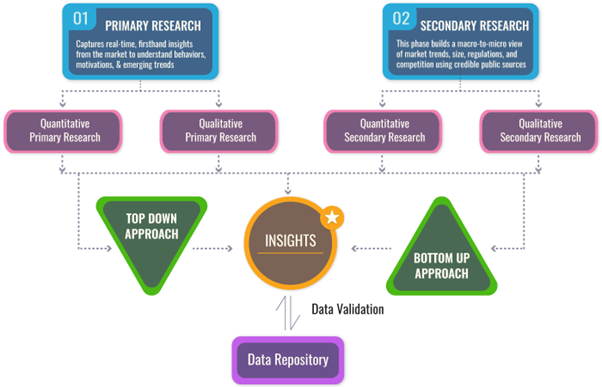
DUAL MODELING: TOP-DOWN + BOTTOM-UP
To ensure robust market estimation, we apply two complementary sizing approaches:
Top-Down Modeling:- Start with broader industry value (e.g., global or regional TAM)
- Apply filters by segment, geography, end-user, or use case
- Adjust with primary insights and validation benchmarks
- Ideal for investor-grade market scans and opportunity mapping
- Aggregate from the ground up using sales volumes, pricing, and unit economics
- Use internal modeling templates aligned with stakeholder data
- Incorporate distributor-level or region-specific inputs
- Most accurate for emerging segments and granular sub-markets
DATA VALIDATION: IN-HOUSE REPOSITORY
We close the loop with proprietary data intelligence built from ongoing projects, industry monitoring, and historical benchmarking. This repository includes:
- Multi-sector market and pricing models
- Key trendlines from past interviews and forecasts
- Benchmarked adoption rates, churn patterns, and ROI indicators
- Industry-specific deviation flags and cross-check logic
- Catches inconsistencies early
- Aligns projections across studies
- Enables consistent, high-trust deliverables