

Computer on Module Market Size and Forecast (2020 - 2033), Global and Regional Growth, Trend, Share and Industry Analysis Report Coverage; Processor (ARM, X86, and PowerPC), Form Factor (Com Express, SMARC, Qseven, and ETX Module), Industry Vertical (Industrial Automation, Aerospace and Defense, Consumer Electronics, Healthcare, and Automotive), and Geography
2026-02-23
Semiconductor and Electronics
Ekta Chaurasia (Team Lead)
Description
Computer
on Module Market Overview
The global Computer
on Module Market is experiencing strong growth, driven by increasing demand for
industrial automation, edge computing, IoT integration, and AI-enabled embedded
systems. Valued at USD 1.37 billion in 2025, the market is projected to reach
USD 2.19 billion by 2033, growing at a CAGR of 6.2% during the forecast period.
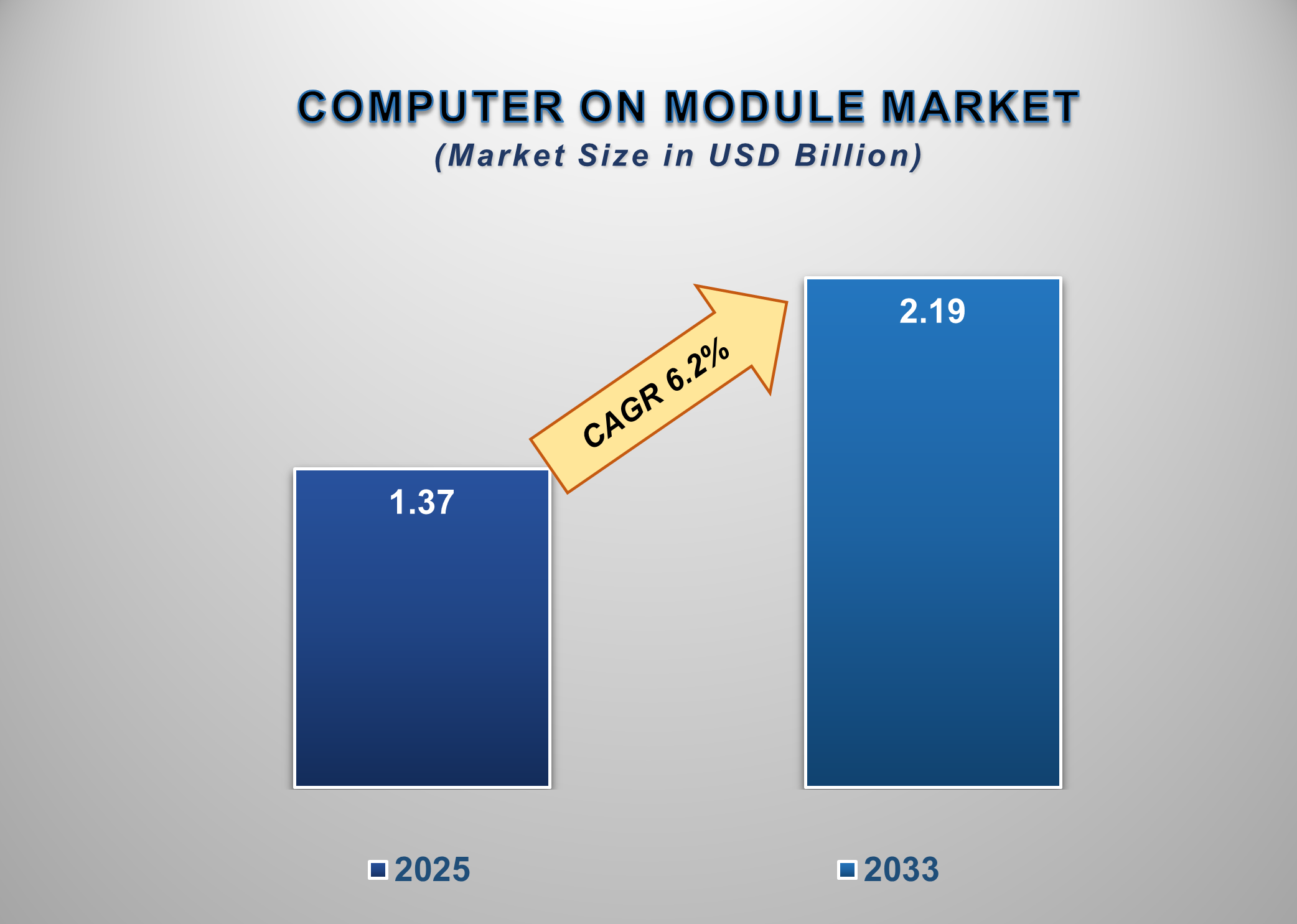
The Computer on Module market represents a
significant segment of the embedded computing industry. It focuses on compact,
pre-integrated modules that combine a processor, memory, power management, and
essential I/O interfaces on a single board. These modules are inserted into
custom carrier boards, enabling faster product development while reducing
design complexity and overall system costs. COM solutions are widely used
across industrial automation, healthcare, aerospace & defense,
transportation, telecommunications, and smart retail applications.
The increasing need for high-performance,
scalable, and energy-efficient embedded systems is propelling the market. IoT
deployments, Industry 4.0, edge computing, and AI-enabled devices are all
growing rapidly, which has raised the demand for modular computing platforms.
COMs are very appealing for long-life industrial verticals because they enable
OEMs to increase processing capabilities without completely rebuilding the
hardware architecture.
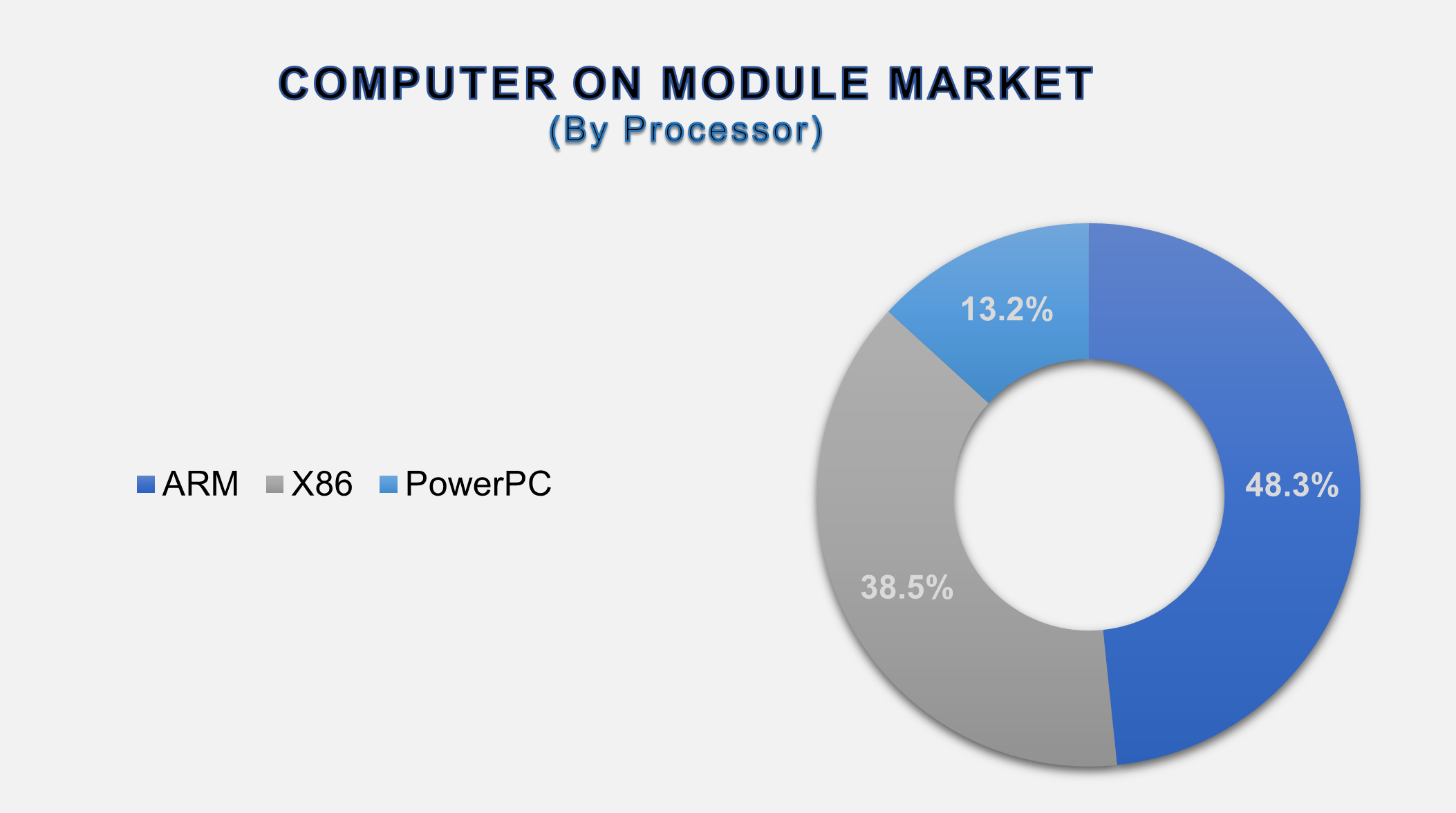
The market is dominated by ARM and x86 processors in terms of architecture.
While x86 modules are frequently utilized in industrial and automation settings
that require high performance, ARM-based modules are preferred for low-power
and Internet of Things industry verticals. COM Express, SMARC, and Qseven are
examples of standardized form factors that have improved ecosystem development
and interoperability.
North America and Europe continue to hold
dominant positions in the region because of their well-established industrial
infrastructure and early adoption of automation technologies. With the help of
growing electronics manufacturing, smart city projects, and rising industrial
automation investments, the Asia-Pacific region is growing quickly at the same
time.
Even with consistent expansion, issues
including supply chain interruptions, shortages of semiconductors, and pricing
pressures continue to be major worries. Nonetheless, additional opportunities
are anticipated as a result of developments in edge processing capabilities,
ruggedized computing, and AI acceleration. The growing need for modular,
flexible, and high-performance embedded computing solutions across a range of
industry verticals is expected to fuel the computers on modules market, which
is expected to increase steadily in the mid-single digits over the next ten
years
Computer on Module Market
Drivers and Opportunities
Rising Adoption of Industrial Automation and Industry 4.0
One of the main factors
propelling the Computer on Module (COM) market is the rapid adoption of
Industry 4.0 and industrial automation technologies. Real-time data analytics,
industrial IoT (IIoT) devices, robotics, and machine vision systems are all being
incorporated into manufacturing facilities' operations more and more. These
applications require compact, high-performance, and scalable embedded computing
platforms, which COMs effectively provide. In addition to their modular nature,
manufacturers can change CPUs or memory without completely redesigning the
system, which lowers engineering costs and downtime. Furthermore, COMs are
appropriate for demanding industrial settings because of
their robust operating characteristics and extended
product life cycles. The need for dependable, adaptable computing modules is
anticipated to increase gradually across all international industrial sectors
as manufacturers continue to move toward smart manufacturing and predictive
maintenance systems.
Growing Demand for Edge Computing and IoT Devices
The need for Computer on Modules is being
greatly increased by the growth of edge computing and IoT installations.
Localized data processing is becoming more and more necessary for businesses to
increase real-time decision-making, lower latency, and improve security. COMs
provide a small and energy-efficient platform that can handle edge connection,
sensor integration, and AI workloads. Embedded systems are growing increasingly
sophisticated and networked, from smart city infrastructure and retail kiosks
to medical imaging devices and smart transportation systems. Modules with ARM
and x86 architectures allow for scalable performance for a range of industry
verticals. The requirement for adaptable and upgradeable embedded computing
solutions will continue to fuel market expansion as companies move from
centralized cloud processing to distributed edge architectures.
Integration of AI Acceleration and
High-Performance Computing
The combination of high-performance computing
capabilities with AI acceleration presents a substantial growth opportunity in
the Computer on Module market. As autonomous systems, computer vision, and
machine learning become more prevalent, embedded devices need more computing
power. In order to handle sophisticated workloads at the device level, COM
suppliers are integrating GPUs, NPUs, and AI-enabled chipsets. This is
especially important for industry verticals like industrial robotics, smart
surveillance, medical diagnostics, and autonomous vehicles. AI-ready COM
solutions improve responsiveness and data protection by enabling real-time
analytics without a significant dependency on cloud infrastructure. Vendors
offering high-performance, AI-integrated modules are well-positioned to capture
emerging revenue opportunities as edge AI adoption expands across industries.
Computer on Module Market Scope
|
Report Attributes |
Description |
|
Market Size in
2025 |
USD 1.37
Billion |
|
Market Forecast
in 2033 |
USD 2.19
Billion |
|
CAGR % 2025-2033 |
6.2% |
|
Base Year |
2024 |
|
Historic Data |
2020-2024 |
|
Forecast Period |
2025-2033 |
|
Report USP |
Comprehensive
global Computer on Module Market size and forecast analysis, processor and
form factor assessment, industry vertical performance evaluation, regional
and country-level market dynamics, competitive landscape and market share
analysis, technological advancements in edge computing and AI integration,
digital transformation impact, growth drivers, challenges, opportunities, and
strategic insights for embedded system manufacturers, OEMs, semiconductor
providers, and industrial solution integrators |
|
Segments Covered |
●
By
Processor ●
By Form
Factor ●
By
Industry Verticals |
|
Regional Scope |
●
North
America ●
Europe ●
APAC ●
Latin
America ●
Middle
East and Africa |
|
Country Scope |
1)
U.S. 2)
Canada
3)
U.K. 4)
Germany
5)
France
6)
Italy 7)
Spain 8)
Switzerland
9)
China
10)
India
11)
Japan 12)
South
Korea 13)
Australia 14)
Mexico
15)
Brazil
16)
Argentina
17)
Saudi
Arabia 18)
UAE 19)
South
Africa |
Computer on
Module Market Report Segmentation Analysis
The global Computer
on Module Market analysis is segmented by Processor, Form Factor, Industry
Verticals, and Region.
The X86 segment
dominated the market in 2025 and is projected to grow at the highest CAGR
during the forecast period.
By Processor, the
Computer on Module Market is segmented into ARM, x86, and PowerPC. The X86
segment accounts for the largest share of the global Computer on Module Market.
The x86 architecture segment dominates the Computer on Module (COM) industry
because of its widespread use in high-performance embedded systems, industrial
automation, transportation, and medical equipment. In addition to their strong
processing power and interoperability with popular operating systems like
Windows and Linux, x86-based COMs are the preferred choice for demanding
applications that need multitasking and sophisticated graphics support. Because
of their scalability and dependability, x86 modules are frequently used in
industries that require sophisticated data processing, machine vision, and
real-time analytics. For industrial OEMs, x86 is a reliable option due to its
ecosystem maturity and long-term product availability. Despite the quick growth
of ARM-based modules, x86 still has a high demand in applications that require
compatibility with legacy systems and more processing capability.
COM Express holds
the highest share of the Form Factor Segment over the forecast period
Based on Form Factor, the market is bifurcated into COM Express, SMARC,
Qseven, and ETX modules. The compress segment accounts for the largest share of
the market. One of the most popular standardized form factors in the Computer
on Modules (COM) market is COM Express. COM Express modules are made for
high-performance embedded computing applications and were created in accordance
with the PICMG (PCI Industrial Computer Manufacturers Group) specification.
Strong x86 CPUs are usually supported by these modules, which also provide a
wide range of high-speed connections, including PCIe, SATA, USB, Ethernet, and
graphics outputs. When robust processing power and long-term dependability are
needed, COM Express is frequently utilized in industrial automation, medical
imaging, transportation systems, defense equipment, and gaming machines. OEMs
may improve CPU performance without redesigning the carrier board due to the
modular architecture, which cuts down on development time and lifecycle
expenses.
Industrial Automation
Segment will probably dominate the market during the forecast period
In terms of
Industry Vertical, the Computer on Module Market is segmented into industrial
automation, aerospace & defense, consumer electronics, healthcare, and
automotive. The industrial automation segment holds the largest share of the
Computer on Module market. One of the largest application areas in the Computer
on Modules (COM) market is industrial automation. To increase output, accuracy,
and operational efficiency, manufacturing facilities are depending more and
more on robotics, automated production lines, PLCs, and machine vision systems.
Long product life cycles and harsh operating environments are supported by
COMs, which offer small, powerful computing platforms that are simple to
integrate into industrial machinery. COMs facilitate edge-based analytics,
predictive maintenance, and real-time data processing in smart factories and
Industry 4.0 implementations. Their modular architecture lowers engineering
costs and downtime by enabling manufacturers to increase processing capacities
without completely revamping the system.
The following
segments are part of an in-depth analysis of the global Computer on Module
Market:
|
Market Segments |
|
|
By
Processor |
●
ARM ●
X86 ●
PowerPC |
|
By
Form Factor |
●
Com
Express ●
SMARC ●
Qseven ●
ETX Module |
|
By
Industry Vertical |
●
Industrial
Automation ●
Aerospace
and Defense ●
Consumer
Electronics ●
Healthcare ●
Automotive |
Computer on Module Market Share Analysis
by Region
The North America
region is projected to hold the largest share of the global Computer on Module
Market over the forecast period.
The North
America region is projected to hold the largest share of the global computer on
module market over the forecast period and is also expected to be the
fastest-growing region. The Computer on Modules (COM) market is dominated by
North America due to the region's robust industrial automation, cutting-edge
medical technologies, aerospace and defense systems, and intelligent
transportation infrastructure. Due to its early adoption of Industry 4.0
technologies and significant investment in edge computing and AI-enabled
embedded systems, the United States contributes more than any other country in
this area. COM integration throughout production facilities is being
accelerated by the growing demand for robotics systems, machine vision, and
industrial IoT applications. Leading suppliers of semiconductors and embedded
solutions are also present, which boosts local product development and
innovation. Through programs for automation and transportation modernization,
Canada also contributes. Throughout the forecast period, North America is
anticipated to sustain consistent growth due to ongoing infrastructure
improvements and technology breakthroughs.
Global
Computer on Module Market Recent Developments News:
●
In July 2025,
Congatec announced a strategic majority investment in the module business of
Kontron AG, including JUMPtec GmbH, strengthening its global portfolio and
market leadership in standardized COM offerings.
● In November 2025, Congatec introduced its first
COM-HPC Mini module powered by Qualcomm Dragonwing IQ-X Series processors for
high-performance, energy-efficient embedded and edge AI workloads.
●
In September
2024, AAEON and The Embedded Kit announced a strategic collaboration at SIDO
Lyon to simplify hardware + software integration for industrial organizations,
reflecting growing partnerships in the COM ecosystem.
The Global Computer on Module Market is dominated by a few large
companies, such as
●
AAEON
Technology Inc.
●
ADLINK
Technology Inc.
●
Advantech Co.,
Ltd.
●
Intel
Corporation
●
Texas
Instruments Inc.
●
EUROTECH
S.p.A.
●
Penguin
Solutions
●
Deutsche
Beteiligungs AG
●
Congatec GmbH
●
MSC
Technologies (Avnet)
●
APC Technology
Group Ltd
●
ARBOR
Technology Corp.
●
Argus Embedded
Systems Pvt Ltd
●
BVM Limited
●
European
Portwell Technology B.V.
●
Portwell, Inc.
●
SoMLabs
●
Toradex
Systems (India) Pvt. Ltd.
●
Variscite Ltd.
● WINSYSTEMS Inc.
Frequently Asked Questions
Ekta Chaurasia (Team Lead)
Ekta Chaurasia is a highly experienced Team Lead at M2Square Consultancy with over 7 years of expertise in market research, strategic consulting, competitive benchmarking, and business intelligence solutions. She specializes in ICT, semiconductors & electronics, automotive & transportation, and industrial machinery markets.
She leads end-to-end global research projects focused on market trends, industry analysis, growth forecasting, customer insights, and strategic decision-making. Known for her analytical leadership and industry expertise, Ekta helps businesses uncover growth opportunities, evaluate competitive landscapes, and stay ahead in rapidly evolving markets through accurate and insight-driven research.
1.
Global Computer on Module Market Introduction and Market Overview
1.1.
Objectives of the Study
1.2.
Global Computer on Module Market Scope and Market Estimation
1.2.1.Global Computer
on Module Overall Market Size (US$ Bn), Market CAGR (%), Market forecast (2025
- 2033)
1.2.2.Global Computer
on Module Market Revenue Share (%) and Growth Rate (Y-o-Y) from 2020 - 2033
1.3.
Market Segmentation
1.3.1.Processor of
Global Computer on Module Market
1.3.2.Form Factor of
Global Computer on Module Market
1.3.3.Industry
Vertical of Global Computer on Module Market
1.3.4.Region of
Global Computer on Module Market
2.
Executive
Summary
2.1.
Demand Side Trends
2.2.
Key Market Trends
2.3.
Market Demand (US$ Bn) Analysis 2020 – 2024 and Forecast, 2025 – 2033
2.4.
Demand and Opportunity Assessment
2.5.
Market Dynamics
2.5.1.Drivers
2.5.2.Limitations
2.5.3.Opportunities
2.5.4.Impact
Analysis of Drivers and Restraints
2.6.
Porter’s Five Forces Analysis
2.7.
PEST Analysis
2.8.
Key Regulation
2.9.
Key Developments
2.10. Value
Chain / Ecosystem Analysis
3.
Global
Computer on Module Market Estimates & Historical Trend Analysis (2020 - 2024)
4. Global Computer on Module Market Estimates & Forecast Trend Analysis, by Processor
4.1.
Global Computer on Module Market Revenue (US$ Bn) Estimates and
Forecasts, by Processor, 2020 - 2033
4.1.1.ARM
4.1.2.X86
4.1.3.PowerPC
5. Global Computer on Module Market Estimates & Forecast Trend Analysis, by Form Factor
5.1.
Global Computer on Module Market Revenue (US$ Bn) Estimates and
Forecasts, by Form Factor, 2020 - 2033
5.1.1.Com Express
5.1.2.SMARC
5.1.3.Qseven
5.1.4.ETX Module
6. Global Computer on Module Market Estimates & Forecast Trend Analysis, by Industry Vertical
6.1.
Global Computer on Module Market Revenue (US$ Bn) Estimates and
Forecasts, by Industry Vertical, 2020 - 2033
6.1.1.Industrial
Automation
6.1.2.Aerospace and
Defense
6.1.3.Consumer
Electronics
6.1.4.Healthcare
6.1.5.Automotive
7.
Global
Computer on Module Market Estimates & Forecast Trend Analysis, by Region
7.1.
Global Computer on Module Market Revenue (US$ Bn) Estimates and
Forecasts, by Region, 2020 - 2033
7.1.1.North America
7.1.2.Europe
7.1.3.Asia Pacific
7.1.4.Middle East
& Africa
7.1.5.Latin America
8.
North America Computer
on Module Market: Estimates &
Forecast Trend Analysis
8.1.
North America Computer on Module Market Assessments & Key
Findings
8.1.1.North America
Computer on Module Market Introduction
8.1.2.North America
Computer on Module Market Size Estimates and Forecast (US$ Billion) (2020 - 2033)
8.1.2.1. By Processor
8.1.2.2. By Form Factor
8.1.2.3. By Industry Vertical
8.1.2.4.
By Country
8.1.2.4.1.
The U.S.
8.1.2.4.2.
Canada
9.
Europe Computer
on Module Market: Estimates &
Forecast Trend Analysis
9.1.
Europe Computer on Module Market Assessments & Key Findings
9.1.1.Europe Computer
on Module Market Introduction
9.1.2.Europe Computer
on Module Market Size Estimates and Forecast (US$ Billion) (2020 - 2033)
9.1.2.1. By Processor
9.1.2.2. By Form Factor
9.1.2.3. By Industry Vertical
9.1.2.4. By
Country
9.1.2.4.1.
Germany
9.1.2.4.2.
Italy
9.1.2.4.3.
U.K.
9.1.2.4.4.
France
9.1.2.4.5.
Spain
9.1.2.4.6.
Russia
9.1.2.4.7.
Rest
of Europe
10.
Asia Pacific Computer
on Module Market: Estimates &
Forecast Trend Analysis
10.1. Asia
Pacific Computer on Module Market Assessments & Key Findings
10.1.1.
Asia Pacific Computer on Module Market Introduction
10.1.2.
Asia Pacific Computer on Module Market Size Estimates and Forecast
(US$ Billion) (2020 - 2033)
10.1.2.1. By Processor
10.1.2.2. By Form Factor
10.1.2.3. By Industry Vertical
10.1.2.4.
By Country
10.1.2.4.1.
China
10.1.2.4.2.
Japan
10.1.2.4.3.
India
10.1.2.4.4.
Australia
10.1.2.4.5.
South Korea
10.1.2.4.6. Rest
of Asia Pacific
11.
Middle East & Africa Computer on Module Market:
Estimates & Forecast Trend Analysis
11.1. Middle
East & Africa Computer on Module Market Assessments & Key Findings
11.1.1.
Middle East & Africa Computer
on Module Market Introduction
11.1.2.
Middle East & Africa Computer
on Module Market Size Estimates and Forecast (US$ Billion) (2020 - 2033)
11.1.2.1. By Processor
11.1.2.2. By Form Factor
11.1.2.3. By Industry Vertical
11.1.2.4.
By Country
11.1.2.4.1.
UAE
11.1.2.4.2.
Saudi Arabia
11.1.2.4.3.
South Africa
11.1.2.4.4. Rest of MEA
12.
Latin America Computer
on Module Market: Estimates &
Forecast Trend Analysis
12.1. Latin
America Event Industry Assessments & Key Findings
12.1.1.
Latin America Computer on Module Market Introduction
12.1.2.
Latin America Computer on Module Market Size Estimates and Forecast
(US$ Billion) (2020 - 2033)
12.1.2.1. By Processor
12.1.2.2. By Form Factor
12.1.2.3. By Industry Vertical
12.1.2.4.
By Country
12.1.2.4.1.
Brazil
12.1.2.4.2.
Mexico
12.1.2.4.3.
Argentina
12.1.2.4.4. Rest of LATAM
13.
Country Wise Market: Introduction
14. Competition
Landscape
14.1. Global
Computer on Module Market Product Mapping
14.2. Global
Computer on Module Market Concentration Analysis, by Leading Players /
Innovators / Emerging Players / New Entrants
14.3. Global
Computer on Module Market Tier Structure Analysis
14.4. Global
Computer on Module Market Concentration & Company Market Shares (%)
Analysis, 2024
15. Company
Profiles
15.1.
AAEON Technology Inc.
15.1.1.
Company Overview & Key Stats
15.1.2.
Financial Performance & KPIs
15.1.3.
Product Portfolio
15.1.4.
SWOT Analysis
15.1.5.
Business Strategy & Recent Developments
*
Similar details would be provided for all the players mentioned below
15.2.
ADLINK Technology Inc.
15.3.
Advantech Co., Ltd.
15.4.
Intel Corporation
15.5.
Texas Instruments Inc.
15.6.
EUROTECH S.p.A.
15.7.
Penguin Solutions
15.8.
Deutsche Beteiligungs AG
15.9.
Congatec GmbH
15.10.
MSC Technologies (Avnet)
15.11.
APC Technology Group Ltd
15.12.
ARBOR Technology Corp.
15.13.
Argus Embedded Systems Pvt Ltd
15.14.
BVM Limited
15.15.
European Portwell Technology B.V.
15.16.
Portwell, Inc.
15.17.
SoMLabs
15.18.
Toradex Systems (India) Pvt. Ltd.
15.19.
Variscite Ltd.
15.20.
Other Prominent Players
16.
Research
Methodology
16.1. External
Transportations / Databases
16.2. Internal
Proprietary Database
16.3. Primary
Research
16.4. Secondary
Research
16.5. Assumptions
16.6. Limitations
16.7. Report
FAQs
17.
Research
Findings & Conclusion
Our Research Methodology
"Insight without rigor is just noise."
We follow a comprehensive, multi-phase research framework designed to deliver accurate, strategic, and decision-ready intelligence. Our process integrates primary and secondary research , both quantitative and qualitative , along with dual modeling techniques ( top-down and bottom-up) and a final layer of validation through our proprietary in-house repository.
PRIMARY RESEARCH
Primary research captures real-time, firsthand insights from the market to understand behaviors, motivations, and emerging trends.
1. Quantitative Primary Research
Objective: Generate statistically significant data directly from market participants.
Approaches:- Structured surveys with customers, distributors, and field agents
- Mobile-based data collection for point-of-sale audits and usage behavior
- Phone-based interviews (CATI) for market sizing and product feedback
- Online polling around industry events and digital campaigns
- Purchase frequency by customer type
- Channel performance across geographies
- Feature demand by application or demographic
2. Qualitative Primary Research
Objective: Explore decision-making drivers, pain points, and market readiness.
Approaches:- In-depth interviews (IDIs) with executives, product managers, and key decision-makers
- Focus groups among end users and early adopters
- Site visits and observational research for consumer products
- Informal field-level discussions for regional and cultural nuances
SECONDARY RESEARCH
This phase helps establish a macro-to-micro understanding of market trends, size, regulation, and competitive dynamics, sourced from credible and public domain information.
1. Quantitative Secondary Research
Objective: Model market value and segment-level forecasts based on published data.
Sources include:- Financial reports and investor summaries
- Government trade data, customs records, and regulatory statistics
- Industry association publications and economic databases
- Channel performance and pricing data from marketplace listings
- Revenue splits, pricing trends, and CAGR estimates
- Supply-side capacity and volume tracking
- Investment analysis and funding benchmarks
2. Qualitative Secondary Research
Objective: Capture strategic direction, innovation signals, and behavioral trends.
Sources include:- Company announcements, roadmaps, and product pipelines
- Publicly available whitepapers, conference abstracts, and academic research
- Regulatory body publications and policy briefs
- Social and media sentiment scanning for early-stage shifts
- Strategic shifts in market positioning
- Unmet needs and white spaces
- Regulatory triggers and compliance impact
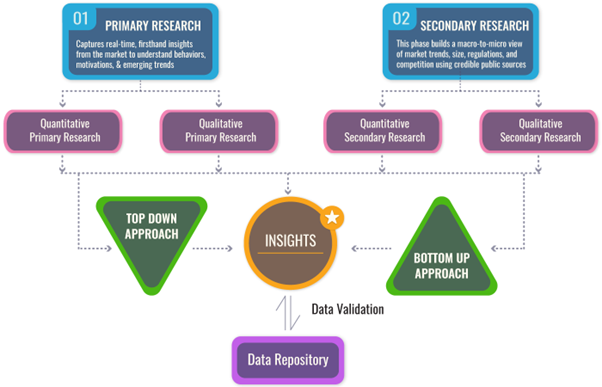
DUAL MODELING: TOP-DOWN + BOTTOM-UP
To ensure robust market estimation, we apply two complementary sizing approaches:
Top-Down Modeling:- Start with broader industry value (e.g., global or regional TAM)
- Apply filters by segment, geography, end-user, or use case
- Adjust with primary insights and validation benchmarks
- Ideal for investor-grade market scans and opportunity mapping
- Aggregate from the ground up using sales volumes, pricing, and unit economics
- Use internal modeling templates aligned with stakeholder data
- Incorporate distributor-level or region-specific inputs
- Most accurate for emerging segments and granular sub-markets
DATA VALIDATION: IN-HOUSE REPOSITORY
We close the loop with proprietary data intelligence built from ongoing projects, industry monitoring, and historical benchmarking. This repository includes:
- Multi-sector market and pricing models
- Key trendlines from past interviews and forecasts
- Benchmarked adoption rates, churn patterns, and ROI indicators
- Industry-specific deviation flags and cross-check logic
- Catches inconsistencies early
- Aligns projections across studies
- Enables consistent, high-trust deliverables