

Connected Car Market Size and Forecast (2026 - 2034), Global and Regional Growth, Trend, Share and Industry Analysis Report Coverage; Technology (3G, 4G/LTE, and 5G), Connectivity Solutions (Integrated, Embedded, and Tethered), Service (Driver assistance, Safety, Entertainment, Well-being, Vehicle management, and Mobility management), Sales Channel (OEM and Aftermarket), and Geography
2026-07-07
Automotive & Transportation (Mobility)
Ekta Chaurasia (Team Lead)
Description
Connected
Car Market Overview
The
global connected car market is experiencing strong growth, driven by increasing
demand for advanced in-vehicle connectivity, rising adoption of smart
technologies, and the growing integration of IoT in the automotive sector. Valued
at USD 14.81 billion in 2026, the market is projected to reach USD 37.75 billion
by 2034, growing at a CAGR of 14.3% during the forecast period.
Connected cars are vehicles equipped with
internet connectivity and advanced communication technologies that enable
real-time data transmission between
the car, driver, infrastructure, and external devices are referred to as
connected cars. By combining telematics, infotainment systems, advanced driver
assistance systems (ADAS), and vehicle-to-everything (V2X) communication, this
ecosystem enhances driving experience, safety, and
convenience.
The market has been
expanding rapidly as a result of growing consumer demand for better in-car
experiences, growing smart device use, and the quick advancement of automotive
electronics. Connectivity services like navigation, predictive maintenance,
remote diagnostics, and over-the-air (OTA) software upgrades are becoming more
and more integrated by automakers. Adoption is also being accelerated by the
promotion of intelligent transportation systems and automobile safety laws by
regional governments.
Increasing focus on vehicle safety and
security is a key driver of market growth. Features like collision avoidance alerts, real-time vehicle tracking,
and emergency call systems (eCall) are made possible by connected cars and significantly reduce the risk of accidents. Additionally, the development of 5G networks
is essential for providing dependable communication, low latency, and faster
data transmission, which supports cutting-edge applications like autonomous
driving.
In addition to their robust technological infrastructure, high vehicle
penetration, and early adoption of linked technology, North America and Europe
dominate the market from a regional standpoint. In the meantime, rapid
urbanization, rising disposable income, and expanding automobile production in
nations like China, Japan, and India are making Asia-Pacific a lucrative
market.
Despite the market's
potential for expansion, concerns with data privacy, cybersecurity threats, and
high implementation are present. However, it is anticipated that ongoing
developments in IoT, cloud computing, and artificial intelligence will resolve
these problems and open up new business prospects. As a result, the market for
connected cars is expected to grow significantly due to technical advancements,
changing consumer demands, and the automotive sector's move toward digitization
and mobility-as-a-service.
Connected Car Market Drivers and Opportunities
Rising Demand for Enhanced In-Car
Connectivity and User Experience
The need for sophisticated in-car networking services
is being driven by consumers' growing expectation that their cars would serve
as extensions of their digital lives. Convenience and customization are greatly
increased by modern connected cars' smooth connection with smartphones, voice
assistants, navigation systems, and entertainment platforms. Rather than being
high-end add-ons, features like infotainment services, remote car access, and
real-time traffic information are now considered standard. Additionally,
automakers are being encouraged to make significant investments in connection
solutions by the increasing use of digital ecosystems and subscription-based
services in automobiles. One of the main factors driving the global expansion
of the connected car industry is the shift in consumer preferences toward
smarter, more engaging driving experiences.
Increasing Focus on Vehicle Safety
and Government Regulations
The adoption of
connected car technology is being further accelerated by governments and regulatory
agencies around the world requiring the incorporation of cutting-edge safety
measures in automobiles. Connectivity is essential to the operation of systems
like collision detection, real-time diagnostics, vehicle tracking, and
emergency call (eCall). In addition to improving passenger safety, these
technologies aid in lowering traffic fatalities and accidents.
Vehicle-to-vehicle (V2V) and vehicle-to-infrastructure (V2I) communication is
also becoming more and more necessary due to initiatives supporting smart city
development and intelligent transportation systems. As a result, automakers are
using connected solutions to enhance safety standards and adhere to laws, which
is a crucial factor in the market's growth.
Expansion of 5G and
Vehicle-to-Everything (V2X) Communication
By facilitating
quicker, more dependable, and low-latency communication, the deployment of 5G
networks offers a substantial opportunity for the connected car sector. The
development of vehicle-to-everything (V2X) technologies, which enable real-time
communication between automobiles, infrastructure, pedestrians, and networks,
is aided by this progress. The development of autonomous driving, traffic
control, and improved road safety depend on such capabilities. Furthermore,
real-time video streaming, cloud-based services, and over-the-air upgrades are
among the high-bandwidth applications that 5G enables. Automakers and
technology companies can use these skills to launch cutting-edge services,
generating new revenue streams and revolutionizing the future of mobility as
telecom infrastructure continues to grow globally.
Connected Car Market Scope
|
Report Attributes |
Description |
|
Market Size in 2026 |
USD 14.81 Billion |
|
Market Forecast in 2034 |
USD 37.75 Billion |
|
CAGR % 2026-2034 |
14.3% |
|
Base Year |
2024 |
|
Historic Data |
2021-2025 |
|
Forecast Period |
2026-2034 |
|
Report USP |
Comprehensive
global connected car market size and forecast analysis with detailed
segmentation by Technology, Connectivity Solutions, Service, Sales Channel,
and geography. The report provides in-depth insights into market share,
competitive landscape, and strategic positioning of key players. It includes
a detailed analysis of growth drivers, challenges, and emerging opportunities
influencing market expansion. The study evaluates technological advancements
in telematics, advanced driver assistance systems (ADAS),
vehicle-to-everything (V2X) communication, and over-the-air (OTA) updates,
along with evolving consumer demand for enhanced in-vehicle connectivity and
digital experiences. Additionally, the report offers regional and
country-level market trends, regulatory landscape assessment, and strategic
developments such as product launches, partnerships, collaborations, and
expansions, enabling stakeholders, automotive manufacturers, technology
providers, and investors to make informed business decisions |
|
Segments Covered |
●
By Technology ●
By Connectivity
Solutions ●
By Service ●
By Sales Channel |
|
Regional Scope |
●
North America ●
Europe ●
APAC ●
Latin America ●
Middle East and Africa |
|
Country Scope |
1)
U.S. 2)
Canada 3)
U.K. 4)
Germany 5)
France 6)
Italy 7)
Spain 8)
Switzerland 9)
China 10) India 11) Japan 12) South Korea 13) Australia 14) Mexico 15) Brazil 16) Argentina 17) Saudi Arabia 18) UAE 19) South Africa |
Connected Car Market
Report Segmentation Analysis
The global connected car market
analysis is segmented by Technology, Connectivity Solutions, Service, Sales
Channel, and Region.
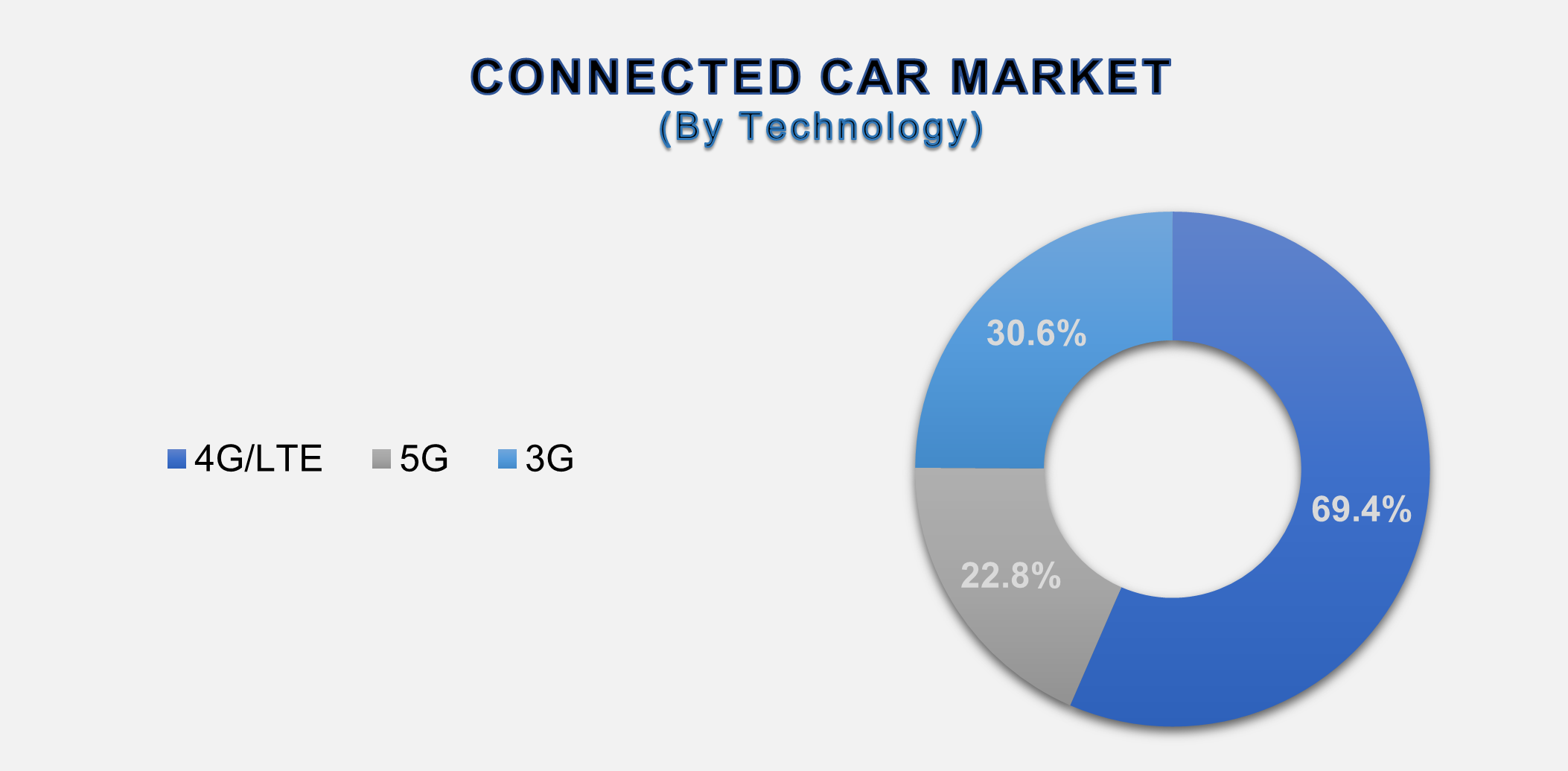
4G/LTE segment dominated
the market in 2025 and is projected to grow at the highest CAGR during the
forecast period.
By Technology, the connected car
market is segmented into 3G, 4G/LTE, and 5G. 4G/LTE dominates the connected car
market. 4G/LTE technology is essential for enabling connected car features
because it offers dependable, fast wireless communication. Real-time
navigation, remote diagnostics, infotainment streaming, and over-the-air (OTA)
updates are among the key features it provides. 4G/LTE continues to be the
foundation of contemporary connected car ecosystems due to its extensive
worldwide coverage and well-established infrastructure, guaranteeing reliable
access even in non-urban regions. LTE is used by automakers to provide
emergency support, vehicle tracking, and telematics services. Due to its
affordability, scalability, and interoperability with current technologies,
4G/LTE remains the dominant technology in the connected automobile sector,
despite the emergence of 5G.
Integrated segment holds
the highest share of the connectivity solutions segment over the forecast
period
Based on connectivity solutions, the
market is bifurcated into integrated,
embedded, and tethered. The integrated segment accounts for the largest share
of the market. The term "integrated connectivity" describes embedded
communication technologies that are included right into the car during
production, allowing for constant and easy internet access without the need for
additional equipment. To provide features like real-time navigation, remote
diagnostics, emergency services, and over-the-air (OTA) updates, these systems
usually use embedded SIM (eSIM) technology and specialized onboard modules.
Compared to tethered or smartphone-based connectivity, integrated solutions
offer greater security, dependability, and consistent performance. This
strategy is becoming more and more popular among automakers since it gives them
complete control over data, improves user experience, and supports cutting-edge
applications like telematics and vehicle-to-everything (V2X) communication,
making it a crucial market niche for connected cars.
Driver Assistance segment holds the highest share of the service
segment over the forecast period
Based on service, the market is
bifurcated into driver assistance, safety, entertainment, well-being, vehicle
management, and mobility management. The driver assistance segment accounts for
the largest share of the market. Driver assistance refers to a set of advanced
technologiesintended to decrease human error, increase vehicle safety, and improve
driving comfort. These systems, which are sometimes grouped under Advanced
Driver Assistance Systems (ADAS), use sensors, cameras, radar, and
communication elements to monitor the vehicle’s surroundings around the car and assist the driver in real time. Lane
departure warning, adaptive cruise control, automatic emergency braking,
parking assistance, and blind-spot recognition are some of the main features.
These systems can obtain real-time data due to connected automobile
connectivity, which increases their responsiveness and accuracy. Driver
assistance technologies are becoming commonplace as consumer awareness rises
and road safety laws tighten, which is crucial to the expansion of the
connected car market.
OEM segment holds the highest share of the sales
channel segment over the forecast period
Based on sales channel, the market is
bifurcated into OEM and aftermarket. The OEM segment accounts for the largest
share of the market. OEMs (Original Equipment Manufacturers) are key
players in the connected car market since they design, produce, and incorporate
connectivity technologies directly into automobiles. To provide seamless
connectivity, these businesses—which are mostly automakers—embed technology
like telematics units, infotainment platforms, and advanced driver assistance
systems (ADAS). To allow features like in-car digital services, real-time
diagnostics, and over-the-air (OTA) upgrades, OEMs work with software
developers, telecom operators, and technology providers. Better performance,
security, and user experience are guaranteed by their great control over
hardware and software integration. In an effort to create new revenue streams,
OEMs are concentrating more on digital ecosystems and subscription-based
services as competition heats up.
The following
segments are part of an in-depth analysis of the global Connected Car Market:
|
Market
Segments |
|
|
By
Technology |
● 4G/LTE ● 5G ● 3G |
|
By
Connectivity Solutions |
● Integrated ● Embedded ● Tethered |
|
By
Service |
● Driver assistance ● Safety ● Entertainment ● Well-being ● Vehicle management ● Mobility management |
|
By
Sales Channel |
● OEM ● Aftermarket |
Connected Car Market Share Analysis by Region
Europe region is projected
to hold the largest share of the global connected car market over the forecast
period.
Europe is projected to
hold the largest share of the global connected car market during the forecast
period. Strong legislative frameworks, high vehicle penetration, and early
adoption of automotive advances have made Europe a developed and
technologically advanced market for connected automobiles. The region has led
the way in enforcing car safety regulations, such as the mandatory installation
of eCall systems, which has greatly sped up the incorporation of connectivity
capabilities. Furthermore, the presence of leading
automotive manufacturers and a
solid automotive ecosystem foster ongoing innovation in advanced driving
assistance systems (ADAS), infotainment, and telematics.
Global Connected Car Market Recent Developments News:
·
In June 2024, the U.S.
Department of Transportation announced nearly USD 60 million in grants to accelerate
vehicle-to-everything (V2X) deployment, supporting connected vehicle
infrastructure and road safety initiatives.
·
In December 2024, Sonatus
expanded its connected vehicle software deployment to over 3 million vehicles
globally, highlighting the growing adoption of software-defined and OTA-enabled
platforms.
The Global Connected Car Market is dominated by a few large
companies, such as
· General Motors Company
· Ford Motor Company
· BMW AG
· Mercedes-Benz Group AG
· Toyota Motor Corporation
· Volkswagen AG
· Audi AG
· Tesla, Inc.
· Nissan Motor Corporation
· Hyundai Motor Company
· Robert Bosch GmbH
· Continental AG
· Qualcomm Technologies, Inc.
· Harman International
· Visteon Corporation
· NXP Semiconductors N.V.
· DENSO Corporation
· AT&T Inc.
· Verizon Communications Inc.
· TomTom International B.V.
Frequently Asked Questions
Ekta Chaurasia (Team Lead)
Ekta Chaurasia is a highly experienced Team Lead at M2Square Consultancy with over 7 years of expertise in market research, strategic consulting, competitive benchmarking, and business intelligence solutions. She specializes in ICT, semiconductors & electronics, automotive & transportation, and industrial machinery markets.
She leads end-to-end global research projects focused on market trends, industry analysis, growth forecasting, customer insights, and strategic decision-making. Known for her analytical leadership and industry expertise, Ekta helps businesses uncover growth opportunities, evaluate competitive landscapes, and stay ahead in rapidly evolving markets through accurate and insight-driven research.
1.
Global
Connected Car Market Introduction and Market Overview
1.1. Objectives of the Study
1.2. Market Segmentation
1.2.1.Technology of Global Connected Car Market
1.2.2.Connectivity Solutions of Global Connected Car
Market
1.2.3.Service of Global Connected Car Market
1.2.4.Sales Channel of Global Connected Car Market
1.2.5.Region of Global Connected Car Market
1.3. Competition Coverage List of
Market Participants
1.4. Market Definition: Connected Car
Market
2.
Executive Summary
2.1. Global Connected Car Market
Estimation & Forecast
2.1.1.Global Connected Car Market Size
(US$ Million) Estimates & Historical Trend Analysis (2021 - 2025)
2.1.2.Global Connected Car Overall
Market Size (US$ Million), Growth Rate (Y-o-Y), Market CAGR (%), Market
forecast (2026 - 2034)
2.2. Snapshot of Global Connected Car
Market
2.3. Global Connected Car Market
Revenue Share (%) 2025
2.4. REGIONAL OUTLINE: Revenue CAGR,
by Region
2.5. Key Competitors & Key
Insights
3.
Market Overview (Qualitative
Analysis)
3.1. Demand Side Trends
3.2. Supply Side Trends /
Manufacturing Trends
3.3. Demand and Opportunity Assessment,
2026 - 2034
3.4. Market Dynamics
3.4.1.Drivers
3.4.2.Limitations
3.4.3.Opportunities
3.4.4.Impact Analysis of Drivers and
Restraints
3.5. Key Developments
3.6. Regulatory Landscape
3.7. Value Chain / Ecosystem Analysis
3.8. Porter’s Five Forces Analysis
3.8.1.Bargaining Power of Suppliers
3.8.2.Bargaining Power of Buyers
3.8.3.Threat of Substitutes
3.8.4.Threat of New Entrants
3.8.5.Competitive Rivalry
3.9. PEST Analysis
3.9.1.Political Factors
3.9.2.Economic Factors
3.9.3.Social Factors
3.9.4.Technology Factors
4.
Global Connected Car Market
Estimates & Forecast Trend Analysis, by Technology
4.1. Global Connected Car Market
Assessments & Key Findings, by Technology
4.2. Global Connected Car Market
Revenue (US$ Million) Estimates and Forecasts, by Technology, 2021 - 2034
4.2.1.4G/LTE
4.2.2.5G
4.2.3.3G
5.
Global Connected Car Market
Estimates & Forecast Trend Analysis, by Connectivity Solutions
5.1. Global Connected Car Market
Assessments & Key Findings, by Connectivity Solutions
5.2. Global Connected Car Market
Revenue (US$ Million) Estimates and Forecasts, by Connectivity Solutions, 2021
- 2034
5.2.1.Integrated
5.2.2.Embedded
5.2.3.Tethered
6.
Global Connected Car Market
Estimates & Forecast Trend Analysis, by Service
6.1. Global Connected Car Market
Assessments & Key Findings, by Service
6.2. Global Connected Car Market
Revenue (US$ Million) Estimates and Forecasts, by Service, 2021 - 2034
6.2.1.Driver assistance
6.2.2.Safety
6.2.3.Entertainment
6.2.4.Well-being
6.2.5.Vehicle management
6.2.6.Mobility management
7.
Global Connected Car Market
Estimates & Forecast Trend Analysis, by Sales Channel
7.1. Global Connected Car Market
Assessments & Key Findings, by Sales Channel
7.2. Global Connected Car Market
Revenue (US$ Million) Estimates and Forecasts, by Sales Channel, 2021 - 2034
7.2.1.OEM
7.2.2.Aftermarket
8.
Global Connected Car Market
Estimates & Forecast Trend Analysis, by Region
8.1. Global Connected Car Market
Assessments & Key Findings, by Region
8.2. Global Connected Car Market
Revenue (US$ Million) Estimates and Forecasts, by Region, 2021 - 2034
8.2.1.North America
8.2.2.Europe
8.2.3.Asia Pacific
8.2.4.Middle East & Africa
8.2.5.Latin America
9.
North
America Connected Car Market: Estimates & Forecast Trend Analysis
9.1.
North
America Connected Car Market Assessments & Key Findings
9.1.1.North America Connected Car
Market Introduction
9.1.2.North America Connected Car
Market Size Estimates and Forecast (US$ Million) (2021 - 2034)
9.1.2.1. By Technology
9.1.2.2. By Connectivity Solutions
9.1.2.3. By Service
9.1.2.4. By Sales Channel
9.1.2.5. By Country
9.1.2.5.1. The U.S.
9.1.2.5.2. Canada
10. Europe Connected
Car Market: Estimates & Forecast
Trend Analysis
10.1. Europe Connected Car Market
Assessments & Key Findings
10.1.1. Europe Connected Car Market
Introduction
10.1.2. Europe Connected Car Market Size
Estimates and Forecast (US$ Million) (2021 - 2034)
10.1.2.1. By Technology
10.1.2.2. By Connectivity Solutions
10.1.2.3. By Service
10.1.2.4. By Sales Channel
10.1.2.5. By Country
10.1.2.5.1.
Germany
10.1.2.5.2.
Italy
10.1.2.5.3.
U.K.
10.1.2.5.4.
France
10.1.2.5.5.
Spain
10.1.2.5.6.
Switzerland
10.1.2.5.7. Rest
of Europe
11. Asia Pacific Connected
Car Market: Estimates & Forecast
Trend Analysis
11.1. Asia Pacific Market Assessments
& Key Findings
11.1.1. Asia Pacific Connected Car
Market Introduction
11.1.2. Asia Pacific Connected Car
Market Size Estimates and Forecast (US$ Million) (2021 - 2034)
11.1.2.1. By Technology
11.1.2.2. By Connectivity Solutions
11.1.2.3. By Service
11.1.2.4. By Sales Channel
11.1.2.5. By Country
11.1.2.5.1. China
11.1.2.5.2. Japan
11.1.2.5.3. India
11.1.2.5.4. Australia
11.1.2.5.5. South Korea
11.1.2.5.6. Rest of Asia Pacific
12. Middle East & Africa Connected
Car Market: Estimates & Forecast
Trend Analysis
12.1. Middle East & Africa Market
Assessments & Key Findings
12.1.1. Middle
East & Africa Connected
Car Market Introduction
12.1.2. Middle
East & Africa Connected
Car Market Size Estimates and Forecast (US$ Million) (2021 - 2034)
12.1.2.1. By Technology
12.1.2.2. By Connectivity Solutions
12.1.2.3. By Service
12.1.2.4. By Sales Channel
12.1.2.5. By Country
12.1.2.5.1. South Africa
12.1.2.5.2. UAE
12.1.2.5.3. Saudi Arabia
12.1.2.5.4. Rest of MEA
13. Latin America
Connected Car Market: Estimates &
Forecast Trend Analysis
13.1. Latin America Market Assessments
& Key Findings
13.1.1. Latin America Connected Car
Market Introduction
13.1.2. Latin America Connected Car
Market Size Estimates and Forecast (US$ Million) (2021 - 2034)
13.1.2.1. By Technology
13.1.2.2. By Connectivity Solutions
13.1.2.3. By Service
13.1.2.4. By Sales Channel
13.1.2.5. By Country
13.1.2.5.1. Brazil
13.1.2.5.2. Mexico
13.1.2.5.3. Argentina
13.1.2.5.4. Rest of LATAM
14. Competition Landscape
14.1. Global Connected Car Market Technology
Mapping
14.2. Global Connected Car Market
Concentration Analysis, by Leading Players / Innovators / Emerging Players /
New Entrants
14.3. Global Connected Car Market Tier
Structure Analysis
14.4. Global Connected Car Market
Concentration & Company Market Shares (%) Analysis, 2025
15. Company Profiles
15.1. General Motors Company
15.1.1. Company Overview & Key Stats
15.1.2. Financial Performance & KPIs
15.1.3. Product Portfolio
15.1.4. SWOT Analysis
15.1.5. Business Strategy & Recent Developments
* Similar details would be provided for all
the players mentioned below
15.2. Ford Motor Company
15.3. BMW AG
15.4. Mercedes-Benz Group AG
15.5. Toyota Motor Corporation
15.6. Volkswagen AG
15.7. Audi AG
15.8. Tesla, Inc.
15.9. Nissan Motor Corporation
15.10. Hyundai Motor Company
15.11. Robert Bosch GmbH
15.12. Continental AG
15.13. Qualcomm Technologies, Inc.
15.14. Harman International
15.15. Visteon Corporation
15.16. NXP Semiconductors N.V.
15.17. DENSO Corporation
15.18. AT&T Inc.
15.19. Verizon Communications Inc.
15.20. Other Prominent
Players
16. Research
Findings & Conclusion
17. Assumption & Acronyms Used
18. Research
Methodology
18.1. External Transportations /
Databases
18.2. Internal Proprietary Database
18.3. Primary Research
18.4. Secondary Research
18.5. Assumptions
18.6. Limitations
18.7. Report FAQs
Our Research Methodology
"Insight without rigor is just noise."
We follow a comprehensive, multi-phase research framework designed to deliver accurate, strategic, and decision-ready intelligence. Our process integrates primary and secondary research , both quantitative and qualitative , along with dual modeling techniques ( top-down and bottom-up) and a final layer of validation through our proprietary in-house repository.
PRIMARY RESEARCH
Primary research captures real-time, firsthand insights from the market to understand behaviors, motivations, and emerging trends.
1. Quantitative Primary Research
Objective: Generate statistically significant data directly from market participants.
Approaches:- Structured surveys with customers, distributors, and field agents
- Mobile-based data collection for point-of-sale audits and usage behavior
- Phone-based interviews (CATI) for market sizing and product feedback
- Online polling around industry events and digital campaigns
- Purchase frequency by customer type
- Channel performance across geographies
- Feature demand by application or demographic
2. Qualitative Primary Research
Objective: Explore decision-making drivers, pain points, and market readiness.
Approaches:- In-depth interviews (IDIs) with executives, product managers, and key decision-makers
- Focus groups among end users and early adopters
- Site visits and observational research for consumer products
- Informal field-level discussions for regional and cultural nuances
SECONDARY RESEARCH
This phase helps establish a macro-to-micro understanding of market trends, size, regulation, and competitive dynamics, sourced from credible and public domain information.
1. Quantitative Secondary Research
Objective: Model market value and segment-level forecasts based on published data.
Sources include:- Financial reports and investor summaries
- Government trade data, customs records, and regulatory statistics
- Industry association publications and economic databases
- Channel performance and pricing data from marketplace listings
- Revenue splits, pricing trends, and CAGR estimates
- Supply-side capacity and volume tracking
- Investment analysis and funding benchmarks
2. Qualitative Secondary Research
Objective: Capture strategic direction, innovation signals, and behavioral trends.
Sources include:- Company announcements, roadmaps, and product pipelines
- Publicly available whitepapers, conference abstracts, and academic research
- Regulatory body publications and policy briefs
- Social and media sentiment scanning for early-stage shifts
- Strategic shifts in market positioning
- Unmet needs and white spaces
- Regulatory triggers and compliance impact
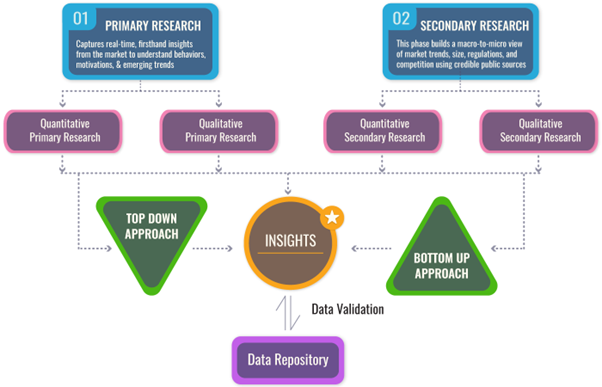
DUAL MODELING: TOP-DOWN + BOTTOM-UP
To ensure robust market estimation, we apply two complementary sizing approaches:
Top-Down Modeling:- Start with broader industry value (e.g., global or regional TAM)
- Apply filters by segment, geography, end-user, or use case
- Adjust with primary insights and validation benchmarks
- Ideal for investor-grade market scans and opportunity mapping
- Aggregate from the ground up using sales volumes, pricing, and unit economics
- Use internal modeling templates aligned with stakeholder data
- Incorporate distributor-level or region-specific inputs
- Most accurate for emerging segments and granular sub-markets
DATA VALIDATION: IN-HOUSE REPOSITORY
We close the loop with proprietary data intelligence built from ongoing projects, industry monitoring, and historical benchmarking. This repository includes:
- Multi-sector market and pricing models
- Key trendlines from past interviews and forecasts
- Benchmarked adoption rates, churn patterns, and ROI indicators
- Industry-specific deviation flags and cross-check logic
- Catches inconsistencies early
- Aligns projections across studies
- Enables consistent, high-trust deliverables