Connected Mining Market Size and Forecast (2026–2034), Global and Regional Growth, Trend, Share and Industry Analysis Report Coverage; By Component (Solutions, Services); By Technology (Internet of Things (IoT), Artificial Intelligence & Analytics, Automation Systems, Cloud Computing, Cybersecurity Solutions, Others); By Application (Fleet Management, Predictive Maintenance, Remote Operations, Worker Safety & Monitoring, Asset Tracking, Production Optimization, Others); By End User (Coal Mining, Metal Mining, Mineral Mining, Others), and Geography
2026-05-27
ICT
Ekta Chaurasia (Team Lead)
Description
Connected Mining Market Overview
The global Connected
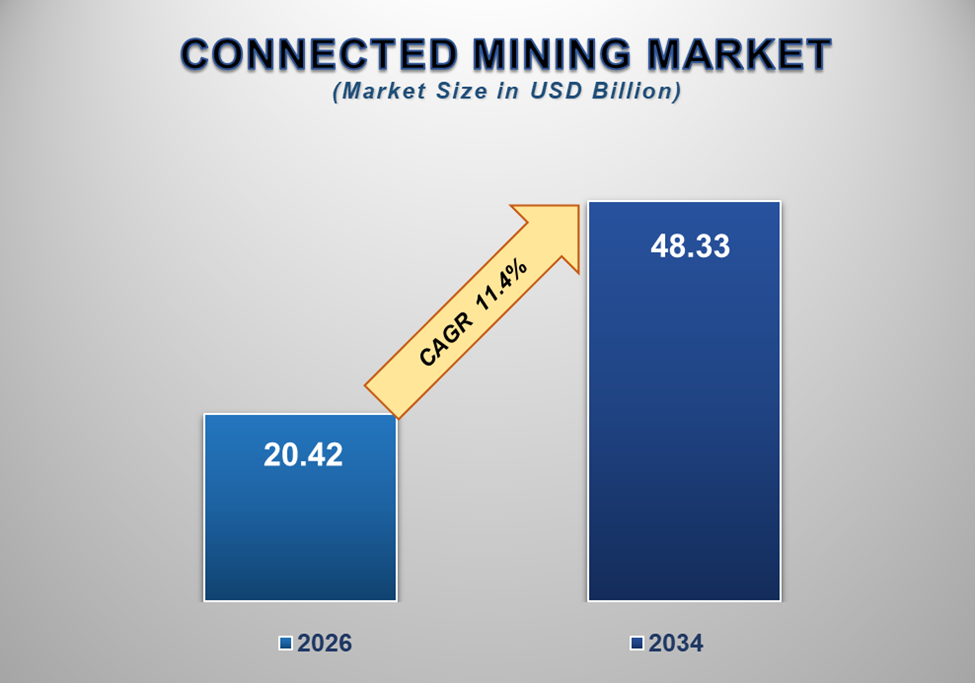
Mining market was valued at USD 20.42 billion in 2026 and is
projected to reach USD 48.33 billion by 2034, expanding at a CAGR of 11.4%
during the forecast period. The market is experiencing strong growth due to
increasing adoption of digital mining technologies, rising demand for
operational efficiency, growing focus on worker safety, and expanding
integration of IoT-enabled monitoring systems across mining operations
worldwide.
Connected mining
refers to the integration of advanced digital technologies, automation systems,
data analytics, cloud platforms, and IoT-enabled communication networks within
mining operations to improve productivity, operational visibility, safety, and
resource management. It enables real-time connectivity between mining
equipment, workers, control centers, and production systems through intelligent
digital ecosystems.
Mining companies
are increasingly transforming traditional mining operations into highly
automated and data-driven environments to improve efficiency and reduce
operational costs. Connected mining solutions provide centralized monitoring
capabilities, predictive analytics, remote asset management, and intelligent
automation that enhance overall mine productivity.
The growing
complexity of mining activities, combined with rising global demand for
minerals, metals, and energy resources, is significantly driving the adoption
of connected mining technologies. Mining operators are under increasing
pressure to maximize production output while ensuring worker safety,
environmental sustainability, and regulatory compliance.
Advanced
technologies such as artificial intelligence, machine learning, autonomous
vehicles, digital twins, edge computing, and industrial IoT are revolutionizing
modern mining operations. These technologies enable real-time data collection,
predictive maintenance, automated drilling, remote operations, and optimized
fleet management.
Additionally,
mining companies are increasingly investing in smart mining infrastructure to
reduce equipment downtime, improve fuel efficiency, optimize ore extraction
processes, and minimize workplace accidents. The integration of connected
systems also supports sustainability initiatives through energy optimization
and emissions monitoring.
As the mining
industry continues its digital transformation journey, the connected mining
market is expected to witness substantial growth through 2034.
Connected Mining Market Drivers and OpportunitiesRising Adoption of Automation and Smart Mining Technologies Is Driving Market Growth
The increasing
adoption of automation technologies across mining operations is one of the
primary drivers of the connected mining market. Mining companies are rapidly
deploying intelligent automation systems to improve productivity, minimize
manual intervention, and optimize operational performance.
Autonomous haul
trucks, robotic drilling systems, automated conveyor systems, and remotely
operated machinery are becoming increasingly common in modern mining
environments. These technologies help improve operational precision while
reducing labor-intensive activities and safety risks.
Connected mining
solutions provide centralized control and real-time monitoring capabilities
that allow operators to manage multiple mining assets simultaneously. Real-time
communication between equipment, sensors, and control centers improves
decision-making and operational efficiency.
Furthermore, increasing labor shortages and rising operational costs within the mining sector are encouraging companies to adopt automated and connected technologies to maintain profitability and long-term sustainability.
Growing Focus
on Worker Safety and Predictive Maintenance Is Fueling Market Expansion
Worker safety
remains a major concern within the mining industry due to the hazardous nature
of underground and open-pit mining operations. Connected mining technologies
significantly enhance workplace safety through continuous monitoring,
predictive analytics, and automated alert systems.
IoT-enabled
wearable devices, environmental sensors, and real-time communication platforms
help monitor worker health, equipment conditions, gas levels, temperature
fluctuations, and hazardous operational zones. These systems enable faster
emergency response and reduce accident risks.
Predictive
maintenance is another key growth driver for the connected mining market.
Mining equipment operates under extreme environmental conditions, making
machinery failures highly costly and operationally disruptive. Connected
sensors and AI-powered analytics platforms enable mining companies to monitor
equipment performance continuously and identify potential failures before
breakdowns occur.
This predictive approach helps reduce unplanned downtime, lower maintenance costs, extend equipment lifespan, and improve overall operational reliability.
Expansion of
Remote Operations and Digital Twin Technologies Presents Significant
Opportunities
The growing
adoption of remote mining operations presents substantial opportunities for the
connected mining market. Mining companies are increasingly utilizing
centralized remote operation centers to monitor and manage geographically
dispersed mining sites from a single location.
Remote
operations improve operational efficiency, reduce workforce exposure to
hazardous environments, and support better resource allocation. High-speed
communication networks, cloud computing, and edge processing technologies are
enabling seamless connectivity between mining sites and centralized control
centers.
Digital twin
technology is also emerging as a transformative opportunity within the
connected mining industry. Digital twins create virtual replicas of mining
operations, equipment, and production systems, allowing operators to simulate
processes, optimize workflows, and improve decision-making capabilities.
Additionally,
increasing investments in sustainable mining practices and environmental
monitoring are creating further opportunities for connected mining solutions.
Mining companies are increasingly utilizing digital technologies to monitor
emissions, optimize water usage, improve energy efficiency, and support
regulatory compliance initiatives.
As mining companies continue prioritizing digital transformation and operational modernization, the demand for connected mining technologies is expected to rise significantly.
Connected
Mining Market Scope
|
Report
Attributes |
Description |
|
Market Size
in 2026 |
USD
20.42 Billion |
|
Market
Forecast in 2034 |
USD 48.33 Billion |
|
CAGR %
2026-2034 |
11..4% |
|
Base Year |
2025 |
|
Historic
Data |
2021-2025 |
|
Forecast
Period |
2026-2034 |
|
Report USP |
Production,
Consumption, Company Share, Company Heatmap, Company Production, Service
Type, Growth Factors and more |
|
Segments
Covered |
∙ By Component |
|
Regional
Scope |
● North America |
|
Country
Scope |
U.S. |
Connected
Mining Market Report Segmentation Analysis
The global connected mining market industry analysis is segmented by component, by technology, by application, by end user, and by region.
Solutions
Segment Is Expected to Dominate the Market During the Forecast Period
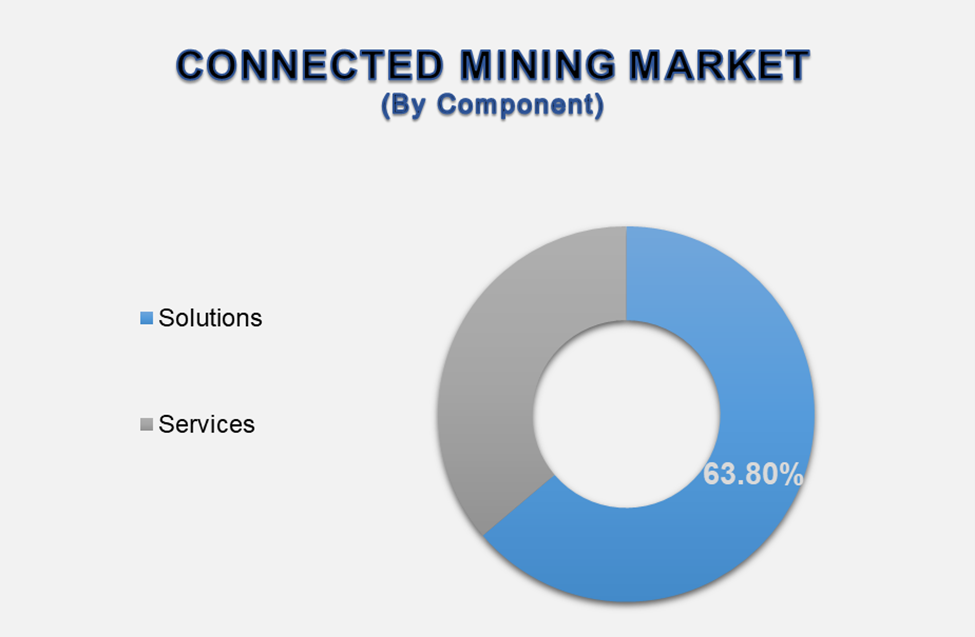
The solutions
segment accounted for approximately 63.8% of the global market, making
it the dominant component category.
Connected mining
solutions include fleet management systems, predictive maintenance platforms,
industrial IoT systems, remote monitoring software, production optimization
tools, and advanced analytics platforms.
Mining companies
are increasingly investing in integrated digital platforms capable of providing
real-time operational visibility and intelligent automation capabilities. These
solutions help optimize mine productivity, improve resource allocation, and reduce
operational risks.
The increasing demand for data-driven decision-making and operational efficiency is significantly contributing to segment growth.
Internet of
Things (IoT) Segment Is Expected to Lead the Market by Technology
The IoT segment
dominates the market due to its critical role in enabling real-time
connectivity and communication across mining operations.
IoT-enabled
sensors and monitoring devices are widely utilized to collect operational data
related to equipment performance, environmental conditions, worker safety, fuel
consumption, and production activities.
These connected systems provide mining operators with actionable insights that improve productivity, predictive maintenance, and operational safety. The rapid expansion of industrial IoT ecosystems and wireless communication infrastructure is further supporting segment growth.
Fleet
Management Segment Is Expected to Dominate the Market by Application
Fleet management
represents the leading application segment within the connected mining market
due to the extensive use of heavy machinery and transportation equipment in
mining operations.
Connected fleet
management systems enable mining companies to monitor vehicle performance, fuel
usage, driver behavior, route optimization, and maintenance schedules in real
time.
These systems help improve equipment utilization, reduce fuel consumption, minimize downtime, and enhance overall operational efficiency. The increasing deployment of autonomous and semi-autonomous mining vehicles is also contributing significantly to segment expansion.
Metal Mining
Segment Is Expected to Dominate the End-User Market
The metal mining
segment accounts for the largest market share due to rising global demand for
industrial metals such as copper, iron ore, nickel, lithium, and rare earth
elements.
Metal mining
operations are increasingly adopting connected technologies to improve ore
extraction efficiency, optimize production planning, and manage complex,
large-scale operations more effectively.
The growing demand for critical minerals used in electric vehicles, renewable energy systems, and advanced electronics is further accelerating digital transformation within metal mining operations.
The following
segments are part of an in-depth analysis of the global Connected Mining
market:
|
Market Segments |
|
|
By
Component |
∙ Solutions |
|
By Technology |
∙
Internet of Things (IoT) |
|
By
Application |
∙
Fleet Management |
|
By
End User |
∙
Coal Mining |
Connected
Mining Market Share Analysis by Region
North America is
projected to hold the largest share of the global connected mining market over
the forecast period.
North America
accounted for approximately 36.9% of the global market in 2026, driven
by strong adoption of mining automation technologies, advanced industrial
infrastructure, and increasing investments in smart mining initiatives.
The United
States and Canada are major contributors due to the presence of technologically
advanced mining companies and the increasing deployment of autonomous mining
equipment and IoT-enabled operational systems.
Asia Pacific is
expected to register the highest CAGR during the forecast period due to rapid
industrialization, growing mining activities, increasing demand for critical
minerals, and rising investments in mining modernization programs.
Countries such
as China, India, and Australia are significantly expanding smart mining
infrastructure and digital transformation initiatives to improve operational
efficiency and resource management.
Latin America
and the Middle East & Africa are also witnessing increasing adoption of
connected mining technologies due to large-scale mineral extraction projects
and rising foreign investments in mining operations.
Connected
Mining Market Competition Landscape Analysis
The connected
mining market is highly competitive and technology-intensive, with leading
companies focusing on industrial automation, AI-driven analytics, cloud-based
mining platforms, and advanced IoT integration solutions.
Companies are
increasingly investing in research and development activities aimed at
improving autonomous mining capabilities, operational intelligence,
cybersecurity protection, and predictive maintenance technologies.
Strategic
collaborations between mining operators, technology providers,
telecommunications companies, and industrial automation firms are becoming
increasingly common as organizations seek to develop fully integrated smart
mining ecosystems.
Global
Connected Mining Market Recent Developments News:
In March 2026 – Mining companies
accelerated the deployment of AI-powered predictive maintenance systems for
heavy equipment monitoring.
In January 2026 – Autonomous haul trucks and connected fleet management systems
witnessed increased adoption across large mining sites.
In October 2025 – Industrial IoT sensor networks expanded significantly within
underground mining operations for safety monitoring.
In August 2025 – Mining operators invested heavily in remote operation centers
and cloud-based production management platforms.
In June 2025 – Advanced digital twin technologies were introduced to optimize
mine planning and operational simulation capabilities.
The Global
Connected Mining Market is dominated by a few large companies, such as
∙ Caterpillar Inc.
∙ Komatsu Ltd.
∙ Hitachi Construction Machinery Co., Ltd.
∙ Sandvik AB
∙ Hexagon AB
∙ ABB Ltd.
∙ Cisco Systems, Inc.
∙ SAP SE
∙ IBM Corporation
∙ Rockwell Automation, Inc.
∙ Siemens AG
∙ Trimble Inc.
∙ Epiroc AB
∙ Wenco International Mining Systems Ltd.
∙ Schneider Electric SE
∙ Nokia Corporation
∙ Ericsson AB
∙ Accenture plc
∙ Others
Frequently Asked Questions
Ekta Chaurasia (Team Lead)
Ekta Chaurasia is a highly experienced Team Lead at M2Square Consultancy with over 7 years of expertise in market research, strategic consulting, competitive benchmarking, and business intelligence solutions. She specializes in ICT, semiconductors & electronics, automotive & transportation, and industrial machinery markets.
She leads end-to-end global research projects focused on market trends, industry analysis, growth forecasting, customer insights, and strategic decision-making. Known for her analytical leadership and industry expertise, Ekta helps businesses uncover growth opportunities, evaluate competitive landscapes, and stay ahead in rapidly evolving markets through accurate and insight-driven research.
1.
Global Connected Mining
Market Introduction and Market Overview
1.1. Objectives of the Study
1.2. Global Connected Mining Market Scope and Market Estimation
1.2.1.
Global Connected Mining Market
Size (US$ Million), Market CAGR (%), Market Forecast (2026 - 2034)
1.2.2.
Global Connected Mining Market
Revenue Share (%) and Growth Rate (Y-o-Y), 2021 - 2034
1.3. Market Segmentation
1.3.1.
Component of Global Connected
Mining Market
1.3.2.
Technology of Global Connected
Mining Market
1.3.3.
Application of Global Connected
Mining Market
1.3.4.
End User of Global Connected
Mining Market
1.3.5.
Region of Global Connected
Mining Market
1.4. Competition Coverage List of Market Participants
1.5. Market Definition
2.
Executive Summary
2.1. Global Connected Mining Market Snapshot
2.1.1.
Global Connected Mining Market
Size Estimation, 2021 - 2034
2.1.2.
Global Connected Mining Market
CAGR Analysis, 2026 - 2034
2.2. Global Connected Mining Market Revenue Share Analysis
2.3. Global Connected Mining Market Trends Analysis
2.4. REGIONAL OUTLOOK
2.5. Competitive Insights
3.
Global Connected Mining
Market Dynamics
3.1. Global Connected Mining Market Drivers
3.1.1.
Rising Adoption of Automation
and Smart Mining Technologies
3.1.2.
Increasing Focus on Operational
Efficiency and Productivity
3.1.3.
Growing Demand for Worker
Safety and Remote Monitoring Solutions
3.2. Global Connected Mining Market Restraints
3.2.1.
High Initial Investment and
Infrastructure Costs
3.2.2.
Cybersecurity Risks and Data
Privacy Concerns
3.3. Global Connected Mining Market Opportunities
3.3.1.
Expansion of Digital Twin and
Predictive Maintenance Technologies
3.3.2.
Growing Adoption of AI and
IoT-Based Mining Operations
3.4. Global Connected Mining Market Challenges
3.5. Porter’s Five Forces Analysis
3.6. PESTEL Analysis
3.7. Value Chain Analysis
3.8. Technology Landscape
3.9. Regulatory Framework
3.10.
COVID-19 Impact Analysis
4.
Global Connected Mining
Market Size Analysis and Forecast, by Component
4.1. Market Overview
4.2. Solutions
4.3. Services
5.
Global Connected Mining
Market Size Analysis and Forecast, by Technology
5.1. Market Overview
5.2. Internet of Things (IoT)
5.3. Artificial Intelligence & Analytics
5.4. Automation Systems
5.5. Cloud Computing
5.6. Cybersecurity Solutions
5.7. Others
6.
Global Connected Mining
Market Size Analysis and Forecast, by Application
6.1. Market Overview
6.2. Fleet Management
6.3. Predictive Maintenance
6.4. Remote Operations
6.5. Worker Safety & Monitoring
6.6. Asset Tracking
6.7. Production Optimization
6.8. Others
7.
Global Connected Mining
Market Size Analysis and Forecast, by End User
7.1. Market Overview
7.2. Coal Mining
7.3. Metal Mining
7.4. Mineral Mining
7.5. Others
8.
Global Connected Mining
Market Size Analysis and Forecast, by Region
8.1. North America
8.2. Europe
8.3. Asia Pacific
8.4. Latin America
8.5. Middle East & Africa
9.
North America Connected
Mining Market Size Analysis and Forecast
9.1. Market Overview
9.2. North America Connected Mining Market Size and Forecast, 2021 - 2034
9.2.1.
By Component
9.2.2.
By Technology
9.2.3.
By Application
9.2.4.
By End User
9.2.5.
By Country
9.2.5.1.
U.S.
9.2.5.2.
Canada
10. Europe Connected Mining Market Size Analysis and Forecast
10.1.
Market Overview
10.2.
Europe Connected Mining Market
Size and Forecast, 2021 - 2034
10.2.1.
By Component
10.2.2.
By Technology
10.2.3.
By Application
10.2.4.
By End User
10.2.5.
By Country
10.2.5.1.
Germany
10.2.5.2.
U.K.
10.2.5.3.
France
10.2.5.4.
Italy
10.2.5.5.
Spain
10.2.5.6.
Switzerland
10.2.5.7.
Rest of Europe
11. Asia Pacific Connected Mining Market Size Analysis and Forecast
11.1.
Market Overview
11.2.
Asia Pacific Connected Mining
Market Size and Forecast, 2021 - 2034
11.2.1.
By Component
11.2.2.
By Technology
11.2.3.
By Application
11.2.4.
By End User
11.2.5.
By Country
11.2.5.1.
China
11.2.5.2.
India
11.2.5.3.
Japan
11.2.5.4.
South Korea
11.2.5.5.
Australia
11.2.5.6.
Rest of Asia Pacific
12. Latin America Connected Mining Market Size Analysis and Forecast
12.1.
Market Overview
12.2.
Latin America Connected Mining
Market Size and Forecast, 2021 - 2034
12.2.1.
By Component
12.2.2.
By Technlogy
12.2.3.
By Application
12.2.4.
By End Use
12.2.5.
By Country
12.2.5.1.
Brazil
12.2.5.2.
Mexico
12.2.5.3.
Argentina
12.2.5.4.
Rest of Latin America
13. Middle East & Africa Connected Mining Market Size Analysis and
Forecast
13.1.
Market Overview
13.2.
Middle East & Africa
Connected Mining Market Size and Forecast, 2021 - 2034
13.2.1.
By Component
13.2.2.
By Technology
13.2.3.
By Application
13.2.4.
By End User
13.2.5.
By Country
13.2.5.1.
Saudi Arabia
13.2.5.2.
UAE
13.2.5.3.
South Africa
13.2.5.4.
Rest of Middle East &
Africa
14. Competition Landscape
14.1.
Market Share Analysis of Key
Players
14.2.
Competitive Benchmarking
14.3.
Product and Service Portfolio
Analysis
14.4.
Strategic Initiatives
14.5.
Mergers and Acquisitions
14.6.
Partnerships and Collaborations
15. Company Profiles
15.1.
Caterpillar Inc.
15.1.1.
Company Overview
15.1.2.
Financial Overview
15.1.3.
Product Portfolio
15.1.4.
Recent Developments
15.1.5.
Business Strategy
15.2.
Komatsu Ltd.
15.3.
Hitachi Construction Machinery
Co., Ltd.
15.4.
Sandvik AB
15.5.
Hexagon AB
15.6.
ABB Ltd.
15.7.
Cisco Systems, Inc.
15.8.
SAP SE
15.9.
IBM Corporation
15.10.
Rockwell Automation, Inc.
15.11.
Siemens AG
15.12.
Trimble Inc.
15.13.
Epiroc AB
15.14.
Wenco International Mining
Systems Ltd.
15.15.
Schneider Electric SE
15.16.
Nokia Corporation
15.17.
Ericsson AB
15.18.
Accenture plc
15.19.
Others
16. Research Findings and Conclusion
17. Assumptions and Acronyms Used
18. Research Methodology
18.1.
Primary Research
18.2.
Secondary Research
18.3.
Market Size Estimation
18.4.
Forecasting Methodology
18.5.
Data Triangulation
18.6.
Research Assumptions
18.7.
Limitations
Our Research Methodology
"Insight without rigor is just noise."
We follow a comprehensive, multi-phase research framework designed to deliver accurate, strategic, and decision-ready intelligence. Our process integrates primary and secondary research , both quantitative and qualitative , along with dual modeling techniques ( top-down and bottom-up) and a final layer of validation through our proprietary in-house repository.
PRIMARY RESEARCH
Primary research captures real-time, firsthand insights from the market to understand behaviors, motivations, and emerging trends.
1. Quantitative Primary Research
Objective: Generate statistically significant data directly from market participants.
Approaches:- Structured surveys with customers, distributors, and field agents
- Mobile-based data collection for point-of-sale audits and usage behavior
- Phone-based interviews (CATI) for market sizing and product feedback
- Online polling around industry events and digital campaigns
- Purchase frequency by customer type
- Channel performance across geographies
- Feature demand by application or demographic
2. Qualitative Primary Research
Objective: Explore decision-making drivers, pain points, and market readiness.
Approaches:- In-depth interviews (IDIs) with executives, product managers, and key decision-makers
- Focus groups among end users and early adopters
- Site visits and observational research for consumer products
- Informal field-level discussions for regional and cultural nuances
SECONDARY RESEARCH
This phase helps establish a macro-to-micro understanding of market trends, size, regulation, and competitive dynamics, sourced from credible and public domain information.
1. Quantitative Secondary Research
Objective: Model market value and segment-level forecasts based on published data.
Sources include:- Financial reports and investor summaries
- Government trade data, customs records, and regulatory statistics
- Industry association publications and economic databases
- Channel performance and pricing data from marketplace listings
- Revenue splits, pricing trends, and CAGR estimates
- Supply-side capacity and volume tracking
- Investment analysis and funding benchmarks
2. Qualitative Secondary Research
Objective: Capture strategic direction, innovation signals, and behavioral trends.
Sources include:- Company announcements, roadmaps, and product pipelines
- Publicly available whitepapers, conference abstracts, and academic research
- Regulatory body publications and policy briefs
- Social and media sentiment scanning for early-stage shifts
- Strategic shifts in market positioning
- Unmet needs and white spaces
- Regulatory triggers and compliance impact
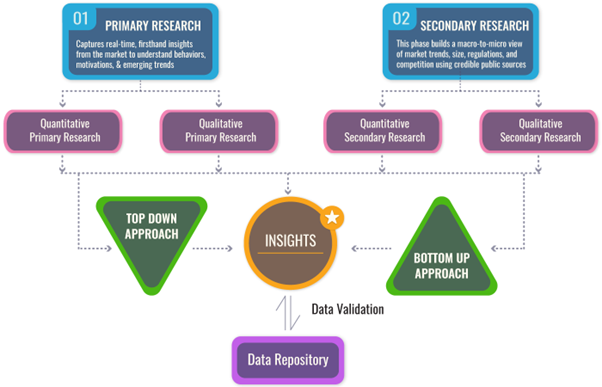
DUAL MODELING: TOP-DOWN + BOTTOM-UP
To ensure robust market estimation, we apply two complementary sizing approaches:
Top-Down Modeling:- Start with broader industry value (e.g., global or regional TAM)
- Apply filters by segment, geography, end-user, or use case
- Adjust with primary insights and validation benchmarks
- Ideal for investor-grade market scans and opportunity mapping
- Aggregate from the ground up using sales volumes, pricing, and unit economics
- Use internal modeling templates aligned with stakeholder data
- Incorporate distributor-level or region-specific inputs
- Most accurate for emerging segments and granular sub-markets
DATA VALIDATION: IN-HOUSE REPOSITORY
We close the loop with proprietary data intelligence built from ongoing projects, industry monitoring, and historical benchmarking. This repository includes:
- Multi-sector market and pricing models
- Key trendlines from past interviews and forecasts
- Benchmarked adoption rates, churn patterns, and ROI indicators
- Industry-specific deviation flags and cross-check logic
- Catches inconsistencies early
- Aligns projections across studies
- Enables consistent, high-trust deliverables