

Cosmetic Pencil & Pen Market Size and Forecast (2020–2033), Global and Regional Growth, Trend, Share, and Industry Analysis Report Coverage: By Product Type (Eyebrow Pencils & Pens, Eyeliner Pencils & Pens, Lip Pencils, Concealer & Highlighter Pens), By Formulation (Conventional, Organic & Natural), By Distribution Channel (Offline Retail, Online Retail), By End User (Professional Use, Consumer Use) and Geography
2026-01-09
Consumer Products
Jaya Bundele (Research Analyst)
Description
Cosmetic
Pencil & Pen Market Overview
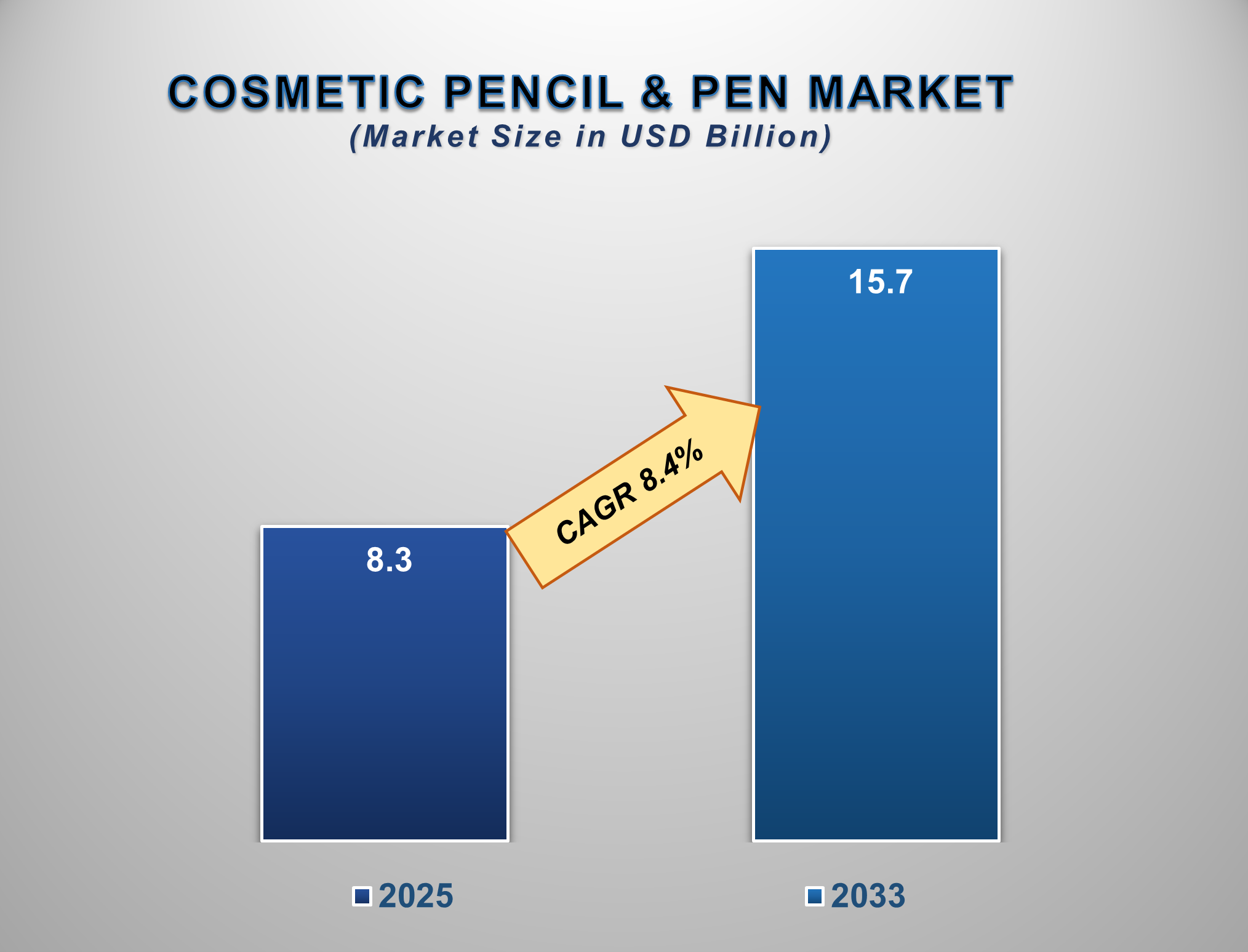
The Cosmetic Pencil & Pen Market is expected to witness steady and sustained growth during the forecast period from 2025 to 2033, driven by rising consumer demand for precision-based makeup products, increasing beauty consciousness, and the growing influence of social media and beauty influencers. The market is projected to be valued at approximately USD 8.3 billion in 2025 and is anticipated to reach nearly USD 15.7 billion by 2033, registering a compound annual growth rate (CAGR) of 8.4% over the forecast period.
Cosmetic pencils and pens are essential color cosmetics designed to deliver precise application for
facial features such as eyes, lips, and eyebrows. These products are widely
used due to their convenience, portability, and ability to offer defined,
controlled makeup results. The market’s growth is strongly supported by
evolving fashion trends, rapid product innovation in retractable and long-wear
formats, and increasing consumer preference for easy-to-use, multifunctional
cosmetic products.
The expansion of the global beauty and personal care
industry, particularly in emerging economies, has significantly boosted demand
for cosmetic pencils and pens. Additionally, rising disposable income,
urbanization, and growing participation of working women are accelerating
product adoption. The surge in vegan, cruelty-free, organic, and clean beauty
formulations is further reshaping market dynamics. North America and Europe
currently dominate the market due to established beauty brands and high per
capita cosmetic spending, while the Asia-Pacific
region is projected to experience the fastest growth owing to expanding
middle-class populations, growing e-commerce penetration, and increasing
awareness of global beauty trends.
Cosmetic Pencil & Pen Market Drivers and
Opportunities
Rising Demand for Precision Makeup Products and Everyday
Beauty Essentials Is Driving Market Growth
One of the primary drivers of the cosmetic
pencil & pen market is the increasing consumer preference for
precision-based makeup products. Eyeliner pens, lip pencils, and eyebrow
pencils allow users to achieve defined and professional-looking results with
minimal effort, making them popular for daily use. The growing trend toward
minimalistic and natural makeup looks has further enhanced the demand for such
products, as consumers seek tools that enable subtle enhancement rather than
heavy coverage. Additionally, cosmetic pencils and pens are widely perceived as
beginner-friendly products, contributing to their strong adoption among younger
consumers and first-time makeup users.
Influence of Social Media, Beauty Influencers, and Celebrity
Endorsements Is Accelerating Adoption
The rapid rise of social media platforms such as
Instagram, YouTube, and TikTok has transformed consumer purchasing behavior in
the cosmetics industry. Beauty influencers and makeup artists frequently
showcase the application techniques and benefits of cosmetic pencils and pens,
significantly boosting product visibility and desirability. Tutorials
highlighting winged eyeliners, defined brows, and contoured lips have directly
increased product demand. Furthermore, celebrity-endorsed cosmetic brands and collaborations
are driving brand loyalty and premiumization within the market, encouraging
consumers to experiment with new product variants and formulations.
Expansion of Organic, Clean Beauty, and E-commerce Channels
Presents Strong Growth Opportunities
The increasing consumer awareness regarding
product ingredients and sustainability has created substantial opportunities
for manufacturers to expand their organic, natural, and clean-label cosmetic
pencil portfolios. Demand for products free from parabens, sulfates, and
synthetic dyes is rising, particularly among health-conscious and
environmentally aware consumers. In parallel, the rapid growth of online retail
platforms and direct-to-consumer (DTC) models is transforming market
accessibility. Brands are leveraging digital channels to offer personalized
product recommendations, virtual try-ons, and subscription-based beauty
services, significantly expanding their consumer reach and driving long-term
market growth.
Cosmetic Pencil & Pen Market Scope
|
Report Attributes |
Description |
|
Market Size in 2025 |
USD 8.3 Billion |
|
Market Forecast in 2033 |
USD 15.7 Billion |
|
CAGR % 2025-2033 |
8.4% |
|
Base Year |
2024 |
|
Historic Data |
2020-2024 |
|
Forecast Period |
2025-2033 |
|
Report USP |
Product Portfolio,
Technological Analysis, Company Market Share, Company Heatmap, Pricing
Analysis, Growth Factors and more |
|
Segments Covered |
●
By Product Type ●
By Formulation ●
By Distribution
Channel ●
By End-user |
|
Regional Scope |
●
North America ●
Europe ●
APAC ●
Latin America ●
Middle East and
Africa |
|
Country Scope |
1)
U.S. 2)
Canada 3)
Germany 4)
UK 5)
France 6)
Spain 7)
Italy 8)
Switzerland 9)
China 10)
Japan 11)
India 12)
Australia 13)
South Korea 14)
Brazil 15)
Mexico 16)
Argentina 17)
South Africa 18)
Saudi Arabia 19)
UAE |
Cosmetic Pencil & Pen Market Report
Segmentation Analysis
The global
Cosmetic Pencil & Pen Market industry analysis is segmented by Product
Type, by Formulation, by Distribution Channel, by End-User, and by region.
Eyeliner Pencils & Pens Segment Is Expected to Hold the
Largest Market Share in 2025
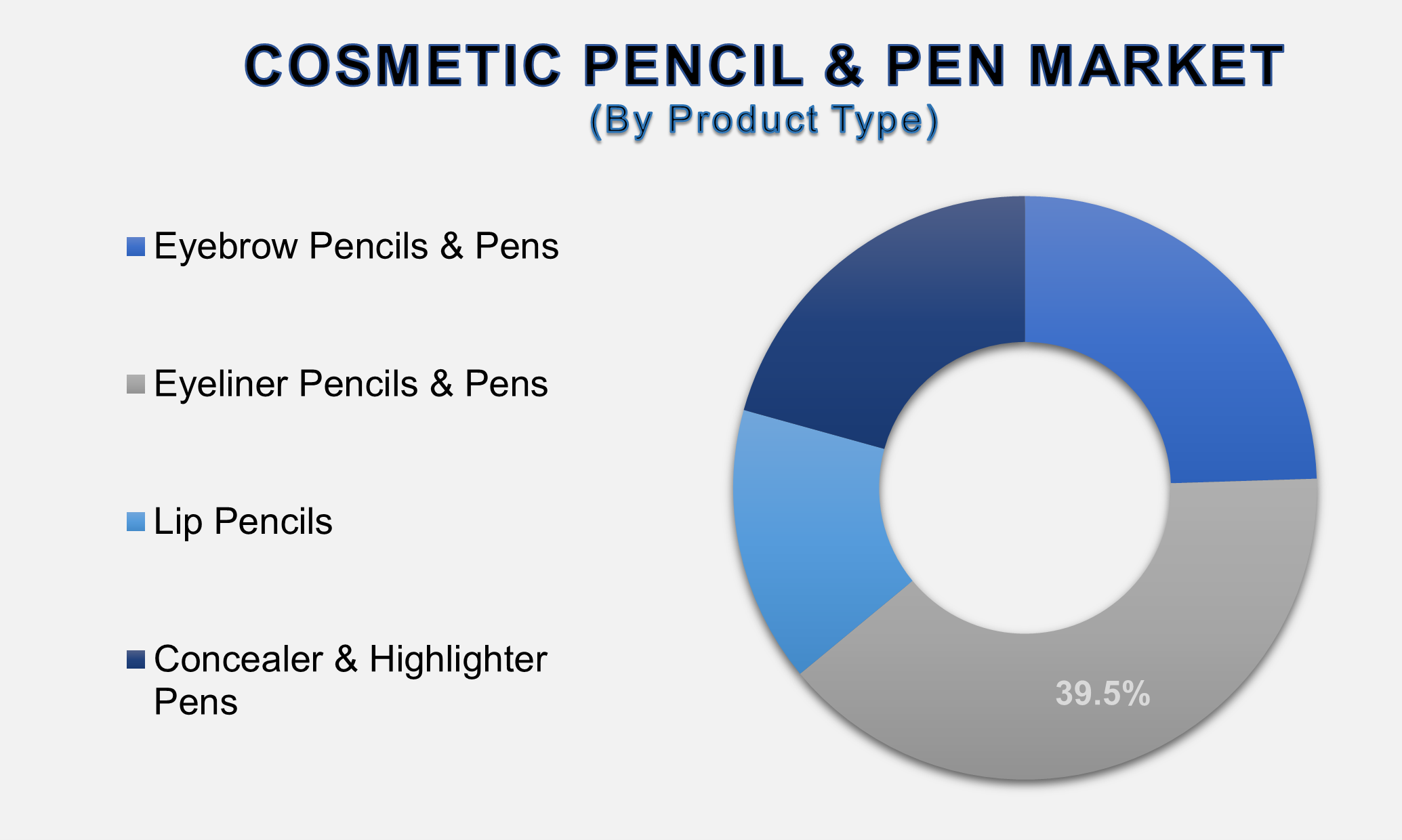
The eyeliner pencils & pens segment is expected to
dominate the cosmetic pencil & pen market in 2025 due to its extensive
daily usage and broad consumer appeal across age groups and gender
demographics. Eyeliner is considered a core makeup essential, used for both
minimal everyday looks and more elaborate cosmetic styles, which drives
consistently high demand. The segment benefits significantly from continuous
product innovation, including waterproof, smudge-proof, sweat-resistant, and
long-wear formulations that meet the needs of consumers with active lifestyles.
Additionally, the rising popularity of liquid eyeliner pens and felt-tip
applicators has enhanced ease of use and precision, making these products
suitable for both beginners and professional users. Fashion trends driven by
social media, celebrity makeup looks, and beauty influencers have further
increased the frequency of eyeliner usage globally. Strong product availability
across mass, premium, and luxury price points ensures high penetration in both
developed and emerging markets, reinforcing this segment’s leading market
position.
Conventional Formulation Segment Continues to Lead, While
Organic Products Gain Momentum
The conventional formulation segment continues to hold the
largest share of the cosmetic pencil & pen market, primarily due to its
affordability, extensive product availability, and strong brand familiarity.
Conventional cosmetic pencils offer a wide variety of shades, textures, and
finishes, making them accessible to a broad consumer base across different
income groups. These products benefit from established manufacturing processes,
longer shelf life, and widespread distribution across offline and online retail
channels. Leading cosmetic brands continue to invest heavily in improving
conventional formulations by incorporating dermatologically tested ingredients,
enhanced pigmentation, and improved wear performance. However, growing consumer
awareness regarding ingredient safety and environmental sustainability is
gradually influencing purchasing decisions. While conventional products
dominate in volume sales, organic and natural formulations are gaining traction
among health-conscious consumers seeking paraben-free, cruelty-free, and
eco-friendly alternatives, signaling a gradual shift in long-term market
dynamics.
Offline Retail Dominates, While Online Channels Show Rapid
Growth
Offline retail remains the dominant distribution channel
for cosmetic pencils and pens due to the importance of physical product
evaluation in beauty purchases. Consumers often prefer to test shades,
textures, and applicator quality in person before making a purchase,
particularly for eye and lip products. Specialty beauty stores, department
stores, supermarkets, and brand-owned outlets provide personalized assistance,
professional recommendations, and in-store promotions that enhance customer
confidence and brand loyalty. Additionally, offline retail offers immediate
product availability, which continues to appeal to impulse buyers. However,
online retail channels are experiencing rapid growth, driven by increasing
smartphone penetration, improved logistics infrastructure, and the convenience
of home delivery. Digital platforms enable consumers to access a wider product
range, competitive pricing, influencer reviews, and virtual try-on tools. While
offline retail leads in market share, the accelerated growth of e-commerce is
reshaping future distribution strategies.
The
following segments are part of an in-depth analysis of the global Cosmetic
Pencil & Pen Market:
|
Market
Segments |
|
|
By Product
Type |
●
Eyebrow Pencils
& Pens ●
Eyeliner Pencils
& Pens ●
Lip Pencils ●
Concealer &
Highlighter Pens |
|
By Formulation
|
●
Conventional ●
Organic &
Natural |
|
By
Distribution Channel |
●
Offline Retail ●
Online Retail |
|
By End-user |
●
By End User ●
Professional Use ●
Consumer Use |
Cosmetic Pencil & Pen Market Share Analysis
by Region
The Europe region is anticipated to hold the largest portion
of the Cosmetic Pencil & Pen Market globally throughout the forecast
period.
Europe
dominates the global cosmetic pencil & pen market due to its
well-established beauty and personal care industry, high consumer awareness
regarding premium cosmetics, and the strong presence of globally recognized
cosmetic brands. Countries such as France, Germany, the United Kingdom, and
Italy serve as major hubs for cosmetic manufacturing, innovation, and luxury
beauty consumption. European consumers exhibit a strong preference for
high-quality, dermatologically tested, and sustainably formulated products,
which supports the widespread adoption of cosmetic pencils and pens across
mass, premium, and luxury segments. The region’s strict regulatory framework,
including compliance with the EU Cosmetics
Regulation (EC No. 1223/2009), has enhanced consumer trust in product safety
and quality, further strengthening market demand.
Additionally,
Europe leads in the adoption of organic, vegan, and cruelty-free cosmetics,
driving innovation in clean-label eyeliner, lip, and eyebrow pencil
formulations. The strong network of specialty beauty retailers, pharmacies, and
brand-owned boutiques ensures extensive offline distribution, while the rapid
expansion of e-commerce and omnichannel retail strategies is broadening product
accessibility. Fashion-forward consumer behavior, frequent product launches,
and the influence of European fashion weeks and beauty trends collectively
reinforce Europe’s leading position in the cosmetic pencil & pen market.
Cosmetic Pencil & Pen Market Competition
Landscape Analysis
The global
cosmetic pencil & pen market is highly competitive, characterized by the
presence of multinational cosmetic giants and emerging indie beauty brands.
Competition is based on product quality, formulation innovation, packaging
design, pricing, and brand image. Key strategic initiatives include new product
launches, influencer collaborations, sustainable packaging adoption, and
expansion of online sales channels.
Global Cosmetic Pencil & Pen Market Recent Developments
News:
o In January 2025, L’Oréal
launched a new range of vegan eyeliner pens with extended wear technology under
its premium brand portfolio.
o In October 2024, Estée
Lauder Companies expanded its clean beauty pencil lineup, introducing
recyclable packaging solutions.
o In August 2024, Shiseido
introduced precision eyebrow pens designed specifically for Asian skin tones
and facial structures.
o In June 2024, Coty Inc.
partnered with leading e-commerce platforms to strengthen its digital cosmetic
sales strategy globally.
The Global Cosmetic Pencil & Pen
Market Is Dominated by a Few Large Companies, such as
●
L’Oréal S.A.
●
Estée Lauder Companies
Inc.
●
Coty Inc.
●
Shiseido Company,
Limited
●
LVMH Moët Hennessy
Louis Vuitton
●
Revlon, Inc.
●
Procter & Gamble
●
Unilever
●
Chanel Ltd.
●
Amorepacific
Corporation
●
Kao Corporation
●
Oriflame Cosmetics
●
Colorbar Cosmetics
●
Lakmé (HUL)
● Other Prominent Players
Frequently Asked Questions
Jaya Bundele (Research Analyst)
Jaya Bundele is a skilled Research Analyst with 4+ years of experience in market intelligence, consumer insights, competitive analysis, and industry forecasting across the consumer goods, agriculture, and food & beverage sectors. She specializes in market sizing, trend analysis, growth opportunity mapping, and strategic secondary research for global and regional markets.
Her expertise lies in transforming complex industry data into actionable business strategies that help organizations identify emerging trends, understand customer behavior, and gain a competitive edge. With a strong focus on data-driven insights, business intelligence, and future market trends, Jaya delivers high-quality research solutions aligned with evolving industry demands and market dynamics.
1. Global Cosmetic Pencil
& Pen Market Introduction and Market Overview
1.1.
Objectives
of the Study
1.2.
Global
Cosmetic Pencil & Pen Market Scope and Market Estimation
1.2.1.Global Electronic Toll
Collection Overall Market Size (US$ Bn), Market CAGR (%), Market forecast (2025
- 2033)
1.2.2.Global Cosmetic Pencil
& Pen Market Revenue Share (%) and Growth Rate (Y-o-Y) from 2020 - 2033
1.3.
Market
Segmentation
1.3.1.Product Type of Global Cosmetic
Pencil & Pen Market
1.3.2.Formulation of Global Cosmetic
Pencil & Pen Market
1.3.3.Distribution Channel of Global
Cosmetic Pencil & Pen Market
1.3.4.End-user of Global Cosmetic
Pencil & Pen Market
1.3.5.Region of Global Cosmetic
Pencil & Pen Market
2. Executive
Summary
2.1.
Demand
Side Trends
2.2.
Key
Market Trends
2.3.
Market
Demand (US$ Bn) Analysis 2020 – 2024 and forecast, 2025 – 2033
2.4.
Demand
and Opportunity Assessment
2.5.
Key
Developments
2.6.
Market
Entry Strategies
2.7.
Market
Dynamics
2.7.1.Drivers
2.7.2.Limitations
2.7.3.Opportunities
2.7.4.Impact Analysis of Drivers
and Restraints
2.8.
Porter’s
Five Forces Analysis
2.9.
PEST
Analysis
3. Global
Cosmetic Pencil & Pen Market Estimates
& Historical Trend Analysis (2020 - 2024)
4. Global
Cosmetic Pencil & Pen Market Estimates
& Forecast Trend Analysis, by Product Type
4.1.
Global
Cosmetic Pencil & Pen Market Revenue (US$ Bn) Estimates and Forecasts, by Product
Type, 2020 - 2033
4.1.1.Eyebrow Pencils & Pens
4.1.2.Eyeliner Pencils &
Pens
4.1.3.Lip Pencils
4.1.4.Concealer &
Highlighter Pens
5. Global
Cosmetic Pencil & Pen Market Estimates
& Forecast Trend Analysis, by Formulation
5.1.
Global
Cosmetic Pencil & Pen Market Revenue (US$ Bn) Estimates and Forecasts, by Formulation,
2020 - 2033
5.1.1.Conventional
5.1.2.Organic & Natural
6. Global
Cosmetic Pencil & Pen Market Estimates
& Forecast Trend Analysis, by Distribution Channel
6.1.
Global
Cosmetic Pencil & Pen Market Revenue (US$ Bn) Estimates and Forecasts, by Distribution
Channel, 2020 - 2033
6.1.1.Offline Retail
6.1.2.Online Retail
7. Global
Cosmetic Pencil & Pen Market Estimates
& Forecast Trend Analysis, by End-user
7.1.
Global
Cosmetic Pencil & Pen Market Revenue (US$ Bn) Estimates and Forecasts, by End-user
2020 - 2033
7.1.1.Professional Use
7.1.2.Consumer Use
8. Global
Cosmetic Pencil & Pen Market Estimates
& Forecast Trend Analysis, by region
8.1.
Global
Cosmetic Pencil & Pen Market Revenue (US$ Bn) Estimates and Forecasts, by region,
2020 - 2033
8.1.1.North America
8.1.2.Europe
8.1.3.Asia Pacific
8.1.4.Middle East & Africa
8.1.5.Latin America
9. North America Cosmetic
Pencil & Pen Market: Estimates
& Forecast Trend Analysis
9.1.
North
America Cosmetic Pencil & Pen Market Assessments & Key Findings
9.1.1.North America Cosmetic
Pencil & Pen Market Introduction
9.1.2.North America Cosmetic
Pencil & Pen Market Size Estimates and Forecast (US$ Billion) (2020 - 2033)
9.1.2.1. By Product
Type
9.1.2.2. By Formulation
9.1.2.3. By
Distribution Channel
9.1.2.4. By End-user
9.1.2.5.
By
Country
9.1.2.5.1. The U.S.
9.1.2.5.2. Canada
10. Europe Cosmetic
Pencil & Pen Market: Estimates
& Forecast Trend Analysis
10.1.
Europe
Cosmetic Pencil & Pen Market Assessments & Key Findings
10.1.1.
Europe
Cosmetic Pencil & Pen Market Introduction
10.1.2.
Europe
Cosmetic Pencil & Pen Market Size Estimates and Forecast (US$ Billion) (2020
- 2033)
10.1.2.1. By Product
Type
10.1.2.2. By Formulation
10.1.2.3. By
Distribution Channel
10.1.2.4. By End-user
10.1.2.5.
By
Country
10.1.2.5.1.
Germany
10.1.2.5.2.
Italy
10.1.2.5.3.
U.K.
10.1.2.5.4.
France
10.1.2.5.5.
Spain
10.1.2.5.6.
Switzerland
10.1.2.5.7. Rest
of Europe
11. Asia Pacific Cosmetic
Pencil & Pen Market: Estimates
& Forecast Trend Analysis
11.1.
Asia
Pacific Market Assessments & Key Findings
11.1.1.
Asia
Pacific Cosmetic Pencil & Pen Market Introduction
11.1.2.
Asia
Pacific Cosmetic Pencil & Pen Market Size Estimates and Forecast (US$ Billion)
(2020 - 2033)
11.1.2.1. By Product
Type
11.1.2.2. By Formulation
11.1.2.3. By
Distribution Channel
11.1.2.4. By End-user
11.1.2.5.
By
Country
11.1.2.5.1. China
11.1.2.5.2. Japan
11.1.2.5.3. India
11.1.2.5.4. Australia
11.1.2.5.5. South Korea
11.1.2.5.6. Rest of Asia Pacific
12. Middle East & Africa Cosmetic
Pencil & Pen Market: Estimates
& Forecast Trend Analysis
12.1.
Middle
East & Africa Market Assessments & Key Findings
12.1.1.
Middle East & Africa Cosmetic Pencil & Pen Market
Introduction
12.1.2.
Middle East & Africa Cosmetic Pencil & Pen Market
Size Estimates and Forecast (US$ Billion) (2020 - 2033)
12.1.2.1. By Product
Type
12.1.2.2. By Formulation
12.1.2.3. By
Distribution Channel
12.1.2.4. By End-user
12.1.2.5.
By
Country
12.1.2.5.1. UAE
12.1.2.5.2. Saudi
Arabia
12.1.2.5.3. South
Africa
12.1.2.5.4. Rest
of MEA
13. Latin America
Cosmetic Pencil & Pen Market:
Estimates & Forecast Trend Analysis
13.1.
Latin
America Market Assessments & Key Findings
13.1.1.
Latin
America Cosmetic Pencil & Pen Market Introduction
13.1.2.
Latin
America Cosmetic Pencil & Pen Market Size Estimates and Forecast (US$ Billion)
(2020 - 2033)
13.1.2.1. By Product
Type
13.1.2.2. By Formulation
13.1.2.3. By
Distribution Channel
13.1.2.4. By End-user
13.1.2.5.
By
Country
13.1.2.5.1. Brazil
13.1.2.5.2. Argentina
13.1.2.5.3. Mexico
13.1.2.5.4. Rest
of LATAM
14. Country Wise Market:
Introduction
15.
Competition
Landscape
15.1.
Global
Cosmetic Pencil & Pen Market Product Mapping
15.2.
Global
Cosmetic Pencil & Pen Market Concentration Analysis, by Leading Players /
Innovators / Emerging Players / New Entrants
15.3.
Global
Cosmetic Pencil & Pen Market Tier Structure Analysis
15.4.
Global
Cosmetic Pencil & Pen Market Concentration & Company Market Shares (%)
Analysis, 2024
16.
Company
Profiles
16.1.
L’Oréal S.A.
16.1.1.
Company
Overview & Key Stats
16.1.2.
Financial
Performance & KPIs
16.1.3.
Product
Portfolio
16.1.4.
SWOT
Analysis
16.1.5.
Business
Strategy & Recent Developments
* Similar details would be provided for all the players
mentioned below
16.2. Estée Lauder
Companies Inc.
16.3. Coty Inc.
16.4. Shiseido
Company, Limited
16.5. LVMH Moët
Hennessy Louis Vuitton
16.6. Revlon, Inc.
16.7. Procter &
Gamble
16.8. Unilever
16.9. Chanel Ltd.
16.10. Amorepacific
Corporation
16.11. Kao
Corporation
16.12. Oriflame
Cosmetics
16.13. Colorbar
Cosmetics
16.14. Lakmé (HUL)
16.15. Other
Prominent Players
17. Research
Methodology
17.1.
External
Transportations / Databases
17.2.
Internal
Proprietary Database
17.3.
Primary
Research
17.4.
Secondary
Research
17.5.
Assumptions
17.6.
Limitations
17.7.
Report
FAQs
18. Research
Findings & Conclusion
Our Research Methodology
"Insight without rigor is just noise."
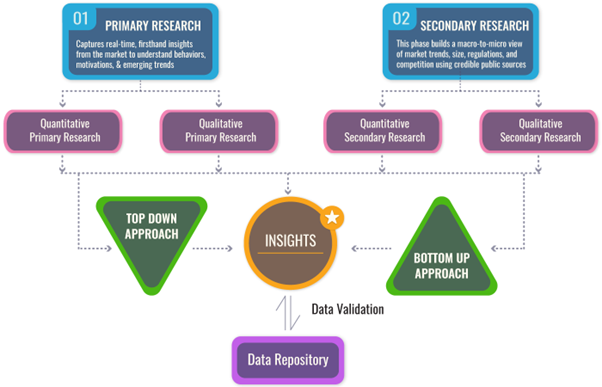
We follow a comprehensive, multi-phase research framework designed to deliver accurate, strategic, and decision-ready intelligence. Our process integrates primary and secondary research , both quantitative and qualitative , along with dual modeling techniques ( top-down and bottom-up) and a final layer of validation through our proprietary in-house repository.
PRIMARY RESEARCH
Primary research captures real-time, firsthand insights from the market to understand behaviors, motivations, and emerging trends.
1. Quantitative Primary Research
Objective: Generate statistically significant data directly from market participants.
Approaches:- Structured surveys with customers, distributors, and field agents
- Mobile-based data collection for point-of-sale audits and usage behavior
- Phone-based interviews (CATI) for market sizing and product feedback
- Online polling around industry events and digital campaigns
- Purchase frequency by customer type
- Channel performance across geographies
- Feature demand by application or demographic
2. Qualitative Primary Research
Objective: Explore decision-making drivers, pain points, and market readiness.
Approaches:- In-depth interviews (IDIs) with executives, product managers, and key decision-makers
- Focus groups among end users and early adopters
- Site visits and observational research for consumer products
- Informal field-level discussions for regional and cultural nuances
SECONDARY RESEARCH
This phase helps establish a macro-to-micro understanding of market trends, size, regulation, and competitive dynamics, sourced from credible and public domain information.
1. Quantitative Secondary Research
Objective: Model market value and segment-level forecasts based on published data.
Sources include:- Financial reports and investor summaries
- Government trade data, customs records, and regulatory statistics
- Industry association publications and economic databases
- Channel performance and pricing data from marketplace listings
- Revenue splits, pricing trends, and CAGR estimates
- Supply-side capacity and volume tracking
- Investment analysis and funding benchmarks
2. Qualitative Secondary Research
Objective: Capture strategic direction, innovation signals, and behavioral trends.
Sources include:- Company announcements, roadmaps, and product pipelines
- Publicly available whitepapers, conference abstracts, and academic research
- Regulatory body publications and policy briefs
- Social and media sentiment scanning for early-stage shifts
- Strategic shifts in market positioning
- Unmet needs and white spaces
- Regulatory triggers and compliance impact
DUAL MODELING: TOP-DOWN + BOTTOM-UP
To ensure robust market estimation, we apply two complementary sizing approaches:
Top-Down Modeling:- Start with broader industry value (e.g., global or regional TAM)
- Apply filters by segment, geography, end-user, or use case
- Adjust with primary insights and validation benchmarks
- Ideal for investor-grade market scans and opportunity mapping
- Aggregate from the ground up using sales volumes, pricing, and unit economics
- Use internal modeling templates aligned with stakeholder data
- Incorporate distributor-level or region-specific inputs
- Most accurate for emerging segments and granular sub-markets
DATA VALIDATION: IN-HOUSE REPOSITORY
We close the loop with proprietary data intelligence built from ongoing projects, industry monitoring, and historical benchmarking. This repository includes:
- Multi-sector market and pricing models
- Key trendlines from past interviews and forecasts
- Benchmarked adoption rates, churn patterns, and ROI indicators
- Industry-specific deviation flags and cross-check logic
- Catches inconsistencies early
- Aligns projections across studies
- Enables consistent, high-trust deliverables