

Cough Syrup Market Size and Forecast (2026–2034), Global and Regional Growth, Trend, Share and Industry Analysis Report Coverage: By Product Type (Expectorants, Cough Suppressants/Antitussives, Combination Medications), By Type (Prescription and Over-the-Counter), By Cough Type (Dry Cough and Wet Cough), By Distribution Channel (Retail Pharmacy, Hospital Pharmacy, and Online Pharmacy) and Geography
2026-08-11
Healthcare
Swetal (Research Analyst)
Description
Cough Syrup Market Overview
The
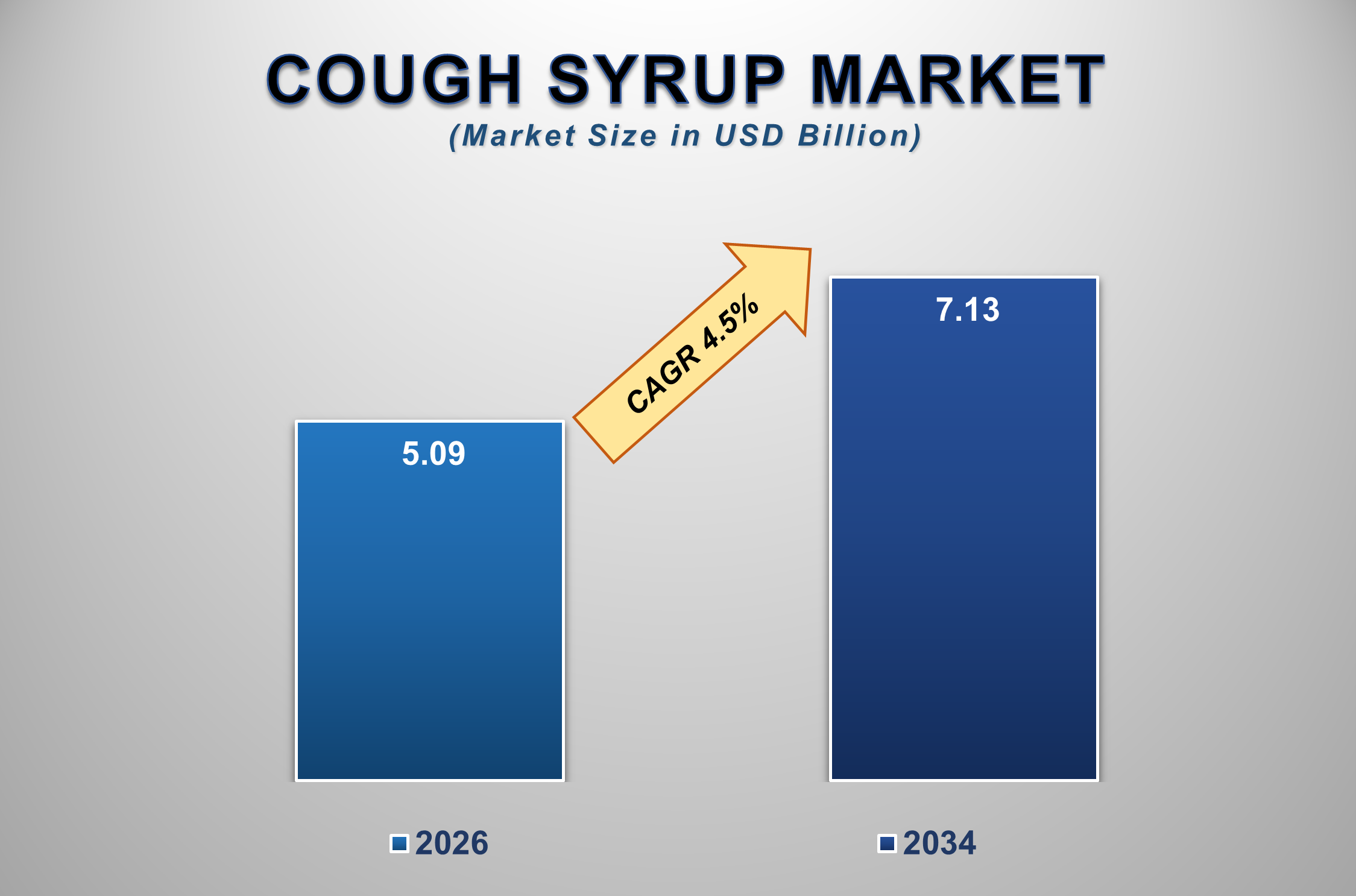
Global Cough Syrup Market Size was valued at USD 5.09 billion in 2026 and is
projected to reach USD 7.13 billion by 2034, expanding at a CAGR of 4.5% during
the forecast period. The worldwide cough syrup market consists of prescription
and over-the-counter (OTC) liquid medicines designed to treat coughs caused by
respiratory diseases and allergies. The market includes expectorants,
antitussives, and combination products, containing active substances such as
antihistamines, decongestants, mucolytics, and herbal ingredients, for the
treatment of both children and adults. The crucial reasons for the expansion of
the market are the rise in the number of patients suffering from respiratory
diseases, the increasing tendency of self-medication among patients, the
availability of OTC medications, and improved access to different health
services. Furthermore, increased demand for alcohol-free, sugar-free, and herbal
products and innovations in product formulation, flavor improvement, and
packaging make the patients more engaged and encouraged to use the products.
The rapid growth of retail shops and online pharmacies, especially in
developing countries, serves as an addition to the development of the cough
syrup market.
Cough Syrup Market Drivers and Opportunities
Rising Prevalence of Respiratory Diseases and
Seasonal Infections Driving Market Growth
The
persistent rise of respiratory diseases and seasonal infections boosts the
global cough syrup market. The growing incidence of disease occurrences is
making the need for efficient cough treatment more urgent, from COVID-19 to
influenza, RSV, the cold, bronchitis, asthma, and COPD. According to the U.S.
Centers for Disease Control and Prevention (CDC), as of March 2026, the
combined hospitalization rate of COVID-19, influenza, and RSV peaked at 16.6
hospitalizations per 100,000 population in the 2025–2026 respiratory season,
remaining nearly at 20% of the maximum last year at 19.5 cases per 100,000,
which indicates the ongoing effects of respiratory diseases. Such disease
prevalence, along with high levels of air pollution and seasonal infections,
will guarantee the continued demand for the use of OTC and prescription cough
syrups.
Growing
Consumer Preference for Over-the-Counter (OTC) Self-Medication Fueling Market
Expansion
The
rising popularity of self-medication through OTC medications is one of the key
drivers helping in the growth of the global cough syrup market. As it is easy
and cheap to purchase OTC cough syrups without a prescription, consumers are
using them to manage minor or moderate symptoms like cough, sore throat, and
blockage. Growing health awareness, busy schedules, and easier access to
pharmacies – offline as well as online – have contributed to the increased
trend of self-care methods among consumers in the market. Apart from this,
different drug manufacturing companies providing both branded and generic cough
syrups, combined with more ingredients being recommended by pharmacists, have
been beneficial in driving the market forward.
Increasing
Demand for Natural and Clean-Label Cough Syrups Creates Significant Growth
Opportunities
The
increasing preference of consumers for natural healthcare products is creating
plenty of opportunities for growth in the global cough syrup market. The
awareness of possible side effects associated with unnatural products is
leading to demand for products created with herbal ingredients, including
honey, ginger, ivy leaves, thyme, etc. Moreover, customers are looking for
syrup products that do not have sugar, alcohol, preservatives, or dyes.
Therefore, due to increasing competition, manufacturers have to offer a diverse
range of products that utilize clean-label ingredients.
Cough
Syrup Market Scope
|
Report
Attributes |
Description |
|
Market Size in 2026 |
USD
5.09 Billion |
|
Market Forecast in 2034 |
USD 7.13 Billion |
|
CAGR % 2026-2034 |
4.5% |
|
Base Year |
2025 |
|
Historic Data |
2021-2025 |
|
Forecast Period |
2026-2034 |
|
Report USP |
Pricing
and Cost Structure Analysis, Product Innovation Benchmarking, Whitespace
Assessment,
Company Share, Company Heatmap, Growth Factors, and more |
|
Segments Covered |
·
By Product Type ·
By Type ·
By Cough Type ·
By Distribution Channel |
|
Regional Scope |
·
North
America ·
Europe
·
APAC ·
Latin
America ·
Middle
East and Africa |
|
Country Scope |
·
U.S. ·
Canada ·
U.K. ·
Germany ·
France ·
Italy ·
Spain ·
Russia ·
China ·
India ·
Japan ·
South Korea ·
Australia ·
Mexico ·
Brazil ·
Saudi Arabia ·
UAE ·
South Africa |
Cough
Syrup Market Report Segmentation Analysis
The
global cough syrup market industry analysis is segmented by product type, by
type, by cough type, by distribution channel, and by region.
Expectorants
Segment Is Expected to Dominate the Cough Syrup Market During the Forecast
Period
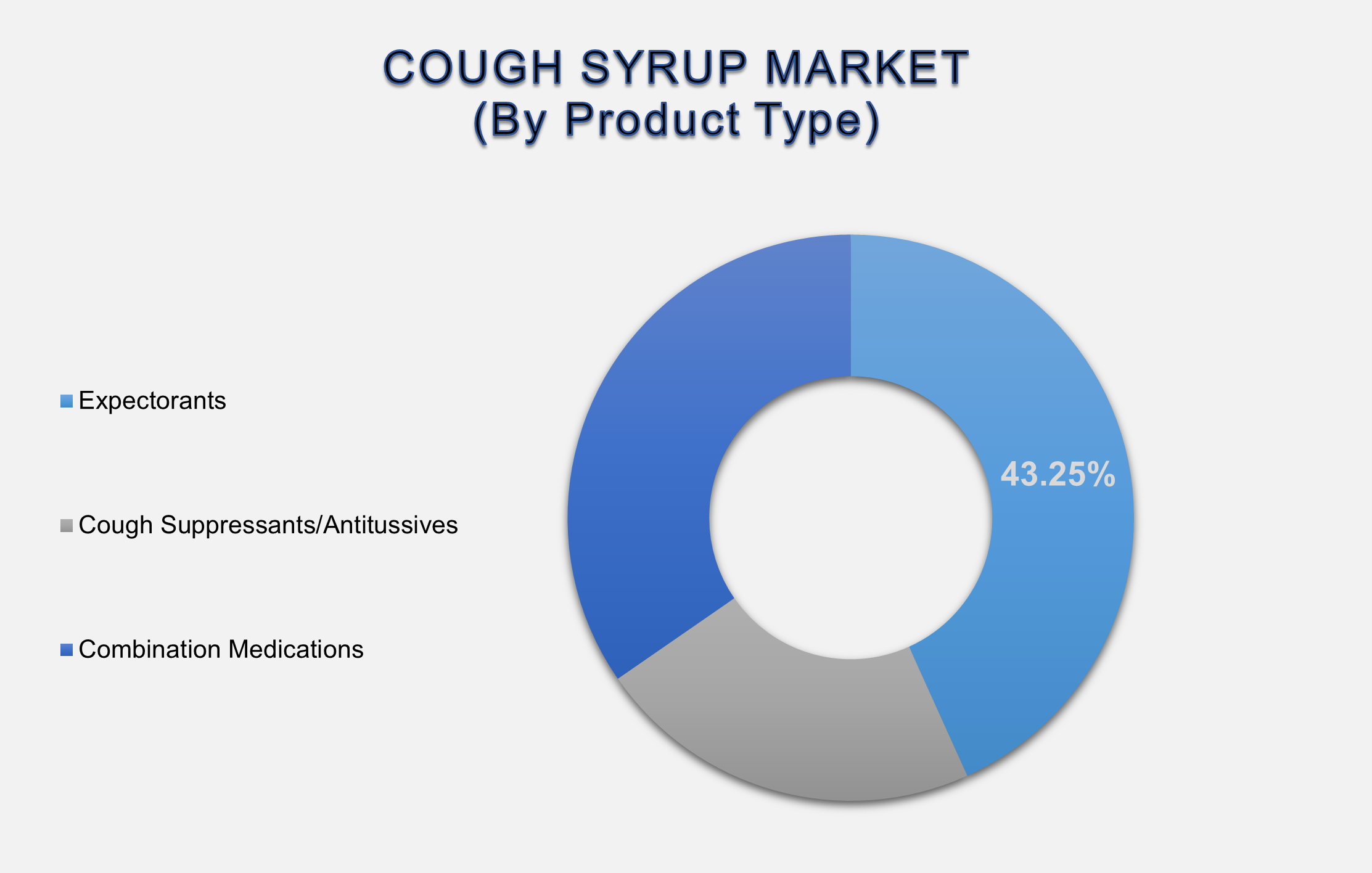
The
expectorants will lead the global cough syrup market in the years to come owing
to various kinds of cases of productive cough associated with different
diseases like the cold, flu, bronchitis, COVID-19, and COPD. Expectorants work
by thinning and loosening mucus, which results in making breathing easier and
hence makes them the first choice to treat a productive cough. The upsurge of
seasonal respiratory diseases, pollution problems, as well as respiratory
illnesses linked to smoking contribute to the growing demand for cough syrups
with expectorants. Moreover, as expectorants can be found in prescription
medications and OTC drugs, the popularity of the self-medication concept will
facilitate the growth of this market segment.
Over-the-Counter
Segment Is Expected to Lead the Cough Syrup Market by Type
The
OTC market is projected to dominate the global cough syrup industry throughout
the estimated period. This is due to the increasing preference for
self-medication among clients as well as the easy access to OTC drugs via
retail and online pharmacies. This is because patients now prefer using OTC
syrups for the treatment of mild-to-moderate symptoms associated with the common
cold, flu, allergic conditions, and respiratory tract diseases. The growth in
the segment can be attributed to affordability, availability of branded and
generic products, as well as rising health concerns and pharmacies. Another
contributing factor to the segment’s successful performance is an increase in
demand for herbal and non-sugar cough syrups.
Wet
Cough Segment Is Expected to Lead the Cough Syrup Market by Cough Type
The
wet cough aspect is projected to dominate the worldwide cough syrup industry
over the estimation duration due to the high incidence of respiratory diseases
that lead to a high production of mucus, such as cold, flu, bronchitis, COVID,
and COPD. Since wet coughs usually need medications like expectorants and
mucolytic medicines to help loosen and clear mucus, cough syrups become a
well-advised solution. The increasing rate of respiratory illnesses during
seasons, increased air pollution, and higher levels of smoking-related
respiratory issues are making wet cough medicines more popular. Furthermore,
the ready availability of both prescription and OTC cough syrups aimed at
relieving productive cough will allow this segment to hold its position in the
market.
The following segments are part of an in-depth analysis of the
global cough syrup market:
|
Market Segments |
|
|
By Product
Type |
· Expectorants · Cough
Suppressants/Antitussives · Combination
Medications |
|
By Type |
· Prescription · Over-the-Counter |
|
By Cough
Type |
· Dry
Cough · Wet
Cough |
|
By
Distribution Channel |
· Retail
Pharmacy · Hospital
Pharmacy · Online
Pharmacy |
Cough
Syrup Market Share Analysis by Region
North America is projected to hold the largest share of the global
cough syrup market over the forecast period
The
cough syrup market worldwide will likely see North America contribute the
biggest slice by the end of the forecast period, fueled by the dominant
prevalence of respiratory conditions, seasonal flu, COVID-19, allergies, and
the likes of asthma and chronic obstructive pulmonary disease (COPD), among
others. North America will take advantage of its well-placed healthcare
infrastructure, availability of OTC and prescription cough syrups, and
widespread self-medication choices. Besides, the existence of some of the major
pharmaceutical companies, a well-placed retail and online pharmacy system,
continuous innovations in products, and relaxed regulations will also enhance
the growth of the market. The ever-growing need for natural, sugar-free, and
clean-label cough syrups will help it retain its market leadership in the
forecast period.
Cough
Syrup Market Competition Landscape Analysis
The
Cough Syrup Market involves competitors like pharmaceutical companies,
manufacturers of consumer healthcare products, producers of generic drugs, and
companies manufacturing over-the-counter (OTC) drugs. The competitive firms are
keen on expanding their product offerings, especially in respiratory care, and
creating distinctive formulations for cough syrups. The focus of the industry
actors is primarily on innovation, leading to the emergence of several unique
and advanced products such as sugar-free, herbal, alcohol-free,
children-friendly, and clean label products while perfecting other attributes
such as taste, dosage, and compliance. The level of competition in the industry
is high, and it is determined by the presence of new product launches, approval
obtained from regulators, and expansion of brands through acquisition and
establishment of joint ventures, as well as continued efforts to invest in
research and development activities in order to strengthen the market share.
Global Cough Syrup Market Recent Developments News:
· In
June 2026 - India amended the Drugs Rules, 1945, making all cough syrups
prescription-only medicines by removing syrups from Schedule K exemptions. The
move aims to strengthen safety oversight following contamination incidents.
· In
December 2025 - Pfizer India and Cipla Limited announced a partnership where
Cipla exclusively markets and distributes four brands of Pfizer in India. Under
the agreement, Cipla now has the sole right to market, distribute and sell the
cough syrup Corex Dx and Corex LS, the non-steroidal anti-inflammatory drug
(NSAID) Dolonex, the proton pump inhibitor (PPI) Neksium and the oral
antibiotic Dalacin C in India.
The
global cough syrup market is
dominated by a few large companies, such as
·
Abbott Laboratories
·
Aurobindo Pharma Limited
·
Bayer AG
·
Boehringer Ingelheim
·
Cipla Limited
·
Dr. Reddy's Laboratories Ltd.
·
Haleon plc
·
Hikma Pharmaceuticals PLC
·
Kenvue Inc.
·
Lupin Limited
·
Opella Healthcare Group
·
Perrigo Company plc
·
Prestige Consumer Healthcare Inc.
·
Procter & Gamble Company
·
Reckitt Benckiser Group plc
·
Sun Pharmaceutical Industries Limited
·
Teva Pharmaceutical Industries Ltd.
·
Zydus Lifesciences Limited
· Other Prominent Players
Frequently Asked Questions
Swetal (Research Analyst)
1.
Global
Cough Syrup Market Introduction and Market Overview
1.1. Objectives of the Study
1.2. Market Segmentation
1.2.1.Product Type of the Global Cough
Syrup Market
1.2.2.Type of the Global Cough Syrup
Market
1.2.3.Cough Type of the Global Cough
Syrup Market
1.2.4.Distribution Channel of the
Global Cough Syrup Market
1.2.5.Region of the Global Cough Syrup
Market
1.3. Competition Coverage List of
Market Participants
1.4. Market Definition: Cough Syrup
Market
2.
Executive Summary
2.1. Global Cough Syrup Market
Estimation & Forecast
2.1.1.Global Cough Syrup Market Size
(US$ Million) Estimates & Historical Trend Analysis (2021 - 2025)
2.1.2.Global Cough Syrup Overall
Market Size (US$ Million), Growth Rate (Y-o-Y), Market CAGR (%), Market
Forecast (2026 - 2034)
2.2. Snapshot of Global Cough Syrup
Market
2.3. Global Cough Syrup Market
Revenue Share (%) 2025
2.4. REGIONAL OUTLINE: Revenue CAGR,
by Region
2.5. Key Competitors & Key
Insights
3.
Market Overview (Qualitative
Analysis)
3.1. Demand Side Trends
3.2. Supply Side Trends /
Manufacturing Trends
3.3. Demand and Opportunity Assessment,
2026 - 2034
3.4. Market Dynamics
3.4.1.Drivers
3.4.2.Limitations
3.4.3.Opportunities
3.4.4.Impact Analysis of Drivers and
Restraints
3.5. Key Developments
3.6. Regulatory Landscape
3.7. Pricing Analysis
3.8. Supply Chain Analysis
3.9. Porter’s Five Forces Analysis
3.9.1.Bargaining Power of Suppliers
3.9.2.Bargaining Power of Buyers
3.9.3.Threat of Substitutes
3.9.4.Threat of New Entrants
3.9.5.Competitive Rivalry
3.10. PEST Analysis
3.10.1. Political Factors
3.10.2. Economic Factors
3.10.3. Social Factors
3.10.4. Technology Factors
4.
Global Cough Syrup Market
Estimates & Forecast Trend Analysis, by Product Type
4.1. Global Cough Syrup Market
Assessments & Key Findings, by Product Type
4.2. Global Cough Syrup Market
Revenue (US$ Million) Estimates and Forecasts, by Product Type, 2021 - 2034
4.2.1.Expectorants
4.2.2.Cough Suppressants/Antitussives
4.2.3.Combination Medications
5.
Global Cough Syrup Market
Estimates & Forecast Trend Analysis, by Type
5.1. Global Cough Syrup Market
Assessments & Key Findings, by Type
5.2. Global Cough Syrup Market
Revenue (US$ Million) Estimates and Forecasts, by Type, 2021 - 2034
5.2.1.Prescription
5.2.2.Over-the-Counter
6.
Global Cough Syrup Market
Estimates & Forecast Trend Analysis, by Cough Type
6.1. Global Cough Syrup Market
Assessments & Key Findings, by Cough Type
6.2. Global Cough Syrup Market
Revenue (US$ Million) Estimates and Forecasts, by Cough Type, 2021 - 2034
6.2.1.Dry Cough
6.2.2.Wet Cough
7.
Global Cough Syrup Market
Estimates & Forecast Trend Analysis, by Distribution Channel
7.1. Global Cough Syrup Market
Assessments & Key Findings, by Distribution Channel
7.2. Global Cough Syrup Market
Revenue (US$ Million) Estimates and Forecasts, by Distribution Channel, 2021 -
2034
7.2.1.Retail Pharmacy
7.2.2.Hospital Pharmacy
7.2.3.Online Pharmacy
8.
Global Cough Syrup Market
Estimates & Forecast Trend Analysis, by Region
8.1.
Global
Cough Syrup Market Assessments & Key Findings, by Region
8.2.
Global
Cough Syrup Market Revenue (US$ Million) Estimates and Forecasts, by Region,
2021 - 2034
8.2.1.North America
8.2.2.Europe
8.2.3.Asia Pacific
8.2.4.Middle East & Africa
8.2.5.Latin America
9.
North
America Cough Syrup Market: Estimates & Forecast Trend Analysis
9.1. North America Cough Syrup Market
Assessments & Key Findings
9.1.1.North America Cough Syrup Market
Introduction
9.1.2.North America Cough Syrup Market
Size Estimates and Forecast (US$ Million) (2021 - 2034)
9.1.2.2. By Type
9.1.2.3. By Cough Type
9.1.2.4. By Distribution Channel
9.1.2.5. By Country
9.1.2.5.1. The U.S.
9.1.2.5.2. Canada
10. Europe Cough
Syrup Market: Estimates & Forecast
Trend Analysis
10.1. Europe Cough Syrup Market
Assessments & Key Findings
10.1.1. Europe Cough Syrup Market
Introduction
10.1.2. Europe Cough Syrup Market Size
Estimates and Forecast (US$ Million) (2021 - 2034)
10.1.2.1. By Product Type
10.1.2.2. By Type
10.1.2.3. By Cough Type
10.1.2.4. By Distribution Channel
10.1.2.5. By Country
10.1.2.5.1.
Germany
10.1.2.5.2.
Italy
10.1.2.5.3.
U.K.
10.1.2.5.4.
France
10.1.2.5.5.
Spain
10.1.2.5.6.
Switzerland
10.1.2.5.7. Rest
of Europe
11. Asia Pacific Cough
Syrup Market: Estimates & Forecast
Trend Analysis
11.1. Asia Pacific Market Assessments
& Key Findings
11.1.1. Asia Pacific Cough Syrup Market
Introduction
11.1.2. Asia Pacific Cough Syrup Market
Size Estimates and Forecast (US$ Million) (2021 - 2034)
11.1.2.1. By Product Type
11.1.2.2. By Type
11.1.2.3. By Cough Type
11.1.2.4. By Distribution Channel
11.1.2.5. By Country
11.1.2.5.1. China
11.1.2.5.2. Japan
11.1.2.5.3. India
11.1.2.5.4. Australia
11.1.2.5.5. South Korea
11.1.2.5.6. Rest of Asia Pacific
12. Middle East & Africa Cough
Syrup Market: Estimates & Forecast
Trend Analysis
12.1. Middle East & Africa Market
Assessments & Key Findings
12.1.1. Middle
East & Africa Cough
Syrup Market Introduction
12.1.2. Middle
East & Africa Cough
Syrup Market Size Estimates and Forecast (US$ Million) (2021 - 2034)
12.1.2.1. By Product Type
12.1.2.2. By Type
12.1.2.3. By Cough Type
12.1.2.4. By Distribution Channel
12.1.2.5. By Country
12.1.2.5.1. South Africa
12.1.2.5.2. UAE
12.1.2.5.3. Saudi Arabia
12.1.2.5.4. Rest of MEA
13. Latin America
Cough Syrup Market: Estimates &
Forecast Trend Analysis
13.1. Latin America Market Assessments
& Key Findings
13.1.1. Latin America Cough Syrup Market
Introduction
13.1.2. Latin America Cough Syrup Market
Size Estimates and Forecast (US$ Million) (2021 - 2034)
13.1.2.1. By Product Type
13.1.2.2. By Type
13.1.2.3. By Cough Type
13.1.2.4. By Distribution Channel
13.1.2.5. By Country
13.1.2.5.1. Brazil
13.1.2.5.2. Mexico
13.1.2.5.3. Argentina
13.1.2.5.4. Rest of LATAM
14. Competition Landscape
14.1. Global Cough Syrup Market
Product Mapping
14.2. Global Cough Syrup Market
Concentration Analysis, by Leading Players / Innovators / Emerging Players /
New Entrants
14.3. Global Cough Syrup Market Tier
Structure Analysis
14.4. Global Cough Syrup Market
Concentration & Company Market Shares (%) Analysis, 2025
15. Company Profiles
15.1. Abbott Laboratories
15.1.1. Company Overview & Key Stats
15.1.2. Financial Performance & KPIs
15.1.3. Product Portfolio
15.1.4. SWOT Analysis
15.1.5. Business Strategy & Recent
Developments
* Similar details would be provided
for all the players mentioned below
15.2. Aurobindo Pharma Limited
15.3. Bayer AG
15.4. Boehringer Ingelheim
15.5. Cipla Limited
15.6. Dr. Reddy's Laboratories Ltd.
15.7. Haleon plc
15.8. Hikma Pharmaceuticals PLC
15.9. Kenvue Inc.
15.10. Lupin Limited
15.11. Opella Healthcare Group
15.12. Perrigo Company plc
15.13. Prestige Consumer Healthcare
Inc.
15.14. Procter & Gamble Company
15.15. Reckitt Benckiser Group plc
15.16. Sun Pharmaceutical Industries
Limited
15.17. Teva Pharmaceutical Industries
Ltd.
15.18. Zydus Lifesciences Limited
15.19. Other Prominent Players
16. Research
Findings & Conclusion
17. Assumptions & Acronyms Used
18. Research
Methodology
18.1. External Transportation /
Databases
18.2. Internal Proprietary Database
18.3. Primary Research
18.4. Secondary Research
18.5. Assumptions
18.6. Limitations
18.7. Report FAQs
Our Research Methodology
"Insight without rigor is just noise."
We follow a comprehensive, multi-phase research framework designed to deliver accurate, strategic, and decision-ready intelligence. Our process integrates primary and secondary research , both quantitative and qualitative , along with dual modeling techniques ( top-down and bottom-up) and a final layer of validation through our proprietary in-house repository.
PRIMARY RESEARCH
Primary research captures real-time, firsthand insights from the market to understand behaviors, motivations, and emerging trends.
1. Quantitative Primary Research
Objective: Generate statistically significant data directly from market participants.
Approaches:- Structured surveys with customers, distributors, and field agents
- Mobile-based data collection for point-of-sale audits and usage behavior
- Phone-based interviews (CATI) for market sizing and product feedback
- Online polling around industry events and digital campaigns
- Purchase frequency by customer type
- Channel performance across geographies
- Feature demand by application or demographic
2. Qualitative Primary Research
Objective: Explore decision-making drivers, pain points, and market readiness.
Approaches:- In-depth interviews (IDIs) with executives, product managers, and key decision-makers
- Focus groups among end users and early adopters
- Site visits and observational research for consumer products
- Informal field-level discussions for regional and cultural nuances
SECONDARY RESEARCH
This phase helps establish a macro-to-micro understanding of market trends, size, regulation, and competitive dynamics, sourced from credible and public domain information.
1. Quantitative Secondary Research
Objective: Model market value and segment-level forecasts based on published data.
Sources include:- Financial reports and investor summaries
- Government trade data, customs records, and regulatory statistics
- Industry association publications and economic databases
- Channel performance and pricing data from marketplace listings
- Revenue splits, pricing trends, and CAGR estimates
- Supply-side capacity and volume tracking
- Investment analysis and funding benchmarks
2. Qualitative Secondary Research
Objective: Capture strategic direction, innovation signals, and behavioral trends.
Sources include:- Company announcements, roadmaps, and product pipelines
- Publicly available whitepapers, conference abstracts, and academic research
- Regulatory body publications and policy briefs
- Social and media sentiment scanning for early-stage shifts
- Strategic shifts in market positioning
- Unmet needs and white spaces
- Regulatory triggers and compliance impact
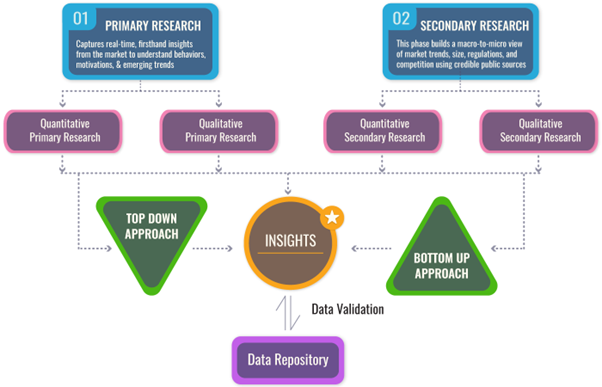
DUAL MODELING: TOP-DOWN + BOTTOM-UP
To ensure robust market estimation, we apply two complementary sizing approaches:
Top-Down Modeling:- Start with broader industry value (e.g., global or regional TAM)
- Apply filters by segment, geography, end-user, or use case
- Adjust with primary insights and validation benchmarks
- Ideal for investor-grade market scans and opportunity mapping
- Aggregate from the ground up using sales volumes, pricing, and unit economics
- Use internal modeling templates aligned with stakeholder data
- Incorporate distributor-level or region-specific inputs
- Most accurate for emerging segments and granular sub-markets
DATA VALIDATION: IN-HOUSE REPOSITORY
We close the loop with proprietary data intelligence built from ongoing projects, industry monitoring, and historical benchmarking. This repository includes:
- Multi-sector market and pricing models
- Key trendlines from past interviews and forecasts
- Benchmarked adoption rates, churn patterns, and ROI indicators
- Industry-specific deviation flags and cross-check logic
- Catches inconsistencies early
- Aligns projections across studies
- Enables consistent, high-trust deliverables