

Crop Insurance Market Size and Forecast (2025–2033), Global and Regional Analysis, Share, Trends, and Industry Outlook, By Type (Multi-peril Crop Insurance (MPCI), Crop-hail Insurance, Revenue Insurance), By Coverage (Yield Protection, Revenue Protection, Price Protection), By Distribution Channel (Government Agencies, Insurance Companies, Others), and Geography
2026-01-02
Agriculture Industry
Jaya Bundele (Research Analyst)
Description
Crop Insurance Market Overview
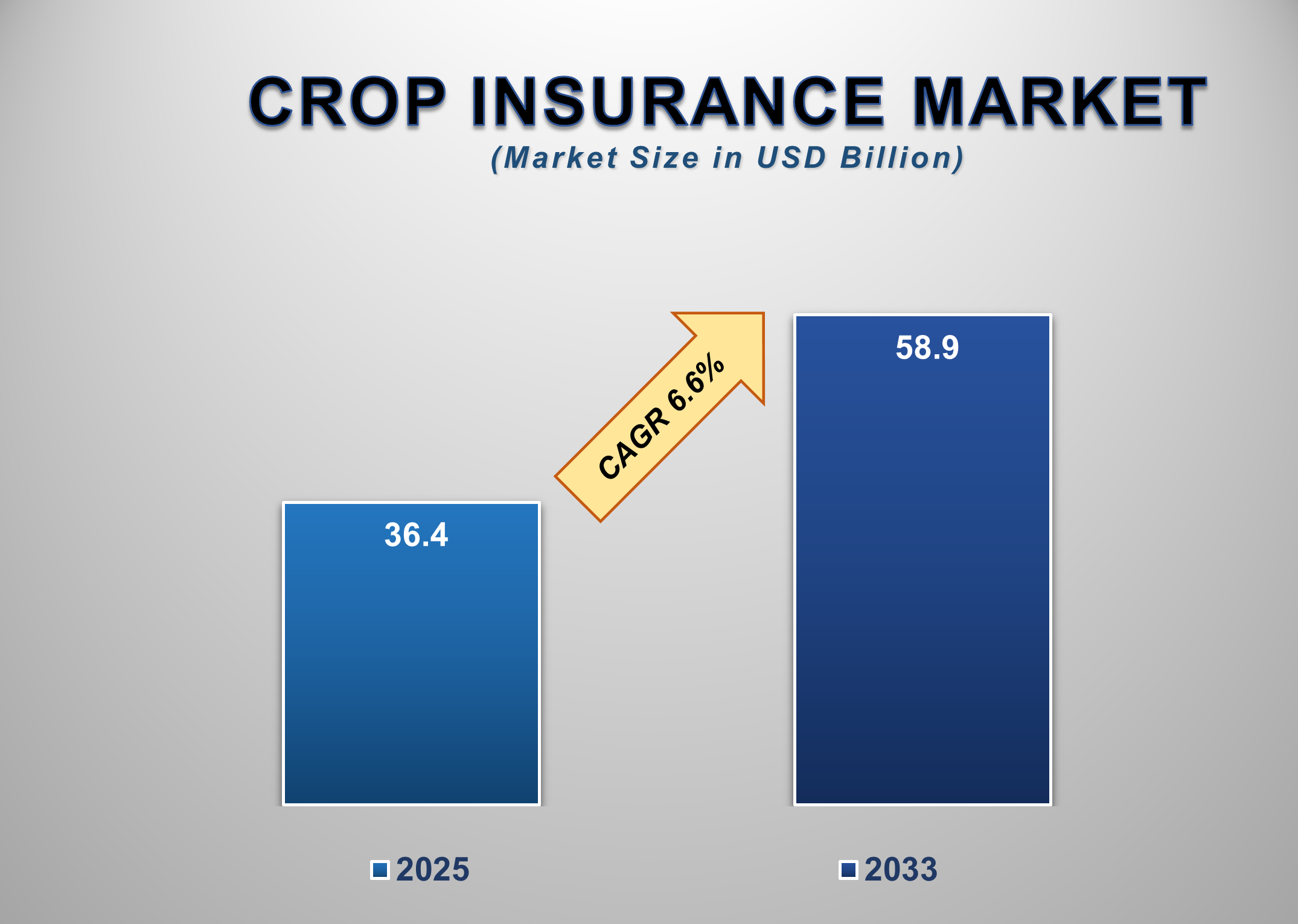
The Global Crop Insurance Market is experiencing steady expansion as nations strengthen agricultural resilience amid rising climate uncertainties, increased production risks, and the need for financial protection for farmers. Valued at USD 36.4 billion in 2025, the market is projected to reach USD 58.9 billion by 2033, reflecting a CAGR of 6.6%. Farmers worldwide face rising economic exposure due to unpredictable weather patterns, disease outbreaks, pest infestations, and volatile commodity prices. Crop insurance provides a crucial financial buffer that helps stabilize farmers’ incomes, reduces reliance on emergency government subsidies, and strengthens food security systems. The market has evolved from simple yield-based protection to sophisticated revenue and price protection products supported by advanced data analytics, remote sensing, and predictive risk modeling.
Government-led programs remain
fundamental to market expansion, particularly in developing economies where
subsidies and public-private partnerships (PPPs) make insurance more affordable
for smallholder farmers. Meanwhile, private insurers are advancing innovative
index-based insurance models and digital distribution platforms to expand
reach. Technological integration is growing rapidly, with satellite-based
monitoring, AI-driven risk scoring, and automated claims management enhancing
accuracy and operational efficiency. With climate risks intensifying globally,
the industry is expected to witness strong demand from both large commercial
farms and smallholders seeking stable risk mitigation solutions. Moreover,
digital transformation and expanded government funding will play a pivotal role
in accelerating global market penetration over the forecast period.
Crop Insurance Market
Drivers and Opportunities
Rising Climate Variability and Weather-related Losses Are
Driving the Crop Insurance Market Growth
Rising climate instability is one of the strongest forces
accelerating the demand for crop insurance globally. Farmers are increasingly
exposed to extreme weather events, including droughts, floods, heatwaves,
hailstorms, and unseasonal rainfall. These unpredictable changes are directly
impacting yields, lowering farm productivity, and threatening the stability of
agricultural supply chains. As climate change intensifies, crop losses have
become more frequent and severe, increasing the financial burden on farmers and
governments alike. Crop insurance provides essential risk transfer mechanisms
that help stabilize farm incomes and reduce reliance on emergency relief
programs. This is especially critical in emerging economies where agriculture
remains the backbone of rural livelihoods.
Furthermore, governments worldwide are strengthening subsidy
programs and expanding public-private partnerships to increase insurance
penetration among smallholders. These initiatives are supported by advancements
in remote sensing, precision agriculture, and climate modeling tools, which
allow insurers to assess risks more accurately and streamline claims
processing. Index-based insurance solutions triggered by satellite or weather
station data are also gaining traction, offering faster and more transparent
claim settlements. As farmers become increasingly aware of the financial risks
associated with climate unpredictability, demand for protection is rising. This
combination of climate-driven vulnerabilities and technological maturity is
expected to fuel sustained market growth throughout the forecast period.
Growing Adoption of Digital Agricultural Platforms and
InsurTech Innovations Is Supporting Market Expansion
Digitization is transforming the crop insurance industry, enabling
faster enrollment, customized policy design, and more accurate loss assessment.
The increasing adoption of digital agriculture tools such as mobile-based farm
management platforms, remote sensing technologies, and AI-driven analytics is
helping insurers create data-rich risk profiles. These tools enable
high-precision underwriting by analyzing soil data, crop health, vegetation
indices, and regional climate patterns. As a result, insurers can provide
tailored insurance products that better reflect the actual risk exposure of
individual farms. Digital payment systems and mobile wallets are further
promoting accessibility in rural areas, allowing farmers to purchase coverage
and receive claim payouts seamlessly.
InsurTech-driven innovations such as satellite-based crop
monitoring, automated yield forecasting, blockchain-enabled claim verification,
and drone-assisted field assessments are reshaping the value chain.
Weather-index and parametric insurance models supported by IoT sensors are
seeing widespread adoption due to their fast, transparent claim workflows.
Governments and private insurers are leveraging these technologies to reduce
fraud, minimize administrative costs, and expand coverage to remote regions where
traditional field-based assessments are challenging. As digital ecosystems
mature and smartphone penetration increases, the industry is witnessing
improved insurance literacy and stronger farmer engagement. This technological
acceleration is expected to solidify digital channels as a major growth
contributor for the global crop insurance market.
Growing Government Support and Subsidized Insurance Programs
Are Creating Significant Market Opportunities Worldwide
Governments worldwide are increasing their focus on agricultural
risk management, opening major growth opportunities for crop insurance
providers. Subsidized programs that lower premiums for farmers are expanding in
countries such as India, China, the U.S., and Brazil, helping improve
affordability and insurance penetration levels. Many nations are implementing
reforms to encourage private sector participation in public crop insurance
schemes, fostering competition and improving product innovation. Strengthened
public-private partnerships (PPPs) are emerging as a key opportunity area,
enabling insurers to scale operations while reducing fiscal burdens on
governments. Another promising opportunity lies in expanding insurance coverage
for high-value crops, horticulture crops, and specialty farming systems that
traditionally lacked structured risk protection. With increased investment in
agricultural modernization, agribusiness firms and cooperatives are adopting
group insurance models, opening new B2B revenue streams for insurers. Enhanced
adoption of climate-resilient seed varieties and precision farming practices is
also reshaping coverage needs, paving the way for dynamic and customized
insurance products. As governments continue to strengthen agricultural resilience
frameworks, insurers are positioned to leverage policy reforms, digital
schemes, and expanded subsidy networks. These developments are expected to
unlock strong market opportunities across Asia-Pacific, Latin America, and
Africa during the forecast period.
Crop Insurance Market
Scope
|
Report Attributes |
Description |
|
Market Size in 2025 |
USD 36.4 Billion |
|
Market Forecast in 2033 |
USD 58.9 Billion |
|
CAGR % 2025-2033 |
6.6% |
|
Base Year |
2024 |
|
Historic Data |
2020-2024 |
|
Forecast Period |
2025-2033 |
|
Report USP |
Production, Consumption,
Company Share, Company Heatmap, Company Production Capacity, Growth Factors,
and more |
|
Segments Covered |
●
By Type, By
Coverage, By Distribution Channel |
|
Regional Scope |
●
North America, ●
Europe, ●
APAC, ●
Latin America ●
Middle East and
Africa |
|
Country Scope |
1)
U.S. 2)
Canada 3)
Germany 4)
UK 5)
France 6)
Spain 7)
Italy 8)
Switzerland 9)
China 10)
Japan 11)
India 12)
Australia 13)
South Korea 14)
Brazil 15)
Mexico 16)
Argentina 17)
South Africa 18)
Saudi Arabia 19)
UAE |
Crop Insurance Market
Report Segmentation Analysis
The Global Crop Insurance Market
is segmented by Type, by Coverage, by Distribution Channel, and by Geography.
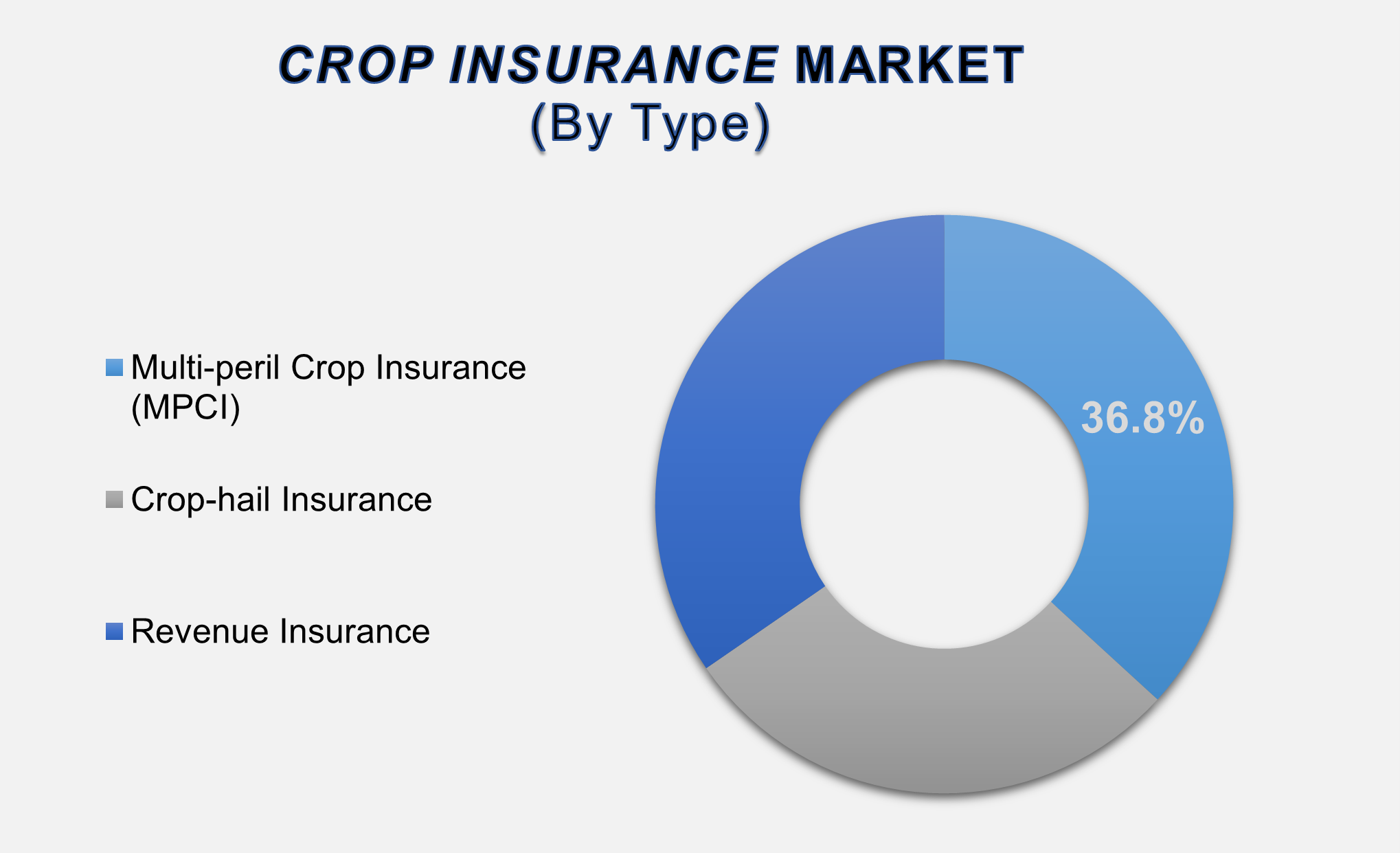
The Multi-peril Crop
Insurance (MPCI) Segment Accounted for the Largest Market Share in the Global
Crop Insurance Market
The
Multi-peril Crop Insurance (MPCI) segment accounted for the largest market
share in the global crop insurance market and continues to dominate due to its
extensive risk coverage and widespread adoption among farmers. This segment
offers comprehensive protection against multiple risks, including drought,
flood, pests, diseases, and adverse weather events, making it the most reliable
option for managing unpredictable farming conditions. MPCI policies are
particularly preferred in developing economies, where climatic variations and
yield uncertainties pose significant challenges for farmers. Governments in
countries such as India, China, and Brazil actively support MPCI through
subsidies and public-private partnerships, further strengthening its adoption.
The segment’s growth is also driven by digital innovations such as satellite-based monitoring, remote sensing, and automated claim settlement systems, which increase transparency and reduce administrative complexities. Insurers are enhancing MPCI offerings by integrating AI-based predictive models to assess yield and climate risks with greater accuracy. As climate volatility intensifies globally, MPCI is expected to remain the cornerstone of agricultural risk mitigation strategies, especially for staple crops such as wheat, rice, maize, and soybeans. The rising need for comprehensive coverage and government-backed affordability measures will ensure sustained dominance for MPCI throughout the forecast period.
Yield Protection Segment
Leads the Market Under the Coverage Category
The
Yield Protection segment accounted for the largest share within the coverage
category and continues to gain traction as farmers seek stable income security
amid rising yield variability. This segment protects growers against losses
stemming from lower-than-expected crop yields caused by adverse weather, pests,
and disease outbreaks. Yield Protection is particularly valued in regions where
agriculture is highly vulnerable to climatic fluctuations, including
Asia-Pacific, Africa, and Latin America. The segment’s popularity is reinforced
by government-led programs that make yield-based insurance policies affordable
and accessible through premium subsidies. Advancements in digital agriculture
are strengthening this coverage type, with satellite imaging, crop-health
monitoring, and vegetation index analytics significantly improving yield
estimation accuracy. These technologies enable insurers to assess risks more
effectively and expedite claims processing, enhancing overall service
reliability. Growth is further supported by increasing adoption of modern
farming techniques, precision agriculture, and standardized yield-data
collection practices, which contribute to better actuarial assessments. As
weather-related uncertainties continue to escalate, the Yield Protection
segment is expected to maintain its leading position, driven by rising farmer
awareness and investments in agricultural productivity enhancement tools.
Government Agencies
Segment Accounted for the Largest Share in the Global Crop Insurance Market
The
Government Agencies segment accounted for the largest share in the global crop
insurance market, supported by strong public-sector involvement in structuring,
funding, and distributing agricultural insurance programs. In most countries,
crop insurance is heavily subsidized to ensure that small and marginal farmers
can afford adequate protection. Government agencies play a pivotal role in
premium support, claim verification, policy administration, and partnership
formation with private insurers. Nations such as India, China, the U.S., and
several European countries operate extensive public crop insurance schemes
covering millions of farmers annually. This dominance is further reinforced by
the development of policies tailored specifically for local agricultural
conditions, supported by regulatory frameworks that mandate coverage for
vulnerable crops. The segment is also benefiting from digitization initiatives
within government programs, such as mobile-based enrollment, online claim
tracking, Aadhaar-linked farmer databases (in India), and remote sensing-based
assessments. By expanding subsidy frameworks, enhancing financial literacy, and
investing in digital agriculture infrastructure, governments are strengthening
risk management mechanisms across the farming ecosystem. Given the strategic
importance of food security and rural economic stability, government agencies
are expected to retain their leadership in the distribution of crop insurance
throughout the forecast period.
The following segments are
part of an in-depth analysis of the global Crop Insurance market:
|
Market Segments |
|
|
by Type |
●
Multi-peril Crop
Insurance (MPCI) ●
Crop-hail Insurance ●
Revenue Insurance |
|
by Coverage |
●
Yield Protection ●
Revenue Protection ●
Price Protection |
|
By
Distribution Channel |
●
Government Agencies ●
Insurance Companies ●
Others |
Crop Insurance Market
Share Analysis by Region
The Asia Pacific region
is projected to hold the largest share of the global Crop Insurance market over
the forecast period
Asia-Pacific
dominated the global crop insurance market with a 40.1% share in 2025, driven
by strong government-led programs, increasing farmer awareness, and rapidly
expanding adoption of risk mitigation solutions. Countries such as China and
India operate some of the world’s largest agricultural insurance schemes,
supported by extensive premium subsidies, digital enrollment systems, and
improved access to financial services. These programs offer large-scale
coverage for staple crops and high-value horticulture, enabling millions of
smallholder farmers to safeguard their livelihoods. Climate change, frequent
floods, droughts, and pest outbreaks further elevate demand for comprehensive
insurance solutions across the region.
North
America is projected to register the fastest CAGR during the forecast period
due to advanced risk modeling techniques, strong regulatory frameworks, and
high adoption of revenue-based insurance products. The United States, in
particular, exhibits a mature and technologically sophisticated crop insurance
market backed by robust federal support and sophisticated loss assessment
tools. Europe is also witnessing steady growth, driven by Common Agricultural
Policy (CAP) reforms, digital agriculture expansion, and rising climate-related
losses. Emerging markets in Latin America and Africa are increasingly adopting
index-based insurance models supported by government initiatives and
international development agencies. Overall, global crop insurance penetration
is accelerating as climate resilience becomes a central priority for
agricultural economies.
Crop Insurance Market
Competition Landscape Analysis
The Global Crop Insurance Market
is moderately consolidated, with a blend of government-backed institutions,
multinational insurance providers, and regional players actively participating
in policy distribution and risk underwriting. Leading companies focus on
developing innovative coverage models, digital claim settlement systems, and
satellite-driven monitoring solutions to enhance underwriting accuracy.
Strategic partnerships with government agencies, agritech startups, and
international development organizations are common, enabling insurers to expand
outreach to rural and underserved farming communities.
Global Crop Insurance
Market Recent Developments News:
- In
December 2024, the Agriculture Insurance Company of India
Limited (AIC) launched ‘Fal Suraksha Bima,’ a specialized insurance
product for banana and papaya crops. Announced during AIC’s 22nd
Foundation Day, the initiative offers tailored risk coverage to protect
farmers against losses from natural calamities and other unforeseen
events, reinforcing AIC’s focus on crop-specific agricultural resilience.
- In September 2024,
Alpha Omega secured a contract with the U.S. Department of Agriculture
(USDA) to modernize its crop insurance programs. The partnership will
leverage Alpha Omega’s expertise in AI, cybersecurity, and digital
transformation to enhance risk management systems and strengthen the
resilience of American agriculture against climate variability.
The Global Crop Insurance Market
Is Dominated by a Few Large Companies, such as
●
Kshema General
Insurance Limited
●
QBE Insurance Ltd.
●
Chubb
●
Zurich
●
Sompo
●
Great American
Insurance Company
●
American International
Group, Inc.
●
Agriculture Insurance
Company of India Limited
●
Tokio Marine HCC
●
FBL Financial Group,
Inc
●
Others
FAQs
Frequently Asked Questions
Jaya Bundele (Research Analyst)
Jaya Bundele is a skilled Research Analyst with 4+ years of experience in market intelligence, consumer insights, competitive analysis, and industry forecasting across the consumer goods, agriculture, and food & beverage sectors. She specializes in market sizing, trend analysis, growth opportunity mapping, and strategic secondary research for global and regional markets.
Her expertise lies in transforming complex industry data into actionable business strategies that help organizations identify emerging trends, understand customer behavior, and gain a competitive edge. With a strong focus on data-driven insights, business intelligence, and future market trends, Jaya delivers high-quality research solutions aligned with evolving industry demands and market dynamics.
1. Global Crop Insurance
Market Introduction and Market Overview
1.1.
Objectives
of the Study
1.2.
Global
Crop Insurance Market Scope and Market Estimation
1.2.1.Global Crop Insurance
Market Overall Market Size (US$ Bn), Market CAGR (%), Market forecast (2025 - 2033)
1.2.2.Global Crop Insurance
Market Revenue Share (%) and Growth Rate (Y-o-Y) from 2020 - 2033
1.3.
Market
Segmentation
1.3.1.Type of Global Crop
Insurance Market
1.3.2.Coverage of Global Crop
Insurance Market
1.3.3.Distribution Channel of
Global Crop Insurance Market
1.3.4.Region of Global Crop
Insurance Market
2. Executive
Summary
2.1.
Demand
Side Trends
2.2.
Key
Market Trends
2.3.
Market
Demand (US$ Bn) Analysis 2020 – 2024 and Forecast, 2025 – 2033
2.4.
Demand
and Opportunity Assessment
2.5.
Demand
Supply Scenario
2.6.
Market
Dynamics
2.6.1.Drivers
2.6.2.Limitations
2.6.3.Opportunities
2.6.4.Impact Analysis of Drivers
and Restraints
2.7.
Emerging
Trends for Crop Insurance Market
2.8.
Porter’s
Five Forces Analysis
2.9.
PEST
Analysis
2.10.
Key
Regulation
3. Global
Crop Insurance Market Estimates
& Historical Trend Analysis (2020 - 2024)
4.
Global Crop Insurance
Market Estimates & Forecast Trend
Analysis, by Type
4.1.
Global
Crop Insurance Market Revenue (US$ Bn) Estimates and Forecasts, by Type, 2020 -
2033
4.1.1.Multi-peril Crop Insurance
(MPCI)
4.1.2.Crop-hail Insurance
4.1.3.Revenue Insurance
5.
Global Crop Insurance
Market Estimates & Forecast Trend
Analysis, by Coverage
5.1.
Global
Crop Insurance Market Revenue (US$ Bn) Estimates and Forecasts, by Coverage, 2020
- 2033
5.1.1.Yield Protection
5.1.2.Revenue Protection
5.1.3.Price Protection
6.
Global Crop Insurance
Market Estimates & Forecast Trend
Analysis, by Distribution Channel
6.1.
Global
Crop Insurance Market Revenue (US$ Bn) Estimates and Forecasts, by Distribution
Channel, 2020 - 2033
6.1.1.Government Agencies
6.1.2.Insurance Companies
6.1.3.Others
7. Global
Crop Insurance Market Estimates
& Forecast Trend Analysis, by region
1.1.
Global
Crop Insurance Market Revenue (US$ Bn) Estimates and Forecasts, by region, 2020
- 2033
1.1.1.North America
1.1.2.Europe
1.1.3.Asia Pacific
1.1.4.Middle East & Africa
1.1.5.Latin America
8. North America Crop
Insurance Market: Estimates &
Forecast Trend Analysis
8.1.
North
America Crop Insurance Market Assessments & Key Findings
8.1.1.North America Crop
Insurance Market Introduction
8.1.2.North America Crop
Insurance Market Size Estimates and Forecast (US$ Billion) (2020 - 2033)
8.1.2.1. By Type
8.1.2.2. By Coverage
8.1.2.3. By Distribution
Channel
8.1.2.4.
By
Country
8.1.2.4.1.
The
U.S.
8.1.2.4.2.
Canada
9. Europe Crop
Insurance Market: Estimates &
Forecast Trend Analysis
9.1.
Europe
Crop Insurance Market Assessments & Key Findings
9.1.1.Europe Crop Insurance
Market Introduction
9.1.2.Europe Crop Insurance
Market Size Estimates and Forecast (US$ Billion) (2020 - 2033)
9.1.2.1. By Type
9.1.2.2. By Coverage
9.1.2.3. By Distribution
Channel
9.1.2.4.
By
Country
9.1.2.4.1. Germany
9.1.2.4.2. Italy
9.1.2.4.3. U.K.
9.1.2.4.4. France
9.1.2.4.5. Spain
9.1.2.4.6. Switzerland
9.1.2.4.7.
Rest of Europe
10. Asia Pacific Crop
Insurance Market: Estimates &
Forecast Trend Analysis
10.1.
Asia
Pacific Market Assessments & Key Findings
10.1.1.
Asia
Pacific Crop Insurance Market Introduction
10.1.2.
Asia
Pacific Crop Insurance Market Size Estimates and Forecast (US$ Billion) (2020 -
2033)
10.1.2.1. By Type
10.1.2.2. By Coverage
10.1.2.3. By Distribution
Channel
10.1.2.4.
By
Country
10.1.2.4.1. China
10.1.2.4.2. Japan
10.1.2.4.3. India
10.1.2.4.4. Australia
10.1.2.4.5. South Korea
10.1.2.4.6.
Rest
of Asia Pacific
11. Middle East & Africa Crop
Insurance Market: Estimates &
Forecast Trend Analysis
11.1.
Middle
East & Africa Market Assessments & Key Findings
11.1.1.
Middle East & Africa Crop Insurance Market Introduction
11.1.2.
Middle East & Africa Crop Insurance Market Size Estimates
and Forecast (US$ Billion) (2020 - 2033)
11.1.2.1. By Type
11.1.2.2. By Coverage
11.1.2.3. By Distribution
Channel
11.1.2.4.
By
Country
11.1.2.4.1. South
Africa
11.1.2.4.2. UAE
11.1.2.4.3. Saudi
Arabia
11.1.2.4.4.
Rest of MEA
12. Latin America
Crop Insurance Market: Estimates &
Forecast Trend Analysis
12.1.
Latin
America Market Assessments & Key Findings
12.1.1.
Latin
America Crop Insurance Market Introduction
12.1.2.
Latin
America Crop Insurance Market Size Estimates and Forecast (US$ Billion) (2020 -
2033)
12.1.2.1. By Type
12.1.2.2. By Coverage
12.1.2.3. By Distribution
Channel
12.1.2.4.
By
Country
12.1.2.4.1. Brazil
12.1.2.4.2. Mexico
12.1.2.4.3. Argentina
12.1.2.4.4.
Rest of LATAM
13. Country Wise Market:
Introduction
14.
Competition
Landscape
14.1.
Global
Crop Insurance Market Product Mapping
14.2.
Global
Crop Insurance Market Concentration Analysis, by Leading Players / Innovators /
Emerging Players / New Entrants
14.3.
Global
Crop Insurance Market Tier Structure Analysis
14.4.
Global
Crop Insurance Market Concentration & Company Market Shares (%) Analysis,
2024
15.
Company
Profiles
15.1. Kshema
General Insurance Limited
15.1.1.
Company
Overview & Key Stats
15.1.2.
Financial
Performance & KPIs
15.1.3.
Product
Portfolio
15.1.4.
SWOT
Analysis
15.1.5.
Business
Strategy & Recent Developments
* Similar details would be provided for all
the players mentioned below
15.2. QBE Insurance
Ltd.
15.3. Chubb
15.4. Zurich
15.5. Sompo
15.6. Great
American Insurance Company
15.7. American
International Group, Inc.
15.8. Agriculture
Insurance Company of India Limited
15.9. Tokio Marine
HCC
15.10. FBL Financial
Group, Inc
15.11. Other
Prominent Players
16. Research
Methodology
16.1.
External
Transportations / Databases
16.2.
Internal
Proprietary Database
16.3.
Primary
Research
16.4.
Secondary
Research
16.5.
Assumptions
16.6.
Limitations
16.7.
Report
FAQs
17. Research
Findings & Conclusion
Our Research Methodology
"Insight without rigor is just noise."
We follow a comprehensive, multi-phase research framework designed to deliver accurate, strategic, and decision-ready intelligence. Our process integrates primary and secondary research , both quantitative and qualitative , along with dual modeling techniques ( top-down and bottom-up) and a final layer of validation through our proprietary in-house repository.
PRIMARY RESEARCH
Primary research captures real-time, firsthand insights from the market to understand behaviors, motivations, and emerging trends.
1. Quantitative Primary Research
Objective: Generate statistically significant data directly from market participants.
Approaches:- Structured surveys with customers, distributors, and field agents
- Mobile-based data collection for point-of-sale audits and usage behavior
- Phone-based interviews (CATI) for market sizing and product feedback
- Online polling around industry events and digital campaigns
- Purchase frequency by customer type
- Channel performance across geographies
- Feature demand by application or demographic
2. Qualitative Primary Research
Objective: Explore decision-making drivers, pain points, and market readiness.
Approaches:- In-depth interviews (IDIs) with executives, product managers, and key decision-makers
- Focus groups among end users and early adopters
- Site visits and observational research for consumer products
- Informal field-level discussions for regional and cultural nuances
SECONDARY RESEARCH
This phase helps establish a macro-to-micro understanding of market trends, size, regulation, and competitive dynamics, sourced from credible and public domain information.
1. Quantitative Secondary Research
Objective: Model market value and segment-level forecasts based on published data.
Sources include:- Financial reports and investor summaries
- Government trade data, customs records, and regulatory statistics
- Industry association publications and economic databases
- Channel performance and pricing data from marketplace listings
- Revenue splits, pricing trends, and CAGR estimates
- Supply-side capacity and volume tracking
- Investment analysis and funding benchmarks
2. Qualitative Secondary Research
Objective: Capture strategic direction, innovation signals, and behavioral trends.
Sources include:- Company announcements, roadmaps, and product pipelines
- Publicly available whitepapers, conference abstracts, and academic research
- Regulatory body publications and policy briefs
- Social and media sentiment scanning for early-stage shifts
- Strategic shifts in market positioning
- Unmet needs and white spaces
- Regulatory triggers and compliance impact
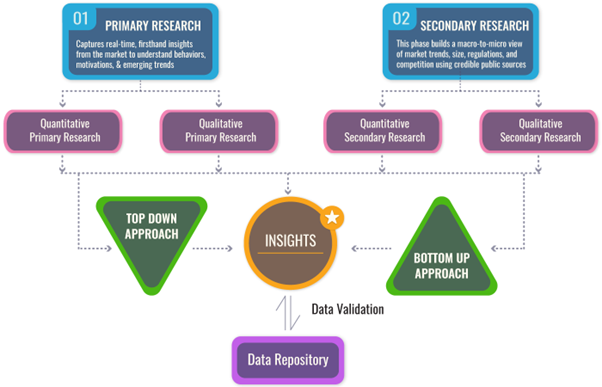
DUAL MODELING: TOP-DOWN + BOTTOM-UP
To ensure robust market estimation, we apply two complementary sizing approaches:
Top-Down Modeling:- Start with broader industry value (e.g., global or regional TAM)
- Apply filters by segment, geography, end-user, or use case
- Adjust with primary insights and validation benchmarks
- Ideal for investor-grade market scans and opportunity mapping
- Aggregate from the ground up using sales volumes, pricing, and unit economics
- Use internal modeling templates aligned with stakeholder data
- Incorporate distributor-level or region-specific inputs
- Most accurate for emerging segments and granular sub-markets
DATA VALIDATION: IN-HOUSE REPOSITORY
We close the loop with proprietary data intelligence built from ongoing projects, industry monitoring, and historical benchmarking. This repository includes:
- Multi-sector market and pricing models
- Key trendlines from past interviews and forecasts
- Benchmarked adoption rates, churn patterns, and ROI indicators
- Industry-specific deviation flags and cross-check logic
- Catches inconsistencies early
- Aligns projections across studies
- Enables consistent, high-trust deliverables