Cybersecurity Consulting Market Size and Forecast (2026–2034), Global and Regional Growth, Trend, Share and Industry Analysis Report Coverage; By Service Type (Risk Assessment and Management, Compliance and Audit, Threat Intelligence and Digital Forensics, Managed Security Services, Incident Response and Resiliency Planning); By Security Type (Network Security, Endpoint Security, Cloud Security, Application Security, Infrastructure/ICS Security, Identity and Access Management); By Organization Size (Large Enterprises, Small and Medium Enterprises); By Industry Vertical (BFSI, Healthcare and Life Sciences, IT and Telecommunications, Government and Defense, Retail and E-Commerce, Manufacturing and Industrial, Energy and Utilities, Others); and Geography
2026-09-25
ICT
Ekta Chaurasia (Team Lead)
Description
Cybersecurity Consulting Market
Overview
The global Cybersecurity
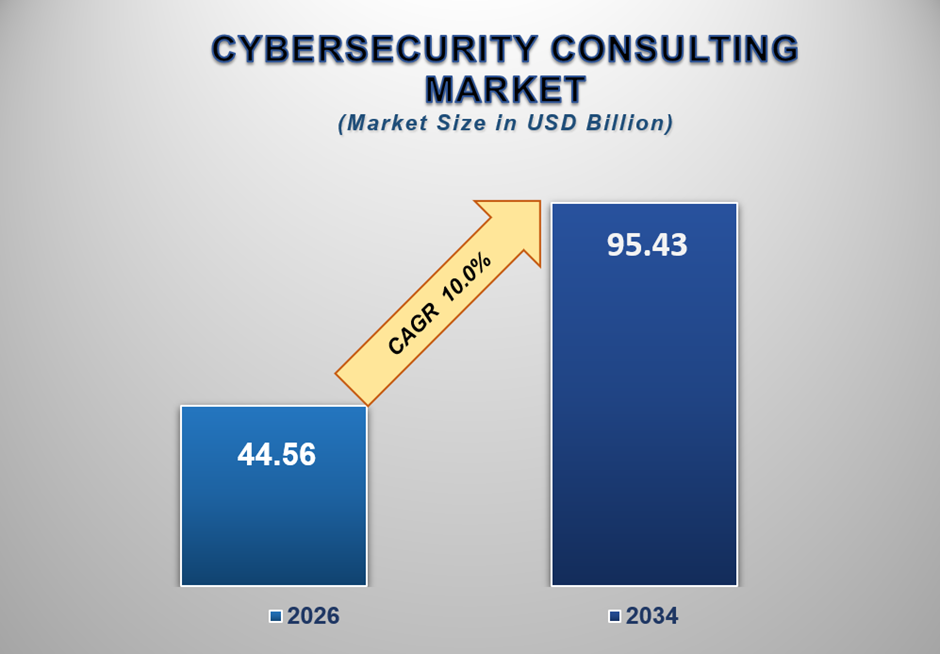
Consulting Market was valued at USD 44.56 billion in 2026 and is
projected to reach USD 95.43 billion by 2034, expanding at a CAGR of
10.0% during the forecast period.
The global
cybersecurity consulting market is moving from a predominantly
compliance-oriented advisory function toward a broader business-resilience
discipline covering cyber risk quantification, cloud security, identity,
artificial intelligence, operational technology, third-party ecosystems,
incident readiness, privacy, and continuous threat exposure management.
Organizations increasingly require external specialists because internal
cybersecurity teams must simultaneously manage expanding technology estates,
increasingly sophisticated attacks, regulatory obligations, and shortages of
specialized personnel.
Cybersecurity
consulting encompasses strategic and technical services that help organizations
identify vulnerabilities, assess cyber risk, design security architectures,
strengthen governance, meet regulatory requirements, investigate incidents,
prepare for ransomware and other disruptive attacks, and establish resilient
security operating models. The service landscape now includes conventional risk
assessments and penetration testing alongside cloud and hybrid-IT security,
zero-trust architecture, digital forensics, OT/ICS security, managed detection
and response readiness, privacy compliance, and virtual CISO services. Current
industry segmentation reflects this expansion from traditional
information-security reviews into continuous cyber-risk management.
The increasing
use of cloud infrastructure, software-as-a-service applications, connected
devices, APIs, remote access technologies, and artificial intelligence is
substantially widening the attack surface. Organizations can no longer evaluate
cybersecurity solely around the perimeter of an internal corporate network.
Security teams must understand identity relationships, cloud configurations,
application dependencies, software supply chains, privileged access,
third-party connections, and the potential business consequences of a
compromise.
Artificial
intelligence is creating a particularly important two-sided effect on
consulting demand. Cyber attackers can use AI to accelerate reconnaissance,
social engineering, malware development, vulnerability exploitation, and
credential attacks, while defenders are using AI to improve threat detection,
investigation, vulnerability prioritization, and security operations. PwC's
2026 outlook describes an environment in which attackers increasingly exploit
legitimate identities and authentication mechanisms, while organizations need
to integrate security earlier into cloud, supply chain, and emerging technology
decisions.
Regulatory
requirements are another structural demand generator. Organizations operating
across multiple jurisdictions must increasingly demonstrate that cybersecurity
risks are identified, governed, monitored, reported, and remediated.
Requirements associated with privacy, operational resilience, critical
infrastructure, financial services, third-party risk, and cyber incident
reporting are increasing the need for specialized advisory support. Current
market assessments identify regulations including GDPR, NIS2, CMMC 2.0, and PCI
DSS 4.0 as important contributors to demand for cybersecurity assessment and
compliance consulting.
The consulting
requirement is particularly pronounced among highly regulated industries. Banks
and financial institutions manage large volumes of sensitive data and operate
interconnected digital payment and transaction environments. Healthcare
organizations face the additional challenge of protecting patient information
while maintaining availability of clinical systems. Manufacturing, energy,
utilities, transportation, and other industrial sectors increasingly require OT
and ICS security because digital connectivity is extending into physical
production and infrastructure environments.
The market is
also shifting toward continuous engagements rather than isolated consulting
projects. Clients increasingly seek multi-year retainers, co-sourced security
capabilities, managed security services, virtual CISO arrangements, and
outcome-based programs. This transition creates more recurring revenue
opportunities for consulting firms and allows customers to maintain security
capabilities as threats and technology environments change. Recent market
analysis indicates that retainer/subscription models represented approximately 50.2%
of 2025 cybersecurity consulting revenue in one assessment, highlighting the
increasing importance of long-term relationships.
Cloud security
is becoming one of the fastest-changing areas within the consulting landscape.
Multi-cloud and hybrid environments can create inconsistent identity policies,
misconfigured resources, excessive privileges, fragmented security telemetry,
and complex data flows. Consulting firms therefore increasingly combine cloud
architecture reviews with identity management, threat detection, security
operations, data protection, and regulatory assessments rather than treating
cloud security as an isolated technical activity.
The shortage of
cybersecurity specialists further supports external consulting demand.
Organizations frequently have difficulty hiring and retaining experts in areas
such as cloud forensics, threat hunting, OT security, AI security, identity
governance, incident response, and post-quantum cryptography. External
consultants allow enterprises to obtain specialized capabilities for defined
projects or supplement internal teams without building every skill internally.
Post-quantum
readiness is another emerging consulting opportunity. The publication of
post-quantum cryptography standards has encouraged organizations with
long-lived sensitive data and critical infrastructure to review cryptographic
inventories, key-management practices, dependencies, and migration plans. Such
programs require extensive discovery and architectural assessment, creating
additional demand for specialist advisory services.
Large
professional-services and technology companies are strengthening their
cybersecurity consulting portfolios through acquisitions, alliances, AI-enabled
platforms, and managed-service capabilities. Deloitte reported that global
security-services revenue increased 11.5% to USD 84.4 billion in 2025,
while its Security Consulting sub-segment represented a 32% global share
in 2025 according to Gartner's cited market-share assessment.
Cybersecurity Consulting Market
Drivers and Opportunities
Escalating
AI-Enabled Threats and Expanding Digital Attack Surfaces Are Increasing Demand
for Specialized Cyber Expertise
The rapid
expansion of digital infrastructure is one of the strongest structural drivers
of the cybersecurity consulting market. Enterprises are operating
interconnected combinations of cloud platforms, SaaS applications, mobile
endpoints, APIs, IoT devices, enterprise applications, data platforms, and
third-party services. Every additional connection creates potential pathways
for unauthorized access, data theft, operational disruption, or supply-chain
compromise.
At the same
time, attackers are increasingly using automation and artificial intelligence
to improve the speed and scale of cyber operations. Traditional security
approaches based on periodic assessments are becoming less sufficient when
vulnerabilities can be discovered and exploited within much shorter windows.
Accenture noted in 2026 that the time between vulnerability discovery and
exploitation has compressed significantly, reinforcing the need for continuous
exposure management rather than periodic patching cycles.
Identity-based
attacks are also increasing the importance of consulting. Rather than relying
exclusively on exploiting software vulnerabilities, attackers can compromise
legitimate credentials, manipulate authentication processes, abuse privileged
identities, and move through trusted systems. This requires organizations to
rethink identity governance, access controls, authentication architecture,
privileged access, and detection strategies.
Cybersecurity
consultants increasingly help organizations establish zero-trust architectures,
identity-centric controls, attack-path analysis, continuous vulnerability
management, security validation programs, and incident-response capabilities.
The demand is therefore shifting from simply asking whether a company has
security tools to determining whether its controls actually reduce measurable
business risk.
The growing use
of generative and agentic AI creates an additional advisory layer. Enterprises
need policies governing employee use of AI tools, protection of sensitive
information submitted to AI systems, security of AI agents and applications,
model and data integrity, third-party AI dependencies, and monitoring for
AI-specific attacks. PwC's 2026 cyber outlook identifies AI and emerging
technologies as major forces requiring organizations to embed cybersecurity
earlier into technology and business decisions.
Regulatory
Expansion, Cyber-Resilience Requirements, and Third-Party Risk Are Sustaining
Consulting Demand
Cybersecurity
regulations are transforming security from a discretionary IT expenditure into
a governance and risk-management responsibility. Boards, regulators, insurers,
customers, and business partners increasingly expect organizations to
demonstrate structured cybersecurity controls and measurable resilience.
Financial
services companies face extensive regulatory and operational-resilience
requirements, while healthcare providers must protect highly sensitive personal
information and maintain availability of critical systems. Manufacturing and
energy organizations face increasing requirements around OT security,
supply-chain security, and critical infrastructure resilience.
Third-party risk
is another major source of consulting demand. Enterprises increasingly depend
on cloud providers, software vendors, outsourced service providers, logistics
networks, payment processors, and other partners. A cybersecurity incident
originating at one supplier can propagate into multiple downstream
organizations. Consultants therefore conduct supplier assessments, cyber due
diligence, security questionnaires, control reviews, penetration testing,
contractual evaluations, and continuous third-party monitoring programs.
Cyber insurance
is reinforcing this trend because insurers increasingly require organizations
to demonstrate security controls before coverage is obtained or renewed.
Consulting firms can support organizations in identifying control gaps,
improving security maturity, documenting risk-management processes, and
preparing evidence for insurance and regulatory requirements.
The movement
toward operational resilience is particularly important. Organizations are
increasingly expected not merely to prevent attacks but to maintain critical
operations during and after security incidents. This expands consulting
opportunities across business continuity, disaster recovery, crisis management,
incident response, ransomware readiness, recovery testing, and executive-level
cyber simulations.
AI-Powered
Cyber Risk Quantification, Managed Consulting, and Cyber-Resilience Platforms
Create Significant Opportunities
Artificial
intelligence and analytics are opening new opportunities for cybersecurity
consultants to move from static assessment reports toward continuously updated
risk intelligence. AI-enabled platforms can combine vulnerability information,
asset inventories, threat intelligence, business criticality, identity
relationships, and security-control data to identify which exposures are most
likely to produce material business consequences.
This approach
allows consultants to communicate cybersecurity in business terms rather than
relying solely on technical vulnerability scores. Boards and senior executives
increasingly want to understand which vulnerabilities threaten revenue,
operational continuity, customer trust, regulatory standing, or critical
assets.
The development
of AI-enabled consulting platforms is already becoming commercially visible. In
July 2026, EY India launched its Cyber Performance Management platform,
designed to quantify cyber risk through a unified framework and integrate
information from more than 50 security tools. EY stated that the platform can
support faster response and analyst efficiency improvements.
Managed
cybersecurity consulting is another important opportunity. Many organizations
cannot maintain a full internal security operations capability, particularly
SMEs and mid-market companies. Consulting firms can therefore provide
co-managed SOC services, virtual CISO capabilities, threat intelligence,
vulnerability management, incident readiness, identity governance, and
continuous compliance.
The convergence
of consulting and managed services is likely to become increasingly important.
EY, for example, describes its cybersecurity managed-services model as
combining cyber frameworks, AI capabilities, and alliance ecosystems across
threat detection and response, digital identity, vulnerability management, and
cyber resilience.
Consulting firms
also have an opportunity to specialize in emerging areas such as OT security,
AI security, software supply-chain security, post-quantum readiness,
cyber-physical security, and cloud-native environments. These domains require
multidisciplinary expertise and are difficult for many enterprises to build
internally, creating favorable conditions for specialist advisory providers.
Cybersecurity Consulting Market Scope
|
Report
Attributes |
Description |
|
Market Size
in 2026 |
USD 44.56 Billion |
|
Market
Forecast in 2034 |
USD 95.43
Billion |
|
CAGR %
2026-2034 |
10.0% |
|
Base Year |
2025 |
|
Historic
Data |
2021-2025 |
|
Forecast
Period |
2026-2034 |
|
Report USP |
Production,
Consumption, Company Share, Company Heatmap, Company Production, Service
Type, Growth Factors and more |
|
Segments
Covered |
● Service Type ● Security Type ● Organization Size ● Industry Vertical |
|
Regional Scope |
● North America |
|
Country Scope |
U.S. |
Cybersecurity Consulting Market
Report Segmentation Analysis
The global Cybersecurity
Consulting Market industry analysis is segmented by service type, security
type, organization size, industry vertical, and region.
The Risk
Assessment and Management Segment Is Expected to Maintain Its Leading Position
During the Forecast Period
The Risk
Assessment and Management segment accounted for approximately 30.7%
of the cybersecurity consulting market in 2025, representing the largest share
among service categories in the available market benchmark. Organizations
increasingly use formal risk assessments to identify vulnerabilities, evaluate
control effectiveness, prioritize remediation, quantify business exposure, and
establish cybersecurity investment priorities.
Risk assessment
has expanded beyond conventional vulnerability scanning. Modern engagements
increasingly consider business-critical assets, attack paths, identity
relationships, cloud infrastructure, third-party exposure, ransomware
readiness, operational technology, and regulatory requirements. Consultants may
combine technical testing with governance reviews and business-impact analysis
to provide executives with a more complete view of cyber exposure.
The Compliance
and Audit segment is supported by the proliferation of privacy,
cybersecurity, industry-specific, and operational-resilience requirements.
Organizations increasingly require external assessments to validate their
compliance posture and prepare documentation for regulators, customers,
insurers, and business partners.
The Threat
Intelligence and Digital Forensics segment is gaining importance as
organizations seek a deeper understanding of threat actors, attack patterns,
compromised assets, and indicators of compromise. Digital forensics is
particularly important following security incidents because organizations need
to establish attack timelines, determine affected systems, identify persistence
mechanisms, and support legal or regulatory investigations.
The Managed
Security Services segment is expected to record strong growth as
organizations seek continuous monitoring and specialist capabilities without
building large internal teams. Market analysis indicates managed security
services are among the fastest-growing service categories because of persistent
talent shortages and rising demand for 24/7 security operations.
The Incident
Response and Resiliency Planning segment is expanding as ransomware,
destructive attacks, and operational disruptions force organizations to prepare
for events that bypass preventive controls. Consulting firms increasingly
support tabletop exercises, crisis simulations, recovery planning,
incident-response playbooks, ransomware readiness, and post-incident
remediation.
The Network
Security Segment Continues to Represent a Major Security Consulting Requirement
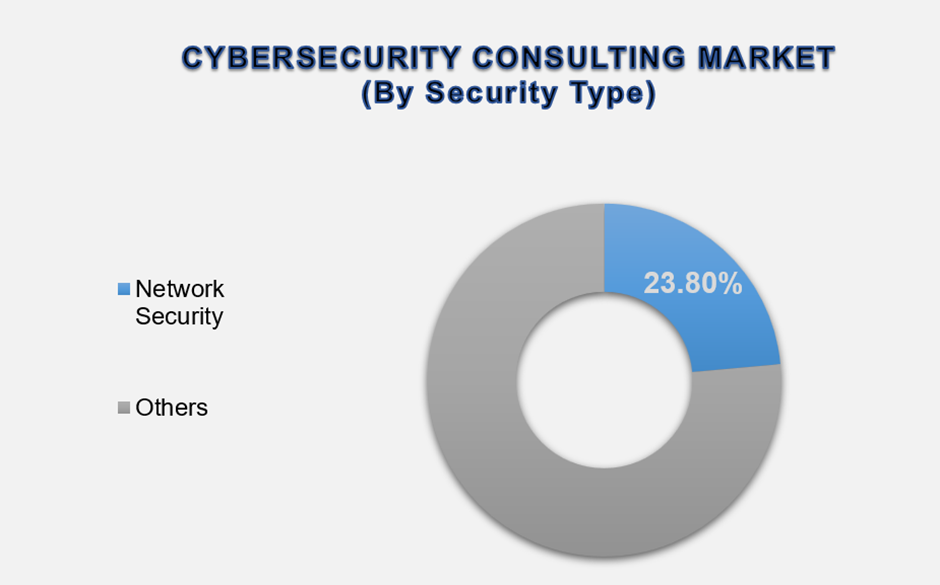
The Network
Security segment accounted for approximately 23.8% of the
cybersecurity consulting market in 2025 and remained the largest security-type
category in the available benchmark.
Network security
consulting covers architecture reviews, segmentation, firewall strategy, secure
remote access, intrusion prevention, network monitoring, secure connectivity,
and zero-trust transformation. Although enterprises increasingly operate cloud environments,
traditional networks remain critical because data and applications continue to
move across corporate facilities, data centers, cloud platforms, remote
locations, and third-party systems.
The Endpoint
Security segment remains important because laptops, mobile devices,
servers, operational endpoints, and employee devices provide common entry
points for attackers. Consulting engagements increasingly focus on endpoint
detection and response, hardening, privileged access, patching, application
controls, and device-management strategies.
The Cloud
Security segment is expected to experience rapid growth as organizations
expand multi-cloud and hybrid environments. Consultants help organizations
address cloud misconfiguration, identity and access management, workload
protection, data security, container and Kubernetes security, cloud-native
application risks, and cross-cloud governance.
The Application
Security segment is expanding as organizations adopt DevSecOps and
accelerate software development. Security consulting increasingly becomes
embedded into software-development lifecycles through secure coding,
application testing, API security, software composition analysis, threat
modeling, and continuous security validation.
The Infrastructure/ICS
Security segment is gaining strategic importance as industrial facilities
become increasingly connected. Manufacturing, energy, utilities,
transportation, and critical infrastructure operators require specialized
approaches because compromise of an industrial system can produce physical
consequences as well as data loss.
The Identity
and Access Management segment is expanding because identity has become a
central control layer across cloud and hybrid environments. Consultants
increasingly support privileged-access management, identity governance,
authentication modernization, zero-trust architecture, passwordless strategies,
and detection of anomalous identity behavior.
Large
Enterprises Are Expected to Continue Dominating Cybersecurity Consulting Demand
The Large
Enterprises segment accounted for approximately 65.6% of the
cybersecurity consulting market revenue in 2025. Large organizations generally
operate more complex IT environments, manage larger volumes of sensitive
information, maintain extensive third-party ecosystems, and face broader
regulatory obligations than smaller organizations.
Large
enterprises also have greater requirements for specialized consulting in areas
such as global compliance, cloud transformation, cyber-risk quantification,
security architecture, identity modernization, mergers and acquisitions due
diligence, incident response, and critical infrastructure security.
The Small and
Medium Enterprises segment is expected to grow at a faster pace as
cybersecurity becomes increasingly accessible through managed consulting,
subscription services, virtual CISO offerings, and packaged security
assessments. SMEs often lack dedicated security specialists, creating a
structural need for external expertise.
The growth of
ransomware, regulatory requirements, cyber insurance, cloud adoption, and
customer security assessments is pushing SMEs to professionalize their
cybersecurity programs. Consulting providers that can package assessment,
remediation, compliance, monitoring, and advisory services into predictable
subscription models are positioned to capture this expanding demand.
The BFSI
Segment Is Expected to Remain the Leading Industry Vertical for Cybersecurity
Consulting
The Banking,
Financial Services and Insurance (BFSI) segment accounted for approximately
21.1% of the cybersecurity consulting market in 2025, making it the
leading industry vertical in the available market benchmark.
Financial
institutions are particularly dependent on secure digital infrastructure
because banking applications, payment networks, trading systems, customer
platforms, APIs, cloud infrastructure, and third-party financial services are
tightly interconnected. A security incident can create direct financial losses
while also triggering regulatory, legal, and reputational consequences.
The Healthcare
and Life Sciences segment represents a high-growth consulting opportunity
because healthcare organizations combine highly sensitive data with
mission-critical systems. Consultants support privacy, identity, medical-device
security, ransomware preparedness, cloud security, third-party risk, and
resilience planning.
The IT and
Telecommunications segment requires extensive consulting because technology
companies operate large cloud, data, software, and network environments. Their
cybersecurity requirements also extend to customer-facing infrastructure,
software supply chains, APIs, and digital identity.
The Government
and Defense segment remains strategically important because public-sector
systems are targets for espionage, ransomware, disruption, and nation-state
activity. Consulting demand includes zero-trust architecture, critical
infrastructure protection, secure cloud migration, identity modernization,
supply-chain security, and incident response.
The Retail
and E-Commerce segment is driven by payment security, customer data
protection, fraud prevention, application security, identity management, and
third-party risk. Digital commerce platforms expose retailers to large volumes
of credential attacks and application-layer threats.
The Manufacturing
and Industrial segment is increasingly important because IT and OT
environments are converging. Consultants help manufacturers segment industrial
networks, secure connected machinery, manage remote access, assess suppliers,
and improve incident response.
The Energy
and Utilities segment represents another strategically important category
because cyber incidents can affect physical infrastructure and service
continuity. Demand is supported by digital grid modernization, connected
industrial systems, distributed energy infrastructure, and increasing
regulatory attention to critical infrastructure resilience.
The following segments are part of an in-depth analysis of the global Cybersecurity Consulting Market:
|
Market Segments |
|
|
By Service Type |
• Risk Assessment and
Management • Compliance and
Audit • Threat Intelligence
and Digital Forensics • Managed Security
Services • Incident Response
and Resiliency Planning |
|
By
Security Type |
• Network Security • Endpoint Security • Cloud Security • Application
Security • Infrastructure/ICS
Security • Identity and Access
Management |
|
By Organization Size |
• Large Enterprises • Small and Medium
Enterprises |
|
By Industry Vertical |
• Banking, Financial
Services, and Insurance (BFSI) • Healthcare and Life
Sciences • IT and
Telecommunications • Government and
Defense • Retail and
E-Commerce • Manufacturing and
Industrial • Energy and
Utilities • Others |
Cybersecurity Consulting Market Share
Analysis By Region
North America
Is Expected to Maintain Its Leading Position in the Global Cybersecurity
Consulting Market
North America
accounted for approximately 37.5% of global cybersecurity consulting
revenue in 2025 in the available market benchmark, making it the leading
regional market. The region benefits from mature enterprise cybersecurity
budgets, extensive technology adoption, a large concentration of cybersecurity
providers, stringent regulatory requirements, and substantial government
investment in cyber resilience.
The United
States represents the primary demand center in North America. Large financial
institutions, technology companies, healthcare organizations, government
agencies, defense contractors, and critical infrastructure operators require
continuous advisory support across risk management, cloud security, identity,
incident response, compliance, and threat intelligence.
The Canadian
market is supported by increasing digitization, critical infrastructure
protection, privacy requirements, and demand for resilience against ransomware
and state-sponsored threats. Cross-border business relationships with the
United States also increase demand for harmonized security and privacy
programs.
Europe Is
Strengthening Demand Through Regulatory and Cyber-Resilience Requirements
Europe
represents a highly developed cybersecurity consulting market driven by GDPR,
NIS2, financial-sector resilience requirements, supply-chain obligations, and
growing emphasis on digital sovereignty. Organizations operating across
multiple European jurisdictions increasingly require assistance translating
regulatory requirements into measurable security controls and operating
processes.
The region's
manufacturing, automotive, financial services, healthcare, energy, and
public-sector industries provide substantial consulting opportunities. Demand
is increasingly shifting toward cyber resilience, third-party risk, OT
security, data protection, and continuous compliance rather than one-time audit
preparation.
PwC's 2026
recognition as a leader in the IDC MarketScape for European cybersecurity GRC
consulting illustrates the strategic importance of governance, risk,
compliance, proprietary tooling, AI-enabled delivery, and sovereignty-oriented
service models in the region.
Asia Pacific
Is Expected to Register the Fastest Growth During the Forecast Period
Asia Pacific is
expected to be the fastest-growing regional market as enterprises accelerate
cloud adoption, digital transformation, e-commerce, financial technology, smart
manufacturing, and digital-government initiatives. Recent market analysis
similarly identifies Asia Pacific as the fastest-growing major region for
cybersecurity consulting.
China's
cybersecurity environment is shaped by data-security, privacy, localization,
and critical-infrastructure requirements. Japan continues to invest in cyber
resilience, advanced security architectures, and preparation for future
cryptographic requirements. South Korea has strong demand for security
operations, digital infrastructure protection, and advanced threat detection.
India represents
a particularly attractive consulting market because of rapid digitalization
across banking, healthcare, telecommunications, manufacturing, government, and
technology services. Increasing awareness of data protection, cloud security,
AI governance, and cyber resilience is expanding demand for both strategic and
technical consulting.
Australia is
supported by critical infrastructure regulation, financial-sector cybersecurity
requirements, government digitalization, and a sophisticated enterprise
cybersecurity ecosystem. The region also benefits from growing cybersecurity
investment by large enterprises and government organizations.
Latin America
Is Expanding Through Digital Transformation and Financial-Sector Cybersecurity
Requirements
Latin America is
experiencing increasing demand for cybersecurity consulting as governments,
banks, retailers, telecommunications companies, and enterprises digitize their
operations. Brazil and Mexico are particularly important markets because of
their large enterprise bases and growing digital ecosystems.
Financial
services remain a major source of demand, while retail and e-commerce create
additional requirements for payment security, identity management, fraud
prevention, privacy, and application security. Local consulting expertise is
increasingly important because organizations must navigate national privacy
requirements and region-specific regulatory environments.
Middle East
and Africa Are Developing New Consulting Opportunities Through Critical
Infrastructure and Digital Government Programs
The Middle East
and Africa region is experiencing growing demand for cybersecurity consulting
as governments and enterprises invest in smart-city programs, cloud
infrastructure, digital government, energy systems, financial technology, and
critical infrastructure.
Saudi Arabia and
the UAE are important regional markets because of their large-scale digital
transformation and national cybersecurity programs. Energy, utilities,
financial services, government, and smart infrastructure provide significant
opportunities for consulting firms.
South Africa
represents a major African cybersecurity consulting market due to its financial
services sector, telecommunications infrastructure, industrial base, government
systems, and increasing focus on privacy and cyber resilience. Across the
broader region, the shortage of specialized cybersecurity professionals creates
additional opportunities for outsourced advisory and managed services.
Cybersecurity
Consulting Market Competition Landscape Analysis
The global
cybersecurity consulting market is highly competitive, with large
professional-services firms, technology consulting companies, specialist
cybersecurity consultancies, managed security providers, and cybersecurity
technology companies competing across overlapping service categories.
Competition
increasingly centers on the ability to combine strategic advisory expertise
with implementation, managed services, proprietary analytics, threat
intelligence, AI capabilities, and technology alliances. Clients increasingly
prefer providers capable of moving from assessment to remediation and
continuous monitoring rather than delivering a standalone report.
Deloitte
strengthened its position in 2026 by reporting the No. 1 position in global
Security Services revenue according to Gartner's 2025 market-share assessment.
Deloitte reported 19.1% revenue growth in Security Services during 2025
and a 32% share of Security Consulting in that assessment.
Accenture is
aggressively expanding its cybersecurity capabilities through acquisitions and
technology alliances. In February 2026, its acquisition of CyberCX closed,
adding approximately 1,400 cybersecurity professionals and strengthening its
Asia Pacific capabilities. In June 2026, Accenture also announced agreements to
acquire a majority stake in Dragos and all of runZero and NetRise, expanding
capabilities across OT security, asset intelligence, exposure assessment, and
device/software supply-chain security.
PwC is
strengthening its position through AI and cloud-security collaborations. In
July 2026, PwC announced a collaboration with OpenAI to expand AI-powered
cyber-defense capabilities, while its 2026 collaboration with Google Cloud was
expanded through a reported USD 400 million collaboration focused on
AI-powered security operations.
IBM Consulting
is expanding identity-focused cybersecurity services. In June 2026, IBM
announced consulting services for Microsoft Security solutions focused on
identity threat detection and remediation, combining IBM's identity expertise
with managed-service capabilities.
EY is
increasingly positioning AI-enabled cyber-risk management as a differentiator.
Its July 2026 launch of EY Cyber Performance Management combined AI and
cybersecurity capabilities to help organizations quantify cyber risk and
prioritize exposures across security environments.
Specialist
providers and cybersecurity technology companies are also increasing
competition by developing focused capabilities in cloud security, endpoint
security, identity, threat intelligence, penetration testing, OT security,
incident response, and managed detection and response.
The competitive
landscape is therefore moving toward ecosystem-based delivery.
Professional-services firms increasingly integrate platforms from companies
such as Microsoft, Google Cloud, CrowdStrike, Palo Alto Networks, Fortinet,
Cisco, and other technology vendors into consulting and managed-service
engagements.
Global
Cybersecurity Consulting Market Recent Developments News
●
August 2026 – IBM: IBM opened its FutureNow Centre in Visakhapatnam, India,
expanding consulting and technology delivery capabilities across AI, hybrid
cloud, cybersecurity, data and analytics, and enterprise transformation.
●
July 2026 – EY India: EY India launched EY Cyber Performance Management, an
AI-powered platform designed to quantify cyber risk in real time through an
integrated framework. The platform integrates information across more than 50
security tools and is designed to improve risk prioritization and response
efficiency.
●
July 2026 – PwC: PwC announced a collaboration with OpenAI to expand
AI-powered cyber-defense capabilities, focusing on the use of advanced AI
within enterprise cybersecurity workflows for threat detection, investigation,
and response.
●
June 2026 – Accenture: Accenture announced agreements to acquire a majority stake in Dragos
and acquire runZero and NetRise, expanding its cybersecurity services.
The Global
Cybersecurity Consulting Market is Dominated by a Few Large Companies, Such As
- Accenture plc
- Deloitte Touche Tohmatsu Limited
- PricewaterhouseCoopers International Limited (PwC)
- Ernst & Young Global Limited (EY)
- KPMG International
- International Business Machines Corporation (IBM)
- Capgemini SE
- Tata Consultancy Services Limited (TCS)
- Infosys Limited
- Wipro Limited
- HCLTech
- Cognizant Technology Solutions Corporation
- NTT DATA Corporation
- Booz Allen Hamilton Holding Corporation
- Kyndryl Holdings, Inc.
- Mandiant / Google Cloud
- CrowdStrike Holdings, Inc.
- Palo Alto Networks, Inc.
- Coalfire
- Others
Frequently Asked Questions
Ekta Chaurasia (Team Lead)
Ekta Chaurasia is a highly experienced Team Lead at M2Square Consultancy with over 7 years of expertise in market research, strategic consulting, competitive benchmarking, and business intelligence solutions. She specializes in ICT, semiconductors & electronics, automotive & transportation, and industrial machinery markets.
She leads end-to-end global research projects focused on market trends, industry analysis, growth forecasting, customer insights, and strategic decision-making. Known for her analytical leadership and industry expertise, Ekta helps businesses uncover growth opportunities, evaluate competitive landscapes, and stay ahead in rapidly evolving markets through accurate and insight-driven research.
1.
Global Cybersecurity
Consulting Market Introduction and Market Overview
1.1. Objectives of the Study
1.2. Global Cybersecurity Consulting Market Scope and Market Estimation
1.2.1.
Global Cybersecurity Consulting
Market Size (US$ Million), Market CAGR (%), Market Forecast (2026 - 2034)
1.2.2.
Global Cybersecurity Consulting
Market Revenue Share (%) and Growth Rate (Y-o-Y) Analysis (2021 - 2034)
1.3. Market Segmentation
1.3.1.
By Service Type of Global
Cybersecurity Consulting Market
1.3.2.
By Security Type of Global
Cybersecurity Consulting Market
1.3.3.
By Organization Size of Global
Cybersecurity Consulting Market
1.3.4.
By Industry Vertical of Global
Cybersecurity Consulting Market
1.3.5.
Region of Global Cybersecurity
Consulting Market
1.4. Competition Coverage List of Market Participants
1.5. Market Definition: Cybersecurity Consulting Market
2.
Executive Summary
2.1. Demand Side Trends
2.2. Key Market Trends
2.3. Market Demand (US$ Million) Analysis 2021 – 2025 and Forecast, 2026
– 2034
2.4. Demand and Opportunity Assessment
2.5. Key Developments
2.6. Overview of Regulatory Landscape, Compliance Framework, and Industry
Standards
2.7. Market Entry Strategies
2.8. Market Dynamics
2.8.1.
Drivers
2.8.2.
Limitations
2.8.3.
Opportunities
2.8.4.
Impact Analysis of Drivers and
Restraints
2.9. Porter's Five Forces Analysis
2.10.
PEST Analysis
3.
Global Cybersecurity
Consulting Market Estimates & Historical Trend Analysis (2021 – 2025)
4.
Global Cybersecurity
Consulting Market Estimates & Forecast Trend Analysis, by Service Type
4.1. Global Cybersecurity Consulting Market Revenue (US$ Million)
Estimates and Forecasts, by Service Type, 2021 - 2034
4.1.1.
Risk Assessment and Management
4.1.2.
Compliance and Audit
4.1.3.
Threat Intelligence and Digital
Forensics
4.1.4.
Managed Security Services
4.1.5.
Incident Response and
Resiliency Planning
5.
Global Cybersecurity
Consulting Market Estimates & Forecast Trend Analysis, by Security Type
5.1. Global Cybersecurity Consulting Market Revenue (US$ Million)
Estimates and Forecasts, by Security Type, 2021 - 2034
5.1.1.
Network Security
5.1.2.
Endpoint Security
5.1.3.
Cloud Security
5.1.4.
Application Security
5.1.5.
Infrastructure/ICS Security
5.1.6.
Identity and Access Management
6.
Global Cybersecurity
Consulting Market Estimates & Forecast Trend Analysis, by Organization Size
6.1. Global Cybersecurity Consulting Market Revenue (US$ Million)
Estimates and Forecasts, by Organization Size, 2021 - 2034
6.1.1.
Large Enterprises
6.1.2.
Small and Medium Enterprises
7.
Global Cybersecurity
Consulting Market Estimates & Forecast Trend Analysis, by Industry Vertical
7.1. Global Cybersecurity Consulting Market Revenue (US$ Million)
Estimates and Forecasts, by Industry Vertical, 2021 - 2034
7.1.1.
BFSI
7.1.2.
Healthcare and Life Sciences
7.1.3.
IT and Telecommunications
7.1.4.
Government and Defense
7.1.5.
Retail and E-Commerce
7.1.6.
Manufacturing and Industrial
7.1.7.
Energy and Utilities
7.1.8.
Others
8.
Global Cybersecurity
Consulting Market Estimates & Forecast Trend Analysis, by Region
8.1. Global Cybersecurity Consulting Market Revenue (US$ Million)
Estimates and Forecasts, by Region, 2021 - 2034
8.1.1.
North America
8.1.2.
Europe
8.1.3.
Asia Pacific
8.1.4.
Middle East & Africa
8.1.5.
Latin America
9.
North America
Cybersecurity Consulting Market: Estimates & Forecast Trend Analysis
9.1. North America Cybersecurity Consulting Market Assessments & Key
Findings
9.1.1.
North America Cybersecurity
Consulting Market Introduction
9.1.2.
North America Cybersecurity
Consulting Market Size Estimates and Forecast (US$ Million) (2021 - 2034)
9.1.2.1.
By Service Type
9.1.2.2.
By Security Type
9.1.2.3.
By Organization Size
9.1.2.4.
By Industry Vertical
9.1.2.5.
By Country
9.1.2.5.1.
The U.S.
9.1.2.5.2.
Canada
10. Europe Cybersecurity Consulting Market: Estimates & Forecast
Trend Analysis
10.1.
Europe Cybersecurity Consulting
Market Assessments & Key Findings
10.1.1.
Europe Cybersecurity Consulting
Market Introduction
10.1.2.
Europe Cybersecurity Consulting
Market Size Estimates and Forecast (US$ Million) (2021 - 2034)
10.1.2.1.
By Service Type
10.1.2.2.
By Security Type
10.1.2.3.
By Organization Size
10.1.2.4.
By Industry Vertical
10.1.2.5.
By Country
10.1.2.5.1.
Germany
10.1.2.5.2.
Italy
10.1.2.5.3.
The U.K.
10.1.2.5.4.
France
10.1.2.5.5.
Spain
10.1.2.5.6.
Switzerland
10.1.2.5.7.
Rest of Europe
11. Asia Pacific Cybersecurity Consulting Market: Estimates &
Forecast Trend Analysis
11.1.
Asia Pacific Cybersecurity
Consulting Market Assessments & Key Findings
11.1.1.
Asia Pacific Cybersecurity
Consulting Market Introduction
11.1.2.
Asia Pacific Cybersecurity
Consulting Market Size Estimates and Forecast (US$ Million) (2021 - 2034)
11.1.2.1.
By Service Type
11.1.2.2.
By Security Type
11.1.2.3.
By Organization Size
11.1.2.4.
By Industry Vertical
11.1.2.5.
By Country
11.1.2.5.1.
China
11.1.2.5.2.
Japan
11.1.2.5.3.
India
11.1.2.5.4.
Australia
11.1.2.5.5.
South Korea
11.1.2.5.6.
Rest of Asia Pacific
12. Middle East & Africa Cybersecurity Consulting Market: Estimates
& Forecast Trend Analysis
12.1.
Middle East & Africa
Cybersecurity Consulting Market Assessments & Key Findings
12.1.1.
Middle East & Africa
Cybersecurity Consulting Market Introduction
12.1.2.
Middle East & Africa
Cybersecurity Consulting Market Size Estimates and Forecast (US$ Million) (2021
- 2034)
12.1.2.1.
By Service Type
12.1.2.2.
By Security Type
12.1.2.3.
By Organization Size
12.1.2.4.
By Industry Vertical
12.1.2.5.
By Country
12.1.2.5.1.
UAE
12.1.2.5.2.
Saudi Arabia
12.1.2.5.3.
South Africa
12.1.2.5.4.
Rest of Middle East &
Africa
13. Latin America Cybersecurity Consulting Market: Estimates &
Forecast Trend Analysis
13.1.
Latin America Cybersecurity
Consulting Market Assessments & Key Findings
13.1.1.
Latin America Cybersecurity
Consulting Market Introduction
13.1.2.
Latin America Cybersecurity
Consulting Market Size Estimates and Forecast (US$ Million) (2021 - 2034)
13.1.2.1.
By Service Type
13.1.2.2.
By Security Type
13.1.2.3.
By Organization Size
13.1.2.4.
By Industry Vertical
13.1.2.5.
By Country
13.1.2.5.1.
Brazil
13.1.2.5.2.
Mexico
13.1.2.5.3.
Argentina
13.1.2.5.4.
Rest of Latin America
14. Competition Landscape
14.1.
Global Cybersecurity Consulting
Market Product Mapping
14.2.
Global Cybersecurity Consulting
Market Concentration Analysis, by Leading Players / Innovators / Emerging
Players / New Entrants
14.3.
Global Cybersecurity Consulting
Market Tier Structure Analysis
14.4.
Global Cybersecurity Consulting
Market Concentration & Company Market Shares (%) Analysis, 2026
15. Company Profiles
15.1.
Accenture plc
15.1.1.
Company Overview & Key
Stats
15.1.2.
Financial Performance &
KPIs
15.1.3.
Product Portfolio
15.1.4.
SWOT Analysis
15.1.5.
Business Strategy & Recent
Developments
*Similar details would be provided for all
the players mentioned below
15.2.
Deloitte Touche Tohmatsu
Limited
15.3.
PricewaterhouseCoopers
International Limited (PwC)
15.4.
Ernst & Young Global
Limited (EY)
15.5.
KPMG International
15.6.
International Business Machines
Corporation (IBM)
15.7.
Capgemini SE
15.8.
Tata Consultancy Services
Limited (TCS)
15.9.
Infosys Limited
15.10.
Wipro Limited
15.11.
HCLTech
15.12.
Cognizant Technology Solutions
Corporation
15.13.
NTT DATA Corporation
15.14.
Booz Allen Hamilton Holding
Corporation
15.15.
Kyndryl Holdings, Inc.
15.16.
Mandiant / Google Cloud
15.17.
CrowdStrike Holdings, Inc.
15.18.
Palo Alto Networks, Inc.
15.19.
Coalfire
15.20.
Others
16. Research Findings & Conclusion
17. Assumptions & Acronyms Used
18. Research Methodology
18.1.
External Databases
18.2.
Internal Proprietary Database
18.3.
Primary Research
18.4.
Secondary Research
18.5.
Assumptions
18.6.
Limitations
18.7.
Report FAQ
Our Research Methodology
"Insight without rigor is just noise."
We follow a comprehensive, multi-phase research framework designed to deliver accurate, strategic, and decision-ready intelligence. Our process integrates primary and secondary research , both quantitative and qualitative , along with dual modeling techniques ( top-down and bottom-up) and a final layer of validation through our proprietary in-house repository.
PRIMARY RESEARCH
Primary research captures real-time, firsthand insights from the market to understand behaviors, motivations, and emerging trends.
1. Quantitative Primary Research
Objective: Generate statistically significant data directly from market participants.
Approaches:- Structured surveys with customers, distributors, and field agents
- Mobile-based data collection for point-of-sale audits and usage behavior
- Phone-based interviews (CATI) for market sizing and product feedback
- Online polling around industry events and digital campaigns
- Purchase frequency by customer type
- Channel performance across geographies
- Feature demand by application or demographic
2. Qualitative Primary Research
Objective: Explore decision-making drivers, pain points, and market readiness.
Approaches:- In-depth interviews (IDIs) with executives, product managers, and key decision-makers
- Focus groups among end users and early adopters
- Site visits and observational research for consumer products
- Informal field-level discussions for regional and cultural nuances
SECONDARY RESEARCH
This phase helps establish a macro-to-micro understanding of market trends, size, regulation, and competitive dynamics, sourced from credible and public domain information.
1. Quantitative Secondary Research
Objective: Model market value and segment-level forecasts based on published data.
Sources include:- Financial reports and investor summaries
- Government trade data, customs records, and regulatory statistics
- Industry association publications and economic databases
- Channel performance and pricing data from marketplace listings
- Revenue splits, pricing trends, and CAGR estimates
- Supply-side capacity and volume tracking
- Investment analysis and funding benchmarks
2. Qualitative Secondary Research
Objective: Capture strategic direction, innovation signals, and behavioral trends.
Sources include:- Company announcements, roadmaps, and product pipelines
- Publicly available whitepapers, conference abstracts, and academic research
- Regulatory body publications and policy briefs
- Social and media sentiment scanning for early-stage shifts
- Strategic shifts in market positioning
- Unmet needs and white spaces
- Regulatory triggers and compliance impact
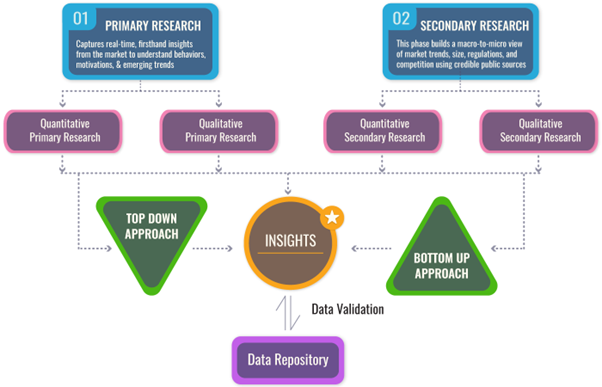
DUAL MODELING: TOP-DOWN + BOTTOM-UP
To ensure robust market estimation, we apply two complementary sizing approaches:
Top-Down Modeling:- Start with broader industry value (e.g., global or regional TAM)
- Apply filters by segment, geography, end-user, or use case
- Adjust with primary insights and validation benchmarks
- Ideal for investor-grade market scans and opportunity mapping
- Aggregate from the ground up using sales volumes, pricing, and unit economics
- Use internal modeling templates aligned with stakeholder data
- Incorporate distributor-level or region-specific inputs
- Most accurate for emerging segments and granular sub-markets
DATA VALIDATION: IN-HOUSE REPOSITORY
We close the loop with proprietary data intelligence built from ongoing projects, industry monitoring, and historical benchmarking. This repository includes:
- Multi-sector market and pricing models
- Key trendlines from past interviews and forecasts
- Benchmarked adoption rates, churn patterns, and ROI indicators
- Industry-specific deviation flags and cross-check logic
- Catches inconsistencies early
- Aligns projections across studies
- Enables consistent, high-trust deliverables