

Dairy Blends Market Size and Forecast (2026–2034), Global and Regional Growth, Trend, Share and Industry Analysis Report Coverage; By Type (Dairy Mixtures, Dairy and Non-Dairy Ingredients, Dairy as a Functional Ingredient, Dairy as a Carrier, and Other Types); By Form (Powder, Liquid, and Spreadable); By Application (Ice Cream, Yogurt, Infant Formula, Bakery Products, Beverages, Animal Feed, and Other Applications); and Geography
2026-11-04
Consumer Products
Aishwarya Panbude (Research Analyst)
Description
Dairy Blends Market Overview
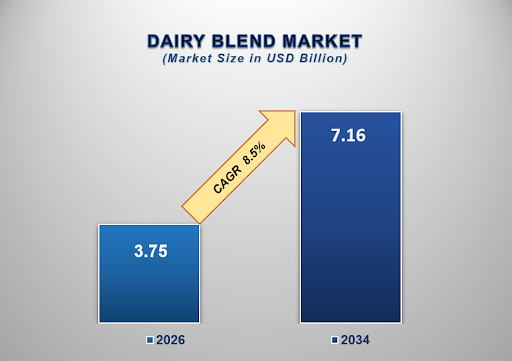
The global dairy blends market is valued at USD 3.75 billion in 2026 and is projected to reach USD 7.16 billion by 2034, registering a compound annual growth rate (CAGR) of 8.5% from 2026 to 2034. Market expansion is supported by the increasing use of customized dairy ingredient combinations across industrial food manufacturing, growing demand for consistent product quality, and the need to balance ingredient costs with nutritional value and functional performance. Dairy blends combine two or more dairy ingredients or incorporate dairy components with selected non-dairy ingredients to achieve specific characteristics, including creaminess, emulsion stability, protein content, spreadability, flavor, and shelf-life performance. Their flexibility makes them relevant to manufacturers of bakery products, frozen desserts, yogurt, beverages, infant nutrition products, and other processed foods.
Dairy blends occupy an important position between conventional dairy ingredients and specialized food formulation systems. Rather than relying on a single ingredient to provide all required product characteristics, manufacturers can combine milk solids, milk fat, whey proteins, casein ingredients, vegetable fats, stabilizers, and other permitted components for the intended application. This approach enables food processors to manage texture, moisture retention, melting behavior, nutritional composition, and production consistency. The composition of a blend varies depending on its intended use, and formulations developed for bakery fillings may differ substantially from those designed for beverage powders, ice cream, yogurt, or infant formula.
The expansion of commercial food processing is creating opportunities for ingredient suppliers that can deliver repeatable performance at an industrial scale. Large food manufacturers often require ingredients that behave consistently across production batches, equipment configurations, storage conditions, and distribution environments. Dairy blends can help address these requirements by combining complementary ingredients in predetermined proportions. Pre-formulated blends may also simplify ingredient handling, reduce the number of separate materials that production teams must manage, and support more standardized manufacturing procedures. These advantages are particularly relevant to companies operating multiple production facilities or supplying products across different geographic markets.
Ingredient-cost management is another important influence on the market. Milk fat, milk powders, whey proteins, and other dairy-derived materials are exposed to changes in agricultural output, energy costs, feed prices, processing expenses, and international trade conditions. Manufacturers may therefore evaluate alternative blend compositions to manage fluctuations in raw-material expenditure while retaining the product characteristics expected by consumers. In selected applications, dairy ingredients can be combined with vegetable fats or other non-dairy components to alter cost, texture, and functional properties. However, the suitability of these substitutions depends on product requirements, applicable food regulations, ingredient declarations, and consumer expectations regarding composition and authenticity.
The market is also influenced by the growing importance of nutritional formulation. Food manufacturers are developing products that deliver protein, essential nutrients, and specific sensory characteristics in formats suitable for different consumer groups. Dairy-derived proteins and milk solids can contribute to nutritional value, while carefully selected supporting ingredients help maintain solubility, texture, and stability. These combinations are relevant to fortified beverages, nutritional powders, dairy-based snacks, and selected early-life and clinical nutrition applications. Infant formula and medical nutrition require particularly rigorous formulation controls because ingredient selection, nutritional composition, manufacturing procedures, and regulatory compliance are central to product suitability.
Powdered dairy blends are relevant to manufacturers that require ingredients with convenient storage, efficient transportation, and flexibility in industrial use. When appropriately processed and packaged, powdered blends can be stored and distributed without the same refrigeration requirements associated with many liquid dairy ingredients. They can be incorporated into dry mixes, reconstituted beverages, bakery preparations, confectionery products, and other manufactured foods. Their commercial usefulness depends on characteristics such as moisture content, solubility, dispersibility, particle properties, flavor retention, and resistance to deterioration during storage. For manufacturers serving distant markets, these considerations can influence procurement decisions and production planning.
Liquid and spreadable blends serve different operational requirements. Liquid formulations can reduce the need for on-site mixing or reconstitution and may be convenient for industrial users with suitable storage and handling infrastructure. Spreadable blends can provide the consistency and handling characteristics needed for bakery applications, foodservice operations, toppings, fillings, and selected household products. The commercial value of each form is determined not only by its ingredient composition but also by its processing requirements, storage conditions, packaging, transport costs, and compatibility with downstream equipment.
Product development is increasingly focused on balancing sensory quality, nutritional characteristics, affordability, and ingredient transparency. Consumers may expect a creamy texture and familiar dairy taste while also paying attention to protein content, sugar levels, fat composition, and the origin of ingredients. These expectations create opportunities for suppliers capable of tailoring formulations to specific customer requirements. Nevertheless, dairy blends do not automatically qualify as healthier, more sustainable, or more natural than conventional dairy products. Such attributes depend on the actual formulation, manufacturing process, nutritional profile, sourcing practices, and evidence supporting the relevant product claims.
Dairy Blends Market Drivers and Opportunities
Rising Demand for Cost-Efficient and Application-Specific Food Ingredients
The increasing need for cost control and formulation flexibility is a significant driver of the dairy blends market. Food manufacturers operate in an environment where raw-material prices, energy expenses, packaging costs, and distribution charges can affect production margins. When the cost of individual dairy ingredients changes, manufacturers may reassess their formulations to identify combinations that preserve essential product characteristics without creating unsustainable production costs. Dairy blends provide a means of combining complementary ingredients to meet a defined specification, making them useful for businesses seeking greater control over ingredient utilization.
The economic value of a dairy blend depends on its intended application. A blend developed for a bakery filling may be designed to maintain structure during baking, deliver the expected flavor, and retain moisture throughout storage. A blend for ice cream may require particular melting behavior, creaminess, and resistance to undesirable texture changes. Beverage applications may place greater emphasis on dispersion, solubility, sedimentation control, and flavor stability. By selecting ingredients according to these requirements, manufacturers can develop more consistent formulations and avoid relying on materials that do not contribute meaningfully to the finished product.
Pre-blended ingredients can also support production efficiency. Manufacturers that purchase multiple individual ingredients must manage separate specifications, storage arrangements, weighing procedures, and quality checks. A suitably designed blend can consolidate some of these activities, reduce formulation complexity, and support repeatable dosing during production. These advantages can be valuable for businesses that manufacture several product varieties or operate facilities with different levels of technical capability. The extent of the benefit depends on the blend's complexity, purchasing volume, equipment, and the degree to which the supplier's formulation matches the customer's process.
Demand is further supported by the expansion of industrial food production. Bakery and confectionery manufacturers, frozen-dessert producers, beverage companies, and prepared-food businesses require ingredients that perform consistently under commercial processing conditions. As production volumes increase and product portfolios diversify, ingredient suppliers are expected to provide solutions tailored to different equipment, processing temperatures, storage conditions, and final-product specifications. This encourages the development of application-specific blends rather than one-size-fits-all ingredient combinations.
However, cost efficiency must be assessed alongside product quality and regulatory compliance. A lower-cost formulation may not be commercially suitable if it changes flavor, mouthfeel, stability, or nutritional composition beyond acceptable limits. Manufacturers must also ensure that ingredient substitutions comply with the relevant product standards and labeling requirements. Consequently, the strongest demand is likely to come from blends that demonstrate a practical balance between cost, functional performance, manufacturing reliability, and consumer acceptance.
Growing Importance of Nutritional Customization and Functional Performance
The second major driver is the growing demand for food products with specific nutritional and functional characteristics. Food manufacturers increasingly develop products for defined consumption occasions and customer groups, including protein-enriched beverages, fortified foods, dairy-based snacks, specialized nutrition products, and convenient meal components. Dairy ingredients provide a range of proteins, milk solids, and other constituents that can be combined to achieve targeted formulation outcomes. Blends allow manufacturers to adjust ingredient proportions and incorporate supporting materials according to the nutritional and processing requirements of a particular product.
Protein functionality is especially important in many dairy-based applications. Milk proteins and whey proteins can contribute to nutritional value while influencing texture, water binding, emulsification, and the physical behavior of a formulation. The appropriate ingredient selection varies with the final product: a powdered nutritional beverage may require good reconstitution and dispersion, whereas a yogurt or dessert formulation may prioritize viscosity, smoothness, and stability. Blend suppliers that understand these differences can help food manufacturers address formulation challenges more efficiently.
Functional performance also influences the use of dairy blends in established food categories. Ice cream manufacturers may need ingredients that contribute to creaminess and control ice-crystal development. Yogurt producers may focus on body, consistency, and reduced separation during storage. Bakery manufacturers may seek blends that maintain filling stability or deliver repeatable performance during mixing and baking. In beverages, the key requirements can include dispersion, mouthfeel, flavor compatibility, and resistance to sedimentation. These different demands encourage continued investment in ingredient research, application testing, and technical collaboration between suppliers and food processors.
Nutritional customization is particularly important in specialized nutrition, including infant formula and medical nutrition. In these applications, manufacturers must work within precise compositional and regulatory requirements. Ingredient combinations must be evaluated for nutritional suitability, safety, stability, and consistency rather than selected solely on cost or convenience. Suppliers that can demonstrate strong quality management, reliable traceability, and technical support may therefore have an advantage when serving customers with demanding product specifications.
The development of hybrid dairy and plant-based products creates another area of formulation activity. Some manufacturers are exploring combinations of dairy and plant-derived proteins or other ingredients to achieve particular nutritional, sensory, or cost objectives. Such products require careful attention to flavor, texture, allergen declarations, ingredient compatibility, and consumer expectations. Hybrid formulation is not suitable for every product category, but it illustrates how ingredient blending can support experimentation with new product concepts.
Overall, the market benefits from the need to make ingredients perform more than one function in a finished product. Growth will depend on whether suppliers can translate nutritional and technical requirements into commercially viable formulations without compromising food safety, labeling accuracy, or product quality.
Opportunities in Customized Blends, Emerging Food Markets, and Sustainable Ingredient Utilization
The dairy blends market presents opportunities for suppliers that develop customized formulations for customers with specialized processing and product requirements. Instead of selling only standardized ingredients, suppliers can offer application-specific blends supported by laboratory testing, pilot production, formulation advice, and troubleshooting. This model can help food manufacturers reduce development time and improve the consistency of finished products. It can also strengthen commercial relationships by allowing suppliers to participate earlier in product development rather than competing exclusively on ingredient price.
Emerging food-processing markets offer another area of potential expansion. Growth in packaged foods, commercial bakeries, frozen desserts, beverage manufacturing, and organized foodservice can increase demand for ingredients that simplify production and improve repeatability. In markets where manufacturers are expanding their product portfolios, ready-to-use or easily incorporated blends may help reduce formulation complexity. Suppliers can pursue these opportunities by adapting product specifications to regional taste preferences, local manufacturing conditions, ingredient availability, and regulatory requirements.
There is also scope to develop formulations that use dairy resources more efficiently. Whey and other dairy-derived streams can provide valuable functional ingredients when processed under appropriate quality and safety controls. Greater utilization of suitable by-products can support ingredient diversification and improve the value recovered from dairy processing. However, the commercial and environmental benefits depend on the processing technology, energy requirements, transport arrangements, quality specifications, and end use. Sustainability claims must therefore be assessed using evidence relevant to the particular ingredient and supply chain.
Digital formulation tools, application databases, and improved analytical methods may help suppliers accelerate the development of new blends. By combining customer specifications with ingredient-performance data, companies can screen potential formulations, reduce unnecessary testing, and improve the reproducibility of product development. These tools may be particularly useful for suppliers serving customers across multiple food categories, where each application requires a different balance of nutritional, sensory, and processing characteristics.
Longer-term opportunities will favor companies that can combine technical formulation capabilities with dependable sourcing, transparent ingredient information, regulatory expertise, and scalable production. Manufacturers are likely to value suppliers that can address specific performance challenges rather than offer broad claims without practical evidence. Investment in application laboratories, regional customer support, and quality systems can therefore help dairy blend suppliers compete for higher-value business while supporting expansion across food and nutrition markets.
Dairy Blends Market Scope
Dairy Blends Market Report Segmentation Analysis
The dairy blends market is segmented by type, form, and application, with regional analysis covering North America, Europe, Asia-Pacific, Latin America, and the Middle East and Africa. These categories reflect differences in ingredient composition, physical format, and intended use across food manufacturing and nutrition applications. Demand within each segment is influenced by product specifications, ingredient costs, processing requirements, distribution conditions, regulatory considerations, and the ability of a formulation to deliver consistent performance in the finished product.
Dairy Mixtures Segment
Dairy mixtures are used when manufacturers require combinations of dairy-derived ingredients to achieve a defined composition or functional result. Depending on the product, these mixtures may incorporate milk solids, milk fat, whey ingredients, milk proteins, and other dairy components in predetermined proportions. The exact formulation varies by application, and products sold under this broad category may serve different purposes across bakery, confectionery, beverages, dairy desserts, and other processed foods.
The principal value of dairy mixtures lies in their ability to combine complementary ingredient characteristics. Milk solids can contribute flavor and overall composition, while proteins and fat influence texture, mouthfeel, and performance during processing. A properly designed mixture may help manufacturers standardize product characteristics across batches and reduce the need to formulate each production run from individual ingredients. This can be useful for companies that require repeatability across multiple production sites or product lines.
Industrial users evaluate dairy mixtures according to the conditions in which they will be processed. Some applications require heat stability, while others depend on whipping behavior, viscosity, water retention, melting characteristics, or dispersibility. Suppliers must therefore ensure that a blend performs reliably under the customer's actual processing conditions rather than relying solely on its laboratory specifications. Application testing and technical collaboration are important for determining whether a mixture is suitable for a particular use.
Competition in this segment depends on ingredient quality, consistency, customization, supply reliability, and the supplier's ability to meet customer specifications. As food manufacturers seek greater control over product performance and costs, demand may increase for mixtures designed around specific production challenges. However, market leadership within this category cannot be assigned reliably without comparable segment-share data.
Dairy and Non-Dairy Ingredients Segment
Dairy and non-dairy ingredient blends combine selected dairy components with non-dairy materials to achieve particular cost, functional, or sensory objectives. Depending on the intended application, a formulation may include dairy solids alongside vegetable fats, plant-derived proteins, carbohydrates, stabilizers, or other permitted ingredients. The choice of components depends on the required nutritional profile, flavor, texture, processing behavior, product standards, and price target.
Cost management is one reason manufacturers evaluate this type of blend. Dairy ingredients can be exposed to substantial price variation, and selected non-dairy ingredients may provide alternative ways to achieve some functional characteristics. In appropriate applications, a blend can help manage ingredient expenditure while maintaining acceptable mouthfeel, texture, and processing performance. Such substitutions require careful technical assessment because replacing one ingredient can change several product characteristics at the same time.
The segment is relevant to bakery fillings, frozen desserts, beverage formulations, selected confectionery products, and other manufactured foods. Manufacturers may use dairy and non-dairy combinations where the formulation requirements permit them and where the resulting product meets the applicable labeling and food regulations. The extent of adoption depends on consumer acceptance, the expected sensory experience, and the degree to which the formulation aligns with the product's positioning.
The distinction between a conventional dairy product, a dairy blend, and a plant-based alternative must remain clear. The presence of non-dairy ingredients can affect how a product is described and marketed, and manufacturers must not imply that a formulation has the same composition as a conventional dairy product when it does not. Transparent labeling and suitable quality controls are essential to maintaining customer trust.
Suppliers with expertise in ingredient compatibility and product reformulation may find opportunities in this segment. Commercial success depends on producing a blend that performs consistently, satisfies regulatory requirements, and delivers a measurable benefit for the intended application.
Dairy as a Functional Ingredient Segment
Dairy ingredients are often selected for their technical contribution to a finished product, rather than solely for their nutritional or flavor properties. Milk proteins, whey ingredients, milk powders, and dairy fats can influence emulsification, water binding, viscosity, structure, creaminess, and stability. When combined with other components, these ingredients can help food manufacturers achieve product characteristics that are difficult to obtain through a single ingredient.
In bakery and confectionery applications, dairy components may contribute flavor, browning behavior, moisture retention, and texture. In frozen desserts, they influence creaminess and the physical properties of the mixture during freezing and storage. In yogurt and other dairy products, selected ingredients may help control consistency and support a uniform product structure. Functional requirements differ across applications, so the formulation must be tailored to the manufacturing process and the desired finished-product characteristics.
The segment also has relevance in beverages and nutritional products, where protein content and ingredient behavior can influence solubility, dispersion, mouthfeel, and stability. A blend designed for a ready-to-mix powder may need to disperse efficiently in liquid, while a high-protein beverage may require additional formulation work to manage viscosity or maintain stability. Such technical demands create opportunities for suppliers with application-development laboratories and experience across different food categories.
Food manufacturers increasingly expect ingredient suppliers to help resolve formulation challenges, including changes in texture, separation, processing efficiency, and shelf-life performance. Functional dairy blends can support this work when their ingredients are selected and validated for the intended use. Suppliers that provide technical guidance and reliable product specifications may strengthen their relationships with industrial customers.
Nevertheless, the functional-ingredient category covers diverse products, and no single performance characteristic defines the entire segment. Demand is shaped by the requirements of individual applications and the commercial benefits that a blend can demonstrate in production.
Dairy as a Carrier Segment
Dairy ingredients can serve as carriers for flavoring materials, nutrients, and other permitted components in selected food formulations. Milk powders and other dairy-based ingredients may provide a base that helps distribute added ingredients through a product while contributing flavor, body, or nutritional content. The performance of a carrier depends on its composition and the physical and chemical properties of the materials incorporated into it.
This function is relevant to dry mixes, beverage powders, bakery preparations, desserts, and certain nutritional formulations. In powdered products, manufacturers may prioritize flowability, dispersibility, moisture management, and consistent distribution of the added components. In liquid or semi-solid formulations, the requirements may include uniformity, stability, and compatibility with the product's processing and storage conditions.
The use of dairy as a carrier can help manufacturers simplify formulation and achieve a more consistent ingredient distribution. However, the carrier must be appropriate for the intended product and processing method. Moisture sensitivity, heat exposure, flavor interactions, and storage conditions can affect the quality of the final formulation. Manufacturers therefore need to evaluate the full ingredient system rather than considering the carrier in isolation.
Demand in this segment is linked to the diversification of packaged foods and nutritional products, including products that require controlled incorporation of additional ingredients. Suppliers with expertise in powder technology, ingredient compatibility, and formulation stability can address these needs through application-specific solutions.
Other Types Segment
The other-types category includes dairy blend formulations that do not fit neatly into the principal categories above. It may cover specialized combinations developed for particular industrial processes, customer specifications, or niche product applications. These formulations can vary widely in ingredient composition and functional purpose, making it difficult to treat the category as a single homogeneous market.
Specialized blends may be developed to address particular texture, flavor, stability, processing, or nutritional requirements. For example, an ingredient supplier may work with a manufacturer to create a formulation for a specific filling, dessert, beverage, or foodservice application. The blend may require adjustments to fat content, milk solids, protein composition, stabilizers, or other ingredients to match the customer's product specifications.
The commercial prospects of this segment depend on the scale and repeatability of customer demand. Customized formulations can create stronger supplier relationships, but they may also require additional technical development, smaller production runs, and more complex quality-control procedures. Suppliers must assess whether the value of customization justifies the associated development and manufacturing costs.
As manufacturers continue to diversify their product portfolios, specialized blends may provide an avenue for addressing needs that are not fully served by standardized ingredient products. Their contribution to total market revenue, however, requires more detailed segment data than is publicly available in the sources reviewed.
Powder Form Segment
Powdered dairy blends are used in applications that require dry ingredients, controlled storage, convenient transportation, and flexibility in industrial formulation. They can contain combinations of milk solids, dairy proteins, fats, and other ingredients processed into a powder suitable for the intended use. Depending on their composition, powders may be used in bakery mixes, beverages, frozen desserts, nutritional formulations, and other manufactured foods.
One important advantage of powder form is its suitability for distribution across supply chains where refrigerated storage is difficult or expensive. Properly manufactured and packaged powders can offer an extended storage life under the conditions specified by the supplier. Their lower moisture content can reduce certain deterioration risks compared with liquid products, although quality still depends on packaging integrity, storage temperature, humidity, and handling practices.
Powdered blends also allow manufacturers to incorporate ingredients in measured quantities during production. Their commercial suitability depends on properties such as particle size, bulk density, flowability, solubility, dispersibility, and resistance to caking. In products intended to be reconstituted, the powder must mix effectively with the liquid and deliver the expected sensory characteristics. These requirements can influence the selection of processing methods and supporting ingredients.
Powder form has an established role in dairy ingredient markets. Mordor Intelligence's separate 2026–2031 market analysis identifies powder as the leading form in its 2025 estimates, reporting a 46.71% share. That figure belongs to a different forecast model and period and should not be treated as a verified 2026 share for this report's USD 3.75 billion market baseline.
The outlook for powdered blends is supported by demand for ingredients that are practical to store, transport, and incorporate into large-scale production. Future growth will depend on product functionality, raw-material economics, processing improvements, and the ability to maintain consistent performance throughout the supply chain.
Liquid Form Segment
Liquid dairy blends provide manufacturers with ingredients that can be incorporated directly into suitable production processes. Depending on their composition, they may combine dairy solids, fats, proteins, and other components in a ready-to-use format. Liquid formulations can be particularly useful where industrial users have established pumping, metering, mixing, and temperature-control systems.
One advantage of liquid blends is that they may reduce the need for dry-ingredient reconstitution or separate on-site mixing. This can help streamline operations when the blend is designed for the customer's equipment and processing sequence. Liquid formulations can also support consistent ingredient dosing and may be appropriate for certain sauces, beverages, dairy desserts, foodservice preparations, and industrial food applications.
The principal limitations relate to storage, transportation, handling, and microbial stability. Depending on the formulation and processing method, liquid blends may require refrigeration or other controlled conditions. Their water content can increase transport costs relative to concentrated or powdered products, and their shelf life depends on processing, packaging, and storage. Manufacturers must therefore compare the convenience of direct use against the cost of maintaining suitable distribution infrastructure.
Liquid dairy blends may appeal to industrial users that prioritize operational simplicity and consistent dosing. Suppliers can strengthen their position by providing products with reliable specifications, appropriate packaging, and clear handling guidance. Demand will vary by application and region according to infrastructure, processing volumes, and the economics of liquid versus powdered ingredients.
Spreadable Form Segment
Spreadable dairy blends are designed to deliver a consistency that allows the product to be applied, portioned, or incorporated into food without excessive firmness or unwanted separation. Depending on the formulation, they may combine dairy fats, other permitted fats, milk solids, and supporting ingredients to achieve the required texture, flavor, and handling characteristics.
Bakery and foodservice applications can benefit from spreadable blends that provide consistent performance during preparation and use. Manufacturers may require products that remain workable under specified temperatures, deliver uniform flavor, and perform predictably in fillings, toppings, dough preparation, or other applications. Product requirements can differ considerably depending on whether the blend is intended for household use, commercial kitchens, or industrial food production.
Spreadable blends are influenced by the physical behavior of fats, temperature changes, storage conditions, and the interaction between ingredients. Their performance can affect ease of handling, spreadability, texture, and the finished product's sensory qualities. Manufacturers therefore evaluate these products against the intended application and the relevant storage and distribution conditions.
Opportunities in this segment are linked to the demand for convenient ingredients that simplify preparation and provide predictable results. However, spreadable products compete with conventional butter, margarine, and other fat-based formulations. Their commercial position depends on composition, labeling, price, performance, and consumer acceptance rather than spreadability alone.
Ice Cream Application Segment
Ice cream production requires ingredient systems capable of delivering the expected creaminess, body, flavor, and stability throughout freezing and storage. Dairy blends can combine milk solids, fats, proteins, and other components to help manufacturers meet these requirements. The specific composition depends on the intended product, processing conditions, price positioning, and applicable product standards.
The behavior of ingredients during freezing is particularly important. Manufacturers need to manage air incorporation, viscosity, ice-crystal development, melting behavior, and texture. A suitable blend can help create a more consistent mixture and support the desired sensory characteristics in the finished dessert. However, the result depends on the complete formulation, including sweeteners, stabilizers, emulsifiers, and processing parameters.
The ice cream application also reflects the diversity of the frozen-dessert market. Premium products may emphasize richness and distinctive sensory characteristics, while value-oriented products may focus on affordability and consistent quality. Ingredient suppliers must adapt formulations to these different requirements while ensuring that the product's composition and labeling accurately reflect the ingredients used.
Growth opportunities are associated with product innovation, expanding frozen-dessert distribution, and the development of formulations that balance quality with production costs. Suppliers that provide reliable application support can help manufacturers address texture and stability challenges as they introduce new product varieties.
Yogurt Application Segment
Yogurt manufacturers use dairy ingredients to manage protein content, solids concentration, viscosity, texture, and consistency. Dairy blends can help achieve a desired body and mouthfeel while supporting repeatability across production batches. Their composition depends on the yogurt style, whether the product is stirred, set, drinkable, or otherwise formulated, and the characteristics expected by consumers.
The physical stability of yogurt is an important formulation consideration. Manufacturers must manage moisture retention, separation, and changes in texture during storage. Selected dairy ingredients and compatible supporting components can help improve the finished product's structure when properly matched to the processing method. Ingredient selection must also account for acidity, fermentation, heat treatment, and the interactions between proteins and other components.
Yogurt producers are also developing products with varied nutritional and sensory profiles, including higher-protein options and products with additional ingredients. These innovations can require more specialized formulation work because increasing one component may affect viscosity, flavor, or stability. Dairy blends can provide flexibility when they are designed around the complete product specification.
The segment's prospects are supported by the continued diversification of dairy-based products and the need for consistent manufacturing outcomes. Suppliers with expertise in dairy protein functionality, stabilization, and product development can serve manufacturers seeking to improve quality or introduce new formulations.
Infant Formula Application Segment
Infant formula is a specialized application for dairy-derived ingredients and carefully designed ingredient systems. Formulations may incorporate dairy proteins, milk-derived fats, lactose, and other nutrients selected to meet applicable nutritional and regulatory requirements. The composition of these products must be developed and controlled with particular attention to safety, nutrient levels, ingredient quality, and product consistency.
Ingredient suppliers serving infant formula manufacturers must meet demanding expectations for traceability, testing, documentation, and manufacturing controls. The suitability of an ingredient depends on its composition, quality, safety, functionality, and compliance with the relevant regulatory framework. Manufacturers cannot treat infant formula as interchangeable with general food applications, and cost-saving substitutions must never compromise nutritional or safety requirements.
Specialized dairy ingredients can contribute to the formulation of early-life nutrition products, but their use requires rigorous evaluation. Suppliers may need to demonstrate consistent ingredient specifications, reliable production processes, and the ability to maintain quality across commercial volumes. These requirements can create barriers to entry while increasing the importance of established supplier relationships.
The application has opportunities associated with the development of specialized nutritional products and improvements in ingredient processing. However, growth depends on regulatory approvals, product standards, scientific evidence, and market-specific requirements. It would be inappropriate to identify infant formula as the leading application by market share without a reliable estimate tied to the same market definition and forecast period.
Bakery Products Application Segment
Bakery manufacturers use dairy blends to support flavor, texture, moisture retention, browning, filling stability, and other product characteristics. Depending on the application, a blend may be incorporated into dough, cake mixes, cream fillings, frostings, toppings, pastries, or other bakery products. Its formulation must be suitable for the temperature, mixing sequence, moisture conditions, and storage requirements involved in production.
Industrial bakeries place considerable importance on consistency because small changes in ingredient performance can affect large production runs. A blend that delivers predictable behavior during mixing and baking can help reduce formulation variation and support standardized product quality. Pre-formulated blends may also simplify procurement and handling when the manufacturer needs to combine several ingredients to achieve a defined result.
Demand is influenced by the scale of commercial baking, the growth of packaged bakery products, and the diversification of fillings and desserts. Manufacturers may require different formulations for products intended for ambient storage, chilled distribution, or frozen supply chains. This makes application-specific testing important, particularly where the blend must retain texture or moisture over an extended period.
Suppliers that understand bakery processing and can adapt formulations to customer requirements may be able to establish long-term business relationships. Their competitiveness depends on reliable performance, food safety, cost control, and the ability to deliver consistent results at commercial scale.
Beverages Application Segment
Dairy blends are used in a variety of beverage formulations, including dairy-based drinks, powdered beverages, flavored milk products, and selected nutritional beverages. Depending on the formulation, the ingredients can contribute protein, flavor, body, creaminess, and other characteristics. Beverage manufacturers must ensure that the blend is compatible with the liquid base and the intended processing and storage conditions.
Solubility and dispersion are important requirements for powdered beverage blends. Poor dispersion can create lumps, sedimentation, or an inconsistent drinking experience. Liquid products may require control over viscosity, emulsion stability, and separation during storage. These characteristics depend on ingredient composition, processing methods, and the interactions between dairy proteins, fats, and other formulation components.
The development of beverages with specific nutritional attributes is creating additional formulation requirements. Products positioned around protein content or nutritional fortification may need careful ingredient selection to maintain acceptable taste and texture. Increasing protein concentration, for example, can influence viscosity, solubility, and flavor, making technical support valuable during product development.
The segment's opportunities include ready-to-mix formats, convenient beverages, and specialized formulations for different consumer needs. Commercial growth will depend on the ability to deliver stable, palatable products while meeting nutritional, labeling, and food safety requirements.
Animal Feed Application Segment
Dairy-derived ingredients can be incorporated into selected animal feed formulations where their nutritional composition and functionality are suitable for the intended species and production objective. Depending on the ingredient and formulation, dairy components may contribute proteins, energy, or other nutrients. The suitability of a blend depends on its nutrient profile, digestibility, quality, safety, and the requirements of the animal nutrition application.
Feed manufacturers evaluate ingredient costs in relation to nutritional value and the consistency of supply. Dairy-derived materials may be considered alongside other protein or energy sources, but their commercial use depends on availability, price, formulation compatibility, and applicable feed regulations. The use of dairy ingredients in animal feed should not be assumed to have the same market drivers as dairy blends intended for human food.
Specialized feed applications require attention to ingredient specifications and nutritional formulation. Suppliers must provide accurate compositional information and maintain appropriate quality controls so that feed manufacturers can formulate products against defined requirements. Storage and handling also matter, particularly for powders that can be affected by moisture, caking, or deterioration.
This segment provides a potential outlet for suitable dairy-derived ingredients and selected blends. Its growth depends on the economics of feed formulation, ingredient availability, livestock and companion-animal nutrition requirements, and competition from alternative feed materials.
Other Applications Segment
Other applications include dairy blend uses that fall outside the principal categories of ice cream, yogurt, infant formula, bakery products, beverages, and animal feed. These may include selected sauces, fillings, confectionery products, prepared foods, foodservice formulations, and other manufactured products. The range of applications reflects the flexibility of dairy ingredients and the ability of suppliers to develop blends for particular production requirements.
The formulation needs within this category vary widely. Some applications require creaminess and flavor, while others emphasize water retention, emulsion stability, texture, or convenient ingredient handling. Manufacturers must evaluate blends in the context of the complete recipe and production process to ensure that they deliver the required characteristics.
Specialized uses can provide opportunities for customized products and closer collaboration between ingredient suppliers and food manufacturers. However, the segment's diversity makes broad conclusions about its growth or relative market share difficult without more detailed data. Commercial prospects will depend on the scale of the individual applications, the suitability of dairy ingredients, and the availability of cost-effective alternatives.
The following segments are part of an in-depth analysis of the global Dairy Blends Market:
Dairy Blends Market Share Analysis By Region
The global dairy blends market covers regions with different dairy production capabilities, food-processing industries, consumer preferences, and distribution infrastructure. Regional demand is influenced by the availability and cost of dairy ingredients, the scale of industrial food manufacturing, the development of packaged-food categories, and the extent to which manufacturers use specialized blends in their production processes.
Published market estimates do not consistently identify the same leading region because research providers use different market definitions, geographic groupings, forecast periods, and valuation methods. One recent market estimate identifies Asia-Pacific as the largest region, while another identifies Europe as the leading market. These differences mean that a single regional share should not be applied to this report without a compatible dataset.
North America
North America is an established market for dairy ingredients and specialized food formulations. The region has a developed food-processing industry that includes commercial bakeries, beverage manufacturers, dairy processors, frozen-dessert producers, and companies serving specialized nutrition categories. These businesses require ingredients that deliver consistent performance and can be integrated into standardized production systems.
The United States is an important market for food ingredient development because of its large packaged-food industry and the presence of established ingredient suppliers. Manufacturers may use dairy blends to manage formulation costs, maintain product consistency, and develop new product varieties. Demand is also influenced by the development of protein-focused foods and beverages, although the use of dairy blends varies by product category and formulation.
Canada contributes demand through dairy processing, bakery production, food manufacturing, and other applications that use dairy-derived ingredients. Its market is influenced by domestic supply conditions, food regulations, processing requirements, and trade relationships. Suppliers serving Canadian customers must ensure that ingredients and product claims meet the relevant regulatory requirements.
Mexico offers opportunities associated with food manufacturing, bakery products, beverages, dairy consumption, and expanding modern distribution channels. Commercial growth depends on local purchasing conditions, ingredient prices, production infrastructure, and the ability of suppliers to deliver suitable products at competitive costs.
Across North America, suppliers compete through formulation expertise, quality assurance, manufacturing reliability, and customer support. The region's future market development will depend on continued industrial demand, raw-material economics, and the ability to meet evolving requirements for product quality and nutritional composition.
Europe
Europe is an established dairy-processing and food-manufacturing region with a developed ingredient supply chain and a broad range of industrial food applications. Manufacturers use dairy-derived ingredients in bakery products, confectionery, dairy desserts, beverages, nutritional products, and other processed foods. The region's demand is influenced by product innovation, ingredient quality requirements, cost management, and the technical capabilities of food processors.
Countries such as Germany, France, Italy, the United Kingdom, Spain, and Switzerland contribute to the region's food and dairy manufacturing landscape. The specific requirements differ by country and application, reflecting local product preferences, manufacturing specialization, regulatory conditions, and the structure of the food industry. Suppliers must adapt formulations to these needs while maintaining consistent specifications and suitable documentation.
European manufacturers also operate within a regulatory environment that places importance on food safety, ingredient declarations, and accurate product claims. Where dairy and non-dairy ingredients are combined, companies must ensure that product descriptions and labels correctly reflect the formulation. This is particularly important for products marketed around dairy content, nutrition, or specific ingredient attributes.
The region offers opportunities for specialized blends that improve processing performance or address particular formulation challenges. Ingredient suppliers that combine application expertise with dependable sourcing and quality management can serve manufacturers seeking consistent outcomes. However, competition from conventional ingredients and alternative formulations means that suppliers must demonstrate practical value rather than rely solely on broad innovation claims.
Asia-Pacific
Asia-Pacific presents opportunities for dairy blend suppliers because of the scale and diversity of its food-processing industries. The region includes large markets such as China and India, as well as Japan, South Korea, and Australia, each with distinct consumption patterns, manufacturing capabilities, and regulatory requirements. Demand can arise from bakery and confectionery production, beverage manufacturing, dairy-based foods, specialized nutrition, and other industrial applications.
China's market is influenced by the scale of its food manufacturing sector, demand for processed foods, and the development of dairy-based and nutritional products. Manufacturers may use specialized blends to achieve consistent product quality, meet formulation targets, and manage ingredient costs. Competition depends on product specifications, technical support, sourcing reliability, and the ability to serve large industrial customers.
India offers opportunities linked to its dairy industry, expanding packaged-food sector, bakery and confectionery production, beverage manufacturing, and institutional foodservice. Manufacturers may require blends that suit local taste preferences and production conditions while remaining commercially accessible. Ingredient suppliers must also account for differences in manufacturing scale, distribution infrastructure, and regulatory requirements.
Japan, South Korea, and Australia contribute demand through established food-processing industries and specialized applications. Product consistency, quality assurance, and technical performance can be important considerations for industrial users. Across the region, the use of dairy blends varies according to local ingredient availability, consumer preferences, food manufacturing capabilities, and the economics of imported and domestically sourced ingredients.
Asia-Pacific's future growth will depend on the expansion of food manufacturing, the development of specialized product categories, and the ability of suppliers to adapt to different markets. However, the region's exact share of the global market cannot be reliably quantified here using the same market baseline without a compatible regional dataset.
Latin America
Latin America offers demand opportunities through its dairy industry, commercial bakery sector, beverage manufacturing, confectionery production, and other processed-food categories. Brazil and Argentina are important markets within the region, while Mexico is included separately under North America in this report's regional structure. Regional demand depends on the scale of food manufacturing, ingredient price movements, distribution capabilities, and the requirements of local product categories.
Brazil's large food-processing sector creates opportunities for suppliers offering ingredients that improve production consistency and support product diversification. Dairy blends may be used in selected bakery, dessert, beverage, and other food applications where the formulation meets the required technical and regulatory specifications. Local ingredient availability and cost competitiveness influence purchasing decisions.
Argentina contributes through its dairy and food-processing industries. Demand for specialized blends is shaped by domestic economic conditions, raw-material prices, manufacturing requirements, and access to ingredient supply chains. Suppliers must remain responsive to changes in purchasing power and production economics while maintaining consistent product quality.
The region also presents opportunities for customized formulations suited to local processing systems and consumer preferences. Suppliers that provide practical technical support and dependable distribution may strengthen their position with industrial customers. Nevertheless, market expansion can be affected by currency movements, trade conditions, operating costs, and variability in raw-material supply.
Middle East and Africa
The Middle East and Africa market includes countries with differing levels of dairy production, food-processing capacity, import dependence, and distribution infrastructure. Demand for dairy blends can arise from bakery products, beverages, desserts, foodservice, and other manufactured foods. In markets where food manufacturers depend on imported ingredients, shelf life, packaging, transport efficiency, and product consistency can influence procurement decisions.
Saudi Arabia and the United Arab Emirates represent important food-processing and distribution markets in the Middle East. Demand is influenced by the development of food manufacturing, hospitality, foodservice, and modern retail. Suppliers may find opportunities in formulations that support industrial production and offer predictable performance under the customer's processing and storage conditions.
South Africa contributes demand through its established food-processing industry and distribution networks. Dairy ingredients and blends may be used across bakery, confectionery, beverage, and other food applications. Commercial prospects depend on ingredient costs, local production capabilities, customer requirements, and the availability of suitable products through established supply chains.
Across the wider region, opportunities may emerge for powdered blends and other ingredients that can be stored and transported efficiently. However, the suitability of a product depends on local conditions, including humidity, storage facilities, packaging, and the availability of refrigeration where required. Suppliers must also comply with applicable food regulations and labeling requirements.
The long-term outlook depends on food-processing investment, demand for convenient packaged products, supply-chain development, and the ability to serve customers with different technical and commercial needs. Regional growth rates and market shares require further compatible data before precise comparisons can be made.
Dairy Blends Market Competition Landscape Analysis
The dairy blends market includes dairy cooperatives, multinational food ingredient suppliers, specialized ingredient manufacturers, and companies that develop formulations for particular food applications. Competition is influenced by the availability and quality of raw materials, ingredient processing capabilities, technical expertise, supply reliability, regulatory compliance, and the ability to meet customer-specific requirements.
A key competitive factor is the ability to translate formulation requirements into a product that performs consistently under commercial manufacturing conditions. Food manufacturers may require ingredients that deliver a defined texture, solubility, melting behavior, moisture retention, nutritional composition, or storage stability. Suppliers with application laboratories and experienced technical teams can support customers during formulation development, production trials, and troubleshooting. These capabilities can help differentiate a supplier from competitors offering products with similar basic ingredient compositions.
Raw-material procurement and manufacturing efficiency also influence competition. Dairy ingredients are exposed to fluctuations in agricultural supply, milk production, energy expenses, transportation costs, and international trade conditions. Suppliers must manage these variables while maintaining quality and reliable delivery. Companies with diversified sourcing, efficient processing facilities, and established customer relationships may be better positioned to respond to disruptions, although the advantages depend on their specific operations and supply contracts.
Product customization is another area of differentiation. Standardized blends may serve customers seeking reliable ingredients for high-volume production, while customized formulations may address specialized requirements that cannot be met by a general-purpose product. Customized solutions can support stronger business relationships but require technical investment, testing, and effective coordination between sales, research and development, quality assurance, and manufacturing teams.
Innovation in dairy blends is often focused on functional performance rather than on creating an entirely new ingredient category. Suppliers may refine formulations to improve stability, texture, dispersibility, processing behavior, or ingredient compatibility. They may also explore ways to incorporate dairy-derived proteins and other functional components into products with specific nutritional objectives. Such development must be supported by suitable testing and must comply with applicable food safety and labeling requirements.
The competitive landscape also reflects the interaction between dairy and non-dairy ingredients. Some manufacturers seek formulations that incorporate dairy components alongside vegetable fats, plant proteins, or other materials to achieve particular cost or performance targets. Suppliers must understand the implications of these combinations for taste, texture, nutrition, labeling, and consumer acceptance. Companies that can provide technically sound formulations with clear ingredient information may be better positioned to support customers undertaking reformulation.
Quality assurance and traceability remain essential, particularly when blends are intended for specialized nutrition or other tightly controlled applications. Customers may require detailed ingredient specifications, testing documentation, batch consistency, allergen information, and evidence of compliance with relevant standards. Suppliers serving multiple markets must also navigate differences in national regulations and customer requirements. These obligations can increase operating complexity but are important to maintaining long-term commercial relationships.
Regional presence and distribution capability influence a supplier's ability to serve customers efficiently. Food manufacturers often need dependable delivery schedules and technical assistance that reflects local production conditions. Companies with regional application teams, distribution partners, and manufacturing or blending capabilities may be able to respond more effectively to customer needs. Smaller specialists can also compete by focusing on particular applications, providing flexible service, or developing formulations for niche markets.
Overall, competition is shaped by a combination of ingredient quality, functional performance, price, technical service, manufacturing scale, and customer relationships. As food manufacturers demand more specialized formulations, suppliers are likely to place greater emphasis on application-specific development, dependable supply chains, and measurable product performance. The companies best positioned for growth will be those able to balance these requirements without compromising food safety, transparency, or product consistency.
Global Dairy Blends Recent Developments News
The following developments provide relevant context for innovation and investment in dairy ingredients and adjacent blend technologies. They are not all direct launches of products categorized exclusively as dairy blends; each is included because it relates to ingredient formulation, functional dairy applications, or supply capabilities.
March 4, 2025 – Cargill showcased functional ingredient solutions in India: At AAHAR 2025, Cargill presented ingredient and formulation solutions for food categories including bakery, confectionery, dairy, and ice cream. Its demonstrations included functional systems intended to improve product quality, texture, and performance, illustrating the importance of application-specific ingredient development.
2025 – Kerry reported a shelf-stable cheddar-flavoured sauce application: Kerry described a customer project in Brazil involving a cheddar-flavoured sauce that launched in July 2025. The project addressed product performance, shelf life, logistics, and food-waste considerations. Although it is not evidence of a broad dairy-blends market launch, it illustrates the commercial relevance of tailored formulations for food manufacturers.
March 19, 2026 – FrieslandCampina Ingredients completed an expansion at Borculo: The company announced that its Netherlands facility had doubled production capacity for whey protein isolate and milk fat globule membrane. The additional capacity supports ingredient supply for early-life, performance, active, and medical nutrition applications. This is a relevant development in the supply of specialized dairy ingredients that may be used in formulated nutrition products.
The Global Dairy Blends Market Is Served by Several Large Companies, Such As
Fonterra Co-operative Group Limited
Cargill, Incorporated
Kerry Group plc
Royal FrieslandCampina N.V.
Arla Foods amba
Agropur Cooperative
Döhler GmbH
AAK AB
Kraft Heinz Company
All American Foods, Inc.
Cape Food Ingredients
Batory Foods
Dairy Farmers of America
Lactalis Ingredients
Intermix Australia Pty Ltd.
Frequently Asked Questions
Aishwarya Panbude (Research Analyst)
Aishwarya Panbude is a skilled Research Analyst with 4+ years of experience in market intelligence, consumer insights, competitive analysis, and industry forecasting across the consumer goods, agriculture, and food & beverage sectors. She specializes in market sizing, trend analysis, growth opportunity mapping, and strategic secondary research for global and regional markets.
Her expertise lies in transforming complex industry data into actionable business strategies that help organizations identify emerging trends, understand customer behavior, and gain a competitive edge. With a strong focus on data-driven insights, business intelligence, and future market trends, Aishwarya delivers high-quality research solutions aligned with evolving industry demands and market dynamics.
Global Dairy Blends Market Introduction and Market Overview
Objectives of the Study
Global Dairy Blends Market Scope and Market Estimation
Global Dairy Blends Market Size (US$ Million), Market CAGR (%), Market Forecast (2026 - 2034)
Global Dairy Blends Market Revenue Share (%) and Growth Rate (Y-o-Y) Analysis (2021 - 2034)
Market Segmentation
By Type
Dairy Mixtures
Dairy and Non-Dairy Ingredients
Dairy as a Functional Ingredient
Dairy as a Carrier
Other Types
By Form
Powder
Liquid
Spreadable
By Application
Ice Cream
Yogurt
Infant Formula
Bakery Products
Beverages
Animal Feed
Other Applications
By Region
North America
Europe
Asia Pacific
Middle East & Africa
Latin America
Competition Coverage List of Market Participants
Market Definition: Dairy Blends Market
Executive Summary
Demand Side Trends
Key Market Trends
Market Demand (US$ Million) Analysis 2021 – 2025 and Forecast, 2026 – 2034
Demand and Opportunity Assessment
Key Developments
Overview of Regulatory Landscape, Compliance Framework, and Industry Standards
Market Entry Strategies
Market Dynamics
Drivers
Limitations
Opportunities
Impact Analysis of Drivers and Restraints
Porter's Five Forces Analysis
PEST Analysis
Global Dairy Blends Market Estimates & Historical Trend Analysis (2021 – 2025)
Global Dairy Blends Market Estimates & Forecast Trend Analysis, by Type
Global Dairy Blends Market Revenue (US$ Million) Estimates and Forecasts, by Type, 2021 - 2034
Dairy Mixtures
Dairy and Non-Dairy Ingredients
Dairy as a Functional Ingredient
Dairy as a Carrier
Other Types
Global Dairy Blends Market Estimates & Forecast Trend Analysis, by Form
Global Dairy Blends Market Revenue (US$ Million) Estimates and Forecasts, by Form, 2021 - 2034
Powder
Liquid
Spreadable
Global Dairy Blends Market Estimates & Forecast Trend Analysis, by Application
Global Dairy Blends Market Revenue (US$ Million) Estimates and Forecasts, by Application, 2021 - 2034
Ice Cream
Yogurt
Infant Formula
Bakery Products
Beverages
Animal Feed
Other Applications
Global Dairy Blends Market Estimates & Forecast Trend Analysis, by Region
Global Dairy Blends Market Revenue (US$ Million) Estimates and Forecasts, by Region, 2021 - 2034
North America
Europe
Asia Pacific
Middle East & Africa
Latin America
North America Dairy Blends Market Estimates & Forecast Trend Analysis
Assessments & Key Findings
Introduction
North America Dairy Blends Market Size (US$ Million) Estimates and Forecasts, 2021 - 2034
North America Dairy Blends Market, by Type
North America Dairy Blends Market, by Form
North America Dairy Blends Market, by Application
North America Dairy Blends Market, by Country
The U.S.
Canada
Europe Dairy Blends Market Estimates & Forecast Trend Analysis
Assessments & Key Findings
Introduction
Europe Dairy Blends Market Size (US$ Million) Estimates and Forecasts, 2021 - 2034
Europe Dairy Blends Market, by Type
Europe Dairy Blends Market, by Form
Europe Dairy Blends Market, by Application
Europe Dairy Blends Market, by Country
Germany
Italy
The U.K.
France
Spain
Switzerland
Rest of Europe
Asia Pacific Dairy Blends Market Estimates & Forecast Trend Analysis
Assessments & Key Findings
Introduction
Asia Pacific Dairy Blends Market Size (US$ Million) Estimates and Forecasts, 2021 - 2034
Asia Pacific Dairy Blends Market, by Type
Asia Pacific Dairy Blends Market, by Form
Asia Pacific Dairy Blends Market, by Application
Asia Pacific Dairy Blends Market, by Country
China
Japan
India
Australia
South Korea
Rest of Asia Pacific
Middle East & Africa Dairy Blends Market Estimates & Forecast Trend Analysis
Assessments & Key Findings
Introduction
Middle East & Africa Dairy Blends Market Size (US$ Million) Estimates and Forecasts, 2021 - 2034
Middle East & Africa Dairy Blends Market, by Type
Middle East & Africa Dairy Blends Market, by Form
Middle East & Africa Dairy Blends Market, by Application
Middle East & Africa Dairy Blends Market, by Country
UAE
Saudi Arabia
South Africa
Rest of Middle East & Africa
Latin America Dairy Blends Market Estimates & Forecast Trend Analysis
Assessments & Key Findings
Introduction
Latin America Dairy Blends Market Size (US$ Million) Estimates and Forecasts, 2021 - 2034
Latin America Dairy Blends Market, by Type
Latin America Dairy Blends Market, by Form
Latin America Dairy Blends Market, by Application
Latin America Dairy Blends Market, by Country
Brazil
Mexico
Argentina
Rest of Latin America
Global Dairy Blends Market Competition Landscape Analysis
Global Dairy Blends Market Product Mapping
Global Dairy Blends Market Concentration by Leading Players
Global Dairy Blends Market Concentration by Innovators
Global Dairy Blends Market Concentration by Emerging Players
Global Dairy Blends Market Concentration by New Entrants
Global Dairy Blends Market Tier Structure Analysis
Global Dairy Blends Market Concentration & Company Market Shares (%) Analysis, 2026
Global Dairy Blends Market Company Profiles
Fonterra Co-operative Group Limited
Company Overview & Key Stats
Financial Performance & KPIs
Product Portfolio
SWOT Analysis
Business Strategy & Recent Developments
Cargill, Incorporated
Kerry Group plc
Royal FrieslandCampina N.V.
Arla Foods amba
Agropur Cooperative
Döhler GmbH
AAK AB
Kraft Heinz Company
All American Foods, Inc.
Cape Food Ingredients
Batory Foods
Dairy Farmers of America
Lactalis Ingredients
Intermix Australia Pty Ltd.
Research Findings & Conclusion
Assumptions & Acronyms Used
Research Methodology
External Databases
Internal Proprietary Database
Primary Research
Secondary Research
Assumptions
Limitations
Report FAQ
Our Research Methodology
"Insight without rigor is just noise."
We follow a comprehensive, multi-phase research framework designed to deliver accurate, strategic, and decision-ready intelligence. Our process integrates primary and secondary research , both quantitative and qualitative , along with dual modeling techniques ( top-down and bottom-up) and a final layer of validation through our proprietary in-house repository.
PRIMARY RESEARCH
Primary research captures real-time, firsthand insights from the market to understand behaviors, motivations, and emerging trends.
1. Quantitative Primary Research
Objective: Generate statistically significant data directly from market participants.
Approaches:- Structured surveys with customers, distributors, and field agents
- Mobile-based data collection for point-of-sale audits and usage behavior
- Phone-based interviews (CATI) for market sizing and product feedback
- Online polling around industry events and digital campaigns
- Purchase frequency by customer type
- Channel performance across geographies
- Feature demand by application or demographic
2. Qualitative Primary Research
Objective: Explore decision-making drivers, pain points, and market readiness.
Approaches:- In-depth interviews (IDIs) with executives, product managers, and key decision-makers
- Focus groups among end users and early adopters
- Site visits and observational research for consumer products
- Informal field-level discussions for regional and cultural nuances
SECONDARY RESEARCH
This phase helps establish a macro-to-micro understanding of market trends, size, regulation, and competitive dynamics, sourced from credible and public domain information.
1. Quantitative Secondary Research
Objective: Model market value and segment-level forecasts based on published data.
Sources include:- Financial reports and investor summaries
- Government trade data, customs records, and regulatory statistics
- Industry association publications and economic databases
- Channel performance and pricing data from marketplace listings
- Revenue splits, pricing trends, and CAGR estimates
- Supply-side capacity and volume tracking
- Investment analysis and funding benchmarks
2. Qualitative Secondary Research
Objective: Capture strategic direction, innovation signals, and behavioral trends.
Sources include:- Company announcements, roadmaps, and product pipelines
- Publicly available whitepapers, conference abstracts, and academic research
- Regulatory body publications and policy briefs
- Social and media sentiment scanning for early-stage shifts
- Strategic shifts in market positioning
- Unmet needs and white spaces
- Regulatory triggers and compliance impact
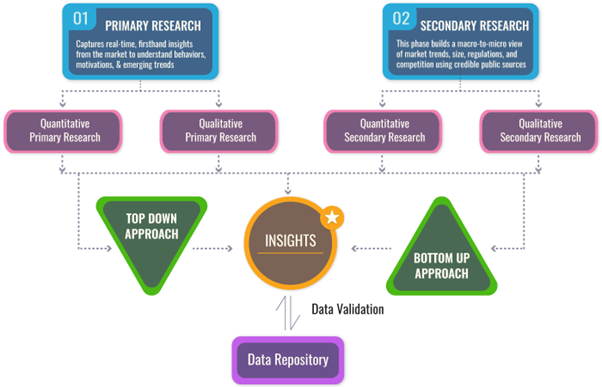
DUAL MODELING: TOP-DOWN + BOTTOM-UP
To ensure robust market estimation, we apply two complementary sizing approaches:
Top-Down Modeling:- Start with broader industry value (e.g., global or regional TAM)
- Apply filters by segment, geography, end-user, or use case
- Adjust with primary insights and validation benchmarks
- Ideal for investor-grade market scans and opportunity mapping
- Aggregate from the ground up using sales volumes, pricing, and unit economics
- Use internal modeling templates aligned with stakeholder data
- Incorporate distributor-level or region-specific inputs
- Most accurate for emerging segments and granular sub-markets
DATA VALIDATION: IN-HOUSE REPOSITORY
We close the loop with proprietary data intelligence built from ongoing projects, industry monitoring, and historical benchmarking. This repository includes:
- Multi-sector market and pricing models
- Key trendlines from past interviews and forecasts
- Benchmarked adoption rates, churn patterns, and ROI indicators
- Industry-specific deviation flags and cross-check logic
- Catches inconsistencies early
- Aligns projections across studies
- Enables consistent, high-trust deliverables