Data Center Rack Market Size and Forecast (2026–2034), Global and Regional Growth, Trend, Share and Industry Analysis Report Coverage; By Rack Type, Data Center Size, Rack Height, Industry; and Geography
2026-10-09
ICT
Ekta Chaurasia (Team Lead)
Description
Data Center Rack Market Overview
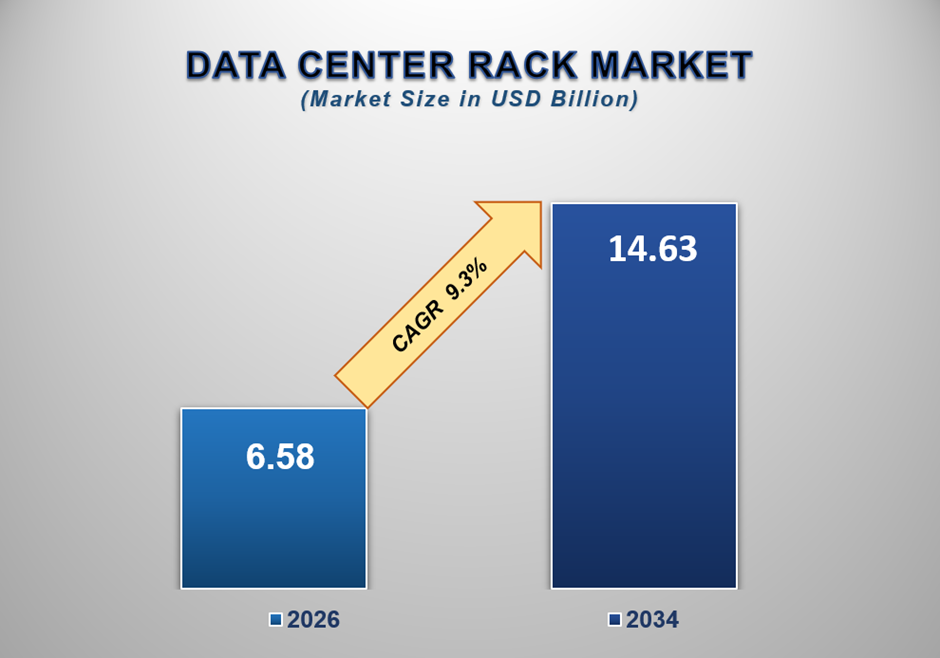
The global Data Center Rack Market is projected to reach USD 6.58 billion in 2026 and is expected to expand to USD 14.63 billion by 2034, registering a CAGR of 9.3% during 2026–2034. Data center racks are engineered enclosures used to organize and secure servers, networking equipment, storage systems, power-distribution components and associated infrastructure within data centers and other computing facilities.
The role of the
data center rack is changing as computing infrastructure becomes more
power-dense. Traditional racks primarily provided physical mounting, cable
organization and basic airflow management. New-generation rack systems
increasingly need to accommodate higher equipment weights, greater electrical
loads, sophisticated cable pathways, monitoring equipment, and cooling
architectures designed for accelerated computing.
The growth of
artificial intelligence is one of the most significant forces changing rack
requirements. AI servers equipped with GPUs and other accelerators can generate
considerably more heat and require substantially greater power than
conventional enterprise servers. This is increasing demand for rack
architectures capable of supporting high-density deployments and liquid-cooling
infrastructure. Current industry research identifies rising GPU density and
liquid-cooling compatibility as major drivers of data center rack demand.
This transition
means that rack manufacturers increasingly have to design around the complete
physical environment of a computing system. Rack depth, structural load
capacity, airflow containment, power distribution, cooling interfaces and
service accessibility must be considered together. A rack that was suitable for
conventional 5–15 kW deployments may require substantial modification for
high-density AI environments.
Hyperscale cloud
operators and colocation providers are also influencing rack specifications.
These facilities deploy large numbers of standardized cabinets and need systems
that can be manufactured, transported, installed and commissioned rapidly.
Factory-integrated rack solutions can shorten deployment schedules by combining
enclosure, power and cooling components before delivery to the data center.
The growth of
modular and prefabricated data center construction is reinforcing this trend.
Instead of constructing every infrastructure element independently at the
facility, operators can increasingly use standardized infrastructure blocks.
Rack manufacturers that can provide configurable systems compatible with
different server, networking and cooling requirements can therefore participate
in larger infrastructure projects.
Liquid cooling
is becoming particularly important. Direct-to-chip cooling, rear-door heat
exchangers and other liquid-based technologies are being adopted where
conventional air cooling becomes less practical at high rack densities. Data
center racks must consequently accommodate coolant distribution units,
manifolds, piping connections and associated leak-detection or monitoring
equipment. Vertiv's 2026 collaboration with Netweb Technologies in India
illustrates this shift, combining rack-scale GPU platforms with liquid-cooling
infrastructure and advanced power systems for AI workloads.
The physical
security and organization of IT equipment remain important as well. Enclosed
cabinets can provide controlled access, structured cabling and improved airflow
management when combined with appropriate containment systems. Open-frame racks
remain useful where equipment accessibility, lower cost or specialized
deployment requirements are more important than enclosure and security.
Edge computing
is creating another application layer. Smaller data processing facilities
located closer to users, industrial sites, telecommunications infrastructure
and distributed enterprises may require compact rack systems that can operate
in environments with limited floor space and different cooling conditions.
The market is therefore developing along two simultaneous paths: standardized high-volume rack deployment for hyperscale and colocation facilities, and specialized, highly configurable racks for AI, edge, enterprise and industrial environments. This combination is expected to support sustained demand through 2034.
Data Center
Rack Market Drivers and Opportunities
The Rapid
Expansion of AI and High-Density Computing Is Increasing Rack Requirements
Artificial
intelligence is changing the physical architecture of data centers because
accelerator-based computing places substantially greater demands on power
delivery and thermal management. High-performance GPU servers can concentrate
significant computing capacity into a relatively small physical footprint,
increasing the importance of rack-level infrastructure.
For rack
manufacturers, this creates requirements beyond conventional server mounting.
Cabinets need sufficient structural strength, greater depth and improved
cable-management capacity while remaining compatible with increasingly
sophisticated cooling systems.
Liquid cooling
is particularly important in these deployments. Data center cooling research
indicates that the rapid expansion of AI infrastructure and hyperscale
facilities is accelerating demand for liquid-cooling technologies and
rack-level thermal management.
The resulting
opportunity is shifting toward AI-ready rack platforms rather than commodity
cabinets. Vendors increasingly compete on load capacity, cooling compatibility,
power integration and the ability to deliver complete rack-scale
infrastructure.
Hyperscale
and Colocation Expansion Is Increasing Demand for Standardized Rack
Infrastructure
Cloud service
providers and colocation operators continue to expand computing capacity to
accommodate cloud applications, enterprise workloads, and AI infrastructure.
These facilities require large volumes of racks with predictable specifications
and repeatable installation processes.
Standardization
is valuable because operators may deploy hundreds or thousands of racks within
a single facility. Consistent dimensions and interfaces simplify installation,
cabling, maintenance and future expansion.
At the same
time, standardization does not mean that every rack has identical requirements.
Operators increasingly need configurable rack designs capable of supporting
different server generations, power levels and cooling approaches. This creates
demand for modular rack systems that retain standardized external dimensions
while allowing internal configurations to change.
The combination
of large-scale deployment and higher rack density is consequently encouraging
manufacturers to move toward factory-integrated and preconfigured solutions.
Industry research identifies prefabricated and high-density rack infrastructure
as an important opportunity associated with hyperscale and edge data center
expansion.
The Shift
Toward Liquid Cooling and Modular Infrastructure Creates New Product
Opportunities
Liquid cooling
is opening a significant area of product development for rack manufacturers.
Traditional air-cooled cabinets were designed around airflow through server
equipment, but direct-to-chip cooling and rear-door heat exchangers introduce
additional mechanical and fluid-management requirements.
Rack suppliers
can differentiate through integrated manifolds, coolant distribution
interfaces, leak detection, rear-door heat exchanger compatibility and
monitoring systems. These capabilities become particularly important as
operators deploy higher-density accelerator systems.
Modular
infrastructure represents another opportunity. Preassembled rack systems can
reduce onsite installation requirements and help data center developers
accelerate commissioning. They can also improve consistency because critical
components are assembled and tested before arriving at the facility.
The increasing
demand for these systems is encouraging collaboration between rack
manufacturers, power-infrastructure suppliers, cooling companies and server
vendors. Vertiv's partnership with Netweb Technologies is one example of this
convergence, with rack-scale AI infrastructure combining compute, liquid
cooling and power-management technologies.
Data Center Rack Market Scope
|
Report
Attributes |
Description |
|
Market Size
in 2026 |
USD 6.58 Billion |
|
Market
Forecast in 2034 |
USD 14.63 Billion |
|
CAGR %
2026-2034 |
9.3% |
|
Base Year |
2025 |
|
Historic
Data |
2021-2025 |
|
Forecast
Period |
2026-2034 |
|
Report USP |
Production,
Consumption, Company Share, Company Heatmap, Company Production, Service
Type, Growth Factors and more |
|
Segments
Covered |
By Rack Type By Data
Center Size |
|
Regional
Scope |
● North America |
|
Country
Scope |
U.S. |
Data Center Rack Market Report
Segmentation Analysis
The Data Center
Rack Market is analyzed according to rack type, data center size, rack height
and industry. These dimensions reflect differences in equipment density,
security requirements, facility scale and physical infrastructure needs.
The Cabinets
and Enclosed Racks Segment Is Expected to Hold the Largest Market Share
Cabinets and
enclosed racks represent the leading rack configuration because they provide a
controlled physical environment around sensitive IT equipment. Enclosed designs
can incorporate lockable doors, structured cabling, airflow management and
containment-compatible configurations, making them particularly suitable for
enterprise, colocation and high-density data center deployments.
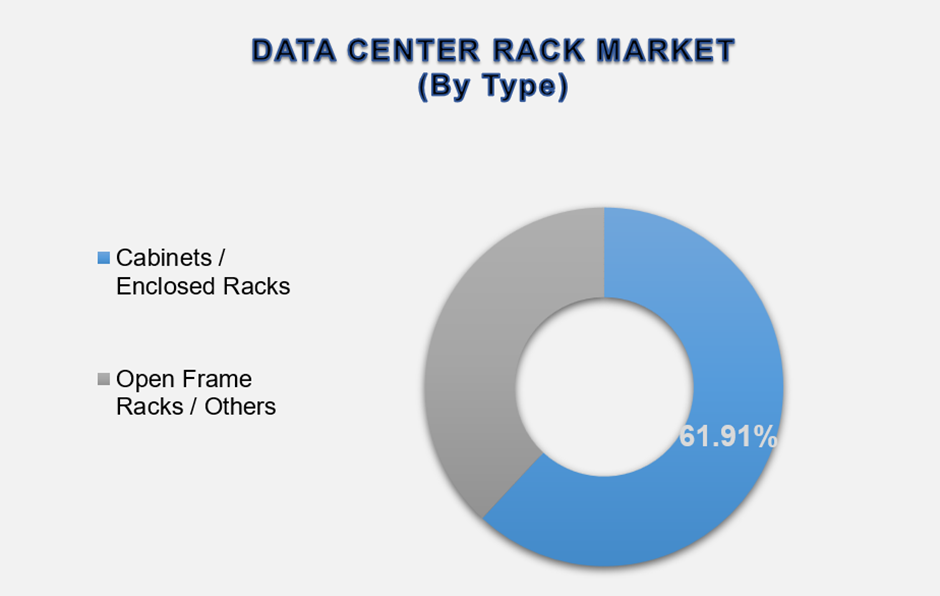
According to
Fortune Business Insights, cabinets and enclosed racks are expected to account
for 61.91% of the global Data Center Rack Market in 2026, while
open-frame racks represent the remaining 38.09%.
The importance
of enclosed cabinets is increasing as data centers deploy heavier and more
expensive computing equipment. AI and high-performance computing environments
also require better management of airflow and cooling interfaces, which can be
incorporated into enclosed rack architectures.
Open-frame racks
remain relevant where accessibility and installation flexibility are
priorities. Their exposed structure makes equipment and cabling easier to
access and can reduce the material cost associated with doors and side panels.
They are therefore used in selected telecom, edge, laboratory and
equipment-room applications.
The Small and
Mid-sized Data Center Segment Serves Distributed Computing Requirements
Small and
mid-sized data centers require racks that can provide efficient equipment
organization without the infrastructure scale associated with large hyperscale
facilities. These deployments include enterprise server rooms, regional
facilities, edge sites and specialized computing environments.
Space
utilization is particularly important in these locations. Operators may need
racks that can accommodate servers, network equipment, and power components
within constrained floor areas while still allowing technicians to access
equipment safely.
The Large
Data Center Segment Is Being Reshaped by Hyperscale and AI Deployments
Large data
centers require standardized racks that can be deployed in substantial
quantities. The design priority is increasingly shifting from basic equipment
storage toward high-density power and thermal management.
Large facilities
also place greater emphasis on deployment speed. Standardized rack
specifications allow infrastructure teams to repeat installation processes
across multiple halls and sites.
The 40U and
Below Segment Supports Space-Constrained Deployments
Lower-height
racks are useful where floor space, equipment volume or facility height
restricts the deployment of taller cabinets. They are common in smaller server
rooms, edge facilities and applications where the equipment load does not
justify a full-height enclosure.
The 41U up to
50U Segment Provides a Balance Between Capacity and Accessibility
Racks in the
41U–50U range provide substantial vertical capacity while remaining compatible
with widely deployed server and networking configurations. The 42U format is
particularly established in conventional data center infrastructure.
As AI systems
require additional space for power distribution, networking and cooling
components, taller configurations are increasingly being considered for
high-density environments. Mordor Intelligence reports that 48U configurations
are among the faster-growing rack-height categories because the additional
vertical capacity can accommodate cooling and networking components without
requiring additional floor space.
The Above 51U
Segment Addresses High-Density and Specialized Deployments
Very tall racks
can increase equipment density where facility ceiling height and structural
conditions permit. These configurations are more specialized because they must
account for equipment weight, stability, service access and safe installation.
They can be
particularly relevant in large facilities where maximizing equipment capacity
per unit of floor area is a priority.
The IT and
Telecom Industry Remains a Major Consumer of Data Center Rack Infrastructure
IT and
telecommunications companies operate extensive computing and networking
infrastructure, creating recurring requirements for racks, cabinets and related
accessories. Cloud services, content delivery, enterprise applications, and
telecommunications networks all depend on organized physical infrastructure.
The increasing
deployment of AI workloads within IT infrastructure is further increasing
demand for high-density rack systems capable of accommodating accelerator-based
servers and advanced cooling.
BFSI
Organizations Require Secure and Highly Organized Rack Environments
Banks, financial
institutions and insurers operate large volumes of sensitive digital
information and require reliable computing infrastructure. Rack systems support
the physical organization and security of servers, networking equipment and
storage infrastructure.
Financial
institutions also operate a mixture of centralized data centers, colocation
facilities and distributed infrastructure, creating demand for rack solutions
across different facility sizes.
Retail Data
Centers Are Increasingly Distributed
Retailers
increasingly use distributed computing infrastructure to support e-commerce,
point-of-sale systems, inventory management, analytics and customer-facing
digital services. Smaller rack deployments can therefore appear in regional
facilities and edge environments in addition to centralized data centers.
Government
and Healthcare Applications Require Reliable Infrastructure
Government
agencies and healthcare organizations maintain computing infrastructure for
data-intensive applications and sensitive information. Their rack requirements
can include controlled physical access, cable organization, equipment
protection and compatibility with facility-specific cooling and power systems.
The Following Segments Are Part of an In-Depth Analysis of the Data Center Rack Market
|
Market Segments |
|
|
By Rack Type |
●
Cabinets/Enclosed Racks ●
Open Frame Racks |
|
By
Data Center Size |
●
Small and Mid-sized Data Centers ●
Large Data Centers |
|
By Rack Height |
●
40U and Below ●
41U up to 50U ●
Above 51U |
|
By Industry |
●
BFSI ●
Retail ●
IT & Telecom ●
Government ●
Healthcare ●
Others |
Data Center Rack Market Share
Analysis By Region
North America
North America
remains a major center of data center rack demand because of its large
installed base of hyperscale facilities, cloud infrastructure and colocation
campuses. The region continues to attract substantial investment in AI
computing capacity, increasing requirements for high-density rack
infrastructure.
The growth of AI
is also creating physical infrastructure constraints. Current reporting
indicates that rapidly increasing electricity requirements from U.S. data
centers are putting pressure on available power capacity, reinforcing the
importance of infrastructure efficiency and high-density deployment planning.
The competitive
environment is well developed, with major rack and infrastructure companies
including Schneider Electric, Vertiv, Eaton and Chatsworth serving hyperscale,
enterprise and colocation customers.
Europe
Europe has a
mature data center ecosystem supported by cloud computing, enterprise
digitalization and colocation demand. Data center operators are increasingly
concerned with energy efficiency, thermal management and available power
capacity.
High-density
computing is encouraging greater interest in enclosed cabinets compatible with
advanced cooling technologies. Germany and other major European data center
markets are also experiencing infrastructure constraints that make efficient
use of power and cooling increasingly important.
Rittal maintains
a significant European presence and continues to develop data center
infrastructure around modular rack, power and cooling solutions.
Asia-Pacific
Asia-Pacific is
experiencing strong data center expansion as cloud adoption, digital services,
AI infrastructure and enterprise modernization accelerate. China, Japan, India,
South Korea and Australia are among the important markets supporting regional demand.
India is
particularly notable because hyperscale and colocation development is expanding
in Mumbai, Chennai, Hyderabad and Pune. Industry analysis points to increasing
demand for high-density rack systems with improved thermal management,
particularly as domestic AI infrastructure develops.
The region is
also becoming more important for localized rack manufacturing and assembly.
Vertiv's collaboration with Netweb Technologies illustrates how international
infrastructure providers are working with Indian technology companies to
address high-density AI deployments locally.
Latin America
Latin American
demand is being supported by cloud adoption, enterprise digitalization and new
regional data center facilities. Brazil and Mexico represent important markets
because of their large digital economies and growing demand for localized
computing capacity.
Rack
manufacturers can benefit from deployments requiring modular and scalable
infrastructure because regional operators often need to expand capacity
incrementally rather than construct extremely large facilities in a single
phase.
Middle East
and Africa
The Middle East
is developing into an important data center investment region as cloud
services, digital government initiatives and AI infrastructure expand.
Large-scale facilities require rack systems capable of supporting higher
densities while maintaining thermal performance under challenging environmental
conditions.
Africa is also
developing data center capacity as internet usage, cloud services and digital
infrastructure expand. Edge and regional facilities create additional
opportunities for compact and modular rack systems.
Data Center
Rack Market Competition Landscape Analysis
The Data Center
Rack Market is moderately consolidated at the premium end, where customers
increasingly evaluate racks as part of a wider power, cooling and
physical-infrastructure ecosystem. Major suppliers are competing not only on
cabinet construction but also on high-density capability, liquid-cooling
compatibility, monitoring, customization and deployment speed.
Schneider
Electric, Vertiv and Eaton are increasingly positioning racks alongside power
and cooling equipment. This integrated approach allows data center operators to
procure multiple physical-infrastructure components from a coordinated
supplier.
Rittal maintains
a strong position in rack and enclosure infrastructure, particularly across
European and industrial markets. Legrand, nVent, Panduit and Chatsworth compete
through specialized enclosure, cable-management and data center infrastructure
portfolios.
The rise of AI
is changing competitive requirements. Rack manufacturers must increasingly
support equipment that is heavier, consumes more power and generates more heat.
As a result, vendors are developing liquid-cooling-ready configurations,
high-load cabinets and factory-integrated solutions.
Mordor
Intelligence identifies Schneider Electric, Vertiv, Eaton, Rittal and Hewlett
Packard Enterprise among the major companies participating in the market, while
also noting competition from Chatsworth, Panduit, Legrand and other specialized
infrastructure providers.
Major
Companies Operating in the Data Center Rack Market
●
Schneider Electric SE
●
Vertiv Holdings Co.
●
Eaton Corporation plc
●
Rittal GmbH & Co. KG
●
Legrand SA
●
nVent Electric plc
●
Panduit Corp.
●
Chatsworth Products, Inc.
●
Belden Inc.
●
Hammond Manufacturing Ltd.
●
Great Lakes Case & Cabinet
Co.
●
Dell Technologies Inc.
●
Hewlett Packard Enterprise
●
Tripp Lite
●
Fujitsu Ltd.
●
IBM Corporation
●
Cisco Systems, Inc.
●
Black Box Corporation
●
Belkin International
●
Oracle Corporation
Global Data
Center Rack Recent Developments News
Vertiv and
Netweb Technologies — February 2026: Vertiv
announced a collaboration with Netweb Technologies India to jointly engineer
and validate GPU computing platforms using Vertiv's integrated AI data center
infrastructure. The solution combines rack-scale computing with liquid cooling,
coolant distribution units, free-cooling chillers, busways and UPS
infrastructure.
Schneider
Electric and AI infrastructure — 2026: Schneider
Electric continues to expand its AI-ready data center infrastructure portfolio,
with rack systems increasingly positioned alongside power and cooling
technologies. Industry research identifies its NetShelter portfolio as a major
component of its data center rack offering.
Eaton and
prefabricated infrastructure — 2026: Eaton's
expansion into prefabricated data center infrastructure, including its
acquisition of Fibrebond, reflects the industry's movement toward
factory-assembled infrastructure that can accelerate deployment at hyperscale
facilities.
Rittal and
high-density infrastructure — 2026: Rittal
continues to develop rack and infrastructure solutions around high-density data
center requirements. Its activities in India are also increasingly focused on
supporting the country's growing digital infrastructure and data center
ecosystem.
AI-driven
rack density — 2026: The increasing use of
GPU-based AI computing is raising rack power and thermal requirements. This is
accelerating interest in liquid-cooling-compatible racks, higher-capacity
cabinets and integrated rack-scale infrastructure rather than conventional air-cooled
server enclosures alone.
The Global
Data Center Rack Market is Dominated by a Few Large Companies, Such As
Schneider
Electric SE, Vertiv Holdings Co., Eaton Corporation plc, Rittal GmbH & Co.
KG, Legrand SA, nVent Electric plc, Panduit Corp., Chatsworth Products, Inc.,
Belden Inc., Hammond Manufacturing Ltd., Great Lakes Case & Cabinet Co.,
Dell Technologies Inc., Hewlett Packard Enterprise, Tripp Lite, Fujitsu Ltd.,
IBM Corporation, Cisco Systems, Inc., Black Box Corporation, Belkin
International, and Oracle Corporation.
The competitive landscape is expected to evolve as AI workloads increase rack density and data center operators demand infrastructure that combines physical enclosure, power distribution, cooling compatibility, and monitoring. The ability to deliver standardized systems at hyperscale volumes while also supporting customized high-density deployments is becoming increasingly important.
Frequently Asked Questions
Ekta Chaurasia (Team Lead)
Ekta Chaurasia is a highly experienced Team Lead at M2Square Consultancy with over 7 years of expertise in market research, strategic consulting, competitive benchmarking, and business intelligence solutions. She specializes in ICT, semiconductors & electronics, automotive & transportation, and industrial machinery markets.
She leads end-to-end global research projects focused on market trends, industry analysis, growth forecasting, customer insights, and strategic decision-making. Known for her analytical leadership and industry expertise, Ekta helps businesses uncover growth opportunities, evaluate competitive landscapes, and stay ahead in rapidly evolving markets through accurate and insight-driven research.
1.
Global Data Center Rack
Market Introduction and Market Overview
1.1. Objectives of the Study
1.2. Global Data Center Rack Market Scope and Market Estimation
1.2.1.
Global Data Center Rack Market
Size (US$ Million), Market CAGR (%), Market Forecast (2026 - 2034)
1.2.2.
Global Data Center Rack Market
Revenue Share (%) and Growth Rate (Y-o-Y) Analysis (2021 - 2034)
1.3. Market Segmentation
1.3.1.
By Rack Type of Global Data
Center Rack Market
1.3.2.
By Data Center Size of Global
Data Center Rack Market
1.3.3.
By Rack Height of Global Data
Center Rack Market
1.3.4.
By Industry of Global Data
Center Rack Market
1.3.5.
Region of Global Data Center
Rack Market
1.4. Competition Coverage List of Market Participants
1.5. Market Definition: Data Center Rack Market
2.
Executive Summary
2.1. Demand Side Trends
2.2. Key Market Trends
2.3. Market Demand (US$ Million) Analysis 2021 – 2025 and Forecast, 2026
– 2034
2.4. Demand and Opportunity Assessment
2.5. Key Developments
2.6. Overview of Regulatory Landscape, Compliance Framework, and Industry
Standards
2.7. Market Entry Strategies
2.8. Market Dynamics
2.8.1.
Drivers
2.8.2.
Limitations
2.8.3.
Opportunities
2.8.4.
Impact Analysis of Drivers and
Restraints
2.9. Porter's Five Forces Analysis
2.10.
PEST Analysis
3.
Global Data Center Rack
Market Estimates & Historical Trend Analysis (2021 – 2025)
4.
Global Data Center Rack
Market Estimates & Forecast Trend Analysis, by Rack Type
4.1. Global Data Center Rack Market Revenue (US$ Million) Estimates and
Forecasts, by Rack Type, 2021 - 2034
4.1.1.
Cabinets/Enclosed Racks
4.1.2.
Open Frame Racks
5.
Global Data Center Rack
Market Estimates & Forecast Trend Analysis, by Data Center Size
5.1. Global Data Center Rack Market Revenue (US$ Million) Estimates and
Forecasts, by Data Center Size, 2021 - 2034
5.1.1.
Small and Mid-sized Data
Centers
5.1.2.
Large Data Centers
6.
Global Data Center Rack
Market Estimates & Forecast Trend Analysis, by Rack Height
6.1. Global Data Center Rack Market Revenue (US$ Million) Estimates and
Forecasts, by Rack Height, 2021 - 2034
6.1.1.
40U and Below
6.1.2.
41U up to 50U
6.1.3.
Above 51U
7.
Global Data Center Rack
Market Estimates & Forecast Trend Analysis, by Industry
7.1. Global Data Center Rack Market Revenue (US$ Million) Estimates and
Forecasts, by Industry, 2021 - 2034
7.1.1.
BFSI
7.1.2.
Retail
7.1.3.
IT & Telecom
7.1.4.
Government
7.1.5.
Healthcare
7.1.6.
Others
8.
Global Data Center Rack
Market Estimates & Forecast Trend Analysis, by Region
8.1. Global Data Center Rack Market Revenue (US$ Million) Estimates and
Forecasts, by Region, 2021 - 2034
8.1.1.
North America
8.1.2.
Europe
8.1.3.
Asia Pacific
8.1.4.
Middle East & Africa
8.1.5.
Latin America
9.
North America Data
Center Rack Market: Estimates & Forecast Trend Analysis
9.1. North America Data Center Rack Market Assessments & Key Findings
9.1.1.
North America Data Center Rack
Market Introduction
9.1.2.
North America Data Center Rack
Market Size Estimates and Forecast (US$ Million) (2021 - 2034)
9.1.2.1.
By Rack Type
9.1.2.2.
By Data Center Size
9.1.2.3.
By Rack Height
9.1.2.4.
By Industry
9.1.2.5.
By Country
9.1.2.5.1.
The U.S.
9.1.2.5.2.
Canada
10. Europe Data Center Rack Market: Estimates & Forecast Trend
Analysis
10.1.
Europe Data Center Rack Market
Assessments & Key Findings
10.1.1.
Europe Data Center Rack Market
Introduction
10.1.2.
Europe Data Center Rack Market
Size Estimates and Forecast (US$ Million) (2021 - 2034)
10.1.2.1.
By Rack Type
10.1.2.2.
By Data Center Size
10.1.2.3.
By Rack Height
10.1.2.4.
By Industry
10.1.2.5.
By Country
10.1.2.5.1.
Germany
10.1.2.5.2.
Italy
10.1.2.5.3.
The U.K.
10.1.2.5.4.
France
10.1.2.5.5.
Spain
10.1.2.5.6.
Switzerland
10.1.2.5.7.
Rest of Europe
11. Asia Pacific Data Center Rack Market: Estimates & Forecast Trend
Analysis
11.1.
Asia Pacific Data Center Rack
Market Assessments & Key Findings
11.1.1.
Asia Pacific Data Center Rack
Market Introduction
11.1.2.
Asia Pacific Data Center Rack
Market Size Estimates and Forecast (US$ Million) (2021 - 2034)
11.1.2.1.
By Rack Type
11.1.2.2.
By Data Center Size
11.1.2.3.
By Rack Height
11.1.2.4.
By Industry
11.1.2.5.
By Country
11.1.2.5.1.
China
11.1.2.5.2.
Japan
11.1.2.5.3.
India
11.1.2.5.4.
Australia
11.1.2.5.5.
South Korea
11.1.2.5.6.
Rest of Asia Pacific
12. Middle East & Africa Data Center Rack Market: Estimates &
Forecast Trend Analysis
12.1.
Middle East & Africa Data
Center Rack Market Assessments & Key Findings
12.1.1.
Middle East & Africa Data
Center Rack Market Introduction
12.1.2.
Middle East & Africa Data
Center Rack Market Size Estimates and Forecast (US$ Million) (2021 - 2034)
12.1.2.1.
By Rack Type
12.1.2.2.
By Data Center Size
12.1.2.3.
By Rack Height
12.1.2.4.
By Industry
12.1.2.5.
By Country
12.1.2.5.1.
UAE
12.1.2.5.2.
Saudi Arabia
12.1.2.5.3.
South Africa
12.1.2.5.4.
Rest of Middle East &
Africa
13. Latin America Data Center Rack Market: Estimates & Forecast
Trend Analysis
13.1.
Latin America Data Center Rack
Market Assessments & Key Findings
13.1.1.
Latin America Data Center Rack
Market Introduction
13.1.2.
Latin America Data Center Rack
Market Size Estimates and Forecast (US$ Million) (2021 - 2034)
13.1.2.1.
By Rack Type
13.1.2.2.
By Data Center Size
13.1.2.3.
By Rack Height
13.1.2.4.
By Industry
13.1.2.5.
By Country
13.1.2.5.1.
Brazil
13.1.2.5.2.
Mexico
13.1.2.5.3.
Argentina
13.1.2.5.4.
Rest of Latin America
14. Competition Landscape
14.1.
Global Data Center Rack Market
Product Mapping
14.2.
Global Data Center Rack Market
Concentration Analysis, by Leading Players / Innovators / Emerging Players /
New Entrants
14.3.
Global Data Center Rack Market
Tier Structure Analysis
14.4.
Global Data Center Rack Market
Concentration & Company Market Shares (%) Analysis, 2026
15. Company Profiles
15.1.
Schneider Electric SE
15.1.1.
Company Overview & Key
Stats
15.1.2.
Financial Performance &
KPIs
15.1.3.
Product Portfolio
15.1.4.
SWOT Analysis
15.1.5.
Business Strategy & Recent
Developments
*Similar details would be provided for all
the players mentioned below
15.2.
Vertiv Holdings Co.
15.3.
Eaton Corporation plc
15.4.
Rittal GmbH & Co. KG
15.5.
Legrand SA
15.6.
nVent Electric plc
15.7.
Panduit Corp.
15.8.
Chatsworth Products, Inc.
15.9.
Belden Inc.
15.10.
Hammond Manufacturing Ltd.
15.11.
Great Lakes Case & Cabinet
Co.
15.12.
Dell Technologies Inc.
15.13.
Hewlett Packard Enterprise
15.14.
Tripp Lite
15.15.
Fujitsu Ltd.
15.16.
IBM Corporation
15.17.
Cisco Systems, Inc.
15.18.
Black Box Corporation
15.19.
Belkin International
15.20.
Oracle Corporation
16. Research Findings & Conclusion
17. Assumptions & Acronyms Used
18. Research Methodology
18.1.
External Databases
18.2.
Internal Proprietary Database
18.3.
Primary Research
18.4.
Secondary Research
18.5.
Assumptions
18.6.
Limitations
18.7.
Report FAQ
Our Research Methodology
"Insight without rigor is just noise."
We follow a comprehensive, multi-phase research framework designed to deliver accurate, strategic, and decision-ready intelligence. Our process integrates primary and secondary research , both quantitative and qualitative , along with dual modeling techniques ( top-down and bottom-up) and a final layer of validation through our proprietary in-house repository.
PRIMARY RESEARCH
Primary research captures real-time, firsthand insights from the market to understand behaviors, motivations, and emerging trends.
1. Quantitative Primary Research
Objective: Generate statistically significant data directly from market participants.
Approaches:- Structured surveys with customers, distributors, and field agents
- Mobile-based data collection for point-of-sale audits and usage behavior
- Phone-based interviews (CATI) for market sizing and product feedback
- Online polling around industry events and digital campaigns
- Purchase frequency by customer type
- Channel performance across geographies
- Feature demand by application or demographic
2. Qualitative Primary Research
Objective: Explore decision-making drivers, pain points, and market readiness.
Approaches:- In-depth interviews (IDIs) with executives, product managers, and key decision-makers
- Focus groups among end users and early adopters
- Site visits and observational research for consumer products
- Informal field-level discussions for regional and cultural nuances
SECONDARY RESEARCH
This phase helps establish a macro-to-micro understanding of market trends, size, regulation, and competitive dynamics, sourced from credible and public domain information.
1. Quantitative Secondary Research
Objective: Model market value and segment-level forecasts based on published data.
Sources include:- Financial reports and investor summaries
- Government trade data, customs records, and regulatory statistics
- Industry association publications and economic databases
- Channel performance and pricing data from marketplace listings
- Revenue splits, pricing trends, and CAGR estimates
- Supply-side capacity and volume tracking
- Investment analysis and funding benchmarks
2. Qualitative Secondary Research
Objective: Capture strategic direction, innovation signals, and behavioral trends.
Sources include:- Company announcements, roadmaps, and product pipelines
- Publicly available whitepapers, conference abstracts, and academic research
- Regulatory body publications and policy briefs
- Social and media sentiment scanning for early-stage shifts
- Strategic shifts in market positioning
- Unmet needs and white spaces
- Regulatory triggers and compliance impact
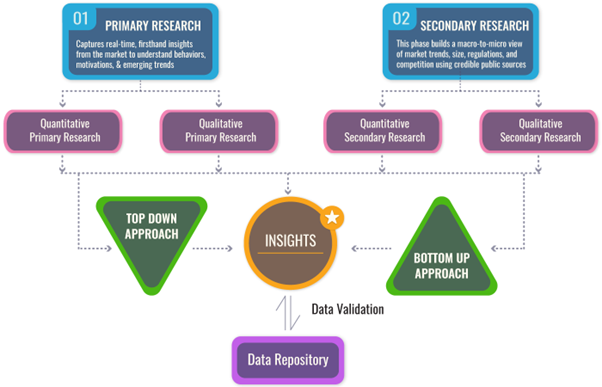
DUAL MODELING: TOP-DOWN + BOTTOM-UP
To ensure robust market estimation, we apply two complementary sizing approaches:
Top-Down Modeling:- Start with broader industry value (e.g., global or regional TAM)
- Apply filters by segment, geography, end-user, or use case
- Adjust with primary insights and validation benchmarks
- Ideal for investor-grade market scans and opportunity mapping
- Aggregate from the ground up using sales volumes, pricing, and unit economics
- Use internal modeling templates aligned with stakeholder data
- Incorporate distributor-level or region-specific inputs
- Most accurate for emerging segments and granular sub-markets
DATA VALIDATION: IN-HOUSE REPOSITORY
We close the loop with proprietary data intelligence built from ongoing projects, industry monitoring, and historical benchmarking. This repository includes:
- Multi-sector market and pricing models
- Key trendlines from past interviews and forecasts
- Benchmarked adoption rates, churn patterns, and ROI indicators
- Industry-specific deviation flags and cross-check logic
- Catches inconsistencies early
- Aligns projections across studies
- Enables consistent, high-trust deliverables