

DC Motor Control Devices Market Size and Forecast (2026 - 2034), Global and Regional Growth, Trend, Share and Industry Analysis Report Coverage; By Type (DC Drives, DC Motor Starters and DC Motor Controllers); By Component (Power Modules, Control Modules, Sensors and Others); By Voltage Range (Low Voltage, Medium Voltage and High Voltage); By End-use Industry (Manufacturing, Automotive, Oil & Gas, Energy & Utilities, Mining and Others) and Geography
2026-03-12
Semiconductor and Electronics
Ekta Chaurasia (Team Lead)
Description
DC Motor Control Devices Market Overview
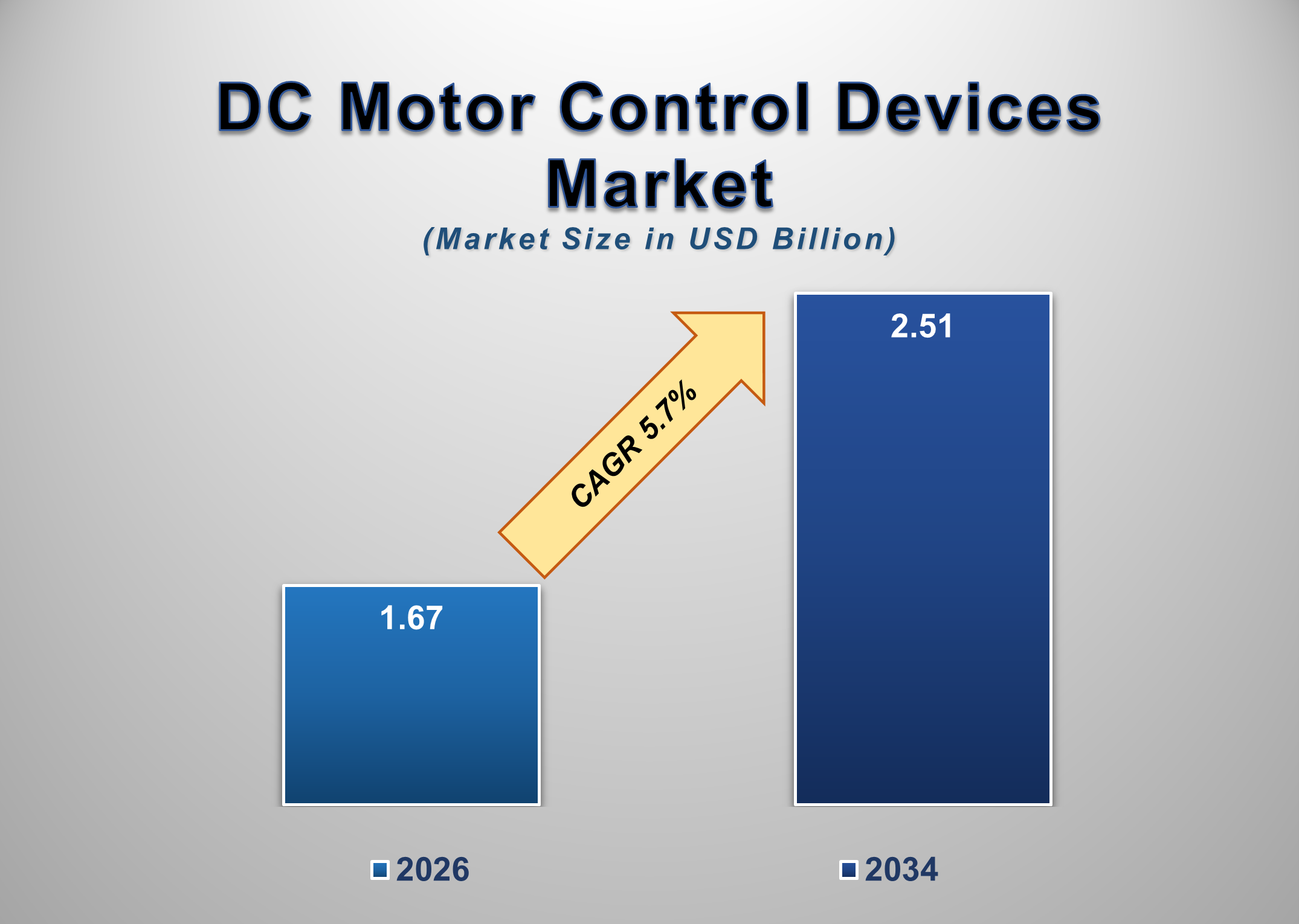
The global DC Motor Control Devices Market is experiencing steady expansion as industries increasingly rely on automated systems, precision motor operations, and energy-efficient motion control technologies. The market is valued at USD 1.67 billion in 2026 and is projected to reach USD 2.51 billion by 2034, registering a CAGR of 5.7% during the forecast period.
DC motor control devices are electronic systems designed to regulate the speed, torque, and direction of direct current motors in various industrial and commercial applications. These devices include DC drives, motor controllers, starters, and integrated electronic modules that enable precise motor management. By adjusting voltage input and current flow, these control devices allow operators to optimize motor performance for different operational requirements.
DC motors remain essential in applications where high starting torque, smooth speed control, and reliable performance are required. Industries such as manufacturing, automotive production, mining operations, and material handling systems rely heavily on DC motor control devices to manage machinery efficiently. These devices also contribute to improved operational safety by providing protection mechanisms against overloads, voltage fluctuations, and overheating.
The integration of advanced power electronics, digital controllers, and intelligent monitoring systems has significantly improved the capabilities of modern DC motor control devices. Contemporary systems are capable of delivering high accuracy in motor regulation while supporting remote monitoring and predictive maintenance. As industries continue to modernize their production facilities and adopt automation technologies, demand for advanced motor control devices is expected to increase steadily.
DC Motor Control Devices Market Drivers and Opportunities
Increasing Industrial Automation and Smart Manufacturing Initiatives are anticipated to drive the DC Motor Control Devices market growth
The rapid adoption of industrial automation technologies across manufacturing and processing industries is one of the primary drivers supporting the expansion of the DC motor control devices market. Modern production facilities increasingly depend on automated machinery that requires precise motor control to maintain consistent output quality and operational efficiency.
DC motor control devices play a crucial role in regulating the movement of conveyor systems, robotic arms, machine tools, and packaging equipment. By providing accurate control over motor speed and torque, these devices enable manufacturers to achieve greater productivity while minimizing operational errors. Automation systems also rely on motor controllers to synchronize multiple mechanical components within a production line.
Furthermore, the emergence of Industry 4.0 technologies has accelerated the integration of intelligent motor control systems capable of communicating with centralized monitoring platforms. Smart DC motor controllers equipped with sensors and communication modules allow operators to monitor equipment performance in real time. This capability helps detect anomalies early, reducing downtime and maintenance costs.
As industries across Asia-Pacific, North America, and Europe continue to invest in digital manufacturing infrastructure, the demand for advanced DC motor control devices is expected to expand considerably.
Growing Demand for Energy-Efficient Motor Control Solutions is accelerating market expansion
Energy efficiency has become a critical priority for industrial operations due to rising electricity costs and increasing regulatory pressure to reduce energy consumption. Motor-driven systems account for a significant portion of industrial energy usage, making efficient motor control technologies essential for sustainable operations.
DC motor control devices help optimize energy consumption by adjusting motor speed according to operational demand. Instead of running motors continuously at full power, controllers regulate voltage and current to match load requirements. This capability reduces unnecessary energy usage and improves overall system efficiency.
Advanced DC motor drives also incorporate regenerative braking technology, which allows energy generated during motor deceleration to be recovered and reused within the system. This feature is particularly valuable in heavy industrial applications such as cranes, elevators, and automated transport systems.
As governments and industrial organizations prioritize energy-efficient manufacturing practices, the adoption of intelligent motor control technologies is expected to increase significantly, further strengthening market growth.
Integration of Intelligent Motor Control Systems Creates Emerging Opportunities
The evolution of digital control technologies and advanced semiconductor components is creating new opportunities in the DC motor control devices market. Modern controllers are increasingly designed with embedded processors, communication interfaces, and advanced diagnostic capabilities that allow seamless integration with industrial automation networks.
These intelligent control systems enable predictive maintenance by continuously monitoring parameters such as temperature, vibration, current load, and voltage fluctuations. By analyzing operational data, these systems can identify potential equipment failures before they occur, helping operators prevent costly production interruptions.
Additionally, the growing use of electric vehicles, robotics, and battery-powered equipment is opening new application areas for compact and high-performance DC motor controllers. Portable machinery, electric mobility solutions, and automated warehouse systems require efficient motor control electronics capable of operating within limited space and power constraints.
As industries move toward smarter and more connected manufacturing environments, demand for intelligent DC motor control solutions is expected to grow significantly over the coming years
DC Motor Control Devices Market Scope
DC Motor Control Devices Market Report Segmentation Analysis
The global DC Motor Control Devices Market industry analysis is segmented by type, component, voltage range, end-use industry, and region.
DC Drives Segment Dominates the Market by Type
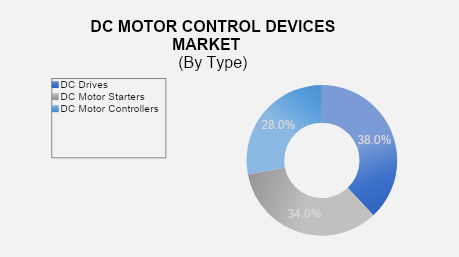
By type, the market is segmented into DC drives, DC motor starters, and DC motor controllers. DC drives dominate the market, as they provide comprehensive motor management capabilities, including speed control, torque regulation, and operational monitoring. These drives are widely used in heavy industrial machinery where precise motor control is essential for maintaining consistent performance.
Power Modules hold the largest share of the Component Segment
Based on component, the market is segmented into power modules, control modules, sensors, and others. Power modules account for the largest share, as they manage voltage conversion and current regulation within motor control systems. High-performance semiconductor devices such as insulated gate bipolar transistors (IGBTs) and MOSFETs are widely used in power modules to improve efficiency and reliability.
Low Voltage Segment Leads the Voltage Range Category
By voltage range, the market is segmented into low-voltage, medium-voltage, and high-voltage systems. Low-voltage DC motor control devices dominate the market due to their extensive use in small industrial equipment, automated systems, and robotics applications.
Manufacturing Sector Leads the End-use Industry Segment
In terms of end-use industry, the market is segmented into manufacturing, automotive, oil & gas, energy & utilities, mining, and others. The manufacturing sector represents the largest market share because motor-driven equipment is widely used in assembly lines, processing plants, and packaging systems.
The following segments are part of an in-depth analysis of the global DC Motor Control Devices Market:
DC Motor Control Devices Market Share Analysis by Region
The Asia-Pacific region is expected to dominate the global DC Motor Control Devices Market during the forecast period due to rapid industrialization, large-scale manufacturing operations, and increasing adoption of automation technologies. Countries such as China, India, Japan, and South Korea have become major manufacturing hubs that require advanced motor control technologies to support industrial productivity.
Europe holds a significant share of the market as industries in the region focus on energy-efficient manufacturing systems and digital industrial infrastructure. Meanwhile, North America continues to witness strong demand for motor control technologies driven by automation in manufacturing facilities and technological advancements in industrial robotics.
Global DC Motor Control Devices Market Recent Developments News:
o In July 2025, a global industrial automation company introduced a new range of high-efficiency DC motor controllers designed for automated manufacturing systems.
o In April 2025, a major electronics manufacturer launched compact DC drive modules optimized for robotics and smart industrial machinery.
o In January 2025, an automation technology provider expanded its portfolio of digital motor control solutions with integrated monitoring capabilities.
The Global DC Motor Control Devices Market is dominated by a few large companies, such as
● Siemens AG
● ABB Ltd.
● Schneider Electric
● Rockwell Automation Inc.
● Mitsubishi Electric Corporation
● Toshiba Corporation
● Fuji Electric Co., Ltd.
● Eaton Corporation
● Emerson Electric Co.
● Yaskawa Electric Corporation
● Delta Electronics Inc.
● Parker Hannifin Corporation
● Other Prominent Players
Frequently Asked Questions
Ekta Chaurasia (Team Lead)
Ekta Chaurasia is a highly experienced Team Lead at M2Square Consultancy with over 7 years of expertise in market research, strategic consulting, competitive benchmarking, and business intelligence solutions. She specializes in ICT, semiconductors & electronics, automotive & transportation, and industrial machinery markets.
She leads end-to-end global research projects focused on market trends, industry analysis, growth forecasting, customer insights, and strategic decision-making. Known for her analytical leadership and industry expertise, Ekta helps businesses uncover growth opportunities, evaluate competitive landscapes, and stay ahead in rapidly evolving markets through accurate and insight-driven research.
DC Motor Control Devices Market
Our Research Methodology
"Insight without rigor is just noise."
We follow a comprehensive, multi-phase research framework designed to deliver accurate, strategic, and decision-ready intelligence. Our process integrates primary and secondary research , both quantitative and qualitative , along with dual modeling techniques ( top-down and bottom-up) and a final layer of validation through our proprietary in-house repository.
PRIMARY RESEARCH
Primary research captures real-time, firsthand insights from the market to understand behaviors, motivations, and emerging trends.
1. Quantitative Primary Research
Objective: Generate statistically significant data directly from market participants.
Approaches:- Structured surveys with customers, distributors, and field agents
- Mobile-based data collection for point-of-sale audits and usage behavior
- Phone-based interviews (CATI) for market sizing and product feedback
- Online polling around industry events and digital campaigns
- Purchase frequency by customer type
- Channel performance across geographies
- Feature demand by application or demographic
2. Qualitative Primary Research
Objective: Explore decision-making drivers, pain points, and market readiness.
Approaches:- In-depth interviews (IDIs) with executives, product managers, and key decision-makers
- Focus groups among end users and early adopters
- Site visits and observational research for consumer products
- Informal field-level discussions for regional and cultural nuances
SECONDARY RESEARCH
This phase helps establish a macro-to-micro understanding of market trends, size, regulation, and competitive dynamics, sourced from credible and public domain information.
1. Quantitative Secondary Research
Objective: Model market value and segment-level forecasts based on published data.
Sources include:- Financial reports and investor summaries
- Government trade data, customs records, and regulatory statistics
- Industry association publications and economic databases
- Channel performance and pricing data from marketplace listings
- Revenue splits, pricing trends, and CAGR estimates
- Supply-side capacity and volume tracking
- Investment analysis and funding benchmarks
2. Qualitative Secondary Research
Objective: Capture strategic direction, innovation signals, and behavioral trends.
Sources include:- Company announcements, roadmaps, and product pipelines
- Publicly available whitepapers, conference abstracts, and academic research
- Regulatory body publications and policy briefs
- Social and media sentiment scanning for early-stage shifts
- Strategic shifts in market positioning
- Unmet needs and white spaces
- Regulatory triggers and compliance impact
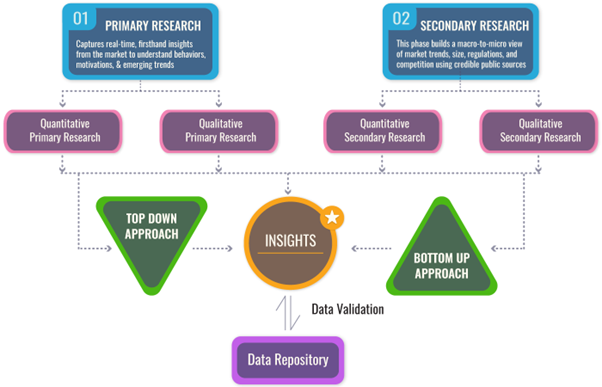
DUAL MODELING: TOP-DOWN + BOTTOM-UP
To ensure robust market estimation, we apply two complementary sizing approaches:
Top-Down Modeling:- Start with broader industry value (e.g., global or regional TAM)
- Apply filters by segment, geography, end-user, or use case
- Adjust with primary insights and validation benchmarks
- Ideal for investor-grade market scans and opportunity mapping
- Aggregate from the ground up using sales volumes, pricing, and unit economics
- Use internal modeling templates aligned with stakeholder data
- Incorporate distributor-level or region-specific inputs
- Most accurate for emerging segments and granular sub-markets
DATA VALIDATION: IN-HOUSE REPOSITORY
We close the loop with proprietary data intelligence built from ongoing projects, industry monitoring, and historical benchmarking. This repository includes:
- Multi-sector market and pricing models
- Key trendlines from past interviews and forecasts
- Benchmarked adoption rates, churn patterns, and ROI indicators
- Industry-specific deviation flags and cross-check logic
- Catches inconsistencies early
- Aligns projections across studies
- Enables consistent, high-trust deliverables