

Diabetes Management Market Size and Forecast (2020 - 2033), Global and Regional Growth, Trend, Share and Industry Analysis Report Coverage; By Product (Devices, Drugs); By Distribution Channel (Hospital Pharmacies, Retail Pharmacies, Online Pharmacies); and Geography
2025-11-10
Healthcare
Swetal (Research Analyst)
Description
Diabetes Management Market Overview
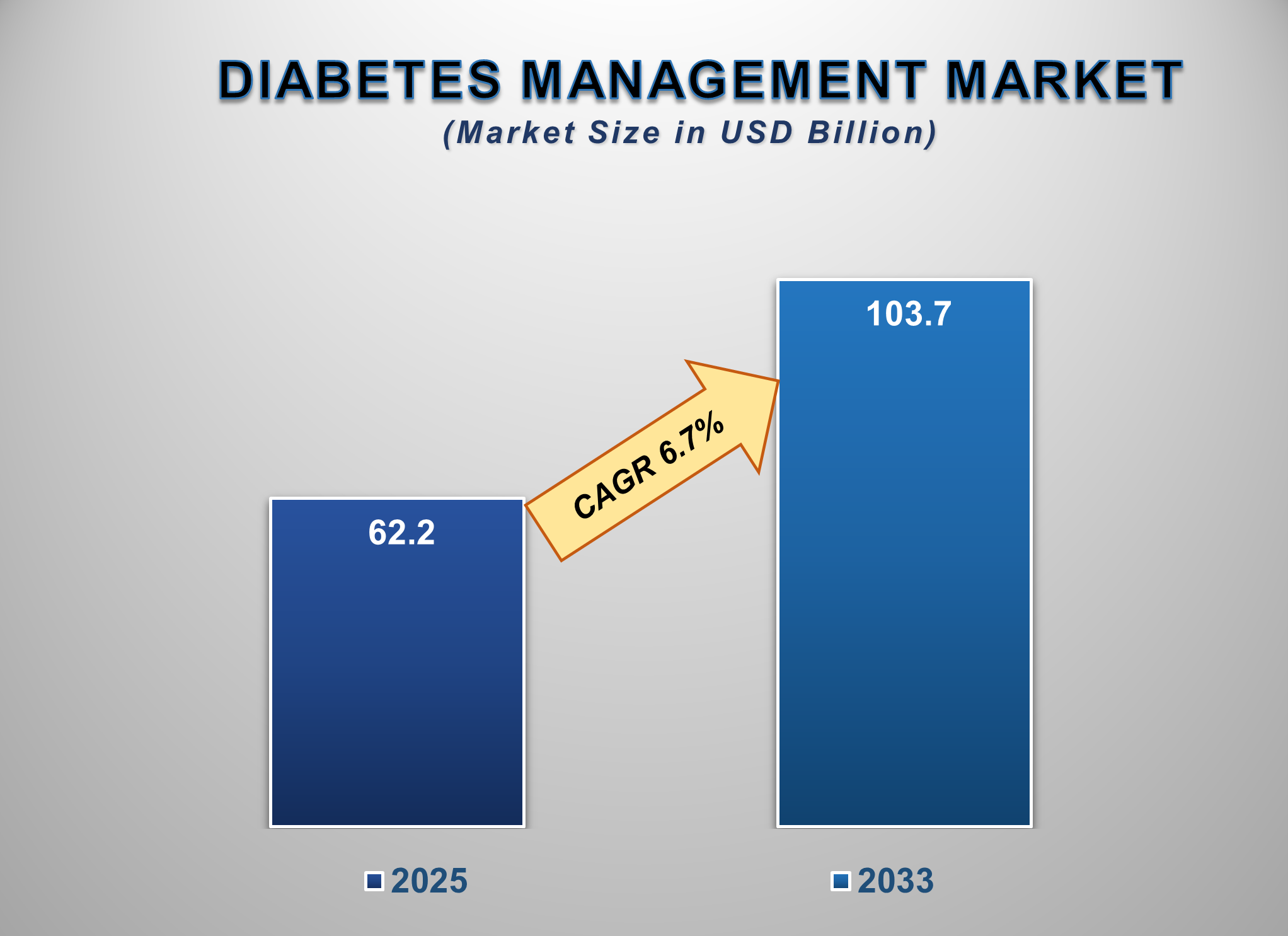
The Global Diabetes Management Market Size is projected to witness robust growth from 2025 to 2033, propelled by the escalating global prevalence of diabetes, increasing adoption of advanced technological solutions, and growing government initiatives for chronic disease management. Valued at approximately USD 62.2 billion in 2025, the market is expected to reach USD 103.7 billion by 2033, reflecting a compound annual growth rate (CAGR) of 6.7% over the forecast period.
The diabetes management market is
a critical and rapidly evolving sector within the global healthcare industry,
encompassing a wide array of products from monitoring devices to therapeutic
drugs. The market is experiencing a significant transformation, moving from
traditional management approaches to integrated, technology-driven solutions
focused on improving patient outcomes and quality of life. The high efficacy
and essential nature of insulin and other anti-diabetic medications continue to
form a substantial foundation of market revenue. A primary growth catalyst is
the expanding global diabetic population, which is strongly linked to the
rising incidence of risk factors such as obesity, sedentary lifestyles, and
unhealthy diets. The growing aging population, which has a higher
susceptibility to Type 2 diabetes, further fuels market expansion.
The market is also benefiting
from rapid technological innovation, particularly in the field of glucose
monitoring, with Continuous Glucose Monitoring (CGM) systems and smart insulin
pens revolutionizing patient care. These technologies offer real-time data,
improved glycemic control, and enhanced convenience. Furthermore, the
increasing penetration of digital health platforms and telehealth services is
facilitating remote patient monitoring and personalized care management. The
patent expiry of several blockbuster drugs has spurred robust generic
competition, improving affordability and access, especially in cost-sensitive
markets. North America remains the dominant region due to high healthcare
expenditure and early technology adoption, while the Asia-Pacific region is
anticipated to exhibit the fastest growth, driven by a large and
under-diagnosed patient pool and improving healthcare infrastructure.
Diabetes Management
Market Drivers and Opportunities
Rising Global Prevalence
of Diabetes and Associated Complications
The
increasing global incidence of diabetes mellitus is the fundamental driver for
this market. This surge is intrinsically linked to the growing prevalence of
obesity, physical inactivity, and population aging, which are major risk
factors for Type 2 diabetes. Diabetes is a chronic condition that requires
lifelong management, and its serious complications, including cardiovascular
disease, neuropathy, retinopathy, and nephropathy, create a substantial and
continuous demand for effective management tools and medications. Growing
public health awareness campaigns and screening programs are leading to earlier
diagnosis and a greater emphasis on proactive management to prevent
complications, thereby driving the adoption of various diabetes management
products.
The United States is confronting a severe and
expanding diabetes epidemic, a condition that affects a substantial portion of
the population and imposes a tremendous burden on the healthcare system.
According to the Centers for Disease Control and Prevention (CDC), over 38
million Americans have diabetes, with approximately 90-95% of cases being Type
2. The economic impact is staggering, with diagnosed diabetes costing the U.S.
economy over $400 billion annually in direct medical costs and reduced productivity.
This high prevalence is driven by a powerful confluence of demographic,
lifestyle, and health factors. Primarily, the high rates of obesity and
overweight individuals are a key driver, as excess body fat is a leading risk
factor for insulin resistance. Concurrently, sedentary lifestyles and dietary
patterns high in processed foods and sugars contribute significantly.
Furthermore, the aging population is a major factor, as the risk of Type 2
diabetes increases with age. Increased focus on preventive care and screening
is identifying more cases, further illuminating the scale of this public health
crisis.
Technological
Advancements and Shift Towards Digital Health
The
rapid pace of technological innovation is a significant driver for the diabetes
management market. The development and widespread adoption of CGM systems,
which provide real-time glucose readings without fingersticks, represent a
paradigm shift in patient care. Integrated systems like smart insulin pens and
automated insulin delivery (AID) systems are enhancing dosing accuracy and
adherence. The overarching trend towards digitalization, including mobile
health apps and cloud-based data platforms, allows for better data tracking,
remote consultation with healthcare providers, and personalized insights,
empowering patients to take a more active role in managing their condition.
Opportunity for the Diabetes Management Market
Expansion in Emerging Markets and Development of Personalized
& AI-Driven Solutions
A
significant opportunity lies in the vast untapped potential of emerging
economies in the Asia-Pacific, Latin America, and Africa. Rising disposable
incomes, improving healthcare access, and growing awareness of diabetes in
these regions are creating new growth frontiers. Companies that can offer
cost-effective monitoring devices and generic medications are poised to capture
a substantial market share. Furthermore, a major opportunity exists in the
development of next-generation, personalized therapies, including advanced
closed-loop AID systems, ultra-rapid and smart insulins, and the integration of
artificial intelligence (AI) and machine learning for predictive analytics in
glucose management. These innovations promise to automate and optimize diabetes
care, thereby appealing to a broader patient base and improving clinical
outcomes.
Diabetes Management
Market Scope
|
Report Attributes |
Description |
|
Market Size in 2025 |
USD 62.2 Billion |
|
Market Forecast in 2033 |
USD 103.7 Billion |
|
CAGR % 2025-2033 |
6.7% |
|
Base Year |
2024 |
|
Historic Data |
2020-2024 |
|
Forecast Period |
2025-2033 |
|
Report USP |
Production, Consumption, Company Share, Company Heatmap, Company
Production Capacity, Growth Factors and more |
|
Segments Covered |
●
By Product ●
By Distribution Channel |
|
Regional Scope |
●
North America ●
Europe ●
APAC ●
Latin America ●
Middle East and Africa |
|
Country Scope |
1)
U.S. 2)
Canada 3)
U.K. 4)
Germany 5)
France 6)
Italy 7)
Spain 8)
Netherlands 9)
China 10)
India 11)
Japan 12)
South Korea 13)
Australia 14)
Mexico 15)
Brazil 16)
Argentina 17)
Saudi Arabia 18)
UAE 19)
Egypt 20) South Africa |
Diabetes Management
Market Report Segmentation Analysis
The global Diabetes Management
Market industry analysis is segmented by product and by distribution channel.
The Dominance of the Devices Product Segment
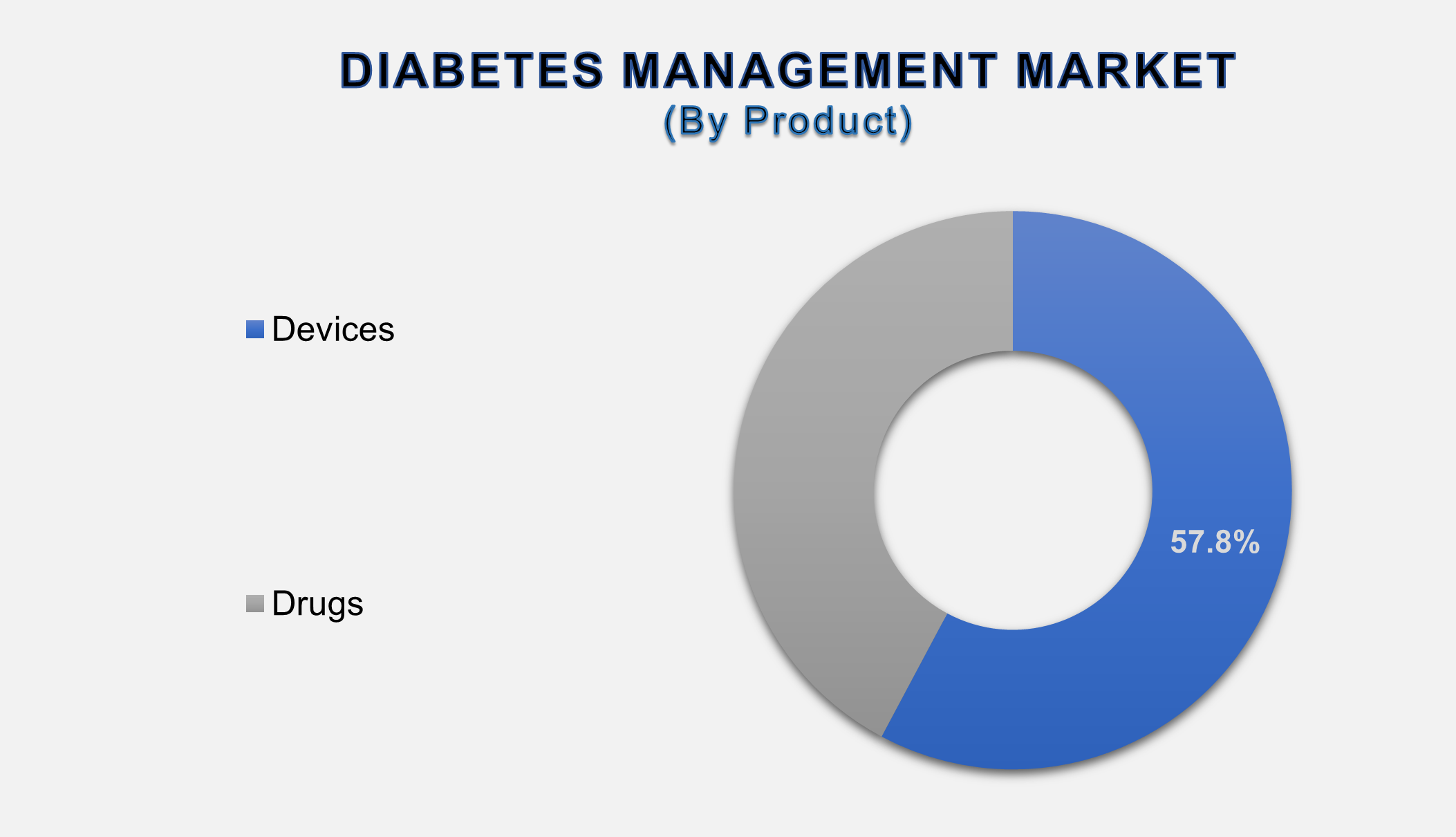
The Devices segment is the leading and
fastest-growing contributor to the diabetes management market. This dominance
is secured by the critical and continuous need for glucose monitoring and
insulin delivery. The segment is primarily driven by the revolutionary adoption
of Continuous Glucose Monitoring (CGM) systems, which offer superior glycemic
control and quality of life compared to traditional blood glucose meters (BGM).
Alongside CGMs, advanced insulin delivery devices
such as insulin pumps and smart pens are gaining significant traction due to
their precision and convenience. The constant technological innovation, leading
to more accurate, user-friendly, and integrated devices, ensures this segment's
continued leadership in driving market growth and revenue.
Within devices, the Blood Glucose Monitoring
Systems segment holds a dominant share, with CGM systems spearheading growth.
While traditional BGM strips and meters remain a massive market due to their
low cost and widespread availability, the shift towards CGM is undeniable. CGM
systems provide real-time, dynamic glucose information, trend data, and alerts
for highs and lows, enabling proactive diabetes management. The strong clinical
evidence supporting their benefits in reducing hypoglycemic events and improving
HbA1c levels, coupled with increasing insurance coverage, is driving their
rapid adoption among both Type 1 and Type 2 diabetes patients, cementing the
segment's leadership.
The Insulin Drugs Segment commands a major share of the
market
The Insulin segment commands a dominant market
share within drugs because it is a life-saving therapy for all Type 1 diabetic
patients and a critical treatment for many with advanced Type 2 diabetes.
Despite the emergence of new drug classes, insulin remains irreplaceable for a
large patient population.
The market includes a diverse range of products
from rapid-acting to long-acting analog insulins, which offer improved
pharmacokinetic profiles and reduced risk of hypoglycemia compared to human
insulin. The high cost of modern analog insulins and the chronic nature of the
disease, requiring daily administration, ensure that this segment continues to
generate substantial and steady revenue, even amid pricing pressures and
biosimilar competition.
The following segments are part of an in-depth analysis of the global
diabetes management market:
|
Market Segments |
|
|
By Product |
●
Devices o
Blood Glucose
Monitoring Systems o
Insulin Delivery
Devices o
Others ●
Drugs o
Insulin o
Oral Anti-diabetic
Drugs o
Non-Insulin
Injectables |
|
By Distribution Channel |
●
Hospital Pharmacies ●
Retail Pharmacies ●
Online Pharmacies |
Diabetes Management
Market Share Analysis by Region
The North America region is expected to
dominate the global diabetes management market during the forecast period.
North America is anticipated to be the
leader in the global Diabetes Management Market. This dominance is anchored by
the region's high healthcare expenditure, favourable reimbursement policies for
advanced devices like CGMs and insulin pumps, and a high prevalence of
diabetes. The presence of major market players, a strong focus on technological
innovation, and high awareness levels among patients and healthcare providers
in the U.S. and Canada create a highly conducive environment for market growth.
Furthermore, well-established regulatory pathways and a robust digital health
infrastructure secure North America's leading position.
Diabetes represents a profound and growing
public health challenge in the United States, affecting tens of millions of
individuals and placing an immense strain on the healthcare system. Current
data indicate
that over 38 million Americans have diabetes, with Type 2 diabetes accounting
for the vast majority of cases.
The economic impact is monumental, with
total estimated costs exceeding US$400 billion annually when factoring in
direct medical expenses and indirect costs from lost productivity and
disability. This high prevalence is driven by a powerful synergy of factors,
primarily the obesity epidemic, as excess weight is a leading risk factor for
insulin resistance. Concurrently, sedentary lifestyles, dietary habits, and an
aging population are major contributors. The burden of pre-diabetes, affecting
nearly 98 million American adults, highlights the scale of the potential future
patient pool. The condition's chronic nature and severe complications,
including heart disease, stroke, kidney failure, and blindness, underscore the
critical need for effective and continuous management solutions.
Global Diabetes
Management Market Recent Developments News:
- In January 2025, Dexcom, Inc. launched its
next-generation G7+ Continuous Glucose Monitoring system in the U.S.,
featuring an extended wear time and a smaller, more discreet form factor.
- In February 2025, Novo Nordisk A/S entered a
strategic collaboration with a digital therapeutics company to combine its
GLP-1 receptor agonists with a personalized digital coaching platform for
weight and diabetes management.
- In March 2025, Medtronic plc received FDA approval
for its new hybrid closed-loop system with enhanced automated insulin
delivery algorithms for improved overnight glycemic control.
- In April 2025, Eli Lilly and Company announced
positive Phase III results for a novel once-weekly dual GIP and GLP-1
receptor agonist, showing superior efficacy in blood glucose control and
weight reduction.
The Global Diabetes
Management Market is dominated by a few large companies, such as
●
Medtronic plc
●
Dexcom, Inc.
●
Abbott Laboratories
●
Roche Diagnostics
●
Insulet Corporation
●
Novo Nordisk A/S
●
Sanofi
●
Eli Lilly and Company
●
Merck & Co., Inc.
●
AstraZeneca PLC
●
Tandem Diabetes Care,
Inc.
●
LifeScan, Inc.
●
Ascensia Diabetes Care
●
Ypsomed Holding AG
●
Beta Bionics, Inc.
● Other Prominent Players
Frequently Asked Questions
Swetal (Research Analyst)
Swetal is a Research Analyst with 4+ years of experience specializing in healthcare market research, medical devices, healthcare IT, and medical technology industry analysis. Her expertise includes competitive intelligence, secondary research, market trend forecasting, and healthcare business insights across global healthcare ecosystems.
She contributes to advanced market research reports by analyzing regulatory frameworks, emerging healthcare technologies, competitive landscapes, and innovation trends shaping the medical industry. With a strong focus on accurate market intelligence, strategic insights, and healthcare industry trends, Swetal supports businesses in making informed, data-backed decisions in a rapidly transforming healthcare environment.
1. Global Diabetes Management
Market Introduction and Market Overview
1.1.
Objectives
of the Study
1.2.
Global
Diabetes Management Market Scope and Market Estimation
1.2.1.Global Diabetes Management
Market Overall Market Size (US$ Bn), Market CAGR (%), Market forecast (2025 - 2033)
1.2.2.Global Diabetes Management
Market Revenue Share (%) and Growth Rate (Y-o-Y) from 2020 - 2033
1.3.
Market
Segmentation
1.3.1.Product of Global Diabetes
Management Market
1.3.2.Distribution Channel of
Global Diabetes Management Market
1.3.3.Region of Global Diabetes
Management Market
2. Executive
Summary
2.1.
Demand
Side Trends
2.2.
Key
Market Trends
2.3.
Market
Demand (US$ Bn) Analysis 2020 – 2024 and Forecast, 2025 – 2033
2.4.
Demand
and Opportunity Assessment
2.5.
Demand
Supply Scenario
2.6.
Market
Dynamics
2.6.1.Drivers
2.6.2.Limitations
2.6.3.Opportunities
2.6.4.Impact Analysis of Drivers
and Restraints
2.7.
Emerging
Trends for Diabetes Management Market
2.8.
Incidence
and Prevalence of Diabetes, by key countries
2.9.
Key
Products/Brand Analysis
2.10.
Porter’s
Five Forces Analysis
2.11.
PEST
Analysis
2.12.
Key
Regulation
3. Global
Diabetes Management Market Estimates
& Historical Trend Analysis (2020 - 2024)
4.
Global Diabetes Management
Market Estimates & Forecast Trend
Analysis, by Product
4.1.
Global
Diabetes Management Market Revenue (US$ Bn) Estimates and Forecasts, by Product,
2020 - 2033
4.1.1.Devices
4.1.1.1.
Blood
Glucose Monitoring Systems
4.1.1.2.
Insulin
Delivery Devices
4.1.1.3.
Others
4.1.2.Drugs
4.1.2.1.
Insulin
4.1.2.2.
Oral
Anti-diabetic Drugs
4.1.2.3.
Non-Insulin
Injectables
5.
Global Diabetes Management
Market Estimates & Forecast Trend
Analysis, by Distribution Channel
5.1.
Global
Diabetes Management Market Revenue (US$ Bn) Estimates and Forecasts, by Distribution
Channel, 2020 - 2033
5.1.1.Hospital Pharmacies
5.1.2.Retail Pharmacies
5.1.3.Online Pharmacies
6. Global
Diabetes Management Market Estimates
& Forecast Trend Analysis, by region
1.1.
Global
Diabetes Management Market Revenue (US$ Bn) Estimates and Forecasts, by region,
2020 - 2033
1.1.1.North America
1.1.2.Europe
1.1.3.Asia Pacific
1.1.4.Middle East & Africa
1.1.5.Latin America
7. North America Diabetes
Management Market: Estimates &
Forecast Trend Analysis
7.1. North America Diabetes
Management Market Assessments & Key Findings
7.1.1.North America Diabetes
Management Market Introduction
7.1.2.North America Diabetes
Management Market Size Estimates and Forecast (US$ Billion) (2020 - 2033)
7.1.2.1. By Product
7.1.2.2. By Distribution
Channel
7.1.2.3.
By
Country
7.1.2.3.1.
The
U.S.
7.1.2.3.2.
Canada
8. Europe Diabetes
Management Market: Estimates &
Forecast Trend Analysis
8.1.
Europe
Diabetes Management Market Assessments & Key Findings
8.1.1.Europe Diabetes Management
Market Introduction
8.1.2.Europe Diabetes Management
Market Size Estimates and Forecast (US$ Billion) (2020 - 2033)
8.1.2.1. By Product
8.1.2.2. By Distribution
Channel
8.1.2.3.
By
Country
8.1.2.3.1. Germany
8.1.2.3.2. Italy
8.1.2.3.3. U.K.
8.1.2.3.4. France
8.1.2.3.5. Spain
8.1.2.3.6. Netherlands
8.1.2.3.7.
Rest of Europe
9. Asia Pacific Diabetes
Management Market: Estimates &
Forecast Trend Analysis
9.1.
Asia
Pacific Market Assessments & Key Findings
9.1.1.Asia Pacific Diabetes
Management Market Introduction
9.1.2.Asia Pacific Diabetes
Management Market Size Estimates and Forecast (US$ Billion) (2020 - 2033)
9.1.2.1. By Product
9.1.2.2. By Distribution
Channel
9.1.2.3.
By
Country
9.1.2.3.1. China
9.1.2.3.2. Japan
9.1.2.3.3. India
9.1.2.3.4. Australia
9.1.2.3.5. South Korea
9.1.2.3.6.
Rest
of Asia Pacific
10. Middle East & Africa Diabetes
Management Market: Estimates &
Forecast Trend Analysis
10.1.
Middle
East & Africa Market Assessments & Key Findings
10.1.1.
Middle East & Africa Diabetes Management Market
Introduction
10.1.2.
Middle East & Africa Diabetes Management Market Size Estimates
and Forecast (US$ Billion) (2020 - 2033)
10.1.2.1. By Product
10.1.2.2. By Distribution
Channel
10.1.2.3.
By
Country
10.1.2.3.1. UAE
10.1.2.3.2. Saudi
Arabia
10.1.2.3.3. South
Africa
10.1.2.3.4.
Rest of MEA
11. Latin America
Diabetes Management Market: Estimates
& Forecast Trend Analysis
11.1.
Latin
America Market Assessments & Key Findings
11.1.1.
Latin
America Diabetes Management Market Introduction
11.1.2.
Latin
America Diabetes Management Market Size Estimates and Forecast (US$ Billion) (2020
- 2033)
11.1.2.1. By Product
11.1.2.2. By Distribution
Channel
11.1.2.3.
By
Country
11.1.2.3.1. Brazil
11.1.2.3.2. Mexico
11.1.2.3.3. Argentina
11.1.2.3.4.
Rest of LATAM
12. Country Wise Market:
Introduction
13.
Competition
Landscape
13.1.
Global
Diabetes Management Market Product Mapping
13.2.
Global
Diabetes Management Market Concentration Analysis, by Leading Players /
Innovators / Emerging Players / New Entrants
13.3.
Global
Diabetes Management Market Tier Structure Analysis
13.4.
Global
Diabetes Management Market Concentration & Company Market Shares (%)
Analysis, 2024
14.
Company
Profiles
14.1. Medtronic plc
14.1.1.
Company
Overview & Key Stats
14.1.2.
Financial
Performance & KPIs
14.1.3.
Product
Portfolio
14.1.4.
SWOT
Analysis
14.1.5.
Business
Strategy & Recent Developments
* Similar details would be provided for all
the players mentioned below
14.2. Dexcom, Inc.
14.3. Abbott
Laboratories
14.4. Roche
Diagnostics
14.5. Insulet
Corporation
14.6. Novo Nordisk
A/S
14.7. Sanofi
14.8. Eli Lilly and
Company
14.9. Merck &
Co., Inc.
14.10. AstraZeneca
PLC
14.11. Tandem
Diabetes Care, Inc.
14.12. LifeScan,
Inc.
14.13. Ascensia
Diabetes Care
14.14. Ypsomed
Holding AG
14.15. Beta Bionics,
Inc.
14.16. Other
Prominent Players
15. Research
Methodology
15.1.
External
Databases
15.2.
Internal
Proprietary Database
15.3.
Primary
Research
15.4.
Secondary
Research
15.5.
Assumptions
15.6.
Limitations
15.7.
Report
FAQs
16. Research
Findings & Conclusion
Our Research Methodology
"Insight without rigor is just noise."
We follow a comprehensive, multi-phase research framework designed to deliver accurate, strategic, and decision-ready intelligence. Our process integrates primary and secondary research , both quantitative and qualitative , along with dual modeling techniques ( top-down and bottom-up) and a final layer of validation through our proprietary in-house repository.
PRIMARY RESEARCH
Primary research captures real-time, firsthand insights from the market to understand behaviors, motivations, and emerging trends.
1. Quantitative Primary Research
Objective: Generate statistically significant data directly from market participants.
Approaches:- Structured surveys with customers, distributors, and field agents
- Mobile-based data collection for point-of-sale audits and usage behavior
- Phone-based interviews (CATI) for market sizing and product feedback
- Online polling around industry events and digital campaigns
- Purchase frequency by customer type
- Channel performance across geographies
- Feature demand by application or demographic
2. Qualitative Primary Research
Objective: Explore decision-making drivers, pain points, and market readiness.
Approaches:- In-depth interviews (IDIs) with executives, product managers, and key decision-makers
- Focus groups among end users and early adopters
- Site visits and observational research for consumer products
- Informal field-level discussions for regional and cultural nuances
SECONDARY RESEARCH
This phase helps establish a macro-to-micro understanding of market trends, size, regulation, and competitive dynamics, sourced from credible and public domain information.
1. Quantitative Secondary Research
Objective: Model market value and segment-level forecasts based on published data.
Sources include:- Financial reports and investor summaries
- Government trade data, customs records, and regulatory statistics
- Industry association publications and economic databases
- Channel performance and pricing data from marketplace listings
- Revenue splits, pricing trends, and CAGR estimates
- Supply-side capacity and volume tracking
- Investment analysis and funding benchmarks
2. Qualitative Secondary Research
Objective: Capture strategic direction, innovation signals, and behavioral trends.
Sources include:- Company announcements, roadmaps, and product pipelines
- Publicly available whitepapers, conference abstracts, and academic research
- Regulatory body publications and policy briefs
- Social and media sentiment scanning for early-stage shifts
- Strategic shifts in market positioning
- Unmet needs and white spaces
- Regulatory triggers and compliance impact
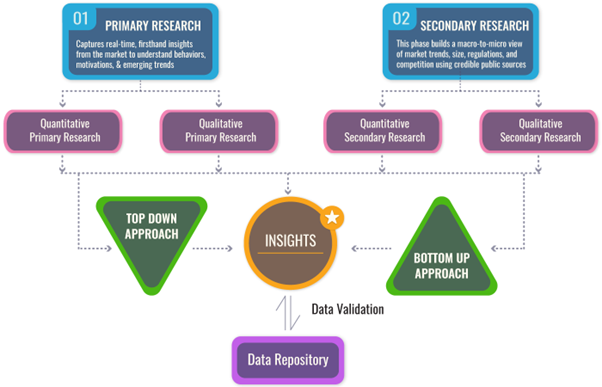
DUAL MODELING: TOP-DOWN + BOTTOM-UP
To ensure robust market estimation, we apply two complementary sizing approaches:
Top-Down Modeling:- Start with broader industry value (e.g., global or regional TAM)
- Apply filters by segment, geography, end-user, or use case
- Adjust with primary insights and validation benchmarks
- Ideal for investor-grade market scans and opportunity mapping
- Aggregate from the ground up using sales volumes, pricing, and unit economics
- Use internal modeling templates aligned with stakeholder data
- Incorporate distributor-level or region-specific inputs
- Most accurate for emerging segments and granular sub-markets
DATA VALIDATION: IN-HOUSE REPOSITORY
We close the loop with proprietary data intelligence built from ongoing projects, industry monitoring, and historical benchmarking. This repository includes:
- Multi-sector market and pricing models
- Key trendlines from past interviews and forecasts
- Benchmarked adoption rates, churn patterns, and ROI indicators
- Industry-specific deviation flags and cross-check logic
- Catches inconsistencies early
- Aligns projections across studies
- Enables consistent, high-trust deliverables